You are currently on the new version of our website. Access the old version .
SustainabilitySustainability
  • Article
  • Open Access

24 August 2023

The Development of an Interview Questionnaire and Guide for the Sustainable Use of Assistive Devices among the Disabled in Korea


,
,
,
,
and
1
Assistive Technology Research Team for Independent Living, National Rehabilitation Center, Seoul 01022, Republic of Korea
2
Division of Public Medical Rehabilitation, National Rehabilitation Center, Seoul 01022, Republic of Korea
*
Author to whom correspondence should be addressed.
This article belongs to the Section Sustainable Products and Services

Abstract

Assistive device use has increased in recent years in Korea following the expansion of disability categories, increase in acquired disabilities, and an aging society. Although assistive devices can improve the quality of life by aiding social participation and removing physical restrictions, some devices are simply not used after users receive them via public distribution projects. Understanding assistive device usage after distribution is crucial to improve their service and supported products by disability type. This study constructed an interview questionnaire and interview guide for investigating the reason for (not) using the assistive device, and the necessity of assistive devices according to time point after disability. The aim was to establish a foundation for accumulating systematic and in-depth data. The interview questionnaire was developed primarily for frequent device users across 15 physical disability types. The terms used in the questionnaire were systematically defined, and interview items were derived based on assistive device-related questionnaires from the extant literature. The final interview questionnaire and guide were then refined after pilot test (N = 4) and expert (N = 2) consultations. The data accumulated by utilizing the interview questionnaire and interview guide developed in this study can improve the service support system for assistive devices by disability type and improvements by assistive devices in the future. This can help improve users’ quality of life by providing a more appropriate and enhanced assistive device.

1. Introduction

Assistive device use has increased in recent years in Korea following the expansion of disability categories, increase in acquired disabilities, and an aging society [1]. For instance, four Korean government departments, Ministry of Health and Welfare, Ministry of Patriots and Veterans Affairs, Ministry of Employment and Labor, and Ministry of Science and ICT are jointly distributing assistive devices to the disabled through eight public benefit system projects. The number of distribution cases has continuously increased from approximately 4,550,000 cases in 2019 to 6,020,000 in 2021 [2].
Using assistive devices can improve the quality of life of people with disabilities by eliminating physical limitations and inducing various social participation [3]. With the development of science and technology and the increase in public welfare budgets, the demand and expectations for various assistive devices are also increasing [4]. Yet, the assistive device industry remains quite limited and experiences difficulties in meeting the demand [2].
To increase the utilization and level of satisfaction of assistive devices, a detailed analysis is required on the usage after distribution. A survey conducted on the level of satisfaction with the assistive device distribution project by the Central Assistive Device Center found that poor product fit and inappropriate usage environment were the most prevalent reasons for not using these devices. Notably, 16.7% of assistive devices distributed through the project were not being used [5]. In addition, Phillips’ study [6] of assistive device abandonment found that 29.3% of users abandoned their assistive devices for reasons such as changing needs or priorities. To reduce these cases of support failure, it is necessary to study what kind of assistive devices are needed according to the current situation of people with disabilities, and what reasons led to changes in the utilization of assistive devices or non-use. In order to obtain such information, this study found that not only should interviews be conducted for each type of disability, but also that assistive devices should be investigated by identifying the current situation of people with disabilities according to their disability characteristics. Therefore, among people with physical disabilities, people with spinal cord injuries were categorized by the stage after the disability occurred (In-hospital care, Return to home, Community re-integration), and people with muscular diseases were categorized by changes in physical function (Independent walking, Independent indoor mobility, Total dependence).
This becomes even more important as new assistive devices are being introduced every year in line with the demand of the disabled population. For instance, the number of products increased from 18 in 2014 to 28 in 2018 [7]. Nevertheless, the demands are still not being met, with comments such as the “number of products being distributed is too few” and “products are of inadequate quality [7]”. It is necessary to further investigate and reflect the detailed needs of each type of disability, such as what kind of assistive devices are needed and what kind of assistive devices need to be improved in quality, so that the project can be transformed into a support project that satisfies users. By developing an interview questionnaire and guide, this study aims to improve the accuracy of the information on assistive device users’ demands and prevent confusion from unnecessary expenses [8].

2. Purpose and Methods

2.1. Research Purpose

We would like to develop an interview questionnaire based on the post-disability stage so that we can closely examine the increased demand and expectations of users for assistive devices and reflect them in policy and institutional settings. According to a research report by NRC [9], assistive devices provided to people with disabilities are often neglected if they do not fit the individual’s characteristics and degree of disability. However, it is challenging to find accumulated information in Korea on which and how assistive devices are uncomfortable. Only when this information is explicitly matched can practical improvements to assistive devices be made. Therefore, in this study, we aim to develop an interview questionnaire that can obtain information that can not only improve the actual assistive devices, but also the support system by closely examining the reasons for changes in the use of assistive devices and the reasons for non-purchase/non-use of assistive devices, by detailed criteria of the type of disability (spinal cord injury and muscular disease among the physically disabled) and the correlated assistive devices. In addition, we would like to develop an interview guide and use it in assistive device consultations, which are conducted by local assistive device centers to systematically accumulate more information.
In this study, we prioritized the physically challenged (spinal cord injury, muscle disease) who have the largest number of people with disabilities and use the most assistive devices in order to define the terms used in the interview and develop a guide, such as an interview sheet and a list of interview questions.

2.2. Research Methods

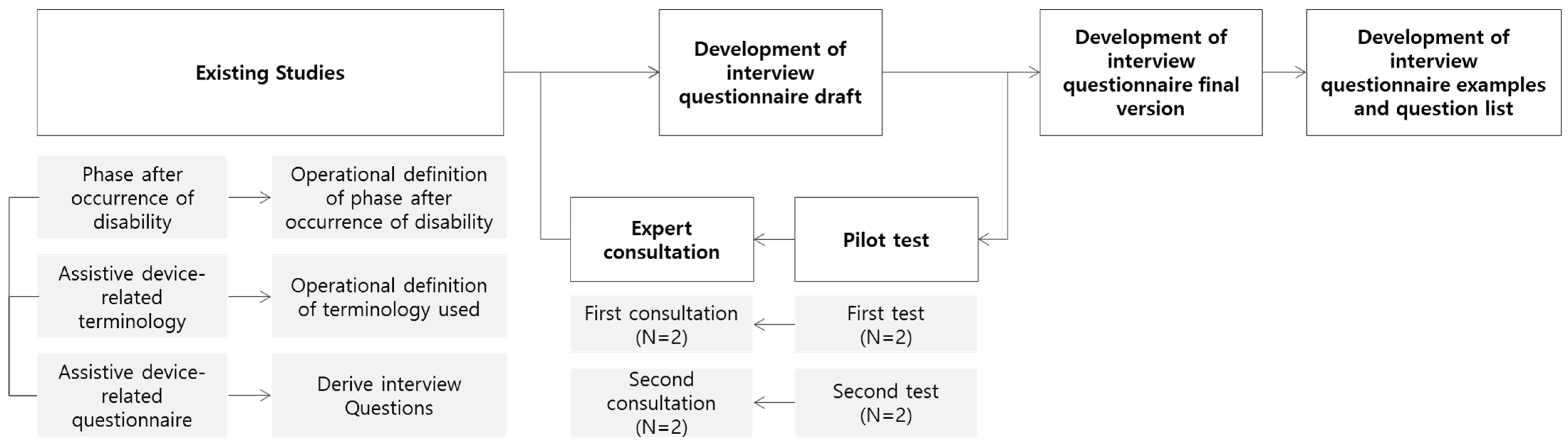
The interview questionnaire and guide for the assistive device utilization study were developed over five months (February 2022 to June 2022). The research methodology is shown in Figure 1, and a draft interview questionnaire was developed by analyzing previous research. We analyzed a total of three topics: First, we analyzed studies to establish detailed classification criteria for the post-disability phase. The classification of the post-disability phase was conducted to find criteria that may change the utilization and need for assistive devices according to the stages of life cycle changes or physical function changes by disability subtype. Since the study was conducted using an interview methodology, asking retrospective questions at the time of the interview, the coordinates of the periods that were imprinted in the participants’ minds and had a high degree of variation in assistive device utilization and needs were important.
Figure 1. Research Process.
The second topic of prior research was analyzed to define the terms used in the interview to facilitate the process, and finally, the draft interview topics were derived through the analysis of similar questionnaires.
The draft interview questionnaire was pilot tested twice with people with spinal cord injury (N = 2) and muscular disease (N = 2) among people with disabilities. In particular, spinal cord injured people were limited to the C4–6 level, which can use the most assistive devices, to conduct a more focused interview.
The test was conducted by two interviewers to ensure reliability and validity, and the test results were analyzed by one internal expert (assistive device profession) and one external expert (occupational therapy profession), as shown in Table 1.
Table 1. List of Professions.
We discussed the results of the pilot test with the experts (N = 2) and revised the interview instrument to ensure that all the information that could fulfill the research objectives was collected. We conducted a second pilot test with the revised questionnaire and discussed the results with the same experts (N = 2) to develop a finalized version of the questionnaire. We also developed an interview guide based on the finalized questionnaire, including an example of writing and a list of interview questions.

3. Results

3.1. Results of Previous Studies

3.1.1. Operational Definition of Phases after Occurrence of Disability

The phases after disability occurrence were categorized based on the criteria, which may influence assistive device usage by disability type. A study by the National Institute of Rehabilitation [10] found that those with a spinal cord injury are characterized by severe disability. Three categories were outlined for them, as shown in Table 2, according to the steps for their re-integration into the community: in-hospital care, return to home, and community re-integration. In addition, for the International Classification of Functioning, Disability and Health (ICF) core set, which comprehensively explains the functionalities and disabilities in those with spinal cord injury, a study provided definitions by distinguishing between the early post-acute and long-term contexts [11].
Table 2. Operational Definition of Phases After Disability’s Occurrence.
Following existing studies [11], the phases after disability occurrence were operationally defined into three phases, as in Table 2, to clearly show the changes in assistive device: in-hospital care, return to home, and community re-integration.
Next, due to the progressive nature of the muscular disease, the phases after disability occurrence were defined according to the physical changes for the subject. There are two existing studies: the first [13], which found that for the pediatric population with muscular disease, these phases can be largely categorized into Duchenne/Becker muscular dystrophy, Limb-girdle type muscular dystrophy (LGMD), Congenital muscular dystrophy (CMDs), and Facioscapulohumeral muscular dystrophy (FSHD); and the second, which showed that muscle disorders can also be categorized based on walking for the functional assessment of those with muscular disease [14]: Level 1: walks with normal posture and speed; level 2: able to walk independently without a brace, but exhibits abnormal patterns such as tiptoeing, hopping, or excessive lordosis; level 3: walks only short distances using a portable mobility device, such as a walker or crutches; level 4: unable to walk, may use a motorized mobility device; level 5: ambulatory with manual W/C.
Here, we collapsed the five phases for muscular disease into three phases, as shown in Table 3, following Kim et al. [14]: independent walking, independent indoor mobility, and total dependence.
Table 3. Operational Definition of Phases After Occurrence of Disability for Those with Muscular Disease.

3.1.2. Operational Definition of Terminology Used

Following Danemayer et al. [15], we consider nine indicators related to assistive device usage: needs, perceived needs, expressed needs, possession, utilization, acquisition, met needs, unmet needs, and unused needs. And by following KIHASA’s Report [5], the disabled status survey categorized questions into three (need, possession, and utilization) when conducting interviews on assistive device use. Based on these studies, the assistive device related terminology was defined as (Table 4) follows: Use, Non-use, Required, and Changes in need.
Table 4. Operational Definition of Terminology Used.

3.1.3. Deriving Interview Questions

To derive interview topics, three similar cases were analyzed as shown in Table 5: a survey on the actual situation of people with disabilities, case management of the assistive device center, and a questionnaire for the satisfaction survey of the assistive device grant project. We also analyzed two previous studies on facilitators and barriers to the use of assistive technology to derive draft interview topics.
Table 5. Details in Existing Assistive Device Questionnaire.
For the 2020 Disability Survey [5], about 7000 people with disabilities were sampled from registered persons with disabilities living in general residential facilities in 17 cities and provinces across the country. The purpose of this study is to identify the number of people with disabilities in Korea, the prevalence of disabilities, and the living conditions and welfare needs of people with disabilities, and to accumulate basic data for the establishment of short- and long-term welfare policies for people with disabilities. Therefore, as shown in Table 5, the survey covers not only the general characteristics of people with disabilities but also their health, daily life, education, and employment. Among them, the survey related to assistive devices is being conducted in Section 5, Assistive Devices for the Disabled, but it was difficult to identify the specific usage of assistive devices by collecting data in a quantitative survey method.
In the case of the Satisfaction Survey on Assistive Device Grant Project [7], people with disabilities registered under the Disability Welfare Act are surveyed about their satisfaction with the products they received and system improvements through a qualitative survey (N = 1033) and a group in-depth survey (N = 15). The satisfaction survey of government-supported assistive devices is conducted to obtain basic data necessary for institutional improvement and expansion. Although the survey examines satisfaction with the convenience and durability of assistive devices, it is difficult to identify specific information because it provides satisfaction information on all assistive devices provided by each type of disability. In addition, although the necessary assistive devices are surveyed by disability type, the specific reasons for why they are not purchased or supported are not investigated, which makes it difficult to make strategic government plans.
Finally, the assistive device service assessment completion guide [16] helps the regional assistive device centers, which undertake assistive device case management projects, to conduct a systemized assessment on the overall process of servicing assistive devices, and for maintenance and follow up. The questionnaire is conducted in every process from inquiry on assistive device, application and training of assistive device, maintenance, and completion to follow up. The assistive device-related part of the questionnaire explores the assistive device owned, recommended assistive device according to subject’s physical functioning, and accessories when assessing assistive devices. Further, for the consistent completion of the assessment, the guide provides examples for each, as well as detailed information, considerations for assessment, example cases, and methods for taking physical measurements. This study was not a survey study, but rather a guide to a survey instrument, which was used to inform the development of an interview guide.
A previous study on facilitators and barriers to assistive technology utilization, the Assistive Technology System Gap study [17], defined that a person’s needs must overcome nine barriers (need, awareness, availability, affordability, accessibility, adaptability, acceptability, quality, and utilization) to actually be used by that person.
In addition, another study, which analyzed the factors affecting non-use of assistive technology [18], defined the non-use of assistive technology and classified six factors affecting non-use as personal characteristics, assistive technology, user environment, assistive technology services, employment environment, and performance to understand the impact of each factor on assistive technology use.
By collecting the similar cases studied above, we derived the following interview items: basic information (including personal characteristics, user environment and employment environment), used assistive device, non-use assistive device, and non-purchased assistive device.

3.2. Development of Interview Questionnaire

3.2.1. Development of Interview Questionnaire Draft

Considering the characteristics of each disability type, the phases after disability’s occurrence were classified into three: in-hospital care, return to home, and community re-integration for the subject with spinal cord injury; and independent walking, independent indoor mobility, and total dependence for the subject with muscular disease. Then, by analyzing the promoting/interfering factors for assistive device usage and existing questionnaires, we developed an initial draft of the interview questionnaire that could collect details on the use, non-use, and non-purchase of assistive device. For assistive devices being used, the time point of use for type of device, purchasing route, purchasing price, reason for additional purchasing, functions, and usage were investigated. For non-use assistive devices, reason for non-use by device, usage period, pattern of usage, and usage environment were investigated. For assistive devices needed but not purchased yet, only the reason for not purchasing was investigated by device.

3.2.2. Pilot Testing and Expert Consultation

To ensure the validity of the interview questionnaire, we conducted two pilot tests and consulted with experts. The pilot tests were conducted with a total of four people, including one person with a spinal cord injury and one person with a muscular disease, per session. Among the people with disabilities, we selected people with spinal cord injuries and people with muscular diseases who have the most disabilities and use the most assistive devices in order to conduct the pilot test. The pilot test lasted about 2 h per person, and the information on the participants is shown in Table 6.
Table 6. Participants’ Information of Pilot tests.
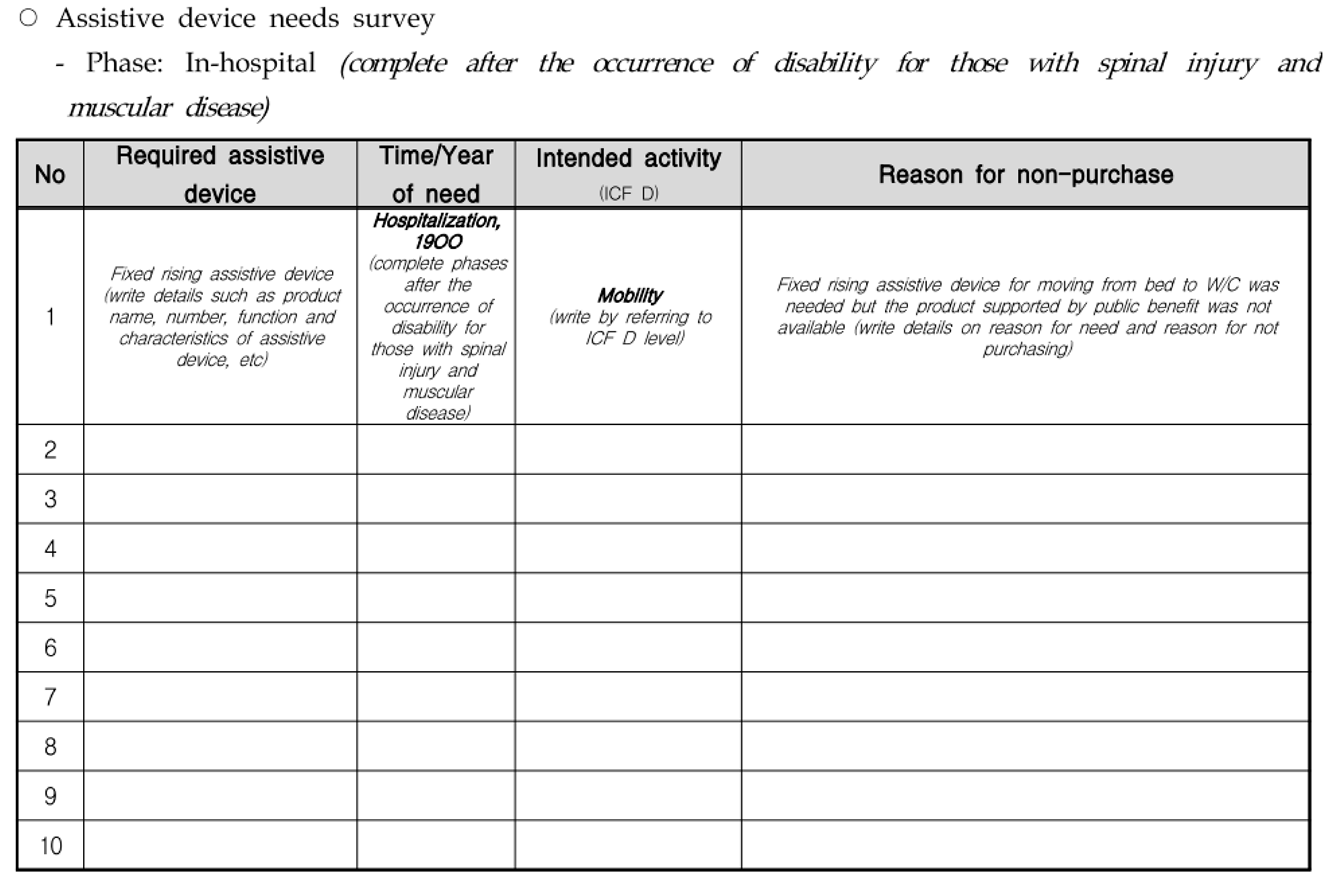
As you can see in Table 7, the main modification that emerged from the first round of pilot testing and expert advice (N = 2) was to move the question about the post-disability phase to earlier in the interview. In the first draft, the question centered around the use of assistive technology, but there was a lot of back and forth during the interview due to memory confusion. Therefore, we changed the question to ask about the timing of the post-disability phase first, so that the interview could be conducted with a larger frame of reference. We asked about the assistive devices used during hospitalization and the ones used when they returned home. This way, both the interviewer and the interviewee had a clearer idea of the time frame in which to talk about assistive technology.
Table 7. Modification of Interview Questionnaire Based on Pilot Testing.
We also changed the questionnaire to ask about the length of time people have been using their assistive devices, as this allows us to ask about both currently utilized and unutilized devices at the same time. To investigate specific assistive devices, we also added product type (off-the-shelf, customized, modified, etc.) and target activity to the interview.
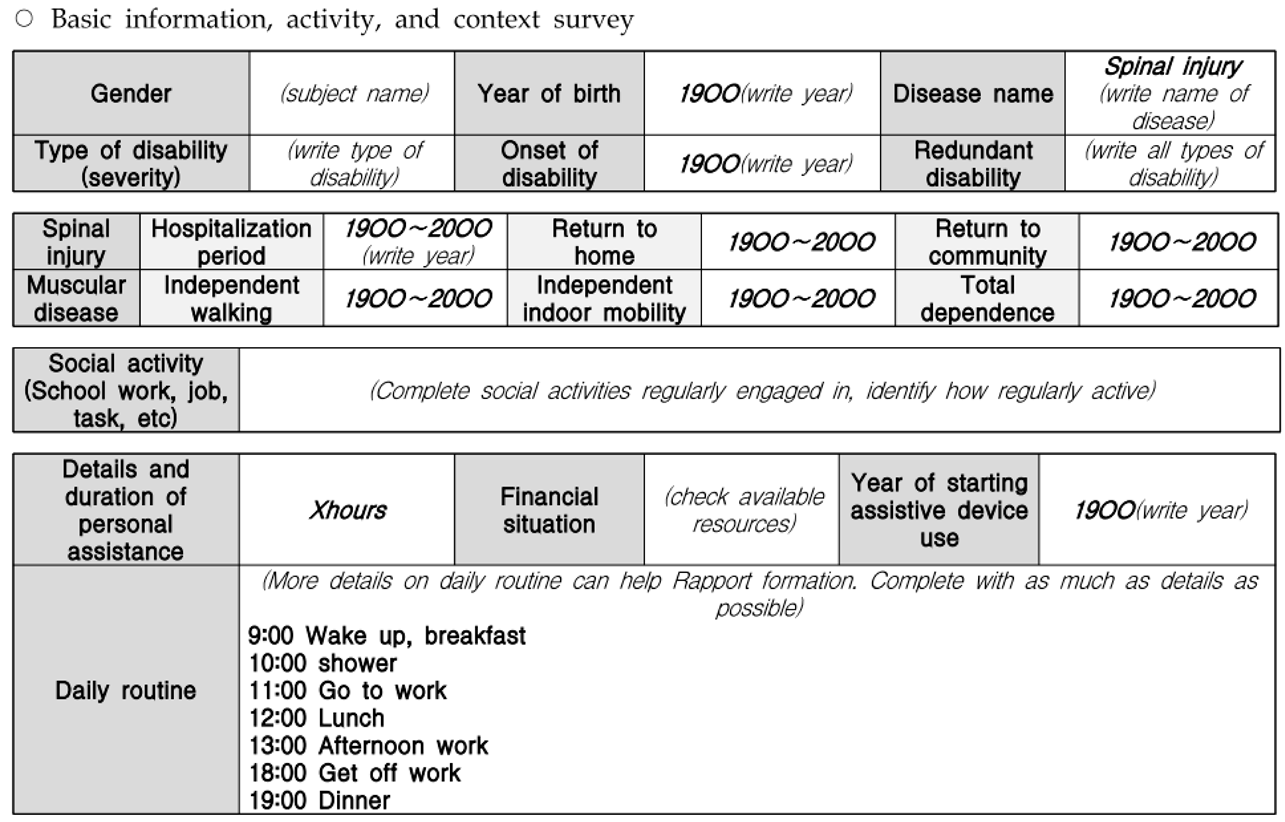
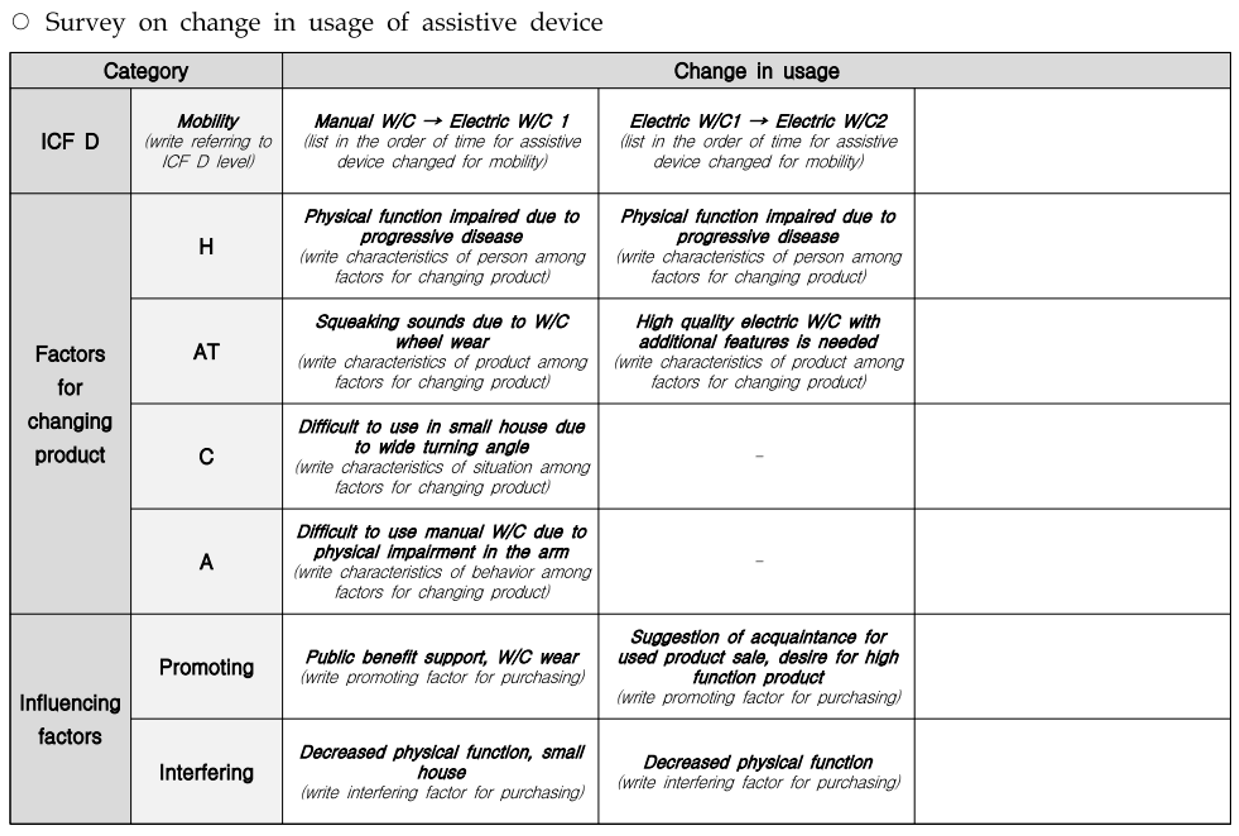
We conducted a second pilot test based on the revised questionnaire and consulted the same experts (N = 2) as in the first test, adding questions such as economic situation and daily routine to understand the overall life of the interviewees. In addition, we modified the interview questions to be more specific by organizing them so that they could be written separately for facilitators and barriers in utilizing assistive devices. In addition, we added questions about the time and year of need for unpurchased assistive devices in order to understand whether there was a change in the need-by stage after the disability occurred. For the change in utilization, we added an item to interview people in-depth on various aspects such as people, assistive devices, behaviors, and situations based on the HAAT (Human-Activity-Assistive Technology Context) model [19] to understand why their assistive devices continue to change.

3.2.3. Development of Final Version of Interview Questionnaire

The final interview questionnaire is shown in Table 8. Table 9 shows the question guide that can be used to facilitate the interview.
Table 8. Final Interview Questionnaire.
Table 9. Interview Question Guide by Category.

4. Limitation

Although there are many manuals on how to design an interview guide [20], the theory of how to organize a guide in qualitative interviews is less well documented and more implicit, and often does not strictly follow a particular theoretical approach [21]. However, conducting a pilot test helps to determine if there are any flaws, limitations, or other weaknesses in the interview design and allows for necessary modifications to be made before conducting the study [22]. Therefore, a pilot test was conducted with a total of four people (two people with spinal cord injury and two people with muscular disease), but this may not be enough to obtain sufficient data. It is necessary to continuously develop new questions and update the guide through actual interviews with people with disabilities in the future.
In addition, pilot testing should be conducted with participants who have similar interests to those who will participate in the research conducted [23]. Therefore, in this study, the validity and reliability of the interview guide was established through a consultation meeting with an expert who has been active in the field of occupational therapy and assistive devices for a long time. However, this process may have resulted in modifications to the interview guide due to the inclusion of subjective views. It is necessary to continuously upgrade the guide in the future with a larger and more diverse number of expert consultations.
It is virtually impossible to develop a perfect guideline [24]. Nevertheless, the interview guide is a schematic and a guide for conducting and concluding the entire interview [24]. However, it is important to keep in mind that the interview guide is only a guide, and it is more important to utilize the interview guide flexibly when conducting the actual interview, so as not to lose the purpose of the study [24].

5. Conclusions

Many people with disabilities have assistive devices at home and do not use them [9]. However, current surveys on assistive devices in Korea do not specifically ask about the reasons for the non-use of each device. People with disabilities have different degrees of disability and individual characteristics, so even if the same assistive device is provided to people with the same type of disability, the reasons for non-use may vary [9]. In order to identify these specific reasons, it is necessary to conduct in-depth interviews through qualitative research. In this study, we aimed to develop an interview questionnaire and an interview guide to explore the usage and needs of assistive devices according to the stage of post-disability by detailed disability type.
First, the post-disability stage and assistive device-related terms were defined operationally by analyzing previous studies. Then, interview items were derived through analyzing similar questionnaires and a draft interview guide was developed. Based on the developed questionnaire, we conducted a pilot test with two interviewers simultaneously with four people with disabilities. Based on the test results, the interview topics were revised by two experts through two consultation meetings to develop the final interview. We developed a guide for the interviews by writing examples and guides on the developed interview form and developing a list of questions.
Interview guides are a suitable tool for collecting data on specific topics and generating complex narratives [21]. This study was also conducted to accumulate data on the continuous utilization of assistive devices by people with disabilities. The data that specifically analyzes the needs/demands that change at different stages after the onset of disability will be very helpful in developing a policy strategy to propose appropriate assistive devices at the right time, as well as the practical improvement of assistive devices in the future. In addition, it was difficult to find an interview guide study to collect specific data in the field of assistive devices in Korea, so it is significant as a first step to accumulate meaningful data.

Author Contributions

Methodology, M.-J.L. and K.-O.A.; investigation, E.-R.R. and S.-Y.L.; data curation & writing—original draft preparation, review and editing, E.-R.R.; supervision, S.-D.E. and D.-A.K.; project administration and funding acquisition, S.-D.E. and D.-A.K. All authors have read and agreed to the published version of the manuscript.

Funding

This research was fuded by the Assistive Technology R&D Project for People with Disabilities and the elderly funded by the Ministry of Health & Welfare, Republic of Korea (#HJ20C0002) and also supported by the Research Program of NRCRI (Project No. #22-E-01).

Institutional Review Board Statement

The study was conducted in accordance with the Declaration of Helsinki, and approved by the Institutional Review Board of National Rehabilitation Hospital (protocol code NRCIRB-014-1 and 26 April 2022).

Data Availability Statement

Data in this article is unavailable due to privacy restrictions.

Conflicts of Interest

The authors declare no conflict of interest. The funders had no role in the design of the study; in the collection, analyses, or interpretation of data; in the writing of the manuscript; or in the decision to publish the results.

References

  1. Kwon, S.-J.; Park, J.-Y. A Study of the Current Status of the Assistive Devices Industry in Korea. Disabil. Employ. 2012, 22, 5–31. [Google Scholar]
  2. National Rehabilitation Center (NRC); Korea National Assistive Technology Center (KNAT). Assistive Technology Baseline Data Analysis Report; KNAT: Seoul, Republic of Korea, 2022. [Google Scholar]
  3. Choi, W.H.; Jung, E.J. The Effect of Assistive Technology Service and Strategy for Support: For the Disabled Using Assistive Devices in Gyeonggi-do. J. Rehabil. Res. 2015, 19, 205–228. [Google Scholar]
  4. Choi, D.-L.; Bae, Y.; Ryu, J.; Lee, B.S.; Song, W.-K. A Case Study of Assistive Technology Service Process for People with Severe Retardation and Brain Lesions. Rehabil. Eng. Assist. Technol. Soc. Korea 2022, 16, 92–100. [Google Scholar]
  5. Korea Institute for Health and Social Affairs (KIHASA). Disabled Status Survey; KIHASA: Sejong, Republic of Korea, 2020. [Google Scholar]
  6. Phillips, B.; Zhao, H. Predictors of Assistive Technology Abandonment. Assist. Technol. 1993, 5, 36–45. [Google Scholar] [CrossRef]
  7. National Rehabilitation Center (NRC); Korea National Assistive Technology Center (KNAT). Satisfaction Survey and Focus Group Interview Report on the Provision of Assistive Devices for the Disabled; KNAT: Seoul, Republic of Korea, 2019. [Google Scholar]
  8. Lee, K.-H. A Study on Information Design of Social Commerce-Focusing on Development in Contents Guide of Group on Korea; Konkuk University: Seoul, Republic of Korea, 2013. [Google Scholar]
  9. National Rehabilitation Center (NRC); Korea National Assistive Technology Center (KNAT). Assistive Technology Survey; KNAT: Seoul, Republic of Korea, 2017. [Google Scholar]
  10. National Rehabilitation Center (NRC). Hospital Discharge Disabled Social Rehabilitation Support Program; NRC: Seoul, Republic of Korea, 2010. [Google Scholar]
  11. Cieza, A.; Kirchberger, I.; Biering-Sørensen, F.; Baumberger, M.; Charlifue, S.; Post, M.W.; Stucki, G. ICF Core Sets for Individuals with Spinal Cord Injury in the Long-Term Context. Spinal Cord 2010, 48, 305–312. [Google Scholar] [CrossRef] [PubMed]
  12. Dijkers, M.P. Correlates of Life Satisfaction among Persons with Spinal Cord Injury. Arch. Phys. Med. Rehabil. 1999, 80, 867–876. [Google Scholar] [CrossRef]
  13. Chae, J.H. Diagnosis and Treatment of Pediatric Myopathy. Korean J. Pediatr. 2008, 51, 1295–1299. [Google Scholar] [CrossRef]
  14. Kim, J.; Jung, I.-Y.; Kim, S.J.; Lee, J.-Y.; Park, S.K.; Shin, H.-I.; Bang, M.S. A New Functional Scale and Ambulatory Functional Classification of Duchenne Muscular Dystrophy: Scale Development and Preliminary Analyses of Reliability and Validity. Anal. Reliab. Validity. Ann. Rehabil. Med. 2018, 42, 690–701. [Google Scholar] [CrossRef]
  15. Danemayer, J.; Boggs, D.; Polack, S.; Smith, E.M.; Ramos, V.D.; Battistella, L.R.; Holloway, C. Measuring Assistive Technology Supply and Demand: A Scoping Review. Assist. Technol. 2021, 33, S35–S49. [Google Scholar] [CrossRef] [PubMed]
  16. National Rehabilitation Center (NRC); Korea National Assistive Technology Center (KNAT). Assistive Device Service Assessment Form Guidelines; KNAT: Seoul, Republic of Korea, 2020. [Google Scholar]
  17. MacLachlan, M.; Banes, D.; Bell, D.; Borg, J.; Donnelly, B.; Fembek, M.; Ghosh, R.; Gowran, R.J.; Hannay, E.; Hiscock, D.; et al. Assistive Technology Policy: A Position Paper from the First Global Research, Innovation, and Education on Assistive Technology (GREAT) Summit. Disabil. Rehabil. Assist. Technol. 2018, 13, 454–466. [Google Scholar] [CrossRef] [PubMed]
  18. Jeon, Y.H. Analysis of Influencing Factors on Non-Use of Assistive Technology Devices; Project Report; Korea Employment Agency for Persons with Disabilities: Seoul, Republic of Korea, 2009; pp. 1–26. [Google Scholar]
  19. Cook, A.M.; Hussey, S.M. Assistive Technologies: Principles and Practice, 2nd ed.; Mosby: St. Louis, MI, USA, 2002. [Google Scholar]
  20. Roulston, K. Reflective Interviewing: A Guide to Theory and Practice; Sage: Los Angeles, CA, USA, 2010. [Google Scholar]
  21. Kalender, U.; Wiegmann, S.; Ernst, M.; Ihme, L.; Neumann, U.; Stöckigt, B. Who is Sensitising Whom? A Participatory Interview Guide Development as an Awareness Tool within a Health Care Research Project. Heliyon 2023, 9, e16778. [Google Scholar] [CrossRef]
  22. Kvale, S. Doing Interviews; Sage: Thousand Oaks, CA, USA, 2007. [Google Scholar]
  23. Turner, D.W., III. Qualitative Interview Design: A Practical Guide for Novice Investigators. Qual. Rep. 2010, 15, 754–760. [Google Scholar] [CrossRef]
  24. Kim, Y.-C.; Lee, D.S.; Hwang, C.-H. Developing Interview Guide for Life Historic Research on the Children of Multicultural Families. Multicult. Educ. Stud. 2010, 3, 5–35. [Google Scholar]
Disclaimer/Publisher’s Note: The statements, opinions and data contained in all publications are solely those of the individual author(s) and contributor(s) and not of MDPI and/or the editor(s). MDPI and/or the editor(s) disclaim responsibility for any injury to people or property resulting from any ideas, methods, instructions or products referred to in the content.

Article Metrics

Citations

Article Access Statistics

Multiple requests from the same IP address are counted as one view.