Review

Aquatic Plants and Aquatic Animals in the Context of Sustainability: Cultivation Techniques, Integration, and Blue Revolution


by
Abdallah Tageldein Mansour
1,2,*,
Mohamed Ashour
3,*,
Ahmed E. Alprol
3 and
Ahmed Saud Alsaqufi
1
1
Animal and Fish Production Department, College of Agricultural and Food Sciences, King Faisal University, P.O. Box 420, Al-Ahsa 31982, Saudi Arabia
2
Fish and Animal Production Department, Faculty of Agriculture (Saba Basha), Alexandria University, Alexandria 21531, Egypt
3
National Institute of Oceanography and Fisheries (NIOF), Cairo 11516, Egypt
*
Authors to whom correspondence should be addressed.
Sustainability 2022, 14(6), 3257; https://doi.org/10.3390/su14063257
Submission received: 13 February 2022 / Revised: 8 March 2022 / Accepted: 9 March 2022 / Published: 10 March 2022

Abstract

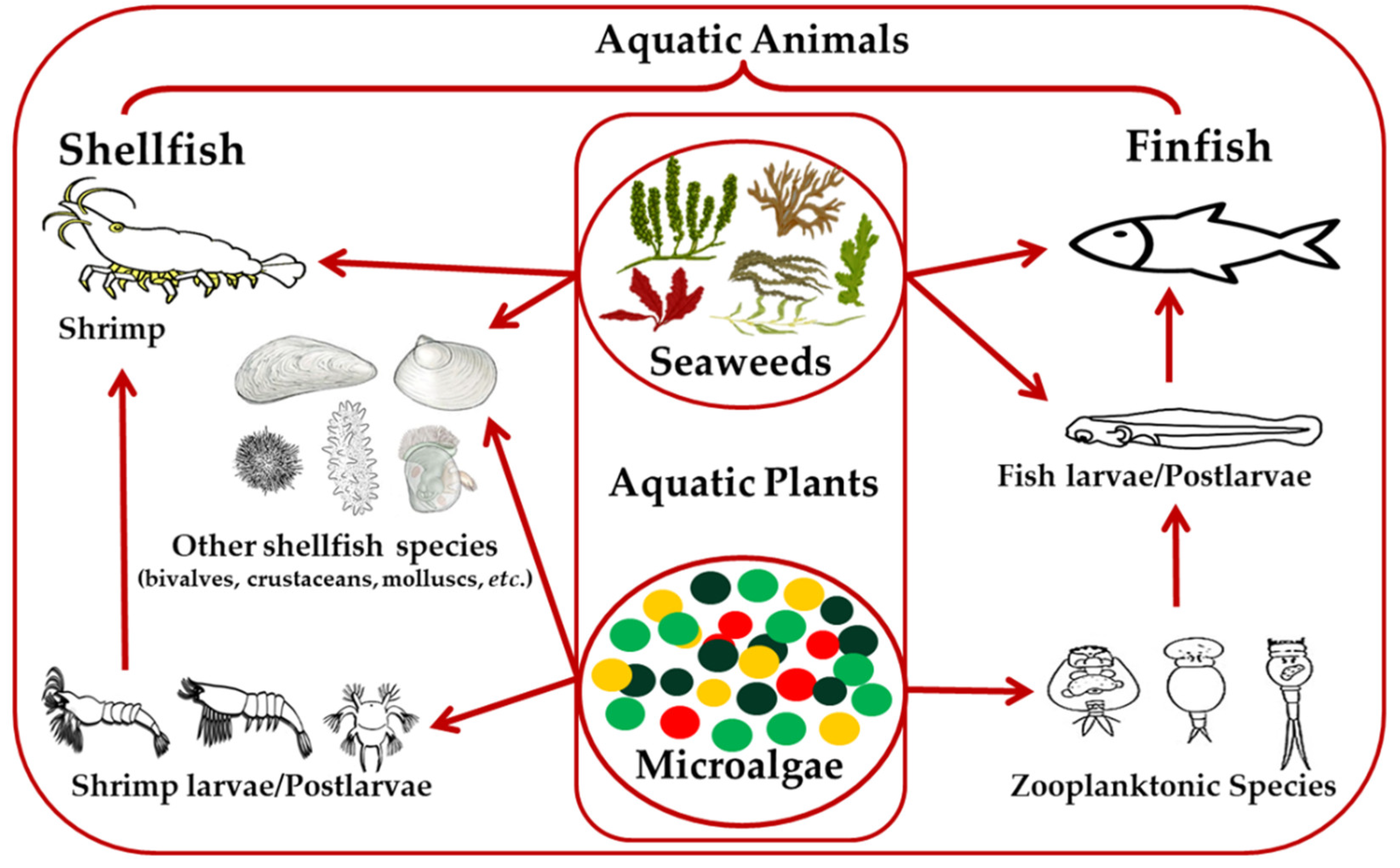
The aquaculture industry has rapidly increased in response to the increasing world population, with the appreciation that aquaculture products are beneficial for human health and nutrition. Globally, aquaculture organisms are mainly divided into two divisions, aquatic animals (finfish, crustaceans, and molluscs) and aquatic plants (microalgae and seaweed). Worldwide aquaculture production has reached more than 82 million tonnes (MTs) in 2018 with more than 450 cultured species. The development of economical, environmentally friendly, and large-scale feasible technologies to produce aquaculture organisms (even aquatic animals and/or aquatic plants) is an essential need of the world. Some aquaculture technologies are related to aquatic animals or aquatic plants, as well as some technologies have an integrated system. This integration between aquatic plants and aquatic animals could be performed during early larvae rearing, on-growing and/or mass production. In the context of the blue revolution, the current review focuses on the generations of integration between aquatic plants and aquatic animals, such as live feeds, biomass concentrates, water conditioners “green water technique”, aqua-feed additives, co-culturing technologies, and integrated multi-trophic aquaculture (IMTA). This review could shed light on the benefit of aquatic animals and plant integration, which could lead future low-cost, highly efficient, and sustainable aquaculture industry projects.
Keywords: integrated aquaculture; IMTA; aquatic animals; microalgae; seaweeds; feed additive; microalgae biomass concentrates integrated aquaculture; IMTA; aquatic animals; microalgae; seaweeds; feed additive; microalgae biomass concentrates