Article

The Impact of Green HRM on Employees’ Eco-Friendly Behavior: The Mediator Role of Organizational Identification


by
Neuza Ribeiro
1,*,
Daniel Roque Gomes
2,3,
Eduardo Ortega
4,
Gabriela Pedro Gomes
4 and
Ana Suzete Semedo
5,6,7
1
Centre of Applied Research in Management and Economics (CARME), School of Technology and Management, Polytechnic of Leiria, 2411-901 Leiria, Portugal
2
School of Education, Polytechnic Institute of Coimbra, 3045-093 Coimbra, Portugal
3
ICNOVA—Instituto de Comunicação da NOVA, 1069-061 Lisboa, Portugal
4
Centre of Applied Research in Management and Economics (CARME), Polytechnic of Leiria, 2411-901 Leiria, Portugal
5
School of Management, Hospitality and Tourism University of Algarve, 8005-139 Faro, Portugal
6
Centre for Business and Economics Research-CeBER, 3004-512 Coimbra, Portugal
7
Universidade de Santiago, Assomada 7310, Cape Verde
*
Author to whom correspondence should be addressed.
Sustainability 2022, 14(5), 2897; https://doi.org/10.3390/su14052897
Submission received: 11 February 2022 / Revised: 26 February 2022 / Accepted: 27 February 2022 / Published: 2 March 2022

Abstract

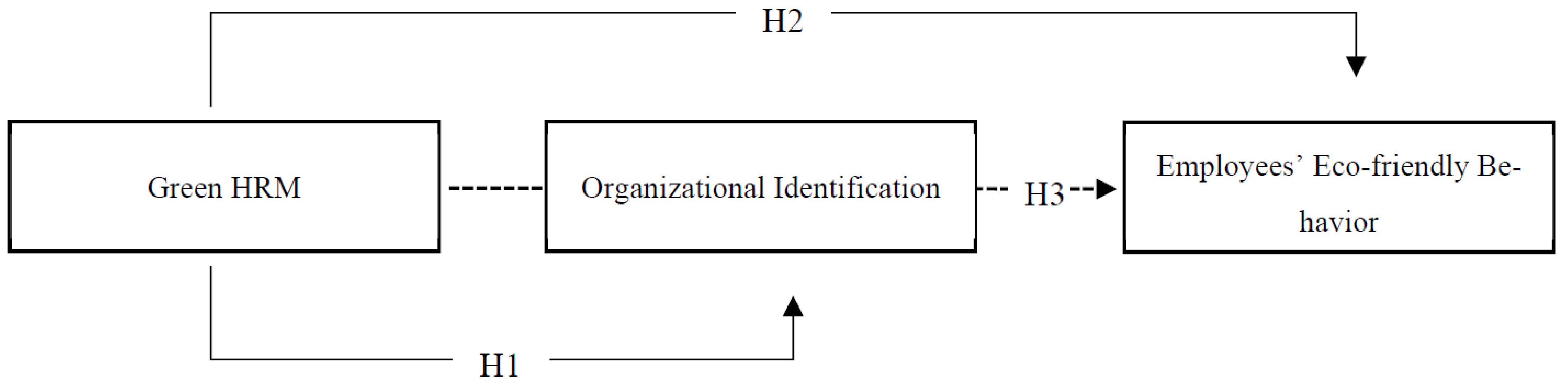
This study sought to explore the impact of green human resource management on organizational identification and employees’ eco-friendly behavior, as well as the mediating role of organizational identification in the relationship between green human resource management and employees’ eco-friendly behavior. To achieve the study objectives, a cross-sectional quantitative study was developed, for which the data were obtained through a structured questionnaire containing the measures of the study variables. Data were collected from 235 employees from several Portuguese tourism organizations participating in the study. The Harman test and bootstrapping were applied previously to the assessment of the results. The mediation study’s hypothesis was evaluated using Baron and Kenny’s linear regression method, and subsequently complemented using the Sobel test. The findings showed that the implementation of green HRM practices in tourism organizations has a positive impact on employees’ eco-friendly behavior and on organizational identification, with the latter mediating the relationship between green human resource management and employees’ eco-friendly behavior. The study is breaking new ground because it incorporates the impact of green human resource management on organizational identification and employees’ eco-friendly behavior in a single research model, thus expanding knowledge on the subject, namely in the tourism sector in Portugal.
Keywords: green HRM; organizational identification; employees’ eco-friendly behavior; tourism sector green HRM; organizational identification; employees’ eco-friendly behavior; tourism sector