


Performance Implications of Organizational and Technological Innovation: An Integrative Perspective


Abstract
1. Introduction
2. Literature Review and Hypothesis Development
3. Materials and Methods
3.1. Data and Sample
3.2. Reliability and Validity Assessment
3.3. Structural Modeling
4. Results and Discussion
4.1. Theoretical Implications
4.2. Practical Implications
4.3. Limitations and Future Research
5. Conclusions
Author Contributions
Funding
Institutional Review Board Statement
Informed Consent Statement
Data Availability Statement
Conflicts of Interest
References
- Hausstein, A.; Grunwald, A. The Proliferation of the Innovation Discourse, on the Formation, Semantics and Social Function of the Innovation Concept; Karlsruher Institut für Technologie: Karlsruhe, Germany, 2015; p. 18. [Google Scholar]
- Crossan, M.M.; Apaydin, M. A Multi-Dimensional Framework of Organizational Innovation: A Systematic Review of the Literature: A Framework of Organizational Innovation. J. Manag. Stud. 2010, 47, 1154–1191. [Google Scholar] [CrossRef] [Scilit]
- Geldes, C.; Felzensztein, C.; Palacios-Fenech, J. Technological and non-technological innovations, performance and propensity to innovate across industries: The case of an emerging economy. Ind. Mark. Manag. 2017, 61, 55–66. [Google Scholar] [CrossRef] [Scilit]
- Torres, P.; Augusto, M. Understanding complementarities among different forms of innovation. Eur. J. Innov. Manag. 2019, 23, 813–834. [Google Scholar] [CrossRef] [Scilit]
- Azar, G.; Ciabuschi, F. Organizational innovation, technological innovation, and export performance: The effects of innovation radicalness and extensiveness. Int. Bus. Rev. 2017, 26, 324–336. [Google Scholar] [CrossRef] [Scilit]
- Donbesuur, F.; Ampong, G.O.A.; Owusu-Yirenkyi, D.; Chu, I. Technological innovation, organizational innovation and international performance of SMEs: The moderating role of domestic institutional environment. Technol. Forecast. Soc. Chang. 2020, 161, 120252. [Google Scholar] [CrossRef] [Scilit]
- Hullova, D.; Trott, P.; Simms, C. Uncovering the reciprocal complementarity between product and process innovation. Res. Policy 2016, 45, 929–940. [Google Scholar] [CrossRef] [Scilit]
- Evangelista, R.; Vezzani, A. The economic impact of technological and organizational innovations. A firm-level analysis. Res. Policy 2010, 39, 1253–1263. [Google Scholar] [CrossRef] [Scilit]
- Damanpour, F. Organizational Innovation, A Meta-Analysis of Effects of Determinants and Moderators. Acad. Manag. J. 1991, 34, 555–590. [Google Scholar]
- OCDE. Oslo Manual, 3rd ed.; Eurostat: Luxembourg, 2007. [Google Scholar]
- Gunday, G.; Ulusoy, G.; Kilic, K.; Alpkan, L. Effects of innovation types on firm performance. Int. J. Prod. Econ. 2011, 133, 662–676. [Google Scholar] [CrossRef] [Scilit]
- Pino, C.; Felzensztein, C.; Zwerg-Villegas, A.M.; Arias-Bolzmann, L. Non-technological innovations: Market performance of exporting firms in South America. J. Bus. Res. 2016, 69, 4385–4393. [Google Scholar] [CrossRef] [Scilit]
- Geldes, C.; Felzensztein, C. Marketing innovations in the agribusiness sector. Acad. Rev. Latinoam. Adm. 2013, 26, 108–138. [Google Scholar] [CrossRef] [Scilit]
- Walker, R.M.; Damanpour, F.; Devece, C.A. Management Innovation and Organizational Performance: The Mediating Effect of Performance Management. J. Public Adm. Res. Theory 2010, 21, 367–386. [Google Scholar] [CrossRef] [Scilit]
- Damanpour, F.; Evan, W.M. Organizational Innovation and Performance: The Problem of “Organizational Lag”. Adm. Sci. Q. 1984, 29, 392. [Google Scholar] [CrossRef] [Scilit]
- Birkinshaw, J.M.; Hamel, G.; Mol, M.J. Management Innovation. Acad. Manag. Rev. 2008, 33, 825–845. [Google Scholar] [CrossRef] [Scilit]
- Azeem, M.; Ahmed, M.; Haider, S. Does organizational innovation moderate technical innovation directly or indirectly? Technovation 2021, 26, 187–206. [Google Scholar]
- Daft, R.L. Essentials of Organization Theory and Design; South Western Educational Publishing: Mason, OH, USA, 1978; p. 213. [Google Scholar]
- Hwang, A.-S. Integrating Technology, Marketing and Management Innovation. Res. Manag. 2004, 47, 27–31. [Google Scholar] [CrossRef] [Scilit]
- Ozturk, E.; Ozen, O. How Management Innovation Affects Product and Process Innovation in Turkey: The Moderating Role of Industry and Firm Size. Eur. Manag. Rev. 2020, 18, 293–310. [Google Scholar] [CrossRef] [Scilit]
- Khosravi, P.; Newton, C.; Rezvani, A. Management innovation: A systematic review and meta-analysis of past decades of research. Eur. Manag. J. 2019, 37, 694–707. [Google Scholar] [CrossRef] [Scilit]
- Kraśnicka, T.; Głód, W.; Wronka-Pośpiech, M. Management innovation, pro-innovation organisational culture and enterprise performance: Testing the mediation effect. Rev. Manag. Sci. 2018, 12, 737–769. [Google Scholar] [CrossRef] [Scilit]
- Zhang, Y.; Khan, U.; Lee, S.; Salik, M. The Influence of Management Innovation and Technological Innovation on Organization Performance. A Mediating Role of Sustainability. Sustainability 2019, 11, 495. [Google Scholar] [CrossRef] [Scilit]
- Simao, L.B.; Carvalho, L.C.; Madeira, M.J. Intellectual structure of management innovation: Bibliometric analysis. Manag. Rev. Q. 2021, 71, 651–677. [Google Scholar] [CrossRef] [Scilit]
- Koster, F. Organisational Antecedents of Innovation Performance: An Analysis Across 32 European Countries. Int. J. Innov. Manag. 2020, 25, 1–21. [Google Scholar] [CrossRef] [Scilit]
- Laforet, S. Organizational innovation outcomes in SMEs: Effects of age, size, and sector. J. World Bus. 2013, 48, 490–502. [Google Scholar] [CrossRef] [Scilit]
- Černe, M.; Kaše, R.; Škerlavaj, M. Non-technological innovation research: Evaluating the intellectual structure and prospects of an emerging field. Scand. J. Manag. 2016, 32, 69–85. [Google Scholar] [CrossRef] [Scilit]
- Volberda, H.W.; Van Den Bosch, F.A.; Heij, C.V. Management Innovation: Management as Fertile Ground for Innovation. Eur. Manag. Rev. 2013, 10, 1–15. [Google Scholar] [CrossRef] [Scilit]
- Kraśnicka, T.; Głód, W.; Wronka-Pośpiech, M. Management Innovation and Its Measurement. J. Entrep. Manag. Innov. 2016, 12, 95–121. [Google Scholar] [CrossRef] [Scilit]
- Teece, D.J. Explicating dynamic capabilities: The nature and microfoundations of (sustainable) enterprise performance. Strat. Manag. J. 2007, 28, 1319–1350. [Google Scholar] [CrossRef] [Scilit]
- Armbruster, H.; Bikfalvi, A.; Kinkel, S.; Lay, G. Organizational innovation: The challenge of measuring non-technical innovation in large-scale surveys. Technovation 2008, 28, 644–657. [Google Scholar] [CrossRef] [Scilit]
- Ballot, G.; Fakhfakh, F.; Galia, F.; Salter, A. The fateful triangle, Complementarities in performance between product, process and organizational innovation in France and the UK. Res. Policy 2015, 44, 217–232. [Google Scholar] [CrossRef] [Scilit]
- Mothe, C.; Thi, T.U.N. The link between non-technological innovations and technological innovation. Eur. J. Innov. Manag. 2010, 13, 313–332. [Google Scholar] [CrossRef] [Scilit]
- Lam, A. Organizational Innovation, The Oxford Handbook of Innovation; Oxford University Press: Oxford, UK, 2009; pp. 115–147. [Google Scholar]
- Anzola-Román, P.; Bayona-Sáez, C.; García-Marco, T. Organizational innovation, internal R&D and externally sourced innovation practices. Effects on technological innovation outcomes. J. Bus. Res. 2018, 91, 233–247. [Google Scholar]
- Cozzarin, B.P.; Kim, W.; Koo, B. Does organizational innovation moderate technical innovation directly or indirectly? Econ. Innov. New. Technol. 2017, 26, 385–403. [Google Scholar] [CrossRef] [Scilit]
- Hollen, R.M.; Van Den Bosch, F.A.; Volberda, H.W. The Role of Management Innovation in Enabling Technological Process Innovation: An Inter-Organizational Perspective. Eur. Manag. Rev. 2013, 10, 35–50. [Google Scholar] [CrossRef] [Scilit]
- Damanpour, F.; Aravind, D. Managerial Innovation: Conceptions, Processes and Antecedents. Manag. Organ. Rev. 2012, 8, 423–454. [Google Scholar] [CrossRef] [Scilit]
- Rehman, J.; Hawryszkiewycz, I.; Sohaib, O. Deriving high performance knowledge sharing culture (HPKSC), A firm performance & innovation capabilities perspective. In Proceedings of the 22nd Pacific Asia Conference on Information Systems (PACIS 2018)—Opportunities, Challenges for the Digital Society Are We Ready? Yokohama, Japan, 26–30 June 2018. [Google Scholar]
- Goos, M.; Arntz, M. The Impact of Technological Innovation on the Future of Work; Joint Research Centre (JRC): Ispra, Italy, 2019. [Google Scholar]
- Frambach, R.T.; Schillewaert, N. Organizational innovation adoption: A multi-level framework of determinants and opportunities for future research. J. Bus. Res. 2002, 55, 163–176. [Google Scholar] [CrossRef] [Scilit]
- Arranz, N.; Arroyabe, M.; Li, J.; de Arroyabe, J.F. An integrated model of organisational innovation and firm performance: Generation, persistence and complementarity. J. Bus. Res. 2019, 105, 270–282. [Google Scholar] [CrossRef] [Scilit]
- Attar, M.; Kang, K.; Sohaib, O. Knowledge Sharing Practices, Intellectual Capital and Organizational Performance. In Proceedings of the Annual Hawaii International Conference on System Sciences, Maui, HI, USA, 8–11 January 2019. [Google Scholar]
- Binsawad, M.; Sohaib, O.; Hawryszkiewycz, I. Factors Impacting Technology Business Incubator Performance. Int. J. Innov. Manag. 2019, 23, 1–30. [Google Scholar] [CrossRef] [Scilit]
- Ober, J. Innovation Adoption: Empirical Analysis on the Example of Selected Factors of Organizational Culture in the IT Industry in Poland. Sustainability 2020, 12, 8630. [Google Scholar] [CrossRef] [Scilit]
- Haned, N.; Mothe, C.; Nguyen-Thi, T.U. Firm persistence in technological innovation: The relevance of organizational innovation. Econ. Innov. New Technol. 2014, 23, 490–516. [Google Scholar] [CrossRef] [Scilit]
- Costa, J.; Teixeira, A.A.C.; Botelho, A. Persistence in innovation and innovative behavior in unstable environments. Int. J. Syst. Innov. 2020, 6, 1–19. [Google Scholar]
- Battisti, G.; Stoneman, P. How Innovative are UK Firms? Evidence from the Fourth UK Community Innovation Survey on Synergies between Technological and Organizational Innovations. Br. J. Manag. 2010, 21, 187–206. [Google Scholar] [CrossRef] [Scilit]
- Camisón, C.; Villar-López, A. Organizational innovation as an enabler of technological innovation capabilities and firm performance. J. Bus. Res. 2014, 67, 2891–2902. [Google Scholar] [CrossRef] [Scilit]
- Lee, R.; Lee, J.-H.; Garrett, T.C. Synergy effects of innovation on firm performance. J. Bus. Res. 2019, 99, 507–515. [Google Scholar] [CrossRef] [Scilit]
- Hervas-Oliver, J.L.; Sempere-Ripoll, F.; Boronat-Moll, C.; Alvarado, R.R. On the joint effect of technological and management innovations on performance: Increasing or diminishing returns? Technol. Anal. Strat. Manag. 2017, 30, 569–581. [Google Scholar] [CrossRef] [Scilit]
- Chen, Q.; Wang, C.-H.; Huang, S.-Z. Effects of organizational innovation and technological innovation capabilities on firm performance: Evidence from firms in China’s Pearl River Delta. Asia Pac. Bus. Rev. 2019, 26, 72–96. [Google Scholar] [CrossRef] [Scilit]
- Cheah, S.L.-Y.; Ho, Y.-P.; Li, S. Search strategy, innovation and financial performance of firms in process industries. Technovation 2021, 105, 102257. [Google Scholar] [CrossRef] [Scilit]
- Medic, N.; Anisic, Z.; Lalic, B.; Marjanovic, U.; Brezocnik, M. Hybrid fuzzy multi-attribute decision making model for evaluation of advanced digital technologies in manufacturing: Industry 4.0 perspective. Adv. Prod. Eng. Manag. 2019, 14, 483–493. [Google Scholar] [CrossRef] [Scilit]
- Manresa, A.; Bikfalvi, A.; Simon, A. Exploring the relationship between individual and bundle implementation of High-Performance Work Practices and performance: Evidence from Spanish manufacturing firms. Int. J. Ind. Eng. Manag. 2021, 12, 178–196. [Google Scholar] [CrossRef] [Scilit]
- Sijtsma, K. On the Use, the Misuse, and the Very Limited Usefulness of Cronbach’s Alpha. Psychometrika 2008, 74, 107–120. [Google Scholar] [CrossRef] [Scilit]
- Asparouhov, T.; Muthén, B. Exploratory structural equation modeling. Struct. Equ. Model. 2009, 16, 397–438. [Google Scholar] [CrossRef] [Scilit]
- Bentler, P.M.; Bonett, D.G. Significance tests and goodness of fit in the analysis of covariance structures. Psychol. Bull. 1980, 88, 588–606. [Google Scholar] [CrossRef]
- Ahire, S.L.; Golhar, D.Y.; Waller, M.A. Development and Validation of TQM Implementation Constructs. Decis. Sci. 1996, 27, 23–56. [Google Scholar] [CrossRef] [Scilit]
- Hu, L.-T.; Bentler, P.M. Cutoff criteria for fit indexes in covariance structure analysis: Conventional criteria versus new alternatives. Struct. Equ. Model. Multidiscip. J. 1999, 6, 1–55. [Google Scholar] [CrossRef] [Scilit]
- Todorovic, T.; Lalic, B.; Majstorovic, V.; Marjanovic, U.; Tasic, N. General Readiness Assessment of Industry 4.0: Evidence from Serbian Manufacturing Industry. IFIP Adv. Inf. Commun. Technol. 2020, 59, 139–146. [Google Scholar] [CrossRef] [Scilit]

| Research Hypothesis |
|---|
Hypothesis 1 (H1). The positive effects of organizational innovation on firm performance are mediated by the implementation of digital factory technologies. |
Hypothesis 1 (H1a). The positive effects of organization of production on firm performance are mediated by the implementation of digital factory technologies. |
Hypothesis 1 (H1b). The positive effects of management/controlling on firm performance are mediated by the implementation of digital factory technologies. |
Hypothesis 1 (H1c). The positive effects of human resources on firm performance are mediated by the implementation of digital factory technologies. |
Hypothesis 2 (H2). The positive effects of organizational innovation on firm performance are mediated by the implementation of automation and robotics. |
Hypothesis 2 (H2a). The positive effects of organization of production on firm performance are mediated by the implementation of automation and robotics. |
Hypothesis 2 (H2b). The positive effects of management/controlling on firm performance are mediated by the implementation of automation and robotics. |
Hypothesis 2 (H2c). The positive effects of human resources on firm performance are mediated by the implementation of automation and robotics. |
Hypothesis 3 (H3). The positive effects of organizational innovation on firm performance are mediated by the implementation of additive manufacturing technologies. |
Hypothesis 3 (H3a). The positive effects of organization of production on firm performance are mediated by the implementation of additive manufacturing technologies. |
Hypothesis 3 (H3b). The positive effects of management/controlling on firm performance are mediated by the implementation of additive manufacturing technologies. |
Hypothesis 3 (H3c). The positive effects of human resources on firm performance are mediated by the implementation of additive manufacturing technologies. |
Hypothesis 4 (H4). The positive effects of organizational innovation on firm performance are mediated by the implementation of energy efficiency technologies. |
Hypothesis 4 (H4a). The positive effects of organization of production on firm performance are mediated by the implementation of energy efficiency technologies. |
Hypothesis 4 (H4b). The positive effects of management/controlling on firm performance are mediated by the implementation of energy efficiency technologies. |
Hypothesis 4 (H4c). The positive effects of human resources on firm performance are mediated by the implementation of energy efficiency technologies. |
| Concepts | First-Level Factor | Item | Encoded |
|---|---|---|---|
| Organizational concepts | Organization of production | Standardized and detailed work instructions | U1 |
| Measures to improve internal logistics | U2 | ||
| Fixed process flows to reduce setup time or optimize change-over time | U3 | ||
| Integration of tasks | U4 | ||
| Production controlling following the Pull principle | U5 | ||
| Management/controlling | Display boards in production to illustrate work processes and work status | U6 | |
| Methods of assuring quality in production | U7 | ||
| Certified quality standards | U8 | ||
| Certified energy management system | U9 | ||
| Methods of operation management for mathematical analyses of the production | U10 | ||
| Certified environmental management system | U11 | ||
| Human resources | Instruments to promote staff loyalty | U12 | |
| On-the-job training | U13 | ||
| Technologies | Digital factory | Mobile/wireless devices for programming and controlling facilities and machinery | U14 |
| Digital solutions to provide drawings, work schedules, or work instructions directly on the shop floor | U15 | ||
| Software for production planning and scheduling | U16 | ||
| Digital Exchange of product/process data with suppliers/customers | U17 | ||
| Near real-time production control system | U18 | ||
| Systems for automation and management of internal logistics | U19 | ||
| Product-lifecycle-management-systems (PLM) or product/process data management | U20 | ||
| Virtual Reality or simulation for product design | U21 | ||
| Automation and robotics | Industrial robots for manufacturing processes | U22 | |
| Industrial robots for handling processes | U23 | ||
| Additive manufacturing technologies | 3D printing technologies for prototyping | U24 | |
| 3D printing technologies for the manufacturing of products | U25 | ||
| Energy efficiency technologies | Technologies for recycling and re-use of water | U26 | |
| Technologies to recuperate kinetic and process energy | U27 | ||
| Outcome variable | Return on sales | U35 |
| Manifest Variables | Latent Variables | λ | Standard Error | t | p | Sig. |
|---|---|---|---|---|---|---|
| U1 | Organization of production | 0.842 | 0.060 | 14.104 | 0.000 | Yes |
| U2 | 0.941 | 0.031 | 30.749 | 0.000 | Yes | |
| U3 | 0.847 | 0.052 | 16.193 | 0.000 | Yes | |
| U4 | 0.747 | 0.063 | 11.898 | 0.000 | Yes | |
| U5 | 0.873 | 0.048 | 18.052 | 0.000 | Yes | |
| U6 | Management/controlling | 0.755 | 0.058 | 12.968 | 0.000 | Yes |
| U7 | 0.881 | 0.036 | 24.673 | 0.000 | Yes | |
| U8 | 0.911 | 0.045 | 20.250 | 0.000 | Yes | |
| U9 | 0.796 | 0.077 | 10.386 | 0.000 | Yes | |
| U10 | 0.779 | 0.086 | 9.052 | 0.000 | Yes | |
| U11 | 0.786 | 0.048 | 16.498 | 0.000 | Yes | |
| U12 | Human resources | 0.817 | 0.063 | 12.989 | 0.000 | Yes |
| U13 | 0.877 | 0.080 | 10.934 | 0.000 | Yes | |
| U14 * | Production control Digital factory | 0.195 * | 0.162 * | 1.202 * | 0.229 * | No * |
| U15 | 0.726 | 0.092 | 7.891 | 0.000 | Yes | |
| U16 | 0.844 | 0.076 | 11.132 | 0.000 | Yes | |
| U17 | 0.806 | 0.056 | 14.416 | 0.000 | Yes | |
| U18 | 0.868 | 0.052 | 16.672 | 0.000 | Yes | |
| U19 | 0.858 | 0.070 | 12.252 | 0.000 | Yes | |
| U20 | 0.769 | 0.079 | 9.722 | 0.000 | Yes | |
| U21 * | 0.160 * | 0.127 * | 1.265 * | 0.206 * | No * | |
| U22 | Automation and robotics | 0.704 | 0.139 | 5.058 | 0.000 | Yes |
| U23 | 0.802 | 0.154 | 5.194 | 0.000 | Yes | |
| U24 | Additive manufacturing technologies | 0.964 | 0.091 | 10.636 | 0.000 | Yes |
| U25 | 0.958 | 0.077 | 12.411 | 0.000 | Yes | |
| U26 | Energy efficiency technologies | 0.711 | 0.116 | 6.117 | 0.000 | Yes |
| U27 | 0.902 | 0.155 | 5.799 | 0.000 | Yes |
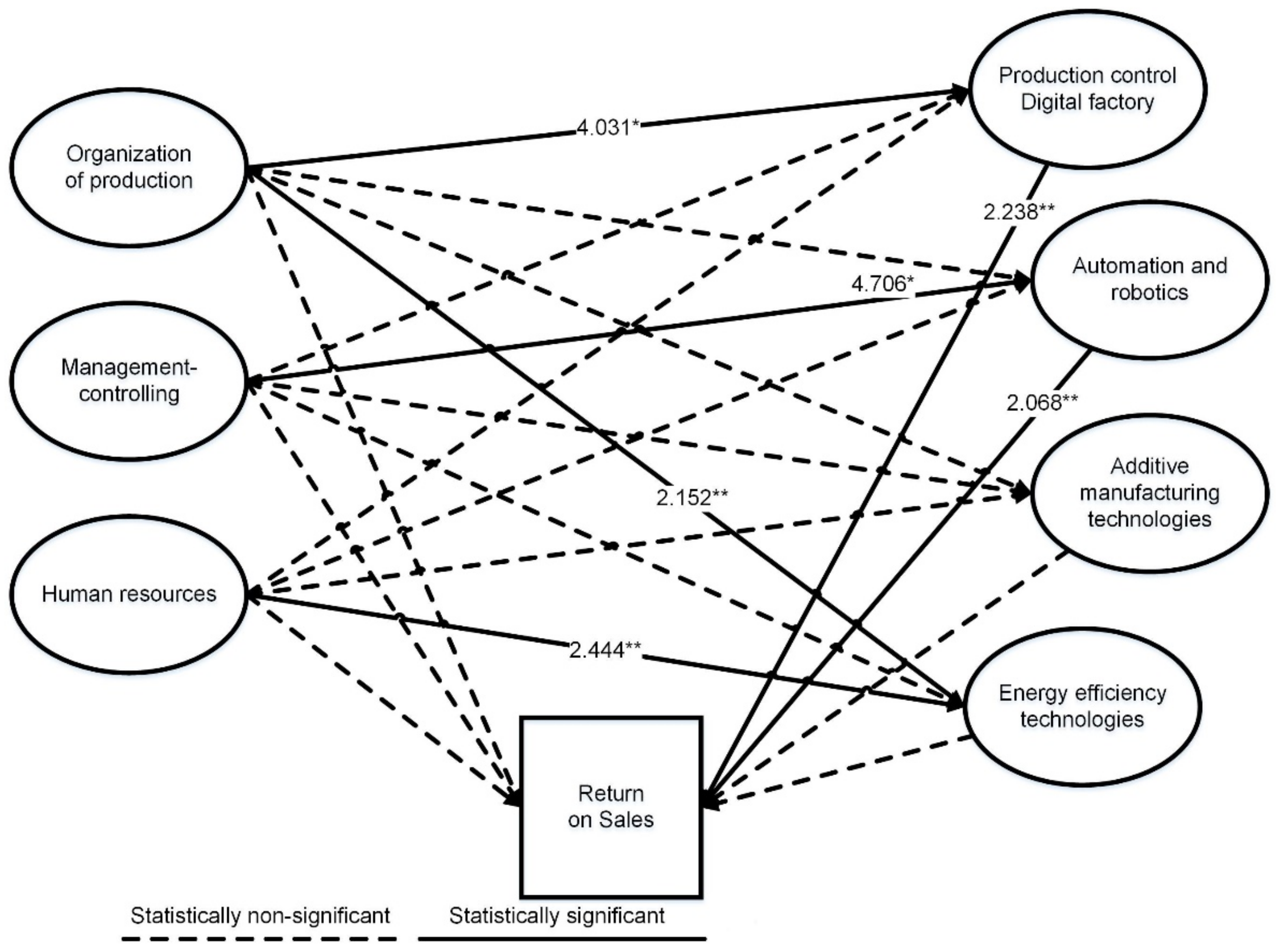
| Organizational Concepts → | Technological Concepts | Γ | Standard Error | t | p | Sig. |
|---|---|---|---|---|---|---|
| Organization of production | Production control, Digital factory | 0.864 | 0.214 | 4.031 | 0.000 | Yes * |
| Management/controlling | 0.270 | 0.175 | 1.543 | 0.123 | No | |
| Human resources | 0.343 | 0.192 | 1.791 | 0.073 | No | |
| Organization of production | Automation and robotics | 0.070 | 0.407 | 0.173 | 0.863 | No |
| Management/controlling | 0.795 | 0.169 | 4.706 | 0.000 | Yes * | |
| Human resources | 0.694 | 0.425 | 1.632 | 0.103 | No | |
| Organization of production | Additive manufacturing technologies | 0.150 | 0.339 | 0.444 | 0.657 | No |
| Management/controlling | 0.498 | 0.327 | 1.522 | 0.128 | No | |
| Human resources | 0.059 | 0.320 | 0.185 | 0.657 | No | |
| Organization of production | Energy efficiency technologies | 0.749 | 0.348 | 2.152 | 0.031 | Yes ** |
| Management/controlling | 0.922 | 0.519 | 1.779 | 0.075 | No | |
| Human resources | 0.711 | 0.291 | 2.444 | 0.014 | Yes ** |
| Org. and Tech. Concepts → Return on Sales | β | Standard Error | t | p | Sig. |
|---|---|---|---|---|---|
| Organization of production | 0.059 | 1.358 | 0.044 | 0.965 | No |
| Management/controlling | 1.009 | 0.900 | 1.122 | 0.262 | No |
| Human resources | 0.575 | 1.664 | 0.345 | 0.730 | No |
| Production control/Digital factory | 0.743 | 0.331 | 2.238 | 0.036 | Yes ** |
| Automation and robotics | 0.724 | 0.350 | 2.068 | 0.040 | Yes ** |
| Additive manufacturing technologies | 0.249 | 0.225 | 1.108 | 0.268 | No |
| Energy efficiency technologies | 0.314 | 0.960 | 0.327 | 0.744 | No |
| Model | Baseline Χ2 | Χ2 | df | Χ2/df | RMSEA | CFI | TLI |
|---|---|---|---|---|---|---|---|
| CFA | 2124.825 * | 291.668 * | 254 | 1.5 | 0.033 | 0.979 | 0.976 |
| SEM | 2155.347 * | 323.391 * | 278 | 1.6 | 0.035 | 0.975 | 0.971 |
| Recommended | Comparison | less, the better | - | ≤2, 3 | <0.08 | >0.95 | >0.90 |
| Organizational innovations | Number of Firms | Share in Total Sample (%) |
|---|---|---|
| Organization of production | ||
| Standardized and detailed work instructions (e.g., standard operation procedures, SOP, MOST) | 155 | 64.6 |
| Measures to improve internal logistics (e.g., value stream mapping/design, changed spatial arrangements of production steps) | 42 | 17.5 |
| Fixed process flows to reduce setup time or optimize change-over-time (e.g., SMED, QCO) | 62 | 25.8 |
| Integration of tasks (planning, operating, or controlling functions with the machine operator) | 77 | 32.1 |
| Production controlling following the Pull principle (e.g., KANBAN, Internal zero-buffer principle) | 42 | 17.5 |
| Management/controlling | ||
| Display boards in production to illustrate work processes and work status (e.g., visual management) | 77 | 32.1 |
| Methods of assuring quality in production (e.g., CIP, TQM, Six Sigma, preventive maintenance) | 103 | 42.9 |
| Certified quality standards (e.g., ISO 900xx) | 151 | 62.9 |
| Certified energy management system (e.g., EN ISO 50001) | 11 | 4.6 |
| Methods of operation management for mathematical analyses of production (e.g., regression analysis, queening models) | 23 | 9.6 |
| Certified environmental management system (e.g., EN ISO 14001) | 88 | 36.7 |
| Human resources | ||
| Instruments to promote staff loyalty (e.g., attractively designed responsibilities, offering learning opportunities, flexible working hours, child care) | 49 | 20.4 |
| On-the-job training | 152 | 63.3 |
| Technological Innovations | Number of Firms | Share in Total Sample (%) |
| Digital factory | ||
| Digital solutions to provide drawings, work schedules, or work instructions directly on the shop floor | 59 | 24.6 |
| Software for production planning and scheduling (e.g., ERP system) | 96 | 40 |
| Digital exchange of product/process data with suppliers/customers (electronic data interchange, EDI) | 87 | 36.3 |
| Near real-time production control system (e.g., systems of centralized operating and machine data acquisition, MES) | 69 | 28.8 |
| Systems for automation and management of internal logistics (e.g., warehouse management systems, RFID) | 44 | 18.3 |
| Product-lifecycle-management-systems (PLM) or product/process data management | 31 | 12.9 |
| Automation and robotics | ||
| Industrial robots for manufacturing processes (e.g., welding, painting, cutting) | 34 | 14.2 |
| Industrial robots for handling processes (e.g., depositing, assembling, sorting, packing processes, AGV) | 22 | 9.2 |
| Additive manufacturing technologies | ||
| 3D printing technologies for prototyping (prototypes, demonstration models, 0 series) | 21 | 8.8 |
| 3D printing technologies for manufacturing products, components, forms, tools, etc.) | 14 | 5.8 |
| Energy efficiency technologies | ||
| Technologies for recycling and re-use of water (e.g., water recirculating system) | 31 | 12.9 |
| Technologies to recuperate kinetic and process energy (e.g., waste heat recovery, energy storage) | 21 | 8.8 |
Publisher’s Note: MDPI stays neutral with regard to jurisdictional claims in published maps and institutional affiliations. |
© 2022 by the authors. Licensee MDPI, Basel, Switzerland. This article is an open access article distributed under the terms and conditions of the Creative Commons Attribution (CC BY) license (https://creativecommons.org/licenses/by/4.0/).
Share and Cite
Todorovic, T.; Medic, N.; Delic, M.; Zivlak, N.; Gracanin, D. Performance Implications of Organizational and Technological Innovation: An Integrative Perspective. Sustainability 2022, 14, 2836. https://doi.org/10.3390/su14052836
Todorovic T, Medic N, Delic M, Zivlak N, Gracanin D. Performance Implications of Organizational and Technological Innovation: An Integrative Perspective. Sustainability. 2022; 14(5):2836. https://doi.org/10.3390/su14052836
Chicago/Turabian StyleTodorovic, Tanja, Nenad Medic, Milan Delic, Nikola Zivlak, and Danijela Gracanin. 2022. "Performance Implications of Organizational and Technological Innovation: An Integrative Perspective" Sustainability 14, no. 5: 2836. https://doi.org/10.3390/su14052836
APA StyleTodorovic, T., Medic, N., Delic, M., Zivlak, N., & Gracanin, D. (2022). Performance Implications of Organizational and Technological Innovation: An Integrative Perspective. Sustainability, 14(5), 2836. https://doi.org/10.3390/su14052836

