Locating the Principal Sectors for Carbon Emission Reduction on the Global Supply Chains by the Methods of Complex Network and Susceptible–Infective Model

Abstract
1. Introduction
2. Methods and Materials
2.1. Embodied Carbon Emission Accounting
2.2. Global Embodied Carbon Emission Flow Network Construction
2.2.1. Strength-Out
2.2.2. Closeness-Out
2.2.3. Betweenness
2.2.4. Clustering Coefficient
2.3. The Influence Spreading Model
2.4. Data Source
3. Results
3.1. The Global Embodied Carbon Emission Flow Network
3.2. The Principal Sectors with Different Spreading Capabilities
3.3. The Simulation of the Influence Spreading Process
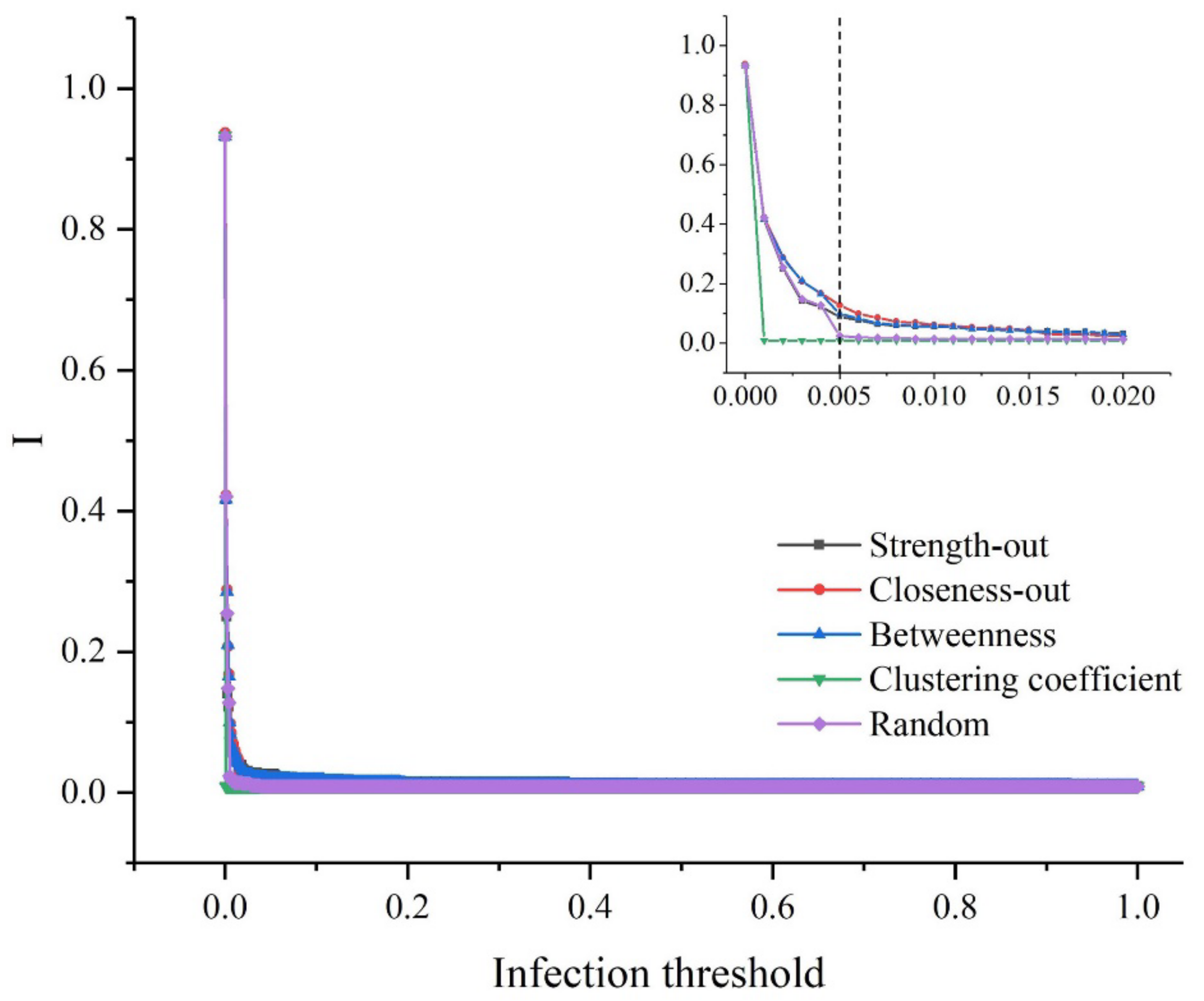
3.3.1. The Sensitivity Analysis of the Infection Thresholds
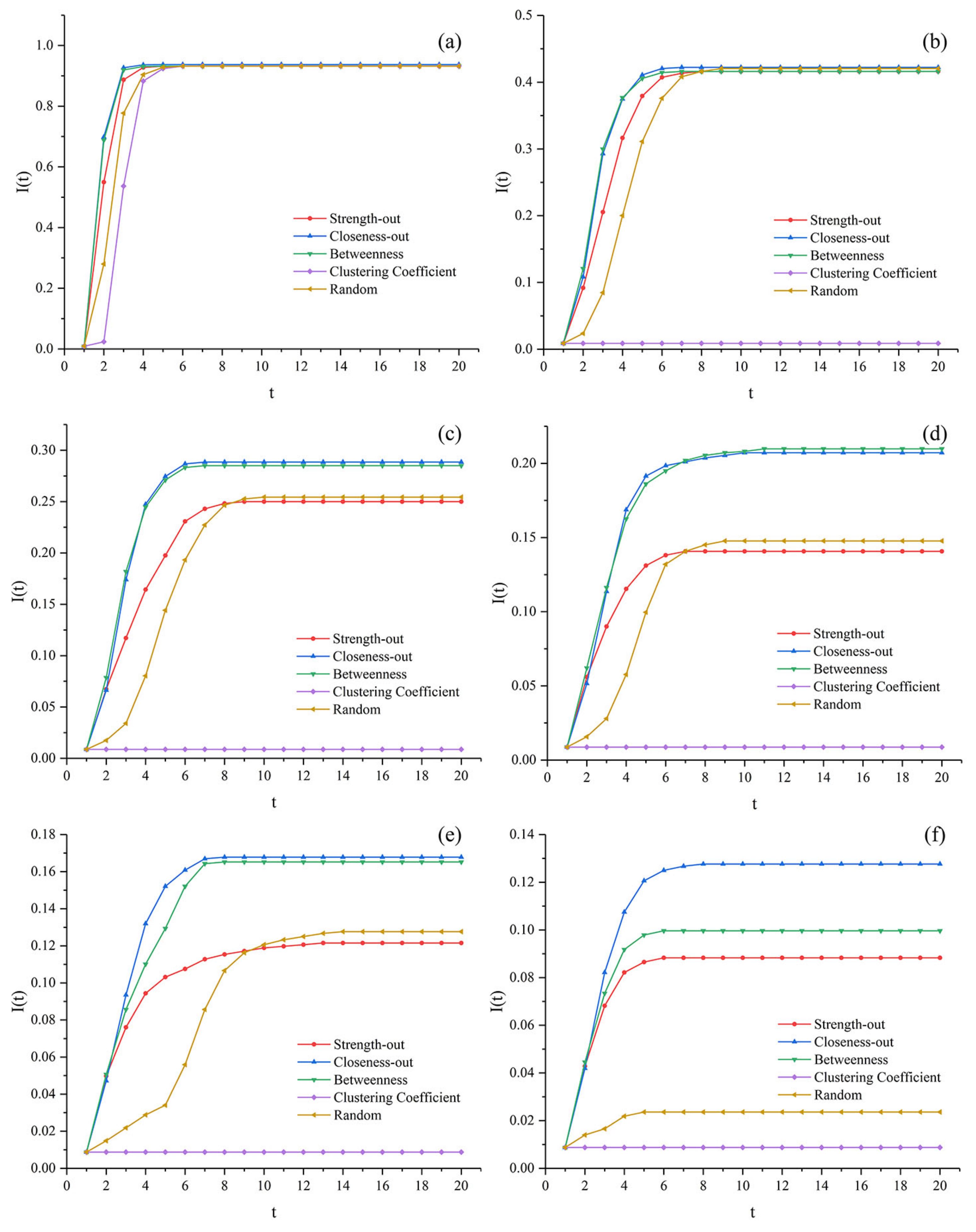
3.3.2. The Performance of Sectors with Different Spread Capabilities
4. Discussion and Conclusions
Funding
Institutional Review Board Statement
Informed Consent Statement
Data Availability Statement
Conflicts of Interest
Appendix A

| Sector Code | Integrated Sectors |
|---|---|
| 1 | Crops, vegetables, fruit and nuts |
| 2 | Cattle |
| 3 | Animal husbandry n.e.c. |
| 4 | Raw milk |
| 5 | Fish |
| 6 | Dairy and eggs |
| 7 | Beef |
| 8 | Meat n.e.c. |
| 9 | Drinks and tobacco |
| 10 | Food n.e.c. |
| 11 | Mining and quarrying |
| 12 | Textiles, leather and wearing apparel |
| 13 | Forestry, etc. |
| 14 | Wood, paper and publishing |
| 15 | Petroleum, chemicals and non-metallic mineral products |
| 16 | Metal and metal products |
| 17 | Electrical and machinery |
| 18 | Transport equipment |
| 19 | Manufacturing and recycling |
| 20 | Electricity, gas and water |
| 21 | Construction |
| 22 | Sale, maintenance and repair of vehicles; fuel; trade; hotels and restaurants |
| 23 | Transport |
| 24 | Post and telecommunications |
| 25 | Financial intermediation and business activity |
| 26 | Public administration; education; health; recreation; other services |
| Code | Country | Code | Country |
|---|---|---|---|
| AT | Austria | PT | Portugal |
| BE | Belgium | RO | Romania |
| BG | Bulgaria | SE | Sweden |
| CY | Cyprus | SI | Slovenia |
| CZ | Czech Republic | SK | Slovakia |
| DE | Germany | GB | United Kingdom |
| DK | Denmark | US | United States |
| EE | Estonia | JP | Japan |
| ES | Spain | CN | China |
| FI | Finland | CA | Canada |
| FR | France | KR | South Korea |
| GR | Greece | BR | Brazil |
| HR | Croatia | IN | India |
| HU | Hungary | MX | Mexico |
| IE | Ireland | RU | Russia |
| IT | Italy | AU | Australia |
| LT | Lithuania | CH | Switzerland |
| LU | Luxembourg | TR | Turkey |
| LV | Latvia | TW | Taiwan |
| MT | Malta | NO | Norway |
| NL | Netherlands | ID | Indonesia |
| PL | Poland | ZA | South Africa |
References
- Tokarska, K.B.; Gillett, N.P. Cumulative carbon emissions budgets consistent with 1.5 degrees C global warming. Nat. Clim. Chang. 2018, 8, 296–299. [Google Scholar] [CrossRef] [Scilit]
- Zheng, B.; Wang, S.; Xu, J.X. A Review on the CO2 Emission Reduction Scheme and Countermeasures in China’s Energy and Power Industry under the Background of Carbon Peak. Sustainability 2022, 14, 879. [Google Scholar] [CrossRef] [Scilit]
- Rong, Y.Y.; Jia, J.S.; Ju, M.; Chen, C.D.; Zhou, Y.M.; Zhong, Y.X. Multi-Perspective Analysis of Household Carbon Dioxide Emissions from Direct Energy Consumption by the Methods of Logarithmic Mean Divisia Index and sigma Convergence in Central China. Sustainability 2021, 13, 9285. [Google Scholar] [CrossRef] [Scilit]
- Zhang, H.W.; Zhang, L.Q.; Wang, K.Y.; Shi, X.P. Unveiling Key Drivers of Indirect Carbon Emissions of Chinese Older Households. Sustainability 2019, 11, 5740. [Google Scholar] [CrossRef] [Scilit]
- Xu, H.R.; Ren, Y.A.; Zhang, W.X.; Meng, W.J.; Yun, X.; Yu, X.Y.; Li, J.; Zhang, Y.Z.; Shen, G.F.; Ma, J.M.; et al. Updated Global Black Carbon Emissions from 1960 to 2017: Improvements, Trends, and Drivers. Environ. Sci. Technol. 2021, 55, 7869–7879. [Google Scholar] [CrossRef] [Scilit] [PubMed]
- Zhong, Z.Q.; Jiang, L.; Zhou, P. Transnational transfer of carbon emissions embodied in trade: Characteristics and determinants from a spatial perspective. Energy 2018, 147, 858–875. [Google Scholar] [CrossRef] [Scilit]
- Long, R.Y.; Li, J.Q.; Chen, H.; Zhang, L.L.; Li, Q.W. Embodied carbon dioxide flow in international trade: A comparative analysis based on China and Japan. J. Environ. Manag. 2018, 209, 371–381. [Google Scholar] [CrossRef] [Scilit]
- Li, Y.E.; Li, J.D. How Does China’s Economic Policy Uncertainty Affect the Sustainability of Its Net Grain Imports? Sustainability 2021, 13, 6899. [Google Scholar] [CrossRef] [Scilit]
- Liu, H.G.; Fan, X.M. Value-Added-Based Accounting of CO2 Emissions: A Multi-Regional Input-Output Approach. Sustainability 2017, 9, 2220. [Google Scholar] [CrossRef] [Scilit]
- Deng, G.Y.; Xu, Y. Accounting and structure decomposition analysis of embodied carbon trade: A global perspective. Energy 2017, 137, 140–151. [Google Scholar] [CrossRef] [Scilit]
- Zhang, Z.K.; Zhu, K.F.; Hewings, G.J.D. A multi-regional input-output analysis of the pollution haven hypothesis from the perspective of global production fragmentation. Energy Econ. 2017, 64, 13–23. [Google Scholar] [CrossRef] [Scilit]
- Xu, P.Q.; Shao, L.; Geng, Z.H.; Guo, M.L.; Wei, Z.J.; Wu, Z. Consumption-Based Carbon Emissions of Tianjin Based on Multi-Scale Input-Output Analysis. Sustainability 2019, 11, 6270. [Google Scholar] [CrossRef] [Scilit]
- Chastas, P.; Theodosiou, T.; Kontoleon, K.J.; Bikas, D. Normalising and assessing carbon emissions in the building sector: A review on the embodied CO2 emissions of residential buildings. Build Environ. 2018, 130, 212–226. [Google Scholar] [CrossRef] [Scilit]
- Zhang, X.C.; Zheng, R.Y.; Wang, F.L. Uncertainty in the life cycle assessment of building emissions: A comparative case study of stochastic approaches. Build Environ. 2019, 147, 121–131. [Google Scholar] [CrossRef] [Scilit]
- Robati, M.; Daly, D.; Kokogiannakis, G. A method of uncertainty analysis for whole-life embodied carbon emissions (CO2-e) of building materials of a net-zero energy building in Australia. J. Clean. Prod. 2019, 225, 541–553. [Google Scholar] [CrossRef] [Scilit]
- Ding, T.; Ning, Y.D.; Zhang, Y. The contribution of China’s bilateral trade to global carbon emissions in the context of globalization. Struct. Chang. Econ. Dyn. 2018, 46, 78–88. [Google Scholar] [CrossRef] [Scilit]
- Zhang, W.; Li, J.; Li, G.X.; Guo, S.C. Emission reduction effect and carbon market efficiency of carbon emissions trading policy in China. Energy 2020, 196, 9. [Google Scholar] [CrossRef] [Scilit]
- Liu, Z.; Meng, J.; Deng, Z.; Lu, P.; Guan, D.B.; Zhang, Q.; He, K.B.; Gong, P. Embodied carbon emissions in China-US trade. Sci. China-Earth Sci. 2020, 63, 1577–1586. [Google Scholar] [CrossRef] [Scilit]
- Hotak, S.; Islam, M.; Kakinaka, M.; Kotani, K. Carbon emissions and carbon trade balances: International evidence from panel ARDL analysis. Environ. Sci. Pollut. Res. 2020, 27, 24115–24128. [Google Scholar] [CrossRef] [Scilit]
- Liao, H.; Shen, J.; Wu, X.T.; Chen, B.K.; Zhou, M.Y. Empirical topological investigation of practical supply chains based on complex networks. Chin. Phys. B 2017, 26, 7. [Google Scholar] [CrossRef] [Scilit]
- He, G.; Zhou, L.; Dai, Y.Y.; Dang, Y.G.; Ji, X. Coal Industrial Supply Chain Network and Associated Evaluation Models. Sustainability 2020, 12, 9919. [Google Scholar] [CrossRef] [Scilit]
- Xia, Q.; Tian, G.L.; Wu, Z. Examining embodied carbon emission flow relationships among different industrial sectors in China. Sustain. Prod. Consum. 2022, 29, 100–114. [Google Scholar] [CrossRef] [Scilit]
- Wang, X.P.; Yu, J.Q.; Song, J.Z.; Di, X.L.; Wang, R.R. Structural evolution of China’s intersectoral embodied carbon emission flow network. Environ. Sci. Pollut. Res. 2021, 28, 21145–21158. [Google Scholar] [CrossRef] [Scilit] [PubMed]
- Wang, X.C.; Tang, X.; Feng, Z.H.; Zhang, Y. Characterizing the Embodied Carbon Emissions Flows and Ecological Relationships among Four Chinese Megacities and Other Provinces. Sustainability 2019, 11, 2591. [Google Scholar] [CrossRef] [Scilit]
- Wu, B.; Huang, W.Y.; Liu, P.F. Carbon Reduction Strategies Based on an NW Small-World Network with a Progressive Carbon Tax. Sustainability 2017, 9, 1747. [Google Scholar] [CrossRef] [Scilit]
- Wang, L.; Zheng, J.J. Research on low-carbon diffusion considering the game among enterprises in the complex network context. J. Clean. Prod. 2019, 210, 1–11. [Google Scholar] [CrossRef] [Scilit]
- Chen, B.; Wang, X.B.; Li, Y.L.; Yang, Q.; Li, J.S. Energy-induced mercury emissions in global supply chain networks: Structural characteristics and policy implications. Sci. Total Environ. 2019, 670, 87–97. [Google Scholar] [CrossRef] [Scilit]
- Hanaka, T.; Kagawa, S.; Ono, H.; Kanemoto, K. Finding environmentally critical transmission sectors, transactions, and paths in global supply chain networks. Energy Econ. 2017, 68, 44–52. [Google Scholar] [CrossRef] [Scilit]
- Tokito, S. Environmentally-Targeted Sectors and Linkages in the Global Supply-Chain Complexity of Transport Equipment. Ecol. Econ 2018, 150, 177–183. [Google Scholar] [CrossRef] [Scilit]
- Fu, Y.; Xue, L.; Yan, Y.X.; Pan, Y.; Wu, X.F.; Shao, Y. Energy Network Embodied in Trade along the Belt and Road: Spatiotemporal Evolution and Influencing Factors. Sustainability 2021, 13, 530. [Google Scholar] [CrossRef] [Scilit]
- Duan, Y.W.; Jiang, X.M. Visualizing the change of embodied CO2 emissions along global production chains. J. Clean. Prod. 2018, 194, 499–514. [Google Scholar] [CrossRef] [Scilit]
- Gao, C.X.; Su, B.; Sun, M.; Zhang, X.L.; Zhang, Z.H. Interprovincial transfer of embodied primary energy in China: A complex network approach. Appl. Energy 2018, 215, 792–807. [Google Scholar] [CrossRef] [Scilit]
- Hong, S.Y.; Wang, H.R.; Cheng, T. Circulation Characteristic Analysis of Implied Water Flow Based on a Complex Network: A Case Study for Beijing, China. Water 2018, 10, 834. [Google Scholar] [CrossRef] [Scilit]
- Wang, Y.Y.; Lei, Y.L.; Fan, F.Y.; Li, L.; Liu, L.N.; Wang, H.T. Inter-provincial sectoral embodied CO2 net-transfer analysis in China based on hypothetical extraction method and complex network analysis. Sci. Total Environ. 2021, 786, 13. [Google Scholar] [CrossRef] [Scilit] [PubMed]
- Jiang, M.; Gao, X.Y.; Guan, Q.; Hao, X.Q.; An, F. The structural roles of sectors and their contributions to global carbon emissions: A complex network perspective. J. Clean. Prod. 2019, 208, 426–435. [Google Scholar] [CrossRef] [Scilit]
- Pu, C.L.; Li, S.Y.; Yang, X.X.; Xu, Z.Q.; Ji, Z.X.; Yang, J. Traffic-driven SIR epidemic spreading in networks. Phys. A-Stat. Mech. Its Appl. 2016, 446, 129–137. [Google Scholar] [CrossRef] [Scilit]
- Dadlani, A.; Kumar, M.S.; Murugan, S.; Kim, K. System Dynamics of a Refined Epidemic Model for Infection Propagation Over Complex Networks. IEEE Syst. J. 2016, 10, 1316–1325. [Google Scholar] [CrossRef] [Scilit]
- Liu, Q.M.; Li, T.; Sun, M.C. The analysis of an SEIR rumor propagation model on heterogeneous network. Phys. A-Stat. Mech. Its Appl. 2017, 469, 372–380. [Google Scholar] [CrossRef] [Scilit]
- Wang, X.C.; Klemes, J.J.; Wang, Y.T.; Dong, X.B.; Wei, H.J.; Xu, Z.H.; Varbanov, P.S. Water-Energy-Carbon Emissions nexus analysis of China: An environmental input-output model-based approach. Appl. Energy 2020, 261, 12. [Google Scholar] [CrossRef] [Scilit]
- Wu, X.D.; Guo, J.L.; Li, C.H.; Chen, G.Q.; Ji, X. Carbon emissions embodied in the global supply chain: Intermediate and final trade imbalances. Sci. Total Environ. 2020, 707, 23. [Google Scholar] [CrossRef] [Scilit]
- Hertwich, E.G.; Wood, R. The growing importance of scope 3 greenhouse gas emissions from industry. Environ. Res. Lett. 2018, 13, 11. [Google Scholar] [CrossRef] [Scilit]
- Sun, X.Q.; An, H.Z.; Gao, X.Y.; Jia, X.L.; Liu, X.J. Indirect energy flow between industrial sectors in China: A complex network approach. Energy 2016, 94, 195–205. [Google Scholar] [CrossRef] [Scilit]
- Stella, M.; De Domenico, M. Distance Entropy Cartography Characterises Centrality in Complex Networks. Entropy 2018, 20, 268. [Google Scholar] [CrossRef] [Scilit] [PubMed]
- Mahyar, I.; Hasheminezhad, R.; Ghalebi, K.E.; Nazemian, A.; Grosu, R.; Movaghar, A.; Rabiee, H.R. Compressive sensing of high betweenness centrality nodes in networks. Phys. A-Stat. Mech. Its Appl. 2018, 497, 166–184. [Google Scholar] [CrossRef] [Scilit]
- Yin, H.; Benson, A.R.; Leskovec, J. Higher-order clustering in networks. Phys. Rev. E. 2018, 97, 11. [Google Scholar] [CrossRef] [Scilit] [PubMed]
- Jiang, M.; An, H.Z.; Gao, X.Y.; Liu, S.Y.; Xi, X. Factors driving global carbon emissions: A complex network perspective. Resour. Conserv. Recyl. 2019, 146, 431–440. [Google Scholar] [CrossRef] [Scilit]


| Rank | Sector | Strength-Out | Sector | Closeness-Out |
|---|---|---|---|---|
| 1 | CN15 | 4.060 × 10¹² | NL13 | 1.132 × 10⁻⁵ |
| 2 | CN20 | 3.557 × 10¹² | ES13 | 1.111 × 10⁻⁵ |
| 3 | CN16 | 3.072 × 10¹² | PT11 | 1.102 × 10⁻⁵ |
| 4 | CN17 | 1.009 × 10¹² | RU15 | 1.101 × 10⁻⁵ |
| 5 | US20 | 8.942 × 10¹¹ | CN15 | 1.100 × 10⁻⁵ |
| 6 | IN20 | 5.852 × 10¹¹ | CN17 | 1.099 × 10⁻⁵ |
| 7 | CN11 | 5.843 × 10¹¹ | MX13 | 1.099 × 10⁻⁵ |
| 8 | CN23 | 5.574 × 10¹¹ | DE15 | 1.098 × 10⁻⁵ |
| 9 | CN25 | 3.323 × 10¹¹ | US15 | 1.098 × 10⁻⁵ |
| 10 | IN16 | 3.227 × 10¹¹ | RU23 | 1.097 × 10⁻⁵ |
| Rank | Sector | Clustering Coefficient | Sector | Betweenness |
| 1 | BG24 | 1.000 | CN15 | 0.079 |
| 2 | HR06 | 1.000 | RU15 | 0.071 |
| 3 | LT05 | 1.000 | CN17 | 0.063 |
| 4 | RO13 | 1.000 | US15 | 0.040 |
| 5 | CH08 | 1.000 | DE15 | 0.031 |
| 6 | KR13 | 0.954 | DE17 | 0.029 |
| 7 | SE12 | 0.944 | CN16 | 0.023 |
| 8 | FI12 | 0.943 | IE25 | 0.020 |
| 9 | US13 | 0.910 | DE18 | 0.019 |
| 10 | MX13 | 0.880 | IN15 | 0.017 |
Publisher’s Note: MDPI stays neutral with regard to jurisdictional claims in published maps and institutional affiliations. |
© 2022 by the author. Licensee MDPI, Basel, Switzerland. This article is an open access article distributed under the terms and conditions of the Creative Commons Attribution (CC BY) license (https://creativecommons.org/licenses/by/4.0/).
Share and Cite
Jiang, M. Locating the Principal Sectors for Carbon Emission Reduction on the Global Supply Chains by the Methods of Complex Network and Susceptible–Infective Model. Sustainability 2022, 14, 2821. https://doi.org/10.3390/su14052821
Jiang M. Locating the Principal Sectors for Carbon Emission Reduction on the Global Supply Chains by the Methods of Complex Network and Susceptible–Infective Model. Sustainability. 2022; 14(5):2821. https://doi.org/10.3390/su14052821
Chicago/Turabian StyleJiang, Meihui. 2022. "Locating the Principal Sectors for Carbon Emission Reduction on the Global Supply Chains by the Methods of Complex Network and Susceptible–Infective Model" Sustainability 14, no. 5: 2821. https://doi.org/10.3390/su14052821
APA StyleJiang, M. (2022). Locating the Principal Sectors for Carbon Emission Reduction on the Global Supply Chains by the Methods of Complex Network and Susceptible–Infective Model. Sustainability, 14(5), 2821. https://doi.org/10.3390/su14052821