Article

Occupational Health and Safety Scope Significance in Achieving Sustainability
by
Sotirios Kavouras
1,*,
Ioannis Vardopoulos
1,2,3,
Roido Mitoula
1,
Antonis A. Zorpas
2,* and
Panagiotis Kaldis
4
1
Department of Economics and Sustainable Development, School of Environment, Geography and Applied Economics, Harokopio University (HUA), 17671 Kallithea, Attica, Greece
2
Laboratory of Chemical Engineering and Engineering Sustainability, Faculty of Pure and Applied Sciences, Open University of Cyprus (OUC), Giannou Kranisdioti 33, Latsia, Nicosia 2220, Cyprus
3
School of Architecture, Engineering, Land and Environmental Sciences, Neapolis University Pafos (NUP), Pafos 8042, Cyprus
4
Department of Wine, Vine, and Beverage Sciences, School of Food Sciences, University of West Attica, 12243 Egaleo, Attica, Greece
*
Authors to whom correspondence should be addressed.
Sustainability 2022, 14(4), 2424; https://doi.org/10.3390/su14042424
Submission received: 19 December 2021 / Revised: 7 February 2022 / Accepted: 16 February 2022 / Published: 20 February 2022

Abstract

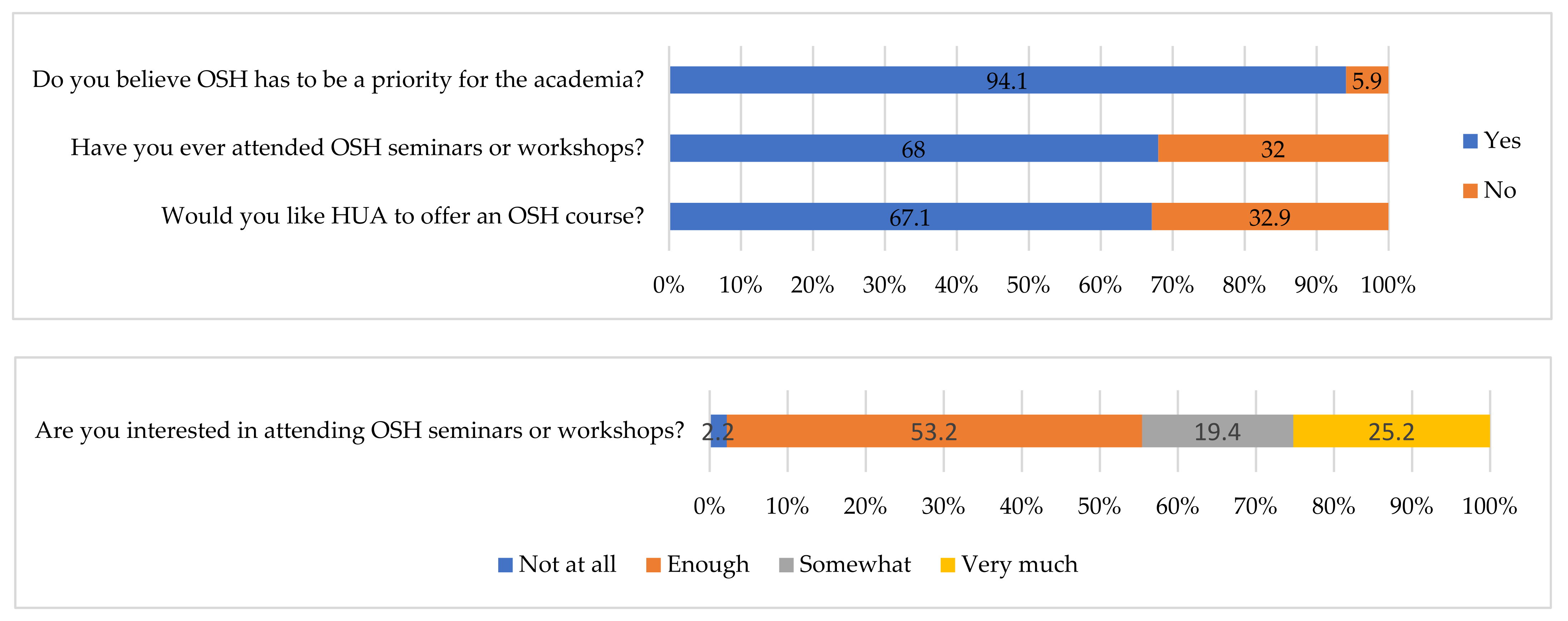
A safe and healthy working environment is vital for overall sustainability, due to the fact that it affects opportunities of economic and social development. However, according to the International Labour Organization (ILO), despite the international commitment to Occupational Health and Safety (OSH) via the 2030’s Agenda Sustainable Development Goals (SDGs), work-related accidents are still far too common. Work-related mortality accounts for 5% of all deaths worldwide; a toll which has increased dramatically due to the COVID-19 pandemic. Yet, in the context of COVID-19, new demands on the labour market, such as teleworking, adequate protective measures, and proper use of personal protective equipment when physical presence cannot be avoided, are necessitating new approaches to ensure health and safety. Arguably, education can be viewed as a cross-cutting strategy in advance of a culture of safety for future generations, through strengthening skills and broadening knowledge. Indeed, even though education cannot be considered a panacea, related to SDG 4, which seeks to ensure inclusive and equitable quality education and promote lifelong learning opportunities for all, it can be considered a critical component to deal with OSH issues using a preventive, rather than a reactive, approach. Given this fact, European Agency for Safety and Health at Work (EU-OSHA) has stressed the prevention approach through mainstreaming OSH in education at all levels, and in all fields of vocational and academic training. Aware of the potential of universities to provide graduates the broad-based knowledge to produce labour-market skills including OSH, the aim of this study is to contribute to the discussion on mainstreaming OSH into Greek university education, using Harokopio University (HUA) as a case study. For this purpose, a web-based survey was conducted to address HUA’s students, faculty members, and staff OSH knowledge, risks awareness, and attitudes, as well as their perceptions, opinions, and beliefs about the role of OSH for academia. A statistical analysis depicted respondents’ high level of willingness to contribute to the promotion of OSH, while additional evidence suggests a considerable commitment of the respondents to participate in HUA’s OSH-related training and education.
Keywords: occupational safety and health; training; education; higher education; Sustainable Development; SDGs; 2030 Agenda occupational safety and health; training; education; higher education; Sustainable Development; SDGs; 2030 Agenda