


How to Enhance Smart Work Effectiveness as a Sustainable HRM Practice in the Tourism Industry
 ,
,  ,
, 
Abstract
1. Introduction
2. Literature Review
2.1. Sustainable HRM and Social Exchange Theory
2.2. Concept of Smart Work
2.3. Effectiveness of Smart Work
3. Methodology
3.1. Q-Population and Sample Selection
3.2. P-Sample
3.3. Q-sorting and Data Processing
4. Results
4.1. Respondents’ Subjective Perspectives toward Smart Work
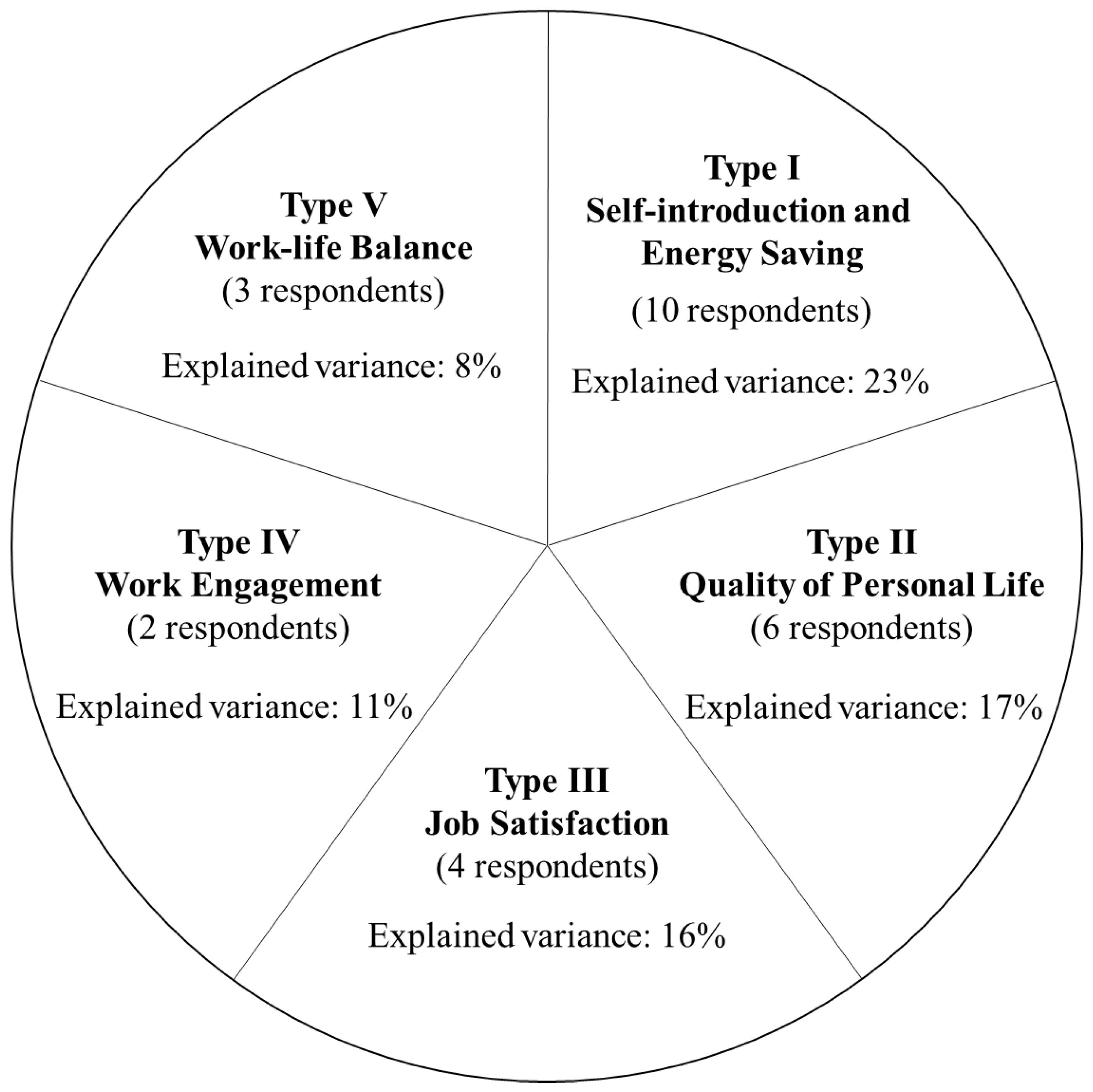
4.2. Types of Smart Work Perceptions
4.2.1. Type I: Self-Development and Energy Saving
4.2.2. Type II: Quality of Personal Life
4.2.3. Type III: Job Satisfaction
4.2.4. Type IV: Work Engagement
4.2.5. Type V: Work–Life Balance
5. Discussion
5.1. Theoretical Contribution
5.2. Practical Implications
5.3. Limitations and Future Research
Author Contributions
Funding
Institutional Review Board Statement
Informed Consent Statement
Conflicts of Interest
References
- Chams, N.; García-Blandón, J. On the importance of sustainable human resource management for the adoption of sustainable development goals. Int. J. Prod. Econ. 2019, 140, 219–226. [Google Scholar] [CrossRef] [Scilit]
- Palm, K.; Bergman, A.; Rosengren, C. Toward more proactive sustainable human resource management practices? A study on stress due to the ICT-Mediated integration of work and private life. Sustainability 2020, 12, 8303. [Google Scholar] [CrossRef] [Scilit]
- Wikhamn, W. Innovation, sustainable HRM and customer satisfaction. Int. J. Hosp. Manag. 2019, 76, 102–110. [Google Scholar] [CrossRef] [Scilit]
- Scholl, H.J.; Scholl, M.C. Smart Governance: A Roadmap for Research and Practice. In iConference 2014 Proceedings; iSchools: Grandville, MI, USA, 2014; pp. 163–176. [Google Scholar]
- Hana Tour. Expansion of Smart Work Center, 500 Project; Hana Tour Human Resource Management Report: Seoul, Korea, 9 August 2016. [Google Scholar]
- Kwon, M.; Jeon, S.H. Why permit telework? Exploring the determinants of California city gevernments’ decisions to permit telework. Public Pers. Manag. 2017, 46, 239–262. [Google Scholar] [CrossRef] [Scilit]
- Nedelcu, E. The perspective of young people on the effects of telework on the quality of life at work. Rom. Rev. Soc. Sci. 2020, 11, 3–12. [Google Scholar]
- Eom, S.J.; Choi, N.B.; Sung, W. The use of smart work in Korea: Who and for what? In Proceedings of the 15th Annual International Conference on Digital Government Research; Association for Computing Machinery: New York, NY, USA, 2014; Volume 18, pp. 253–262. [Google Scholar]
- Kang, Y.Y. Good Day, I’ll Work at Home! Midas News. Available online: http://www.yonhapmidas.com/article/160907204550_681501 (accessed on 1 November 2017).
- Choi, M.; Choi, Y. Employee perceptions of hotel CSR activities during the COVID-19 pandemic. Int. J. Contemp. Hosp. Manag. 2021, 33, 3355–3378. [Google Scholar] [CrossRef] [Scilit]
- Hana Tour. Hana Tour Homepage, Company Introduction. Available online: http://www.hanatourcompany.com/eng/company/intro.asp (accessed on 24 February 2018).
- Troup, C.; Rose, J. Working from home: Do formal or informal telework arrangements provide better work-family outcomes? Community Work Fam. 2012, 15, 471–486. [Google Scholar] [CrossRef] [Scilit]
- McNall, L.A.; Masuda, A.D.; Nicklin, J.M. Flexible work arrangements, job satisfaction, and turnover intentions: The mediating role of work-to-family enrichment. J. Psychol. 2009, 144, 61–71. [Google Scholar] [CrossRef] [Scilit]
- Boell, S.K.; Cecez-Kecmanovic, D.; Campbell, J. Telework paradoxes and practices: The importance of the nature of work. New Technol. Work Employ. 2016, 31, 114–131. [Google Scholar] [CrossRef] [Scilit]
- Caillier, J.G. Does satisfaction with family-friendly programs reduce turnover? A panel study conducted in U.S. federal agencies. Public Pers. Manag. 2016, 45, 284–307. [Google Scholar] [CrossRef] [Scilit]
- Crandall, W.; Gao, L. An update on telecommuting: Review and prospects for emerging issues. Adv. Manag. J. 2005, 70, 30–37. [Google Scholar]
- Pailleé, P.; Grima, F.; Dufour, M.-È. Contribution to social exchange in public organizations: Examinig how support, trust, satisfaction, commitment and work outcomes are related. Int. J. Hum. Resour. Manag. 2015, 26, 520–546. [Google Scholar] [CrossRef] [Scilit]
- Kramar, R. Beyond strategic human resource management: Is sustainable human resource management the next approach? Int. J. Hum. Resour. Manag. 2014, 25, 1069–1089. [Google Scholar] [CrossRef] [Scilit]
- Homan, G. Social behavior as exchange. Am. J. Soc. 1958, 63, 597–606. [Google Scholar] [CrossRef] [Scilit]
- Cropanzano, R.; Mitchell, M. Social exchange theory: An interdisciplinary review. J. Manag. 2005, 31, 874–899. [Google Scholar] [CrossRef] [Scilit]
- Langè, V.; Gastaldi, L. Coping Italian Emergency COVID-19 through Smart Working: From Necessity to Opportunity. J. Mediterr. Knowl. JMK 2020, 5, 163–172. [Google Scholar]
- Kelliher, C.; Anderson, D. Doing more with less? Flexible working practices and the intensification of work. Hum. Relat. 2010, 63, 83–106. [Google Scholar] [CrossRef] [Scilit]
- Hynes, M. Telework isn’t working: A policy review. Econ. Soc. Rev. 2014, 45, 579–602. [Google Scholar]
- Vilhelmson, B.; Thulin, E. Who and where are the flexible workers? Exploring the current diffusion of telework in Sweden. New Technol. Work Employ. 2016, 31, 77–96. [Google Scholar] [CrossRef] [Scilit]
- Tremblay, D.G.; Thomsin, L. Telework and mobile working: Analysis of its benefits and drawbacks. Int. J. Work Innov. 2012, 1, 100–113. [Google Scholar] [CrossRef] [Scilit]
- Ko, E.; Kim, A.; Kim, S. Toward the understanding of the appropriation of ICT-based Smart-work and its impact on performance in organizations. Technol. Forecast Soc. Change 2021, 171, 120994. [Google Scholar] [CrossRef] [Scilit]
- Campbell, J.; McDonald, C. Defining a Conceptual Framework for Telework and an Agenda for Research in Accounting and Finance. Int. J. Bus. Inf. Syst. 2009, 4, 387–402. [Google Scholar] [CrossRef] [Scilit]
- Baruch, Y. Teleworking: Benefits and pitfalls as perceived by professionals managers. New Technol. Work Employ. 2000, 15, 34–49. [Google Scholar] [CrossRef] [Scilit]
- Marino, L.; Capone, V. Smart working and well-being before and during the COVID-19 pandemic: A scoping review. Eur. J. Investig. Health Psychol. Educ. 2021, 11, 1516–1536. [Google Scholar] [CrossRef] [Scilit]
- Sung, W.J. A study on the activation plan of smart work in public sector. J. Inf. Soc. Policy 2013, 20, 43–62. [Google Scholar]
- Bucea-Manea-Tonis, R.; Prokop, V.; Ilic, D.; Gurgu, E.; Bucea-Manea-Tonis, R.; Braicu, C.; Moanta, A. The relationship between Eco-innovation and smart working as support for sustainable management. Sustainability 2021, 13, 1437. [Google Scholar] [CrossRef] [Scilit]
- Sarker, S.; Xiao, X.; Sarker, S.; Ahuja, M.K. Managing employees’ use of mobile technologies to minimize work-life balance impacts. MIS Q. Exec. 2012, 11, 1–5. [Google Scholar]
- Golden, T.D. Applying technology to work: Toward a better understanding of telework. Organ. Manag. J. 2009, 6, 241–250. [Google Scholar] [CrossRef] [Scilit]
- Leonardi, P.M.; Treem, J.W.; Jackson, M.H. The connectivity paradox: Using technology to both decrease and increase perceptions of distance in distributed work arrangements. J. Appl. Commun. Res. 2010, 38, 85–105. [Google Scholar] [CrossRef] [Scilit]
- Kim, H.K. Agreement between the Q-block and Q-tool. J. Korean Soc. Sci. Study Subj. 2008, 16, 5–16. [Google Scholar]
- McKeown, B.; Thomas, D. Q Methodology; Sage: Newbury Park, CA, USA, 1988. [Google Scholar]
- Brown, S. Q methodology and qualitative research. Qual. Health Res. 1988, 6, 561–567. [Google Scholar] [CrossRef] [Scilit]
- Gold, M.; Mustafa, M. Work always wins: Client colonisation, time management and the anxieties of connected freelancers. New Technol. Work Employ. 2013, 28, 197–211. [Google Scholar] [CrossRef] [Scilit]
- Aggerholm, H.K.; Andersen, S.E.; Thomsen, C. Conceptualizing employer branding in sustainable organisations. Corp. Commun. Int. J. 2011, 16, 105–123. [Google Scholar] [CrossRef] [Scilit]
- Choi, H.J.; Kim, Y.T. Work-family conflict, work-family facilitation and job outcomes in the Korean hotel industry. Int. J. Contemp. Hosp. Manag. 2012, 24, 1011–1028. [Google Scholar] [CrossRef] [Scilit]
- Baum, T.; Mooney, S.K.; Robinson, R.N.; Solnet, D. COVID-19’s impact on the hospitality workforce–new crisis or amplification of the norm? Int. J. Contemp. Hosp. Manag. 2020, 32, 2813–2829. [Google Scholar] [CrossRef] [Scilit]
- Hao, F.; Xiao, Q.; Chon, K. COVID-19 and China’s hotel industry: Impacts, a disaster management framework, and post-pandemic agenda. Int. J. Hosp. Manag. 2020, 90, 102636. [Google Scholar] [CrossRef] [Scilit]

| Statement | Standard Score (Z-Score) | |||||
|---|---|---|---|---|---|---|
| Type I | Type II | Type III | Type IV | Type V | ||
| 1 | My job satisfaction is improved. | 0.98 | 1.01 | 2.05 * | 0.07 | 0.74 |
| 2 | My turnover intention has decreased. | 0.76 | 0.50 | −0.06 | −1.09 | −0.60 |
| 3 | My attachment to the company has grown. | 0.52 | 0.51 | 1.69 * | −0.36 | −0.52 |
| 4 | It is convenient because I pay less attention on my clothing. | 0.57 | −0.46 | 0.04 | 0.58 | 1.07 |
| 5 | I do not need to read my colleagues’ countenance when I leave the office at the usual time. | 0.29 | −0.03 | 0.10 | −0.86 | −0.89 |
| 6 | I do not need to read my boss’ countenance when I leave the office at the usual time. | 0.56 | −0.14 | 0.10 | 0.07 | −0.14 |
| 7 | My work stress is reduced. | −0.03 | −0.55 | 0.80 | −0.36 | −0.23 |
| 8 | My work engagement is improved. | −0.16 | 1.21 | 1.57 * | 2.02 * | 1.18 |
| 9 | Smart work can enhance my creativity. | −1.05 | −0.31 | 1.03 | −2.02 * | −0.96 |
| 10 | Smart work makes me feel more responsible to my work. | −0.13 | 0.39 | 0.79 | 0.00 | 0.47 |
| 11 | I can immerse myself further in my work. | −0.04 | 0.80 | 1.50 * | 1.01 | 1.02 |
| 12 | Smart work can contribute to an increase in birth rates. | −0.27 | −0.92 | −1.17 | −1.09 | −1.24 |
| 13 | I can contribute to environmental protection by using less energy or reducing carbon emissions. | −0.47 | −0.78 | 0.10 | −2.02 * | −1.59 * |
| 14 | Smart work is beneficial for parenting and housekeeping. | 1.04 | 1.73 * | −1.28 | 0.43 | 2.10 * |
| 15 | The balance between my work and life is improved. | 1.53 * | 1.67 * | 1.93 * | 0.65 | −1.06 |
| 16 | My time with my family has increased. | 0.98 | 1.43 | −0.05 | −0.13 | 1.81 * |
| 17 | The boundary between my work and personal life is blurred. | −1.04 | −1.20 | −0.67 | −0.86 | 0.90 |
| 18 | I can develop myself by attending private educational institutes or doing exercises. | 1.91 * | 1.46 | 1.21 | 1.95 * | 0.70 |
| 19 | My commuting expenses are reduced. | 1.21 | 0.02 | −0.48 | −1.29 | −0.77 |
| 20 | I can reduce personal maintenance costs. | 1.04 | −0.14 | 0.10 | −0.36 | −0.81 |
| 21 | The reduction in commuting time is beneficial. | 1.87 * | 1.52 * | 0.96 | 0.65 | 1.77 * |
| 22 | Smart work improves my quality of life. | 1.01 | 1.94 * | 0.90 | 1.01 | 0.10 |
| 23 | I can avoid the rush hour by using public transportation or avoid a traffic jam. | 1.79 * | 0.91 | 0.11 | 1.44 | 1.92 * |
| 24 | It is difficult to manage and control employees. | −0.89 | −1.75 * | −0.58 | 1.29 | −0.22 |
| 25 | The company’s inside information can be easily leaked. | −1.00 | −1.46 | −1.25 | −0.58 | −0.33 |
| 26 | The synergy effect of co-working is decreased. | −1.01 | −0.09 | −0.54 | −0.07 | 0.52 |
| 27 | Sharing work-related information is difficult. | −0.77 | −1.38 | −0.51 | −0.15 | −0.32 |
| 28 | It feels inconvenient due to the increased reporting and documentation works for meetings. | −1.51 * | −0.58 | −0.64 | −0.07 | −0.85 |
| 29 | I cannot easily communicate with the other employees. | −0.82 | −1.16 | −1.21 | 0.79 | 0.77 |
| 30 | I feel lonely because I am separated from my colleagues. | −0.45 | −0.19 | −1.13 | 0.79 | −0.58 |
| 31 | I feel less attached to my colleagues. | −0.76 | −0.68 | −1.34 | 0.28 | −0.26 |
| 32 | There are less opportunities for me to engage in socializing activities, such as congregate dinners. | −0.30 | −0.21 | 0.66 | −0.07 | 0.22 |
| 33 | I do not feel any pleasure from working with my colleagues. | −0.50 | 0.29 | −1.01 | 0.36 | −0.91 |
| 34 | I am reluctant to apply for an annual leave or vacation. | −1.45 | −1.00 | −0.89 | −1.29 | −1.21 |
| 35 | It is inconvenient because my boss scolded me more often. | −1.80 * | −0.98 | −0.51 | −1.52 * | −0.66 |
| 36 | My sense of belonging is lowered. | −0.40 | −0.73 | −0.16 | 1.29 | −0.10 |
| 37 | I worry about the possible disadvantages in staff performance appraisal. | −0.67 | 0.29 | −0.95 | 0.07 | −1.62 * |
| 38 | I feel uncomfortable visiting the headquarter offices to attend meetings. | −0.51 | −0.90 | −1.20 | −0.58 | 0.59 |
| Type | P-Sample | Gender | Age | Marital Status | No. of Children | Position | Participated Smart Work Program(s) | Duration (Months) | Factor Weight |
|---|---|---|---|---|---|---|---|---|---|
| Type I | 4 | F | 20s | Single | None | Staff | Smart work center/Mobile Work | 36 | 0.62 |
| 10 | F | 40s | Single | None | Junior manager | Smart work center | 10 | 0.65 | |
| 11 | F | 30s | Single | None | Junior manager | Home office/Flexible time/Smart work center | 12 | 0.54 | |
| 12 | F | 30s | Married | None | Junior manager | Smart work center | 12 | 0.81 | |
| 15 | F | 30s | Married | None | Junior manager | Home office | 24 | 0.75 | |
| 16 | F | 30s | Married | None | Junior manager | Smart work center | 24 | 0.57 | |
| 17 | F | 20s | Single | None | Staff | Flexible time/Smart work center | 12 | 0.72 | |
| 18 | F | 30s | Single | None | Junior manager | Flexible time/Smart work center | 18 | 0.55 | |
| 20 | F | 40s | Married | 1 | Junior manager | Home office/Flexible time | 60 | 0.69 | |
| 23 | F | 40s | Married | 1 | Senior manager | Smart work center/Mobile work | 21 | 0.66 | |
| Type II | 5 | M | 30s | Married | 1 | Junior manager | Flexible time/Smart work center | 24 | 0.49 |
| 6 | M | 40s | Single | 1 | Senior manager | Smart work center | 24 | 0.69 | |
| 7 | F | 30s | Married | 2 | Senior manager | Home office/Flexible time | 24 | 0.74 | |
| 9 | F | 30s | Single | None | Junior manager | Smart work center | 36 | 0.61 | |
| 14 | M | 40s | Married | 1 | Senior manager | Smart work center | 12 | 0.71 | |
| 19 | F | 30s | Married | 2 | Senior manager | Home office | 36 | 0.67 | |
| Type III | 1 | F | 40s | Single | None | Senior manager | Flexible time/Smart work center | 11 | 0.70 |
| 8 | M | 30s | Single | None | Junior manager | Smart work center | 10 | 0.60 | |
| 21 | M | 30s | Married | None | Junior manager | Smart work center | 18 | 0.64 | |
| 25 | F | 50s | Single | None | Managing director | Discretion work | 12 | 0.85 | |
| Type IV | 2 | F | 40s | Married | None | Senior manager | Flexible time/Smart work center | 3 | 0.52 |
| 22 | F | 30s | Single | None | Junior manager | Flexible time/Smart work center | 12 | 0.89 | |
| Type V | 3 | F | 30s | Married | 1 | Junior manager | Smart work center | 36 | 0.57 |
| 13 | F | 40s | Married | None | Senior manager | Home office | 24 | 0.78 | |
| 24 | F | 50s | Married | 1 | Senior manager | Home office | 36 | 0.74 |
| No. | Q-Sample | Z-Score |
|---|---|---|
| 18 | I can develop myself by attending private educational institutes or doing exercises. | 1.905 |
| 21 | The reduction in commuting time is beneficial. | 1.865 |
| 23 | I can avoid the rush hour by using public transportation or avoid a traffic jam. | 1.785 |
| 15 | The balance between my work and life is improved. | 1.533 |
| 28 | It feels inconvenient due to the increased reporting and documentation works for meetings. | −1.509 |
| 35 | It is inconvenient because my boss scolded me more often. | −1.798 |
| No. | Q-Sample | Z-Score |
|---|---|---|
| 22 | Smart work improves my quality of life. | 1.938 |
| 14 | Smart work is beneficial for parenting and housekeeping. | 1.726 |
| 15 | The balance between my work and life is improved. | 1.671 |
| 21 | The reduction in commuting time is beneficial. | 1.522 |
| 24 | It is difficult to manage and control employees. | −1.749 |
| No. | Q-Sample | Z-Score |
|---|---|---|
| 1 | My job satisfaction is improved. | 2.048 |
| 15 | The balance between my work and life is improved. | 1.926 |
| 3 | My attachment to the company has grown. | 1.686 |
| 8 | My work engagement is improved. | 1.572 |
| 11 | I can immerse myself further in my work. | 1.502 |
| No. | Q-Sample | Z-Score |
|---|---|---|
| 8 | My work engagement is improved. | 2.023 |
| 18 | I can develop myself by attending private educational institutes or doing exercises. | 1.948 |
| 35 | It is inconvenient because my boss scolded me more often. | −1.517 |
| 13 | I can contribute to environmental protection by using less energy or reducing carbon emissions. | −2.023 |
| 9 | Smart work can enhance my creativity. | −2.023 |
| No. | Q-Sample | Z-Score |
|---|---|---|
| 14 | Smart work is beneficial for parenting and housekeeping. | 2.096 |
| 23 | I can avoid the rush hour by using public transportation or avoid a traffic jam. | 1.919 |
| 16 | My time with my family has increased. | 1.806 |
| 21 | The reduction in commuting time is beneficial. | 1.766 |
| 13 | I can contribute to environmental protection by using less energy or reducing carbon emissions. | −1.588 |
| 37 | I worry about the possible disadvantages in staff performance appraisal. | −1.621 |
Publisher’s Note: MDPI stays neutral with regard to jurisdictional claims in published maps and institutional affiliations. |
© 2022 by the authors. Licensee MDPI, Basel, Switzerland. This article is an open access article distributed under the terms and conditions of the Creative Commons Attribution (CC BY) license (https://creativecommons.org/licenses/by/4.0/).
Share and Cite
Choi, H.; Lee, J.Y.; Choi, Y.; Juan, Y.; Lee, C.-K. How to Enhance Smart Work Effectiveness as a Sustainable HRM Practice in the Tourism Industry. Sustainability 2022, 14, 2218. https://doi.org/10.3390/su14042218
Choi H, Lee JY, Choi Y, Juan Y, Lee C-K. How to Enhance Smart Work Effectiveness as a Sustainable HRM Practice in the Tourism Industry. Sustainability. 2022; 14(4):2218. https://doi.org/10.3390/su14042218
Chicago/Turabian StyleChoi, Hyunjung (Helen), Jin Young Lee, Youngjoon Choi, Yuxian Juan, and Choong-Ki Lee. 2022. "How to Enhance Smart Work Effectiveness as a Sustainable HRM Practice in the Tourism Industry" Sustainability 14, no. 4: 2218. https://doi.org/10.3390/su14042218
APA StyleChoi, H., Lee, J. Y., Choi, Y., Juan, Y., & Lee, C.-K. (2022). How to Enhance Smart Work Effectiveness as a Sustainable HRM Practice in the Tourism Industry. Sustainability, 14(4), 2218. https://doi.org/10.3390/su14042218

