Article

Does Stronger Protection of Intellectual Property Improve Sustainable Development? Evidence from City Data in China

1
Business School, Hunan Institute of Technology, Hengyang 421002, China
2
Business School, Xiangtan University, Xiangtan 411105, China
3
Economics and Finance Group, Portsmouth Business School, University of Portsmouth, Portsmouth PO1 3DE, UK
*
Authors to whom correspondence should be addressed.
Sustainability 2022, 14(21), 14369; https://doi.org/10.3390/su142114369
Submission received: 20 September 2022 / Revised: 26 October 2022 / Accepted: 1 November 2022 / Published: 2 November 2022

Abstract

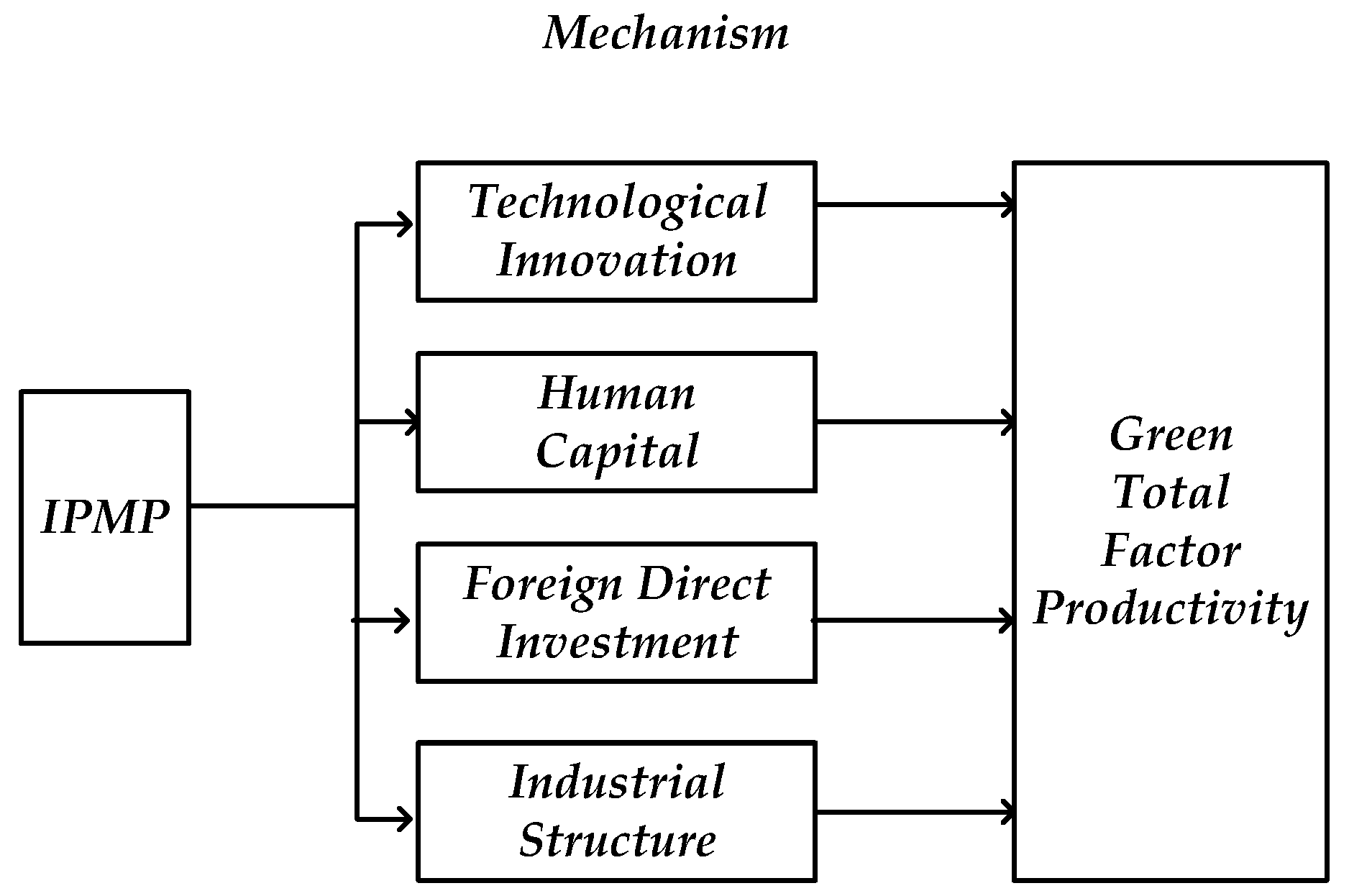
Achieving sustainable development goals is a challenge for countries. The core way is to enhance the green total factor productivity. While the literature has examined the various external institutional factors, there is a lack of research on the impact of intellectual property protection (IPP), which is an important external institution. This study adopts the differences-in-differences (DID) model and propensity scores matching (PSM) using the Chinese intellectual property model city policy (IPMP), as a quasi-natural experiment, and Chinese cities’ panel data from 2005 to 2019 to investigate the effect of IPP on sustainable development. The findings demonstrate that: (1) The IPMP significantly increases urban GTFP. (2) Mediation mechanism analyses show that the IPMP can support urban GTFP by fostering technological advancement, boosting human capital, luring foreign direct investment, and modernizing industrial structure. (3) Heterogeneity analysis shows that the Chinese central region, the eastern region, and the region with more fiscal transparency are where the IPMP has the greatest promotion effect on GTFP. Lastly, this study provides several recommendations for the improvement of sustainability in China.
Keywords: intellectual property rights model city policy (IPMP); green total factor productivity (GTFP); PSM-DID intellectual property rights model city policy (IPMP); green total factor productivity (GTFP); PSM-DID