How Can Sewage Sludge Use in Sustainable Tunisian Agriculture Be Increased?
 , ,
, , 
 and
and
Abstract
1. Introduction
2. Materials and Methods
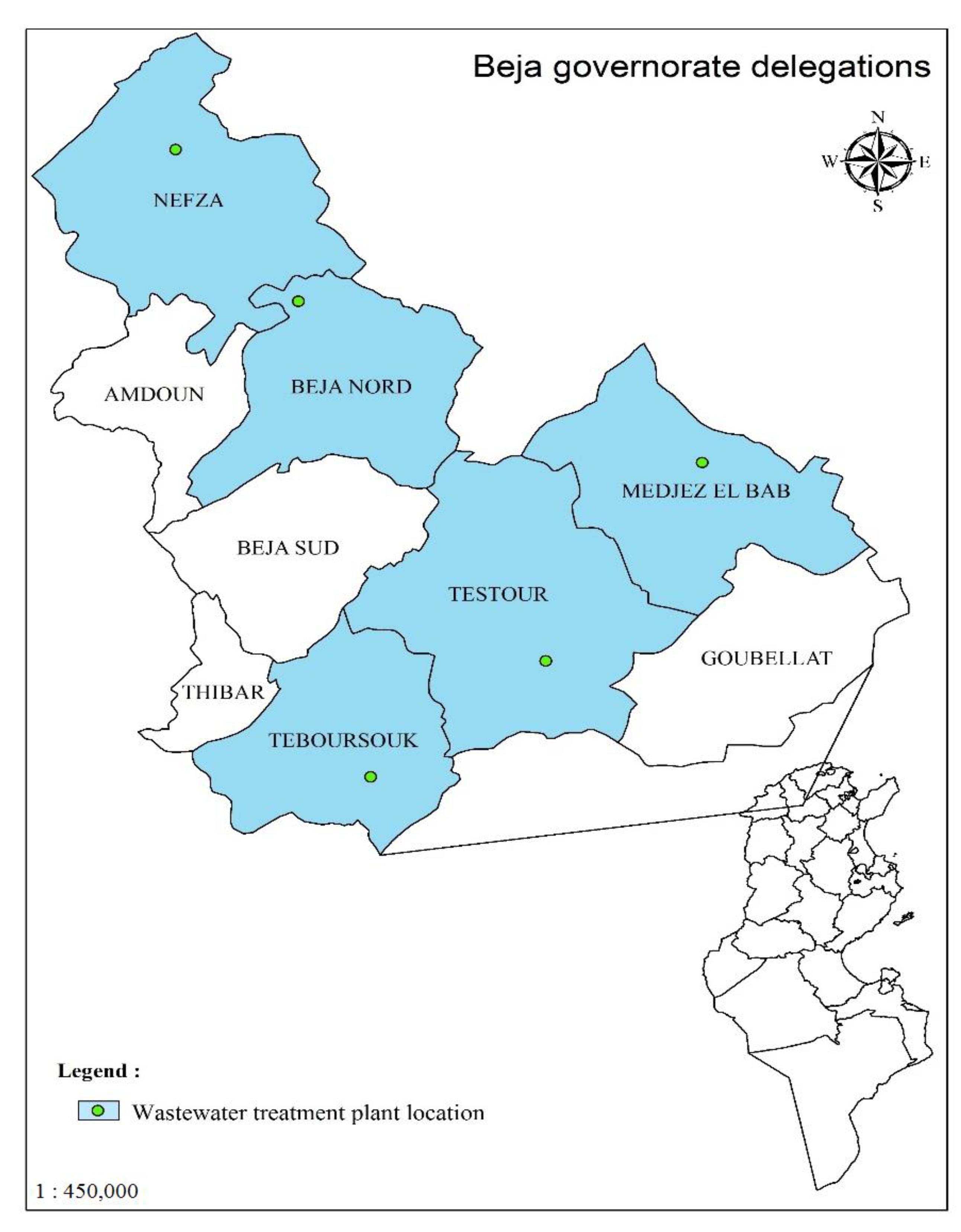
2.1. Study Area, Sludge Sampling, and Analysis

| Plant | Delegation | Size in kg BOD5/Day | Flow Rate (m3/day) | Capacity E.I. | Wastewater Treatment Process | Sludge Treatment | Dried Sludge Production (m3) |
|---|---|---|---|---|---|---|---|
| Beja-Nord | Beja | 7800 | 14,000 | 144,000 | Low load activated sludge (waterfall basins) | Drying beds | 540 |
| Medjez El Bab | Medjez El Bab | 2000 | 4500 | 40,000 | Low load activated sludge (waterfall basins) | Drying beds | 500 |
| Teboursouk | Teboursouk | 719 | 1280 | 18,000 | Low load activated sludge (oxidation ditch) | Drying beds | 345 |
| Testour | Testour | 720 | 1180 | 19,000 | Low load activated sludge (oxidation ditch) | Drying beds | 256 |
| Nefza | Nefza | 680 | 1500 | 17,000 | Low load activated sludge (oxidation ditch) | Drying beds | 49 |
| Parameter | Analysis Method | Unit | Source |
|---|---|---|---|
| pH | Electrochemical method | - | [39] |
| Dry matter (DM) | Gravimetry | % | [40] |
| Organic matter (OM) | Calcination | g/kg DM | [41] |
| Total organic carbon (TOC) | Colorimetry | g/kg DM | [42] |
| Total nitrogen (TN) | Titrimetric | g/kg DM | [43] |
| Total phosphorus (TP) | Atomic emission-ICP | g/kg DM | [44] |
| Cadmium | mg/kg DM | ||
| Chromium | mg/kg DM | ||
| Copper | mg/kg DM | ||
| Mercury | mg/kg DM | ||
| Lead | mg/kg DM | ||
| Zinc | mg/kg DM | ||
| Nickel | mg/kg DM | ||
| Nematode eggs | Microscopic observation (arithmetic mean) | U/kg | - |
| Faecal coliforms | Solid/liquid extraction | UFC/kg | [45] |
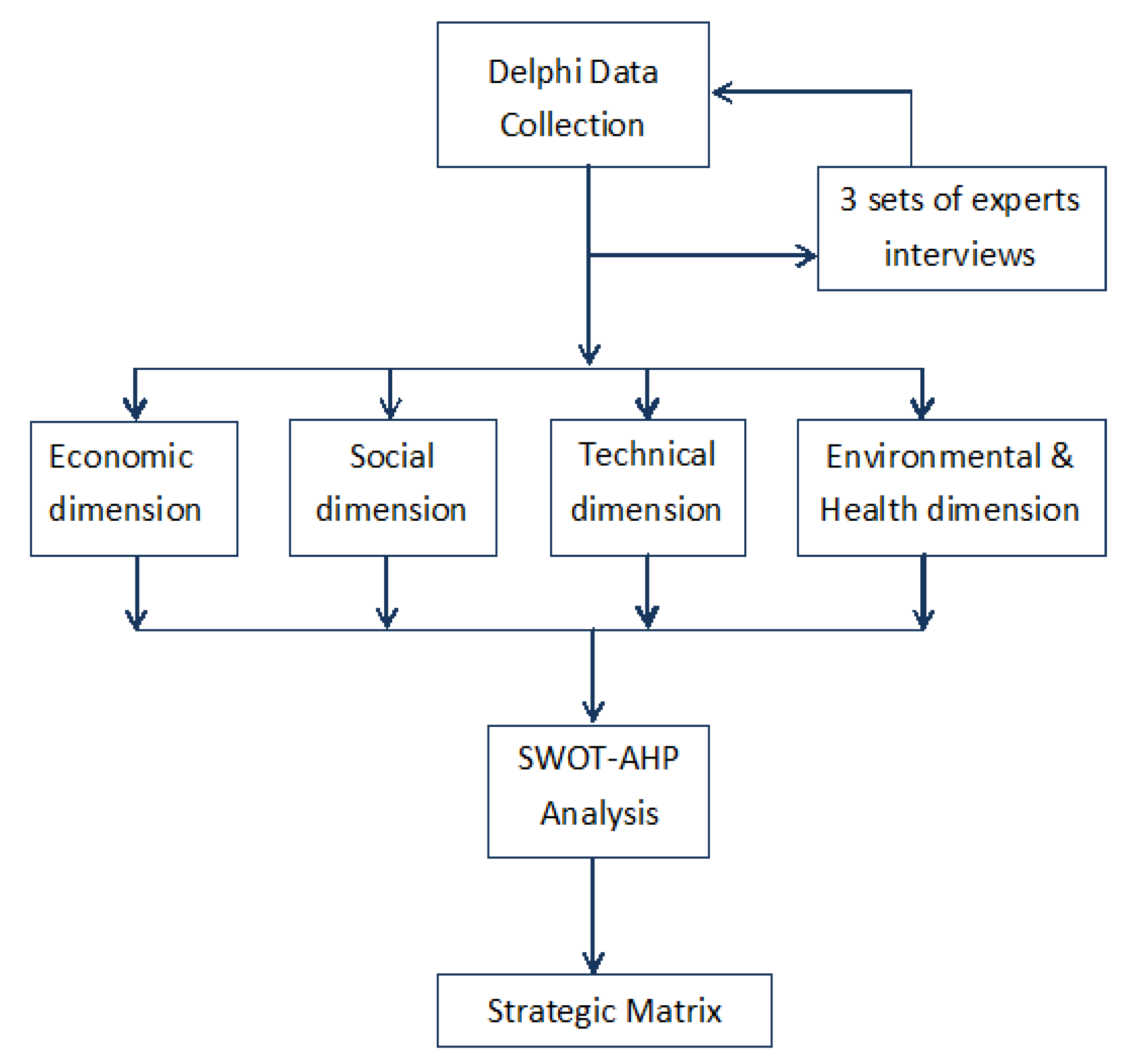
2.2. Collection of Information by the Delphi Method
2.3. SWOT-AHP Methodology
2.4. Strategy Matrix Definition
3. Results and Discussion
3.1. Sewage Sludge Quality in Beja
3.2. The Delphi Method Application
3.3. SWOT-AHP Method Application
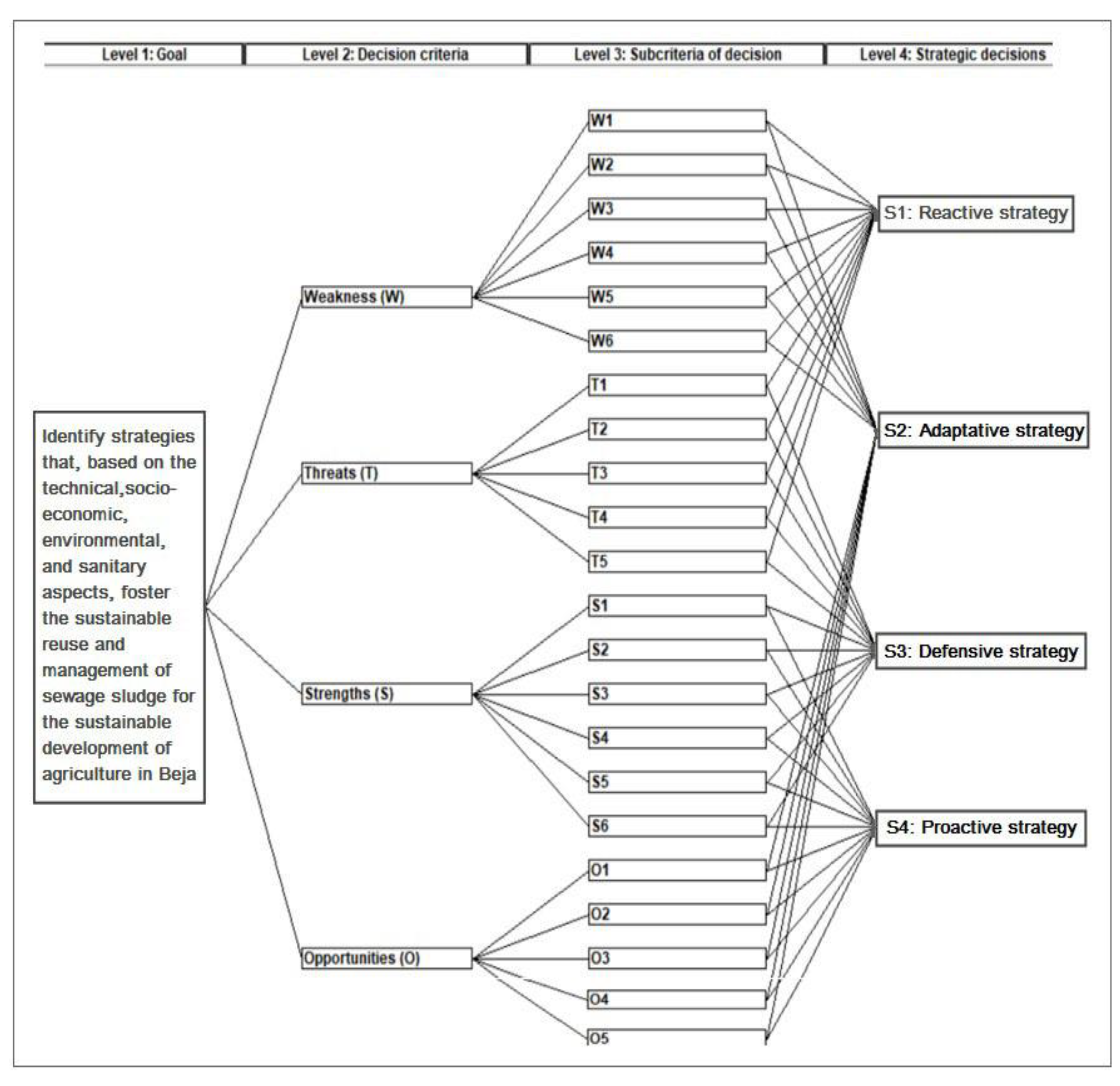
3.3.1. Developing the Hierarchy of Decisions
3.3.2. Relevant Criteria and Sub-Criteria through the AHP Methodology
3.4. Specification of Strategies
- -
- Do not use sludge on agricultural land where vegetables and eaten-raw fruits grow,
- -
- The sludge can be used after 8 months of natural drying,
- -
- Grazing on land treated with sludge should not be permitted until two months after its application,
- -
- Use mechanical burial methods for sludge and not traditional manual methods,
- -
- Sludge produced should not be stored near drainage and irrigation canals and water resources,
- -
- Reduce the number of displacements of sludge so that the agitation of dust in the air is reduced to a minimum,
- -
- Limit the application of the amount of sludge rich in heavy metals,
- -
- During the 30 days following the application of sludge, limit access to agricultural land where it has been applied,
- -
- Application is limited to areas with a 5% slope and no application near water supply plants, areas where the water table is 1 m deep, less than 150 m from a well, and less than 750 m from an intake surface water used for food,
- -
- The sludge should undergo pathogen-reducing treatment (thermophilic process, composting, or humification) before any agricultural reuse.
4. Conclusions
Author Contributions
Funding
Institutional Review Board Statement
Informed Consent Statement
Data Availability Statement
Conflicts of Interest
References
- Trad Rais, M.; Khelil, M.N.; Marzougui, N.; Sabbahi, S. Impact of agricultural spreading of urban residual sludge on the microbiological quality of three vegetables. Eur. J. Sci. Res. 2016, 137, 26–36. [Google Scholar]
- Vaithyanathan, V.K.; Cabana, H. Integrated biotechnology management of biosolids: Sustainable ways to produce value—Added products. Front. Water 2021, 3, 729679. [Google Scholar] [CrossRef]
- Spinosa, L. Wastewater Sludge: A Global Overview of the Current Status and Future Prospects, 2nd ed.; IWA Publishing: London, UK, 2011; pp. 7–61. [Google Scholar]
- Buffet, M. Analysis of the Situation of Agricultural Sludge Recycling in Europe. Master’s Thesis, National School of Engineering of Water and the Environment, University of Strasbourg, Strasbourg, France, 2010. (In French). [Google Scholar]
- Eurostat. Available online: http://appsso.eurostat.ec.europa.eu/nui/show.do?lang=en&dataset=env_ww_spd (accessed on 28 February 2022).
- Unites States Environmental Protection Agency. Standards for the use or disposal of sewage sludge: 40 CFR Parts 257, 403 and 503, Final Rules; Unites States Environmental Protection Agency: Cincinnati, OH, USA, 1993. [Google Scholar]
- Blais, J.F.; Sasseville, J.L. State of the Art in the Treatment and Disposal or Recovery of Sludge from Municipal Wastewater Treatment Plants; INRS-Eau research report N° 429; Blais, J.F., Sasseville, J.L., Eds.; Hydro-Québec: Montreal, Canada, 1996; pp. 67–74. (In French) [Google Scholar]
- Council of European Communities. Council directive concerning urban wastewater treatment. Off. J. Eur. Communities 1991, L 135/40, 91/271/EEC. [Google Scholar]
- Cross, P. Health Aspects of Nightsoil and Sludge Use in Agriculture and Aquaculture. Part I: Existing Practices and Beliefs in the Utilization of Human Exceta; Report N° 04/85; International Reference Centre for Waste Disposal: Dübendorf, Switzerland, 1985. [Google Scholar]
- Shaddel, S.; Bakhtiary-Davijany, H.; Kabbe, C.; Dadgar, F.; Østerhus, S.W. Sustainable sewage sludge management: From current practices to emerging nutrient recovery technologies. Sustainability 2019, 11, 3435. [Google Scholar] [CrossRef]
- Tymchuk, I.; Shkvirko, O.; Sakalova, H.; Malovanyy, M.; Dabizhuk, T.; Shevchuk, O.; Matviichuk, O.; Vasylinych, T. Wastewater a source of nutrients for crops growth and development. J. Ecol. Eng. 2020, 21, 88–96. [Google Scholar] [CrossRef]
- Guidi, C. Relation between Organic Matter of Sewage Sludge and Physicochemical Properties of Soil. In Characterization, Treatment and Use of Sewage Sludge; L’Hermite, P., Ott, H., Eds.; Springer Nature: Dordrecht, The Netherlands, 1981; pp. 530–544. [Google Scholar]
- Food and Agriculture Organization of United Nations. Worlds Fertilizer Trends and Outlook to 2018; FAO: Rome, Italy, 2015. [Google Scholar]
- Risse, M. Best Management Practices for Wood Ash as Agricultural Soil Amendment: UGA Cooperative Extension Bulletin 1142; Cooperative Extension; the University of Georgia, College of Agricultural and Environmental Sciences: Athens, Georgia, 2013. [Google Scholar]
- Van Dijk, K.C.; Lesschen, J.P.; Oenema, O. Phosphorus flows and balances of the European Union Member States. Sci. Total Environ. 2016, 542, 1078–1093. [Google Scholar] [CrossRef] [PubMed]
- Ma, L.; Ma, W.Q.; Velthof, G.L.; Wang, F.H.; Qin, W.; Zhang, F.S.; Oenema, O. Modeling nutrient flows in the food chain of China. J. Environ. Qual. 2010, 39, 1279. [Google Scholar] [CrossRef] [PubMed]
- Cordell, D.; Drangert, J.; White, S. The story of phosphorus: Global food security and food for thought. Glob. Environ. Change 2009, 19, 292–305. [Google Scholar] [CrossRef]
- Roy, E.D. Phosphorus recovery and recycling with ecological engineering: A review. Ecol. Eng. 2017, 98, 213–227. [Google Scholar] [CrossRef]
- Kacprzak, M.; Neczaj, E.; Fijałkowski, K.; Grobelak, A.; Grosser, A.; Worwag, M.; Rorat, A.; Brattebo, H.; Almås, Å.; Singh, B.R. Sewage sludge disposal strategies for sustainable development. Environ. Res. 2017, 156, 39–46. [Google Scholar] [CrossRef]
- Sabbahi, S.; Ben Ayed, L.; Trad, M.; Berndtsson, R.; Karanis, P. Parasitological Assessment of Sewage Sludge Samples for Potential Agricultural Reuse in Tunisia. Int. J. Environ. Res. Public Health 2022, 19, 1657. [Google Scholar] [CrossRef] [PubMed]
- Marzougui, N.; Ounalli, N.; Sabbahi, S.; Gara, A. Agricultural Reuse of Sewage Sludge at Beja Governorate. In Atlas for Adaptation to Climate Change in Tunisian Agriculture; Broekman, A., Jebari, S., Berndtsson, R., Souissi, T., Bouslahi, Z., Eds.; European Commission: Tunis, Tunisia, 2021; pp. 137–139. [Google Scholar]
- Saljnikov, E.; Cakmak, D.; Rahimgalieva, S. Soil Organic Matter Stability as Affected by Land Management in Steppe Ecosystems. In Soil Processes and Current Trends in Quality Assessment; Hernandez Soriano, M.C., Ed.; Intech Open: London, UK, 2013; pp. 269–310. [Google Scholar] [CrossRef]
- Rorat, A.; Courtois, P.; Vandenbulcke, F.; Lemiere, S. Sanitary and Environmental Aspects of Sewage Sludge Management. In Industrial and Municipal Sludge, 1st ed.; Vara Prasad, M.N., de Campos Favas, P.J., Vithanage, M., Mohan, V., Eds.; Elsevier: Amsterdam, The Netherlands, 2019; pp. 155–180. [Google Scholar]
- The National Sanitation Utility. Annual Report 2015; ONAS: Tunis, Tunisia, 2019. (In French) [Google Scholar]
- Mekki, A.; Aloui, F.; Sayadi, S. Influence of biowaste compost amendment on soil organic carbon storage under arid climate. J. Air Waste Manag. Assoc. 2019, 69, 867–877. [Google Scholar] [CrossRef] [PubMed]
- Brahim, N.; Ibrahim, H.; Mlih, R.; Bouajila, A.; Karbout, N.; Bol, R. Soil OC and N stocks in the saline soil of Tunisian Gataaya oasis eight years after application of manure and compost. Land 2022, 11, 442. [Google Scholar] [CrossRef]
- Lassoued Aouini, N. Transfer and bioaccumulation of metallic trace elements in durum wheat and rapeseed amended by sewage sludge. Ph.D. Thesis, University of Carthage, Tunis, Tunisia, June 2016. (In French). [Google Scholar]
- Drechsel, P.; Hanjra, M.A. Case–Wastewater and Biosolids for Fruit Trees (Tunisia). In Resource Recovery from Waste. Business Models for Energy, Nutrient and Water Reuse in Low-and Middle-Income Countries; Otoo, M., Drechsel, P., Eds.; Routledge: Oxfordshire, UK, 2018; p. 832. [Google Scholar]
- The National Sanitation Utility. Annual Report 2020; ONAS: Tunis, Tunisia, 2020. (In Arabic) [Google Scholar]
- The National Sanitation Utility. Annual Report 2016; ONAS: Tunis, Tunisia, 2016. (In Arabic) [Google Scholar]
- The National Sanitation Utility. Annual Report 2017; ONAS: Tunis, Tunisia, 2017. (In French) [Google Scholar]
- The National Sanitation Utility. Annual Report 2018; ONAS: Tunis, Tunisia, 2018. (In French) [Google Scholar]
- The National Sanitation Utility. Annual Report 2019; ONAS: Tunis, Tunisia, 2018. (In Arabic) [Google Scholar]
- Ministry of Agriculture, Hydraulic Resources and Fisheries. National Report of the Water Sector; MARHP: Tunis, Tunisia, 2017. (In French) [Google Scholar]
- Ammonium Nitrate Crisis and Nitrogen Fertilization of Cereals in Tunisia. Available online: https://www.leaders.com.tn/article/31360-crise-de-l-ammonitrate-et-fertilisation-azotee-des-cereales (accessed on 11 January 2022). (In French).
- World Data Atlas. Available online: https://knoema.com/atlas/Tunisia/Beja (accessed on 11 January 2022).
- The National Sanitation Utility of Tunisia. Annual Operating Report for Wastewater Treatment Plants; Ministry of the Environment and Sustainable Development: Tunis, Tunisia, 2020. (In French) [Google Scholar]
- QGIS: A Free and Open-Source Geographic Information System. Available online: http://qgis.org (accessed on 16 January 2022).
- ISO 10390:2021; Sols, Biodéchets Traités et Boues—Détermination du pH, 3rd ed. Organisation Internationale de Normalisation: Genève, Suisse, 2021.
- BS EN 12880: 2000; Caractérisation des boues—Détermination de la teneur en matière sèche et de la teneur en eau, AFNOR ed. Association Française de Normalisation: Paris, France, 2016.
- Jones, J.B., Jr. Laboratory Guide for Conducting Soil Tests and Plant Analysis, 1st ed.; CRC Press: Boca Raton, FL, USA, 2001; pp. 140–148. [Google Scholar]
- NF ISO 11261:1995; Qualité du Sol—Dosage de L’azote Total—Méthode de Kjeldahl modifiée, 1st ed. Organisation Internationale de Normalisation: Genève, Suisse, 1995.
- NF ISO 14235:1998; Qualité du Sol—Dosage du Carbone Organique par Oxydation Sulfo chromique, 1st ed. Organisation Internationale de Normalisation: Genève, Suisse, 1998.
- ISO 11885:2007; Qualité de l’eau—Dosage D’éléments Choisis par Spectroscopie D’émission Optique avec Plasma Induit par Haute Fréquence(ICP-OES), 2nd ed. Organisation Internationale de Normalisation: Genève, Suisse, 2007.
- NF EN ISO 9308–1; Qualité de L’eau-Dénombrement des Escherichia coli et des Bactéries Coliformes-Partie 1: Méthode par Filtration sur Membrane pour les Eaux à Faible Teneuren Bactéries, 3rd ed. Organisation Internationale de Normalisation: Genève, Suisse, 2014.
- Profillidis, V.A.; Botzoris, G.N. Executive Judgment, Delphi, Scenario Writing, and Survey Methods. In Modeling of Transport Demand, 1st ed.; Elsevier: Amsterdam, The Netherlands, 2018; pp. 125–161. [Google Scholar] [CrossRef]
- Bekhtari, M.C. Multi-criteria methods for analyzing the suitability of agricultural land: The case of common wheat in Languedoc-Rousillon analyzed with the AHP method. Master’s Thesis, Paul Valéry University of Montpellier, Montpellier, France, September 2015. (In French). [Google Scholar]
- García Guerrero, J.E.; Rueda López, R.; Luque González, A.; Ceular-Villamandos, N. Indigenous Peoples, Exclusion and Precarious Work: Design of Strategies to Address Poverty in Indigenous and Peasant Populations in Ecuador through the SWOT-AHP Methodology. Int. J. Environ. Res. Public Health 2021, 18, 570. [Google Scholar] [CrossRef]
- Skinner, R.; Nelson, R.R.; Chin, W.W.; Land, L. The Delphi Method Research Strategy in Studies of Information Systems. Commun. Assoc. Inf. Syst. 2015, 37, 31–63. [Google Scholar] [CrossRef]
- The Toilet Board Coalition. The Circular Sanitation Economy: New Pathways to Commercial and Societal Benefits, Faster at Scale; The Toilet Board Coalition: Geneva, Switzerland, 2017. [Google Scholar]
- Lal Meena, A.; Kumari, S.; Lekshmi, N.; Kumar, C.; Kumar, S. Sewage sludge application in agriculture: Impact on crops and human health. Food Sci. Rep. 2020, 1, 53–58. [Google Scholar]
- Aloui, N. The Letter from ONAGRI. Bull. Natl. Obs. Agric. 2021, 7, 8–11. (In French) [Google Scholar]
- Milieu; WRc; RPA. Environmental, economic and social impacts of the use of sewage sludge on land: Final Report; Milieu Ltd.: Brussels, Belgium, 2008. [Google Scholar]
- Winters, L.A. Les objectifs dits “non économiques” du soutien à l’agriculture. Rev. Économique de l’OCDE 1989, 13, 267–302. [Google Scholar]
- Arar, A. Background to Treatment and Use of Sewage Effluent. In Treatment and Use of Sewage Effluent for Irrigation, Proceedings of the FAO Regional Seminar, Nicosia, Cyprus, 7–9 October 1985; Pescod, M.B., Arar, A., Eds.; Butterworths: London, UK, 1988; pp. 10–17. [Google Scholar]
- Serdarevic, A.; Dzubur, A. Importance and Practice of Operation and Maintenance of Wastewater Treatment Plants. In Advanced Technologies, Systems, and Applications III, Proceedings of the International Symposium on Innovative and Interdisciplinary Applications of Advanced Technologies (IAT), Jahorina, Bosnia and Herzegovina, 21–24 June 2018; Avdaković, S., Ed.; Springer: Cham, Switzerland, 2019; Volume 60, pp. 121–137. [Google Scholar] [CrossRef]
- Rorat, A.; Courtois, P.; Vandenbulcke, F.; Lemiere, S. Sanitary and Environmental Aspects of Sewage Sludge Management. In Industrial and Municipal Sludge; Butterworth-Heinemann: Oxford, UK, 2019; pp. 155–180. [Google Scholar]
- Pilli, S.; Bhunia, P.; Yan, S.; Tyagi, R.D.; Surampalli, R.Y. Methodology for the quantification of greenhouse gas emissions during land application of sewage sludge. Greenh. Gas Meas. Manag. 2014, 4, 178–200. [Google Scholar] [CrossRef]
- Görener, A.; Toker, K.; Uluçay, K. Application of combined SWOT and AHP: A case study for a manufacturing firm. Procedia Soc. Behav. Sci. 2012, 58, 1525–1534. [Google Scholar] [CrossRef]
- Canco, I.; Kruja, D.; Iancu, T. AHP, a reliable method for quality decision making: A case study in business. Sustainability 2021, 13, 13932. [Google Scholar] [CrossRef]
- Saaty, T.L. The analytic hierarchy process: Planning, priority setting, resource allocation; McGraw-Hill International Book Co.: London, UK, 1980. [Google Scholar]
- Koo, T.K.; Mae, Y.L. A guideline of selecting and reporting intraclass correlation coefficients for reliability research. J. Chiropr. Med. 2016, 15, 155–163. [Google Scholar] [CrossRef]
- Saaty, T.L. The analytic hierarchy process in conflict management. Int. J. Confl. Manag. 1990, 1, 47–68. [Google Scholar] [CrossRef]
- Weihrich, H. The TOWS Matrix—A Tool for Situational Analysis. Long Range Plan. 1982, 15, 54–66. [Google Scholar] [CrossRef]
- INNORPI (National Institute for Standardization and Industrial Property, Tunisia). Fertilizing Materials—Sludge from Urban Wastewater Treatment Facilities; Tunisian Standards NT 106.20; Ministry of Industry, Energy and Mines: Tunis, Tunisia, 2002. (In French) [Google Scholar]
- European Commission. Environmental, economic and social impacts of the use of sewage sludge on land. In Consultation Report on Options and Impacts, Report by RPA, Milieu Ltd and WRc for the European Commission; DG Environment, European Commission: Brussels, Belgium, 2009. [Google Scholar]
- Khakbaz, A.; De Nobili, M.; Mainardis, M.; Contin, M.; Aneggi, E.; Mattiussi, M.; Cabras, I.; Busut, M.; Goi, D. Monitoring of heavy metals, eox and las in sewage sludge for agricultural use: A case study. Detritus 2020, 12, 160–168. [Google Scholar] [CrossRef]
- Stylianou, M.; Inglezakis, V.; Moustakas, K.; Loizidou, M. Improvement of the quality of sewage sludge compost by adding natural clinoptilolite. Desalination 2008, 224, 240–249. [Google Scholar] [CrossRef]
- The Good and Bad of Applying Sewage Sludge to Farmland. Available online: https://www.farmprogress.com/good-and-bad-applying-sewage-sludge-farmland-1 (accessed on 10 October 2022).
- Mtimet, A. Soils of Tunisia. In Soil Resources of Southern and Eastern Mediterranean Countries; Zdruli, P., Steduto, P., Lacirignola, C., Montanarella, L., Eds.; Options Méditerranéennes: Série B—Etudes et Recherches: N. 34; CIHEAM: Bari, Italy, 2001; pp. 243–262. [Google Scholar]
- ADAS; Rothamsted Research; Water Research Centre (WRc). Effects of Sewage Sludge Applications to Agricultural Soils on Soil Microbial Activity and the Implications for Agricultural Productivity and Long-Term Soil Fertility: Phase III; CSA 6222 Long-term Sludge Experiments Project, UK Water Industry Research Limited: Warrington, UK, 2007. [Google Scholar]
- Nunes, N.; Ragonezi, C.; Gouveia, C.S.S.; Pinheiro de Carvalho, M.Â.A. Review of sewage sludge as a soil amendment in relation to current international guidelines: A heavy metal perspective. Sustainability 2021, 13, 2317. [Google Scholar] [CrossRef]
- Ashraf, M.A.; Maah, M.J.; Yusoff, I. Soil Contamination, Risk Assessment and Remediation. In Environmental Risk Assessment of Soil Contamination; Hernandez-Soriano, M.C., Ed.; Intech Open: London, UK, 2014; pp. 1–25. [Google Scholar] [CrossRef]
- Barriuso, E.; Benoit, P.; Bergheaud, V. Rôle of soil fractions in retention and stabilisation of pesticides in soils. In Environmental Behaviour of Pesticides and Regulatory Aspects; Copin, A., Houins, G., Pussemier, L., Salembier, J.F., Eds.; COST–European Study Service: Rixensart, Belgium, 1994; pp. 138–143. [Google Scholar]
- Zoghlami, R.I.; Hamdi, H.; Mokni-Tlili, S.; Hechmi, S.; Khelil, M.N.; Ben Aissa, N.; Moussa, M.; Bousnina, H.; Benzarti, S.; Jedidi, N. Monitoring the variation of soil quality with sewage sludge application rates in absence of rhizosphere effect. Int. Soil Water Conserv. Res. 2020, 8, 245–252. [Google Scholar] [CrossRef]
- Kchaou, R.; Baccar, R.; Bouzid, J.; Rejeb, S. Agricultural use of sewage sludge under sub-humid Mediterranean conditions: Effect on growth, yield, and metal content of a forage plant. Arab. J. Geosci. 2018, 11, 746. [Google Scholar] [CrossRef]
- US EPA. Environmental regulations and technology—Control of pathogens and vector attraction in sewage sludge (including domestic septage). In Under 40 CFR Part 503. Appendix I—Test Method for Detecting, Enumerating, and Determining the Viability of Ascaris ova in Sludge; EPA/625/R–92/013; United States Environmental Protection Agency: Washington, DC, USA, 2003; p. 166. [Google Scholar]
- World Health Organization. Guidelines for the Save Use of Wastewater, Excreta and Greywater—Volume 2: Wastewater Use in Agriculture; WHO: Geneva, Switzerland, 2006. [Google Scholar]
- García-Martínez, V.; Aquino-Zúñiga, S.P.; Guzmán-Salas, A.; Medina-Meléndez, A. Using the Delphi method as a strategy for the assesment of quality indicators in distance education programs. Rev. Electrón. Didáct. Educ. Super. 2012, 3, 200–222. (In Spanish) [Google Scholar] [CrossRef]
- Sackman, H. DelphiAssessment: Expert Opinion, Forecasting, and Group Process; RAND Corporation: Santa Monica, CA, USA; p. 1974.
- Batanero, C.; González-Ruiz, I.; López-Martín, M.D.M. Dispersion as a structuring element of the statistics and probability curriculum. Épsilon 2015, 32, 7–22. (In Spanish) [Google Scholar]
- Villarreal Larrinaga, O.; Vallejo Alonso, B.; Arregui Ayastuy, G. Application of the Delphi methodology for the forecast of Spanish integration in the Economic Monetary Union. Investig. Eur. Dir. Econ. Empresa 1996, 2, 13–38. (In Spanish) [Google Scholar]
- Crochemore, S. Advantages, Limits and Difficulties of the Delphi Method. Techniques de l’Ingénieur. Available online: https://www.techniques-ingenieur.fr/base-documentaire/archives-th12/archives-management-industriel-tiagb/archive-1/methode-delphi-ag1050/avantages-limites-et-difficultes-ag1050niv10003.html (accessed on 22 August 2022). (In French).
- Donohoe, H.M.; Needham, R.D. Moving Best Practice Forward: Delphi Characteristics, Advantages, Potential Problems, and Solutions. Int. J. Tour. Res. 2009, 11, 415–437. [Google Scholar] [CrossRef]
- Fink-Hafner, D.; Dagen, T.; Dousak, M.; Novak, M.; Hafner-Fink, M. Delphi Method: Strengths and Weaknesses. Metodoloski Zv. 2019, 16, 1–19. [Google Scholar] [CrossRef]
- Delibacak, S.; Voronina, L.; Morachevskaya, E.; Onguna, A.R. Use of sewage sludge in agricultural soils: Useful or harmful. Eurasian J. Soil Sci. 2020, 9, 126–139. [Google Scholar] [CrossRef]
- Goepel, K.D. Implementing the Analytic Hierarchy Process as a standard method for multi-criteria decision making in corporate enterprises—A new AHP Excel template with multiple inputs. In Proceedings of the International Symposium on the Analytic Hierarchy Process, Kuala Lumpur, Malaysia, 23–26 June 2013. [Google Scholar] [CrossRef]
- Piedmont, R.L. Reliability Coefficient. In Encyclopedia of Quality of Life and Well-Being Research; Michalos, A.C., Ed.; Springer: Dordrecht, The Netherlands, 2014; pp. 5454–5455. [Google Scholar] [CrossRef]
- Taber, K.S. The use of Cronbach’s alpha when developing and reporting research instruments in science education. Res. Sci. Educ. 2018, 48, 1273–1296. [Google Scholar] [CrossRef]
- Tolkou, A.K.; Zouboulis, A. Effect of Climate Change in Wastewater Treatment Plants: Reviewing the Problems and Solutions. In Managing Water Resources Under Climate Uncertainty, 1st ed.; Shrestha, S., Anal, A.K., Salam, P.A., van der Valk, M., Eds.; Springer: Cham, Germany, 2015; pp. 197–220. [Google Scholar] [CrossRef]
- Danas, K.; Kurdi, B.; Stark, M.; Mutlaq, A. Climate Change Effects on Wastewater Treatment. CEE Jordan Group Presentation, Jordan, 18 September 2012. Available online: httpss://courses.washington.edu/cejordan/CC%20AND%20WWT.pdf (accessed on 18 August 2022).
- Sánchez-Martín, M.J.; García-Delgado, M.I.; Lorenzo, L.F.; Sánchez-Camazano, M. Heavy Metal Distribution in Sewage Sludge Treated Soil Profiles. In Sustainable Organic Waste Management for Environmental Protection and Food Safety, Proceedings of the FAO ESCORENA Network on Recycling of Agricultural, Municipal and Industrial Residues in Agriculture (RAMIRAN), Murcia, Spain, from 6–9 October 2004; Pilar Bernal, M., Moral, R., Clemente, R., Paredes, C., Eds.; EAO and CSIC: Murcia, Spain, 2004; pp. 93–96. [Google Scholar]
- Dowdy, H.; Volk, V. Movement of Heavy Metals in Soils. In Chemical Mobility and Reactivity in Soil Systems, 1st ed.; Nelson Chmn, D.W., Elrick, D.E., Tanji, K.K., Eds.; American Society of Agronomy, Crop Science Society of America, and Soil Science Society of America: Madison, WI, USA, 1983; Volume 11, pp. 229–240. [Google Scholar] [CrossRef]
- Rejeb, S.; Bahri, A. Impact of urban sewage sludge input on mineral composition and productivity of some cultivated species in Tunisia. Les Cah. De C.R.G.R. 1995, 24, 32–39. (In French) [Google Scholar]
- Parkpian, P.; Klankrong, K.; De Laune, R.; Jugsujinda, A. Metal leachability from sewage sludge-amended Tai soils. J. Environ. Sci. Health A 2002, 37, 765–791. [Google Scholar] [CrossRef] [PubMed]
- Elaloui, S. Evaluation of the Agronomic Value of Sludge on a Fodder Crop in the Northwest Region of Tunisia. Master’s Thesis, Higher Institute of Biotechnology of Beja, University of Jendouba, Beja, Tunisia, 2018. (In French). [Google Scholar]
- Garner, H.V. Experiments on the direct, cumulative and residual effects of town refuse manures and sewage sludge at Rothamsted and other centres 1940–1947. J. Agric. Sci. 1966, 67, 223–233. [Google Scholar] [CrossRef]
- Sigua, G.C.; Adjei, M.B.; Rechcigl, J.E. Cumulative and residual effects of repeated sewage sludge applications: Forage productivity and soil quality implications in South Florida, USA. Environ. Sci. Pollut. Res. Int. 2005, 12, 80–88. [Google Scholar] [CrossRef]
- Pescod, M.B. Waste Water Treatment and Use in Agriculture; FAO Irrigation and Drawing Paper 47; Food and Agriculture Organization of the United Nations: Rome, Italy, 1992. [Google Scholar]
- European Commission. Protection of the Environment, and in particular of the soil, when sewage sludge issued in agriculture. Off. J. Eur. Communities 1986, 4, 6–12. [Google Scholar]


| Variable | Description | Source | Delphi Questions |
|---|---|---|---|
| Economic dimension | Evaluation of sewage sludge’s impact on agricultural plant production was based on evaluation of crop productivity when fertilized with sludge, reduction of production costs due to less use of chemical fertilizers, and farmers’ income. | [50,51,52] | 1. Based on the Tunisian experience in agricultural effects of sludge, will the sludge amendment in agriculture improve crop productivity in the region of Beja? 2. Is it difficult to buy chemical fertilizers in the region? 3. Does the volatility of agricultural costs have a significant impact on farmers’ income? 4. Does sludge use reduce production costs for farmers? |
| Social dimension | Assessment of the social impact of the agricultural reuse of sewage sludge includes assessment of health impact of sewage sludge use, farmer household income, sustainability of population and its environment, and rural exodus rate. | [20,52,53,54] | 5. Do farmers follow national regulations regarding sludge use? 6. Have farmers in the region received training regarding safe sludge use, respecting environment and public health? 7. Does sludge contribute to sustainable farmer income and social security? |
| Technical dimension | Appropriate wastewater treatment produces sewage sludge that meets the recommended chemical and microbiological quality guidelines, at a low cost and with minimal operational and maintenance requirements. Correct operational treatment system activities provide desired sludge quality and quantity that meet regulated standards, while proper maintenance ensures efficient and sustainable operational objectives. | [55,56] | 8. Do WWTPs in Beja governorate produce sewage sludge that meets the recommended chemical and microbiological quality guidelines? 9. Do maintenance activities at Beja governorate WWTPs ensure optimum functioning leading to sludge quality and quantity that meet national standards? |
| Environmental and health dimension | Assessment of environmental impacts of sewage sludge reuse in agriculture results in several agronomic benefits such as improved plant nutrients (nitrogen and phosphorus) that replace chemical soil nutrition. However, there are environmental and health issues including risk of soil contamination by organic and inorganic pollutants as well as pathogens, nutrient, and metallic trace element leaching, potentially toxic elements may be transferred via cultivated plants, possible contamination of groundwater, eutrophication of freshwater systems, impacts on soil biodiversity, and greenhouse gas emissions. | [10,53,57,58] | 10. Is the quality of the sewage sludge produced by the various WWTPs in Beja complying to national regulations concerning reuse as organic soil amendment? 11. Is the reuse of sludge on the Beja soil beneficial for its quality and fertility aspects? 12. In Tunisia, cereal production is the agricultural product that consumes the most mineral nitrogen fertilizer. Beja is a cereal-growing area and among the regions that consume most of these fertilizers. Could the farm spreading of sludge replace the use of chemical fertilizers in the region? |
| Requirement | Condition | Number | Percentage |
|---|---|---|---|
| Sex | Women | 8 | 53.3% |
| Men | 7 | 46.7% | |
| Origin | Indigenous of Beja governorate | 5 | 33.3% |
| Non-Indigenous | 10 | 66.7% | |
| Residence | Beja governorate | 7 | 46.7% |
| Other Tunisian governorates | 8 | 53.3% |
| Importance Scale | Definition | Description |
|---|---|---|
| 1 | Equally important | Two attributes contribute in the same degree to the goal |
| 3 | Moderately dominant | Experience/judgment favors some more attribute over another |
| 5 | Strongly dominant | Experience/judgment dynamically favors one attribute over another |
| 7 | Obviously dominant | A dominance of an attribute is demonstrated in practice |
| 9 | Extremely dominant | Evidence in favor of one attribute over another is asserted at the highest possible level |
| 2, 4, 6, 8 | Intermediate values | More subdivision or alternatives are required |
| Threats: T | Opportunities: O | |
|---|---|---|
| Weaknesses: W | The strategies called “WT-Mini-mini” aim to minimize weaknesses and threats to reduce the risk that may exist. | The “WO-Mini-Maxi” strategies aim to minimize weaknesses and maximize opportunities to identify the internal weaknesses putting opportunities at risk. |
| Strengths: S | The “ST-maxi-mini” strategies aim to maximize the strengths that minimize the external threats. | The “SO-Maxi-maxi Strategies” aim to maximize the strengths allowing for exploitation or developing opportunities for the environment. |
| Parameter | Beja-Nord WWTP | Tboursok WWTP | Mjez El Bab WWTP | Nefza WWTP | Testour WWTP | NT 106.20 [65] |
|---|---|---|---|---|---|---|
| pH | 7.35 ± 0.6 | 6.9 ± 0.5 | 6.9 ± 0.3 | 7.3 ± 0.5 | 6.8 ± 0.2 | - |
| Dry matter (%) | 80.8 ± 17.5 | 83.7 ± 22.0 | 90.4 ± 12.0 | 73.6 ± 25.3 | 88.5 ± 11.4 | - |
| Organic matter (%) | 58.6 ± 16.0 | 63.5 ± 4.5 | 53.3 ± 11.5 | 45.0 ± 15.6 | 49.0 ± 11.6 | - |
| Total nitrogen (g/ kg DM) | 25.5 ± 9.8 | 24.6 ± 19.5 | 26.1 ± 17.7 | 26.2 ± 11.3 | 18.6 ± 10.2 | - |
| TOC (g/kg DM) | 340.6 ± 95.3 | 373.3 ± 36.7 | 310.5 ± 68.0 | 228 ± 61.3 | 311 ± 68.0 | - |
| Total phosphorus (g/kg DM) | 13.8 ± 7.6 | 23.5 ± 5.0 | 23.6 ± 3.4 | 20.25 ± 10.0 | 21.35 ± 8.4 | - |
| Cadmium (mg/kg DM) | 0.57 ± 0.04 | 0.59 ± 0.02 | 1.3 ± 1.0 | 0.7 ± 0.3 | 0.62 ± 0.09 | 20 |
| Chromium (mg/kg DM) | 24.2 ± 16.8 | 22.2 ± 3.0 | 30.7 ± 11.4 | 105.5 ± 144.0 | 33.5 ± 15.7 | 500 |
| Copper (mg/kg DM) | 97.4 ± 32.0 | 101.7 ± 44.5 | 142.5 ± 55.5 | 162.3 ± 86.9 | 97.1 ± 66.0 | 1000 |
| Mercury (mg/kg DM) | 1.2 ± 0.01 | 0.4 ± 0.03 | 0.7 ± 0.02 | 0.75 ± 0.01 | 0.6 ± 0.02 | 10 |
| Lead (mg/kg DM) | 25.8 ± 11.6 | 17.65 ± 11.2 | 38.9 ± 35.0 | 59.8 ± 42.0 | 28.8 ± 15.2 | 500 |
| Zinc (mg/kg DM) | 267.3 ± 119.8 | 253.7 ± 93.4 | 331 ± 165. | 795.7 ± 555.3 | 332.6 ± 117.2 | 2000 |
| Nickel (mg/kg DM) | 24.9 ± 10.5 | 13.2 ± 3.3 | 18.5 ± 7.7 | 25.7 ± 15.5 | 16.3 ± 9.0 | 200 |
| Nematode eggs (HO/g DM) | <1dl | <1dl | <1dl | <1dl | <1dl | - |
| Faecal coliforms (MPN/g DM) | 7·105 ± 107 | 3.3·105 ± 5·105 | 4.4·105 ± 106 | 6.8·105 ± 9·105 | 9.7·105 ± 105 | 2 × 10⁶ |
| Question | Consensus | Median | Q1 | Q3–Q1 | Q3 |
|---|---|---|---|---|---|
| Sludge agricultural spreading will improve crop productivity in the Beja region. | First round | 7.00 | 6.00 | 1.00 | 7.00 |
| Sludge spreading on the soils of Beja will improve production but should be applied according to soil type and following good agricultural practices. | Second round | 6.50 | 6.00 | 1.00 | 7.00 |
| Chemical fertilizers are unavailable in the region. | Second round | 7.00 | 7.00 | - | 7.00 |
| The volatility of agricultural input prices has a significant impact on the development of farmers’ incomes. | Second round | 6.50 | 5.25 | 1.75 | 6.50 |
| Sludge use as an organic fertilizer has reduced production costs for farmers. | Second round | 7.00 | 6.25 | 0.75 | 7.00 |
| The farmers receiving sludge in Beja do the spreading in accordance with the sanitary practices recommended by the controlling national bodies. | First round | 2.00 | 2.00 | 1.00 | 2.00 |
| Farmers receiving sludge in Beja carries out the spreading in an uncontrolled manner. | Second round | 5.00 | 2.75 | 3.00 | 5.75 |
| The staff of CRDAs (Regional Commissariat for Agricultural Development) and CTVs (Territorial Extension Units) should be trained in good sludge spreading practices, with respect to the environment and public health. | Second round | 7.00 | 7.00 | - | 7.00 |
| Farmers in the region have been trained in good sludge spreading practices, respecting the environment and public health. | Second round | 2.50 | 2.00 | 3.25 | 2.50 |
| The CTV (Territorial Extension Unit) should assist farmers during spreading to ensure compliance with good practices. | Second round | 7.00 | 6.25 | 0.75 | 7.00 |
| The CRDA and/or the CTVs should periodically organize training workshops for farmers on good sludge spreading practices. | Second round | 7.00 | 7.00 | - | 7.00 |
| The use of sludge as organic fertilizers is positively correlated to the stability of farmers’ income and thus promotes their social security. | First round | 6.00 | 5.50 | 0.50 | 6.00 |
| The wastewater treatment systems installed in Beja governorate are suitable to produce sewage sludge that meets the recommended chemical and microbiological quality guidelines. | First round | 5.00 | 3.50 | 1.50 | 5.00 |
| There are necessary maintenance activities to be carried out at the WWTPs of Beja governorate to ensure optimum functioning, with sludge quality and quantity meeting the standards. | First round | 7.00 | 6.00 | 1.00 | 7.00 |
| Sludge drying is satisfactory in the WWTPs concerned. | Second round | 3.00 | 1.25 | 2.75 | 4.00 |
| The quality of the sewage sludge produced by the various WWTPs in Beja complies with the standard, allowing its reuse as an organic soil amendment. | Second round | 6.00 | 6.00 | 1.00 | 7.00 |
| ONAS should increase the capacity of WWTPs in the Beja area. | First round | 4.00 | 3.25 | 2.25 | 4.00 |
| ONAS should ensure the proper functioning of WWTPs equipment. | Second round | 6.50 | 6.00 | 1.00 | 7.00 |
| ONAS should ensure the proper functioning of the purification process. | Second round | 6.50 | 6.00 | 1.00 | 7.00 |
| ONAS should control industrial discharges upstream. | Second round | 7.00 | 7.00 | - | 7.00 |
| The WWTPs have sheds for the treatment and storage of sludge. | Second round | 1.00 | 1.00 | 2.25 | 3.25 |
| The state should provide sludge spreading and transport equipment for farmers. | Second round | 7.00 | 6.25 | 0.75 | 7.00 |
| The state should repair broken spreading and sludge transport equipment. | Second round | 7.00 | 6.25 | 0.75 | 7.00 |
| The frequency and quality of the analyses make it possible to make a definitive and solid judgment on the quality of the sludge. | Second round | 7.00 | 4.00 | 3.00 | 7.00 |
| The reuse of sludge on the Beja soil is beneficial for its quality and fertility aspects. | Second round | 6.00 | 6.00 | - | 6.00 |
| The sludge agricultural spreading has contaminated the soil of Beja. | First round | 3.00 | 1.25 | 2.75 | 3.00 |
| The sludge farm spreading could replace the use of chemical fertilizers by farmers in the Beja region. | Second round | 6.00 | 6.00 | - | 6.00 |
| Farmers in the region continue to use nitrogen fertilizers even when applying sludge spreading. | First round | 5.00 | 2.00 | 4.50 | 6.50 |
| State bodies should ensure periodic monitoring of soils that have received doses of sludge. | Second round | 7.00 | 7.00 | - | 7.00 |
| The state should draw up specifications that specify, explain, and define the conditions for using sludge as a fertilizer. | Second round | 7.00 | 7.00 | - | 7.00 |
| Farmers are warned about the potential risks of poor agricultural spreading practices on human and animal health and on agroecosystems. | Second round | 6.00 | 2.25 | 4.50 | 6.00 |
| The sludge quality is assessed on the basis of the available analyses and an additional campaign carried out as part of the green sector study. | Second round | 4.00 | 1.75 | 3.00 | 4.00 |
| The principles of traceability are applied to achieve food safety objectives for agricultural products originating from soils fertilized by sludge. | Second round | 5.50 | 2.00 | 4.75 | 5.50 |
| Final Delphi Question | Median | Q1 | Q3–Q1 | Q3 | Interpretation |
|---|---|---|---|---|---|
| The sludge spreading will improve crop productivity and needs to be applied according to the soil type and with respect to good agricultural practices. | 6.50 | 6.00 | 1.00 | 7.00 | Strong agreement |
| The volatility of agricultural input prices and availability have a significant impact on the development of farmers’ income. | 6.50 | 5.25 | 1.75 | 7.00 | Strong agreement |
| The use of sludge as an organic fertilizer reduces production costs for farmers. | 7.00 | 6.25 | 0.75 | 7.00 | Strong agreement |
| The sludge is spread in an uncontrolled manner without respecting health practices proposed by the controlling national bodies. | 5.00 | 2.75 | 3.00 | 5.75 | Moderate agreement |
| Farmers in the region have not been trained in good sludge-spreading practices to protect the environment and public health. | 6.50 | 4.50 | 2.50 | 7.00 | Moderate agreement |
| CRDA staff should be trained in good sludge spreading practices to protect the environment and public health. | 7.00 | 7.00 | - | 7.00 | Strong agreement |
| The CRDA should periodically organize training sessions for farmers on good sludge spreading practices and assist farmers during spreading to ensure compliance with good practices. | 7.00 | 7.00 | - | 7.00 | Strong agreement |
| Sludge reuse is positively correlated to the farmers’ income stability and improve the social security. | 6.00 | 5.50 | 0.50 | 6.00 | Strong agreement |
| The wastewater treatment systems are suitable to produce sludge with the recommended chemical and microbiological quality standards. | 5.00 | 3.50 | 1.50 | 5.00 | Moderate agreement |
| There are necessary maintenance activities to be carried out at the WWTPs of Beja governorate to ensure optimum functioning, with sludge quality and quantity meeting the standards. | 7.00 | 6.00 | 1.00 | 7.00 | Strong agreement |
| ONAS should ensure proper operation of WWTPs equipment, ensure proper operation of the purification process and control upstream industrial discharge. | 7.00 | 7.00 | - | 7.00 | Strong agreement |
| WWTPs should have sheds allowing sludge treatment and storage. | 7.00 | 7.00 | - | 7.00 | Strong agreement |
| The quantities of sludge produced are not sufficient to meet the farmers’ demands, nor to assure continued distribution during successive years. | 7.00 | 7.00 | - | 7.00 | Strong agreement |
| ONAS should consider bringing sludge produced in other governorates to meet the high demand in Beja. | 7.00 | 7.00 | - | 7.00 | Strong agreement |
| The state should provide new transport and sludge-spreading equipment for farmers in the region, and repair those that are broken. | 7.00 | 6.25 | 0.75 | 7.00 | Strong agreement |
| Analyses’ frequency and quality allow for making a definitive and solid judgment on the sludge quality. | 7.00 | 4.00 | 3.00 | 7.00 | Strong agreement |
| Sludge spreading has improved the quality and fertility of Beja’s soil. | 6.00 | 6.00 | - | 6.00 | Strong agreement |
| Agricultural sewage sludge reuse allows replacing the use of chemical fertilizers in the Beja region. | 6.00 | 6.00 | - | 6.00 | Strong agreement |
| The farmers in Beja continue to use nitrogen fertilizers, even when applying sludge spreading. | 5.00 | 2.00 | 4.50 | 6.50 | Moderate agreement |
| State bodies should ensure periodic monitoring of soils that have received doses of sludge. | 7.00 | 7.00 | - | 7.00 | Strong agreement |
| The state should draw up specifications that specify, explain, and define the conditions for using sludge as a fertilizer. | 7.00 | 7.00 | - | 7.00 | Strong agreement |
| Farmers are warned about the risks of poor agricultural spreading practices for human and animal health and agroecosystems. | 6.00 | 2.25 | 4.50 | 6.75 | Moderate agreement |
| Traceability principles are applied to achieve food safety objectives for agricultural products originating from soils fertilized by sludge. | 5.50 | 2.00 | 4.75 | 6.75 | Moderate agreement |
| Strengths (S) | Weakness (W) |
| S1: Sewage sludge is an organic fertilizer rich in macro- and micronutrients essential for agricultural production that can improve crop productivity. S2: Sewage sludge has a great capacity to improve the quality, structure, and water-holding capacity of the calcareous soils poor in organic matter that characterize the region of Beja. S3: Sewage sludge is produced continuously and in increasing quantity compared to chemical fertilizers that have varying availability in Tunisia. S4: Sewage sludge can replace the chemical fertilizers (ammonium nitrates and diammonium phosphate) used by the local farmers. S5: Sewage sludge is given free to farmers amid volatile chemical fertilizer prices in Tunisia, which reduces production costs and significantly improves the stability farmers’ incomes. S6: Agricultural reuse of sludge will help stabilize farmers’ incomes and promote social security. | W1: The demand for sludge by farmers in the Beja area is greater than the quantities made available by ONAS. W2: Farmers carry out the spreading in an uncontrolled manner that does not comply with the sanitary practices proposed by the national control bodies. W3: Farmers in the region of Beja are not trained in good practices (dosage, frequency of application, etc.) for safe sludge reuse. W4: There are no sludge storage sheds to preserve quality and avoid ignition and biological reactivation. W5: There is a problem with sludge transporting from the WWTPs to agricultural fields, as well as a lack of spreading equipment. W6: The distribution of sludge produced is not performed in a periodic way, even though for optimal agricultural production, the farmer must apply 6 t of sludge/ha for three successive years [28,65]. |
| Opportunities (O) | Threats (T) |
| O1: Having wastewater treatment systems adapted to produce sludge that meets recommended quality standards, ONAS will increase the quantity of naturally dried sludge produced in Beja’s WWTPs through the maintenance of equipment to ensure optimum functioning, e.g., improved drying beds can be obtained by changing the drainage layers composed of sand and gravel to avoid clogging of the drains, depending on the technical conditions of drying beds. O2: The ONAS program for the creation of sludge storage sheds, which is underway, allows to provide safe temporary storage of the sludge, improve its quality, and solve sludge management problems at the regional level. O3: The ONAS should provide safe transport to Beja from WWTPs in other regions with less demand for agricultural sludge reuse. O4: The CRDA should promote reliable control of sludge reuse through frequency and quality of analyses, assuring capacity building for farmers in sludge reuse through periodic training sessions on the application of good sanitary practices, and the safe reuse of sewage sludge. O5: The State could encourage farmers to reuse sludge as organic fertilizer by providing adequate equipment for transporting and spreading sludge in their fields. | T1: WWTPs can malfunction or fail when stressed beyond their historic design thresholds or functional condition. Consequential disruptions can lead to potentially serious implications for the environment and public health. T2: Climate change impacts sewage sludge quality: drought conditions and higher temperatures induce water usage restrictions, resulting in higher concentrated (higher number of contaminants) wastewater and sewage sludge, which are more likely to produce odor and have a negative impact on soil quality. T3: The absence of periodic monitoring of soils that have received doses of sludge could have harmful consequences due to the existence of heavy metals, pathogens, and organic pollutants in sewage sludge [86]. T4: The lack of specifications organizing the agricultural recovery of sewage sludge and limiting uncontrolled recovery such as continuing to use chemical fertilizers in the event of sludge spreading without preceding soil analyses. T5: The lack of traceability application of agricultural products coming from soil amended by sludge can impact the quality of food and thus jeopardize food safety. |
| Criteria | Criteria Relevance at Level 2 | Sub-Criteria | Sub-Criteria Assessment at Level 3 | Rating Sub-Criteria Relative to the Total | ||
|---|---|---|---|---|---|---|
| Relevance | Ranking | Relevance | Ranking | |||
| Weaknesses (W) | 21.2% | W1 | 33.7% | 1 | 7.1% | 19 |
| W2 | 19.7% | 3 | 4.0% | 11 | ||
| W3 | 19.8% | 2 | 3.9% | 10 | ||
| W4 | 8.2% | 5 | 1.1% | 3 | ||
| W5 | 7.5% | 6 | 2.1% | 5 | ||
| W6 | 11.1% | 4 | 3.0% | 7 | ||
| Threats (T) | 15.9% | T1 | 19.9% | 3 | 2.9% | 6 |
| T2 | 29.3% | 1 | 8.1% | 20 | ||
| T3 | 20.2% | 2 | 3.1% | 8 | ||
| T4 | 15.5% | 4 | 0.8% | 1 | ||
| T5 | 15.1% | 5 | 1.1% | 2 | ||
| Strengths (S) | 35.0% | S1 | 29.8% | 1 | 8.7% | 22 |
| S2 | 25.0% | 2 | 7.1% | 19 | ||
| S3 | 10.1% | 5 | 5.2% | 13 | ||
| S4 | 14.9% | 3 | 6.0% | 16 | ||
| S5 | 5.1% | 6 | 1.9% | 4 | ||
| S6 | 15.0% | 4 | 6.1% | 17 | ||
| Opportunities (O) | 27.9% | O1 | 30.0% | 1 | 8.4% | 21 |
| O2 | 15.4% | 4 | 4.2% | 12 | ||
| O3 | 14.8% | 5 | 3.9% | 9 | ||
| O4 | 19.9% | 3 | 5.7% | 15 | ||
| O5 | 19.9% | 2 | 5.7% | 14 | ||
| Reliability coefficient relative to all criteria at level 2: α2 = 0.62 | Total reliability coefficient: αT = 0.743 | |||||
| Type | No. | Description |
|---|---|---|
| Strengths–Opportunities (maxi-maxi strategies): SO | SO1 | Promote the agricultural reuse of sewage sludge as organic fertilizer rich in nutrients, which will improve crop productivity and quality, and which can be provided free of charge. |
| SO2 | Encourage farmers to reuse sludge by providing transport from WWTPs into fields and spreading equipment, which will result in improving the quality, structure, and water retention capacity of the calcareous soil low in organic matter that characterizes the Beja region. | |
| SO3 | Bring sludge produced outside Beja where the demand for agricultural reuse is lower to ensure continuous sludge availability, and thus encourage farmers to use less chemical fertilizers that are difficult to buy in Tunisia. | |
| Strengths–Threats (maxi-mini strategies): ST | ST1 | Providing farmers with standard-compliant sewage sludge independently of climatic change conditions. |
| ST2 | Creating secure sheds for temporary storage that improves sludge quality and solve management issues at the regional level. | |
| ST3 | Ensure periodic monitoring of the quality and structure of soils that have received sewage sludge. | |
| Weaknesses–Opportunities (mini-maxi strategies): WO | WO1 | Ensure regular and effective maintenance of wastewater treatment systems for an optimal operation to increase the quantities of sludge produced. |
| WO2 | Strengthen the capacities of farmers in the sludge safe reuse through periodic training on the application of good sanitary practices to encourage them to stick to this practice which contributes to stabilizing their income and promoting social security. | |
| WO3 | Allow farmers to acquire sludge (6 t/ha) repeatedly for three years by increasing the quantities of sludge produced and ensuring safe temporary storage. | |
| Weaknesses–Threats (mini-mini strategies): WT | WT1 | Promote sustainable and secure sludge valorization by ensuring reliable control of the frequency and quality of product analyses, respecting the principles of traceability. |
| WT2 | Ensure regular, increasing, and meeting the standard sludge production while respecting historical design thresholds of the WWTPs. | |
| WT3 | Create specifications organizing the agronomic recovery of sewage sludge and limiting any uncontrolled reuse. |
Publisher’s Note: MDPI stays neutral with regard to jurisdictional claims in published maps and institutional affiliations. |
© 2022 by the authors. Licensee MDPI, Basel, Switzerland. This article is an open access article distributed under the terms and conditions of the Creative Commons Attribution (CC BY) license (https://creativecommons.org/licenses/by/4.0/).
Share and Cite
Marzougui, N.; Ounalli, N.; Sabbahi, S.; Fezzani, T.; Abidi, F.; Jebari, S.; Melki, S.; Berndtsson, R.; Oueslati, W. How Can Sewage Sludge Use in Sustainable Tunisian Agriculture Be Increased? Sustainability 2022, 14, 13722. https://doi.org/10.3390/su142113722
Marzougui N, Ounalli N, Sabbahi S, Fezzani T, Abidi F, Jebari S, Melki S, Berndtsson R, Oueslati W. How Can Sewage Sludge Use in Sustainable Tunisian Agriculture Be Increased? Sustainability. 2022; 14(21):13722. https://doi.org/10.3390/su142113722
Chicago/Turabian StyleMarzougui, Nidhal, Nadia Ounalli, Sonia Sabbahi, Tarek Fezzani, Farah Abidi, Sihem Jebari, Sourour Melki, Ronny Berndtsson, and Walid Oueslati. 2022. "How Can Sewage Sludge Use in Sustainable Tunisian Agriculture Be Increased?" Sustainability 14, no. 21: 13722. https://doi.org/10.3390/su142113722
APA StyleMarzougui, N., Ounalli, N., Sabbahi, S., Fezzani, T., Abidi, F., Jebari, S., Melki, S., Berndtsson, R., & Oueslati, W. (2022). How Can Sewage Sludge Use in Sustainable Tunisian Agriculture Be Increased? Sustainability, 14(21), 13722. https://doi.org/10.3390/su142113722