Article

Introductory Engineering Mathematics Students’ Weighted Score Predictions Utilising a Novel Multivariate Adaptive Regression Spline Model


1
UniSQ’s Advanced Data Analytics Research Group, School of Mathematics, Physics, and Computing, University of Southern Queensland, Springfield, QLD 4300, Australia
2
Department of Infrastructure Engineering, The University of Melbourne, Parkville, VIC 3010, Australia
3
School of Education and Tertiary Access, The University of the Sunshine Coast, Caboolture, QLD 4510, Australia
4
School of Business, University of Southern Queensland, Springfield, QLD 4300, Australia
5
New Era and Development in Civil Engineering Research Group, Scientific Research Center, Al-Ayen University, Thi-Qar 64001, Iraq
6
Institute for Big Data Analytics and Artificial Intelligence (IBDAAI), Kompleks Al-Khawarizmi, Universiti Teknologi MARA, Shah Alam 40450, Selangor, Malaysia
*
Author to whom correspondence should be addressed.
Sustainability 2022, 14(17), 11070; https://doi.org/10.3390/su141711070
Submission received: 22 July 2022 / Revised: 25 August 2022 / Accepted: 30 August 2022 / Published: 5 September 2022

Abstract

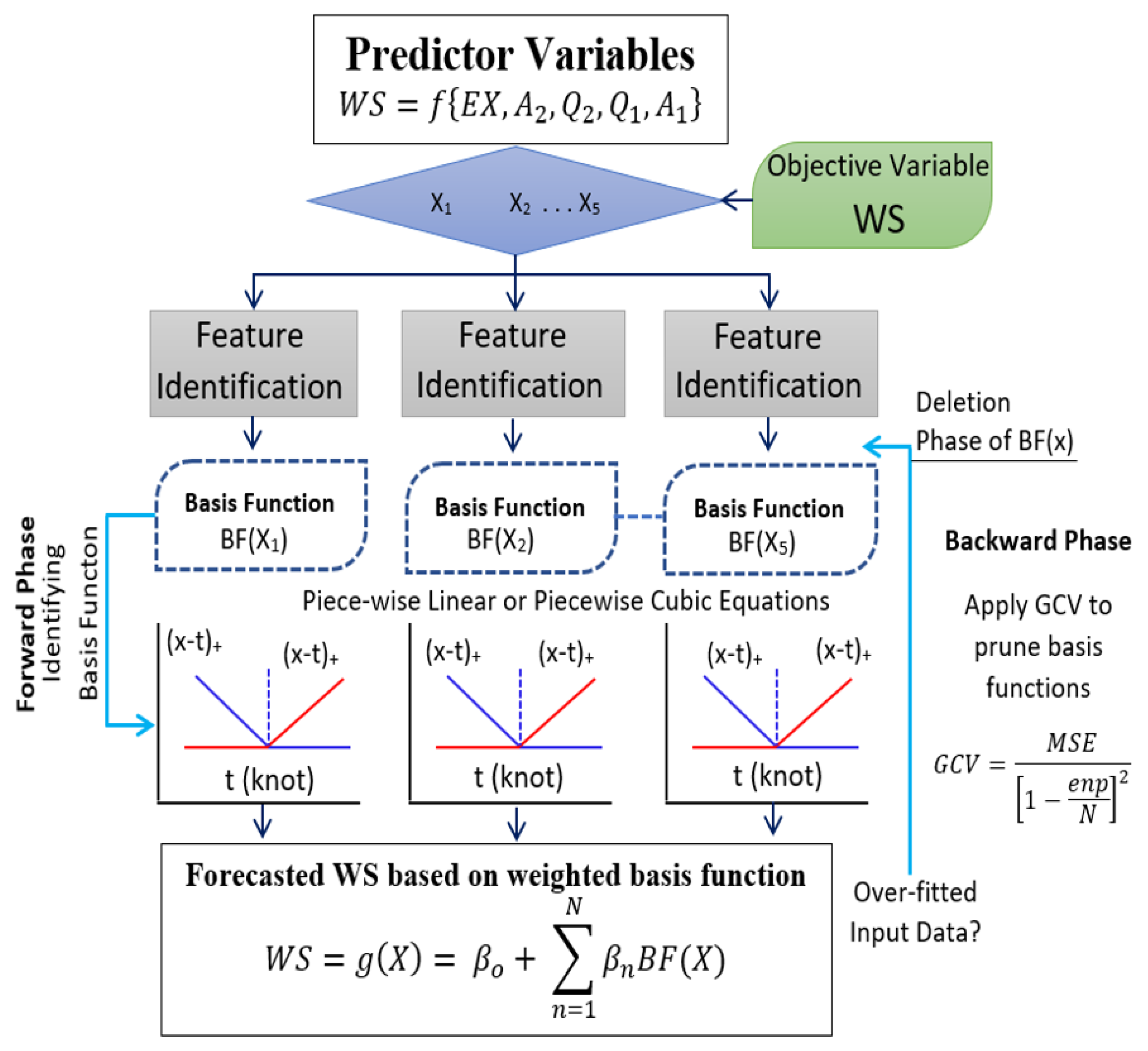
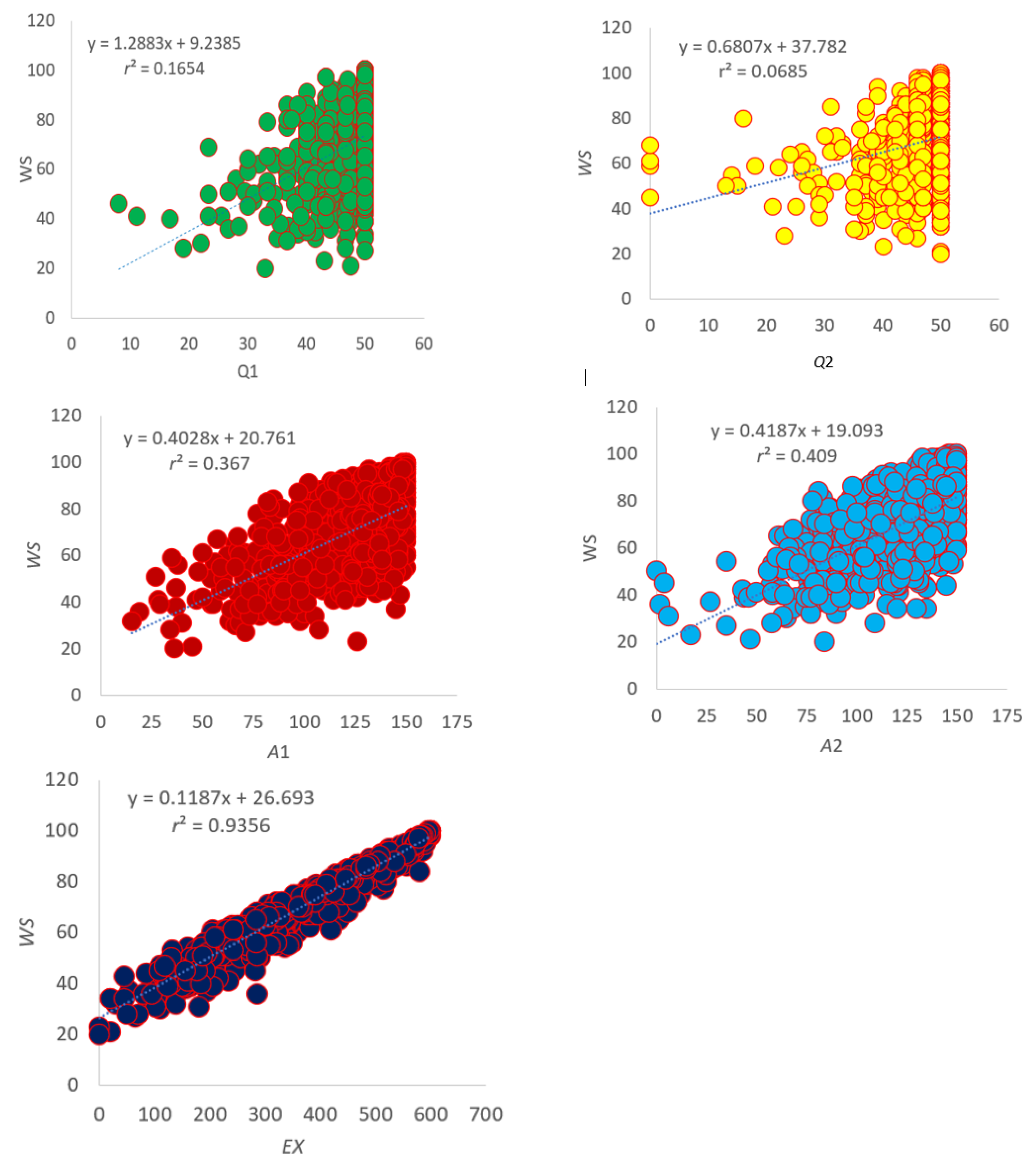
Introductory Engineering Mathematics (a skill builder for engineers) involves developing problem-solving attributes throughout the teaching period. Therefore, the prediction of students’ final course grades with continuous assessment marks is a useful toolkit for degree program educators. Predictive models are practical tools used to evaluate the effectiveness of teaching as well as assessing the students’ progression and implementing interventions for the best learning outcomes. This study develops a novel multivariate adaptive regression spline (MARS) model to predict the weighted score WS (i.e., the course grade). To construct the proposed MARS model, Introductory Engineering Mathematics performance data over five years from the University of Southern Queensland, Australia, were used to design predictive models using input predictors of online quizzes, written assignments, and examination scores. About 60% of randomised predictor grade data were applied to train the model (with 25% of the training set used for validation) and 40% to test the model. Based on the cross-correlation of inputs vs. the WS, 12 distinct combinations with single (i.e., M1–M5) and multiple (M6–M12) features were created to assess the influence of each on the WS with results bench-marked via a decision tree regression (DTR), kernel ridge regression (KRR), and a k-nearest neighbour (KNN) model. The influence of each predictor on WS clearly showed that online quizzes provide the least contribution. However, the MARS model improved dramatically by including written assignments and examination scores. The research demonstrates the merits of the proposed MARS model in uncovering relationships among continuous learning variables, which also provides a distinct advantage to educators in developing early intervention and moderating their teaching by predicting the performance of students ahead of final outcome for a course. The findings and future application have significant practical implications in teaching and learning interventions or planning aimed to improve graduate outcomes in undergraduate engineering program cohorts.
Keywords: educational decision making; multivariate regression spline model; student performance; artificial intelligence in education; engineering mathematics student performance educational decision making; multivariate regression spline model; student performance; artificial intelligence in education; engineering mathematics student performance