Remittance Inflows and Energy Transition of the Residential Sector in Developing Countries

Abstract
1. Introduction
2. Literature Review
2.1. Access to Clean and Modern Energy
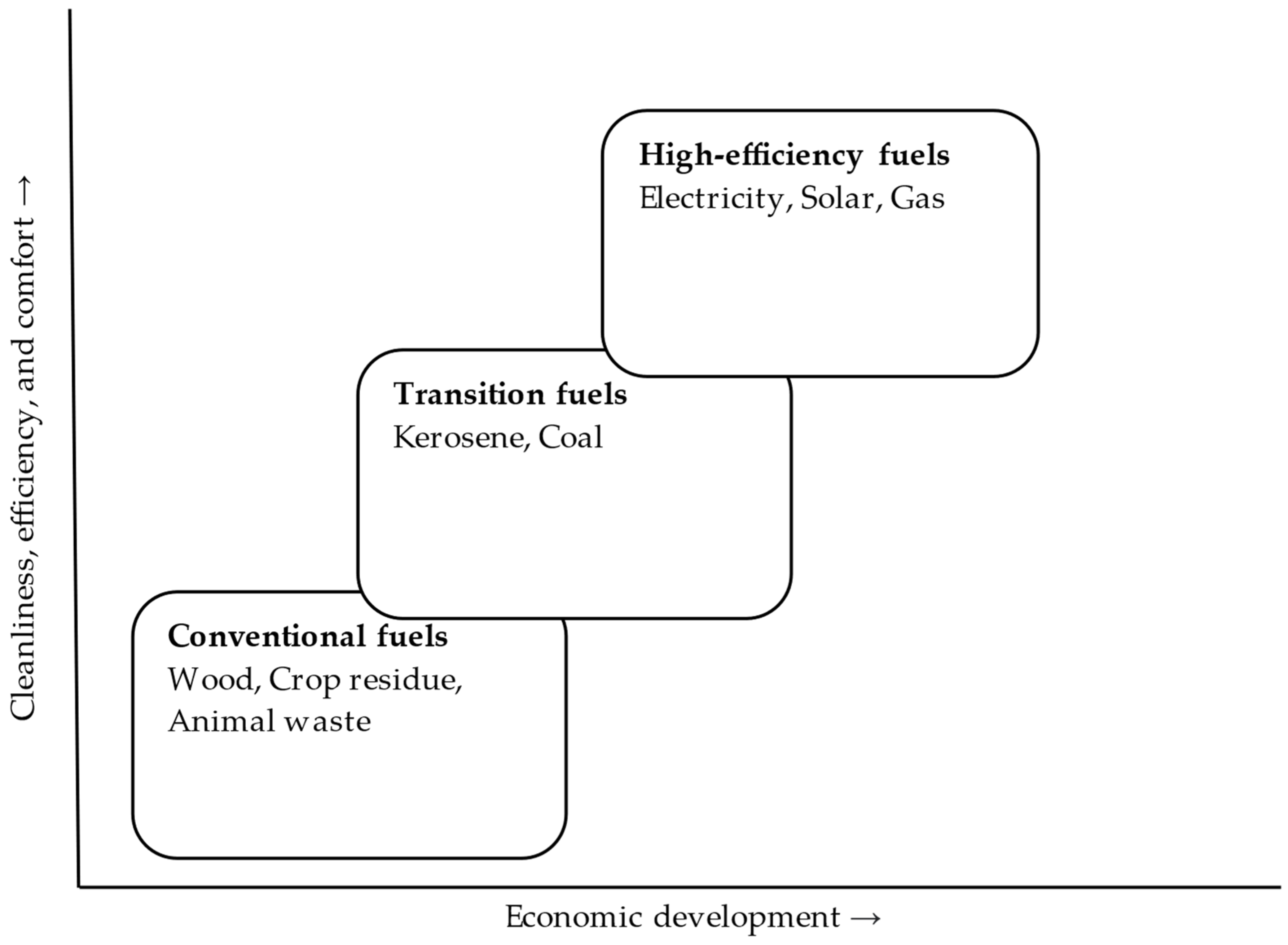
2.2. Energy Transition
2.3. Remittance Inflows and the Energy Transition
3. Methodology and Data
3.1. Data
3.2. Model Specification
4. Results
4.1. Panel Unit Root Tests
4.2. Panel Cointegration Test
4.3. ARDL Estimation
4.4. Discussion
4.5. Robustness Check
5. Conclusions
Author Contributions
Funding
Institutional Review Board Statement
Informed Consent Statement
Data Availability Statement
Conflicts of Interest
References
- Hosier, R.H.; Dowd, J. Household fuel choice in Zimbabwe. Resour. Energy 1987, 9, 347–361. [Google Scholar] [CrossRef] [Scilit]
- Leach, G. The energy transition. Energy Policy 1992, 20, 116–123. [Google Scholar] [CrossRef] [Scilit]
- Baez, J.E. Income Volatility, Risk-Coping Behavior and Consumption Smoothing Mechanisms in Developing Countries: A Survey. Rev. Desarro. Soc. 2006, 37–83. [Google Scholar] [CrossRef] [Scilit]
- Karekezi, S.; Majoro, L. Improving modern energy services for Africa’s urban poor. Energy Policy 2002, 30, 1015–1028. [Google Scholar] [CrossRef] [Scilit]
- Odihi, J. Deforestation in afforestation priority zone in Sudano-Sahelian Nigeria. Appl. Geogr. 2003, 23, 227–259. [Google Scholar] [CrossRef] [Scilit]
- Kebede, B.; Bekele, A.; Kedir, E. Can the urban poor afford modern energy? The case of Ethiopia. Energy Policy 2002, 30, 1029–1045. [Google Scholar] [CrossRef] [Scilit]
- Masera, O.R.; Saatkamp, B.D.; Kammen, D.M. From Linear Fuel Switching to Multiple Cooking Strategies: A Critique and Alternative to the Energy Ladder Model. World Dev. 2000, 28, 2083–2103. [Google Scholar] [CrossRef] [Scilit]
- Yadav, P.; Davies, P.J.; Asumadu-Sarkodie, S. Fuel choice and tradition: Why fuel stacking and the energy ladder are out of step? Sol. Energy 2021, 214, 491–501. [Google Scholar] [CrossRef] [Scilit]
- Azizi, S. The impacts of workers’ remittances on human capital and labor supply in developing countries. Econ. Model. 2018, 75, 377–396. [Google Scholar] [CrossRef] [Scilit]
- Azizi, S. The impacts of workers’ remittances on poverty and inequality in developing countries. Empir. Econ. 2021, 60, 969–991. [Google Scholar] [CrossRef] [Scilit]
- World Bank Group. Migration and Remittances Factbook 2016, 3rd ed.; World Bank: Washington, DC, USA, 2016; ISBN 978-1-4648-0319-2. [Google Scholar]
- Fromentin, V. The long-run and short-run impacts of remittances on financial development in developing countries. Q. Rev. Econ. Financ. 2017, 66, 192–201. [Google Scholar] [CrossRef] [Scilit]
- Lissoni, F. International migration and innovation diffusion: An eclectic survey. Reg. Stud. 2018, 52, 702–714. [Google Scholar] [CrossRef] [Scilit]
- Wagle, U.R.; Devkota, S. The impact of foreign remittances on poverty in Nepal: A panel study of household survey data, 1996–2011. World Dev. 2018, 110, 38–50. [Google Scholar] [CrossRef] [Scilit]
- Manning, D.T.; Taylor, J.E. Migration and fuel use in rural Mexico. Ecol. Econ. 2014, 102, 126–136. [Google Scholar] [CrossRef] [Scilit]
- Martey, E. Tenancy and energy choice for lighting and cooking: Evidence from Ghana. Energy Econ. 2019, 80, 570–581. [Google Scholar] [CrossRef] [Scilit]
- Taylor, M.J.; Moran-Taylor, M.J.; Castellanos, E.J.; Elías, S. Burning for Sustainability: Biomass Energy, International Migration, and the Move to Cleaner Fuels and Cookstoves in Guatemala. Ann. Assoc. Am. Geogr. 2011, 101, 918–928. [Google Scholar] [CrossRef] [Scilit]
- Allen, J.C. Wood energy and preservation of woodlands in semi-arid developing countries. J. Dev. Econ. 1985, 19, 59–84. [Google Scholar] [CrossRef] [Scilit]
- Baquié, S.; Urpelainen, J. Access to modern fuels and satisfaction with cooking arrangements: Survey evidence from rural India. Energy Sustain. Dev. 2017, 38, 34–47. [Google Scholar] [CrossRef] [Scilit]
- The Sustainable Development Goals Report 2021; United Nations Publications: New York, NY, USA, 2021; ISBN 978-92-1-005608-3.
- der Horst, G.; Hovorka, A.J. Reassessing the “energy ladder”: Household energy use in Maun, Botswana. Energy Policy 2008, 36, 3333–3344. [Google Scholar] [CrossRef] [Scilit]
- Hanna, R.; Oliva, P. Moving up the Energy Ladder: The Effect of an Increase in Economic Well-Being on the Fuel Consumption Choices of the Poor in India. Am. Econ. Rev. 2015, 105, 242–246. [Google Scholar] [CrossRef] [Scilit]
- Heltberg, R. Fuel switching: Evidence from eight developing countries. Energy Econ. 2004, 26, 869–887. [Google Scholar] [CrossRef] [Scilit]
- van der Kroon, B.; Brouwer, R.; van Beukering, P.J.H. The energy ladder: Theoretical myth or empirical truth? Results from a meta-analysis. Renew. Sustain. Energy Rev. 2013, 20, 504–513. [Google Scholar] [CrossRef] [Scilit]
- Bonan, J.; Pareglio, S.; Tavoni, M. Access to modern energy: A review of barriers, drivers and impacts. Envirion. Dev. Econ. 2017, 22, 491–516. [Google Scholar] [CrossRef] [Scilit]
- Bos, K.; Chaplin, D.; Mamun, A. Benefits and challenges of expanding grid electricity in Africa: A review of rigorous evidence on household impacts in developing countries. Energy Sustain. Dev. 2018, 44, 64–77. [Google Scholar] [CrossRef] [Scilit]
- Pallegedara, A.; Mottaleb, K.A.; Rahut, D.B. Exploring choice and expenditure on energy for domestic works by the Sri Lankan households: Implications for policy. Energy 2021, 222, 119899. [Google Scholar] [CrossRef] [Scilit]
- Adams, R.H. Evaluating the Economic Impact of International Remittances on Developing Countries Using Household Surveys: A Literature Review. J. Dev. Stud. 2011, 47, 809–828. [Google Scholar] [CrossRef] [Scilit]
- Anzoategui, D.; Demirgüç-Kunt, A.; Martínez Pería, M.S. Remittances and Financial Inclusion: Evidence from El Salvador. World Dev. 2014, 54, 338–349. [Google Scholar] [CrossRef] [Scilit]
- Burns, A.; Mohapatra, S. International Migration and Technological Progress; World Bank: Washington, DC, USA, 2008. [Google Scholar]
- Clarke, G.R.; Wallsten, S. Do Remittances Act Like Insurance? Evidence from a Natural Disaster in Jamaica. The World Bank Working Paper. 2003. Available online: https://www.ssrc.org/publications/do-remittances-act-like-insurance-evidence-from-a-natural-disaster-in-jamaica-working-paper (accessed on 16 August 2022).
- Passel, J.S.; Cohn, D. Mexican Immigrants: How Many Come? How Many Leave? Pew Hispanic Center: Washington, DC, USA, 2009. [Google Scholar]
- Anwar, A.I.; Mang, C.F. Do remittances cause Dutch Disease? A meta-analytic review. Appl. Econ. 2022, 54, 4131–4153. [Google Scholar] [CrossRef] [Scilit]
- Yang, B.; Jahanger, A.; Khan, M.A. Does the inflow of remittances and energy consumption increase CO2 emissions in the era of globalization? A global perspective. Air Qual. Atmos. Health 2020, 13, 1313–1328. [Google Scholar] [CrossRef] [Scilit]
- Amuedo-Dorantes, C.; Pozo, S. Remittances and Income Smoothing. Am. Econ. Rev. 2011, 101, 582–587. [Google Scholar] [CrossRef] [Scilit]
- Amega, K. Remittances, education and health in Sub-Saharan Africa. Cogent Econ. Financ. 2018, 6, 1516488. [Google Scholar] [CrossRef] [Scilit]
- Arif, I.; Raza, S.A.; Friemann, A.; Suleman, M.T. The Role of Remittances in the Development of Higher Education: Evidence from Top Remittance Receiving Countries. Soc. Indic. Res. 2019, 141, 1233–1243. [Google Scholar] [CrossRef] [Scilit]
- International Energy Agency. World Energy Outlook 2020; International Energy Agency: Paris, France, 2020. Available online: https://www.iea.org/reports/world-energy-outlook-2020 (accessed on 16 August 2022).
- Liao, H.; Tang, X.; Wei, Y.M. Solid fuel use in rural China and its health effects. Renew. Sustain. Energy Rev. 2016, 60, 900–908. [Google Scholar] [CrossRef] [Scilit]
- Narasimha Rao, M.; Reddy, B.S. Variations in energy use by Indian households: An analysis of micro level data. Energy 2007, 32, 143–153. [Google Scholar] [CrossRef] [Scilit]
- Chakraborty, D.; Mondal, N.K. Hypertensive and toxicological health risk among women exposed to biomass smoke: A rural Indian scenario. Ecotoxicol. Environ. Saf. 2018, 161, 706–714. [Google Scholar] [CrossRef] [Scilit]
- Dutta, A.; Bhattacharya, P.; Lahiri, T.; Ray, M.R. Immune cells and cardiovascular health in premenopausal women of rural India chronically exposed to biomass smoke during daily household cooking. Sci. Total Environ. 2012, 438, 293–298. [Google Scholar] [CrossRef] [Scilit]
- Heltberg, R. Factors determining household fuel choice in Guatemala. Envirion. Dev. Econ. 2005, 10, 337–361. [Google Scholar] [CrossRef] [Scilit]
- Leach, G.; Mearns, R. Beyond the Woodfuel Crisis: People, Land and Trees in Africa; Energy and infrastructure; First issued in paperback; Earthscan from Routledge: London, UK; New York, NY, USA, 2016; ISBN 978-1-138-98783-8. [Google Scholar]
- Schlag, N.; Zuzarte, F. Market Barriers to Clean Cooking Fuels in Sub-Saharan Africa: A Review of Literature; Stockholm Environment Institute: Stockholm, Sweden, 2008. [Google Scholar]
- Arthur, M.; De Fatima, S.R.; Zahran, S.; Bucini, G. On the adoption of electricity as a domestic source by Mozambican households. Energy Policy 2010, 38, 7235–7249. [Google Scholar] [CrossRef] [Scilit]
- Baiyegunhi, L.J.S.; Hassan, M.B. Rural household fuel energy transition: Evidence from Giwa LGA Kaduna State, Nigeria. Energy Sustain. Dev. 2014, 20, 30–35. [Google Scholar] [CrossRef] [Scilit]
- Jingchao, Z.; Kotani, K. The determinants of household energy demand in rural Beijing: Can environmentally friendly technologies be effective? Energy Econ. 2012, 34, 381–388. [Google Scholar] [CrossRef] [Scilit]
- Adams, R.H.; Page, J. Do international migration and remittances reduce poverty in developing countries? World Dev. 2005, 33, 1645–1669. [Google Scholar] [CrossRef] [Scilit]
- Acharya, C.P.; Leon-Gonzalez, R. How do Migration and Remittances Affect Human Capital Investment? The Effects of Relaxing Information and Liquidity Constraints. J. Dev. Stud. 2014, 50, 444–460. [Google Scholar] [CrossRef] [Scilit]
- Terrelonge, S.C. For Health, Strength, and Daily Food: The Dual Impact of Remittances and Public Health Expenditure on Household Health Spending and Child Health Outcomes. J. Dev. Stud. 2014, 50, 1397–1410. [Google Scholar] [CrossRef] [Scilit]
- Feeny, S.; Iamsiraroj, S.; McGillivray, M. Remittances and Economic Growth: Larger Impacts in Smaller Countries? J. Dev. Stud. 2014, 50, 1055–1066. [Google Scholar] [CrossRef] [Scilit]
- Ratha, A.; Moghaddam, M. Remittances and the Dutch disease phenomenon: Evidence from the bounds error correction modelling and a panel space. Appl. Econ. 2020, 52, 3327–3336. [Google Scholar] [CrossRef] [Scilit]
- Siddique, A.; Selvanathan, E.A.; Selvanathan, S. Remittances and Economic Growth: Empirical Evidence from Bangladesh, India and Sri Lanka. J. Dev. Stud. 2012, 48, 1045–1062. [Google Scholar] [CrossRef] [Scilit]
- Rahman, M.M.; Hosan, S.; Karmaker, S.C.; Chapman, A.J.; Saha, B.B. The effect of remittance on energy consumption: Panel cointegration and dynamic causality analysis for South Asian countries. Energy 2021, 220, 119684. [Google Scholar] [CrossRef] [Scilit]
- Zaman, S.; Wang, Z.; Zaman, Q. Exploring the relationship between remittances received, education expenditures, energy use, income, poverty, and economic growth: Fresh empirical evidence in the context of selected remittances receiving countries. Env. Sci. Pollut. Res. 2021, 28, 17865–17877. [Google Scholar] [CrossRef] [Scilit]
- Lee, L.Y.T. Household energy mix in Uganda. Energy Econ. 2013, 39, 252–261. [Google Scholar] [CrossRef] [Scilit]
- Rahut, D.B.; Behera, B.; Ali, A.; Marenya, P. A ladder within a ladder: Understanding the factors influencing a household’s domestic use of electricity in four African countries. Energy Econ. 2017, 66, 167–181. [Google Scholar] [CrossRef] [Scilit]
- Smith, K.R.; Sagar, A. Making the clean available: Escaping India’s Chulha Trap. Energy Policy 2014, 75, 410–414. [Google Scholar] [CrossRef] [Scilit]
- Adebayo, T.S.; Akinsola, G.D.; Bekun, F.V.; Osemeahon, O.S.; Sarkodie, S.A. Mitigating human-induced emissions in Argentina: Role of renewables, income, globalization, and financial development. Env. Sci. Pollut. Res. 2021, 28, 67764–67778. [Google Scholar] [CrossRef] [Scilit] [PubMed]
- Adebayo, T.S.; Awosusi, A.A.; Bekun, F.V.; Altuntaş, M. Coal energy consumption beat renewable energy consumption in South Africa: Developing policy framework for sustainable development. Renew. Energy 2021, 175, 1012–1024. [Google Scholar] [CrossRef] [Scilit]
- Gyamfi, B.A.; Adedoyin, F.F.; Bein, M.A.; Bekun, F.V.; Agozie, D.Q. The anthropogenic consequences of energy consumption in E7 economies: Juxtaposing roles of renewable, coal, nuclear, oil and gas energy: Evidence from panel quantile method. J. Clean. Prod. 2021, 295, 126373. [Google Scholar] [CrossRef] [Scilit]
- Neagu, I.C.; Schiff, M. Remittance stability, cyclicality and stabilizing impact in developing countries. World Bank Policy Res. Work. Pap. 2009. [Google Scholar] [CrossRef] [Scilit]
- Ai, X.N.; Du, Y.F.; Li, W.M.; Li, H.; Liao, H. The pattern of household energy transition. Energy 2021, 234, 121277. [Google Scholar] [CrossRef] [Scilit]
- Arellano, M.; Bover, O. Another look at the instrumental variable estimation of error-components models. J. Econom. 1995, 68, 29–51. [Google Scholar] [CrossRef] [Scilit]
- Pesaran, M.H.; Shin, Y.; Smith, R.P. Pooled Mean Group Estimation of Dynamic Heterogeneous Panels. J. Am. Stat. Assoc. 1999, 94, 621–634. [Google Scholar] [CrossRef]
- Pesaran, M.H.; Shin, Y.; Smith, R.J. Bounds testing approaches to the analysis of level relationships. J. Appl. Econ. 2001, 16, 289–326. [Google Scholar] [CrossRef] [Scilit]
- Harris, R.I.D.; Sollis, R. Applied Time Series Modelling and Forecasting; J. Wiley: Chichester, UK; Hoboken, NJ, USA, 2003; ISBN 978-0-470-84443-4. [Google Scholar]
- Jalil, A.; Ma, Y. Financial development and economic growth: Time series evidence from Pakistan and China. J. Econ. Coop. Among Islamic Ctries. 2008, 29, 29–68. [Google Scholar]
- Haug, A.A. Temporal Aggregation and the Power of Cointegration Tests: A Monte Carlo Study. Oxf. Bull. Econ. Stats 2002, 64, 399–412. [Google Scholar] [CrossRef] [Scilit]
- Pesaran, M.H.; Smith, R. Estimating long-run relationships from dynamic heterogeneous panels. J. Econom. 1995, 68, 79–113. [Google Scholar] [CrossRef] [Scilit]
- Breitung, J. The local power of some unit root tests for panel data. In Advances in Econometrics; Emerald (MCB UP): Bingley, UK, 2000; Volume 15, pp. 161–177. ISBN 978-0-7623-0688-6. [Google Scholar]
- Hadri, K. Testing for stationarity in heterogeneous panel data. Econom. J. 2000, 3, 148–161. [Google Scholar] [CrossRef] [Scilit]
- Im, K.S.; Pesaran, M.H.; Shin, Y. Testing for unit roots in heterogeneous panels. J. Econom. 2003, 115, 53–74. [Google Scholar] [CrossRef] [Scilit]
- Levin, A.; Lin, C.F.; James Chu, C.S. Unit root tests in panel data: Asymptotic and finite-sample properties. J. Econom. 2002, 108, 1–24. [Google Scholar] [CrossRef] [Scilit]
- Pesaran, M.H. A simple panel unit root test in the presence of cross-section dependence. J. Appl. Econ. 2007, 22, 265–312. [Google Scholar] [CrossRef] [Scilit]
- Banerjee, A.; Marcellino, M.; Osbat, C. Some cautions on the use of panel methods for integrated series of macroeconomic data. Econom. J. 2004, 7, 322–340. [Google Scholar] [CrossRef] [Scilit]
- Phillips, P.C.B.; Sul, D. Dynamic panel estimation and homogeneity testing under cross section dependence. Econom. J. 2003, 6, 217–259. [Google Scholar] [CrossRef] [Scilit]
- Breusch, T.S.; Pagan, A.R. The Lagrange Multiplier Test and its Applications to Model Specification in Econometrics. Rev. Econ. Stud. 1980, 47, 239. [Google Scholar] [CrossRef] [Scilit]
- Pesaran, M.H. General diagnostic tests for cross-sectional dependence in panels. Empir. Econ. 2004, 60, 13–50. [Google Scholar] [CrossRef] [Scilit]
- Baltagi, B.H.; Feng, Q.; Kao, C. A Lagrange Multiplier test for cross-sectional dependence in a fixed effects panel data model. J. Econom. 2012, 170, 164–177. [Google Scholar] [CrossRef] [Scilit]
- Pedroni, P. Critical Values for Cointegration Tests in Heterogeneous Panels with Multiple Regressors. Oxf. Bull. Econ. Stats. 1999, 61, 653–670. [Google Scholar] [CrossRef]
- Pedroni, P. Panel Cointegration: Asymptotic and Finite Sample Properties of Pooled Time Series Tests with an Application to the PPP Hypothesis. Econ. Theory 2004, 20, 597–625. [Google Scholar] [CrossRef] [Scilit]
- Westerlund, J. Testing for Error Correction in Panel Data. Oxf. Bull. Econ. Stats. 2007, 69, 709–748. [Google Scholar] [CrossRef] [Scilit]
- DeFries, R.; Pandey, D. Urbanization, the energy ladder and forest transitions in India’s emerging economy. Land Use Policy 2010, 27, 130–138. [Google Scholar] [CrossRef] [Scilit]
- Ngoma, A.L.; Ismail, N.W. The determinants of brain drain in developing countries. Int. J. Soc. Econ. 2013, 40, 744–754. [Google Scholar] [CrossRef] [Scilit]
- United Nations Remittances Matter: 8 Facts You Don’t Know about the Money Migrants Send Back Home. Available online: https://news.un.org/en/story/2019/06/1040581 (accessed on 6 July 2022).
- Dercon, S.; Christiaensen, L. Consumption risk, technology adoption and poverty traps: Evidence from Ethiopia. J. Dev. Econ. 2011, 96, 159–173. [Google Scholar] [CrossRef] [Scilit]
- Dupas, P.; Robinson, J. Savings Constraints and Microenterprise Development: Evidence from a Field Experiment in Kenya. Am. Econ. J. Appl. Econ. 2013, 5, 163–192. [Google Scholar] [CrossRef] [Scilit]
- Fajnzylber, P.; López, J.H. Close to Home: The Development Impact of Remittances in Latin America; World Bank: Washington, DC, USA, 2007. [Google Scholar]
- Puri, S.; Ritzema, T. Migrant Worker Remittances, Micro-Finance and the Informal Economy: Prospects and Issues; Working Paper N/21; International Labour Office: Geneva, Switzerland, 1999; ISBN 978-92-2-111783-4. [Google Scholar]
- Barnes, D.; Krutilla, K.; Hyde, W. The Urban Household Energy Transition: Energy, Poverty, and the Environment in the Developing World; World Bank: Washington, DC, USA, 2004. [Google Scholar]
- Manandhar, B. Remittance and earthquake preparedness. Int. J. Disaster Risk Reduct. 2016, 15, 52–60. [Google Scholar] [CrossRef] [Scilit]
- O’Neill, A.C. Emigrant remittances: Policies to increase inflows and maximize benefits. Indiana J. Glob. Leg. Stud. 2001, 9, 345–360. [Google Scholar]
- Kersten, I.; Baumbach, G.; Oluwole, A.F.; Obioh, I.B.; Ogunsola, O.J. Urban and rural fuelwood situation in the tropical rain-forest area of south-west Nigeria. Energy 1998, 23, 887–898. [Google Scholar] [CrossRef] [Scilit]



| High-Efficiency Residential Energy Consumption (Ratio to Residential Energy Consumption) | Personal Remittances, Received (Ratio to GDP) | GDP Per Capita (Constant 2010 USD) | |||||||
|---|---|---|---|---|---|---|---|---|---|
| 1995 | 2006 | 2018 | 1995 | 2006 | 2018 | 1995 | 2006 | 2018 | |
| East Asia and Pacific | 0.12 | 0.22 | 0.30 | 0.04 | 0.07 | 0.08 | 954 | 1314 | 2197 |
| Cambodia | 0.03 | 0.09 | 0.11 | 0.00 | 0.03 | 0.06 | 342 | 669 | 1203 |
| Philippines | 0.22 | 0.35 | 0.49 | 0.07 | 0.12 | 0.10 | 1565 | 1959 | 3191 |
| Latin America and the Caribbean | 0.18 | 0.33 | 0.48 | 0.04 | 0.15 | 0.14 | 1675 | 1989 | 2536 |
| Bolivia | 0.39 | 0.64 | 0.94 | 0.00 | 0.05 | 0.03 | 1493 | 1751 | 2560 |
| El Salvador | 0.17 | 0.47 | 0.69 | 0.12 | 0.22 | 0.21 | 2529 | 2905 | 3507 |
| Honduras | 0.09 | 0.13 | 0.16 | 0.02 | 0.22 | 0.20 | 1575 | 1852 | 2219 |
| Nicaragua | 0.07 | 0.09 | 0.15 | 0.02 | 0.10 | 0.12 | 1104 | 1447 | 1857 |
| Middle East and North Africa | 0.76 | 0.76 | 0.84 | 0.04 | 0.04 | 0.05 | 2264 | 3177 | 3858 |
| Algeria | 1.00 | 1.00 | 1.00 | 0.03 | 0.00 | 0.01 | 3240 | 4298 | 4754 |
| Egypt, Arab Rep. | 0.81 | 0.85 | 0.90 | 0.05 | 0.05 | 0.10 | 1659 | 2255 | 2909 |
| Morocco | 0.70 | 0.67 | 0.87 | 0.05 | 0.08 | 0.06 | 1727 | 2513 | 3361 |
| Tunisia | 0.52 | 0.50 | 0.61 | 0.04 | 0.04 | 0.05 | 2429 | 3640 | 4408 |
| South Asia | 0.11 | 0.17 | 0.26 | 0.03 | 0.08 | 0.10 | 761 | 1103 | 1850 |
| Bangladesh | 0.14 | 0.25 | 0.39 | 0.03 | 0.08 | 0.06 | 460 | 650 | 1203 |
| India | 0.14 | 0.22 | 0.32 | 0.02 | 0.03 | 0.03 | 675 | 1107 | 2086 |
| Nepal | 0.03 | 0.03 | 0.05 | 0.01 | 0.16 | 0.28 | 400 | 511 | 818 |
| Pakistan | 0.20 | 0.24 | 0.28 | 0.03 | 0.04 | 0.07 | 804 | 970 | 1198 |
| Sri Lanka | 0.05 | 0.10 | 0.24 | 0.06 | 0.08 | 0.08 | 1469 | 2276 | 3946 |
| Sub-Saharan Africa | 0.05 | 0.08 | 0.09 | 0.01 | 0.03 | 0.03 | 801 | 975 | 1328 |
| Benin | 0.04 | 0.23 | 0.04 | 0.05 | 0.03 | 0.01 | 863 | 999 | 1211 |
| Cameroon | 0.06 | 0.04 | 0.06 | 0.00 | 0.01 | 0.01 | 1055 | 1251 | 1502 |
| Cote d’Ivoire | 0.07 | 0.07 | 0.13 | 0.01 | 0.01 | 0.01 | 1347 | 1208 | 1668 |
| Ethiopia | 0.01 | 0.01 | 0.01 | 0.00 | 0.01 | 0.01 | 184 | 252 | 571 |
| Ghana | 0.08 | 0.15 | 0.27 | 0.00 | 0.01 | 0.05 | 874 | 1117 | 1808 |
| Kenya | 0.05 | 0.04 | 0.05 | 0.01 | 0.02 | 0.03 | 848 | 886 | 1201 |
| Mozambique | 0.01 | 0.01 | 0.11 | 0.02 | 0.01 | 0.02 | 216 | 402 | 593 |
| Nigeria | 0.03 | 0.02 | 0.02 | 0.01 | 0.07 | 0.06 | 1342 | 1910 | 2383 |
| Senegal | 0.13 | 0.22 | 0.20 | 0.02 | 0.08 | 0.10 | 1028 | 1235 | 1547 |
| Sudan | 0.03 | 0.06 | 0.15 | 0.03 | 0.02 | 0.01 | 850 | 1261 | 1812 |
| Tanzania | 0.03 | 0.03 | 0.03 | 0.00 | 0.00 | 0.01 | 479 | 660 | 959 |
| Togo | 0.05 | 0.07 | 0.05 | 0.01 | 0.10 | 0.08 | 526 | 517 | 677 |
| Overall Sample | 0.19 | 0.24 | 0.31 | 0.03 | 0.06 | 0.07 | 1151 | 1500 | 2043 |
| High-Efficiency Residential Energy Consumption (Ratio to Residential Energy Consumption) | Personal Remittances, Received (Ratio to GDP) | Log of GDP Per Capita | Urban Population (Ratio to Total Population) | Log of Real Oil Price | Log of Dependent Population (Young and Old) | Agricultural Land (Ratio to Total Land Area) | |
|---|---|---|---|---|---|---|---|
| RES | REM | Y | URB | OP | DEP | AGR | |
| Countries | 27 | 27 | 27 | 27 | 27 | 27 | 27 |
| Obs | 648 | 648 | 648 | 648 | 635 | 648 | 632 |
| Mean | 0.25 | 0.05 | 7.13 | 0.40 | 3.80 | 16.30 | 0.45 |
| Max | 1.00 | 0.31 | 8.48 | 0.73 | 6.34 | 19.92 | 0.76 |
| Min | 0.01 | 0.00 | 5.21 | 0.11 | 0.72 | 14.53 | 0.03 |
| Std. Dev | 0.28 | 0.05 | 0.69 | 0.16 | 0.92 | 1.23 | 0.18 |
| Average values in years | |||||||
| 1995 | 0.19 | 0.03 | 6.83 | 0.36 | 2.39 | 16.13 | 0.43 |
| 2000 | 0.23 | 0.03 | 6.94 | 0.38 | 3.11 | 16.21 | 0.44 |
| 2005 | 0.24 | 0.06 | 7.07 | 0.40 | 3.81 | 16.28 | 0.45 |
| 2010 | 0.26 | 0.06 | 7.21 | 0.42 | 4.51 | 16.34 | 0.46 |
| 2015 | 0.28 | 0.07 | 7.38 | 0.44 | 4.25 | 16.41 | 0.46 |
| 2018 | 0.31 | 0.07 | 7.46 | 0.45 | 4.65 | 16.46 | 0.46 |
| RES | REM | Y | URB | OP | DEP | AGR | |
|---|---|---|---|---|---|---|---|
| RES | 1.00 | ||||||
| REM | 0.07 | 1.00 | |||||
| Y | 0.67 | 0.23 | 1.00 | ||||
| URB | 0.63 | 0.13 | 0.74 | 1.00 | |||
| OP | 0.10 | 0.25 | 0.25 | 0.19 | 1.00 | ||
| DEP | −0.03 | −0.24 | −0.18 | −0.38 | 0.02 | 1.00 | |
| AGR | −0.19 | 0.08 | 0.02 | 0.10 | 0.03 | 0.10 | 1.00 |
| Variables | Breusch and Pagan [79] LM | Pesaran [80] Scaled LM | Baltagi et al. [81] Bias-Corrected Scaled LM | Pesaran [80] CD | |
|---|---|---|---|---|---|
| Share of high-efficiency energy sources in the residential energy consumption | RES | 2809.35 *** | 92.78 *** | 92.20 *** | 30.68 *** |
| Personal remittances, received (ratio to GDP) | REM | 2765.51 *** | 91.13 *** | 90.54 *** | 23.94 *** |
| Log of real GDP per capita | Y | 6852.54 *** | 245.38 *** | 244.80 *** | 80.04 *** |
| Urban population (ratio to total population) | URB | 6673.73 *** | 238.64 *** | 238.05 *** | 68.72 *** |
| Log of real oil price | OP | 7659.51 *** | 275.84 *** | 275.26 *** | 87.27 *** |
| Log of dependent population (young and old) | DEP | 5408.45 *** | 190.8 8*** | 190.29 *** | 55.95 *** |
| Agricultural land (ratio to total land area) | AGR | 3898.91 *** | 140.18 *** | 139.62 *** | 22.39 *** |
| Variables | Pesaran [76] | ||
|---|---|---|---|
| CIPS t-Stat (Level) | CIPS t-Stat (Difference) | ||
| Share of high-efficiency energy sources in the residential energy consumption | RES | −2.92 *** | −3.99 *** |
| Personal remittances, received (ratio to GDP) | REM | −2.70 ** | −3.94 *** |
| Log (real GDP per capita) | Y | −1.73 | −3.00 *** |
| Urban population (ratio to total population) | URB | −3.22 *** | −3.98 *** |
| Log (real oil price) | OP | −2.46 | −2.98 ** |
| Log (dependent population—young and old) | DEP | −1.54 | −4.94 *** |
| Agricultural land (ratio to total land area) | AGR | −2.70 ** | −3.44 *** |
| Null hypothesis: the series is non-stationary. | |||
| Statistics | |
|---|---|
| Within dimension (panel statistic—weighted) | |
| Panel v | −4.69 |
| Panel rho | 2.92 |
| Panel PP | −3.99 *** |
| Panel ADF | −5.42 *** |
| Between dimension (group statistics) | |
| Group rho | 4.35 |
| Group PP | −8.63 *** |
| Group ADF | −7.05 *** |
| Value | Z-Value | p-Value | |
|---|---|---|---|
| Group mean statistics | |||
| G𝜏 | −3.3 *** | 5.89 *** | 0.00 |
| Gα | −2.76 | 6.06 | 1.00 |
| Panel statistics | |||
| P𝜏 | −13.3 *** | 3.14 *** | 0.00 |
| Pα | −2.72 | 3.76 | 1.00 |
| Dependent Variable: Share of High-Efficiency Energy Sources in the Residential Energy Consumption | ||
|---|---|---|
| (A) Long-run estimates | ||
| Personal remittances, received (ratio to GDP) | REM | 0.244 *** |
| (0.082) | ||
| Log (real GDP per capita) | Y | 0.091 *** |
| (0.009) | ||
| Urban population (ratio to total population) | URB | 0.573 *** |
| (0.128) | ||
| (B) Short-run estimates | ||
| Error correction term | ECT | −0.227 *** |
| (0.049) | ||
| Personal remittances, received (ratio to GDP) | REM | 0.047 |
| (0.111) | ||
| Log (real GDP per capita) | Y | −0.038 |
| (0.043) | ||
| Urban population (ratio to total population) | URB | −1.966 |
| (3.531) | ||
| Intercept | C | −0.13 *** |
| (0.032) | ||
| Hausman test statistics (p-value shown in parentheses) | 1.29 (0.73) | |
| No. of countries | 27 | |
| No. of obs | 621 |
| Dependent Variable: Share of High-Efficiency Energy Sources in the Residential Energy Consumption. | ||
|---|---|---|
| (A) Long-run estimates | ||
| Personal remittances, received (ratio to GDP) | REM | 0.323 *** |
| (0.079) | ||
| Log (real GDP per capita) | Y | 0.073 *** |
| (0.016) | ||
| Urban population (ratio to total population) | URB | 1.845 *** |
| (0.165) | ||
| Log (real oil price) | OP | −0.005 *** |
| (0.002) | ||
| Log (dependent population—young and old) | DEP | −0.464 *** |
| (0.037) | ||
| Agricultural land (ratio to total land area) | AGR | −0.168 * |
| (0.101) | ||
| (B) Short-run estimates | ||
| Error correction term | ECT | −0.242 *** |
| (0.059) | ||
| Personal remittances, received (ratio to GDP) | REM | 0.0 |
| (0.13) | ||
| Log (real GDP per capita) | Y | 0.009 |
| (0.045) | ||
| Urban population (ratio to total population) | URB | 4.418 |
| (4.4) | ||
| Log (real oil price) | OP | 0.0 |
| (0.002) | ||
| Log (dependent population—young and old) | DEP | 0.443 |
| (0.546) | ||
| Agricultural land (ratio to total land area) | AGR | 733.698 |
| (732.313) | ||
| Intercept | C | 0.15 |
| (0.13) | ||
| Hausman test statistics (p-value shown in parentheses) | 1.75 (0.94) | |
| No. of countries | 26 | |
| No. of obs | 585 |
Publisher’s Note: MDPI stays neutral with regard to jurisdictional claims in published maps and institutional affiliations. |
© 2022 by the authors. Licensee MDPI, Basel, Switzerland. This article is an open access article distributed under the terms and conditions of the Creative Commons Attribution (CC BY) license (https://creativecommons.org/licenses/by/4.0/).
Share and Cite
Shrestha, A.; Kakinaka, M. Remittance Inflows and Energy Transition of the Residential Sector in Developing Countries. Sustainability 2022, 14, 10547. https://doi.org/10.3390/su141710547
Shrestha A, Kakinaka M. Remittance Inflows and Energy Transition of the Residential Sector in Developing Countries. Sustainability. 2022; 14(17):10547. https://doi.org/10.3390/su141710547
Chicago/Turabian StyleShrestha, Anil, and Makoto Kakinaka. 2022. "Remittance Inflows and Energy Transition of the Residential Sector in Developing Countries" Sustainability 14, no. 17: 10547. https://doi.org/10.3390/su141710547
APA StyleShrestha, A., & Kakinaka, M. (2022). Remittance Inflows and Energy Transition of the Residential Sector in Developing Countries. Sustainability, 14(17), 10547. https://doi.org/10.3390/su141710547