Next Article in Journal
Decision Support Concept for Improvement of Sustainability-Related Competences
Previous Article in Journal
Conservative Financial Reporting and Resilience to the Financial Crisis
 
 
Correction published on 8 December 2025, see Sustainability 2025, 17(24), 10950.
Article

Livelihood Resilience of Rural Residents under Natural Disasters in China

1
School of Tourism and Urban-Rural Planning, Zhejiang Gongshang University, Hangzhou 310018, China
2
College of Applied Arts and Science, Beijing Union University, Beijing 100191, China
*
Authors to whom correspondence should be addressed.
Sustainability 2022, 14(14), 8540; https://doi.org/10.3390/su14148540
Submission received: 6 June 2022 / Revised: 8 July 2022 / Accepted: 11 July 2022 / Published: 12 July 2022 / Corrected: 8 December 2025

Abstract

The impact of natural disasters on rural areas has recently increased; the question of how to effectively improve the livelihood resilience of rural residents has therefore become an essential issue to solve. In this context, a livelihood resilience evaluation index system for rural residents was constructed from the three dimensions of pressure, state, and response. The PSR model was used to analyze the changing characteristics of the livelihood resilience of rural residents in China between the years 1980 and 2020, and a livelihood resilience trend from 2021 to 2030 was predicted based on the ARIMA model. The main factors influencing livelihood resilience were explored using ridge regression analysis. The results show the following: (1) livelihood resilience of rural residents in China fluctuated significantly between 1980 and 2020, tending to generally increase; (2) livelihood resilience is positively correlated with state and response, while it is negatively correlated with pressure; (3) livelihood resilience, state, and response show an upward trend; and (4) seven variables have a significant positive impact on livelihood resilience and provide a basis for the subsequent enhancement of livelihood resilience.

1. Introduction

Since the 21st century, the world has faced serious impacts and challenges caused by climate change and extreme weather. Historical observational data show that climate change has led to an increase in the frequency and intensity of extreme weather events (heavy rainfall, drought, hail, floods, frost, etc.) in many regions [1]. The rural area is a complex system with dynamic, open, and regional characteristics [2]. With the transformation and upgrading of society, the flow of factors between urban and rural areas has become increasingly complex, and uncertain factors in rural areas have greatly increased. Phenomena and problems such as population aging, labor outflow, land abandonment and hollow villages are gradually emerging, and the rural recession caused by these problems have become a global trend [3,4,5]. Under the influence of the COVID-19 pandemic, rural areas have been more impacted, making the research of rural livelihood resilience very urgent. Meanwhile, rural residents, as the most basic livelihood units and actors in the rural system, are the most direct bearers of climate disturbances. Their livelihood resilience is directly or indirectly affected by external threats and shocks such as natural disasters [6]. As a result, the sensitivity to climate change of agriculture and rural residents who depend on natural resources is changing. However, due to the different ability of rural residents’ livelihood systems to resist the disturbance of potential disasters, the livelihood elements and functional structure of rural areas will also change accordingly, making those livelihoods vulnerable. Therefore, the question of how to prevent or mitigate the impact of natural disasters caused by climate change on livelihood resilience, especially rural households’ livelihood resilience, has gradually become an important issue that needs to be solved urgently around the world.
“Resilience” comes from the Latin word “resilio”, which means to return to the original state. With the deepening of studies on resilience, the concept has been discussed by many scholars from different disciplines, such as physics, engineering, ecosystems, disaster management, and organizational research [7,8,9,10]. According to the relevant definition of resilience by scholars such as Holling, Walker and Folke, the current “resilience” theory is considered to be a theory of a system’s response to extreme disturbances and continuous stress arrived at by analyzing the ability of a system to absorb, cope with, and adapt to changes after being disturbed [11]. It can provide new tools and concepts for ecological environment, natural resource management and socio-economic sustainable development research [12]. Many scholars, especially in the face of the uncertainties brought about by future climate change, believe that resilience thought could be the optimal way to enhance livelihoods and promote sustainable development [13,14,15]. “Livelihood”, as a way of human behavior, is a means of survival, living and production, which is crucial to the sustainable development of society and its individuals. As for the definition of livelihood, Scoones believes that livelihood consists of the capabilities, assets and actions needed for life [16], while Ellis believes that livelihood is a way of survival, which is closely related to income, because income reflects the availability of survival needs to a certain extent, rather than just the result of them [17].
Livelihood resilience is the combination of the concepts and connotations of resilience and livelihoods, which are summarized and applied to all levels of society to explore the resilience of subjects at different levels after disturbances and shocks [18]. It has been widely applied to various directions of research on climate change, disaster management, food security, social ecology and sustainable development [19,20,21,22]. In terms of research perspectives and scales, scholars have conducted studies on livelihood resilience at macro, meso, and micro levels, covering different scales of research such as national, regional, community, and household [23,24]. In terms of research objects, scholars have also shifted their focus from livelihood resilience and livelihood survival to livelihood recovery, learning and adaptive capacity in the context of policy implementation or climate change [25]. In terms of evaluation methods, most of the methods currently used involve sociology, statistics, mathematics and other disciplines, mainly using qualitative and quantitative analyses. Qualitative analysis includes questionnaires, participant observation, and semi-structured interviews [26,27,28], but its livelihood resilience evaluation is more subjective. Quantitative analysis includes entropy weighting method, principal component analysis, and functional modeling method [29,30,31], but the nonlinear relationship between elements is ignored to some extent [32].
It is worth noting that although some research results have been achieved, the following issues still need to be discussed. Firstly, existing studies lack long time series data, especially tracking studies on long time data of more than forty years. There is insufficient attention to the dynamics of livelihoods, and the understanding of livelihood evolution process and evolution mechanism is still limited [33]. Secondly, although climate change is closely related to the current livelihood resilience of rural residents, few studies have been conducted to integrate them, and there is a lack of research on the coupling relationship and impact mechanisms between them. Finally, existing rural residents’ livelihood resilience assessments are often based on comprehensive household surveys, in-depth structured interviews, and comparative analysis of data on changes in rural livelihood capital or livelihood strategies [34,35]. It is difficult to reflect the dynamic characteristics of livelihood resilience and the internal structural effects affecting livelihood resilience, and there is a lack of dynamic analysis and empirical research on changes in farmers’ livelihood resilience. In view of the above, based on the PSR theoretical framework [36], this study constructs a “stress-state response” evaluation system, regards the rural livelihood resilience as a comprehensive attribute [37]. From the causes of resilience [32], we combined key elements and resilience processes to achieve assessment method evolution from dimensionality to structure [38], so as to quantitatively assess livelihood resilience level of rural residents in China over the past four decades.
The objectives of this study include the following four aspects: (1) to establish a livelihood resilience evaluation index system based on PSR model; (2) to analyze the change trend of the livelihood resilience of rural residents in China between 1980 and 2020; (3) to predict the development trend of livelihood resilience of rural residents in China between 2021 and 2030; and (4) to identify the influencing factors of livelihood resilience of rural residents. The significance of the study is mainly reflected in that, firstly, it enriches the theoretical study on the evaluation method of livelihood resilience of rural residents. Secondly, it predicts the livelihood resilience of Chinese rural residents in the next ten years, which can provide support and reference for the precise implementation of China’s rural revitalization strategy. Finally, it identifies the main constraints to the livelihood resilience of rural residents, which can help reduce the negative impact of natural disasters on the livelihoods of rural residents and enhance their resilience and recover from disasters.

2. Materials and Methods

2.1. Study Area

There are 23 provinces, 5 autonomous regions, 4 municipalities, and 2 special administrative regions in China. With a large geographical area and nearly 700,000 villages, rural areas account for a relatively large proportion of China’s population. In 2020, China’s rural population accounted for 36.11%, and there are still 510 million rural residents and a large agricultural population. According to the statistics, the overall income of rural residents has increased by an average of nearly 10% per year over the past 40 years. Although the overall income of rural residents has gradually increased, and the rural economy has entered a virtuous cycle, according to the statistics, the current economic gap between urban and rural areas is still relatively obvious, and the income ratio between urban and rural residents still reaches 2.56:1, the per capita disposable income of rural residents is also lower than that of national residents. In addition, due to the highly complex geographical and climatic conditions in China, the variety and frequency of natural disasters, coupled with the high level of dependence of rural residents on the natural environment, large-scale land development and agricultural production activities further increase the frequency of various disasters, making the negative impact of natural disasters even more significant. Common natural disasters in China, such as local high temperature and drought, cold waves and early spring crop freezes, seasonal heavy rainfall and flooding, and crop pests and diseases, etc., have a significant impact on reduced agricultural production. A series of consequences caused by natural disasters have become important factors restricting the growth and development of the rural economy. Long-term research on rural residents’ livelihood since China’s reform and opening up can truly show the great changes of rural development in China and explore the reasons for the livelihood resilience changes of rural residents. Therefore, it is appropriate to explore the livelihood resilience of Chinese rural residents in the context of natural disasters.

2.2. Data Sources

The original data of this study are from the published materials such as “China Rural Statistical Yearbook” (1981–2021), “China Statistical Yearbook” (1981–2021) and annual statistical bulletins, and some missing values are filled by interpolation method.

2.3. Methods

2.3.1. Pressure-State-Response Model

The “pressure–state–response” model, abbreviated as the PSR model, is mainly used for evaluation and research in the ecological environment field. From the perspective of system theory, the PSR model divides the complex process into three subsystems [36], which have obvious causal relationships with each other. The main characteristic is that the external natural environment causes “pressure” on the system, the system changes its ‘state’, and the result of the change “responds” in some form, which is able to characterize the resilience of the system. Livelihood resilience is dynamic, and the dynamic process of livelihood resilience under the impact of climate change is in line with the “pressure–state–response” model; therefore, the PSR model can be introduced to evaluate the livelihood resilience of rural residents and analyze the characteristics of these three dynamic processes.
Usually, the PSR model uses the entropy method [39] to determine the indicator weights. To ensure the comprehensive evaluation of the livelihood resilience level of rural residents, this paper determines the weights of the three criteria layers of pressure, state, and response into 1/3s, respectively, and then applies the entropy method to assign weights to the 19 indicators. Zij constitutes the evaluation matrix, and the entropy value of each indicator (Ej) is obtained by calculating the uncertainty Pij. K is the normalization coefficient:
P i j = Z i j / i = 1 n Z i j
E i = k i = 1 n P i j ln P i j
k = 1 / ln ( h × n )
The entropy value redundancy Dj, and the weights Wj are calculated using Equations (4) and (5):
D j = 1 E i
W j = D j / j = 1 h D j
The final value of the livelihood resilience level (Rk) is obtained through Equation (6)
R k = Z i j W j

2.3.2. ARIMA Prediction Model

The difference autoregressive moving average model (ARIMA model) is essentially a linear model and is a time series forecasting method proposed by Box and Jenkins [40]. It regards the data sequence formed by the prediction object over time as a random sequence and uses a certain mathematical model to approximately describe the sequence. Once the model is identified, it can predict future values from the past and present values of the time series [41]. In general, ARIMA’s modeling and prediction consists of four parts; (1) data stabilization, where, to eliminate the instability of the original data series, differential processing is performed on the data series; (2) model identification, where ACF and PACF are primarily used to determine the model order p and average order q; (3) model estimation and testing, in which the ARIMA (p, d, q) model is used to fit the data, estimate the parameters of the model and check whether it is stationary; and (4) the obtained parameters from the analysis are used to establish a suitable prediction model.
The ARIMA model is used mainly to analyze time series by specifying three parameters p, d, q, that is, to describe the autoregressive order p, the difference order d and the moving average order q, denoted as ARIMA(p, d, q), which means:
φ p d Z t = θ 0 + θ q B α t
In the formula, Z t is the original sequence; α t is the white noise sequence, which is a sequence of random variables that have nothing to do with each other, the mean value is 0, and the variance is σ 2 ; B is the backshift operator, which defines is B Z t = Z t 1 , so B m Z t = Z t m ; φ p is an autoregressive operator, φ p B = 1 φ 1 B φ 2 B 2 . . . φ p B p , p is the moving average order of the model; φ p B = 1 φ 1 B φ 2 B 2 . . . φ p B p , p is the moving average order of the model;   θ q   is the moving average operator, θ q B = 1 θ 1 B θ 2 B 2 . . . θ q B q , q is the moving average order of the model; is the backward difference operator, which can be represented by B , because, Z t = Z t Z t 1 = 1 B Z t ; θ0 is a constant term, defining θ 0 = u 1 φ 1 φ 2 . . . φ p , where u is the mean.

2.3.3. Ridge Regression Analysis

Most of the existing empirical methods on the influencing factors of livelihood resilience are based on the multiple linear regression analysis of ordinary least squares (OLS), but the premise of applying this regression method is that the independent variables must be independent of each other [42]. It is a complex and multivariable system, and this paper considers the influencing factors of livelihood resilience in the context of natural disasters and based on long-term series, and there may be strong correlations between the influencing factors and variables, so this condition is used in the analysis of livelihood resilience in this paper. It is difficult to meet the toughness factor. Ridge regression analysis is a modified least squares estimation method, and it is also a regression method to solve such problems. When the independent variables have multicollinearity problems, this method can provide a more stable estimation than the least squares method, and the regression coefficients of the standard deviation are also smaller than those estimated by the least squares method. Therefore, to weaken the effect of multi-collinearity, this paper uses a ridge regression model to analyze the influencing factors of rural residents’ livelihood resilience.
Ridge regression estimation is defined as [42]:
β Λ k = X T X + k I 1 X T Y , 0 < k < +
The general equation of ridge regression can be obtained by transforming the equation form:
X T X + k I β Λ k = X T Y
In the formula, X represents the m × n order coefficient matrix, which consists of standardized × variables; β Λ k represents the estimated coefficient vector; I represents the identity matrix; k represents the ridge regression coefficients; appropriate coefficients are obtained by ridge regression analysis.

2.4. Construction of Evaluation Index System

According to the theoretical framework of the PSR model, the level of resilience of rural residents’ livelihoods is a comprehensive reflection of pressure, state, and response. This paper draws on relevant research results [43,44,45], combined with a resilience analysis framework and the livelihood characteristics of rural residents in China. Pressure, state, and response are used as criterion layers to construct the rural residents’ livelihood resilience evaluation index system (Table 1).
“Pressure” refers to disturbances and threats to social systems from the external environment, explaining the reasons for changes in the system, and is a negative effect process. The daily livelihoods of rural residents are extremely vulnerable to multiple shocks and disturbances caused by climate change, and these disturbances have adversely affected their livelihood systems. Natural disasters have also become important factors hindering the sustainable livelihoods of rural residents. According to the actual situation of China’s rural areas, the proportion of rainstorm and flood-affected area in total planting area, the proportion of drought-affected area in total planting area, the proportion of wind and hail disaster-affected area in total planting area, and the proportion of low-temperature disaster-affected area in total planting area were selected as indicators of pressure.
“State” means the condition of the livelihood system under the interference of external pressures, and is the object of feedback from “response”. It can reflect the livelihood status and well-being level of rural residents, emphasize the quality and development level of the livelihood system, and reflect the resources and quality of rural residents’ livelihood. Engel’s coefficient, rural per capita disposable income, rural per capita education, culture and entertainment consumption expenditures, rural residents’ per capita medical consumption expenditures, per capita arable land area, rural per capita grain output, rural per capita agricultural machinery total power, rural per capita housing construction area, and rural per capita electricity consumption are selected as state indicators.
“Response” is the system’s response to the state presented under the stress, which is the feedback of the mechanism made by the system. In the livelihood system, it can be understood as the potential for livelihood restoration of rural residents under pressure disturbances. Therefore, the beds in medical and health institutions for 10,000 people, the proportion of local government’s per capita financial income and expenditure, rural per capita investment in fixed assets, rural per capita investment in fixed assets, rural per capita minimum living security, and per capita agricultural, forestry and water fiscal expenditure are selected as the response indexes.

2.5. Influencing Factors of Livelihood Resilience of Rural Residents

To further explore the impact of factors at different dimensions on the livelihood resilience of rural residents, and with reference to relevant literature [23,45], we took livelihood resilience as a dependent variable, and eight indicators from four dimensions of economic foundation, science and education level, social characteristics and disaster resistance as independent variables (Table 2), in order to conduct ridge regression analysis. Among the independent variables, economic foundation includes rural per capita consumption level (X1) and rural per capita GDP (X2), science and education level includes number of health technicians per thousand population (X3) and higher education level (X4), social characteristics include proportion of people employed in primary industries (X5) and mobile phone penetration rate (X6), and finally, disaster resistance includes effective irrigation area (X7) and embankment protected cultivated land (X8). After data standardization, SPSSAU was used to perform ridge regression analysis on the standardization results of various influencing factors and the livelihood resilience index from 1980 to 2020.

2.6. Data Processing

The key steps in data processing consist of the following:
Step 1: Data normalization. The extreme value method was used to standardize the original data of each index to eliminate the influence of the dimension difference between variables. As one of the most accurate free scaling techniques, the current index standardization method has been widely used in previous studies [46,47]. Equation (10) and Equation (11) were applied for the normalization of positive and negative indicators, respectively. In the formula, X i m a x and X i m i n are the maximum and minimum values of the i-th index, respectively.
Step 2: Calculate the livelihood resilience level of rural residents. Based on the weights obtained from Equations (4) and (5), the level of livelihood resilience of rural residents is determined by Equation (6), along with the values for each year of the three dimensions.
Step 3: Predict the changing trend of rural residents’ livelihood resilience. Using the results obtained above, the appropriate parameters p, d, q in the ARIMA (p, d, q) model were determined through the time series scatter plot, ADF test, and partial autocorrelation plot, and the model was used to predict.
Step 4: Analyze the impact of factors at different levels on the level of livelihood resilience. Taking the level of livelihood resilience as the dependent variable and selecting eight indicators from the four levels of economic foundation, science and education level, social characteristics, and disaster resistance as independent variables, a ridge regression analysis was carried out.
X i = X i X i min X i max X i min
X i = X i max X i X i max X i min

3. Results

3.1. Evaluation Results of Livelihood Resilience of Rural Residents in China

3.1.1. The Changing Trend of Livelihood Resilience of Rural Residents in China

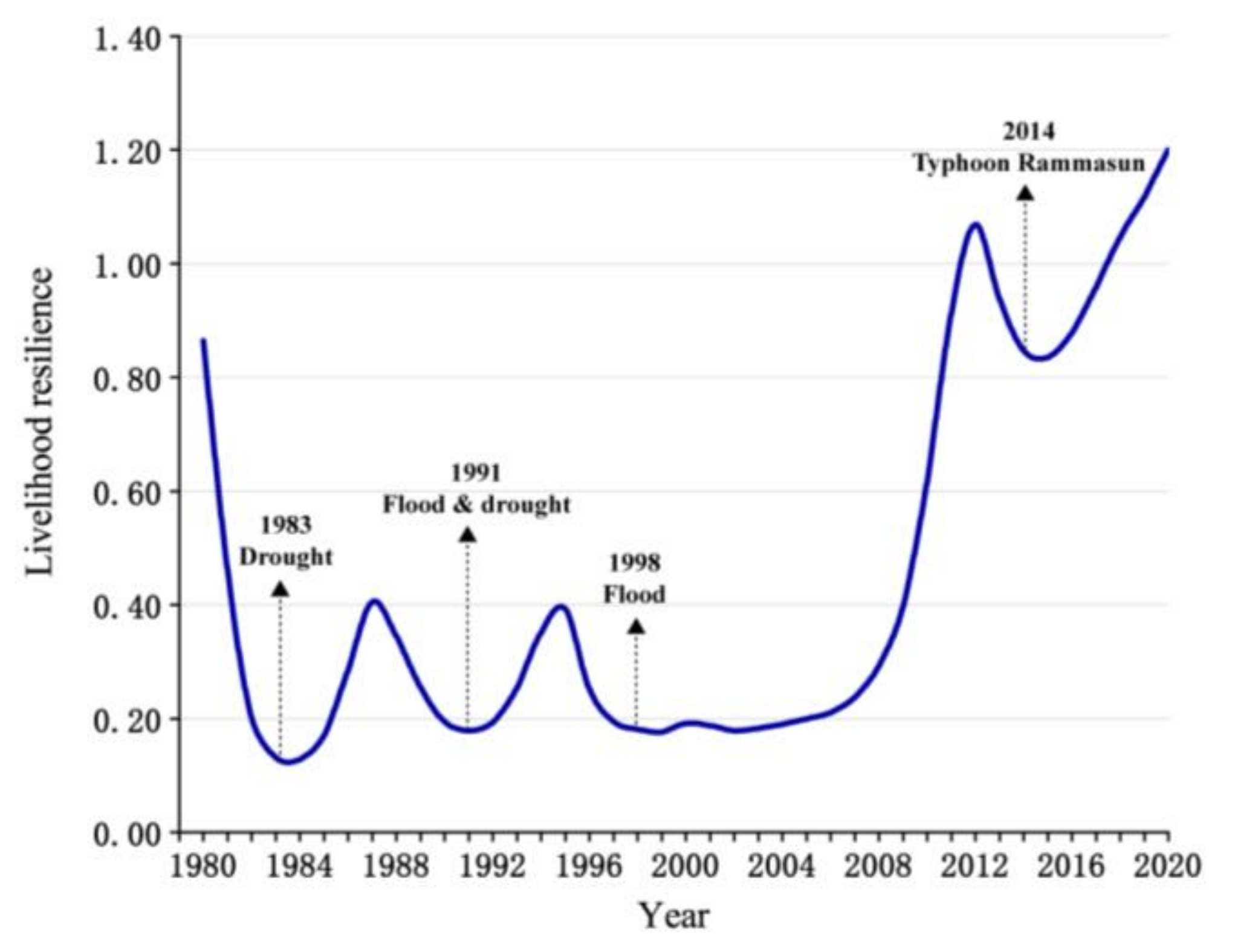
Since 1980, the livelihood resilience of rural residents in China has been on an overall increasing trend, with the year 2003 as the boundary, before which the level of livelihood resilience was low and fluctuated slightly, and after which it showed rapid growth (Figure 1). During the period between 1980 and 1985, there was a large-scale drought across the country, and social and economic construction was still in the initial stage of reform and opening up. The infrastructure construction in rural areas was still incomplete, resulting in major losses due to disaster. Therefore, the livelihood resilience index of rural residents showed a fluctuating downward trend. From 1986 to 1993, the rural livelihood resilience index showed a steady upward trend, but the curve increased slowly. From 1994 to 2002, the rural livelihood resilience index showed an upward and downward fluctuating trend, with an insignificant increase in the curve, and a valley appeared in 1994 and 1999. This was mainly attributed to the occurrence of global climatic anomalies during this period, and the frequent occurrence of meteorological disasters in China, especially the widespread occurrence of heavy rainfall and flooding, which particularly affected rural areas. Since 2003, when China’s rural reform officially entered a new phase of urban–rural integration, the livelihood resilience of rural residents as a whole has shown rapid growth. Although there were still extreme weather and climate impacts during this period, a series of policies by the Chinese Government to strengthen and benefit the agricultural sector helped to increase the resilience of rural residents to risks and disasters to a large extent, further improving their livelihood resilience.

3.1.2. The Changing Characteristics of Livelihood Resilience of Rural Residents in China

Using Pearson correlation analysis, this study explored the relationship between rural residents’ livelihood resilience and the three-dimensional structure of pressure, state, and response. From Table 3, it can be seen that the livelihood resilience of rural residents is significantly and positively correlated with state and response, and significantly and negatively correlated with pressure, indicating that the level of the three is highly relevant to the level of livelihood resilience of rural residents in China.
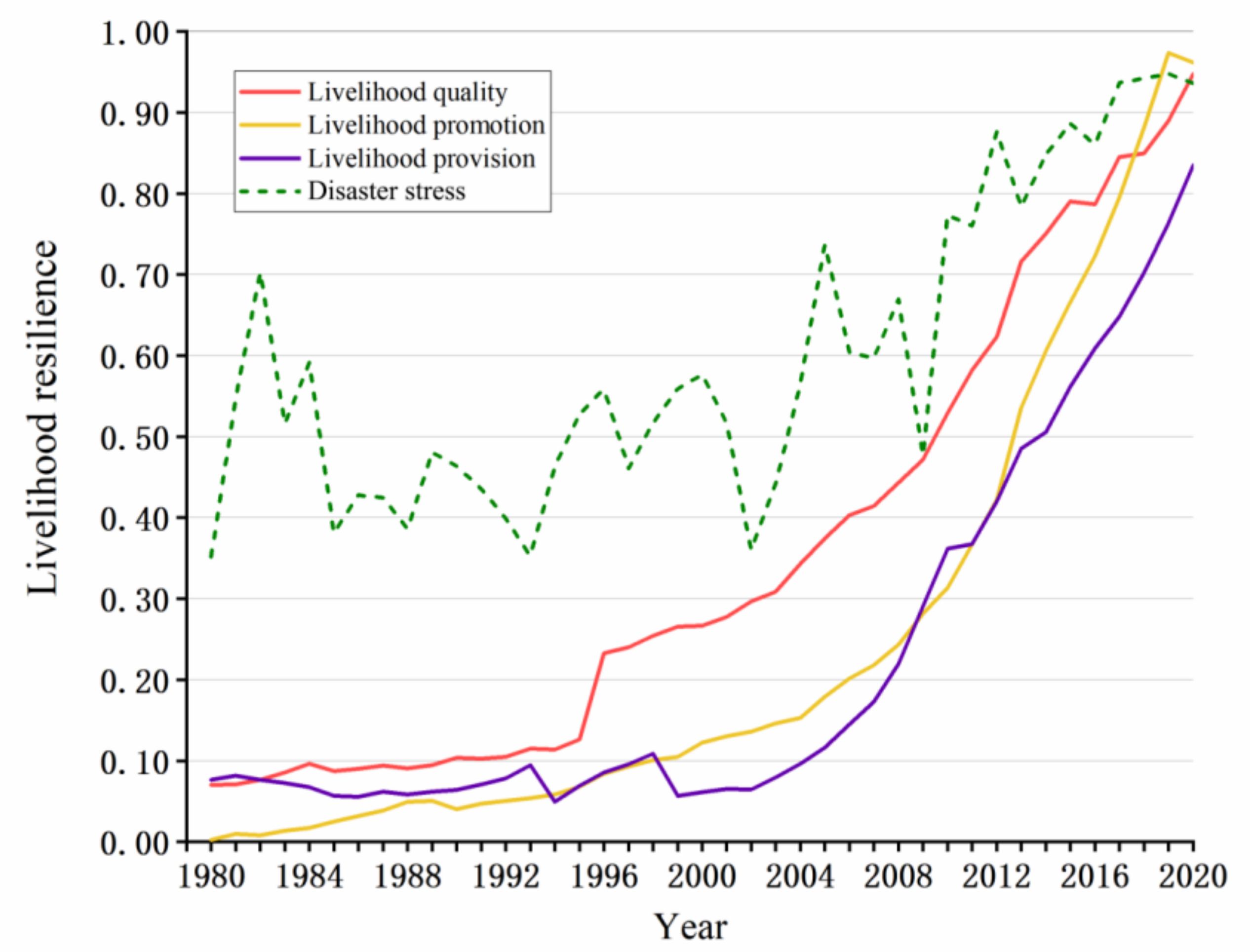
The trend in the three-dimensional structure of livelihood resilience shows that the state and response have an overall increasing upward trend (Figure 2), especially after 2000, when a rapid growth trend occurred, reflecting the rapid increase in China’s rural socio-economic development and infrastructure level in the 21st century.
The trend in the three-dimensional structure of livelihood resilience shows an overall increasing trend in the curves of state and response (Figure 2). In particular, there was a rapid growth trend after 2000, reflecting the level of social–economic development and infrastructure construction of rural China in the 21st century. In addition, pressure also shows a fluctuating growth trend, especially at the time point when the livelihood resilience declined and then increased rapidly. This shows that the level of livelihood resilience in China was significantly affected by natural disasters, and the disaster stress did not change significantly due to the improvement of livelihood quality, livelihood promotion, and livelihood supply.
From 1980 to 2020, the pressure index generally showed fluctuating changes. Since 1980, extreme weather has become frequent in China, resulting in a frequency of natural disasters, especially meteorological disasters. The peaks and troughs of the disaster stress index curve for rural residents appeared alternately, and each rapid increase in disaster stress represented a major natural disaster. From 1980 to 1983, a rare major drought occurred in China, followed by major floods in 1991 and 1998, and a large-scale drought in 2000, the affected area of which reached a magnitude not seen in 41 years, accounting for 25% of the total planting area. Since 2010, disaster stress has shown a fluctuating and rising trend, and has remained at a relatively high level. This was mainly due to the increased frequency of extreme disastrous weather in the context of climate change. In addition to the direct economic losses caused by natural disasters, rural residents have had to invest more money in disaster response, and this additional investment indirectly affected their income, which in turn has caused significant social–economic losses to rural China.
From 1980 to 2020, the overall state index showed a steady upward trend. At the indicator level, the improvement of state was mainly due to the decline of the Engel coefficient, the increase in access to medical care, the improvement of rural per capita education level, and the increase in rural per capita disposable income. From 1980 to 1995, the growth of the state index was relatively slow. According to the Government Work Report, during this period, due to agricultural restructuring, ecological fallowing, and construction occupation, the per capita area of arable land declined from 1.51 mu in 1980 to 1.17 mu in 1995, with a certain negative impact on the state of livelihoods. Meanwhile, rural per capita food production has also shown fluctuations due to uncertainties such as natural disasters and the constant adjustment of cultivated land area, further affecting the livelihood state. In terms of long-term development, the state index grows significantly in the 1980–2020 period. China’s Engel coefficient declined from 61.8 in 1980 at the beginning of China’s reform and opening up to 32.7 in 2020, while the number of beds per 10,000 people in medical and health institutions increased from 22.1 to 64.5, and rural per capita medical consumption expenditure also increased significantly. Since the 1980s, China has implemented the household contract responsibility system, and rural production has been significantly improved. At the same time, the recovery of sideline businesses, diversification of operations, and the transfer of labor to the secondary and tertiary industries has improved the livelihoods of rural residents. The per capita disposable income in rural areas increased from 1980; in increased from CNY 191.3 to CNY 17,131.5 in 2020. In addition, rural residents have gradually emphasized their own and their children’s education, and per capita education expenditures for rural households have risen markedly, resulting in more opportunities for rural residents to acquire knowledge and skills, thereby improving their ability to prevent and withstand livelihood risks, and keeping their livelihoods growing steadily. Rural per capita agricultural machinery total power continued to grow between 1980 and 2020, which helped to improve agricultural production conditions, while reducing, to an extent, the losses caused to agricultural production by natural disasters and contributing to the growth of rural residents’ income. Rural per capita housing construction area and per capita electricity consumption in rural areas also increased year on year, reflecting improvements in the rural productivity and living standards of rural residents, thus creating a virtuous circle. This provided greater development impetus for production and the life of rural residents and has had a positive impact on the livelihood state of rural residents.
Between 1980 and 2020, the response index generally showed a fluctuating upward trend. In particular, during the period from 1980 to 2002, the response index fluctuated and did not change significantly. The response index stagnated or even declined between 1981 and 1986, mainly due to the reduction in the number of beds in medical and health institutions and the per capita minimum living security. In addition, the frequent occurrence of major natural disasters led to a blockage of rural economic development and a slowdown in the growth of fixed-asset investment by rural residents, which caused a valley in the fluctuation curve of the response index in 1994 and 1999. However, since 2003, the rising speed of the state index increased significantly. During this period, the facilities of medical and health institutions were gradually improved, the proportion of local governments’ per capita financial income and expenditure gradually increased, the local government’s financial supply capacity steadily improved, and the intensity of rural residents’ investment in fixed assets further strengthened. Rural per capita minimum living security increased from CNY 1.21 in 2003 to CNY 279.78 in 2020. In years of serious disasters, the government’s financial assistance can enable rural residents to return to normal production and life as soon as possible. With investment in technology, the large amount of rural capital promoted the renewal and improvement of agricultural production technology and the significant improvement of rural production efficiency, especially after the Ministry of Agriculture and Rural Development released the Technical Guidelines for Green Development of Agriculture (2018–2030) in 2018. The construction of rural and agricultural modernization has since received wider attention. It has brought about the effective use of rural labor resources, gradually balancing the relationship between capital and labor resources, providing more security for the livelihood of rural residents, while driving the development of secondary and tertiary industries and providing more employment opportunities. It has also prompted society to invest more in rural areas and promote rural economic development, which plays an important role in promoting the stability of the livelihood system of rural residents.

3.2. Prediction of the Changing Trend of Rural Residents’ Livelihood Resilience

Based on PSR model, the ARIMA model was established according to the constructed livelihood resilience evaluation model. Due to the uncertainty and unpredictability of livelihood pressure, only livelihood state, livelihood response, and livelihood resilience were selected for trend prediction.
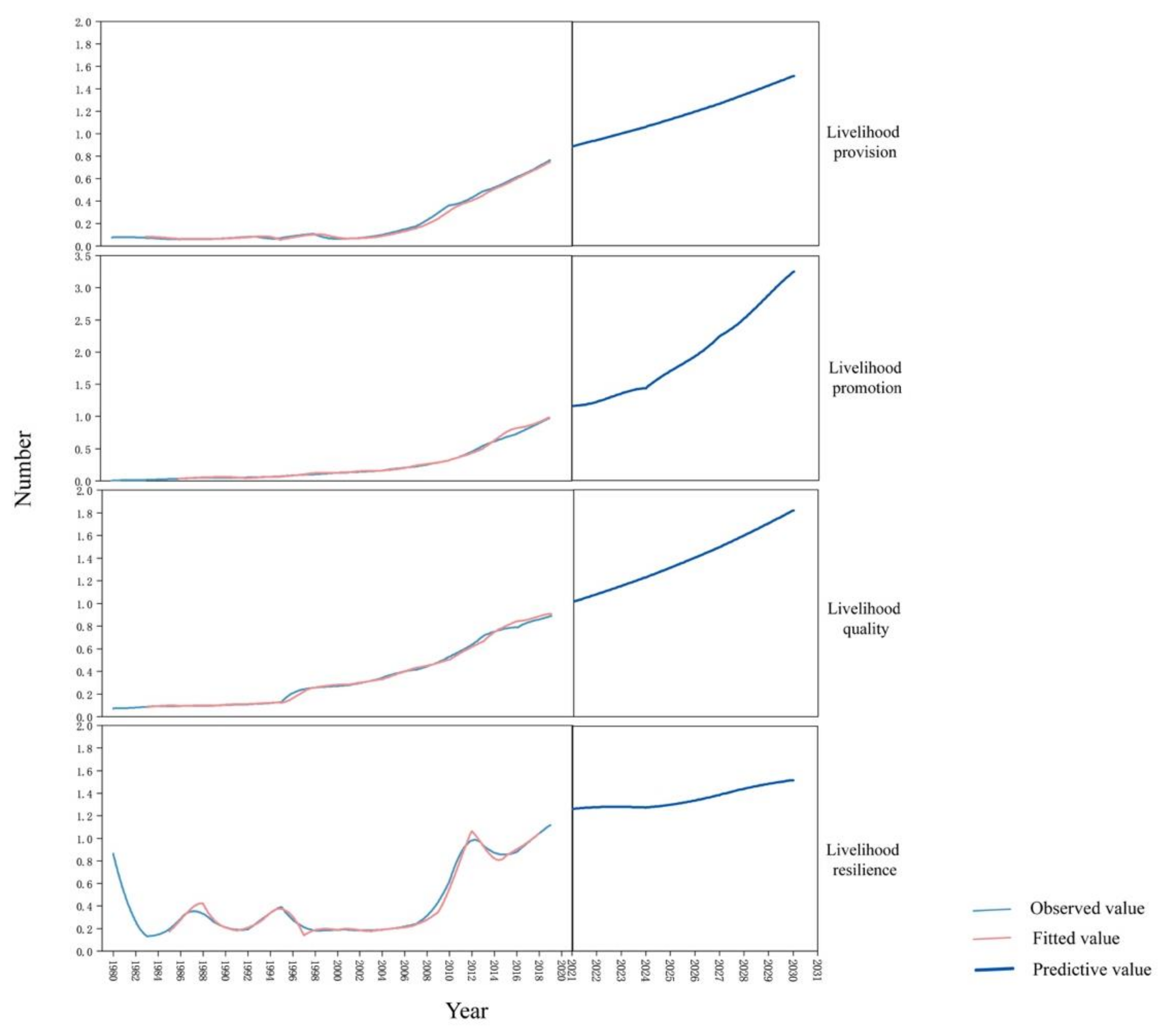
The results of the forecast in Figure 3 show a slow increasing trend of livelihood resilience for rural residents in China from 2021 to 2030. By 2030, the livelihood resilience index will have increased from 0.304 in 2020 to 0.504, with an insignificant overall trend. It can be seen that with the improvement of their production and living conditions and the support and assistance of the government, the volatility of the livelihood system of rural residents will be reduced, and the livelihood of rural residents will enter a stage of stable development in the future. However, no matter how the external conditions are improved, uncertain factors such as natural disasters will always exist and impact the overall livelihood resilience level, so that rural residents’ livelihood resilience will still fluctuate slightly. Therefore, in the future, it is necessary to pay attention to the stability and sustainability of rural residents’ livelihood resilience.
The livelihood state forecast from 2021 to 2030 shows a steady upward trend, which is in line with the 14th Five-Year Plan (2021–2025) for China’s national economic and social development. The 14th Five-Year Plan will further improve people’s livelihood and well-being, consolidate and expand the achievements of poverty alleviation, comprehensively promote the rural revitalization strategy, and promote the construction of public health emergency support and rural education support. The improvement of livelihood state can lead to a more robust development of livelihood resilience among rural residents. It can be expected that as rural society develops, basic livelihood security such as food, clothing, shelter, and transport will gradually stabilize, productive living space will be optimized, the human living environment will be improved, and when basic livelihood needs are met, the focus will shift to other priority areas in the future.
It is predicted that livelihood response will grow rapidly from 2021 to 2030, with the highest growth rate level since the 21st century, indicating that the future strategic development of rural areas in China will remain a key focus of national construction and development. The national government will continue to increase investment in rural construction, improve the multi-level social security system, and speed up the filling of shortcomings in areas such as infrastructure, agriculture, and rural areas, disaster prevention and mitigation, and industrial structure. It can be seen that strengthening the guarantee of rural development factors can promote livelihoods, and the improvement of livelihood response can effectively prevent the shock to rural residents caused by unexpected events. Therefore, livelihood response will be important in the implementation of the rural revitalization strategy in the coming decade, which will also help to incorporate the fundamental role of rural economic formats in social development.

3.3. Ridge Regression Results of Influencing Factors of Livelihood Resilience

According to the regression results (Table 4), the R2 of the model is 0.971, indicating that eight variables could explain 97.1% of the changes in livelihood resilience. Furthermore, the model passed the F test (F = 132.272, p < 0.05), indicating that at least one variable would have an impact on livelihood resilience.
In the economic foundation dimension, the coefficient of rural per capita consumption level (X1) and rural per capita GDP (X2) are 0.048 (p < 0.05), indicating that rural per capita consumption level and rural per capita GDP have a significant positive impact on livelihood resilience.
In the dimension of education level, the regression coefficients of the number of health technicians per thousand population (X3) and higher education penetration level (X4) are 0.054 (p < 0.05) and 0.025 (p < 0.05), respectively, indicating that the higher the value of these two variables, the stronger the sustainable development ability of rural residents’ livelihood system.
In terms of the social characteristics dimension, the proportion of people employed in primary industries (X5) and the mobile phone penetration rate (X6) are 0.027 (p < 0.05) and 0.018 (p < 0.05), respectively, indicating that the proportion of people employed in primary industries and mobile phone penetration have a significant positive impact on livelihood resilience.
In terms of the disaster resistance dimension, the regression coefficient of area of embankment-protected arable land (X8) does not pass the significance test (p > 0.1), while effective irrigated area (X7) is 0.028 (p < 0.05), indicating that the increase in effective irrigated area has a significant positive impact on livelihood resilience.

4. Discussion

4.1. Evaluation and Prediction of Livelihood Resilience

The comprehensive evaluation results show that the livelihood resilience of rural residents in China fluctuated between 1980 and 2020, but generally showed an upward trend. During this period, meteorological disasters occurred frequently in China due to the abnormal global climate [48]. The four major fluctuations of livelihood resilience were all caused by natural disasters, such as droughts or floods in 1983, 1991, and 1998, and Typhoon Rammasun in 2014 [49,50], which made livelihood resilience turn down to the local ‘bottom’. From 2016 to 2020, the livelihoods resilience index showed a rapid upward trend with no major disasters and an improvement in rural socio-economic conditions.
By examining the evaluation value of the three dimensions of resilience, it can be found that the livelihood resilience of rural residents is significantly positively related to livelihood state and livelihood response, and significantly negatively correlated with pressure. According to the trend of the four dimensions between 1980 and 2020, the livelihood state and livelihood response curves showed relatively stable upward trends, while the pressure curve had the characteristic of cyclical fluctuation but still showed an upward trend. Livelihood state, specifically, showed a rapid upward trend. This is mainly due to the implementation of the household contract responsibility system in 1980s and the transfer of rural labor to non-agricultural industry [51], which has greatly improved the quality of life of rural residents. In addition, the increasing emphasis on education among rural residents has greatly improved their ability to withstand life risks [52]. Modernization of agriculture and improvement of rural housing have provided a strong impetus for development in rural areas, which has had a positive impact on improving the state of livelihoods. The response index shows a fluctuating upward trend, in which the government has played a powerful role as a driving force. During the study period, the government’s financial supply capacity has steadily improved, and the expenditure on rural residents’ livelihood security and disaster resistance has also been greatly increased, as well as the investment in agricultural science and technology [53], which has provided a solid guarantee for livelihood resilience. In the context of climate change, natural disasters occur periodically, causing huge economic losses to rural societies in China [54].
Based on the prediction of livelihood resilience from 2021 to 2030, it can be seen that as livelihood state will steadily increase, livelihood response will grow rapidly. Further, the overall livelihood resilience will grow slower than livelihood state and livelihood response. It can be seen that, with the improvement of rural production and living conditions and the role of government assistance [55], the volatility of rural residents’ livelihood system will decrease in the next ten years, and livelihood resilience will enter a stage of stable development.

4.2. Influencing Factors of Rural Residents’ Livelihood Resilience

In the economic foundation dimension, the per capita consumption in rural areas rose rapidly from 178 yuan in 1980 to 16,063 yuan in 2020, which shows that the policies for rural revitalization and poverty alleviation have been effective and have significantly improved the quality of life of rural residents. between 1980 and 2020, rural per capita GDP showed a trend of annual growth. Since 2000 in particular, rural per capita GDP has grown rapidly, this is because at the turn of the century, the state began to transfer payments to rural areas on a large scale, providing basic security for rural residents and alleviating absolute poverty in rural areas [56]. In addition, the abolition of agricultural tax in 2006 [57], the promotion of modern agriculture in 2007 and the construction of agricultural infrastructure in 2008 have further promoted the construction of new countryside [58], resulting in a significant increase in rural GDP and farmers’ income. As a result, the livelihood resilience of China’s rural residents has steadily increased.
In the dimension of education level, the number of health technicians per thousand people reflects the importance the state attaches to health undertakings. The growth rate of health technicians per thousand people had been relatively slow from 1980 to 2000, but showed a trend of rapid growth after 2001, something which is mainly attributed to the reform of national health undertakings [59]. For instance, the new rural cooperative medical system was piloted in 2003 [60], the reform of the medical system was comprehensively deepened in 2009 [59], and the National Health Commission was established in 2018. Higher education penetration level can measure regional education level to some extent. From 1980 to 1998, higher education penetration level was relatively low. However, in 1999, the Ministry of Education launched the Education Revitalization Action Plan for the 21st Century, expanding the ordinary university enrollment [61]. Since then, the proportion of college students has increased year by year. With the joint efforts of the state and of rural residents, the education level of the rural labor force has been continuously improved and rural residents have gained more livelihood capacity through learning, which has a positive impact on the resilience level of livelihood.
In terms of the social characteristics dimension, in 1980, the mobile phone penetration rate was only 0.43%. And by 2012, this rate has exceeded 100%. In 2020, this rate has reached 125.8%. The 1990s saw the fastest growth in mobile phone penetration [62,63]. In a word, the popularity of mobile phones facilitates communication among residents, especially in rural areas where information is relatively isolated. It enables the rapid circulation of livelihood capital of rural residents [64], thus enriching livelihood strategies and improving the livelihood resilience of rural residents.
In terms of the disaster resistance dimension, China’s climate characteristics determine that without the protection of irrigation and water conservancy facilities, there will be no stable agricultural yield [65]. Between 1980 and 2020, while the per capita cultivated land area showed a trend of fluctuating decrease, the area of embankment protected cultivated land still showed a trend of fluctuating increase. After the 1990s in particular, China implemented the eighth five-year Plan (1991–1995), which made clear arrangements for the development of agriculture and water conservancy, and greatly promoted the infrastructure construction [66]. During this period, embankment-protected cultivated land was increased greatly, which improved the disaster resistance level of agriculture and the resilience level of rural residents’ livelihoods.

4.3. Policy Suggestions

Based on the evaluation and prediction of livelihood resilience and the analysis of influencing factors, four policy suggestions are provided for the subsequent improvement of rural residents’ livelihood resilience.
Firstly, the rural revitalization strategy should be taken as an opportunity to promote the optimization and upgrading of economic structure [67,68]. Although the government is taking advantage of the rural revitalization strategy to vigorously support the secondary and tertiary industries in rural China, there are still relatively few employment opportunities there due to the problems of having a single industrial structure, a short tourism industry chain and a great dependence on the natural environment [69]. Therefore, it is necessary to promote the integrated development of primary, secondary and tertiary industries, and realize the dynamic development pattern of government support, industrial integration and rural residents’ participation [70].
Secondly, government should increase the support for rural technical personnel and investment in higher education [71]. At present, education investment in rural areas has been increased, but there is still a problem of uneven distribution of education resources between urban and rural areas [72]. Therefore, more high-quality education resources should be allocated in rural areas, while ensuring that rural students can get equal opportunities to receive education. In addition, local governments should optimize the allocation of human resources while encouraging college students to return to their hometowns to start businesses and find jobs [73], and steadily improve the livelihood resilience in rural areas.
Thirdly, there should be a popularization of knowledge of climate change and natural disasters, and a strengthening of disaster prevention guidance for rural residents [74]. Natural disasters caused by climate change have a great impact on agriculture. Natural disasters such as typhoons, rainstorms, sandstorms, and cold waves often cause a large area of crop yield reduction or even failure [75]. As the main agricultural body, rural residents can effectively reduce disaster losses if they can master the prevention and response measures of climate change and natural disasters and make rational use of agricultural biotechnology and various ecological maintenance means.
Fourthly, it is necessary to promote rural infrastructure projects and implement rural environmental warning and evaluation mechanisms. This study shows that disaster resistance is an important factor affecting the resilience of rural residents. Irrigation and water conservancy is the lifeblood of agricultural development [76]. Over the years, China has suffered serious losses from flood disasters, and the increase of embankment-protected arable land can directly and effectively alleviate the negative effects of flood and soil erosion on agriculture. In addition, rural environmental warning and evaluation mechanisms must be established [77], which requires promoting the development of agricultural modernization, strengthening the support of rural agricultural technology and equipment, and increasing subsidies for the purchase of agricultural machinery, so as to improve the level of agricultural mechanization and informatization. In this way, in the case of external environmental disturbance and climate change, the corresponding departments can immediately make positive responses and take effective measures to minimize the negative impact of natural disasters on rural areas, so as to realize the symbiotic and harmonious development of rural residents and the environment.

4.4. Research Deficiencies and Prospects

Most existing studies evaluate livelihood resilience based on the framework of livelihood resilience analysis, while this study introduces the PSR model, which is a model structure that includes pressure, state, and response. It realizes the study of dynamic changes in livelihood resilience in the context of natural disasters, and also provides a new perspective on the adjustment of rural livelihood systems and response to external disturbances, which is important for reducing disaster losses and scientifically promoting sustainable rural development.
It should be emphasized that there is still a degree of uncertainty in both the dynamic analysis of the past and the prediction of the future trend in livelihood resilience. This study used yearbook data as statistical information, and the research scale was the national scale at the macro level. The research object was only rural resident groups, and there is a need to expand the research on the livelihood resilience of specific groups under the influence of other factors such as policy changes. In addition, the livelihood resilience index is a comprehensive evaluation index influenced by multiple factors, and there are also some unobservable variables, such as residents’ happiness and behavioral characteristics. Therefore, a structural equation model of livelihood influencing factors can be established to measure potential variables with the help of advanced research tools, while exploring the mechanism of synergy between influencing factors. This would provide theoretical bases for finding the best balance between the construction and management of multiple rural areas at a certain time point and for developing strategies for different behavioral objectives to sustain their livelihood levels.

5. Conclusions

This study used the PSR model to measure the livelihood resilience of Chinese rural residents between 1980 and 2020. The results show that although there are fluctuations in the livelihood resilience of Chinese rural residents, the overall trend is upward. The livelihood resilience of rural residents is significantly and positively correlated with state and response, while it is significantly and negatively correlated with pressure. In addition, the livelihood resilience forecast for 2021–2030 shows that livelihood resilience, state, and response are generally on an increasing trend; however, the improvement will slow down in the future. Finally, the seven variables of rural per capita consumption level, rural per capita GDP, number of health technicians per thousand people, higher education penetration level, proportion of people employed in primary industries, mobile phone penetration rate, and effective irrigation area all have a significant positive impact on livelihood resilience, providing a basis for the subsequent enhancement of livelihood resilience.

Author Contributions

H.L., W.P. and F.S.: investigation, software, data curation; W.P., J.H. and F.S.: conceptualization, methodology; W.P., H.L. and J.H.: writing—original draft preparation; F.S., H.L., J.H., J.L., J.F., L.T. and X.F.: writing—review and editing, validation; F.S., J.H. and L.T.: supervision, project administration, funding acquisition. All authors have read and agreed to the published version of the manuscript.

Funding

This research was funded by the National Natural Science Foundation of China, grant number 42171206, 42071159, 51908498, 41901202.

Institutional Review Board Statement

Not applicable.

Informed Consent Statement

Not applicable.

Data Availability Statement

Not applicable.

Conflicts of Interest

The authors declare no conflict of interest.

References

  1. Coumou, D.; Rahmstorf, S. A Decade of Weather Extremes. Nat. Clim. Chang. 2012, 2, 491–496. [Google Scholar] [CrossRef]
  2. Li, Y.; Huang, H.; Song, C. Rural Economic Resilience in Poor Areas and Its Enlightenment: Case Study of Yangyuan County, Hebei Province. Prog. Geogr. 2021, 40, 1839–1846. [Google Scholar] [CrossRef]
  3. Wang, Y. Development Characteristics, Influencing Mechanism and Coping Strategies of Resource-Based Cities in Developing Countries: A Case Study of Urban Agglomeration in Northeast China. Environ. Sci. Pollut. Res. 2022, 29, 25336–25348. [Google Scholar] [CrossRef]
  4. Carr, P.J.; Kefalas, M.J. Hollowing Out the Middle: The Rural Brain Drain and What It Means for America; Beacon Press: Boston, MA, USA, 2009; ISBN 0-8070-4239-0. [Google Scholar]
  5. Liu, Y.; Li, Y. Revitalize the World’s Countryside. Nature 2017, 548, 275–277. [Google Scholar] [CrossRef]
  6. Xiong, S.; Yan, J.; Wu, Y. Review on the Resilience of Farmers’ Livelihoods to Climate Change. Geogr. Res. 2020, 39, 1934–1946. [Google Scholar]
  7. Hui, W.; Yunxue, X.; Siqi, L.; Yilu, R.; Weining, X. A Comparative Study of Chinese Translation of Resilience Terminology in Socio-Ecologi⁃ Cal System and Its Related Research Fields. Urban Plan. Int. 2017, 32, 29–39. [Google Scholar]
  8. Zautra, A.; Hall, J.; Murray, K. Community Development and Community Resilience: An Integrative Approach. Community Dev. 2008, 39, 130–147. [Google Scholar] [CrossRef]
  9. Maguire, B.; Hagan, P. Disasters and Communities: Understanding Social Resilience. Aust. J. Emerg. Manag. 2007, 22, 16–20. [Google Scholar]
  10. Kelly, C.; Ferrara, A.; Wilson, G.A.; Ripullone, F.; Nolè, A.; Harmer, N.; Salvati, L. Community Resilience and Land Degradation in Forest and Shrubland Socio-Ecological Systems: Evidence from Gorgoglione, Basilicata, Italy. Land Use Policy 2015, 46, 11–20. [Google Scholar] [CrossRef]
  11. Folke, C. Resilience (Republished). Ecol. Soc. 2016, 21, 44. [Google Scholar] [CrossRef]
  12. Walker, B.; Salt, D. Resilience Thinking: Sustaining Ecosystems and People in a Changing World; Island Press: Wasington, DC, USA, 2012; ISBN 1-59726-622-1. [Google Scholar]
  13. Walker, B.; Holling, C.S.; Carpenter, S.R.; Kinzig, A. Resilience, Adaptability and Transformability in Social–Ecological Systems. Ecol. Soc. 2004, 9, 5. [Google Scholar] [CrossRef]
  14. Adger, W.N.; Hughes, T.P.; Folke, C.; Carpenter, S.R.; Rockstrom, J. Social-Ecological Resilience to Coastal Disasters. Science 2005, 309, 1036–1039. [Google Scholar] [CrossRef] [PubMed]
  15. Folke, C.; Carpenter, S.; Elmqvist, T.; Gunderson, L.; Holling, C.S.; Walker, B. Resilience and sustainable development: Building adaptive capacity in a world of transformations. Ambio 2002, 31, 437–440. [Google Scholar] [CrossRef]
  16. Scoones, I. Sustainable Rural Livelihoods: A Framework for Analysis. 1998. Available online: https://www.ids.ac.uk/publications/sustainable-rural-livelihoods-a-framework-for-analysis/ (accessed on 10 July 2022).
  17. Ellis, F. Household Strategies and Rural Livelihood Diversification. J. Dev. Stud. 1998, 35, 1–38. [Google Scholar] [CrossRef]
  18. Speranza, C.I.; Wiesmann, U.; Rist, S. An Indicator Framework for Assessing Livelihood Resilience in the Context of Social–Ecological Dynamics. Glob. Environ. Chang. 2014, 28, 109–119. [Google Scholar] [CrossRef]
  19. Gautam, Y. Seasonal Migration and Livelihood Resilience in the Face of Climate Change in Nepal. Mt. Res. Dev. 2017, 37, 436–445. [Google Scholar] [CrossRef]
  20. Pratiwi, N.; Karuniasa, M.; Suroso, D. Self-Organization and Crop Insurance to Enhance Livelihood Resilience: A Case of Rice Farmers in Cirebon Regency, Indonesia. ASEAN J. Community Engag. 2018, 2. [Google Scholar] [CrossRef]
  21. Yang, X.; Shi, Y.; Wang, Z. Exploring the Impacts of Road Construction on a Local Social-Ecological System in Qinling Mountainous Area: A Resilience Perspective. Acta Geogr. Sin. 2015, 70, 1313–1326. [Google Scholar]
  22. Su, F.; Xu, Z.; Shang, H. An Overview of Sustainable Livelihoods Approach. Adv. Earth Sci. 2009, 24, 61–69. [Google Scholar]
  23. Liu, W.; Li, J.; Ren, L.; Xu, J.; Li, C.; Li, S. Exploring Livelihood Resilience and Its Impact on Livelihood Strategy in Rural China. Soc. Indic. Res. 2020, 150, 977–998. [Google Scholar] [CrossRef]
  24. Quandt, A. Measuring Livelihood Resilience: The Household Livelihood Resilience Approach (HLRA). World Dev. 2018, 107, 253–263. [Google Scholar] [CrossRef]
  25. Tian, S.; Chen, J. Farmers’ Adaptation to Climate Change within the Sustainable Livelihood Framework. China Popul. Resour. Environ. 2014, 24, 31–37. [Google Scholar]
  26. Chitongo, L. Rural Livelihood Resilience Strategies in the Face of Harsh Climatic Conditions. The Case of Ward 11 Gwanda, South, Zimbabwe. Cogent Soc. Sci. 2019, 5, 1617090. [Google Scholar] [CrossRef]
  27. Ramanath, R. Defying NGO-Ization?: Lessons in Livelihood Resilience Observed among Involuntarily Displaced Women in Mumbai, India. World Dev. 2016, 84, 1–17. [Google Scholar] [CrossRef]
  28. Thulstrup, A.W. Livelihood Resilience and Adaptive Capacity: Tracing Changes in Household Access to Capital in Central Vietnam. World Dev. 2015, 74, 352–362. [Google Scholar] [CrossRef]
  29. Qin, Y.; Shi, X.; Li, X.; Yan, J. Geographical Indication Agricultural Products, Livelihood Capital, and Resilience to Meteorological Disasters: Evidence from Kiwifruit Farmers in China. Environ. Sci. Pollut. Res. 2021, 28, 65832–65847. [Google Scholar] [CrossRef] [PubMed]
  30. Weldegebriel, Z.B.; Amphune, B.E. Livelihood Resilience in the Face of Recurring Floods: An Empirical Evidence from Northwest Ethiopia. Geoenviron. Disaster 2017, 4, 10. [Google Scholar] [CrossRef]
  31. Arouri, M.; Nguyen, C.; Youssef, A.B. Natural Disasters, Household Welfare, and Resilience: Evidence from Rural Vietnam. World Dev. 2015, 70, 59–77. [Google Scholar] [CrossRef]
  32. Zhao, R.; Fang, C.; Liu, H. Progress and Prospect of Urban Resilience Research. Prog. Geogr. 2020, 39, 1717–1731. [Google Scholar] [CrossRef]
  33. Zhao, X. Sustainable Livelihoods Research from the Perspective of Geography: The Present Status, Questions and Priority Areas. Geogr. Res. 2017, 36, 1859–1872. [Google Scholar]
  34. Liu, Z.; Liu, L. Characteristics and Driving Factors of Rural Livelihood Transition in the East Coastal Region of China: A Case Study of Suburban Shanghai. J. Rural. Stud. 2016, 43, 145–158. [Google Scholar] [CrossRef]
  35. Li, H.; Zhang, P. Research Progress and Prospective Applications of Vulnerability Approach under Global Change. Prog. Geogr. 2011, 30, 920–929. [Google Scholar]
  36. Jieer, R.; Yingbiao, C.; Zhiwei, Y. Assessment of temporal and spatial progress of urban resilience in Guangzhou under rainstorm scenarios. Int. J. Disaster Risk Reduct. 2021, 66, 102578. [Google Scholar] [CrossRef]
  37. Gerlitz, J.-Y.; Macchi, M.; Brooks, N.; Pandey, R.; Banerjee, S.; Jha, S.K. The Multidimensional Livelihood Vulnerability Index–an Instrument to Measure Livelihood Vulnerability to Change in the Hindu Kush Himalayas. Clim. Dev. 2017, 9, 124–140. [Google Scholar] [CrossRef]
  38. Qiu, M.; Liu, D.; Liu, Y. Review on Theoretical Framework and Evaluation System of Rural Resilience. China Land Sci. 2021, 35, 107–114. [Google Scholar]
  39. You, H.; Zhang, X. Sustainable Livelihoods and Rural Sustainability in China: Ecologically Secure, Economically Efficient or Socially Equitable? Resour. Conserv. Recycl. 2017, 120, 1–13. [Google Scholar] [CrossRef]
  40. Jadhav, V.; Reddy, B.V.C.; Gaddi, G.M. Application of ARIMA Model for Forecasting Agricultural Prices. J. Agric. Sci. Technol. 2017, 19, 981–992. [Google Scholar]
  41. Xiong, Z. Research on GDP Time Series Forecasting Based on Integrating ARIMA with Neural Networks. J. Appl. Stat. Manag. 2011, 30, 306–314. [Google Scholar] [CrossRef]
  42. Tsai, T.-R.; Wu, S.-J. Fuzzy-Weighted Estimation in Ridge Regression Analysis. J. Inf. Optim. Sci. 2002, 23, 259–271. [Google Scholar] [CrossRef]
  43. Wang, C.; Dai, R.; Chen, J.; Shen, Y.; Ji, M. Research on the Evolution Law and Promotion Pathway of Rural Human Settlements System Resilience: A Case Study of Western Chongqing, a National Pilot Area for Urban-Rural Integration. J. Nat. Resour. 2022, 37, 645–661. [Google Scholar] [CrossRef]
  44. Fang, Y. The Effects of Natural Capital Protection on Pastoralist’s Livelihood and Management Implication in the Source Region of the Yellow River, China. J. Mt. Sci. 2013, 10, 885–897. [Google Scholar] [CrossRef]
  45. Fang, Y.; Zhu, F.; Qiu, X.; Zhao, S. Effects of Natural Disasters on Livelihood Resilience of Rural Residents in Sichuan. Habitat Int. 2018, 76, 19–28. [Google Scholar] [CrossRef]
  46. Pandey, R.; Jha, S.K.; Alatalo, J.M.; Archie, K.M.; Gupta, A.K. Sustainable Livelihood Framework-Based Indicators for Assessing Climate Change Vulnerability and Adaptation for Himalayan Communities. Ecol. Indic. 2017, 79, 338–346. [Google Scholar] [CrossRef]
  47. Nasrnia, F.; Ashktorab, N. Sustainable Livelihood Framework-Based Assessment of Drought Resilience Patterns of Rural Households of Bakhtegan Basin, Iran. Ecol. Indic. 2021, 128, 107817. [Google Scholar] [CrossRef]
  48. Fang, S.L. Modern Control Theory and Its Practice in MATLAB; Zhejiang University Press: Hangzhou, China, 2005. [Google Scholar]
  49. Liu, Y.; Geng, X.; Hao, Z.; Zheng, J. Changes in Climate Extremes in Central Asia under 1.5 and 2 C Global Warming and Their Impacts on Agricultural Productions. Atmosphere 2020, 11, 1076. [Google Scholar] [CrossRef]
  50. Duan, W.; He, B.; Nover, D.; Fan, J.; Yang, G.; Chen, W.; Meng, H.; Liu, C. Floods and Associated Socioeconomic Damages in China over the Last Century. Nat. Hazards 2016, 82, 401–413. [Google Scholar] [CrossRef]
  51. Wang, X.; Wang, X.; Zhai, J.; Li, X.; Huang, H.; Li, C.; Zheng, J.; Sun, H. Improvement to Flooding Risk Assessment of Storm Surges by Residual Interpolation in the Coastal Areas of Guangdong Province, China. Quat. Int. 2017, 453, 1–14. [Google Scholar] [CrossRef]
  52. Guo, Y.; Wang, J. Poverty Alleviation through Labor Transfer in Rural China: Evidence from Hualong County. Habitat Int. 2021, 116, 102402. [Google Scholar] [CrossRef]
  53. Xue, E.; Li, J.; Li, X. Sustainable Development of Education in Rural Areas for Rural Revitalization in China: A Comprehensive Policy Circle Analysis. Sustainability 2021, 13, 13101. [Google Scholar] [CrossRef]
  54. Zhang, M.; Xiang, W.; Chen, M.; Mao, Z. Measuring Social Vulnerability to Flood Disasters in China. Sustainability 2018, 10, 2676. [Google Scholar] [CrossRef]
  55. Liu, H. The Key Points, Development Path and Potential Traps in Promoting Rural Vitalization Strategy. J. Xinjiang Norm. Univ. 2018, 39, 25–33. [Google Scholar] [CrossRef]
  56. Liu, Y.; Liu, J.; Zhou, Y. Spatio-Temporal Patterns of Rural Poverty in China and Targeted Poverty Alleviation Strategies. J. Rural Stud. 2017, 52, 66–75. [Google Scholar] [CrossRef]
  57. Wang, X.; Shen, Y. The Effect of China’s Agricultural Tax Abolition on Rural Families’ Incomes and Production. China Econ. Rev. 2014, 29, 185–199. [Google Scholar] [CrossRef]
  58. Bao, W. New Countryside Construction and Sustainable Rural Settlement Development in China. In Proceedings of the Renewable and Sustainable Energy; Trans Tech Publications Ltd.: Pfaffikon, Switzerland, 2012; Volume 347, pp. 897–900. [Google Scholar]
  59. Wang, C.; Rao, K.; Wu, S.; Liu, Q. Health Care in China: Improvement, Challenges, and Reform. Chest 2013, 143, 524–531. [Google Scholar] [CrossRef] [PubMed]
  60. Liu, P.; Guo, W.; Liu, H.; Hua, W.; Xiong, L. The Integration of Urban and Rural Medical Insurance to Reduce the Rural Medical Burden in China: A Case Study of a County in Baoji City. BMC Health Serv. Res. 2018, 18, 796. [Google Scholar] [CrossRef] [PubMed]
  61. Li, J. Educational Policy Development in China for the 21st Century: Rationality and Challenges in a Globalizing Age. Chin. Educ. Soc. 2017, 50, 133–141. [Google Scholar] [CrossRef]
  62. Xia, J. Linking ICTs to Rural Development: China’s Rural Information Policy. Gov. Inf. Q. 2010, 27, 187–195. [Google Scholar] [CrossRef]
  63. Ward, M.R.; Zheng, S. Mobile Telecommunications Service and Economic Growth: Evidence from China. Telecommun. Policy 2016, 40, 89–101. [Google Scholar] [CrossRef]
  64. Ma, W.; Grafton, R.Q.; Renwick, A. Smartphone Use and Income Growth in Rural China: Empirical Results and Policy Implications. Electron. Commer. Res. 2020, 20, 713–736. [Google Scholar] [CrossRef]
  65. Huang, Q.; Rozelle, S.; Lohmar, B.; Huang, J.; Wang, J. Irrigation, Agricultural Performance and Poverty Reduction in China. Food Policy 2006, 31, 30–52. [Google Scholar] [CrossRef]
  66. Huang, H.; Zhuo, L.; Wang, R.; Shang, K.; Li, M.; Yang, X.; Wu, P. Agricultural Infrastructure: The Forgotten Key Driving Force of Crop-Related Water Footprints and Virtual Water Flows in China. J. Clean. Prod. 2021, 309, 127455. [Google Scholar] [CrossRef]
  67. Zhang, Y.; Diao, X. The Changing Role of Agriculture with Economic Structural Change—The Case of China. China Econ. Rev. 2020, 62, 101504. [Google Scholar] [CrossRef]
  68. Liu, Y.; Zang, Y.; Yang, Y. China’s Rural Revitalization and Development: Theory, Technology and Management. J. Geogr. Sci. 2020, 30, 1923–1942. [Google Scholar] [CrossRef]
  69. Xiao, W.; Du, Z. Integration of Rural Primary, Secondary and Tertiary Industries: Kernel Interpretation of Connotation, Development Status and Future Ideas. J. Northwest A F Univ. 2019, 19, 120–129. [Google Scholar] [CrossRef]
  70. Cui, W.; Chen, J.; Yuan, Y.; Shen, H.; Zhou, Q. Exploration on the Process of Rural Three-Industry Integration through the Stage of Symbiosis. Wirel. Commun. Mob. Comput. 2022, 2022, 7419736. [Google Scholar] [CrossRef]
  71. Xu, L.; Zhao, H.; Chernova, V.; Strielkowski, W.; Chen, G. Research on Rural Revitalization and Governance from the Perspective of Sustainable Development. Front. Environ. Sci. 2022, 10, 168. [Google Scholar] [CrossRef]
  72. Yang, J.; Huang, X.; Liu, X. An Analysis of Education Inequality in China. Int. J. Educ. Dev. 2014, 37, 2–10. [Google Scholar] [CrossRef]
  73. Ou, Q.; Chen, Y.; Peng, M. Research on the Promotion Path of College Students’ Returning Home to Start Businesses under the Background of Rural Revitalization. Financ. Forum 2020, 9, 157. [Google Scholar] [CrossRef]
  74. Zhou, W.; Guo, S.; Deng, X.; Xu, D. Livelihood Resilience and Strategies of Rural Residents of Earthquake-Threatened Areas in Sichuan Province, China. Nat. Hazards 2021, 106, 255–275. [Google Scholar] [CrossRef] [PubMed]
  75. Shi, W.; Wang, M.; Liu, Y. Crop Yield and Production Responses to Climate Disasters in China. Sci. Total Environ. 2021, 750, 141147. [Google Scholar] [CrossRef]
  76. Jie, B.; Feng, N.; Yun, B.; Kang, Z.; Shurong, W.; Lidan, G. On the Countermeasures of Groundwater Protection and Food Safety Protection China North Area. Procedia Eng. 2016, 154, 132–137. [Google Scholar] [CrossRef]
  77. Sha, F. Environmental Protection and Sustainable Development of Rural Economy. Agric. Technol. 2005, 16–20. [Google Scholar]
Figure 1. Changes in livelihood resilience of rural residents in China.
Sustainability 14 08540 g001
Figure 2. The change trend of the four-dimensional structure of livelihood resilience.
Sustainability 14 08540 g002
Figure 3. Prediction of rural residents’ livelihood resilience from 2021 to 2030.
Sustainability 14 08540 g003
Table 1. The livelihood resilience evaluation index system of rural residents.
DimensionIndicatorUnitQualityWeight
PressureThe proportion of rainstorm and flood-affected area in total planting area%Negative0.009
The proportion of drought-affected area in total planting area%Negative0.017
The proportion of wind and hail disaster-affected area in total planting area%Negative0.017
The proportion of low-temperature disaster-affected area in total planting area%Negative0.004
StateEngel’s coefficient%Negative0.034
Rural per capita disposable incomeCNYPositive0.071
Rural per capita education, culture and entertainment consumption expendituresCNYPositive0.078
Rural residents’ per capita medical consumption expendituresCNYPositive0.099
Per capita arable land areaMuPositive0.017
Rural per capita grain outputTonPositive0.041
Rural per capita agricultural machinery total powerWattPositive0.048
Rural per capita housing construction aream2Positive0.027
Rural per capita electricity consumptionKWHPositive0.066
ResponseBeds in medical and health institutions for 10,000 people-Positive0.073
The proportion of local government’s per capita financial income and expenditure%Negative0.031
Rural per capita investment in fixed assetsCNYPositive0.039
Rural per capita minimum living securityCNYPositive0.139
Per capita agricultural, forestry and water fiscal expenditureCNYPositive0.099
Per capita natural science and technology research expenditureCNYPositive0.091
Note: The attribute of the indicators can be divided into positive and negative. The larger the value of the positive indicator, the better the evaluation result, while the larger the value of the negative indicator, the worse the evaluation result.
Table 2. Factors affecting livelihood resilience.
DimensionVariableCodeExplanation
Economic foundationRural per capita consumption levelX1The more rural per capita GDP, or the higher per capita consumption level, the better the economic level.
Rural per capita GDPX2
Science and education levelThe number of health technicians per thousand populationX3The higher the number of health technicians per thousand people, or the wider the reach of higher education, the higher the level of science and education in the region.
Higher education penetration levelX4
Social characteristicsProportion of people employed in primary industriesX5The lower the proportion of people employed in primary industries, or the higher the penetration of mobile phones, the more diverse the means of living, and therefore the more stable the social system.
Mobile phone penetration rateX6
Disaster resistanceEffective irrigation areaX7The larger the area of effective irrigation or the larger the area of embankment protected cultivated land, the higher the level of disaster resistance infrastructure construction.
Area of embankment-protected arable landX8
Table 3. Correlation analysis of livelihood resilience structure dimensions.
DimensionLivelihood Resilience
Correlation Coefficient p-Value
Pressure−0.897 ***0.000
State0.995 ***0.000
Response0.993 ***0.000
Note: *** indicate significant at 10% level.
Table 4. Ridge regression results of influencing factors of livelihood resilience.
DimensionVariableUnstandardized CoefficientStandardized Coefficientt-Valuep-ValueR2F-Value
BSE
ConstantC0.0130.004-3.4460.002 ***0.971132.272 (0.000 ***)
Economic foundationX10.0480.0020.1621.9510.000 ***
X20.0480.0020.15521.5160.000 ***
Science and education levelX30.0540.0030.16420.480.000 ***
X40.0250.0020.10315.3340.000 ***
Social characteristicsX50.0270.0020.09711.6260.000 ***
X60.0180.0010.11418.2740.000 ***
Disaster resistanceX70.0280.0020.10715.4490.000 ***
X80.0010.0040.0040.3220.75
Note: *** indicate significant at 10% level.
Publisher’s Note: MDPI stays neutral with regard to jurisdictional claims in published maps and institutional affiliations.