Article

Thermal Regulation of Coastal Urban Forest Based on ENVI-Met Model—A Case Study in Qinhuangdao, China


School of Landscape Architecture, Beijing Forestry University, Beijing 100083, China
*
Authors to whom correspondence should be addressed.
These authors contributed equally to this work.
Sustainability 2022, 14(12), 7337; https://doi.org/10.3390/su14127337
Submission received: 15 May 2022 / Revised: 6 June 2022 / Accepted: 14 June 2022 / Published: 15 June 2022

Abstract

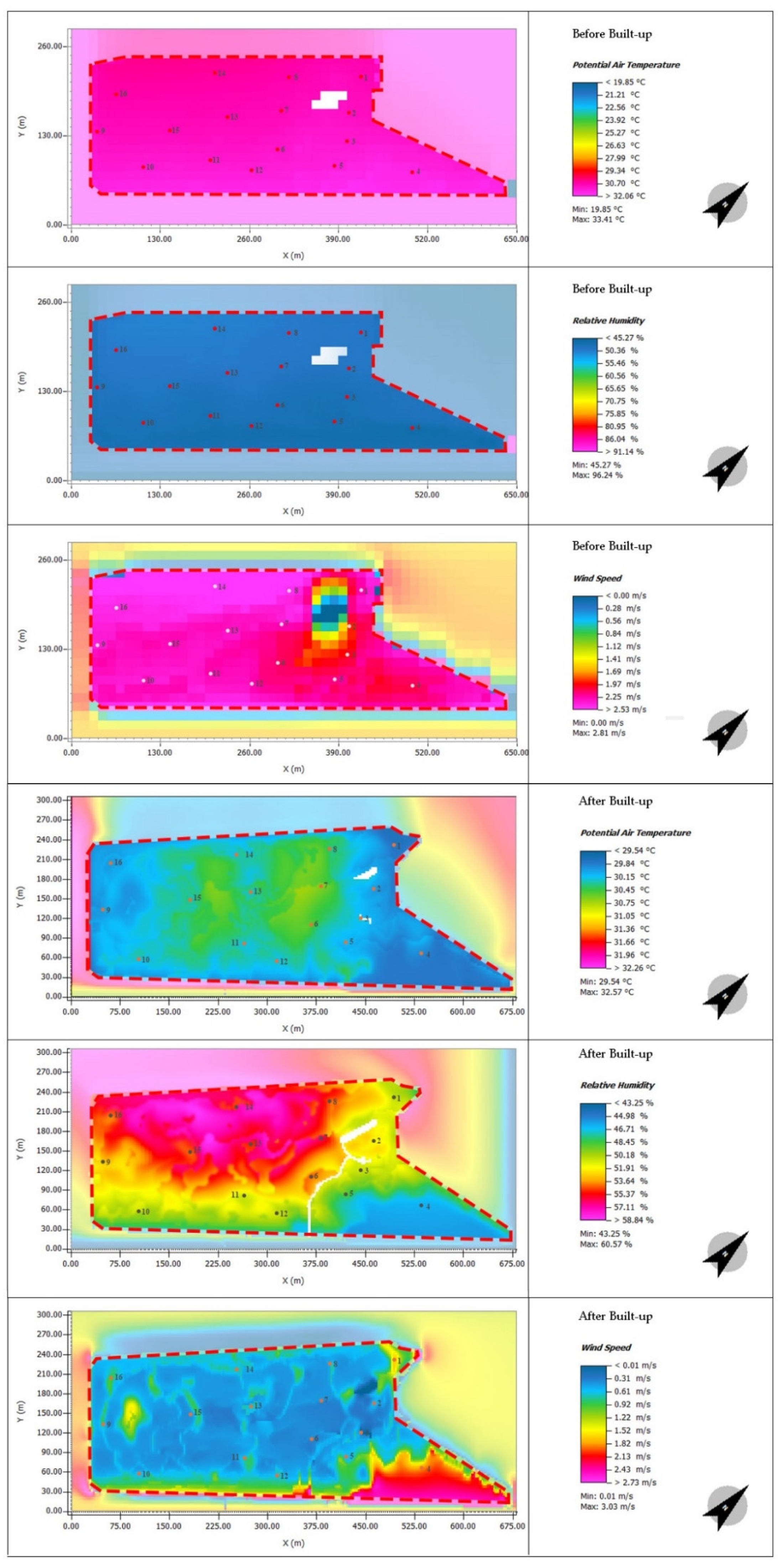
Urban forests can improve human comfort by improving the near-surface microclimate. Exploring the microclimate characteristics of urban forests and their impact on human comfort is particularly important to improve the urban thermal environment through scientific urban forest design. Since most previous studies were conducted under typical inland urban climates and little is known about the thermal regulation services of coastal urban forests, this study field measured the thermal surface radiation temperature of 16 open spaces in the urban forest site in Qinhuangdao. Then the ENVI-met software was used to simulate and analyze the microclimate characteristics before and after the park’s building-up, and compare the differences in the human comfort index in different scenarios. Results indicated that: (1) Vegetation have a significant cooling effect on surrounding environment. The farther away from vegetation area, the higher the average surface temperature. (2) Water bodies have the best cooling and humidifying effect on the 9–18 m surrounding environment with the best human comfort index. (3) In summer, air temperature in park decreased by 0.4~1.4 °C, and the relative humidity increased by 0.07~2.81%. (4) After the park’s built-up, the average human comfort index was optimized by 0.02~1.87. Arranging the leisure open space around the water bodies and forest edge space of the deciduous broad-leaved forest could improve human comfort. This research is expected to provide a scientific basis and planning inspiration for the construction of coastal urban forests in the same latitude area.
Keywords: coastal urban forest; design optimization; thermal regulation; outdoor thermal comfort; ENVI-met simulation; urban forest park coastal urban forest; design optimization; thermal regulation; outdoor thermal comfort; ENVI-met simulation; urban forest park