Abstract
Redundant resources are indispensable resources in corporate entrepreneurship. Nowadays, establishing how to evaluate the impact of redundant resources on corporate entrepreneurial performance has become a critical issue considered by managers. However, few studies have addressed this issue. Based on the perspective of resource bricolage and corporate resource interaction, this work constructs a theoretical model to analyze the influence of redundant resources on corporate entrepreneurial performance. Data were collected in Chinese enterprises. A structural equation modeling (SEM) technique was used. We obtained four valuable conclusions. First, redundant resources have a significant positive effect on corporate entrepreneurial performance. Second, redundant resources exert a significant positive influence on resource bricolage. Third, resource bricolage has a significant positive influence on corporate entrepreneurial performance. Fourth, resource bricolage plays a partial mediation effect between redundant resources and corporate entrepreneurial performance. The insights can provide theoretical and practical guidance for enterprises that intend to use redundant resources to carry out entrepreneurial activities.
1. Introduction
Corporate entrepreneurship is the hot topic in the field of entrepreneurship research [1], and it refers to the process of innovation, new business and strategic update by individuals or teams in an enterprise [2]. In the context of digital transformation, in the face of a highly competitive and dynamic environment, more and more enterprises are engaging in a variety of entrepreneurial activities by revitalizing their resources. In a given market, compared with new companies, existing enterprises often have more resources, business knowledge, etc. However, due to the turbulent environment, existing enterprises do not always have an advantage in competing with new companies. On the contrary, new enterprises can flexibly take advantage of the opportunities caused by the changes in the market and quickly seize the market share, which has attracted the widespread attention of scholars [3].
Resources are one of the core elements in a corporate entrepreneurial model. Redundant resources indicate the difference between the resources actually owned by the enterprise and the resources occupied by the operation process. Such resources can provide support for enterprises to identify and take the chances and quickly carry out competitive activities. Moreover, it can be of great significance to the establishment of a corporate competitive advantage and the promotion of its market position [4,5] However, resource-based theory states that redundant resources can only exert their value under certain conditions. In other words, redundant resources do not directly translate into corporate entrepreneurial performance [6]. Corporate entrepreneurial performance represents a series of behaviors that an enterprise identifies as entrepreneurial opportunities, dynamically optimizes resource, and uses all kinds of innovation activities to plan strategies and achieve essential development [6]. In reality, enterprises often apply resource bricolage to exert the value of redundant resources. Resource bricolage can fully exploit and utilize the inherent properties of redundant resources, which is helpful for enterprises to control and utilize market opportunities [7]. At present, scholars mostly focus on the resource action in the process of enterprise entrepreneurship and ignore the effect of redundant resources on corporate entrepreneurial performance. In view of this, this study proposes the following research question.
RQ: How do redundant resources actually affect a company’s entrepreneurial performance? Specifically, can redundant resources stimulate the enterprises’ entrepreneurial activities to achieve entrepreneurial performance? If redundant resources can play this role, what is the entire impact process? In addition, do redundant resources exert this effect directly or indirectly through some factors?
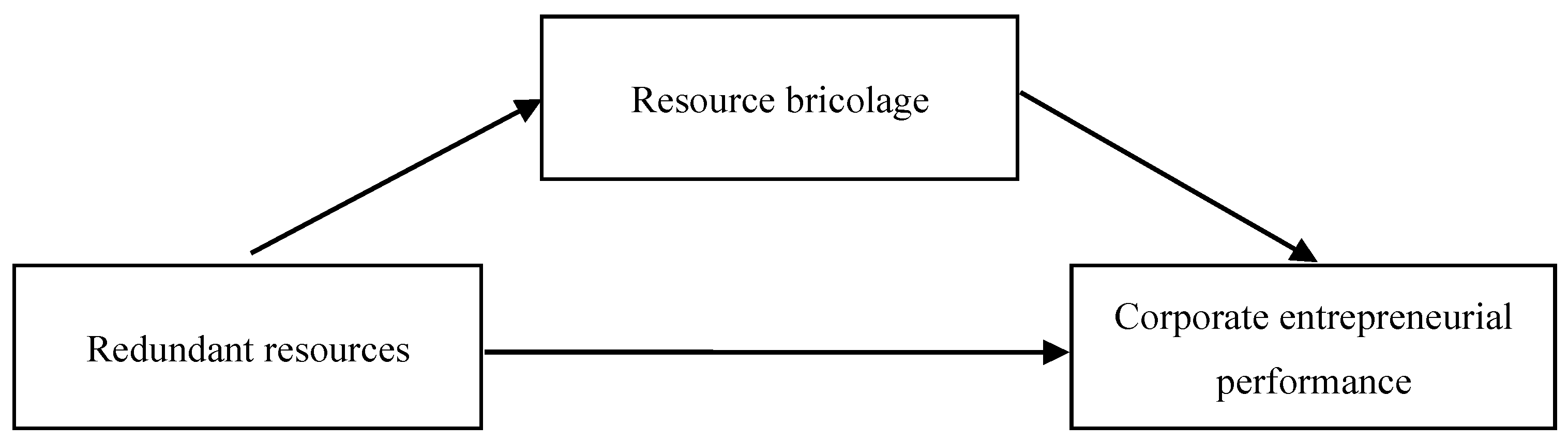
To address this question, this study evaluates the effect of redundant resources on corporate entrepreneurial performance and the mediation effect of resource bricolage. A schematic diagram of this study is shown in Figure 1. So far, most of the existing research has analyzed corporate entrepreneurship from the perspectives of external enterprise and individual enterprise. Little research focuses on the role of internal company factors [8,9,10,11,12,13,14,15,16,17,18]. However, resource bricolage is an effective means for enterprises to utilize redundant resources. It can help enterprises to examine and explore the potential value of corporate resources, and it provides an insight for enterprises to develop and reconstruct redundant resources. Therefore, this study will have important theoretical and practical significance.
Figure 1.
Schematic diagram of this research.
The potential contribution of this research is that we construct a theoretical model that can show that redundant resources affect corporate entrepreneurial performance. This theoretical model not only describes which factors can have a significant impact on corporate entrepreneurial performance, but also explains the interaction of these factors. It shows the effect process of redundant resources–resource bricolage–corporate entrepreneurial performance. At present, most of the studies on the pre-factors of corporate entrepreneurship analyze it from the perspective of resource stock. This research proves that internal redundant resources are also one of the important antecedents of entrepreneurial activities. In addition, most of the existing studies on resource bricolage focus on the practices of new enterprises, which ignores the integration of internal resources by existing enterprises. In this sense, this article enriches the research systems of redundant resources and resource bricolage to some extent. The insights of this study can provide reference and support for enterprise managers to integrate redundant resources and implement resource bricolage to improve corporate entrepreneurial performance.
2. Theoretical Backgrounds
2.1. Redundancy Resources
Cyert and March first proposed redundant resources in 1963, and they pointed out that there was a difference in essence [19]. In detail, redundant resources refer to the difference between the resources owned by the enterprise and the resources occupied by the operation process [20,21]. In other words, it represents underutilized resources and capabilities in enterprises [22,23]. On this basis, many scholars proposed that redundant resources were temporarily idle, potential and untapped resources [24,25]. Based on these concepts, we believe that redundant resources are resources that can reflect the elasticity and flexibility of an organization and can be re-excavated, assembled and utilized according to the corporate development plan. In addition, redundant resources are divided into unabsorbed redundant resources and absorbed redundant resources, depending on whether the resources can be used for strategic objectives [26]. To obtain novel insights, we also adopt this classification in this study. It should be noted that unabsorbed redundant resources are embedded in the operational process of organization and have poor liquidity. Such resources are not fully utilized, and it is difficult to demonstrate their values in a short period, such as semi-finished products, untimely workers and equipment [27]. On the contrary, absorbed redundant resources represent resources that are highly liquid and can be flexibly allocated, such as cash and raw materials [27].
2.2. Resource Bricolage
Redundant resources can prompt enterprises to adjust their decisions to make full use of these resources [28,29]. Baker and Nelson (2005) combined resource bricolage with entrepreneurship, and believed that in the early stage of entrepreneurship, enterprises faced severe resource constraints. Resource bricolage could activate and expand the use of existing resources and provide resource support for enterprises to solve new problems or take advantage of new opportunities [30]. Based on this point of view, we believe that resource bricolage is a resource action to make use of opportunities, quickly examine the inherent characteristics of existing resources, and realize resource reconstruction. It links resources and opportunities effectively.
In addition, according to the studies by Rönkkö et al. (2013) and Senyard et al. (2014), we divide resource bricolage into three types: elements bricolage, customer bricolage and institution bricolage [31,32]. Elements bricolage refers to the activities in which an organization examines, mines, reorganizes, and utilizes various resources with potential to maximize the value of these resources [31]. Customer bricolage is the activities in which enterprises provide services to customers outside the scope of corporate services, and make them an external resource of this company [31] Institution bricolage indicates the activities in which enterprises use existing resources to break through traditional rules, and realize new business models, technical norms and conventions [31].
2.3. Corporate Entrepreneurial Performance
Corporate entrepreneurship has become an important means for enterprises to identify and utilize entrepreneurial opportunities, and maintain and expand their competitive advantages. In essence, entrepreneurship is a dynamic activity for transforming and allocating resources [33,34]. So far, many studies have evaluated the factors that influence corporate entrepreneurship. Table 1 summarizes these factors. However, most of the existing studies explain the enterprises’ entrepreneurial phenomenon from a single external or internal factor. These studies mainly examine the relationship between single or multiple factors and enterprise entrepreneurship, but do not systematically analyze the relationships among these factors. Moreover, enterprises need to actively look for opportunities and quickly allocate resources to carry out entrepreneurial activities. Most of the companies discussed in the existing studies identify entrepreneurial opportunities through market perception, rather than actively exploring these opportunities. In this sense, the existing studies have certain limitations in evaluating the role of redundant resources on entrepreneurial performance. To make up for the shortcomings of existing research, this study analyzes the effect of redundant resources on corporate entrepreneurial performance based on the perspective of resource bricolage and corporate resource interaction. At present, Chinese enterprises are generally faced with various problems such as shortage of resources and backward technology. In this regard, a large number of enterprises have begun to allocate and utilize redundant resources to implement entrepreneurial activities or sustainable management. Therefore, it is feasible to evaluate the impact of redundant resources on corporate entrepreneurial performance based on Chinese enterprises. In addition, considering that corporate entrepreneurship performance is a comprehensive variable, we measure corporate entrepreneurship from the three dimensions of product innovation, management innovation and business expansion [35]. Specifically, product innovation is the behavior of upgrading existing products and developing new products [35]. Management innovation indicates the behavior of realizing management system innovation, including the abolition and establishment of new institutions or departments [35]. Business expansion refers to the behavior of entering new markets and developing new businesses [35].
Table 1.
Influencing factors of corporate entrepreneurship.
3. Research Hypotheses
3.1. The Impact of Redundant Resources on Corporate Entrepreneurial Performance
Abundant redundant resources can provide resource support against external market risk, making it easier for enterprises to carry out entrepreneurial activities, which in turn affects enterprise entrepreneurial performance [41]. Absorbed redundant resources are embedded in the daily activities of the enterprise. It is less liquid, but it can provide resource support and buffer effect for the entrepreneurial change of the organization. When there are many absorbed redundant resources, there will be a lot of idle resources because the resources cannot be fully utilized. At this time, in order to utilize resources and reduce cost pressure, managers will carry out entrepreneurial activities to take advantage of these resources. Entrepreneurial activities can integrate external resources and realize the transformation and use of resources [42]. On the contrary, the unabsorbed redundancy resources have strong liquidity, which is conducive to the implementation of information and opportunity search by the company [43], thus helping to improve the corporate entrepreneurial performance. Therefore, we propose the following hypotheses:
H1a:
Unabsorbed redundant resources have a significant positive influence on corporate entrepreneurial performance.
H1b:
Absorbed redundant resources have a significant positive influence on corporate entrepreneurial performance.
3.2. The Impact of Redundant Resources on Resource Bricolage
From the perspective of resource-based theory, the value of resources is not only determined by the inherent properties of resources, but also by the way enterprises organize and deploy resources [6,44]. Most of the resource bricolage of enterprises focuses on the development of new opportunities or new businesses, which will lead to great risks. However, the abundant redundant resources can provide resource support for the enterprise to conduct various experiments, thus contributing to the spread of entrepreneurship in enterprises [45,46]. Therefore, we propose the following hypotheses:
H2a:
Unabsorbed redundant resources have a significant positive effect on elements bricolage.
H2b:
Unabsorbed redundant resources have a significant positive effect on customer bricolage.
H2c:
Unabsorbed redundant resources have a significant positive effect on institution bricolage.
H2d:
Absorbed redundant resources have a significant positive effect on elements bricolage.
H2e:
Absorbed redundant resources have a significant positive effect on customer bricolage.
H2f:
Absorbed redundant resources have a significant positive effect on institution bricolage.
3.3. The Impact of Resource Bricolage on Corporate Entrepreneurial Performance
Enterprises that use resource bricolage can creatively transform and utilize redundant resources, helping to form unique business models to improve performance [38]. Resource bricolage helps companies stimulate innovation. This not only plays an important role in breaking the resource dilemma and maintaining survival, but also helps to improve the internal research and development (R&D) technology and overall innovation performance of the enterprise [47,48,49,50]. Therefore, we believe that resource bricolage is a logical model of thinking. It enables enterprises to have room for trial and error in the process of developing new businesses, and enables iterative innovation in the process of entrepreneurship [51,52,53,54]. Therefore, we propose the following hypotheses:
H3a:
Elements bricolage has a significant positive impact on corporate entrepreneurship performance.
H3b:
Customer bricolage has a significant positive impact on corporate entrepreneurship performance.
H3c:
Institution bricolage has a significant positive impact on corporate entrepreneurship performance.
3.4. The Mediation Effect of Resource Bricolage
Resource bricolage can examine existing resources from different perspectives, and can fully explore the inherent attributes of resources, which helps enterprises to control and utilize opportunities, and also stimulates entrepreneurial activities and improve performance [55]. Insufficient utilization of redundant resources will result in idle resources. At this time, managers will explore new paths in order to revitalize and utilize resources and reduce cost pressures. Entrepreneurial activities can realize the efficient use of resources [56]. In addition, enterprises can integrate internal redundant resources and external resources, realize the transformation and use of resources, and then convert them into entrepreneurial activities to improve entrepreneurial performance [57]. Therefore, we propose the following hypotheses:
H4a:
Elements bricolage plays a mediation effect between unabsorbed redundant resources and corporate entrepreneurial performance.
H4b:
Elements bricolage plays a mediation effect between absorbed redundant resources and corporate entrepreneurial performance.
H4c:
Customer bricolage plays a mediation effect between unabsorbed redundant resources and corporate entrepreneurial performance.
H4d:
Customer bricolage plays a mediation effect between absorbed redundant resources and corporate entrepreneurial performance.
H4e:
Institution bricolage plays a mediation effect between unabsorbed redundant resources and corporate entrepreneurial performance.
H4f:
Institution bricolage plays a mediation effect between absorbed redundant resources and corporate entrepreneurial performance.
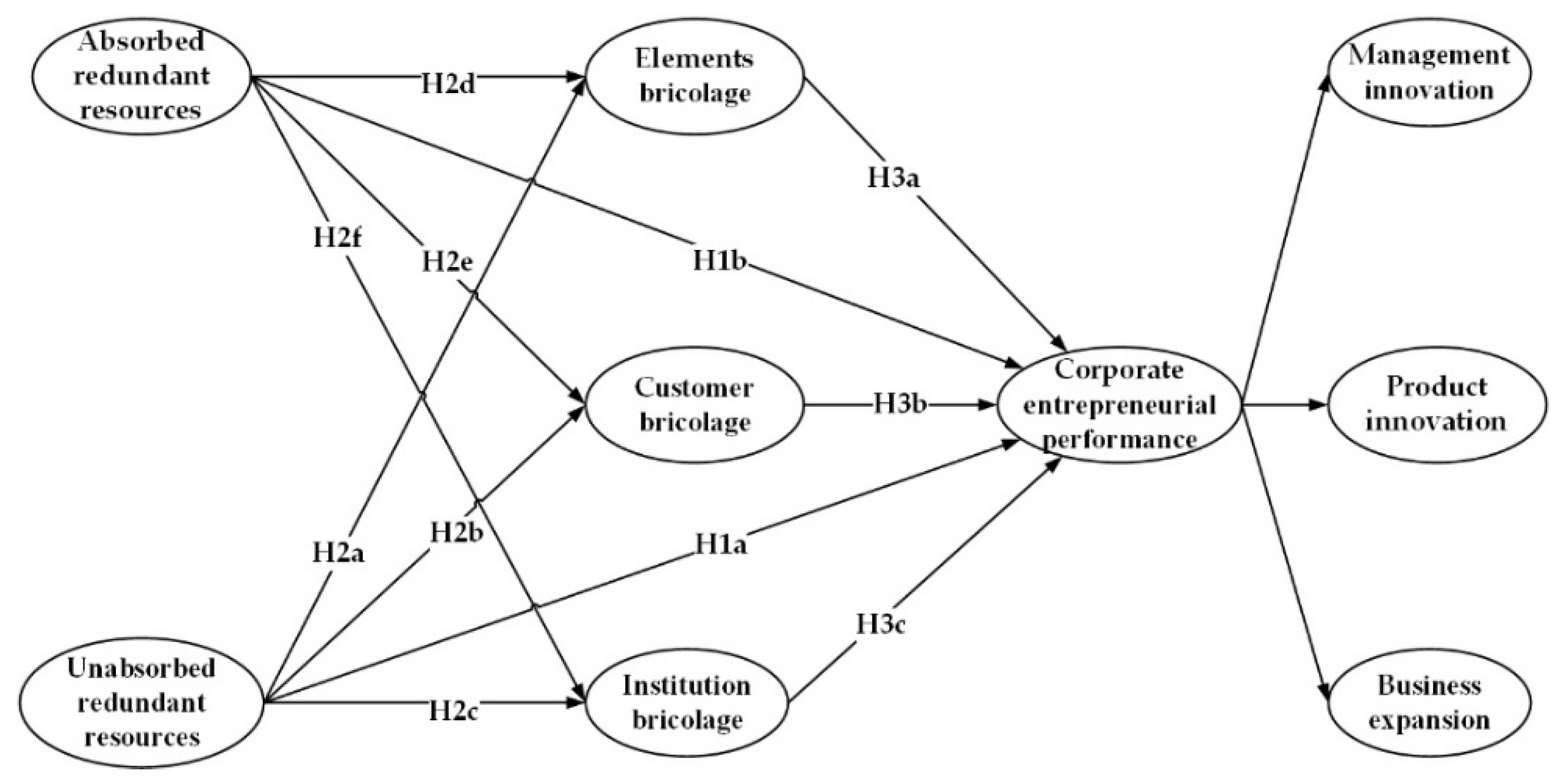
The theoretical model and research hypotheses are shown in Figure 2.
Figure 2.
Theoretical model and research hypotheses.
4. Methodology
4.1. Measures
By using the Likert five-point scale, we designed 25 measurement items to measure the 8 variables in the theoretical model. In this study, it should be noted that corporate entrepreneurial performance was measured by three variables: product innovation, management innovation and business expansion. In addition, we designed each item based on previous valid measures. The contents of all items are shown in Table 2. The 25 items in Table 2 were the main survey contents of the scale used in this study.
Table 2.
The contents of all items.
4.2. Data Collection
The data collection for this study focuses on Chinese companies over 8 years old, and these companies have the following characteristics. First, these enterprises have undertaken entrepreneurial activities. Second, they have accumulated some redundant resources. Third, they have implemented resource bricolage activities. We selected middle and senior managers in these companies who are familiar with redundant resources and resource bricolage and who have been involved in some entrepreneurial activity as respondents. These managers were able to answer all the questions in this survey effectively.
We first conducted a preliminary survey. The results of preliminary survey showed that the questionnaire had good reliability and validity. In the formal investigation, we used the field interview method to obtain data. Specifically, the enterprises selected by this research are all located in more than ten cities in Shandong Province, China, such as Qingdao, Weifang, Yantai and Jinan. During the interview, we strictly followed the epidemic prevention policies of Shandong Province. To improve the efficiency of data collection, we set up eight interview teams. These teams needed to present the nucleic acid test reports at the gate of the enterprise. After the staff checked the reports, the teams could interview the company’s executives. In addition, to ensure the data quality, the interview teams explained and answered various questions of interest to the executives on the spot during the interview. The survey period was from 20 June 2021 to 24 October 2021. We distributed 405 questionnaires and all of them were returned. After careful screening, we obtained 403 effective questionnaires. The attributes of the subjects are shown in Table 3. In addition, to examine common method bias, we performed Harman’s single factor test. The results showed that the percentage of variance explained by the largest eigenvalue was 37.69%. Therefore, there was no common method bias in this study [58].
Table 3.
The attributes of the subjects in this study.
5. Results
5.1. Reliability and Validity Test
We carried out an exploratory factor analysis (EFA) and found that the Kaiser–Meyer–Olkin value was 0.912, indicating that the data were suitable for factor analysis [59,60,61]. In the reliability analysis, the Cronbach’s α values of all factors exceeded 0.7. In addition, all composite reliability (CR) values also exceeded 0.7, indicating that the scale had high reliability. The detailed results are shown in Table 4.
Table 4.
Test results of reliability and convergent validity.
In the convergent validity analysis, the confirmatory factor analysis (CFA) results showed that the factor loading of each item was above 0.7. Moreover, the average variance extraction (AVE) value of each variable was not less than 0.5 (see Table 4). These results suggested that the convergent validity of the scale is acceptable [59]. In addition, the discriminant validity test results were shown in Table 5. In this table, we can learn that the absolute value of the correlation coefficient between any two factors was smaller than the square root of AVE. Therefore, this scale has good discriminant validity [59].
Table 5.
Test results of discriminant validity.
5.2. Hypothesis Test
The AMOS 24.0 software and structural equation modeling technique were used to test research hypotheses. A well-fitted model (χ2/df = 1.696, RMSEA = 0.042, GFI = 0.918, IFI = 0.966, TLI = 0.961, CFI = 0.966) can be obtained after analysis. In this sense, the hypothesis test based on this model is reasonable.
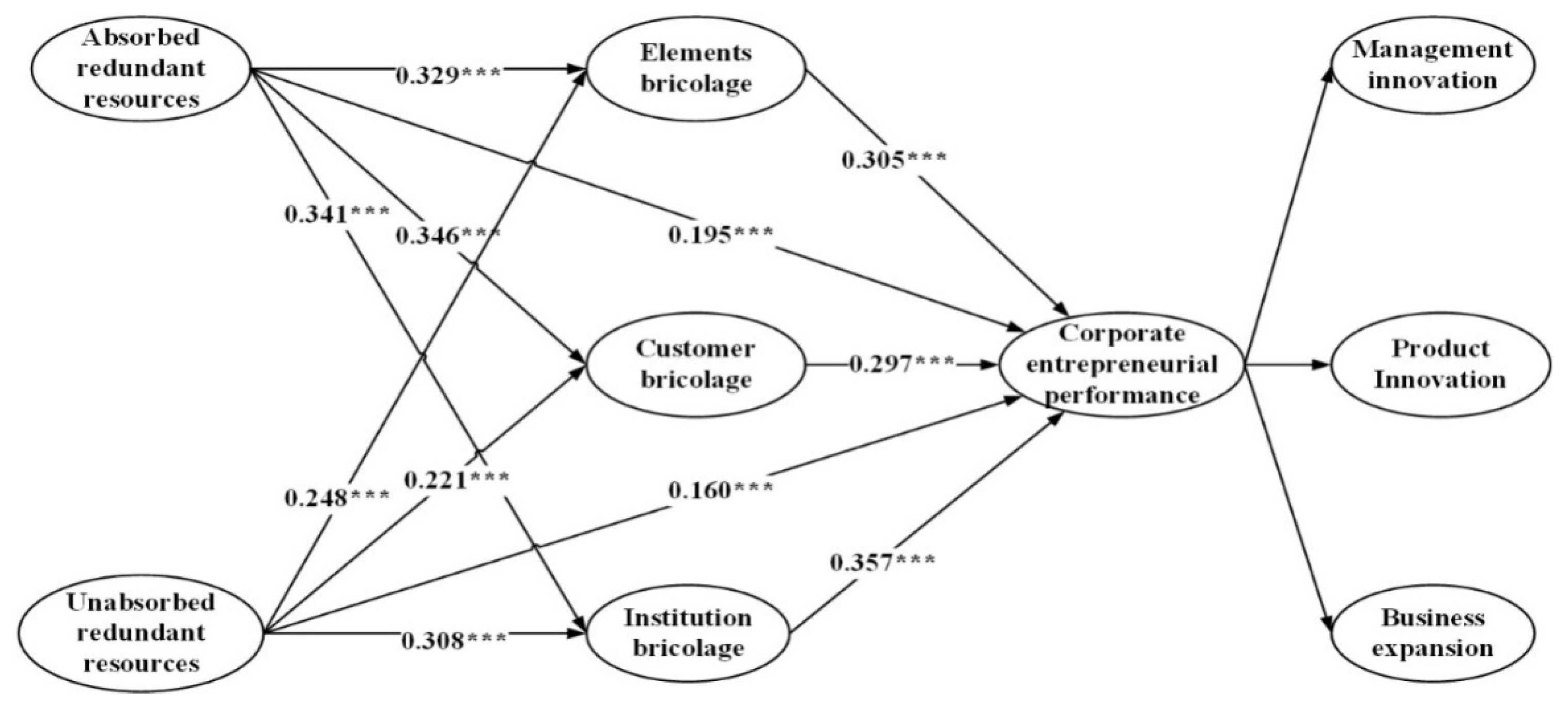
The specific hypothesis test results are shown in Figure 3. Unabsorbed redundant resources and absorbed redundant resources had significant positive effects on corporate entrepreneurial performance. Thus, H1a and H1b were supported. Unabsorbed redundant resources had a significant positive impact on elements bricolage, customer bricolage and institution bricolage, respectively. Thus, H2a, H2b and H2c were all supported. Similarly, absorbed redundant resources produced a significant positive influence on elements bricolage, customer bricolage and institution bricolage, respectively. Thus, H2d, H2e and H2f were all supported. In addition, elements bricolage, customer bricolage and institution bricolage all produced significant positive effects on corporate entrepreneurial performance. Thus, H3a, H3b and H3c were all supported.
Figure 3.
Hypothesis testing results. Note: *** p < 0.001.
5.3. Mediation Effect Test
By using AMOS 24.0 software (IBM, USA), we tested six mediation effects. We used the Bootstrap method, and set the repeated 5000 Bootstrap samples. The results showed that for absorbed redundant resources, the confidence intervals of mediation effects of elements bricolage, customer bricolage and institution bricolage were [0.059, 0.157], [0.055, 0.17] and [0.073, 0.184], respectively. For unabsorbed redundant resources, the confidence intervals of mediation effects of elements bricolage, customer bricolage and institution bricolage were [0.036, 0.125], [0.027, 0.125] and [0.061, 0.18], respectively. The zero point was not included in these six confidence intervals. This shows that the partial mediation effects of elements bricolage, customer bricolage and institution bricolage were significant. Thus, H4a, H4b, H4c, H4d, H4e and H4f were all supported.
6. Discussion
With the continuous development of the digital economy, more and more large enterprises have achieved remarkable development by carrying out corporate entrepreneurial activities. This study explores the effect of redundant resources on corporate entrepreneurial performance. Four novel and valuable insights are identified.
First, redundant resources have a significant positive influence on corporate entrepreneurial performance. Specifically, absorbed redundant resources and unabsorbed redundant resources produce a significant positive influence on corporate entrepreneurial performance. This finding is consistent with the conclusions of existing studies (Vanacker et al., 2017 [62]; Marlin and Geiger, 2015 [63]). Absorbed redundant resources exist in the daily activities of the enterprise. Although the mobility of such resources is insufficient, they can provide resource support for organizational entrepreneurial change through entrepreneurial activities. In this process, the absorbed redundant resources will have a buffer effect, which can realize the transformation of resources. Compared with the absorbed redundant resources, unabsorbed redundant resources are more abundant and easier to use, and can provide enterprises with a resource buffer to cope with the turbulent external environment. Moreover, such resources can provide a guarantee for enterprises to identify and utilize opportunities, which is helpful to improve the corporate entrepreneurial performance.
Second, redundant resources have a significant positive effect on resource bricolage. This finding is not consistent with the conclusions of existing studies (Malen and Vaaler, 2016 [64]; Bromiley, 1991 [65]). From the perspective of enterprise behavior theory, redundant resources are not only the basic elements of the internal operation of enterprises, but also the results of enterprise operation. The empirical analysis results show that such resources can not only provide support for the organization’s information search and opportunity identification, but also help enterprises implement various types of resource bricolage.
Third, resource bricolage has a significant positive impact on corporate entrepreneurial performance. This conclusion is similar to that of Wu et al. (2014) [66] and Desa and Basu (2013) [67]. In reality, resource bricolage emphasizes immediate action that is of great significance for grasping opportunities and improving innovation efficiency. More importantly, resource bricolage focuses on realizing the creative use of existing resources, which can fully utilize the inherent properties of resources and is conducive to enterprises to engage in entrepreneurial activities. Empirical analysis results show that resource bricolage does have a non-negligible effect on entrepreneurial activities, ultimately leading to positive entrepreneurial performance.
Fourth, resource bricolage plays a partial mediation effect between redundant resources and corporate entrepreneurial performance. This conclusion is novel and valuable. It highlights the role of resource bricolage in entrepreneurial activities. Empirical analysis reveals that resource bricolage is an indirect link in the transformation of redundant resources to corporate entrepreneurial performance. Specifically, unabsorbed redundant resources have strong liquidity and high flexibility. Moreover, such resources can quickly switch their uses according to the actual situation of the enterprise. This provides a guarantee for an enterprise to identify entrepreneurial opportunities, grasp and utilize resources, and then improve the entrepreneurial performance. For absorbed redundant resources, they are useful but not flexible enough. Therefore, managers will stimulate the potential of absorbing redundant resources through resource bricolage, so as to realize the transformation of such resources into corporate entrepreneurial performance.
7. Implications
7.1. Theoretical Implication
We summarize the theoretical and practical contributions of this study. In theory, we construct a theoretical model that can show that redundant resources affect corporate entrepreneurial performance. Specifically, firstly, we explain the internal factors that drive entrepreneurial activities in firms from the perspective of redundant resources, which can be used as a necessary supplement to internal resource analysis in the further research. Secondly, we explore and test how redundant resources exert their potential effect through resource bricolage, which provides a new perspective for subsequent research on redundant resources. Thirdly, we integrate redundant resources and resource bricolage to analyze the impact of the synergistic effect of the two on corporate entrepreneurial performance, which is conducive to theoretical innovation in cross-disciplinary research. This theoretical implication can help researchers to incorporate the role of redundant resources and resource bricolage into subsequent studies on corporate entrepreneurial activities. In addition, considering the different effects produced by different types of redundant resources and resource bricolage, researchers can conduct in-depth analysis of a specific redundant resource or resource bricolage.
7.2. Managerial Implication
In enterprise management, on the one hand, enterprises should dynamically match the means of resource bricolage according to their actual conditions, so as to realize the creative transformation of redundant resources. In this way, redundant resources can provide instant and high-quality resource support for enterprises to effectively carry out entrepreneurial activities, thereby achieving the improvement of entrepreneurial performance. Moreover, such resources can also stimulate resource bricolage, and then improve corporate entrepreneurial performance. On the other hand, this research will help enterprise managers to understand the effects of two types of redundant resources and the impacts of three types of resource bricolages on corporate entrepreneurial performance. Enterprises should realize that there is a synergistic and complementary relationship between the two types of redundant resources. Moreover, there are also differences in the roles played by three types of resource bricolage. According to the conclusions of this research, enterprises should pay special attention to the effect of absorbed redundant resources and institution bricolage, as well as trying to play their roles in corporate entrepreneurial performance in a variety of ways. This managerial implication involves practical guidance for enterprises to realize the complementary advantages of various resources and the sound development of internal systems.
Author Contributions
Conceptualization, L.Y., X.Y. and W.Z.; methodology, L.Y., X.Y. and W.Z.; formal analysis, L.Y.; investigation, X.Y. and Z.Z.; supervision, L.Y.; writing—original draft preparation, L.Y., X.Y. and W.Z.; writing—review and editing, L.Y. and W.Z. All authors have read and agreed to the published version of the manuscript.
Funding
This research was supported by MOE (Ministry of Education in China) Project of Humanities and Social Sciences (21YJC630161) and Qingdao Philosophy and Social Science Planning Program (QDSKL1801263).
Institutional Review Board Statement
Not applicable.
Informed Consent Statement
Informed consent was obtained from all subjects involved in the study.
Data Availability Statement
Data available upon request.
Conflicts of Interest
With respect to the provenance of the work, we can declare that this paper presents original, previously unpublished work. It is not currently under consideration elsewhere and has not been submitted before to this or any other journal. There are no conflicts of interest to declare.
References
- Kuratko, D.F. Handbook of Entrepreneurship Research; Springer: New York, NY, USA, 2010. [Google Scholar]
- Sharma, P.; Chrisman, J.J. Entrepreneurship; Springer: Berlin/Heidelberg, Germany, 1999. [Google Scholar]
- Choi, S.B.; Lee, W.R.; Kang, S.W. Entrepreneurial orientation, resource orchestration capability, environmental dynamics and firm performance: A test of three-way interaction. Sustainability 2020, 12, 5415. [Google Scholar] [CrossRef]
- Timmons, J.A.; Spinelli, S.; Tan, Y. New Venture Creation: Entrepreneurship for the 21st Century; McGraw-Hill: New York, NY, USA, 2004. [Google Scholar]
- Bierwerth, M.; Schwens, C.; Isidor, R.; Kabst, R. Corporate entrepreneurship and performance: A meta-analysis. Small Bus. Econ. Group 2015, 45, 255–278. [Google Scholar] [CrossRef]
- Sirmon, D.G.; Hitt, M.A.; Ireland, R.D.; Gilbert, B.A. Resource orchestration to create competitive advantage breadth, depth, and life cycle effects. J. Manag. 2011, 37, 1390–1412. [Google Scholar]
- Welter, C.; Mauer, R.; Wuebker, R.J. Bridging behavioral models and theoretical concepts: Effectuation and bricolage in the opportunity creation framework. Strateg. Entrep. J. 2016, 10, 5–20. [Google Scholar] [CrossRef]
- Burgelman, R.A. Designs for corporate entrepreneurship in established firms. Calif. Manag. Rev. 1984, 26, 154–166. [Google Scholar] [CrossRef]
- Zahra, S.A. A conceptual model of entrepreneurship as firm behavior: A critique and extension. Entrep. Theory Pract. 1993, 17, 5–21. [Google Scholar] [CrossRef]
- Lumpkin, G.T.; Dess, G.G. Clarifying the entrepreneurial orientation construct and linking it to performance. Acad. Manag. Rev. 1996, 21, 135–172. [Google Scholar] [CrossRef]
- Simsek, Z.; Veiga, J.F.; Lubatkin, M.H. The impact of managerial environmental perceptions on corporate entrepreneurship: Towards understanding discretionary slack’s pivotal role. J. Manag. Stud. 2007, 44, 1398–1424. [Google Scholar] [CrossRef]
- Simsek, Z.; Lubatkin, M.H.; Veiga, J.F.; Dino, R.N. The role of an entrepreneurially alert information system in promoting corporate entrepreneurship. J. Bus. Res. 2009, 62, 810–817. [Google Scholar] [CrossRef]
- Sebora, T.C.; Theerapatvong, T.; Sang, M.L. Corporate entrepreneurship in the face of changing competition. J. Organ. Chang. Manag. 2013, 23, 453–470. [Google Scholar] [CrossRef]
- Klerk, S.D. The creative industries: An entrepreneurial bricolage perspective. Manag. Decis. 2015, 53, 828–842. [Google Scholar] [CrossRef]
- Lanza, A.; Simone, G.; Bruno, R. Resource orchestration in the context of knowledge resources acquisition and divestment. The empirical evidence from the Italian “Serie A” football. Eur. Manag. J. 2016, 34, 145–157. [Google Scholar] [CrossRef] [Green Version]
- Song, J.; Li, F.; Wu, D.D.; Dolgui, A. Supply chain coordination through integration of innovation effort and advertising support. Appl. Math. Model. 2017, 49, 108–123. [Google Scholar] [CrossRef]
- Yu, X.; Li, Y.; Su, Z.; Tao, Y.; Nguyen, B.; Xia, F. Entrepreneurial bricolage and its effects on new venture growth and adaptiveness in an emerging economy. Asia Pac. J. Manag. 2019, 37, 1141–1163. [Google Scholar] [CrossRef]
- Sun, Y.; Du, S.; Ding, Y. The relationship between slack resources, resource bricolage, and entrepreneurial opportunity identification—Based on resource opportunity perspective. Sustainability 2020, 12, 1199. [Google Scholar] [CrossRef] [Green Version]
- Cohen, M.D.; March, J.G.; Olsen, J.P. A garbage can model of organizational choice. Adm. Sci. Q. 1972, 17, 1–25. [Google Scholar] [CrossRef] [Green Version]
- Kiss, A.N.; Fernhaber, S.; McDougall–Covin, P.P. Slack, innovation, and export intensity: Implications for small–and medium–sized enterprises. Entrep. Theory Pract. 2018, 42, 671–697. [Google Scholar] [CrossRef]
- Harrison, S.; Smith, C. Trust and moral motivation: Redundant resources in health and social care? Policy Polit. 2004, 32, 371–386. [Google Scholar] [CrossRef]
- Carlier, J.; Néron, E. Computing redundant resources for the resource constrained project scheduling problem. Eur. J. Oper. Res. 2007, 176, 1452–1463. [Google Scholar] [CrossRef]
- Ying, L.; Li, M.; Yang, J. Agglomeration and driving factors of regional innovation space based on intelligent manufacturing and green economy. Environ. Technol. Innov. 2021, 22, 101398. [Google Scholar] [CrossRef]
- George, G. Slack resources and the performance of privately held firms. Acad. Manag. J. 2005, 48, 661–676. [Google Scholar] [CrossRef]
- Gentry, R.; Dibrell, C.; Kim, J. Long-term orientation in publicly traded family businesses: Evidence of a dominant logic. Entrep. Theory Pract. 2016, 40, 733–757. [Google Scholar] [CrossRef]
- Singh, J.V. Performance, slack, and risk taking in organizational decision making. Acad. Manag. J. 1986, 29, 562–585. [Google Scholar]
- Hu, H.; Lu, H.; Huang, T.; Wei, W.X.; Mao, C.; Thomson, S.B. The process of resource bricolage and organizational improvisation in information technology innovation: A case study of BDZX in China. Inform. Technol. Dev. 2020, 1–22. [Google Scholar] [CrossRef]
- Zheng, A. Applying resource bricolage theory to the city integration of new-generation migrant workers in China. PLoS ONE 2021, 16, e0256332. [Google Scholar] [CrossRef]
- Tan, J.; Peng, M.W. Organizational slack and firm performance during economic transitions: Two studies from an emerging economy. Strateg. Manag. J. 2003, 24, 1249–1263. [Google Scholar] [CrossRef]
- Baker, T.; Nelson, R.E. Creating something from nothing: Resource construction through entrepreneurial bricolage. Adm. Sci. Q. 2005, 50, 329–366. [Google Scholar] [CrossRef]
- Rönkkö, M.; Peltonen, J.; Arenius, P. Selective or Parallel? Toward Measuring the Domains of Entrepreneurial Bricolage; Emerald Group Publishing Limited: Bingley, UK, 2014. [Google Scholar]
- Senyard, J.; Baker, T.; Steffens, P.; Davidsson, P. Bricolage as a path to innovativeness for resource-constrained new firms. J. Prod. Innov. Manag. 2014, 31, 211–230. [Google Scholar] [CrossRef]
- Arfi, W.; Hikkerova, L. Corporate entrepreneurship, product innovation, and knowledge conversion: The role of digital platforms. Small Bus. Econ. Group 2021, 56, 1191–1204. [Google Scholar] [CrossRef]
- Ghalwash, S.; Ismail, A. Resource Orchestration Process in the Limited-Resource Environment: The Social Bricolage Perspective. J. Soc. Entrep. 2022. [Google Scholar] [CrossRef]
- Hornsby, J.S.; Kuratko, D.F.; Holt, D.T.; Wales, W.J. Assessing a measurement of organizational preparedness for corporate entrepreneurship. J. Prod. Innov. Manag. 2013, 30, 937–955. [Google Scholar] [CrossRef]
- O’Brien, K. Innovation types and the search for new ideas at the fuzzy front end: Where to look and how often? J. Bus. Res. 2020, 107, 13–24. [Google Scholar] [CrossRef]
- Miocevic, D.; Morgan, R.E. Operational capabilities and entrepreneurial opportunities in emerging market firms. Int. Market. Rev. 2018, 35, 320–341. [Google Scholar] [CrossRef]
- Kim, K.; Hann, I.H. Crowdfunding and the democratization of access to capital—An illusion? Evidence from housing prices. Inf. Syst. Res. 2019, 30, 276–290. [Google Scholar] [CrossRef]
- Blanka, C. An individual-level perspective on intrapreneurship: A review and ways forward. Rev. Manag. Sci. 2019, 13, 919–961. [Google Scholar] [CrossRef] [Green Version]
- Rigtering, J.P.C.C.; Weitzel, G.U.U.; Muehlfeld, K.K. Increasing quantity without compromising quality: How managerial framing affects intrapreneurship. J. Bus. Ventur. 2019, 34, 224–241. [Google Scholar] [CrossRef]
- Stritar, R. Resource hijacking as a bricolage technique. Econ. Bus. Rev. 2012, 14, 5–15. [Google Scholar] [CrossRef]
- Suddaby, R.; Bruton, G.D.; Si, S.X. Entrepreneurship through a qualitative lens: Insights on the construction and/or discovery of entrepreneurial opportunity. J. Bus. Ventur. 2015, 30, 1–10. [Google Scholar] [CrossRef]
- Garud, N.; Prabhu, G.N. Linking R&D inventors’ social skills and bricolage to R&D performance in resource constrained environments in emerging markets. IEEE Trans. Eng. Manag. 2020, 68, 713–724. [Google Scholar]
- Voss, G.B.; Sirdeshmukh, D.; Voss, Z.G. The effects of slack resources and environmental threat on product exploration and exploitation. Acad. Manag. J. 2008, 51, 147–164. [Google Scholar] [CrossRef] [Green Version]
- Liao, Z.; Weng, C.; Long, S.; Xiao, Z. Do social ties foster firms’ environmental innovation? The moderating effect of resource bricolage. Technol. Anal. Strateg. Manag. 2021, 33, 476–490. [Google Scholar] [CrossRef]
- Zahra, S.A.; Neubaum, D.A.; Huse, M. Entrepreneurship in Medium-Size Companies: Exploring the effects of ownership and governance systems. J. Manag. 2000, 26, 947–976. [Google Scholar] [CrossRef]
- Yang, M. International entrepreneurial marketing strategies of MNCs: Bricolage as practiced by marketing managers. Int. Bus. Rev. 2018, 27, 1045–1056. [Google Scholar] [CrossRef]
- An, W.; Zhao, X.; Cao, Z.; Zhang, J.; Liu, H. How bricolage drives corporate entrepreneurship: The roles of opportunity identification and learning orientation. J. Prod. Innov. Manag. 2018, 35, 49–65. [Google Scholar] [CrossRef]
- Hoffman, M.; Schenck, C.J.; Herbst, F. Exploring the Intersection Where Business Models, a Circular Economy and Sustainability Meet in the Waste Economy: A Scoping Review. Sustainability 2022, 14, 3687. [Google Scholar] [CrossRef]
- Busch, C.; Barkema, H. From necessity to opportunity: Scaling bricolage across resource-constrained environments. Strateg. Manag. J. 2021, 42, 741–773. [Google Scholar] [CrossRef]
- Sarasvathy, S.D. Causation and effectuation: Toward a theoretical shift from economic inevitability to entrepreneurial contingency. Acad. Manag. Rev. 2001, 26, 243–263. [Google Scholar] [CrossRef] [Green Version]
- Yu, X.; Lu, J.; Liu, X.; Wang, Y.; Jia, Y. Fractal characteristics of discontinuous growth of digital company: An entrepreneurial bricolage perspective. Complexity 2021, 21, 8839941. [Google Scholar] [CrossRef]
- Steffens, P.R.; Baker, T.; Davidsson, P.; Senyard, J.M. When is less more? Boundary conditions of effective entrepreneurial bricolage. J. Manag. 2022. [Google Scholar] [CrossRef]
- Liu, Z.; Xiao, Y.; Jiang, S.; Hu, S. Social entrepreneurs’ personal network, resource bricolage and relation strength. Manag. Decis. 2020, 59, 2774–2791. [Google Scholar] [CrossRef]
- Wang, J.; Xue, Y.; Yang, J. Boundary-spanning search and firms’ green innovation: The moderating role of resource orchestration capability. Bus. Strateg. Environ. 2020, 29, 361–374. [Google Scholar] [CrossRef]
- Baron, R.A. Opportunity recognition as pattern recognition: How entrepreneurs “connect the dots” to identify new business opportunities. Acad. Manag. Perspect. 2006, 20, 104–119. [Google Scholar] [CrossRef]
- Wales, W.J.; Patel, P.C.; Parida, V.; Kreiser, P.M. Nonlinear effects of entrepreneurial orientation on small firm performance: The moderating role of resource orchestration capabilities. Strateg. Entrep. J. 2013, 7, 93–121. [Google Scholar] [CrossRef]
- Zhu, W.; Mou, J.; Benyoucef, M. Exploring purchase intention in cross-border E-commerce: A three stage model. J. Retail. Consum. Serv. 2019, 51, 320–330. [Google Scholar] [CrossRef]
- Zhu, W.; Yan, R.; Song, Y. Analysing the impact of smart city service quality on citizen engagement in a public emergency. Cities 2022, 120, 103439. [Google Scholar] [CrossRef] [PubMed]
- Li, Y.; Kou, G.; Li, G.; Peng, Y. Consensus reaching process in large-scale group decision making based on bounded confidence and social network. Eur. J. Oper. Res. 2022, in press. [Google Scholar] [CrossRef]
- Li, G.; Kou, G.; Peng, Y. Heterogeneous large-scale group decision-making using fuzzy cluster analysis and its application to emergency response plan selection. IEEE Trans. Syst. Man Cybern.-Syst. 2021, 52, 3391–3403. [Google Scholar] [CrossRef]
- Vanacker, T.; Collewaert, V.; Zahra, S.A. Slack resources, firm performance, and the institutional context: Evidence from privately held E uropean firms. Strateg. Manag. J. 2017, 38, 1305–1326. [Google Scholar] [CrossRef]
- Marlin, D.; Geiger, S.W. The organizational slack and performance relationship: A configurational approach. Manag. Decis. 2015, 53, 2339–2355. [Google Scholar] [CrossRef]
- Malen, J.; Vaaler, P.M. Organizational slack, national institutions, and innovation effort. J. World Bus. 2016, 52, 782–797. [Google Scholar] [CrossRef]
- Bromiley, P. Testing a causal model of corporate risk taking and performance. Acad. Manag. J. 1991, 34, 37–59. [Google Scholar]
- Wu, J.; Wu, Z. Local and international knowledge search and product innovation: The moderating role of technology boundary spanning. Int. Bus. Rev. 2014, 23, 542–551. [Google Scholar] [CrossRef]
- Desa, G.; Basu, S. Optimization or bricolage? Overcoming resource constraints in global social entrepreneurship. Strateg. Entrep. J. 2013, 7, 26–49. [Google Scholar] [CrossRef]
Publisher’s Note: MDPI stays neutral with regard to jurisdictional claims in published maps and institutional affiliations. |
© 2022 by the authors. Licensee MDPI, Basel, Switzerland. This article is an open access article distributed under the terms and conditions of the Creative Commons Attribution (CC BY) license (https://creativecommons.org/licenses/by/4.0/).