


Innovative Approach to Assist Architecture Teachers in Choosing Practical Sessions


Abstract
:1. Introduction
2. Alternatives Analysis
3. Methodology
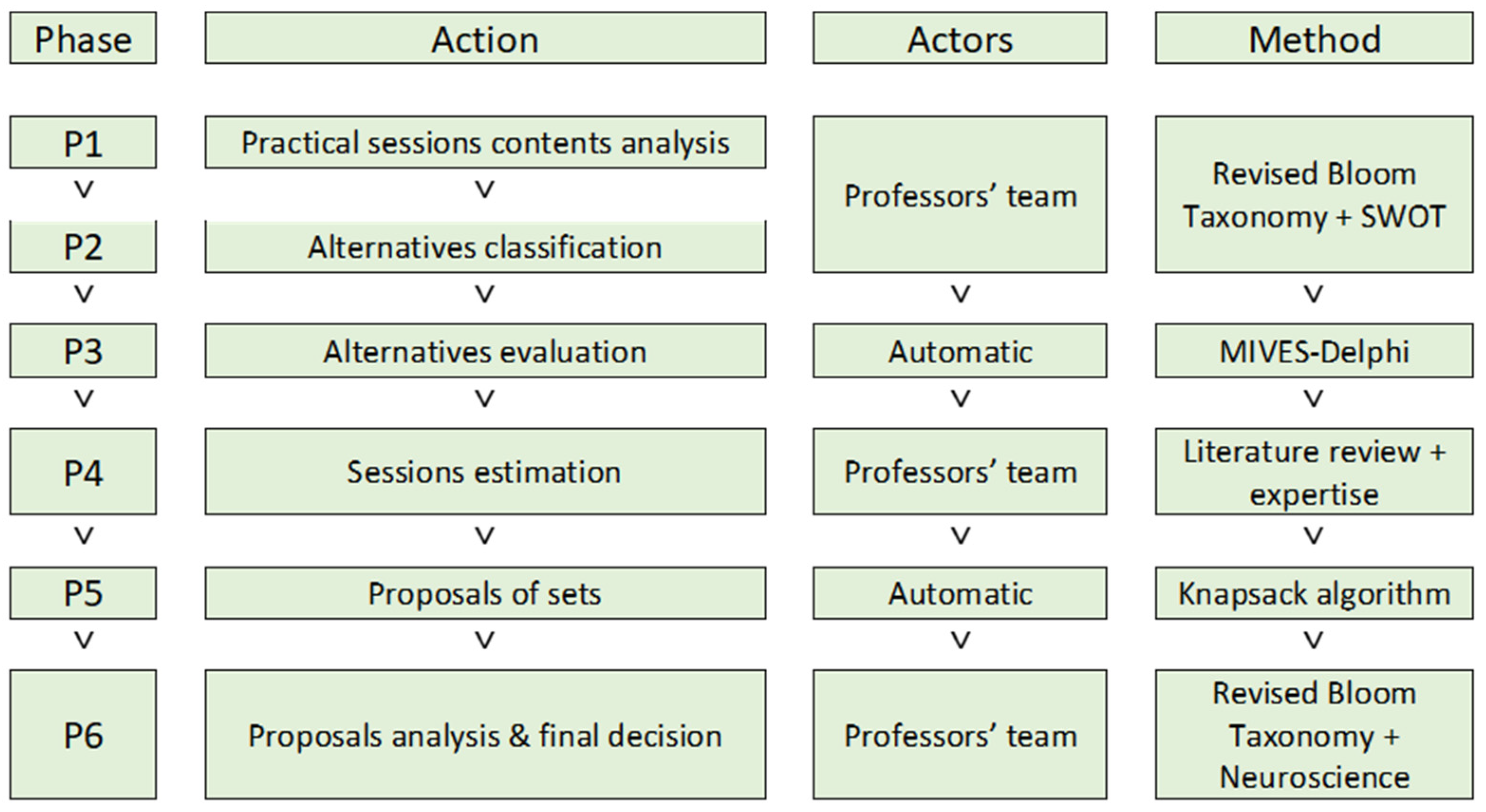
3.1. Phases 1 and 2
3.2. Phase 3
3.3. Phase 4
3.4. Phase 5
3.5. Phase 6
4. Identification of the Problem
5. Results
5.1. Phase 1
5.2. Phase 2
5.3. Phase 3
5.4. Phase 4
5.5. Phase 5
5.6. Phase 6
6. Discussion
7. Conclusions
Author Contributions
Funding
Informed Consent Statement
Data Availability Statement
Acknowledgments
Conflicts of Interest
Appendix A

| Abbreviations | Relevant Values |
|---|---|
| ETSAB | Barcelona Architecture School |
| CBL | Challenge-based learning |
| CLT | Cognitive load theory |
| GSI | Global sustainability index |
| HOTL | Higher-order thinking level |
| LOTL | Lower-order thinking level |
| MIVES | Integrated value model for sustainability assessment |
| MOTL | Middle-order thinking level |
| PBL | Project-based learning |
| TBL | Team-based learning |
| TEAL | Technology-enabled active learning |
| SWOT | Strengths, weaknesses, opportunities and threats |
| VET | Vocational education and training |
| WIL | Work-integrated learning |
Appendix B
| (t1) Online Strategies | (t2) Learning Dynamics | (t3) Activities | |
|---|---|---|---|
| (g1) Recent digital technologies | Blended Learning [48] e-learning [49] | TEAL [50] | Blended and e-learning activities [51] Interactive simulations [52] Social media activities [53] Videos of real cases [54] Virtual learning activities [55] |
| (g2) Active learning | CBL [56] TBL [57] Flipped classrooms [58] PBL [59] Reflective learning [60] | Case studies [61] Discussions [62] Gamification activities [63] Interdisciplinary activities [64] Problem-solving activities [65] Storytelling [66] | |
| (g3) Practical and real experiences | Industry–community projects [67] Internships [68] Placements [69] Dual VET [70] | Real material practices [71] Hands-on activities [72] Role play [73] Site visits [74] |
| New Indicator | Aspects Assessed by This Indicator | Grouping Process |
|---|---|---|
| (a1) Autonomous work | Capacity to promote students’ ability to learn and act by themselves, such as entrustable professional activities [75]. | Lr2 determined that these indicators were necessary to assess practical alternatives in 13, 21 and 94 studies, respectively. |
| (a2) Students’ interest and participation | Ability to promote engagement, interaction, participation and attendance. Includes having fun learning, satisfaction and high expectations [76]. | |
| (a3) Learning outcomes diversity | The capacity to evaluate results was related to a) cognition: course-related content knowledge, programming knowledge, skills and competence, creativity; and b) affect: confidence, attitude, feeling and perceptions. Ability to perform summative and formative assessments [77]. | |
| (b1) Direct costs | A simplified cost analysis regarding the extra costs of each active learning alternative [29,78]. This takes into account the learning materials, resources, transport, insurance, etc., following legal and ethical requirements. It classifies the evaluated alternatives according to six groups of extra cost affordability: (1) no cost; (2) from the course budget; (3) from private foundations’ funds; (4) from the university’s competitive funds; (5) from national public competitive funds; (6) from international competitive funds. | These indicators are crucial for practical sessions because many alternatives involve more costly, complex resources and management, such as virtual learning activities [55] and site visits [74]. Similarly, numerous activities imply that teachers assume new competences, from interactive simulations [58] to gamification [79]. |
| (b2) Logistic and scheduling issues | Analysis of the extra operational processes required by each alternative, including those involving management of resources, time and space, such as required learning spaces and different course scheduling compatibility [80]. It focuses on these requirements without considering whether the alternatives are flexible because it was already included in a former indicator. | |
| (b3) Teachers’ new functions | Number of new roles in teachers’ work that the alternatives require per semester [81]. | |
| (c1) Roles, talents and ways of learning | Ability to allow different roles, talents and ways of learning, styles, approaches, learning and pacing and presentation methods, cultures, recognition of reward and respect for creativity. This also includes students’ abilities, learning level, leadership, collaboration, initiative, attitude, effort, research, communication and a written report, as well as individual tasks [82]. | These indicators were adapted and complemented following Lr2. |
| (c2) Students’ cognitive load | The extent to which the cognitive load theory (CLT) is followed, according to the information processing model [83] and methods to manage cognitive load [84]. |
Appendix C
| N | G | Position | Research Field | N | G | Position | Research Field |
|---|---|---|---|---|---|---|---|
| 1 | F | Lecturer and consultor | Building structures | 11 | M | Associate professor | Light in architecture |
| 2 | M | Construction | 12 | F | Energy in architecture | ||
| 3 | M | 13 | M | Lecturer and consultor | Building facades | ||
| 4 | F | Associate professor | Rehabilitation and restoration | 14 | F | Energy in architecture | |
| 5 | F | 15 | M | Simulation tools | |||
| 6 | F | Lecturer and consultor | 16 | M | Associate professor | Building structures | |
| 7 | F | 17 | F | Lecturer and consultor | Acoustics | ||
| 8 | M | Associate professor | Building facades | 18 | M | Associate professor | Management |
| 9 | M | 19 | F | Lecturer and consultor | Materials | ||
| 10 | M | Lecturer and consultor | Construction | 20 | M | Construction |
| DT Elements | Weights Assigned by Panellist (%) | Mean | Median | Median Absolute Deviation (%) | Consensus | |||||||||||||||||||
|---|---|---|---|---|---|---|---|---|---|---|---|---|---|---|---|---|---|---|---|---|---|---|---|---|
| 1 | 2 | 3 | 4 | 5 | 6 | 7 | 8 | 9 | 10 | 11 | 12 | 13 | 14 | 15 | 16 | 17 | 18 | 19 | 20 | |||||
| R1 | 30 | 20 | 20 | 30 | 30 | 20 | 15 | 20 | 60 | 40 | 25 | 20 | 20 | 25 | 30 | 20 | 30 | 20 | 30 | 20 | 26.3 | 22.5 | 7 | Yes |
| R2 | 10 | 25 | 20 | 30 | 5 | 20 | 15 | 10 | 10 | 10 | 40 | 30 | 20 | 25 | 40 | 30 | 20 | 20 | 10 | 20 | 20.5 | 20 | 8 | Yes |
| R3 | 10 | 15 | 20 | 10 | 0 | 10 | 35 | 35 | 10 | 10 | 0 | 0 | 0 | 10 | 0 | 10 | 10 | 20 | 10 | 10 | 11.3 | 10 | 6 | Yes |
| R4 | 50 | 40 | 40 | 30 | 65 | 50 | 35 | 35 | 20 | 40 | 35 | 50 | 60 | 40 | 30 | 40 | 40 | 40 | 50 | 50 | 42.0 | 40 | 8 | Yes |
| C1 | 70 | 30 | 40 | 60 | 50 | 60 | 40 | 30 | 80 | 75 | 80 | 60 | 60 | 65 | 70 | 65 | 70 | 60 | 70 | 60 | 59.8 | 60 | 11 | No |
| C2 | 30 | 70 | 60 | 40 | 50 | 40 | 60 | 70 | 20 | 25 | 20 | 40 | 40 | 35 | 30 | 35 | 30 | 40 | 30 | 40 | 40.3 | 40 | 11 | No |
| C3 | 40 | 60 | 40 | 40 | 25 | 40 | 30 | 50 | 25 | 50 | 60 | 40 | 30 | 40 | 20 | 40 | 30 | 30 | 30 | 20 | 37.0 | 40 | 9 | Yes |
| C4 | 60 | 40 | 60 | 60 | 75 | 60 | 70 | 50 | 75 | 50 | 40 | 60 | 70 | 60 | 80 | 60 | 70 | 70 | 70 | 80 | 63.0 | 60 | 9 | Yes |
| C5 | 100 | 100 | 100 | 100 | 100 | 100 | 100 | 100 | 100 | 100 | 100 | 100 | 100 | 100 | 100 | 100 | 100 | 100 | 100 | 100 | 100.0 | 100 | 0 | Yes |
| C6 | 35 | 20 | 50 | 20 | 40 | 30 | 25 | 30 | 70 | 40 | 20 | 50 | 50 | 40 | 30 | 40 | 30 | 30 | 30 | 40 | 36.0 | 32.5 | 10 | Yes |
| C7 | 35 | 45 | 25 | 60 | 40 | 50 | 50 | 40 | 10 | 40 | 40 | 20 | 35 | 30 | 40 | 40 | 50 | 40 | 50 | 40 | 39.0 | 40 | 8 | Yes |
| C8 | 30 | 35 | 25 | 20 | 20 | 20 | 25 | 30 | 20 | 20 | 40 | 30 | 15 | 30 | 30 | 30 | 20 | 30 | 20 | 20 | 25.5 | 25 | 6 | Yes |
| I01 | 80 | 50 | 40 | 60 | 50 | 50 | 60 | 80 | 65 | 50 | 60 | 40 | 40 | 55 | 30 | 50 | 50 | 50 | 60 | 40 | 53.0 | 50 | 9 | Yes |
| I02 | 20 | 50 | 60 | 40 | 50 | 50 | 40 | 20 | 35 | 50 | 40 | 60 | 60 | 45 | 70 | 50 | 50 | 50 | 40 | 60 | 47.0 | 50 | 9 | Yes |
| I03 | 80 | 30 | 60 | 50 | 50 | 50 | 40 | 50 | 75 | 50 | 50 | 50 | 75 | 65 | 70 | 60 | 50 | 80 | 60 | 60 | 57.8 | 55 | 11 | No |
| I04 | 20 | 70 | 40 | 50 | 50 | 50 | 60 | 50 | 25 | 50 | 50 | 50 | 25 | 35 | 30 | 40 | 50 | 20 | 40 | 40 | 42.3 | 45 | 11 | No |
| I05 | 60 | 70 | 20 | 30 | 20 | 50 | 75 | 10 | 30 | 30 | 60 | 50 | 40 | 50 | 70 | 60 | 40 | 70 | 30 | 20 | 44.3 | 45 | 17 | No |
| I06 | 40 | 30 | 80 | 70 | 80 | 50 | 25 | 90 | 70 | 70 | 40 | 50 | 60 | 50 | 30 | 40 | 60 | 30 | 70 | 80 | 55.8 | 55 | 17 | No |
| I07 | 50 | 50 | 70 | 40 | 40 | 60 | 20 | 45 | 35 | 25 | 40 | 20 | 40 | 35 | 15 | 30 | 30 | 50 | 50 | 20 | 38.3 | 40 | 11 | No |
| I08 | 20 | 25 | 20 | 20 | 30 | 20 | 40 | 10 | 32 | 50 | 30 | 50 | 30 | 40 | 25 | 30 | 40 | 25 | 20 | 40 | 29.9 | 30 | 8 | Yes |
| I09 | 30 | 25 | 10 | 40 | 30 | 20 | 40 | 45 | 33 | 25 | 30 | 30 | 30 | 40 | 60 | 40 | 30 | 25 | 30 | 40 | 32.7 | 30 | 7 | Yes |
| I10 | 100 | 100 | 100 | 100 | 100 | 100 | 100 | 100 | 100 | 100 | 100 | 100 | 100 | 100 | 100 | 100 | 100 | 100 | 100 | 100 | 100.0 | 100 | 0 | Yes |
| I11 | 15 | 20 | 20 | 20 | 25 | 30 | 30 | 30 | 10 | 25 | 20 | 30 | 25 | 40 | 30 | 20 | 20 | 20 | 20 | 20 | 23.5 | 20 | 5 | Yes |
| I12 | 25 | 45 | 30 | 30 | 25 | 20 | 30 | 20 | 35 | 25 | 25 | 25 | 25 | 25 | 20 | 30 | 30 | 20 | 35 | 40 | 28.0 | 25 | 5 | Yes |
| I13 | 35 | 30 | 30 | 30 | 25 | 30 | 20 | 30 | 40 | 25 | 35 | 25 | 25 | 25 | 30 | 20 | 30 | 30 | 35 | 30 | 29.0 | 30 | 4 | Yes |
| I14 | 25 | 10 | 20 | 20 | 25 | 20 | 20 | 20 | 15 | 25 | 20 | 20 | 25 | 10 | 20 | 30 | 20 | 30 | 10 | 10 | 19.8 | 20 | 4 | Yes |
| I15 | 60 | 40 | 50 | 30 | 40 | 30 | 25 | 20 | 25 | 35 | 30 | 25 | 40 | 30 | 30 | 25 | 20 | 25 | 25 | 20 | 31.3 | 30 | 7 | Yes |
| I16 | 15 | 30 | 20 | 30 | 20 | 20 | 25 | 30 | 10 | 15 | 30 | 20 | 10 | 25 | 15 | 30 | 15 | 20 | 25 | 30 | 21.8 | 20 | 6 | Yes |
| I17 | 10 | 20 | 20 | 20 | 20 | 20 | 15 | 20 | 10 | 15 | 20 | 20 | 25 | 25 | 15 | 20 | 15 | 20 | 25 | 40 | 19.8 | 20 | 4 | Yes |
| I18 | 15 | 10 | 10 | 20 | 20 | 30 | 35 | 30 | 65 | 35 | 20 | 35 | 25 | 20 | 40 | 25 | 50 | 35 | 25 | 10 | 27.8 | 25 | 10 | No |
| I19 | 65 | 40 | 50 | 50 | 50 | 50 | 60 | 50 | 60 | 40 | 70 | 70 | 60 | 40 | 40 | 60 | 50 | 70 | 30 | 40 | 52.3 | 50 | 9 | Yes |
| I20 | 35 | 60 | 50 | 50 | 50 | 50 | 40 | 50 | 40 | 60 | 30 | 30 | 40 | 60 | 60 | 40 | 50 | 30 | 70 | 60 | 47.8 | 50 | 9 | Yes |
| DT Elements | Weights Assigned by Panellist (%) | Mean | Median | Median Absolute Deviation (%) | Consensus | |||||||||||||||||||
|---|---|---|---|---|---|---|---|---|---|---|---|---|---|---|---|---|---|---|---|---|---|---|---|---|
| 1 | 2 | 3 | 4 | 5 | 6 | 7 | 8 | 9 | 10 | 11 | 12 | 13 | 14 | 15 | 16 | 17 | 18 | 19 | 20 | |||||
| R1 | 27 | 20 | 30 | 30 | 30 | 25 | 20 | 20 | 45 | 30 | 25 | 25 | 25 | 25 | 30 | 25 | 30 | 22 | 28 | 20 | 26.6 | 25 | 4 | Yes |
| R2 | 18 | 25 | 20 | 30 | 13 | 19 | 20 | 10 | 15 | 20 | 30 | 25 | 20 | 25 | 30 | 25 | 20 | 20 | 16 | 20 | 21.1 | 20 | 4 | Yes |
| R3 | 10 | 20 | 10 | 10 | 5 | 10 | 20 | 30 | 10 | 10 | 10 | 0 | 0 | 10 | 0 | 10 | 10 | 18 | 10 | 10 | 10.7 | 10 | 4 | Yes |
| R4 | 45 | 35 | 40 | 30 | 52 | 46 | 40 | 40 | 30 | 40 | 35 | 50 | 55 | 40 | 40 | 40 | 40 | 40 | 46 | 50 | 41.7 | 40 | 5 | Yes |
| C1 | 70 | 30 | 45 | 60 | 55 | 60 | 50 | 40 | 65 | 65 | 65 | 60 | 60 | 65 | 65 | 60 | 60 | 60 | 65 | 60 | 58.0 | 60 | 6 | Yes |
| C2 | 30 | 70 | 55 | 40 | 45 | 40 | 50 | 60 | 35 | 35 | 35 | 40 | 40 | 35 | 35 | 40 | 30 | 40 | 35 | 40 | 41.5 | 40 | 7 | Yes |
| C3 | 40 | 60 | 40 | 40 | 27 | 40 | 30 | 50 | 30 | 40 | 50 | 40 | 30 | 40 | 30 | 40 | 35 | 32 | 33 | 30 | 37.9 | 40 | 6 | Yes |
| C4 | 60 | 40 | 60 | 60 | 73 | 60 | 70 | 50 | 70 | 60 | 50 | 60 | 70 | 60 | 70 | 60 | 65 | 68 | 67 | 70 | 62.2 | 60 | 6 | Yes |
| C5 | 100 | 100 | 100 | 100 | 100 | 100 | 100 | 100 | 100 | 100 | 100 | 100 | 100 | 100 | 100 | 100 | 100 | 100 | 100 | 100 | 100.0 | 100 | 0 | Yes |
| C6 | 35 | 25 | 40 | 30 | 38 | 35 | 30 | 30 | 45 | 35 | 30 | 40 | 45 | 37 | 30 | 35 | 40 | 33 | 33 | 40 | 35.3 | 35 | 4 | Yes |
| C7 | 40 | 50 | 30 | 50 | 40 | 42.5 | 45 | 40 | 35 | 40 | 40 | 30 | 35 | 33 | 40 | 40 | 40 | 40 | 45 | 40 | 39.8 | 40 | 3 | Yes |
| C8 | 25 | 25 | 30 | 20 | 22 | 22.5 | 25 | 30 | 20 | 25 | 30 | 30 | 20 | 30 | 30 | 25 | 20 | 27 | 22 | 20 | 24.9 | 25 | 3 | Yes |
| I01 | 70 | 50 | 40 | 55 | 50 | 50 | 55 | 70 | 60 | 50 | 60 | 50 | 45 | 55 | 40 | 55 | 50 | 50 | 58 | 50 | 53.2 | 50 | 6 | Yes |
| I02 | 30 | 50 | 60 | 45 | 50 | 50 | 45 | 30 | 40 | 50 | 40 | 50 | 55 | 45 | 60 | 45 | 50 | 50 | 42 | 50 | 46.9 | 50 | 6 | Yes |
| I03 | 60 | 30 | 60 | 50 | 55 | 55 | 50 | 60 | 65 | 55 | 55 | 50 | 65 | 65 | 65 | 60 | 50 | 70 | 60 | 60 | 57.0 | 60 | 6 | Yes |
| I04 | 40 | 70 | 40 | 50 | 45 | 45 | 50 | 40 | 35 | 45 | 45 | 50 | 35 | 35 | 35 | 40 | 50 | 30 | 40 | 40 | 43.0 | 40 | 6 | Yes |
| I05 | 50 | 65 | 30 | 40 | 34.25 | 45 | 53 | 30 | 35 | 40 | 55 | 45 | 40 | 50 | 60 | 50 | 40 | 50 | 40 | 40 | 44.6 | 42.5 | 8 | Yes |
| I06 | 50 | 35 | 70 | 60 | 65.75 | 55 | 47 | 70 | 65 | 60 | 45 | 55 | 60 | 50 | 40 | 50 | 60 | 50 | 60 | 60 | 55.4 | 57.5 | 8 | Yes |
| I07 | 50 | 55 | 50 | 40 | 40 | 40 | 30 | 40 | 35 | 35 | 40 | 35 | 40 | 35 | 30 | 35 | 30 | 45 | 40 | 30 | 38.8 | 40 | 5 | Yes |
| I08 | 20 | 20 | 30 | 20 | 30 | 30 | 35 | 20 | 32 | 35 | 30 | 35 | 30 | 25 | 30 | 30 | 30 | 28 | 25 | 30 | 28.3 | 30 | 3 | Yes |
| I09 | 30 | 30 | 20 | 40 | 30 | 30 | 35 | 40 | 33 | 30 | 30 | 30 | 30 | 40 | 40 | 35 | 40 | 27 | 35 | 40 | 33.3 | 31.5 | 5 | Yes |
| I10 | 100 | 100 | 100 | 100 | 100 | 100 | 100 | 100 | 100 | 100 | 100 | 100 | 100 | 100 | 100 | 100 | 100 | 100 | 100 | 100 | 100.0 | 100 | 0 | Yes |
| I11 | 20 | 20 | 20 | 20 | 25 | 25 | 25 | 30 | 15 | 23 | 20 | 25 | 25 | 30 | 30 | 25 | 20 | 20 | 20 | 20 | 22.9 | 21.5 | 3 | Yes |
| I12 | 25 | 30 | 30 | 30 | 25 | 25 | 30 | 20 | 35 | 27 | 25 | 25 | 25 | 27 | 20 | 30 | 30 | 22 | 32 | 40 | 27.7 | 27 | 4 | Yes |
| I13 | 35 | 30 | 30 | 30 | 30 | 30 | 25 | 30 | 35 | 27 | 35 | 30 | 25 | 27 | 30 | 25 | 30 | 30 | 32 | 30 | 29.8 | 30 | 2 | Yes |
| I14 | 20 | 20 | 20 | 20 | 20 | 20 | 20 | 20 | 15 | 23 | 20 | 20 | 25 | 16 | 20 | 20 | 20 | 28 | 16 | 10 | 19.7 | 20 | 2 | Yes |
| I15 | 55 | 30 | 40 | 30 | 35 | 30 | 30 | 30 | 30 | 30 | 30 | 30 | 40 | 30 | 30 | 30 | 35 | 27 | 28 | 40 | 33.0 | 30 | 4 | Yes |
| I16 | 20 | 30 | 20 | 30 | 20 | 20 | 25 | 20 | 15 | 20 | 30 | 20 | 10 | 25 | 20 | 25 | 15 | 20 | 24 | 20 | 21.5 | 20 | 3 | Yes |
| I17 | 10 | 20 | 20 | 20 | 20 | 20 | 15 | 20 | 15 | 20 | 20 | 20 | 25 | 25 | 20 | 20 | 15 | 20 | 24 | 20 | 19.5 | 20 | 2 | Yes |
| I18 | 15 | 20 | 20 | 20 | 25 | 30 | 25 | 30 | 40 | 30 | 20 | 30 | 25 | 20 | 30 | 25 | 35 | 33 | 24 | 20 | 25.9 | 25 | 5 | Yes |
| I19 | 65 | 50 | 50 | 50 | 50 | 50 | 55 | 50 | 60 | 50 | 65 | 60 | 60 | 46 | 50 | 55 | 50 | 55 | 45 | 50 | 53.3 | 50 | 4 | Yes |
| I20 | 35 | 50 | 50 | 50 | 50 | 50 | 45 | 50 | 40 | 50 | 35 | 40 | 40 | 54 | 50 | 45 | 50 | 45 | 55 | 50 | 46.7 | 50 | 4 | Yes |
Appendix D
| Alternative | Main Strengths |
|---|---|
| Blended learning | Versatility between face-to-face and online, many advantages from both |
| e-learning | Direct adaptability to face-to-face meeting restrictions (pandemic), fewer real spaces required for face-to-face learning |
| TEAL | Closest to presenting students’ new technological skills and habits. Interactive |
| CBL | Capacity to engage, motivate and enthuse students |
| TBL | Teamworking that combines members’ skills, knowledge and efforts |
| Flipped learn. | Allows classes to focus actively on resolving doubts and work on the foundations of previous individual tasks outside the class |
| PBL | Develop projects that are closer to reality and more practical |
| Reflective learning | Deep learning. Upper part of the brain |
| Ind.–com. proj. | Participate in real projects in the industry and in favour of the community |
| Internships | Participate in real professional activities, in the real environment and context and with controlled expectations and results |
| Placements | |
| Dual VET | Integration of learning into professional work and the university |
| Interact. simul. | Closest to students’ videogames, with which students often interact individually and collectively |
| Social media | Students know and are willing to use this environment. Connects university to students’ other life and activities |
| Videos real cas. | Watch specific issues in detail, repeatedly, at a chosen speed and schedule. Material available on open websites and platforms |
| Virtual learning | Interactive and close to students’ skills and habits |
| Case studies | Attractive to students, engages them, connects to reality |
| Discussions | Attractive and easy to implement. Requires few resources, versatile |
| Gamification | Engages students and relaxes them during the learning process. Both brain sides |
| Interdisciplinary | Reproduces the multidisciplinary professional world. Combines skills, points of view, etc. Promotes brain interrelations, long term memory |
| Problem-solving | Active and close to reality, easy and versatile to apply |
| Storytelling | Reaches the right part of the brain, connects and redirects different brain parts (Zadina 2015; Torrijos-Muelas, González-Víllora, and Bodoque-Osma 2021) |
| Real material | Organoleptic contact with real materials |
| Hands-on activ. | Manual contact with materials, while achieving real proposals |
| Role play | Reproduces professional situations in an easy way that involves and engages students |
| Site visits | Introduces a real professional scenario, in contact with real materials, elements and the environment |
| Alternative | Main Weaknesses |
|---|---|
| Blended learning | Often the real online capability is low. Difficult for teachers to have skills and materials prepared for face-to-face and online activities |
| e-learning | Difficult to engage students to participate and focus on course activities when they tend to multitask. Its idiosyncrasies require teachers and students to adapt their time |
| TEAL | Previous teachers’ and students’ training and working hours or budget to subcontract |
| CBL | Requires teachers’ preparation of material and students’ engagement |
| TBL | Teachers and students must learn strategies to control and manage TBL |
| Flipped learn. | Students are required to work outside the classroom before class |
| PBL | Requires students to acquire specific previous knowledge |
| Reflective learn. | Difficult for teachers to fully support all students |
| Ind.–com. proj. | Large amount of work that depends on the support of industries, community feedback, the general social context, etc. |
| Internships | Professional environment, university and students are required to work together |
| Placements | |
| Dual VET | Further work to interconnect the university and professional learning contexts |
| Interact. Simul. | Previous teachers’ and students’ training and working hours or budget to subcontract. Budget for the right software and hardware |
| Social media | Students may be distracted due to multitasking or using these applications beyond the course activities during the course |
| Videos real cas. | Students do not perceive the real environment and senses. If teachers prepare this material, training and working hours are required or budget to subcontract |
| Virtual learning | Unless existing tools are used, requires teachers’ training and working hours or budget to subcontract. Budget for the right software and hardware |
| Case studies | Are not representative enough, illustrate only part of the course contents |
| Discussions | Requires previous preparation from students and teachers |
| Gamification | Requires teachers’ preparation of material and students’ engagement |
| Interdisciplinary | Requires complicity and teamwork between the disciplines |
| Problem-solving | Preparation and renovation. Re-use might cause obsolescence and copying problems |
| Storytelling | Requires preparation by teachers and theatre/stage skills |
| Real material | Hygiene; supply, transport and storage of materials |
| Hands-on activ. | Spatial, machinery and material barriers/limits. Difficult to reach real scale |
| Role play | Requires previous preparation by teachers and students’ involvement |
| Site visits | Safety risks, management, group size and visibility, weather, partial view; only one point of the building process, low density of concepts |
| Alternative | Main Opportunities |
|---|---|
| Blended learning | Opens possibilities beyond alternatives that are exclusively face-to-face/online |
| e-learning | Easily incorporates experts, participants and environments from far away into classes. Easy recording of classes for viewing after a class is over |
| TEAL | Learning during and after class. Self-learning, self-directed learning |
| CBL | Enthusiasm for the challenge is transmitted among students and to the course in general |
| TBL | Promote and improve teamwork competences |
| Flipped learning | Recorded audios or videos of classes can be reused for students to study/consult later on, for students to come to classes. Sharing between schools |
| PBL | Can promote learning transversally among subjects, courses, etc. |
| Reflective learning | Reflections that are made might promote and improve the deep learning process of other students, courses, etc. |
| Ind.–com. proj. | Strengthen the three vertexes and expand interconnections between industry, community and university. University serving society |
| Internships | Students complement and test their learning process at the university. Collaborations between the professional world and the university and its outputs. Research |
| Placements | |
| Dual VET | Students are better prepared for the professional world. Improve the image and consideration that the professional world has about the university |
| Interact. simul. | Bring the virtual world to the university. Start virtual university learning |
| Social media | Promote the use of social media in university teaching, engage students and their feeling of belonging to the university community, improve social relations |
| Videos of real cases | Libraries of useful videos. Time lapse. Merge teacher’s comments with videos to use videos to promote specific learning (i.e., site risks from unsafe sites). Potential of learning from examples, mirror neurons, empathy. |
| Virtual learning | Able to promote communication and feedback among students and with the teacher |
| Case studies | Learning transversally, incorporating other knowledge areas. Work with real buildings and visit them. Potential of learning from examples, mirror neurons, empathy |
| Discussions | Promote critical thinking, communication skills |
| Gamification | Promote teamwork with gamification. Brain learns through enjoyment |
| Interdisciplinary | Promote connections between areas, schools and universities, also at other levels such as research |
| Problem-solving | Promote self-learning and autonomous working. Enable teamwork as well |
| Storytelling | Promote interactions between brain parts. Introduce moral messages |
| Real material | Promote the importance of different senses. Work on material properties |
| Hands-on activ. | Improve real knowledge of the behaviour of materials, e.g., concrete hardening |
| Role play | Promote communication skills, understanding of others |
| Site visits | Understand real professional environment, for example on-site risks |
| Alternative | Main Threats |
|---|---|
| Blended learning | Implies taking care of the material, platform, facilities, etc. of face-to-face and online material |
| e-learning | Loss of face-to-face contact between the teacher and students and its advantages |
| TEAL | Students multitasking, disconnection from the course activities, etc. |
| CBL | Students do not follow or are not enthusiastic about the challenge |
| TBL | Some team members do not work, leave the group, and unbalanced or incohesive groups |
| Flipped learning | Students do not look at the material/do not do the task before class |
| PBL | Students do not work enough for the project to advance, they lack knowledge |
| Reflective learning | Due to the difficulty of related teamwork, it becomes individual, introspective |
| Ind.–com. proj. | Industries’ low implication. Communities partially reluctant about the initiative |
| Internships | Low support from the professional world. Students have inadequate training. Students attitude is not acceptable/adequate for the employer |
| Placements | |
| Dual VET | Insufficient integration, interrelation between professional and university learning. They advance in parallel |
| Interact. simul. | Low contribution to learning because there are software programming limitations/difficulties |
| Social media | Students’ multitasking, distractions; application outage |
| Videos real case | Students get false ideas, perceptions, misunderstandings |
| Virtual learning | The virtual material is not really useful or relevant due to technological barriers. The material is too specific, for only one context, not replicable |
| Case studies | Not applicable to the course, obsolete, uninteresting, difficult to access interesting and holistic case studies |
| Discussions | Low participation from students, get stuck in a topic, go beyond the main discussion |
| Gamification | Game challenges not aligned with students’ skills, knowledge, etc. |
| Interdisciplinary | No teamwork, respect, comprehension among the disciplines |
| Problem-solving | Not adequate in terms of topic, difficulty, duration, etc. |
| Storytelling | The teacher unable to capture students’ attention, involvement, etc. |
| Real material | Hygiene requirements not achievable, obsolete materials |
| Hands-on activ. | Lack of material, nuisances to other classes, damage/deterioration/dirty spaces |
| Role play | Low involvement/participation of students. Shy students. Uninteresting roles |
| Site visits | Building site stakeholders’ opposition, bad weather, passive students, not an interesting point in the building, lockdowns |
Appendix E
| I01 | I02 | C1 | I03 | I04 | C2 | R1 | I05 | I06 | C3 | I07 | I08 | I09 | C4 | R2 | I10 | C5 | R3 | I11 | I12 | I13 | I14 | C6 | I15 | I16 | I17 | I18 | C7 | I19 | I20 | C8 | R4 | GSI | |
|---|---|---|---|---|---|---|---|---|---|---|---|---|---|---|---|---|---|---|---|---|---|---|---|---|---|---|---|---|---|---|---|---|---|
| A1 | 0.85 | 0.67 | 0.77 | 0.07 | 1.00 | 0.51 | 0.66 | 0.81 | 0.90 | 0.86 | 0.74 | 0.78 | 0.74 | 0.75 | 0.79 | 0.69 | 0.69 | 0.69 | 0.62 | 0.00 | 1.00 | 0.69 | 0.57 | 0.37 | 0.67 | 0.71 | 0.58 | 0.56 | 0.77 | 0.64 | 0.71 | 0.60 | 0.67 |
| A2 | 0.85 | 0.81 | 0.83 | 0.44 | 1.00 | 0.70 | 0.78 | 0.81 | 1.00 | 0.91 | 0.74 | 0.57 | 0.74 | 0.69 | 0.77 | 0.57 | 0.57 | 0.57 | 0.50 | 0.00 | 1.00 | 0.69 | 0.55 | 0.33 | 0.33 | 0.71 | 0.58 | 0.47 | 0.00 | 0.00 | 0.00 | 0.38 | 0.59 |
| A3 | 0.85 | 0.67 | 0.77 | 0.02 | 0.98 | 0.47 | 0.64 | 0.61 | 1.00 | 0.83 | 0.74 | 0.21 | 0.74 | 0.59 | 0.68 | 0.57 | 0.57 | 0.57 | 0.44 | 0.00 | 1.00 | 0.61 | 0.52 | 0.64 | 0.27 | 1.00 | 0.61 | 0.62 | 0.99 | 0.00 | 0.52 | 0.56 | 0.61 |
| A4 | 0.77 | 0.57 | 0.67 | 0.47 | 1.00 | 0.72 | 0.69 | 1.00 | 0.90 | 0.95 | 0.74 | 0.81 | 1.00 | 0.84 | 0.88 | 0.56 | 0.56 | 0.56 | 0.92 | 1.00 | 0.51 | 0.33 | 0.71 | 0.73 | 0.79 | 0.06 | 0.81 | 0.64 | 0.77 | 0.64 | 0.71 | 0.68 | 0.71 |
| A5 | 0.67 | 0.62 | 0.65 | 0.46 | 0.92 | 0.68 | 0.66 | 1.00 | 1.00 | 1.00 | 0.88 | 0.00 | 1.00 | 0.67 | 0.80 | 0.73 | 0.73 | 0.73 | 0.83 | 1.00 | 0.00 | 0.33 | 0.53 | 0.73 | 0.79 | 0.64 | 0.81 | 0.75 | 0.46 | 0.00 | 0.24 | 0.55 | 0.65 |
| A6 | 0.54 | 0.81 | 0.67 | 0.02 | 0.99 | 0.48 | 0.59 | 0.81 | 1.00 | 0.91 | 0.74 | 0.77 | 0.00 | 0.50 | 0.66 | 0.56 | 0.56 | 0.56 | 0.37 | 0.00 | 0.51 | 0.63 | 0.36 | 0.37 | 0.54 | 0.71 | 0.58 | 0.53 | 0.94 | 0.96 | 0.95 | 0.57 | 0.59 |
| A7 | 0.67 | 0.45 | 0.57 | 0.89 | 0.93 | 0.91 | 0.71 | 1.00 | 0.90 | 0.95 | 0.37 | 0.67 | 1.00 | 0.66 | 0.77 | 0.56 | 0.56 | 0.56 | 0.62 | 1.00 | 0.51 | 0.33 | 0.64 | 0.69 | 0.79 | 0.06 | 0.81 | 0.62 | 0.00 | 0.64 | 0.30 | 0.55 | 0.64 |
| A8 | 0.85 | 0.72 | 0.79 | 0.29 | 1.00 | 0.63 | 0.72 | 1.00 | 1.00 | 1.00 | 0.74 | 0.72 | 1.00 | 0.82 | 0.89 | 0.91 | 0.91 | 0.91 | 0.37 | 0.57 | 1.00 | 0.37 | 0.61 | 0.42 | 0.85 | 0.06 | 0.78 | 0.54 | 0.46 | 0.64 | 0.54 | 0.57 | 0.71 |
| A9 | 0.54 | 0.45 | 0.50 | 0.68 | 0.94 | 0.80 | 0.63 | 0.41 | 0.31 | 0.36 | 0.37 | 0.21 | 0.74 | 0.45 | 0.41 | 0.69 | 0.69 | 0.69 | 0.76 | 1.00 | 0.00 | 0.65 | 0.58 | 0.90 | 0.85 | 0.06 | 0.74 | 0.69 | 0.10 | 0.64 | 0.36 | 0.57 | 0.56 |
| A10 | 0.85 | 0.77 | 0.81 | 0.01 | 0.83 | 0.40 | 0.64 | 0.21 | 1.00 | 0.64 | 0.88 | 0.21 | 0.88 | 0.69 | 0.67 | 0.56 | 0.56 | 0.56 | 0.37 | 0.00 | 1.00 | 0.49 | 0.48 | 0.86 | 0.27 | 1.00 | 0.58 | 0.68 | 0.98 | 0.00 | 0.52 | 0.57 | 0.61 |
| A11 | 0.77 | 0.85 | 0.81 | 0.77 | 1.00 | 0.88 | 0.84 | 0.81 | 1.00 | 0.91 | 0.94 | 0.67 | 1.00 | 0.89 | 0.90 | 0.56 | 0.56 | 0.56 | 0.37 | 0.57 | 0.51 | 0.41 | 0.48 | 0.86 | 0.27 | 1.00 | 0.51 | 0.67 | 0.00 | 0.64 | 0.30 | 0.51 | 0.68 |
| A12 | 0.67 | 1.00 | 0.83 | 0.60 | 0.86 | 0.72 | 0.78 | 0.61 | 1.00 | 0.83 | 0.94 | 0.57 | 1.00 | 0.86 | 0.84 | 1.00 | 1.00 | 1.00 | 0.37 | 0.00 | 0.51 | 0.81 | 0.39 | 0.69 | 0.67 | 0.87 | 0.51 | 0.67 | 0.20 | 0.64 | 0.41 | 0.51 | 0.70 |
| A13 | 0.85 | 0.77 | 0.81 | 0.49 | 0.85 | 0.66 | 0.75 | 0.21 | 1.00 | 0.64 | 0.88 | 0.21 | 0.88 | 0.69 | 0.67 | 0.56 | 0.56 | 0.56 | 0.41 | 0.00 | 1.00 | 0.49 | 0.49 | 0.86 | 0.27 | 1.00 | 0.51 | 0.67 | 0.00 | 0.00 | 0.00 | 0.44 | 0.58 |
| A14 | 0.74 | 0.67 | 0.71 | 0.72 | 1.00 | 0.85 | 0.77 | 0.81 | 1.00 | 0.91 | 0.88 | 0.67 | 0.88 | 0.82 | 0.86 | 0.81 | 0.81 | 0.81 | 0.47 | 0.57 | 0.51 | 0.53 | 0.52 | 0.77 | 0.77 | 0.71 | 0.61 | 0.72 | 0.00 | 0.96 | 0.45 | 0.58 | 0.71 |
| A15 | 0.42 | 0.51 | 0.46 | 0.25 | 0.95 | 0.58 | 0.51 | 1.00 | 1.00 | 1.00 | 0.88 | 0.81 | 1.00 | 0.90 | 0.94 | 0.56 | 0.56 | 0.56 | 0.92 | 1.00 | 0.26 | 0.53 | 0.67 | 0.73 | 0.74 | 0.40 | 0.81 | 0.69 | 0.66 | 0.64 | 0.65 | 0.67 | 0.68 |
| A16 | 0.67 | 0.77 | 0.72 | 0.01 | 1.00 | 0.48 | 0.62 | 0.61 | 0.86 | 0.75 | 0.74 | 0.45 | 1.00 | 0.74 | 0.74 | 0.81 | 0.81 | 0.81 | 0.47 | 1.00 | 0.51 | 0.69 | 0.67 | 0.86 | 0.67 | 1.00 | 0.61 | 0.78 | 0.98 | 0.00 | 0.52 | 0.68 | 0.69 |
| A17 | 0.67 | 0.45 | 0.57 | 0.19 | 1.00 | 0.57 | 0.57 | 0.21 | 0.31 | 0.26 | 0.37 | 0.21 | 0.88 | 0.50 | 0.41 | 0.69 | 0.69 | 0.69 | 0.71 | 1.00 | 0.00 | 0.61 | 0.56 | 0.90 | 0.85 | 0.06 | 0.71 | 0.68 | 0.83 | 0.96 | 0.89 | 0.69 | 0.60 |
| A18 | 0.77 | 0.77 | 0.77 | 0.56 | 0.93 | 0.73 | 0.75 | 1.00 | 1.00 | 1.00 | 0.74 | 0.83 | 1.00 | 0.85 | 0.91 | 0.81 | 0.81 | 0.81 | 0.41 | 0.00 | 1.00 | 0.49 | 0.49 | 0.42 | 0.81 | 0.71 | 0.71 | 0.64 | 0.00 | 0.00 | 0.00 | 0.42 | 0.65 |
| A19 | 0.57 | 0.85 | 0.70 | 0.02 | 0.77 | 0.37 | 0.56 | 1.00 | 1.00 | 1.00 | 0.94 | 0.77 | 1.00 | 0.91 | 0.95 | 1.00 | 1.00 | 1.00 | 0.37 | 0.00 | 0.00 | 0.85 | 0.25 | 0.51 | 0.67 | 1.00 | 0.55 | 0.65 | 0.55 | 0.64 | 0.59 | 0.49 | 0.66 |
| A20 | 0.57 | 0.67 | 0.61 | 0.89 | 0.62 | 0.76 | 0.68 | 0.61 | 1.00 | 0.83 | 0.94 | 0.67 | 1.00 | 0.89 | 0.86 | 1.00 | 1.00 | 1.00 | 0.57 | 0.00 | 0.00 | 0.57 | 0.24 | 0.82 | 0.67 | 0.87 | 0.41 | 0.69 | 0.00 | 0.64 | 0.30 | 0.43 | 0.65 |
| A21 | 0.57 | 0.67 | 0.61 | 0.03 | 0.52 | 0.26 | 0.47 | 0.61 | 0.90 | 0.77 | 0.74 | 0.67 | 1.00 | 0.80 | 0.79 | 1.00 | 1.00 | 1.00 | 0.62 | 1.00 | 0.00 | 0.53 | 0.52 | 0.95 | 0.70 | 0.32 | 0.64 | 0.69 | 0.72 | 0.64 | 0.68 | 0.63 | 0.66 |
| A22 | 0.65 | 0.62 | 0.63 | 0.74 | 0.88 | 0.81 | 0.71 | 0.81 | 0.81 | 0.81 | 0.74 | 0.67 | 1.00 | 0.80 | 0.81 | 0.91 | 0.91 | 0.91 | 0.60 | 0.57 | 0.26 | 0.53 | 0.47 | 0.69 | 0.70 | 0.32 | 0.81 | 0.65 | 0.00 | 0.64 | 0.30 | 0.50 | 0.66 |
| A23 | 0.51 | 0.72 | 0.61 | 0.34 | 0.88 | 0.59 | 0.60 | 0.61 | 0.31 | 0.45 | 0.74 | 0.27 | 1.00 | 0.69 | 0.60 | 0.91 | 0.91 | 0.91 | 0.37 | 0.00 | 0.00 | 0.69 | 0.22 | 0.86 | 0.70 | 0.71 | 0.51 | 0.71 | 0.61 | 0.64 | 0.62 | 0.51 | 0.60 |
References
- Vogt, M.; Weber, C. The Role of Universities in a Sustainable Society. Why Value-Free Research is Neither Possible nor Desirable. Sustainability 2020, 12, 2811. [Google Scholar] [CrossRef] [Green Version]
- Maassen, P.; Andreadakis, Z.; Gulbrandsen, M.; Stensaker, B. The Place of Universities in Society; Körber-Stiftung: Hamburg, Germany, 2019; Available online: https://www.guc-hamburg.de/press/study-place-of-universities.pdf (accessed on 5 June 2022).
- Miller, E.; Konstantinou, I. Investigating work-integrated learning and its relevance to skills development in degree apprenticeships. High. Educ. Ski. Work Learn. 2020, 10, 767–781. [Google Scholar] [CrossRef]
- Lauder, H.; Mayhew, K. Higher education and the labour market: An introduction. Oxf. Rev. Educ. 2020, 46, 1–9. [Google Scholar] [CrossRef] [Green Version]
- Jackson, D. Employability skill development in work-integrated learning: Barriers and best practice. Stud. High. Educ. 2015, 40, 350–367. [Google Scholar] [CrossRef]
- Silva, P.; Lopes, B.; Costa, M.; Seabra, D.; Melo, A.I.; Brito, E.; Dias, G.P. Stairway to employment? Internships in higher education. High. Educ. 2016, 72, 703–721. [Google Scholar] [CrossRef]
- Levett-Jones, T.; Gersbach, J.; Arthur, C.; Roche, J. Implementing a clinical competency assessment model that promotes critical reflection and ensures nursing graduates’ readiness for professional practice. Nurse Educ. Pract. 2011, 11, 64–69. [Google Scholar] [CrossRef]
- Sanromán, M.A.; Pazos, M.; Longo, M.A. Efficient planning and assessment of field site visits in science and engineering undergraduate studies. In EDULEARN10 Proceedings, Proceedings of the 2nd International Conference on Education and New Learning Technologies, Barcelona, Spain, 5–7 July 2010; IATED: Barcelona, Spain, 2010; pp. 1839–1843. Available online: https://library.iated.org/view/SANROMAN2010EFF (accessed on 5 June 2022).
- McFaul, H.; FitzGerald, E. A realist evaluation of student use of a virtual reality smartphone application in undergraduate legal education. Br. J. Educ. Technol. 2020, 51, 572–589. [Google Scholar] [CrossRef]
- Pons-Valladares, O.; González-Barroso, J.M.; López-Olivares, R.; Arias, I. Educational project to improve problem-based learning in architectural construction courses using active and co-operative techniques. Rev. Constr. 2015, 14, 35–43. [Google Scholar] [CrossRef] [Green Version]
- Siripongdee, K.; Pımdee, P.; Tuntıwongwanıch, S. A blended learning model with IoT-based technology: Effectively used when the COVID-19 pandemic? J. Educ. Gift. Young-Sci. 2020, 8, 905–917. [Google Scholar] [CrossRef]
- Aboagye, E.; Yawson, J.A.; Appiah, K.N. COVID-19 and E-Learning: The Challenges of Students in Tertiary Institutions. Soc. Educ. Res. 2020, 2, 1–8. [Google Scholar] [CrossRef]
- Salmerón-Manzano, E.; Manzano-Agugliaro, F. The Higher Education Sustainability through Virtual Laboratories: The Spanish University as Case of Study. Sustainability 2018, 10, 4040. [Google Scholar] [CrossRef] [Green Version]
- Marshall, S.J. Internal and External Stakeholders in Higher Education. In Shaping the University of the Future; Springer: Singapore, 2018; pp. 77–102. [Google Scholar] [CrossRef]
- Bezanilla, M.J.; García-Olalla, A.; Paños-Castro, J.; Arruti, A. Developing the Entrepreneurial University: Factors of Influence. Sustainability 2020, 12, 842. [Google Scholar] [CrossRef] [Green Version]
- Arneson, J.B.; Offerdahl, E.G. Visual Literacy in Bloom: Using Bloom’s Taxonomy to Support Visual Learning Skills. CBE—Life Sci. Educ. 2018, 17, ar7. [Google Scholar] [CrossRef] [PubMed] [Green Version]
- Zadina, J.N. The emerging role of educational neuroscience in education reform. Psicol. Educ. 2015, 21, 71–77. [Google Scholar] [CrossRef] [Green Version]
- Pons, O. Actividades de aprendizaje para sesiones prácticas sobre la construcción en arquitectura. In Jornadas Sobre Innovación Docente en Arquitectura; Garcia Escudero, D., Bardí, B., Eds.; Universitat Politècnica de Catalunya, Iniciativa Digital Politècnica: Barcelona, Spain, 2021; pp. 249–260. [Google Scholar] [CrossRef]
- Pons, O.; Franquesa, J.; Hosseini, S.M.A. Integrated Value Model to Assess the Sustainability of Active Learning Activities and Strategies in Architecture Lectures for Large Groups. Sustainability 2019, 11, 2917. [Google Scholar] [CrossRef] [Green Version]
- Clarivate. Web of Science Core Collection. 2022. Available online: https://clarivate.com/webofsciencegroup/solutions/web-of-science-core-collection/ (accessed on 3 September 2021).
- Pons-Valladares, O.; Nikolic, J. Sustainable Design, Construction, Refurbishment and Restoration of Architecture: A Review. Sustainability 2020, 12, 9741. [Google Scholar] [CrossRef]
- Carrasco, G.A.; Behling, K.C.; Lopez, O.J. Evaluation of the role of incentive structure on student participation and performance in active learning strategies: A comparison of case-based and team-based learning. Med. Teach. 2018, 40, 379–386. [Google Scholar] [CrossRef]
- Martin, L.; Lord, G.; Warren-Smith, I. Juggling hats: Academic roles, identity work and new degree apprenticeships. Stud. High. Educ. 2020, 45, 524–537. [Google Scholar] [CrossRef]
- Eiríksdóttir, E. Program Coherence and Integration of School- and Work-Based Learning in the Icelandic Dual Vocational Education and Training (VET) System. Educ. Sci. 2020, 10, 314. [Google Scholar] [CrossRef]
- Eickholt, J.; Johnson, M.R.; Seeling, P. Practical Active Learning Stations to Transform Existing Learning Environments Into Flexible, Active Learning Classrooms. IEEE Trans. Educ. 2021, 64, 95–102. [Google Scholar] [CrossRef]
- Hassan, N.F.; Puteh, S.; Buhari, R. Student Understanding Through the Application of Technology Enabled Active Learning in Practical Training. Procedia-Soc. Behav. Sci. 2015, 204, 318–325. [Google Scholar] [CrossRef] [Green Version]
- Rosenberg, E.; Truong, H.-A.; Hsu, S.-Y.; Taheri, R. Implementation and lessons learned from a mock trial as a teaching-learning and assessment activity. Curr. Pharm. Teach. Learn. 2018, 10, 1076–1086. [Google Scholar] [CrossRef] [PubMed]
- Roulston, A.; Cleak, H.; Vreugdenhil, A. Promoting Readiness to Practice: Which Learning Activities Promote Competence and Professional Identity for Student Social Workers During Practice Learning? J. Soc. Work Educ. 2018, 54, 364–378. [Google Scholar] [CrossRef]
- Scanlon, E.; Issroff, K. Activity Theory and Higher Education: Evaluating learning technologies. J. Comput. Assist. Learn. 2005, 21, 430–439. [Google Scholar] [CrossRef]
- Moore, D.E.J.; Chappell, K.; Sherman, L.; Vinayaga-Pavan, M. A conceptual framework for planning and assessing learning in continuing education activities designed for clinicians in one profession and/or clinical teams. Med. Teach. 2018, 40, 904–913. [Google Scholar] [CrossRef] [PubMed]
- Holdsworth, S.; Sandri, O. Investigating undergraduate student learning experiences using the good practice learning and teaching for sustainability education (GPLTSE) framework. J. Clean. Prod. 2021, 311, 127532. [Google Scholar] [CrossRef]
- Anderson, L.W.; Krathwohl, D.R.; Airasian, P.W.; Cruikshank, K.A.; Mayer, R.E.; Pintrich, P.R.; Raths, J.; Wittrock, M.C. A Taxonomy for Learning, Teaching, and Assessing: Pearson New International Edition: A Revision of Bloom’s Taxonomy of Educational Objectives, Abridged Edition; Pearson Education Limited: Harlow, UK, 2013. [Google Scholar]
- Benzaghta, M.A.; Elwalda, A.; Mousa, M.M.; Erkan, I.; Rahman, M. SWOT analysis applications: An integrative literature review. J. Glob. Bus. Insights 2021, 6, 55–73. [Google Scholar] [CrossRef]
- Motlagh, S.H.B.; Pons, O.; Hosseini, S.M.A. Sustainability model to assess the suitability of green roof alternatives for urban air pollution reduction applied in Tehran. Build. Environ. 2021, 194, 107683. [Google Scholar] [CrossRef]
- Stojčić, M.; Zavadskas, E.K.; Pamučar, D.; Stević, Ž.; Mardani, A. Application of MCDM Methods in Sustainability Engineering: A Literature Review 2008–2018. Symmetry 2019, 11, 350. [Google Scholar] [CrossRef] [Green Version]
- Pons, O.; de la Fuente, A.; Aguado, A. The Use of MIVES as a Sustainability Assessment MCDM Method for Architecture and Civil Engineering Applications. Sustainability 2016, 8, 460. [Google Scholar] [CrossRef] [Green Version]
- Pons, O.; Franquesa, J.; Hosseini, S.M.A. Towards a new interactive tool of resources for active learning in university large groups’ lectures. In ICERI2019 Proceedings, Proceedings of the 12th Annual International Conference of Education, Research and Innovation, Seville, Spain, 11–13 November 2019; IATED: Seville, Spain, 2019; pp. 2277–2286. Available online: https://library.iated.org/view/PONS2019TOW (accessed on 5 June 2022). [CrossRef]
- Pons, O.; Aguado, A. Integrated value model for sustainable assessment applied to technologies used to build schools in Catalonia, Spain. Build. Environ. 2012, 53, 49–58. [Google Scholar] [CrossRef]
- del Mar Casanovas-Rubio, M.; Armengou, J. Decision-making tool for the optimal selection of a domestic water-heating system considering economic, environmental and social criteria: Application to Barcelona (Spain). Renew. Sustain. Energy Rev. 2018, 91, 741–753. [Google Scholar] [CrossRef]
- Hosseini, S.M.A.; Pons, O.; de la Fuente, A. A combination of the Knapsack algorithm and MIVES for choosing optimal temporary housing site locations: A case study in Tehran. Int. J. Disaster Risk Reduct. 2018, 27, 265–277. [Google Scholar] [CrossRef] [Green Version]
- Torrijos-Muelas, M.; González-Víllora, S.; Bodoque-Osma, A.R. The Persistence of Neuromyths in the Educational Settings: A Systematic Review. Front. Psychol. 2021, 11, 3658. [Google Scholar] [CrossRef]
- ETSAB. Syllabus 2018 Schedule 210126–Construction II. 2022. Available online: https://etsab.upc.edu/en/studies/garqetsab/syllabus (accessed on 5 June 2022).
- Josa, I.; Pons, O.; de la Fuente, A.; Aguado, A. Multi-criteria decision-making model to assess the sustainability of girders and trusses: Case study for roofs of sports halls. J. Clean. Prod. 2020, 249, 119312. [Google Scholar] [CrossRef]
- Pons-Valladares, O.; Franquesa, J. Actividades y estrategias de aprendizaje activo para clases teóricas en grupos numerosos (Active learning activities and strategies for theoretical classes in large groups). In Proceedings of the VI Jornadas sobre Innovación Docente en Arquitectura (JIDA’18), Barcelona, Spain, 22–23 November 2018; pp. 10–23. [Google Scholar] [CrossRef]
- Seth, A. Being You: A New Science of Consciousness; Faber & Faber: London, UK, 2021. [Google Scholar]
- Shearer, B. Multiple Intelligences in Teaching and Education: Lessons Learned from Neuroscience. J. Intell. 2018, 6, 38. [Google Scholar] [CrossRef] [Green Version]
- Saraiva, T.S.; Almeida, M.; Bragança, L.; Barbosa, M.T. The Inclusion of a Sustainability Awareness Indicator in Assessment Tools for High School Buildings. Sustainability 2019, 11, 387. [Google Scholar] [CrossRef] [Green Version]
- López-Pérez, M.V.; Pérez-López, M.C.; Rodríguez-Ariza, L. Blended Learning in Higher Education: Students’ Perceptions and Their Relation to Outcomes. Comput. Educ. 2011, 56, 818–826. [Google Scholar] [CrossRef]
- Zaneldin, E.; Ahmed, W.; El-Ariss, B. Video-Based e-Learning for an Undergraduate Engineering Course. E-Learn. Digit. Media 2019, 16, 475–496. [Google Scholar] [CrossRef]
- Shroff, R.H.; Ting, F.S.T.; Lam, W.H. Development and Validation of an Instrument to Measure Students’ Perceptions of Technology-Enabled Active Learning. Australas. J. Educ. Technol. 2019, 35, 109–127. [Google Scholar] [CrossRef]
- Kristanto, A.; Mustaji, M.; Mariono, A. The Development of Instructional Materials E-Learning Based on Blended Learning. Int. Educ. Stud. 2017, 10, 10. Available online: https://eric.ed.gov/?id=EJ1146460 (accessed on 5 June 2022). [CrossRef] [Green Version]
- SenthilKumar, R. Work in Progress: Use of Interactive Simulations in the Active Learning Model in Physics Education for Engineering Students at a College in Oman. In Proceedings of the 2019 IEEE Global Engineering Education Conference (EDUCON), Dubai, United Arab Emirates, 8–11 April 2019; pp. 1359–1362. [Google Scholar] [CrossRef]
- Alt, D. College Students’ Perceived Learning Environment and Their Social Media Engagement in Activities Unrelated to Class Work. Instr. Sci. 2017, 45, 623–643. [Google Scholar] [CrossRef]
- Goeze, A.; Zottmann, J.M.; Vogel, F.; Fischer, F.; Schrader, J. Getting Immersed in Teacher and Student Perspectives? Facilitating Analytical Competence Using Video Cases in Teacher Education. Instr. Sci. 2014, 42, 91–114. [Google Scholar] [CrossRef]
- Khlaisang, J.; Songkram, N. Designing a Virtual Learning Environment System for Teaching Twenty-First Century Skills to Higher Education Students in ASEAN. Technol. Knowl. Learn. 2019, 24, 41–63. [Google Scholar] [CrossRef]
- Castro, M.P.; Zermeño, M.G.G. Challenge Based Learning: Innovative Pedagogy for Sustainability through e-Learning in Higher Education. Sustainability 2020, 12, 4063. [Google Scholar] [CrossRef]
- Leopold, H.; Smith, A. Implementing Reflective Group Work Activities in a Large Chemistry Lab to Support Collaborative Learning. Educ. Sci. 2020, 10, 7. [Google Scholar] [CrossRef] [Green Version]
- Duffy, A.P.; Henshaw, A.; A Trovato, J. Use of Active Learning and Simulation to Teach Pharmacy Students Order Verification and Patient Education Best Practices with Oral Oncolytic Therapies. J. Oncol. Pharm. Pract. Off. Publ. Int. Soc. Oncol. Pharm. Pract. 2020, 27, 834–841. [Google Scholar] [CrossRef]
- Chu, S.K.W.; Zhang, Y.; Chen, K.; Chan, C.K.; Lee, C.W.Y.; Zou, E.; Lau, W. The Effectiveness of Wikis for Project-Based Learning in Different Disciplines in Higher Education. Internet High. Educ. 2017, 33, 49–60. [Google Scholar] [CrossRef]
- Colomer, J.; Serra, T.; Cañabate, D.; Bubnys, R. Reflective Learning in Higher Education: Active Methodologies for Transformative Practices. Sustainability 2020, 12, 3827. [Google Scholar] [CrossRef]
- Pinto, C.; Mendonça, J.M.; Babo, L. Trends of active-learning teaching practices among engineering students. In Proceedings of the 14th International Technology, Education and Development Conference, Valencia, Spain, 2–4 March 2020; pp. 8580–8589. Available online: https://doi.org/10.21125/inted.2020.2338 (accessed on 5 June 2022). [CrossRef]
- Hou, H.-T. A Case Study of Online Instructional Collaborative Discussion Activities for Problem-Solving Using Situated Scenarios: An Examination of Content and Behavior Cluster Analysis. Comput. Educ. 2011, 56, 712–719. [Google Scholar] [CrossRef]
- Rojas-López, A.; Rincón-Flores, E.G.; Mena, J.; García-Peñalvo, F.J.; Ramírez-Montoya, M.S. Engagement in the Course of Programming in Higher Education through the Use of Gamification. Univers. Access Inf. Soc. 2019, 18, 583–597. [Google Scholar] [CrossRef]
- Hardy, J.G.; Sdepanian, S.; Stowell, A.F.; Aljohani, A.D.; Allen, M.J.; Anwar, A.; Barton, D.; Baum, J.V.; Bird, D.; Blaney, A.; et al. Potential for Chemistry in Multidisciplinary, Interdisciplinary, and Transdisciplinary Teaching Activities in Higher Education. J. Chem. Educ. 2021, 98, 1124–1145. [Google Scholar] [CrossRef]
- Csapó, B.; Molnár, G. Potential for Assessing Dynamic Problem-Solving at the Beginning of Higher Education Studies. Front. Psychol. 2022, 8, 2022. [Google Scholar] [CrossRef] [PubMed] [Green Version]
- McLellan, H. Digital Storytelling in Higher Education. J. Comput. High. Educ. 2007, 19, 65–79. [Google Scholar] [CrossRef]
- Jacob, W.J.; Sutin, S.E.; Weidman, J.C.; Yeager, J.I. (Eds.) Community Engagement in Higher Education. In Community Engagement in Higher Education: Policy Reforms and Practice; Sense Publishers: Rotterdam, The Netherlands, 2015; pp. 1–28. [Google Scholar] [CrossRef]
- Franco, M.; Silva, R.; Rodrigues, M. Partnerships between Higher Education Institutions and Firms: The Role of Students’ Curricular Internships. Ind. High. Educ. 2019, 33, 172–185. [Google Scholar] [CrossRef]
- Lundkvist, A.H.; Gustavsson, M. Conditions for Employee Learning and Innovation–Interweaving Competence Development Activities Provided by a Workplace Development Programme with Everyday Work Activities in SMEs. Vocat. Learn. 2017, 11, 45–63. [Google Scholar] [CrossRef]
- Pozo-Llorente, M.T.; de Fátima Poza-Vilches, M. Evaluation of Strengths of Dual Vocational Educational Training in Andalusia (Spain): A Stake on the Future. Educ. Sci. 2020, 10, 392. [Google Scholar] [CrossRef]
- Dunnett, K.; Gorman, M.; Bartlett, P.A. Assessing First-Year Undergraduate Physics Students’ Laboratory Practices: Seeking to Encourage Research Behaviours. Eur. J. Phys. 2018, 40, 015702. [Google Scholar] [CrossRef]
- Lamb, R.; Antonenko, P.; Etopio, E.; Seccia, A. Comparison of Virtual Reality and Hands on Activities in Science Education via Functional near Infrared Spectroscopy. Comput. Educ. 2018, 124, 14–26. [Google Scholar] [CrossRef]
- Gómez-Poyato, M.J.; Aguilar-Latorre, A.; Martínez-Pecharromán, M.M.; Magallon, R.; Blazquez, B.O. Flipped Classroom and Role-Playing as Active Learning Methods in the Social Work Degree: Randomized Experimental Study. Soc. Work Educ. 2020, 39, 879–892. [Google Scholar] [CrossRef]
- Carbone, A.; Rayner, G.M.; Ye, J.; Durandet, Y. Connecting Curricula Content with Career Context: The Value of Engineering Industry Site Visits to Students, Academics and Industry. Eur. J. Eng. Educ. 2020, 45, 971–984. [Google Scholar] [CrossRef]
- Torres, C.; Goïty, L.; Muñoz, N.; Drago, P. Entrustable professional activities: A new proposal for the evaluation of the medical competencies. Rev. Med. Chile 2018, 146, 1064–1069. [Google Scholar] [CrossRef] [PubMed] [Green Version]
- Chu, H.-C.; Chen, J.-M.; Hwang, G.-J.; Chen, T.-W. Effects of Formative Assessment in an Augmented Reality Approach to Conducting Ubiquitous Learning Activities for Architecture Courses. Univers. Access Inf. Soc. 2019, 18, 221–230. [Google Scholar] [CrossRef]
- Sugden, N.; Brunton, R.; MacDonald, J.; Yeo, M.; Hicks, B. Evaluating Student Engagement and Deep Learning in Interactive Online Psychology Learning Activities. Australas. J. Educ. Technol. 2021, 37, 45–65. [Google Scholar] [CrossRef]
- Abio, G.; Alcañiz, M.; Gómez-Puig, M.; Royuela, V.; Rubert, G.; Serrano, M.; Stoyanova, A. Assessing Active Learning Methodologies in Higher Education from a Cost-Benefit Perspective. In ICERI Proceedings, Proceedings of the 12th Annual International Conference of Education, Research and Innovation, Seville, Spain, 11–13 November 2019; Chova, I.C., Martinez, L.G., Torres, A.L., Eds.; IATED (International Association for Technology, Education and Development): Seville, Spain, 2019; pp. 2595–2603. Available online: https://library.iated.org/view/ABIO2019ASS (accessed on 5 June 2022). [CrossRef]
- Westlin, J.; Day, E.A.; Hughes, M.G. Learner-Controlled Practice Difficulty and Task Exploration in an Active-Learning Gaming Environment. Simul. Gaming 2019, 50, 812–831. [Google Scholar] [CrossRef]
- Morien, R.I. Leagility in Pedagogy: Applying Logistics and Supply Chain Management Thinking to Higher Education. In Teacher Education in the 21st Century; Monyai, R.B., Ed.; IntechOpen: London, UK, 2019; Available online: https://www.intechopen.com/chapters/66292 (accessed on 5 June 2022). [CrossRef] [Green Version]
- Emilio, C.E. Student and Teacher. New Roles in the University. J. Educ. Teach. Train. 2011, 2, 84–91. Available online: https://jett.labosfor.com/index.php/jett/article/view/458 (accessed on 5 June 2022).
- Golightly, A. Self- and Peer Assessment of Preservice Geography Teachers’ Contribution in Problem-Based Learning Activities in Geography Education. Int. Res. Geogr. Environ. Educ. 2021, 30, 75–90. [Google Scholar] [CrossRef]
- Atkinson, R.C.; Shiffrin, R.M. Human Memory: A Proposed System and Its Control Processes. In Psychology of Learning and Motivation Spence; Spence, K.W., Janet Taylor, B.T., Eds.; Academic Press: Cambridge, MA, USA, 1968; Volume 2, pp. 89–195. [Google Scholar] [CrossRef]
- Paas, F.; Van Merriënboer, J.J.G. Cognitive-Load Theory: Methods to Manage Working Memory Load in the Learning of Complex Tasks. Curr. Dir. Psychol. Sci. 2020, 29, 394–398. [Google Scholar] [CrossRef]
| Requirements | Criteria | Indicators |
|---|---|---|
| R1. Applicability (26%) | C1. Application (58%) | I01. Ease of application (53%) |
| I02. Flexibility for adaptation (47%) | ||
| C2. Transferability (42%) | I03. To other teachers (57%) | |
| I04. To other disciplines (43%) | ||
| R2. Economic (21%) | C3. Cost (38%) | I05. Direct costs (45%) |
| I06. Logistic and scheduling issues (55%) | ||
| C4. Time (62%) | I07. Dedication in class (39%) | |
| I08. Teachers’ dedication outside (28%) | ||
| I09. Students’ dedication outside (33%) | ||
| R3. Environmental (11%) | C5. Impact (100%) | I10. Extra-environmental impact (100%) |
| R4. Social (42%) | C6. Learning process (Chickering and Gamson principles, among others) (35%) | I11. Roles, talents and ways of learning (23%) |
| I12. Encouraging cooperative work (28%) | ||
| I13. Autonomous work (30%) | ||
| I14. Students’ cognitive load (19%) | ||
| C7. Interaction (Chickering and Gamson principles, among others) (40%) | I15. Students’ interest and participation (33%) | |
| I16. Students and faculty contact (22%) | ||
| I17. Feedback to students’ time (19%) | ||
| I18. Learning outcomes (cognition and affect) (26%) | ||
| C8. Innovation (25%) | I19. University learning (53%) | |
| I20. Teachers’ new functions (47%) |
| Assessment Parameters | |
|---|---|
| I01 | Work required before, during and/or after class, i.e., prepare and handle material, correct, give feedback |
| I02 | Adaptability to different space, time and resource characteristics, i.e., spaces, types or number of sessions |
| I03 | Available technical literature on each alternative, its relation to the case study and ease of use |
| I04 | Number and interdisciplinarity of the related 6-digit UNESCO nomenclature on areas of expertise |
| I05 | Costs per student that must be covered to complete each activity and comply with legal and ethical issues |
| I06 | Number and complexity of logistic and scheduling arrangements required for each alternative |
| I07 | Average time dedicated per session during class, by teachers outside of class, or by students after class, respectively |
| I08 | |
| I09 | |
| I10 | The energy consumption and waste generation that each alternative involves |
| I11 | The number and diversity of roles, styles, approaches and methods that each alternative allows |
| I12 | The extent to which each alternative incorporates, allows and promotes teamwork and dynamics |
| I13 | The extent to which each alternative enables and promotes students’ autonomous learning processes |
| I14 | Cognitive load theory (CLT), according to the information processing model and methods, to manage the cognitive load |
| I15 | Students’ satisfaction with engagement, interaction, participation, attendance, diversion and expectations |
| I16 | Promotion of contact between students and faculty and a sense of belonging to the institution |
| I17 | Average feedback time from teachers on students’ tasks and activities |
| I18 | Average quantitative and qualitative results from grades and commentaries |
| I19 | Previous university research projects and technical literature about each alternative |
| I20 | Number and complexity of new concepts and skills required by teachers for each activity |
| Unit | Equations | Shape | Xmin | Xmax | C | K | P | a | b | c | |
|---|---|---|---|---|---|---|---|---|---|---|---|
| I05 | Points | (4) and (5) | DL | 0 | 100 | 50 | 0.05 | 1 | - | - | - |
| I06 | Points | (4) and (5) | DL | 0 | 100 | 50 | 0.05 | 1 | - | - | - |
| I13 | Points | (4) and (5) | IL | 0 | 100 | 50 | 0.05 | 1 | - | - | - |
| I14 | Points | (4) and (5) | IL | 0 | 100 | 50 | 0.05 | 1 | - | - | - |
| I15 | Points | (4) and (5) | IL | 0 | 100 | 50 | 0.05 | 1 | - | - | - |
| I18 | Points | (4) and (5) | IL | 0 | 100 | 50 | 0.05 | 1 | - | - | - |
| I20 | Points | 6 | Pb | - | - | - | - | - | −0.04 | 0.4 | 0 |
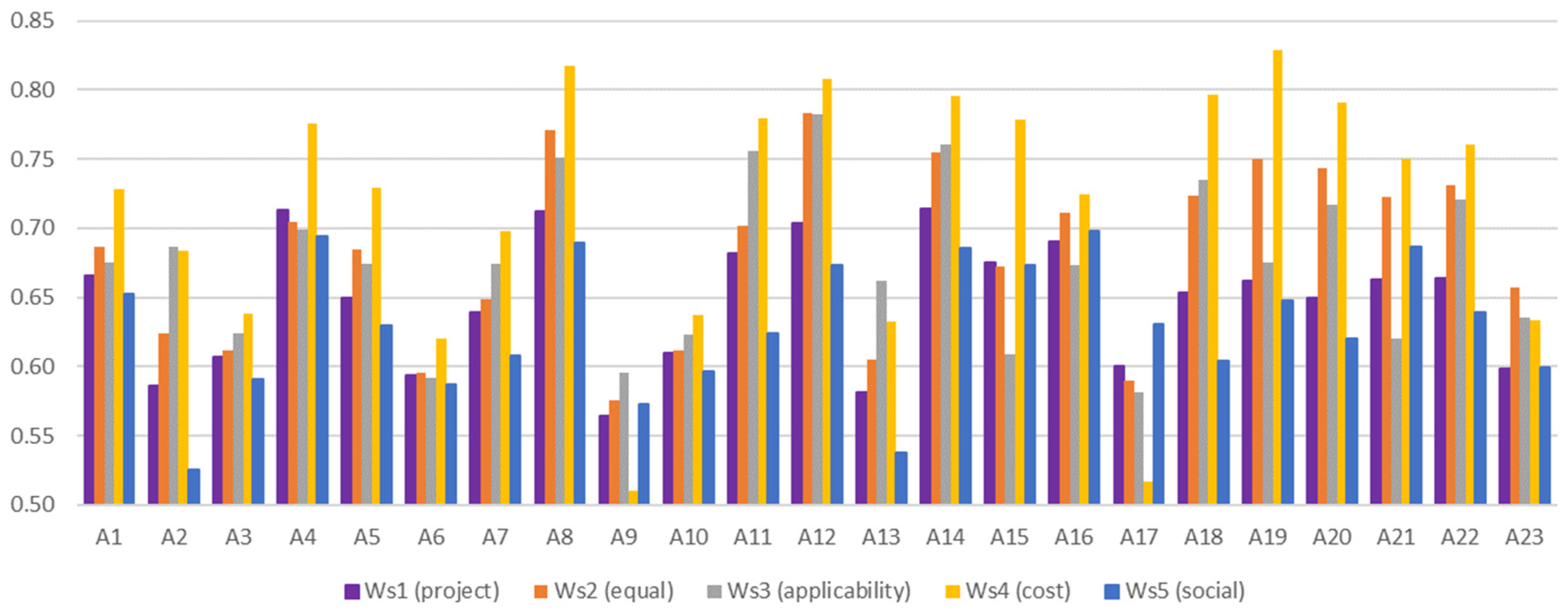
| Code | Alternative | R1 | R2 | R3 | R4 | GSI |
|---|---|---|---|---|---|---|
| A1 | Blended learning | 0.66 | 0.79 | 0.69 | 0.60 | 0.67 |
| A2 | e-learning | 0.78 | 0.77 | 0.57 | 0.38 | 0.59 |
| A3 | TEAL | 0.64 | 0.68 | 0.57 | 0.56 | 0.61 |
| A4 | CBL | 0.69 | 0.88 | 0.56 | 0.68 | 0.71 |
| A5 | Coop. TBL | 0.66 | 0.80 | 0.73 | 0.55 | 0.65 |
| A6 | Flipped learning | 0.59 | 0.66 | 0.56 | 0.57 | 0.59 |
| A7 | PBL | 0.71 | 0.77 | 0.56 | 0.55 | 0.64 |
| A8 | Reflective learning | 0.72 | 0.89 | 0.91 | 0.57 | 0.71 |
| A9 | Ind. com. proj. | 0.63 | 0.41 | 0.69 | 0.57 | 0.56 |
| A10 | Interact. simulation | 0.64 | 0.67 | 0.56 | 0.57 | 0.61 |
| A11 | Social media | 0.84 | 0.90 | 0.56 | 0.51 | 0.68 |
| A12 | Videos of a real case | 0.78 | 0.84 | 1.00 | 0.51 | 0.70 |
| A13 | Virtual learning | 0.75 | 0.67 | 0.56 | 0.44 | 0.58 |
| A14 | Case studies | 0.77 | 0.86 | 0.81 | 0.58 | 0.71 |
| A15 | Discussions | 0.51 | 0.94 | 0.56 | 0.67 | 0.68 |
| A16 | Gamification | 0.62 | 0.74 | 0.81 | 0.68 | 0.69 |
| A17 | Interdisciplinary | 0.57 | 0.41 | 0.69 | 0.69 | 0.60 |
| A18 | Problem-solving | 0.75 | 0.91 | 0.81 | 0.42 | 0.65 |
| A19 | Storytelling | 0.56 | 0.95 | 1.00 | 0.49 | 0.66 |
| A20 | Real material | 0.68 | 0.86 | 1.00 | 0.43 | 0.65 |
| A21 | Hands-on activities | 0.47 | 0.79 | 1.00 | 0.63 | 0.66 |
| A22 | Role play | 0.71 | 0.81 | 0.91 | 0.50 | 0.66 |
| A23 | Site visits | 0.60 | 0.60 | 0.91 | 0.51 | 0.60 |
| Exclusivity | Type and Group | Minimum Required Sessions | Alternatives |
|---|---|---|---|
| Can be combined with any activity | t1 or t2, g1 | 1 | (A1) Blended learning, (A2) e-learning, (A3) TEAL |
| Requires exclusive session/s | t2 or t3, g2 or g3 | 1 | (A5) TBL, (A6) flipped classroom, (A8) reflective learning, (A10) interact. simulation, (A11) social media, (A12) videos of a real case, (A14) case studies, (A15) discussions, (A16) gamification, (A18) problem-solving, (A19) storytelling, (A20) real material, (A22) role play, (A23) site visits |
| 3 | (A13) Virtual learning, (A21) hands-on activities | ||
| 8 | (A4) CBL, (A7) PBL, (A9) ind.-com. proj., (A17) interdisciplinary |
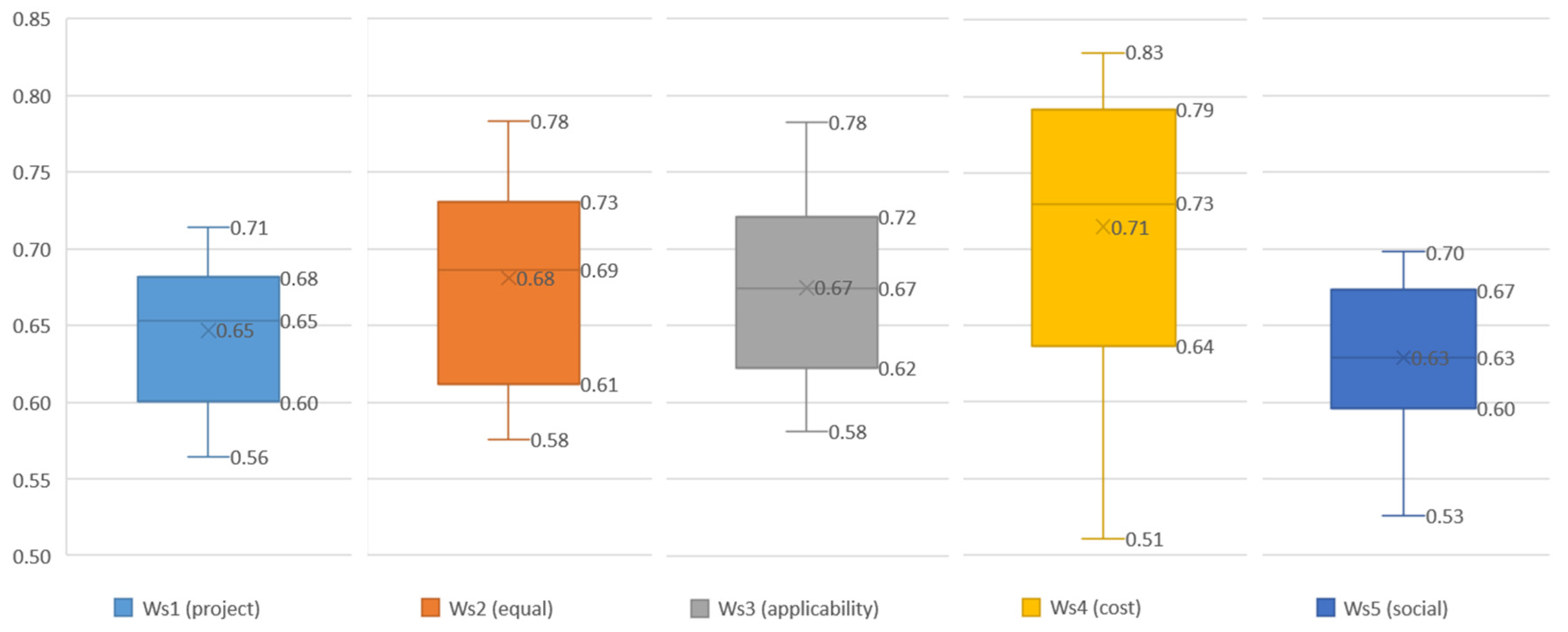
| Weighting Scenario Description | R1 | R2 | R3 | R4 | |
|---|---|---|---|---|---|
| Ws1 | This research project weighting, based on Delphi | 26 | 21 | 11 | 42 |
| Ws2 | Equal weights for all indicators | 25 | 25 | 25 | 25 |
| Ws3 | Applicability requirement-driven scenario | 55 | 15 | 15 | 15 |
| Ws4 | Economic requirement-driven scenario | 15 | 55 | 15 | 15 |
| Ws5 | Social requirement-driven scenario | 15 | 15 | 15 | 55 |
| Weighting Scenarios | 12 Sessions | 14 Sessions | ||
|---|---|---|---|---|
| Proposed Set | GSI | Proposed Set | GSI | |
| Ws1 | A4 (8); A12 (4) | 0.72 | A4 (8); A12 (6) | 0.72 |
| Ws2 | A12 (12) | 0.78 | A12 (14) | 0.78 |
| Ws3 | A12 (12) | 0.78 | A12 (14) | 0.78 |
| Ws4 | A19 (12) | 0.83 | A19 (14) | 0.83 |
| Ws5 | A8 (2); A16 (10) | 0.70 | A8 (4); A16 (10) | 0.70 |
Publisher’s Note: MDPI stays neutral with regard to jurisdictional claims in published maps and institutional affiliations. |
© 2022 by the authors. Licensee MDPI, Basel, Switzerland. This article is an open access article distributed under the terms and conditions of the Creative Commons Attribution (CC BY) license (https://creativecommons.org/licenses/by/4.0/).
Share and Cite
Pons-Valladares, O.; Hosseini, S.M.A.; Franquesa, J. Innovative Approach to Assist Architecture Teachers in Choosing Practical Sessions. Sustainability 2022, 14, 7081. https://doi.org/10.3390/su14127081
Pons-Valladares O, Hosseini SMA, Franquesa J. Innovative Approach to Assist Architecture Teachers in Choosing Practical Sessions. Sustainability. 2022; 14(12):7081. https://doi.org/10.3390/su14127081
Chicago/Turabian StylePons-Valladares, Oriol, S. M. Amin Hosseini, and Jordi Franquesa. 2022. "Innovative Approach to Assist Architecture Teachers in Choosing Practical Sessions" Sustainability 14, no. 12: 7081. https://doi.org/10.3390/su14127081
APA StylePons-Valladares, O., Hosseini, S. M. A., & Franquesa, J. (2022). Innovative Approach to Assist Architecture Teachers in Choosing Practical Sessions. Sustainability, 14(12), 7081. https://doi.org/10.3390/su14127081

