Article

Customer Perception and Its Influence on the Financial Performance in the Ecuadorian Banking Environment


by
Ana Belen Tulcanaza-Prieto
1,*,
Iliana E. Aguilar-Rodríguez
1 and
Chang Won Lee
2
1
Escuela de Negocios, Universidad de Las Américas, UDLA, Vía a Nayón, Quito 170124, Ecuador
2
School of Business, Hanyang University, Seoul 04763, Korea
*
Author to whom correspondence should be addressed.
Sustainability 2022, 14(12), 6960; https://doi.org/10.3390/su14126960
Submission received: 11 May 2022 / Revised: 31 May 2022 / Accepted: 1 June 2022 / Published: 7 June 2022

Abstract

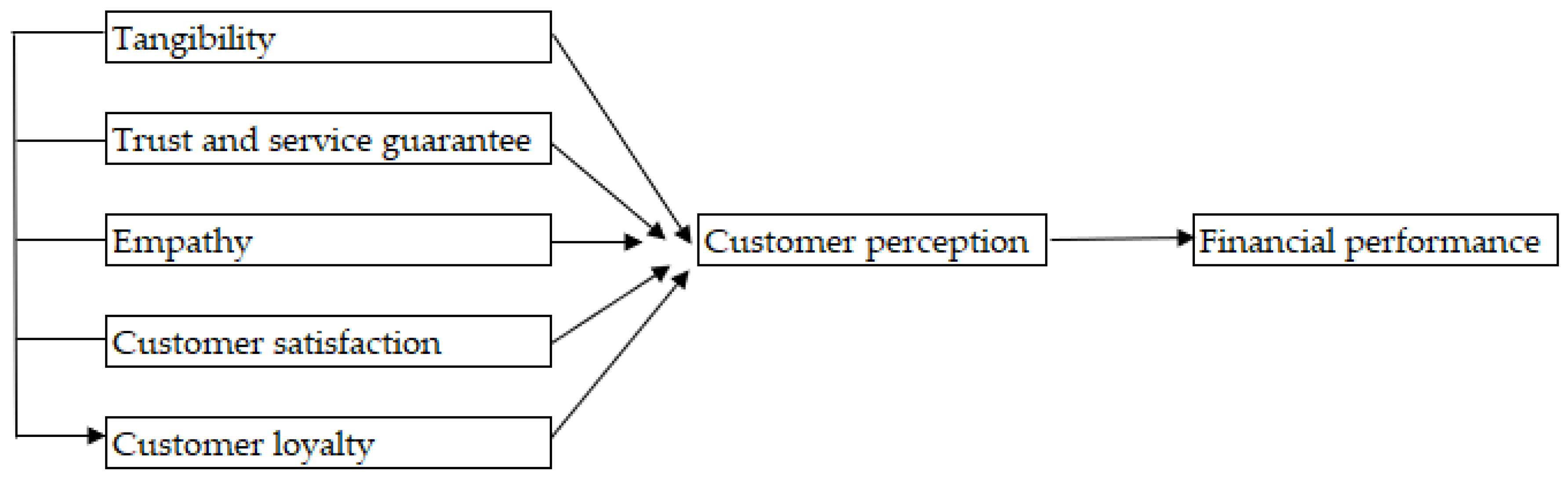
This study examines the relationship between customer perception and financial corporate performance in the Ecuadorian banking environment. A self-designed online questionnaire was carried out to gather information regarding customer perception factors (tangibility, trust and service guarantee, empathy, customer satisfaction, and customer loyalty), while the financial data of the Ecuadorian banks were attained from their annual financial indicator reports (financial efficiency and liquidity). A total of 243 questionnaires were recollected and 219 were considered as the final valid data. SPSS 26 was utilized for data analyses. Structural equation modeling was used to test the hypotheses. Our findings revealed that customer perception has a positive and significant (at least at the 5% level) impact on the financial performance of banks. Similarly, customer loyalty is influenced by tangibility, trust and service guarantee, empathy, and customer satisfaction. Study results are mostly consistent with the banking environment of other countries, especially Nigeria, and Scandinavian nations. Bank managers might always prioritize the customer perception of the bank due to it being considered a strong predictor of the bank’s financial performance. This study provides a complete statistical and econometrical model with tangible and intangible factors of customer perception (qualitative variables) and it includes financial records (quantitative variables). The main limitation of our study is the calculation of the customer perception index because Ecuadorian institutions do not calculate it and thus, we estimate the index in our model. For future research, the suggestion is that a corporate governance index with a customer perception component is included to improve the model.
Keywords: customer perception; financial corporate performance; Ecuadorian banking environment customer perception; financial corporate performance; Ecuadorian banking environment