Abstract
The network operation of the subway can reduce the number of passenger transfers and improve subway operation efficiency. Based on the subway smart card data, this paper proposes an optimal design method for the cross-line operation scheme of subway trains. The method firstly calculates the OD matrix between subway stations, the passenger section flow, and the transfer flow according to the passenger smart card data. It then optimizes the design of the subway train cross-line operation plan, including determining the routing type of cross-line operation and the number of trains running. Finally, for the lines with cross-line operation conditions in the urban subway system, we design the cross-line operation schemes under all possible combinations. According to the volume of the cross-line passenger flow that the cross-line trains can carry, the top-ranked operation plans are preferably recommended. Taking the Chengdu subway network as an example, the research results show that, in the Chengdu subway network, the North Railway Station, Xibo City Station, and South Railway Station bear the highest transfer demand. The transfer demands that can be undertaken by cross-line trains are 23,934, 16,710, and 13,024 trips per hour, respectively. This shows that the proposed design method can accurately and reasonably screen out the transfer stations and lines with an urgent need for cross-line trains.
1. Introduction
Rail transit construction has an important impact on urban development [1,2]. In recent years, with the gradual network construction of urban subways in China, the network operation of urban subways has become an urgent requirement. Subway network operation can reduce the number of passenger transfers and total travel time. Subway network operation requires trains to run across different subway lines, and cross-line operation is one of the train crossing schemes. However, the cross-line operation of the subway involves many conditions such as lines, vehicles, power supply, and signals [3,4,5], and the line reconstruction is difficult and costly in the operation stage. In order to ensure that the huge investment cost can effectively improve the operation efficiency of the subway network, it is particularly important to design a scientific and reasonable plan for the cross-line operation of subway trains.
1.1. Literature Review
Existing research on the optimization of subway train operation mostly focuses on a single subway line [6,7], including the optimization of departure frequency and running intervals, optimization of the train stop plan, optimization of train routing plan, etc. For the optimization of the departure frequency and running interval, Niu and Zhou proposed a genetic algorithm to solve the integer programming models to optimize the timetables of metro lines [8]. Sun et al. proposed three models to design capacitated demand-sensitive timetables for metro services considering capacity constraints [9]. Zhou and Oldache used the simulated annealing algorithm to optimize the timetables for metro services [10]. For the optimization of train stop plans, Gao et al. proposed a mixed-integer linear programming model to design a skip-stop pattern for metro lines in over-crowded situations after disruptions [11]. Jamili et al. proposed a robust mathematical model to design skip-stop patterns for metro lines [12]. Lee et al. designed a skip-stop pattern considering four types of train choice behavior based on passenger smart card data [13]. For the optimization of the train routing plan, Zwaneveld et al. described an algorithm based on valid inequalities and the branch-and-cut approach to solve the problem of routing trains through stations [14]. Liu et al. developed an MINLP model to solve the real-time track reallocation problem [15]. Xu et al. constructed a multi-objective model to determine the receiving routes and departure routes of trains [16].
For the cross-line operation of trains, valuable theoretical and practical experience has been accumulated worldwide. Many scholars have conducted in-depth research on the management and coordination mechanism of rail transit cross-lines based on the rail transit network in the Tokyo metropolitan area [17,18,19]. Ming and Ye studied the traffic demand and engineering technical conditions of cross-line operations in Tokyo [20]. Yang et al. optimized the frequencies, stopping patterns, and operation zones of cross-line trains [21]. In China, Chongqing Rail Transit Line 4 and Circle Line have implemented cross-line operation, and scholars have studied their reasonable distribution layout for cross-line operation through passenger flow analysis [22]. Guangzhou Metro Line 14 and Line 21 have implemented cross-line operations as well, and some scholars have studied the design scheme of their line signal systems [23].
1.2. The Main Contributions of This Paper
With the help of passenger smart card data, it is possible to analyze the travel demand of the subway network in Beijing [24], Shanghai [25], Seoul [26], etc. However, there are few studies exploring the proper metro stations and lines for cross-line operation based on passenger smart card data. Therefore, this paper proposes an optimization design method for subway train cross-line operation schemes based on passenger smart card data. This method can accurately and reasonably screen out the transfer stations and lines with an urgent need for cross-line trains. The method firstly calculates the OD demand matrix between stations of the subway network, the passenger section flow, and the transfer flow in all directions of the transfer station based on the data from the passenger smart card. Passenger smart card data contain a passenger’s entry time, entry station name, exit time, and exit station name. Secondly, for two subway lines, according to the property that the transfer flow in a certain direction of the transfer station is smaller than the passenger section flow of the corresponding adjacent section of the transfer station, the method optimizes the design of the subway train cross-line operation plan, including determining the routing type of train cross-line operation and the number of trains running. This plan can help cross-line trains meet the transfer demand as much as possible and fully consider the crossover conditions of the subway lines around the transfer station. Finally, for the lines with cross-line operation conditions in the subway network, the cross-line operation schemes are designed under all possible combinations. According to the volume of cross-line passenger flow that the cross-line trains can carry, the top-ranked cross-line operation plans are preferably recommended. Taking the Chengdu subway network as an example, the design process of the subway train cross-line operation scheme is expounded.
The next section will introduce the research methodology, which contains the operation scheme design of the independent subway line, the design of the subway cross-line operation scheme between two subway lines, and the design of the cross-line operation scheme of the subway network. Section 3 shows the rationality of the proposed method through examples, and finally explains the conclusions of this paper and the problems to be further studied.
2. Research Methodology
In this section, denotes the subway network; denotes the subway station set; denotes the subway station,; denotes the section set of subway lines, and denotes the section of the subway line, .
The target of this research is choosing proper subway lines and stations for the implementation of cross-line operation, reducing the transfer cost, and then reducing the total travel cost, that is:
In the formula, denotes the path between the OD pair , denotes the traffic flow assigned to the path . denotes the travel time cost of the path . can be divided into two types according to whether they involve subway transfers, as shown in Formula (2):
In the formula, is a 0–1 variable. If the path contains section a, then is equal to 1; otherwise, is equal to 0. denotes the travel time cost of section . denotes the transfer cost and denotes the number of transfers.
For some passengers, operating cross-line trains can reduce their transfer cost, that is . The following part of this paper will study how to choose subway lines and stations to implement cross-line operation to reduce the transfer costs of as many passengers as possible.
2.1. Design of Train Operation Scheme of the Independent Subway Line
For the operation scheme of the independent subway line, the maximum passenger section flow of the line sections shall be calculated through the OD matrix between subway stations, and the number of trains shall be determined in combination with the train operation routing and the stop scheme. The inter-station OD matrix data are the original data for calculating the maximum passenger section flow. According to the inter-station OD matrix data, the number of passengers getting on and off in the upward and downward directions of each station can be calculated, and then the passenger section flow can be calculated. Finally, the maximum passenger section flow of the whole line can be obtained. The calculation formula of passenger section flow is:
In the formula, represents the passenger section flow in section i+1, represents the passenger section flow in section i, represents the number of people getting off at station i, and represents the number of people getting on at station i.
The number of trains can be calculated according to the maximum passenger section flow of the line and the seating capacity of the train, in combination with the train routing and the stop scheme [27]. Considering the limitation of the minimum departure interval, the calculation formula of the number of trains can be expressed as follows:
In the formula, refers to the number of trains during different time periods throughout the day; refers to the maximum passenger section flow of the line; refers to the seating capacity of the train; represents the full-load coefficient of the line, and the recommended value is 0.9; represents the minimum departure interval, which is determined by the technical conditions of the line, and the value in this paper is 120 s.
2.2. Design of Cross-Line Operation Scheme between Two Subway Lines
2.2.1. Calculation of Potential Traffic Demand for Cross-Line Operation
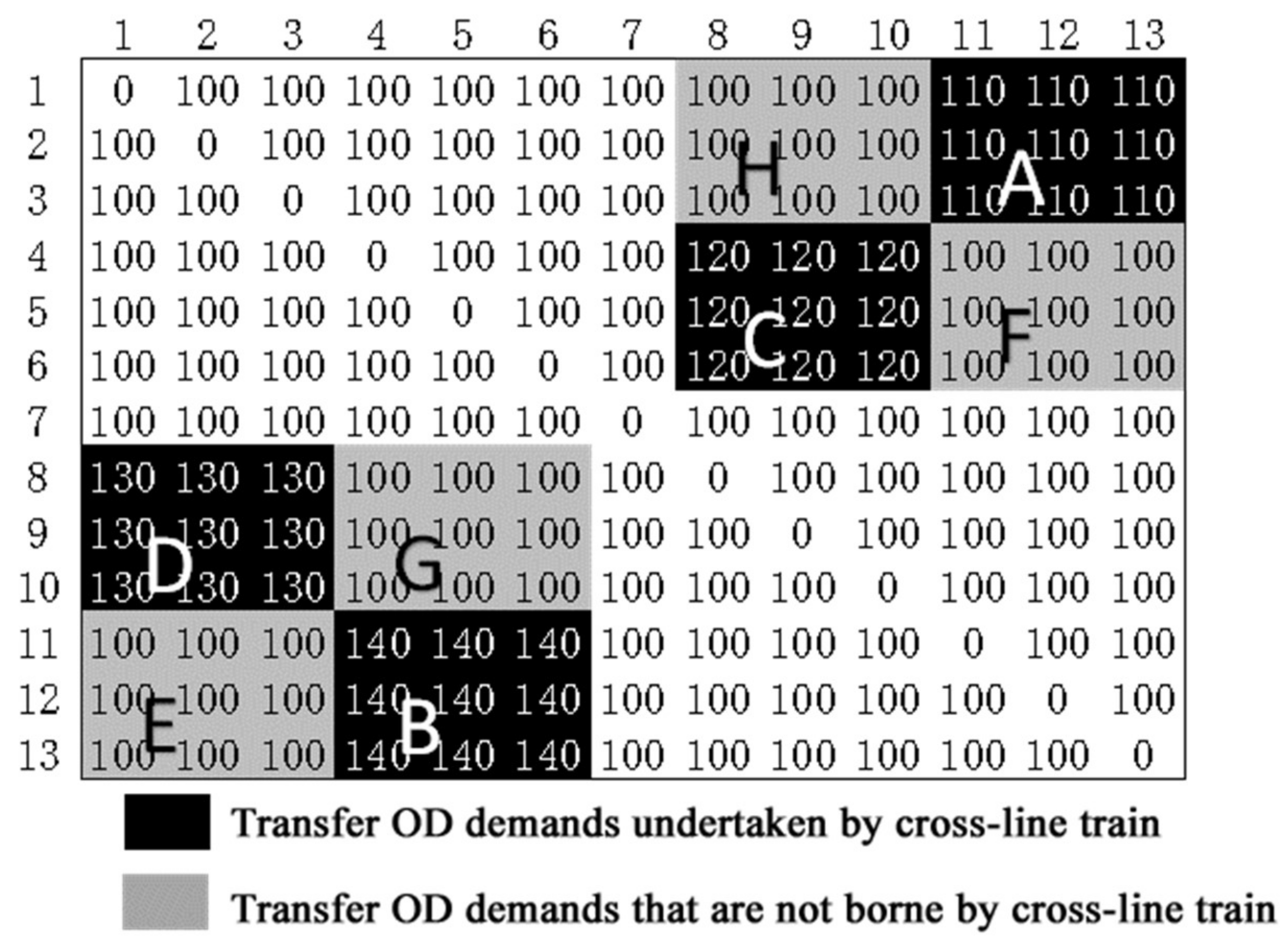
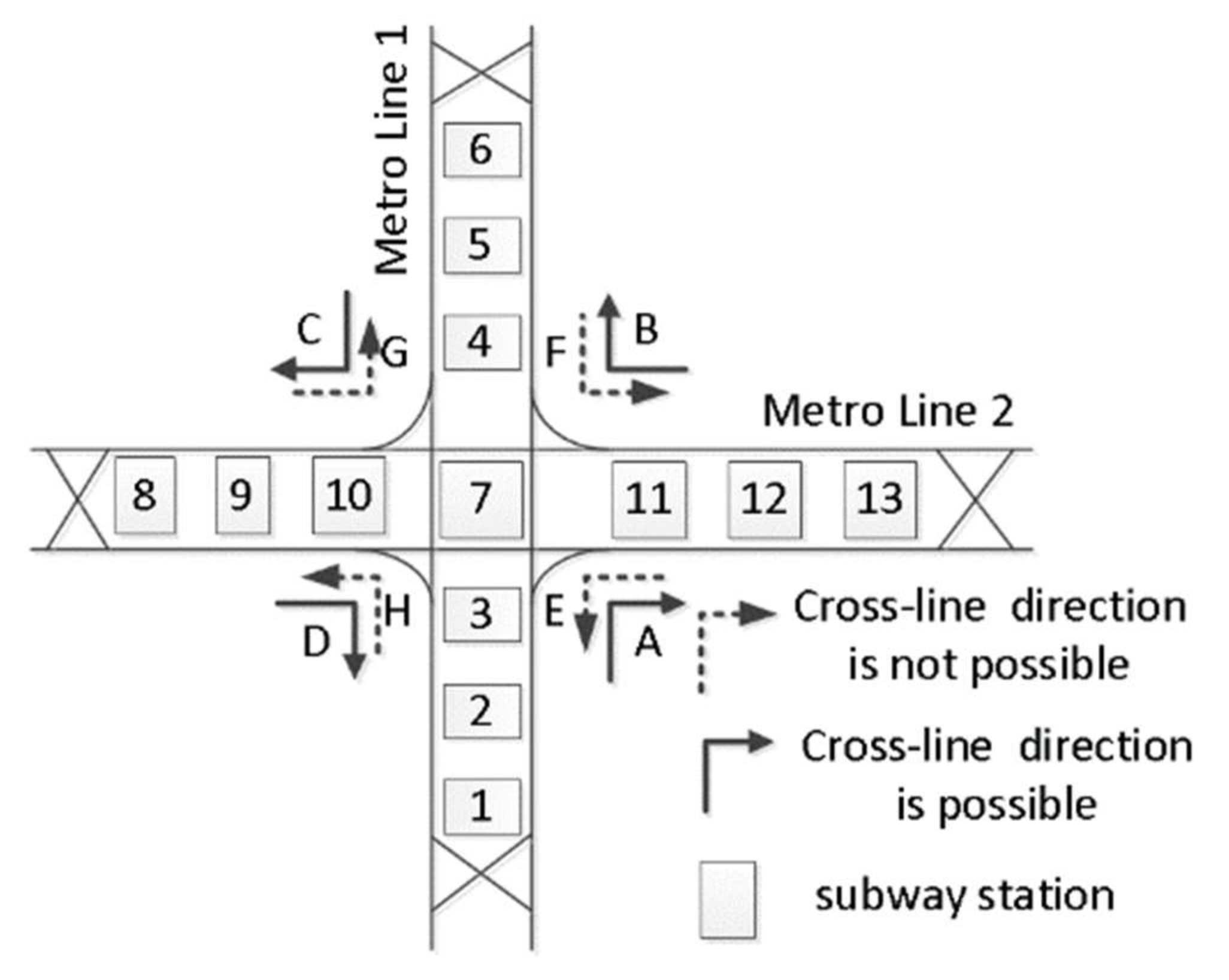
When a subway line operates independently, the passenger section flow can be calculated according to Formula (3), and then the maximum passenger section flow can be found. For two independent subway lines with one transfer station, the passenger section flow can also be calculated by Formula (3), but the difference from the independent operation of one subway line is that the number of passengers getting on at a station includes not only the number of passengers going to other stations of the line but also the number of passengers who transfer to other stations of another line. For example, the number of passengers getting on at station 8 on line 2 in the downward direction includes not only the number of passengers going to stations 9, 10, 7, 11, 12, and 13 on line 2 but also the number of passengers transferring to stations 1, 2, 3, 4, 5, 6, and 7 on line 1. When the trains of the two subway lines run independently, the passenger transfer flow in the eight directions of the transfer station constitutes the potential transfer demand of the cross-line trains. According to the crossover conditions between subway lines, the potential transfer demand of cross-line trains can be divided into conditional and achievable potential transfer demand and unconditional and unrealizable potential transfer demand. As shown in Figure 1, the two lines have a total of 13 stations, one of which is a transfer station, and there are four crossover lines. According to the conditions of crossover lines between subway lines, the potential transfer demands A, B, C, and D of cross-line trains are conditional and achievable potential transfer demands; the potential transfer demands E, F, G, and H of cross-line trains are unconditional and unrealizable potential transfer demands. Since the paths of all transfer OD must pass through the section adjacent to the transfer station, property 1 is satisfied.
Figure 1.
Schematic diagram of subway network.
Property 1: The potential transfer demand in all directions of subway cross-line trains must be less than the maximum section flow of any line of two subway lines.
Take the simple subway network in Figure 1 as an example to illustrate how to calculate the potential transfer demand of cross-line trains. The subway network consists of two lines, each line contains seven stations, and there is one transfer station between the two lines, as shown in Figure 1. The inter-station OD demand matrix corresponding to the subway network is a matrix of 13 × 13, as shown in Figure 2. According to the inter-station OD matrix, the number of people getting on and off in the upward and downward direction at each station can be obtained as shown in Table 1. Then, according to Formula (3), the passenger section flow can be calculated as shown in Table 2. Figure 2 not only shows the inter-station OD demand matrix corresponding to the subway network but also uses black blocks to indicate the transfer OD demand that may be undertaken by the cross-line operation. The transfer OD demands represented by each part of the black block correspond to the running direction of the cross-line trains shown in Figure 1. The potential transfer demand in each cross-line running direction equals the sum of the corresponding OD demand data blocks. For example, the potential transfer demand in direction A in Figure 1 is equal to the sum of the OD demand represented by the black block A in Figure 2. As shown in Table 3, the potential transfer demand in direction A is equal to 990 trips per hour, that is, the sum of the OD demand, represented by black block A in Figure 2, is 990 trips per hour.
Figure 2.
Schematic diagram of OD matrix.
Table 1.
Number of people getting on and off at each station (trips per hour).
Table 2.
Passenger section flow.
Table 3.
Potential transfer demand.
2.2.2. Routing Scheme Design of Cross-Line Operation
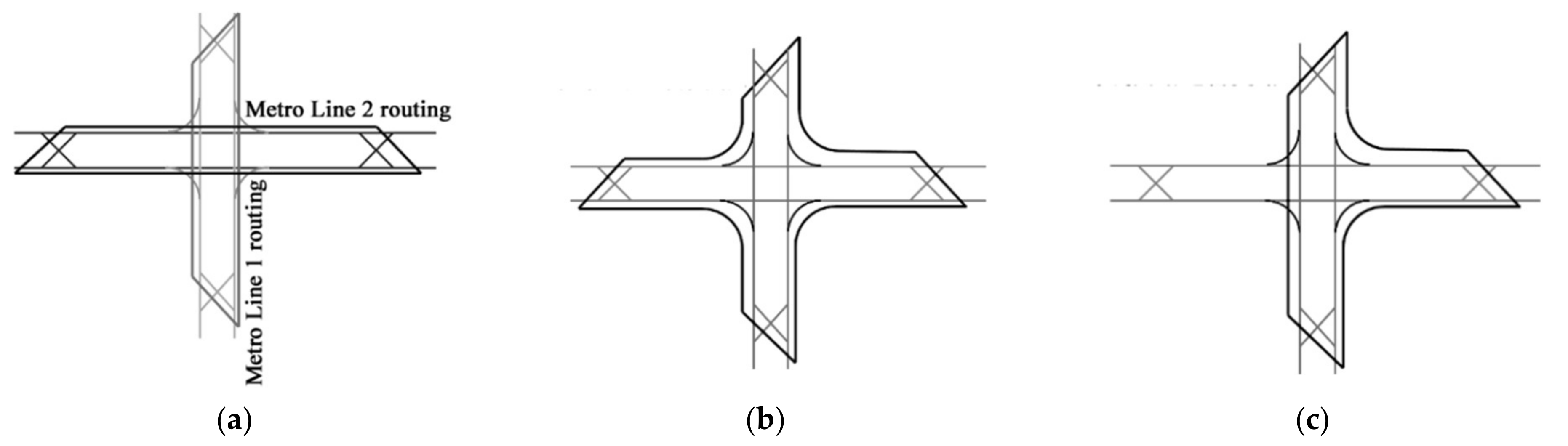
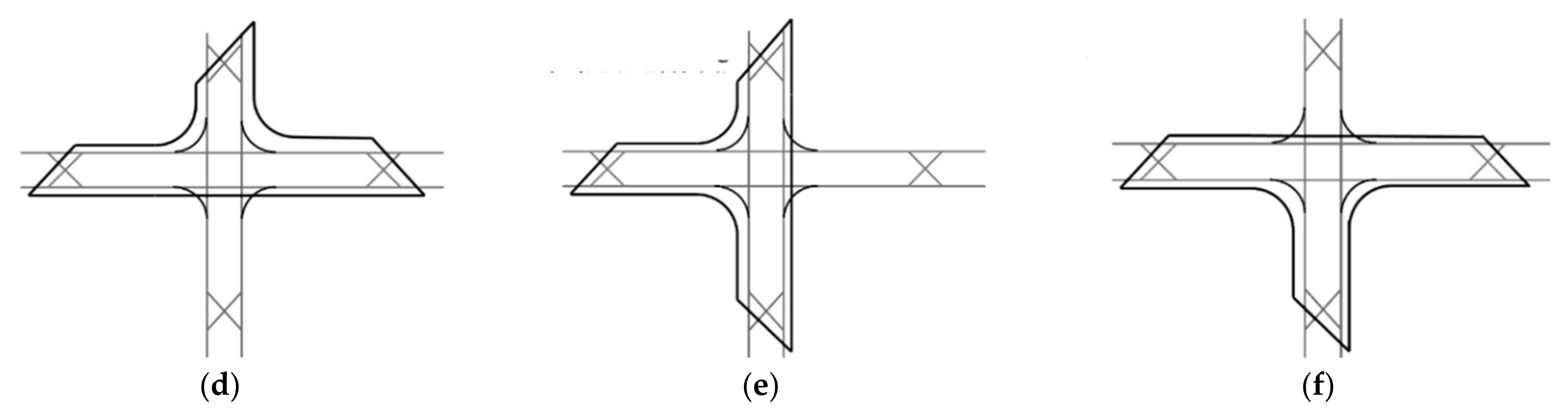
For the independently operated Metro line 1 and Metro line 2 with one transfer station, there are 5 possible subway cross-line routings, as shown in Figure 3. Figure 3a shows the routings of Metro Line 1 and Metro Line 2; Figure 3b–f shows the five types of cross-line routings. It is worth noting that due to the limitations of the construction conditions of the crossover, the cross-line routing can only operate in one direction under normal operation.

Figure 3.
Schematic diagram of subway cross-line operation. (a) Metro Line routings; (b) Cross-line routing 1; (c) Cross-line routing 2; (e) Cross-line routing 4; (f) Cross-line routing 5.
The cross-line routing shown in Figure 3b can undertake the transfer flow of four directions—Direction A, B, C, and D, but it involves four crossover constructions. The cross-line routings shown in Figure 3c–f can undertake the transfer flow of two directions. Figure 3c can undertake the transfer flow of Direction A, B; Figure 3d can undertake the transfer flow of Direction B, C; Figure 3e can undertake the transfer flow of Direction C, D; Figure 3f can undertake the transfer flow of Direction A, D. In addition, they only involve 2 crossover constructions. In engineering practice, it is necessary to select the appropriate type of cross-line routing considering the difficulty of crossover constructions near the transfer station and passenger transfer flow demands.
2.2.3. Calculate the Number of Trains for Different Routings
After determining the subway cross-line routing, the OD demand data of the potential transfer flow undertaken by the cross-line train is also determined. When operating the subway cross-line trains, for cross-line routing 1 shown in Figure 3b, the OD data blocks undertaken by the cross-line train are A, B, C, D; for cross-line routing 2 shown in Figure 3c, the OD data blocks undertaken by the cross-line train are A, B; for cross-line routing 3 shown in Figure 3d, the OD data blocks undertaken by the cross-line train are B, C; for cross-line routing 4 shown in Figure 3e, the OD data blocks undertaken by the cross-line train are C, D; for cross-line routing 5 shown in Figure 3f, the OD data blocks undertaken by the cross-line train are A, D.
After determining the potential transfer OD demand undertaken by the cross-line train, the sum value of each transfer OD data block can be calculated separately, that is, the crossover section flow of all directions. The maximum value of the crossover section flow is the maximum section flow of the cross-line operation. Then, according to Formula (4), the number of trains required for the subway cross-line operation can be obtained.
Based on the number of trains required for the subway cross-line operation and the number of trains for the independent operation of the subway line, one can calculate the number of trains required for the operation of the original subway line after running the subway cross-line train. This value is equal to the number of trains for the independent operation of the subway line minus the number of trains required for the subway cross-line operation.
2.3. Design of Cross-Line Operation Scheme of Subway Network
For the subway network, since there may be multiple transfer stations on a subway line that intersects with multiple subway lines, it is difficult to directly calculate the passenger section flow based on Formula (3). However, the passenger section flow of the subway network can be obtained by using the method of network traffic flow assignment. The method process is as follows:
Firstly, according to the data of passenger smart cards, we calculate the OD demand between stations of the subway network. We find the k-shortest paths between any OD pairs in the subway network.
Secondly, we use the multinomial logit model to calculate the probability of each path being selected [28] and assign the travel demand to each path according to the probability. The calculation formula is as follows:
In the above formula, denotes the probability of selecting the path for a certain OD pair , . denotes the travel time cost of the path . denotes the traffic flow assigned to the path . denotes the traffic demand of the OD pair .
Finally, via the statistical summary of the traffic flow of all paths, the passenger section flow of the subway network and the passenger transfer flow of each transfer station can be obtained. The calculation formula of passenger section flow is as follows:
In the above formula, denotes the section flow of section of the subway line. is a 0–1 variable. If the path contains section a, then is equal to 1; otherwise, is equal to 0.
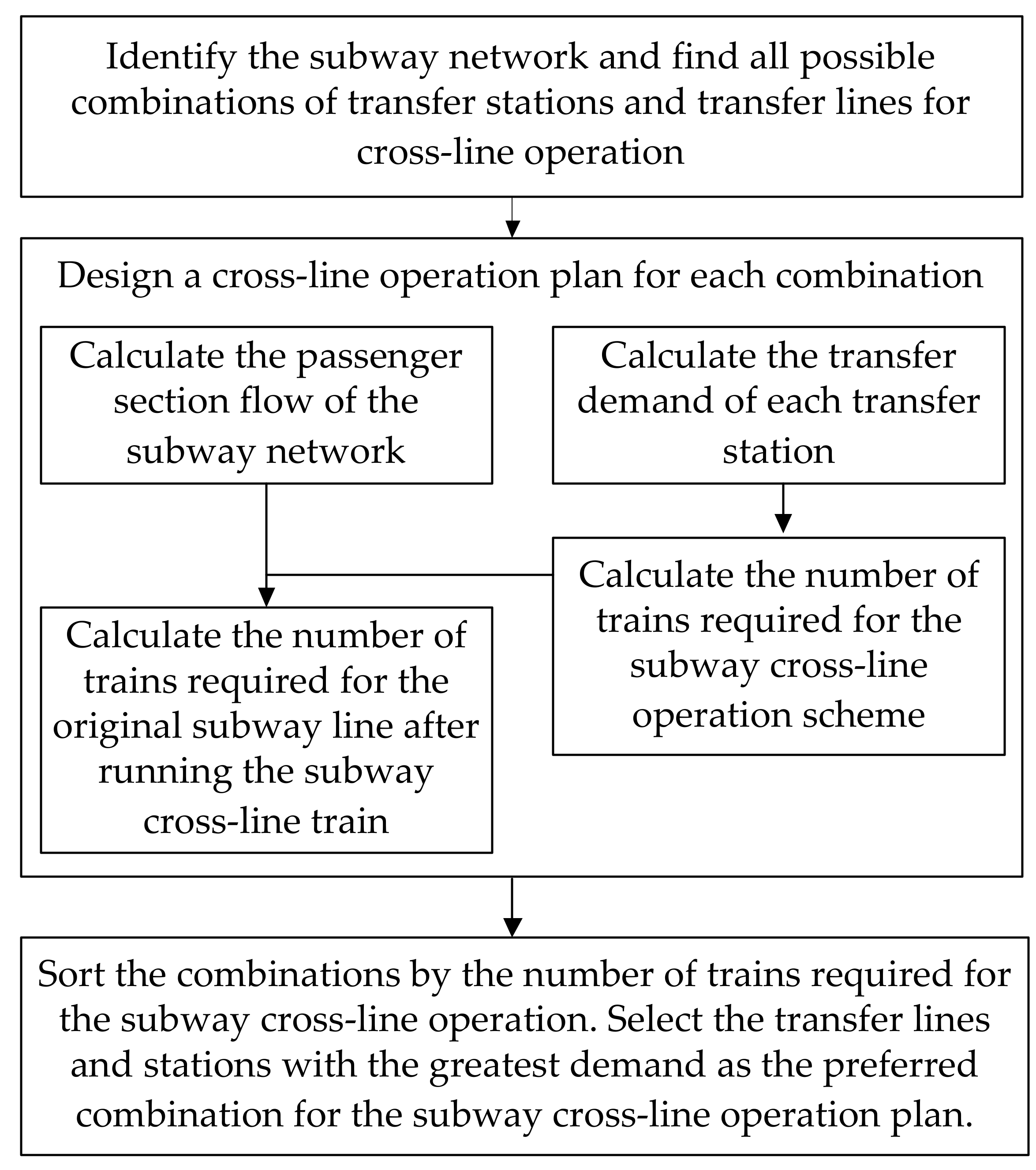
For the subway network, the design method process of the cross-line train operation plan is shown in Figure 4.
Figure 4.
Design method process of the cross-line train operation plan.
3. Case Analysis
This section takes the Chengdu Metro Network as an example to show the process of the design method for subway train cross-line operation schemes proposed by this paper. Chengdu Metro Network refers to urban rail transit serving Chengdu, Sichuan Province, China. Its first line, Chengdu Metro Line 1, was officially opened on 27 September 2010, making Chengdu the twelfth city in mainland China to open rail transit.
Based on the subway smart card data of the Chengdu Metro Network on 23 April 2021, this section designs the operation scheme of cross-line trains. Taking the combination of Chengdu Metro Lines 1 and 2 and the transfer station Tianfu Square Station as an example, the design process of the cross-line operation scheme proposed in this paper is comprehensively displayed. According to the smart card data of t Chengdu Metro Network, the OD demand data between Chengdu Metro Lines 1 and 2 and the transfer demand data in all directions undertaken by the transfer station Tianfu Square Station are calculated. On this basis, considering the infrastructure conditions of the transfer station Tianfu Square Station, the type of cross-line routing is determined to be cross-line routing 5, and the estimated number of trains for subway cross-line operation is 5 trains per hour. Through the analysis of the entire Chengdu Metro Network, it is concluded that transfer stations with the most urgent need for the implementation of subway cross-line operation in the Chengdu subway network are the North Railway Station, Xibo City, and South Railway Station. The number of trains required for operating the cross-line trains is greater than or equal to 10 trains per hour.
3.1. Schematic Design of Cross-Line Operation of Chengdu Metro Lines 1 and 2
3.1.1. Traffic Demand Analysis
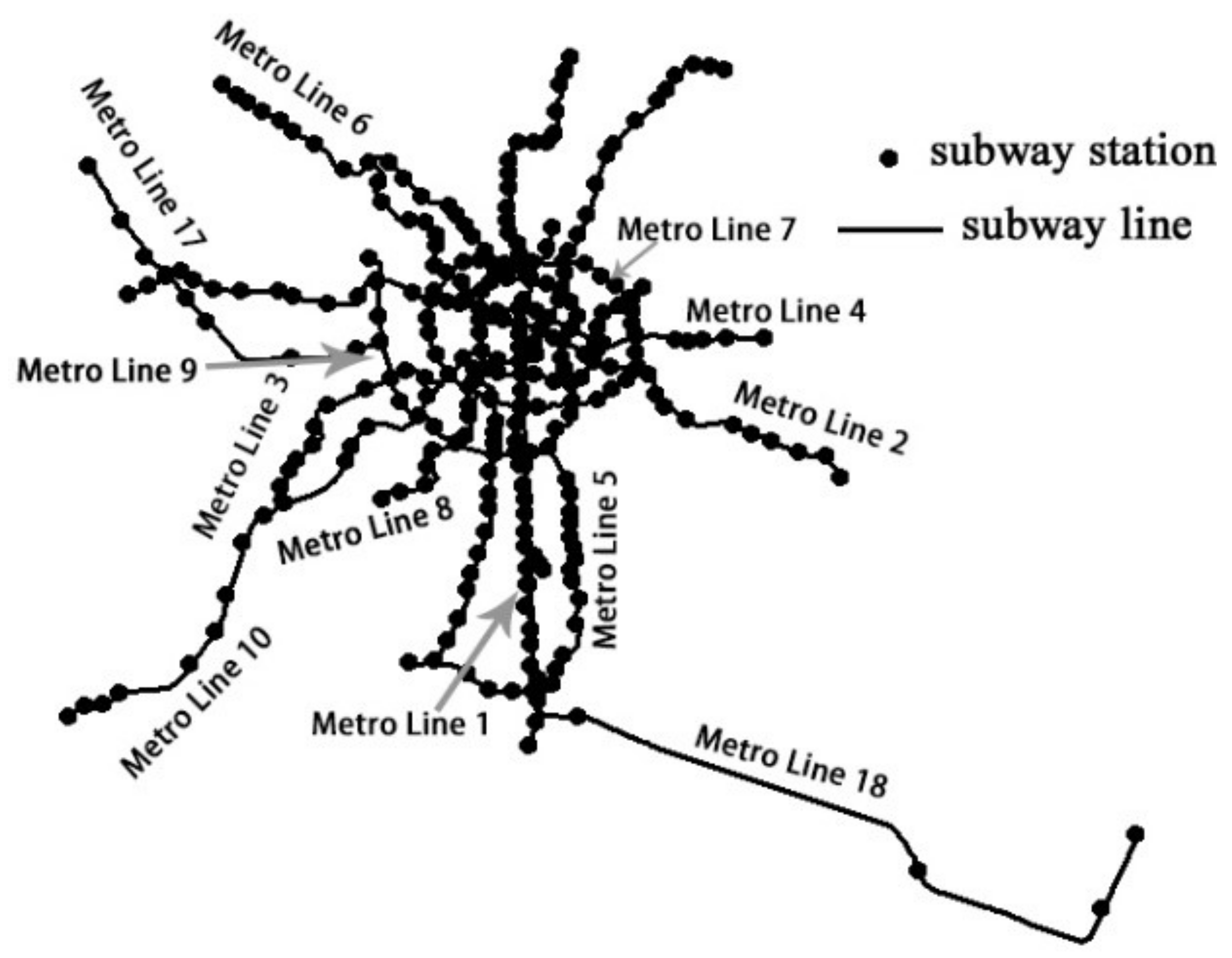
There are smart card data of 3.036 million Chengdu subway passengers every day, and each data must contain four basic fields: Entry time, entry station name, exit time, and exit station name, as shown in Table 4. The Chengdu subway network consists of 12 lines in total (excluding the tram line Rong 2), and the 12 lines have a total of 46 transfer stations, as shown in Figure 5.
Table 4.
Part of data.
Figure 5.
Schematic diagram of Chengdu subway network.
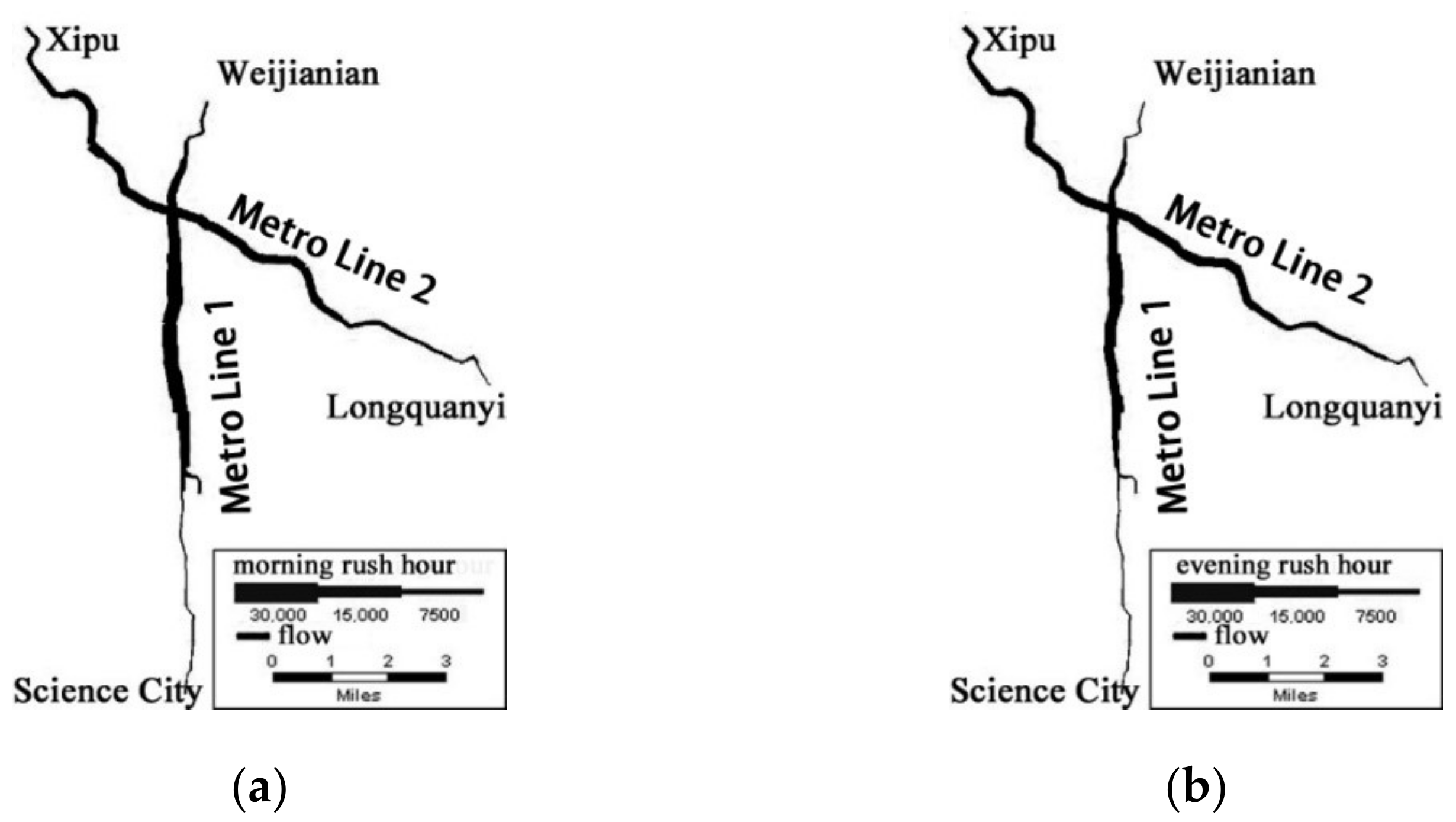
Based on the smart card data of Chengdu subway passengers, the traffic situation of the Chengdu subway network on 23 April 2021 was analyzed. The OD matrix between stations can be easily obtained through statistical analysis of smart card data of Chengdu subway passengers. Through the inter-station OD matrix, based on Formula (5), the passenger section flow of Chengdu Metro Lines 1 and 2 in the morning and evening rush hours can be obtained, as shown in Figure 6.
Figure 6.
Passenger section flow of Chengdu Metro Lines 1 and 2 in the morning and evening rush hour. (a) Morning rush hour; (b) Evening rush hour.
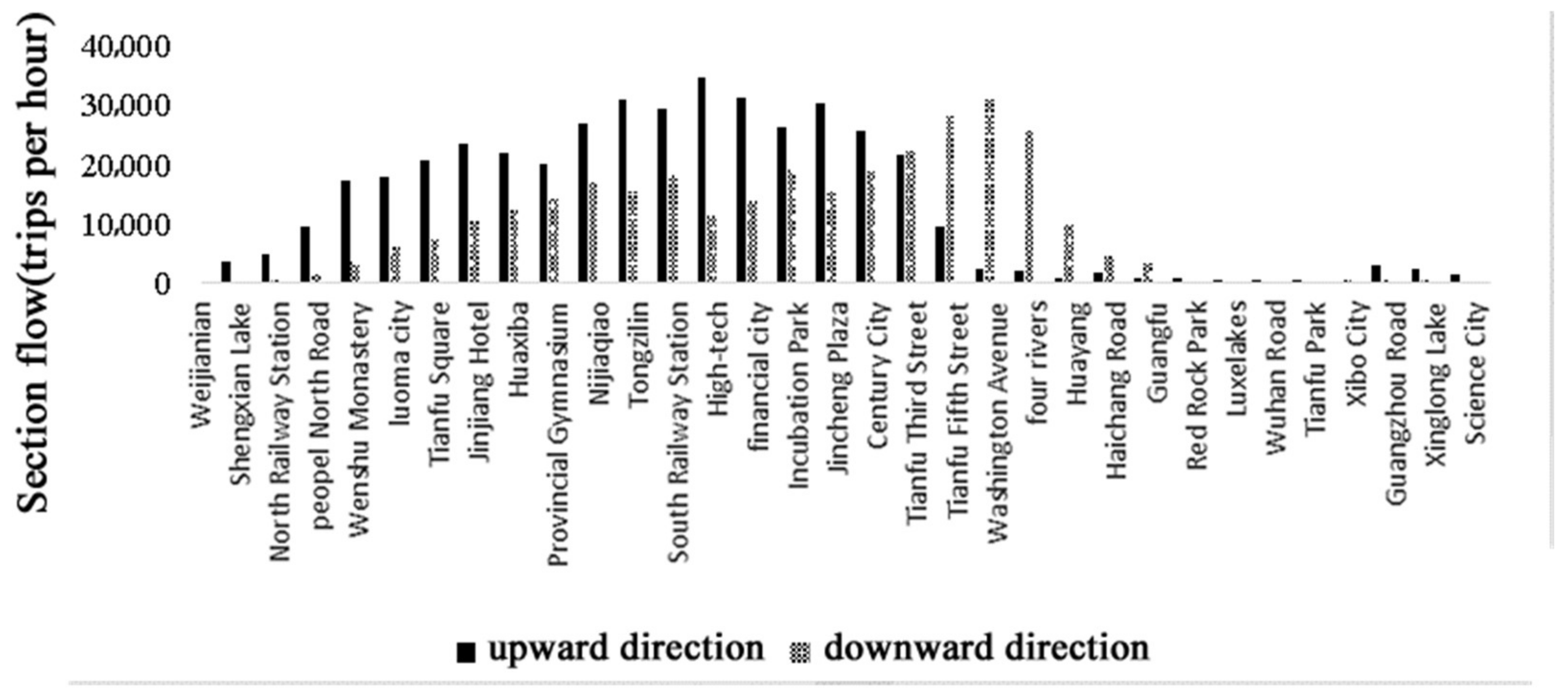
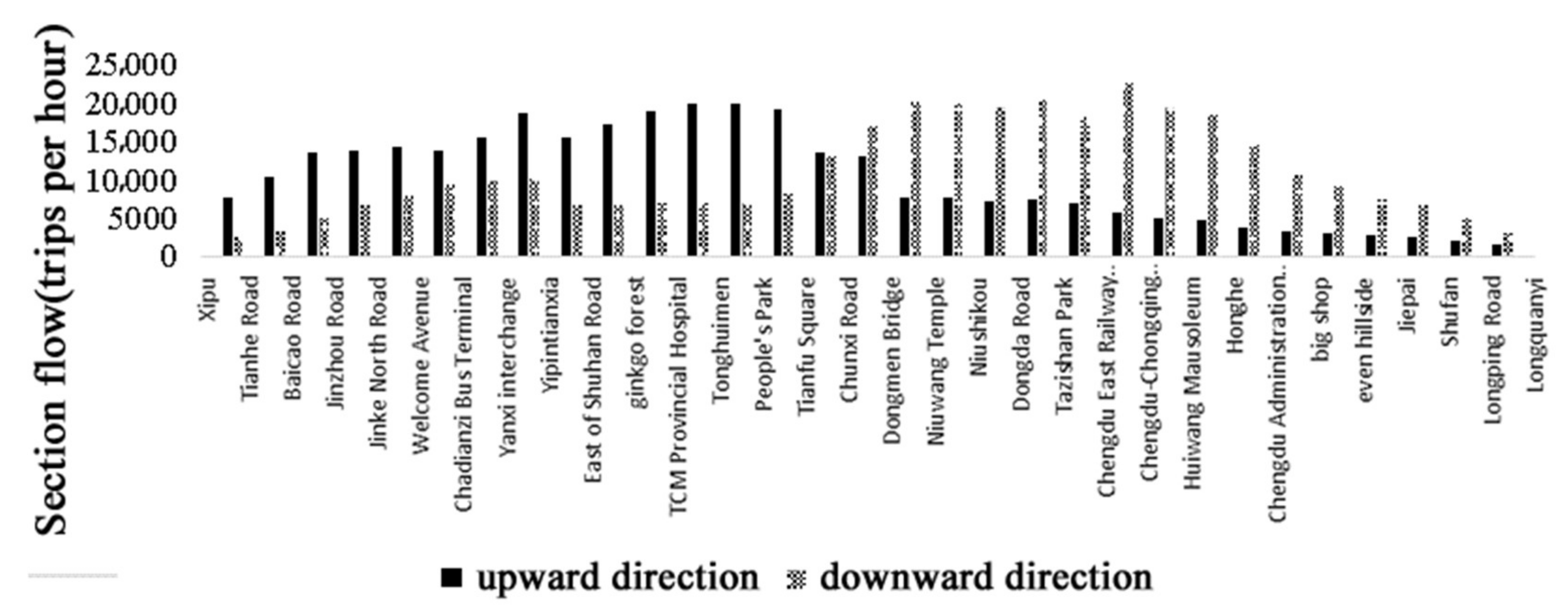
Figure 6 illustrates that the section flow of the Chengdu subway during the morning rush hour is slightly larger than that during the evening rush hour. Therefore, this paper uses the data of the morning rush hour for the design of the cross-line operation scheme. The section flow values during the morning rush hour of Metro Line 1 are shown in Figure 7, and the section flow values during the morning rush hour of Metro Line 2 are shown in Figure 8. The section flow during the morning rush hour of Metro Line 1 in the upward direction is mainly concentrated between People North Road Station and Tianfu Third Street Station, and in the downward direction is mainly concentrated between Four Rivers Station and Financial City Station; the section flow during the morning rush hour of Metro Line 2 in the upward direction is mainly concentrated between Xipu Station and Dongmen Bridge Station, and in the downward direction is mainly concentrated between Chengdu Administration College Station and Tianfu Square Station. From Figure 7 and Figure 8, it can be seen that, during the morning rush hour, the maximum passenger section flow of Metro Line 1 is 34,629 trips per hour and that of Metro Line 2 is 22,640 trips per hour. By consulting the relevant information, it is concluded that the seating capacity of trains running on Chengdu Metro Lines 1 and 2 is 1468. If the implementation of cross-line trains is not considered, based on Formula (4), the number of trains running on Metro Line 1 should be 26 trains per hour, and the number of trains running on Metro Line 2 should be 17 trains per hour.
Figure 7.
Passenger section flow of Metro Line 1 during morning rush hour.
Figure 8.
Passenger section flow of Metro Line 2 during morning rush hour.
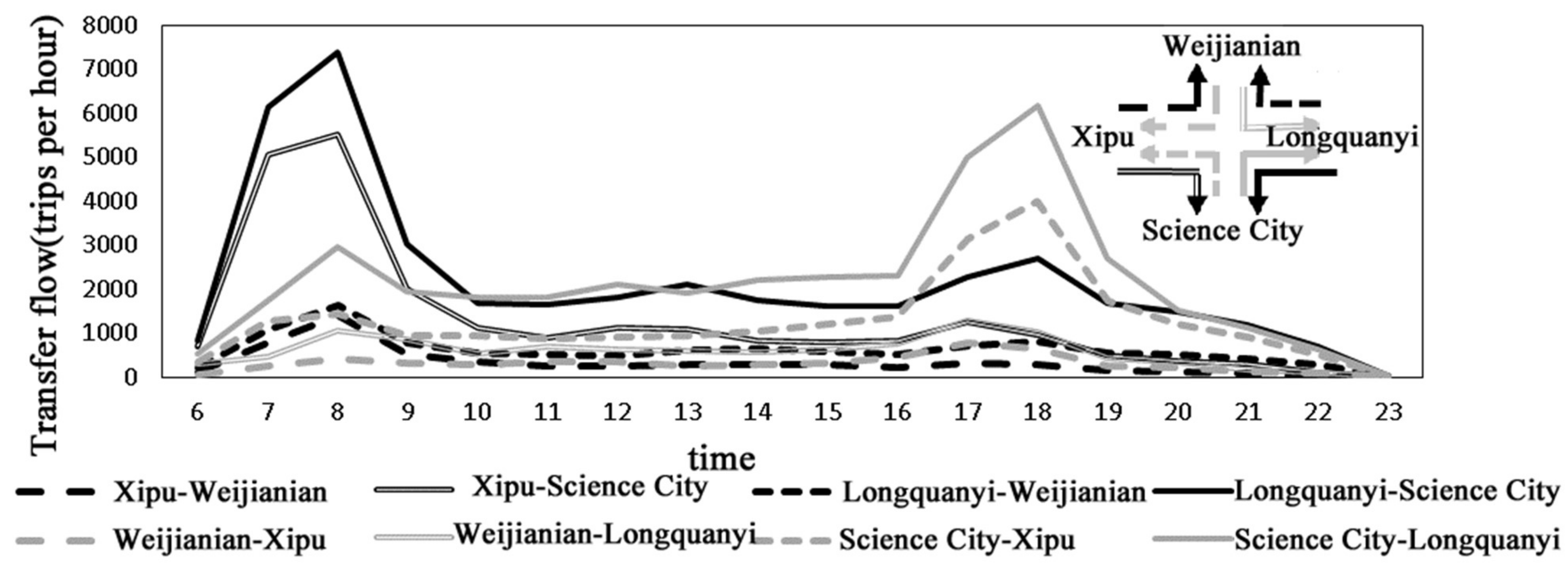
Based on the OD demand data of the Chengdu subway network, this paper calculates the transfer passenger flow of Tianfu Square Station in eight directions, that is from Xipu direction to Weijianian direction, from Xipu direction to Science City direction, from Longquanyi direction to Science City direction, from Longquanyi direction to Weijianian direction, from Weijianian direction to Xipu direction, from Weijianian direction to Longquanyi direction, from Science City direction to Xipu direction, and from Science City direction to Longquanyi direction, as shown in Figure 9.
Figure 9.
Passenger transfer flows in eight directions during different time periods.
Figure 9 shows that during the morning rush hour, the transfer flows from the Longquanyi direction to the Science City direction and from the Xipu direction to the Science City direction are larger; during the evening rush hour, the transfer flows from the Science City direction to the Longquanyi direction and from the Science City direction to the Xipu direction are larger. This phenomenon is due to the fact that most people live in the Longquanyi direction and Xipu direction at night and need to work in the Science City direction during the day. Therefore, in the morning, they transfer from the Xipu direction and Longquanyi direction to the Science City direction, and in the evening, they will transfer from the Science City direction to the Xipu direction and Longquanyi direction.
3.1.2. Subway Cross-Line Operation Design
Based on the main distribution of passenger transfer flow, for Metro Lines 1 and 2 and the transfer station Tianfu Square Station, if the subway cross-line operation is implemented, cross-line routing 5 should be selected.
In order to determine the maximum passenger section flow, this paper lists the passenger transfer flow in all directions during the morning and evening rush hour, as shown in Table 5. It can be seen from Table 5 that although the maximum value of transfer flow occurs in the morning rush hour, it is not considered the potential maximum passenger section flow of the subway cross-line operation, because the transfer direction is inconsistent with the one-way direction of the cross-line train. The value of the maximum passenger section flow should be the transfer flow from Science City direction to Longquanyi direction during the evening rush hour, that is, 6171 trips per hour. After the implementation of the cross-line train, based on Formula (4), it can be obtained that the number of trains required for cross-line operation is five trains per hour.
Table 5.
Passenger transfer flow during morning and evening rush hour.
After obtaining the number of trains required for the subway cross-line operation and the number of trains required for the independent operation of the subway line, it can be obtained that after operating the subway cross-line train, the numbers of trains required to operate the Metro Lines 1 and 2 are 21 trains per hour and 12 trains per hour, respectively. Table 6 shows the comparison of the number of trains running at each routing before and after running the cross-line train.
Table 6.
Changes in the number of trains running at each routing before and after running the cross-line train.
3.2. Analysis of Cross-Line Operation Scheme of Chengdu Subway Network
3.2.1. Build the Subway Network
In order to implement traffic assignment, the subway network must be built. Network construction can generally be composed of four parts: A simulation module, result module, network module, and new facility module [29].
For the design method of the cross-line operation scheme of the subway network, simulation modules can be provided by traffic planning software, such as TransCAD. Based on the OD demand data, it enables the traffic assignment. The result module can also be provided by traffic planning software, which enables one to analyze the passenger section flow and the transfer demand of each transfer station. The network module is the vital module for the design method of the cross-line operation scheme, and it must be based on network topology information and geographic information. The construction process of the network module will be described in detail later in this paper. The new facility Module enables one to add new subway stations and lines to the subway network, and the construction process is similar to the network module.
Subway station information, subway line information, correspondence between subway stations and lines, and the travel time of sections are fundamental information to build the Network Module of the subway network. The part data of the fundamental information about the Chengdu subway network are shown in Table 7, Table 8, Table 9 and Table 10, respectively. The complete data of the fundamental information about the Chengdu subway network can be obtained on Github [30].
Table 7.
Part subway station information of the Chengdu subway network.
Table 8.
Part subway line information of the Chengdu subway network.
Table 9.
Part correspondence information between subway stations and lines of the Chengdu subway network.
Table 10.
Travel time of part sections of the Chengdu subway network.
Table 7 and Table 8 show the name and geographical location of subway lines and stations. Based on these data, using the GeoPandas module of Python and the traffic planning software, TransCAD can easily draw the map of the subway network. Table 9 shows the stations that the subway line passes through in sequence, including beginning stations and end stations. Table 10 shows the travel time of sections of the subway network. This paper assumes subway trains will stop at all stations of each routing and the transfer cost is set as 3.5 min. Based on the information from Table 9 and Table 10, the network module of the subway network can be obtained.
3.2.2. Subway Cross-Line Operation Design
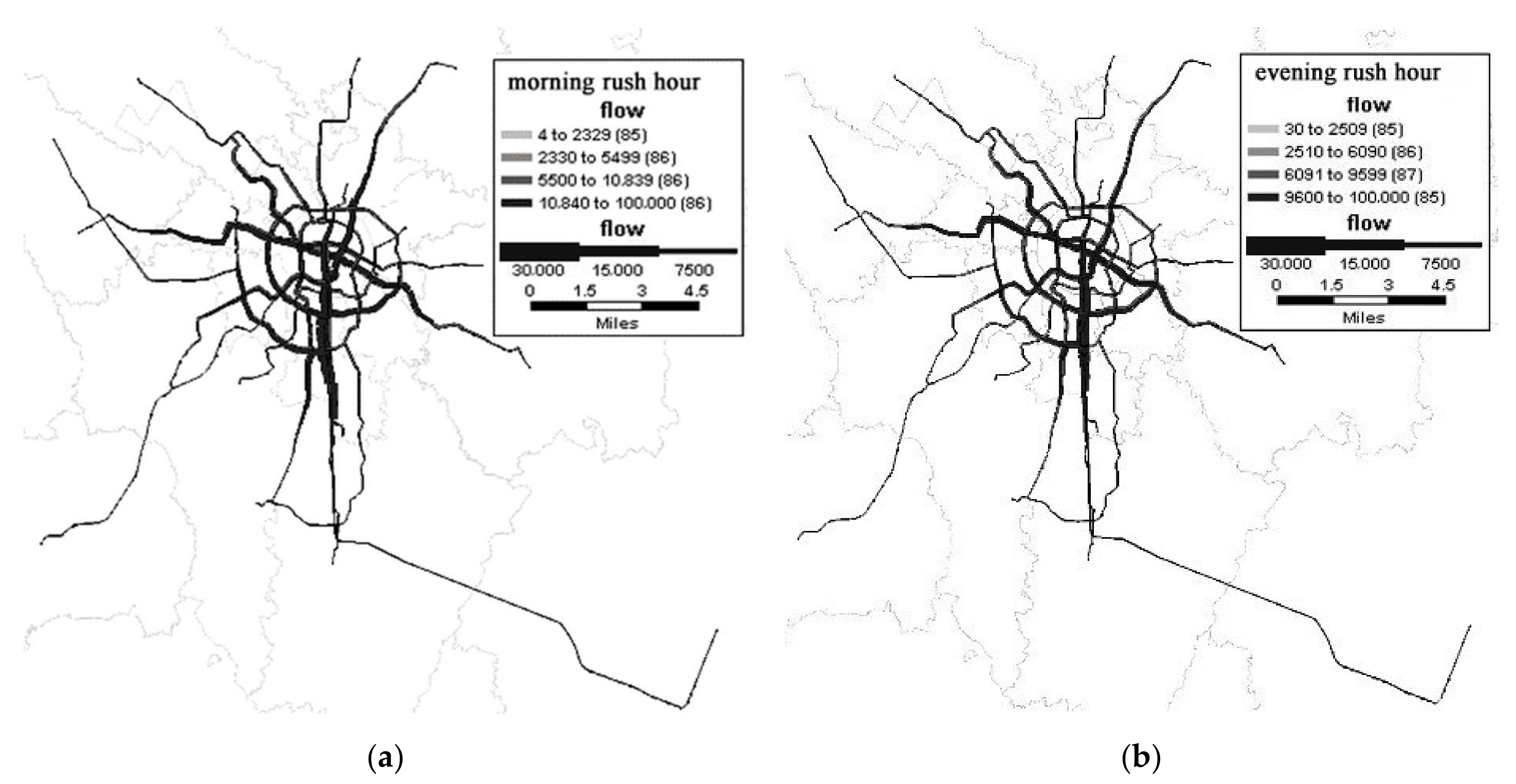
Through the inter-station OD matrix, based on the subway network and Formula (5), the passenger section flow of the Chengdu subway network in the morning and evening rush hour can be obtained as shown in Figure 10.
Figure 10.
Passenger section flow of Chengdu subway network in the morning and evening rush hour. (a) Morning rush hour; (b) Evening rush hour.
For all combinations, which can be formed by 46 transfer stations and 12 subway lines in the Chengdu subway network, according to the above-mentioned design process of the cross-line operation plan of Chengdu Metro Lines 1 and 2, we calculated the number of trains for cross-line operation and the maximum passenger section flow. This paper lists the top 24 cross-line operation plans with the largest passenger section flow, as shown in Table 11.
Table 11.
The top 24 cross-line operation plans with the largest passenger section flow.
Table 11 shows that, in the Chengdu subway network, the transfer stations with the most urgent need for the implementation of the subway cross-line operation are the North Railway Station, Xibo City Station, and South Railway Station. The transfer lines corresponding to the North Railway Station are Metro Line 1 and Metro Line 7, and the number of trains required for running cross-line trains is 18 trains per hour. The best transfer lines corresponding to the Xibo City Station are Metro Line 1 and Metro Line 6, and the number of trains required for running cross-line trains is 13 trains per hour. The transfer lines corresponding to the South Railway Station are Metro Line 1 and Metro Line 7, and the number of trains required for running cross-line trains is 10 trains per hour. After the implementation of the subway cross-line operation at the three transfer stations, 23,934, 16,710, and 13,024 passengers save on transfer time during rush hour, and the traffic efficiency of the subway network can be improved.
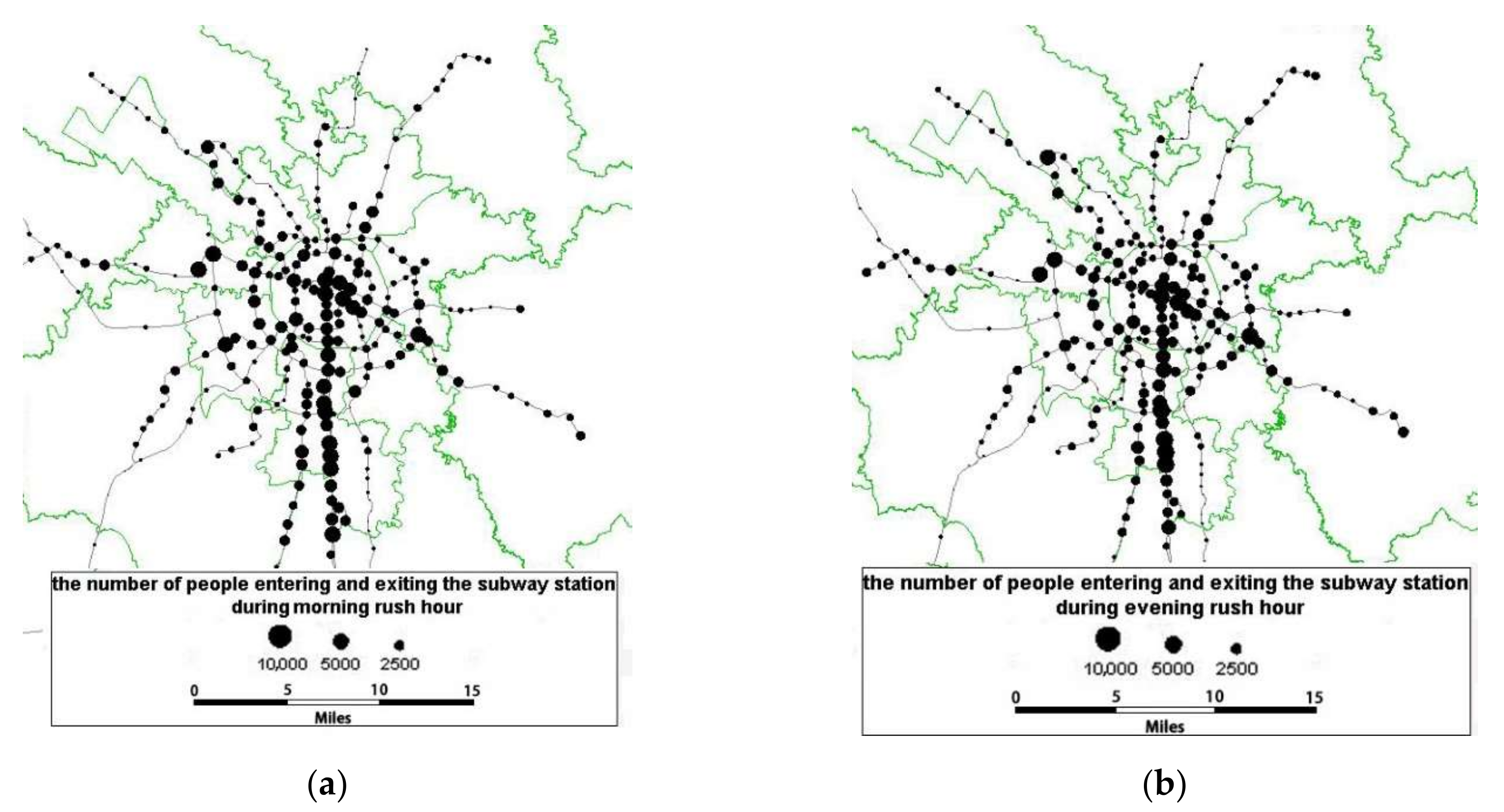
In order to intuitively show the superiority of the method proposed in this paper, Figure 11 shows the number of people entering and exiting the subway station during rush hour.
Figure 11.
The number of people entering and exiting the subway station during rush hour. (a) Morning rush hour; (b) Evening rush hour.
During rush hour, the top three transfer stations with the largest number of people entering and exiting are Shiji City Station, Fuhuayuan Station, and Chunxi Road Station. This is not consistent with the results of the largest passenger section flow, as shown in Table 12. It shows that, compared to the method proposed by this paper, if we use the number of people entering and exiting the subway station to determine which station implements the cross-line operation, there will be 38,451 fewer passengers who can save on transfer time during rush hour.
Table 12.
The results of different methods.
4. Discussion
- (1)
- Taking the cross-line operation scheme design of Chengdu Metro Line 1 and Line 2 as an example comprehensively demonstrates the design process of the subway cross-line operation scheme based on passenger smart card data proposed in this paper; that is, through the analysis of passenger travel demands, determining the subway cross-line routing, the number of trains required for running cross-line trains, etc. The research results show that if Tianfu Square Station is used as the transfer station, and Metro Line 1 and Metro Line 2 are used as transfer lines, the number of trains required to implement cross-line operation is five trains per hour.
- (2)
- The analysis of the travel demand of the entire subway network in Chengdu shows that the transfer stations with the most urgent need for the implementation of the subway cross-line operation are the North Railway Station, Xibo City Station, and South Railway Station, and the numbers of trains required for implementing cross-line operation are all greater than or equal to 10 trains per hour. After the implementation of subway cross-line operation, these operation schemes can help more than 13,000 passengers save on transfer time during rush hour and improve traffic efficiency.
- (3)
- In the design process of the cross-line operation scheme of the subway network, this paper ignores the impact of the cost of subway line reconstruction. In future research directions, we aim to consider the cost of subway line reconstruction and explore more path selection models to ensure the path selection results are more in line with the actual situation.
Author Contributions
Conceptualization, M.L. and H.L.; methodology, M.L.; formal analysis, M.L.; resources, H.L.; data curation, H.L.; writing—original draft preparation, H.L.; writing—review and editing, H.L. All authors have read and agreed to the published version of the manuscript.
Funding
This research was funded by Fundamental Research Funds for the Central Universities of Central South University, grant number 1053320200043.
Data Availability Statement
Publicly available datasets were analyzed in this study. This data can be found here: https://github.com/muxian123/The-four-fundamental-pieces-of-information-about-the-Chengdu-subway-network (accessed on 19 April 2022).
Conflicts of Interest
The authors declare no conflict of interest.
References
- Li, J.; Qian, Y.; Zeng, J.; Yin, F.; Zhu, L.; Guang, X. Research on the Influence of a High-Speed Railway on the Spatial Structure of the Western Urban Agglomeration Based on Fractal Theory—Taking the Chengdu–Chongqing Urban Agglomeration as an Example. Sustainability 2020, 12, 7550. [Google Scholar] [CrossRef]
- Gong, D.; Li, G. Research on Multi-objective Optimized Target Speed Curve of Subway Operation Based on ATO System. Int. Core J. Eng. 2020, 6, 133–137. [Google Scholar]
- Griffin, T. Light rail transit sharing the railtrack system. Proc. Inst. Civ. Eng. Transp. 1996, 117, 98–103. [Google Scholar] [CrossRef]
- Drechsler, G. Light railway on conventional railway tracks in karlsruhe, germany. Proc. Inst. Civ. Eng. Transp. 1996, 117, 81–87. [Google Scholar] [CrossRef]
- Novales, M.; Orro, A.; Bugarin, M.R. The tram-train: State of the art. Proc. Inst. Mech. Eng. 2002, 216, 1–13. [Google Scholar] [CrossRef]
- Zhou, S.; Liu, H.; Wang, B.; Chen, B.; Zhou, Y.; Chang, W. Public Norms in the Operation Scheme of Urban Rail Transit Express Trains: The Case of the Beijing Changping Line. Sustainability 2021, 13, 7187. [Google Scholar] [CrossRef]
- Qian, Y.; Da, C.; Zeng, J.; Wang, X.; Zhang, Y.; Xu, D. A bidirectional quasi-moving block cellular automaton model for single-track railways. Phys. A Stat. Mech. Its Appl. 2022, 598, 127327. [Google Scholar] [CrossRef]
- Niu, H.; Zhou, X. Optimizing urban rail timetable under time-dependent demand and oversaturated conditions. Transp. Res. Part C Emerg. Technol. 2013, 36, 212–230. [Google Scholar] [CrossRef]
- Sun, L.; Jin, J.G.; Lee, D.H.; Axhausen, K.W.; Erath, A. Demand-driven timetable design for metro services. Transp. Res. Part C Emerg. Technol. 2014, 46, 284–299. [Google Scholar] [CrossRef]
- Zhou, W.; Oldache, M. Integrated optimization of line planning, timetabling and rolling stock allocation for urban railway lines. Sustainability 2021, 13, 13059. [Google Scholar] [CrossRef]
- Gao, Y.; Kroon, L.; Schmidt, M.; Yang, L. Rescheduling a metro line in an over-crowded situation after disruptions. Transp. Res. Part B Methodol. 2016, 93, 425–449. [Google Scholar] [CrossRef]
- Jamili, A.; Aghaee, M.P. Robust stop-skipping patterns in urban railway operations under traffic alteration situation. Transp. Res. Part C Emerg. Technol. 2015, 61, 63–74. [Google Scholar] [CrossRef]
- Lee, E.H.; Lee, I.; Cho, S.-H.; Kho, S.-Y.; Kim, D.-K. A travel behavior-based skip-stop strategy considering train choice behaviors based on smartcard data. Sustainability 2019, 11, 2791. [Google Scholar] [CrossRef] [Green Version]
- Zwaneveld, P.J.; Kroon, L.G.; Van Hoesel, S.P.M. Routing trains through a railway station based on a node packing model. Eur. J. Oper. Res. 2001, 128, 14–33. [Google Scholar] [CrossRef] [Green Version]
- Liu, W.; Zhu, X.; Kang, L. Real-time track reallocation for emergency incidents at large railway stations. Math. Probl. Eng. 2015, 296394. [Google Scholar] [CrossRef] [Green Version]
- Xu, J.; Wang, Z.; Yao, S.; Xue, J. Train operations organization in high-speed railway station considering variable configuration. Sustainability 2022, 14, 2365. [Google Scholar] [CrossRef]
- Cao, Z.; Asakura, Y.; Tan, Z. Coordination between node, place, and ridership: Comparing three transit operators in Tokyo. Transp. Res. Part D Transp. Environ. 2020, 87, 102518. [Google Scholar] [CrossRef]
- Kurosaki, F. A comparative study of passenger through train operation between Japan and Europe. J. East. Asia Soc. Transp. Stud. 2017, 12, 316–330. [Google Scholar] [CrossRef]
- Kurosaki, F.; Higashino, S. A study of IC card systems within Japanese urban railway lines: Considering the Integration of Transportation Services. J. East. Asia Soc. Transp. Stud. 2019, 13, 397–413. [Google Scholar] [CrossRef]
- Ming, R.; Ye, X. Through operations between subways and suburban lines in Tokyo. Urban Mass Transit 2009, 12, 26–30. [Google Scholar]
- Yang, A.; Wang, B.; Huang, J.; Li, C. Service replanning in urban rail transit networks: Cross-line express trains for reducing the number of passenger transfers and travel time. Transp. Res. Part C Emerg. Technol. 2020, 115, 102629. [Google Scholar] [CrossRef]
- Le, M.; Wen, C.; Wang, N.; Yang, J.; Jiang, Y. Distribution design of cross line operation between Metro Line 4 and the Circle Line in Chongqing city. Urban Mass Transit 2020, 23, 14–17. [Google Scholar]
- Wang, C. Signal system for the cross-line operation of Guangzhou Metro Line 14 and Line 21. Urban Mass Transit 2017, 20, 36–38. [Google Scholar]
- Yang, C.; Yan, F.; Ukkusuri, S.V. Unraveling traveler mobility patterns and predicting user behavior in the Shenzhen metro system. Transp. A Transp. Sci. 2018, 14, 576–597. [Google Scholar] [CrossRef]
- Yong, N.; Ni, S.; Shen, S.; Chen, P.; Ji, X. Uncovering stable and occasional human mobility patterns: A case study of the Beijing subway. Phys. A Stat. Mech. Its Appl. 2018, 492, 28–38. [Google Scholar] [CrossRef]
- Kim, K. Exploring the difference between ridership patterns of subway and taxi: Case study in Seoul. J. Transp. Geogr. 2018, 66, 213–223. [Google Scholar] [CrossRef]
- He, B. Discussion upon the Calculation of Passenger Train Quantity Launched in Passenger Dedicated Lines. Railw. Transp. Econ. 2005, 2, 61–62+65. [Google Scholar]
- Matejka, F.; Mckay, A. Rational Inattention to Discrete Choices: A New Foundation for the Multinomial Logit Model. Am. Econ. Rev. 2015, 105, 272–298. [Google Scholar] [CrossRef] [Green Version]
- Kostrzewski, M. Implementation of distribution model of an international company with use of simulation method. Procedia Eng. 2017, 192, 445–450. [Google Scholar] [CrossRef]
- Available online: https://github.com/muxian123/The-four-fundamental-pieces-of-information-about-the-Chengdu-subway-network (accessed on 17 May 2022).
Publisher’s Note: MDPI stays neutral with regard to jurisdictional claims in published maps and institutional affiliations. |
© 2022 by the authors. Licensee MDPI, Basel, Switzerland. This article is an open access article distributed under the terms and conditions of the Creative Commons Attribution (CC BY) license (https://creativecommons.org/licenses/by/4.0/).