


Uptake Prediction of Eight Potentially Toxic Elements by Pistia stratiotes L. Grown in the Al-Sero Drain (South Nile Delta, Egypt): A Biomonitoring Approach

 ,
,  ,
,  and
and 
Abstract
1. Introduction
2. Materials and Methods
2.1. Study Area
2.2. Field and Laboratory
2.3. Water Sampling
2.4. Chemical Analysis
2.5. Quality Assurance and Quality Control
2.6. Data Analysis
3. Results
4. Discussion
5. Conclusions
Supplementary Materials
Author Contributions
Funding
Institutional Review Board Statement
Informed Consent Statement
Data Availability Statement
Conflicts of Interest
References
- Leblebici, Z.; Kar, M. Accumulation of heavy metals in vegetables irrigated with different water sources and their daily intake in Nevsehir. J. Agric. Sci. Technol. 2018, 20, 401–415. [Google Scholar]
- Leblebici, Z.; Dalmis, E.; Andeden, E.E. Determination of the potential of Pistia stratiotes L. in removing nickel from the environment by utilizing its rhizofiltration capacity. Braz. Arch. Biol. Technol. 2019, 62, e19180487. [Google Scholar] [CrossRef]
- Charlesworth, S.; De Miguel, E.; Ordonez, A. A review of the distribution of particulate trace elements in urban terrestrial environments and its application to considerations of risk. Environ. Geochem. Health 2011, 33, 103–123. [Google Scholar] [CrossRef]
- Tchounwou, P.B.; Yedjou, C.G.; Patlolla, A.K.; Sutton, D.J. Heavy metal toxicity and the environment. Mol. Clin. Environ. Toxicol. 2012, 3, 133–164. [Google Scholar]
- Knasmuller, S.; Gottmann, E.; Steinkellner, H.; Fomin, A.; Pickl, C.; Paschke, A.; God, R.; Kundi, M. Detection of genotoxic effects of heavy metal contaminated soils with plant bioassay. Mutat. Res. 1998, 420, 37–48. [Google Scholar] [CrossRef]
- Gupta, S.; Satpati, S.; Nayek, S.; Garai, D. Effect of wastewater irrigation on vegetables in relation to bioaccumulation of heavy metals and biochemical changes. Environ. Monit. Assess. 2010, 165, 169–177. [Google Scholar] [CrossRef] [PubMed]
- Bonanno, G.; Vymazal, J. Compartmentalization of potentially hazardous elements in macrophytes: Insights into capacity and efficiency of accumulation. J. Geochem. Explor. 2017, 181, 22–30. [Google Scholar] [CrossRef]
- Chakravarty, P.; Sen Sarma, N.; Sarma, H.P. Biosorption of cadmium (II) from aqueous solution using heartwood powder of Areca catechu. Chem. Eng. J. 2010, 162, 949–955. [Google Scholar] [CrossRef]
- Yang, Y.; Zhang, F.S.; Li, H.F.; Jiang, R.F. Accumulation of cadmium in the edible parts of six vegetable species grown in Cd-contaminated soils. J. Environ. Manag. 2009, 90, 1117–1122. [Google Scholar] [CrossRef]
- Kumar, V.; Singh, J.; Kumar, P. Heavy metal uptake by water lettuce (Pistia stratiotes L.) from paper mill effluent (PME): Experimental and prediction modelling studies. Environ. Sci. Pollut. Res. 2019, 26, 14400–14413. [Google Scholar] [CrossRef]
- Kumar, V.; Singh, J.; Kumar, P. Regression models for removal of heavy metals by water hyacinth (Eichhornia crassipes) from wastewater of pulp and paper processing industry. Environ. Sustain. 2020, 3, 35–44. [Google Scholar] [CrossRef]
- Eid, E.M.; Shaltout, K.H.; Al-Sodany, Y.M.; Haroun, S.A.; Galal, T.M.; Ayed, H.; Khedher, K.M.; Jensen, K. Common reed (Phragmites australis (Cav.) Trin. ex Steudel) as a candidate for predicting heavy metal contamination in Lake Burullus, Egypt: A biomonitoring approach. Ecol. Eng. 2020, 148, 105787. [Google Scholar] [CrossRef]
- Eid, E.M.; Galal, T.M.; Shaltout, K.H.; El-Sheikh, M.A.; Asaeda, T.; Alatar, A.A.; Alfarhan, A.H.; Alharthi, A.; Alshehri, A.M.A.; Picó, Y.; et al. Biomonitoring potential of the native aquatic plant Typha domingensis by predicting trace metals accumulation in the Egyptian Lake Burullus. Sci. Total Environ. 2020, 714, 136603. [Google Scholar] [CrossRef] [PubMed]
- Soriano-Disla, J.M.; Gómez, I.; Navarro-Pedreno, J.; Jordán, M.M. The transfer of heavy metals to barley plants from soils amended with sewage sludge with different heavy metal burdens. J. Soil. Sediment. 2014, 14, 687–696. [Google Scholar] [CrossRef]
- Carluer, N.; Marsily, G. Assessment and modeling of the influence of man-made networks on the hydrology of a small watershed: Implications for fast flow components, water quality and landscape management. J. Hydrol. 2004, 285, 76–95. [Google Scholar] [CrossRef]
- Kumwimba, M.N.; Zhu, B.; Suanon, F.; Muyembe, D.K.; Dzakpasu, M. Long-term impact of primary domestic sewage on metal/loid accumulation in drainage ditch sediments, plants and water: Implications for phytoremediation and restoration. Sci. Total Environ. 2017, 581–582, 773–781. [Google Scholar] [CrossRef]
- Kumwimba, M.N.; Dzakpasu, M.; Zhu, B.; Muyembe, D.K. Uptake and release of sequestered nutrient in subtropical monsoon ecological ditch plant species. Water Air Soil Pollut. 2016, 227, 405. [Google Scholar] [CrossRef]
- Fawzy, M.A.; Badr, N.E.; El-Khatib, A.; Abo El-Kassem, A. Heavy metal biomonitoring and phytoremediation potentialities of aquatic macrophytes in River Nile. Environ. Monit. Assess. 2012, 184, 1753–1771. [Google Scholar] [CrossRef] [PubMed]
- Shaltout, K.H.; Galal, T.M.; El-Komi, T.M. Biomass, nutrients and nutritive value of Persicaria salicifolia Willd. in the water courses of Nile Delta, Egypt. Rend. Lincei 2014, 25, 167–179. [Google Scholar] [CrossRef]
- Shaltout, K.H.; Galal, T.M.; El-Komi, T.M. Phenology, biomass and nutrients of Imperata cylindrica and Desmostachya bipinnata along the water courses in Nile Delta, Egypt. Rend. Lincei 2016, 27, 215–228. [Google Scholar] [CrossRef]
- Shaltout, K.H.; Eid, E.M.; El-Komi, T.M. Phytomass and nutrient value of Potamogeton crispus L. in the water courses of Nile Delta, Egypt. Rend. Lincei 2016, 27, 251–259. [Google Scholar] [CrossRef]
- Täckholm, V. Students’ Flora of Egypt; Cooperative Printing Company: Beirut, Lebanon, 1974. [Google Scholar]
- GISD (Global Invasive Species Database). Species Profile: Pistia Stratiotes. Available online: http://www.iucngisd.org/gisd/speciesname/Pistia+stratiotes (accessed on 30 April 2020).
- Chapman, D.; Coetzee, J.; Hill, M.; Hussner, A.; Netherland, M.; Pescott, O.; Stiers, I.; van Valkenburg, J.; Tanner, R. Pistia stratiotes L. EPPO Bull. 2017, 47, 537–543. [Google Scholar]
- Boulos, L. Flora of Egypt: Volume 4, Monocotyledons (Altismataceae-Orchidaceae); Al-Hadara Publishing: Cairo, Egypt, 2005. [Google Scholar]
- Galal, T.M.; Farahat, E.A. The invasive macrophyte Pistia stratiotes L. as a bioindicator for water pollution in Lake Mariut, Egypt. Environ. Monit. Assess. 2015, 178, 701. [Google Scholar] [CrossRef]
- Galal, T.; Shaltout, K.; Hassan, L. The Egyptian Northern Lakes: Habitat Diversity, Vegetation and Economic Importance; LAP Lambert Academic Publishing: Saarbrücken, Germany, 2012. [Google Scholar]
- Galal, T.M.; Eid, E.M.; Dakhil, M.A.; Hassan, L.M. Bioaccumulation and rhizofiltration potential of Pistia stratiotes L. for mitigating water pollution in the Egyptian wetlands. Int. J. Phytoremediat. 2018, 20, 440–447. [Google Scholar] [CrossRef]
- Zeng, F.; Ali, S.; Zhang, H.; Ouyang, Y.; Qiu, B.; Wu, F.; Zhang, G. The influence of pH and organic matter content in paddy soil on heavy metal availability and their uptake by rice plants. Environ. Pollut. 2011, 159, 84–91. [Google Scholar] [CrossRef]
- Das, S.; Goswami, S.; Talukdar, A.D. A study on cadmium phytoremediation potential of water lettuce, Pistia stratiotes L. Bull. Environ. Contam. Toxicol. 2014, 92, 169–174. [Google Scholar] [CrossRef]
- Hanks, N.A.; Caruso, J.A.; Zhang, P. Assessing Pistia stratiotes for phytoremediation of silver nanoparticles and Ag(I) contaminated waters. J. Environ. Manag. 2015, 164, 41–45. [Google Scholar] [CrossRef]
- Victor, K.K.; Séka, Y.; Norbert, K.K.; Sanogo, T.A.; Celestin, A.B. Phytoremediation of wastewater toxicity using water hyacinth (Eichhornia crassipes) and water lettuce (Pistia stratiotes). Int. J. Phytoremediat. 2016, 18, 949–955. [Google Scholar] [CrossRef] [PubMed]
- Kumar, V.; Singh, J.; Pathak, V.V.; Ahmad, S.; Kothari, R. Experimental and kinetics study for phytoremediation of sugar mill effluent using water lettuce (Pistia stratiotes L.) and its end use for biogas production. Biotech 2017, 7, 330. [Google Scholar] [CrossRef] [PubMed]
- de Campos, F.V.; de Oliveira, J.A.; da Silva, A.A.; Ribeiro, C.; Farnese, F.S. Phytoremediation of arsenite-contaminated environments: Is Pistia stratiotes L. a useful tool? Ecol. Indic. 2019, 104, 794–801. [Google Scholar] [CrossRef]
- Kodituwakku, K.A.R.K.; Yatawara, M. Phytoremediation of industrial sewage sludge with Eichhornia crassipes, Salvinia molesta and Pistia stratiotes in batch fed free water flow constructed wetlands. Bull. Environ. Contam. Toxicol. 2020, 104, 627–633. [Google Scholar] [CrossRef] [PubMed]
- Tabinda, A.B.; Irfan, R.; Yasar, A.; Iqbal, A.; Mahmood, A. Phytoremediation potential of Pistia stratiotes and Eichhornia crassipes to remove chromium and copper. Environ. Technol. 2020, 41, 1514–1519. [Google Scholar] [CrossRef]
- Tang, K.H.D.; Awa, S.H.; Hadibarata, T. Phytoremediation of copper-contaminated water with Pistia stratiotes in surface and distilled water. Water Air Soil Pollut. 2020, 231, 573. [Google Scholar] [CrossRef]
- UNESCO. Map of the World Distribution of Arid Regions; MAB Technical Notes: Paris, France, 1977. [Google Scholar]
- NASA-POWER. Climatology Resource for Agroclimatology. NASA Prediction of Worldwide Energy. Available online: http://power.larc.nasa.gov/cgi-bin/cgiwrap/solar/agro.cgi (accessed on 28 April 2020).
- Galal, T.M.; Dakhil, M.A.; Hassan, L.M.; Eid, E.M. Population dynamics of Pistia stratiotes L. Rend. Lincei 2019, 30, 367–378. [Google Scholar] [CrossRef]
- Dakhil, M.; Galal, T.; Hassan, L. Population Dynamics and Nutrient Cycling of Pistia stratiotes L.; LAP LAMBERT Academic Publishing: Saarbrücken, Germany, 2016. [Google Scholar]
- APHA (American Public Health Association). Standard Methods for the Examination of Water and Wastewater; American Public Health Association: Washington, DC, USA, 1998. [Google Scholar]
- Eid, E.M.; Shaltout, K.H.; Moghanm, F.S.; Youssef, M.S.G.; El-Mohsnawy, E.; Haroun, S.A. Bioaccumulation and translocation of nine heavy metals by Eichhornia crassipes in Nile Delta, Egypt: Perspectives for phytoremediation. Int. J. Phytoremediat. 2019, 21, 821–830. [Google Scholar] [CrossRef] [PubMed]
- Novotná, M.; Mikeš, O.; Komprdová, K. Development and comparison of regression models for the uptake of metals into various field crops. Environ. Pollut. 2015, 207, 357–364. [Google Scholar] [CrossRef] [PubMed]
- Statsoft. Statistica Version 7.1; Statsoft Inc.: Tulsa, OK, USA, 2007. [Google Scholar]
- Kabata-Pendias, A. Trace Elements in Soils and Plants; CRC Press: Boca Raton, FL, USA, 2011. [Google Scholar]
- Lu, Q.; He, Z.L.; Graetz, D.A.; Stoffella, P.J.; Yang, X. Uptake and distribution of metals by water lettuce (Pistia stratiotes L.). Environ. Sci. Pollut. Res. 2011, 18, 978–986. [Google Scholar] [CrossRef]
- Kumar, V.; Sharma, A.; Kumar, R.; Bhardwaj, R.; Thukral, A.K.; Rodrigo-Comino, J. Assessment of heavy-metal pollution in three different Indian water bodies by combination of multivariate analysis and water pollution indices. Hum. Ecol. Risk Assess. 2018, 26, 1–16. [Google Scholar] [CrossRef]
- Singh, S.; Saxena, R.; Pandey, K.; Bhatt, K.; Sinha, S. Response of antioxidants in sunflower (Helianthus annuus L.) grown on different amendments of tannery sludge: Its metal accumulation potential. Chemosphere 2004, 57, 1663–1673. [Google Scholar] [CrossRef] [PubMed]
- Eid, E.M.; Shaltout, K.H. Monthly variations of trace elements accumulation and distribution in above- and below-ground biomass of Phragmites australis (Cav.) Trin. ex Steudel in Lake Burullus (Egypt): A biomonitoring application. Ecol. Eng. 2014, 73, 17–25. [Google Scholar] [CrossRef]
- Ouzounidou, G.; Ciamporova, M.; Moustakas, M.; Karataglis, S. Responses of maize (Zea mays L.) plants to copper stress I. Growth, mineral content and ultrastructure of roots. Environ. Exp. Bot. 1995, 35, 167–176. [Google Scholar] [CrossRef]
- Singha, K.T.; Sebatian, A.; Prasad, M.N.V. Iron plaque formation in the roots of Pistia stratiotes L.: Importance in phytoremediation of cadmium. Int. J. Phytoremediat. 2019, 21, 120–128. [Google Scholar] [CrossRef]
- Hanafiah, M.M.; Mohamad, N.H.S.M.; Abd Aziz, N.I.H. Salvinia molesta and Pistia stratiotes as phytoremediation agents in sewage wastewater treatment. Sains Malays. 2018, 47, 1625–1634. [Google Scholar]
- Lopes, C.; Herva, M.; Franco-Uría, A.; Roca, E. Multicorrelation models and uptake factors to estimate extractable metal concentrations from soil and metal in plants in pasturelands fertilized with manure. Environ. Pollut. 2012, 166, 17–22. [Google Scholar] [CrossRef] [PubMed]
- Eid, E.M.; Shaltout, K.H.; Almuqrin, A.H.; Aloraini, D.A.; Khedher, K.M.; Taher, M.A.; Alfarhan, A.H.; Picó, Y.; Barcelo, D. Uptake prediction of nine heavy metals by Eichhornia crassipes grown in irrigation canals: A biomonitoring approach. Sci. Total Environ. 2021, 782, 146887. [Google Scholar] [CrossRef] [PubMed]
- Nawab, J.; Khan, S.; Shah, M.T.; Gul, N.; Ali, A.; Khan, K.; Huang, Q. Heavy metal bioaccumulation in native plants in chromite impacted sites: A search for effective remediating plant species. Clean Soil Air Water 2016, 44, 37–46. [Google Scholar] [CrossRef]
- Brady, N.; Weil, R. The Nature and Properties of Soils, 11th ed.; Prentice-Hall International Inc.: Hoboken, NJ, USA, 1996. [Google Scholar]
- Allen, S.E. Chemical Analysis of Ecological Materials; Blackwell Scientific Publications: London, UK, 1989. [Google Scholar]
- Whitehead, D.C. Nutrient Elements in Grassland: Soil-Plant-Animal Relationships; CABI Publishing: New York, NY, USA, 2000. [Google Scholar]
- Marschner, H. Mineral Nutrition of Higher Plants; Academic Press: London, UK, 1995. [Google Scholar]
- Nawab, J.; Khan, S.; Shah, M.T.; Qamar, Z.; Din, I.; Mahmood, Q.; Gul, N.; Huang, Q. Contamination of soil, medicinal, and fodder plants with lead and cadmium present in mine-affected areas, Northern Pakistan. J. Environ. Monitor. 2015, 187, 605. [Google Scholar] [CrossRef] [PubMed]
- Divan Junior, A.M.; de Oliveira, P.L.; Perry, C.T.; Atz, V.L.; Azzarini-Rostirola, L.N.; Raya-Rodriguez, M.T. Using wild plant species as indicators for the accumulation of emissions from a thermal power plant, Candiota, South Brazil. Ecol. Indic. 2009, 9, 1156–1162. [Google Scholar] [CrossRef]
- Żurek, G.; Rybka, K.; Bogrzeba, M.; Krzyżak, J.; Prokopiuk, K. Chlorophyll α fluorescence in evaluation of the effect of heavy metal soil contamination on perennial grasses. PLoS ONE 2014, 9, e91475. [Google Scholar] [CrossRef]
- Tessier, A.; Turner, D.R. Metal Speciation and Bioavailability in Aquatic Systems; Wiley: London, UK, 1995. [Google Scholar]
- Singh, R.P.; Agrawal, M. Variations in heavy metal accumulation, growth and yield of rice plants grown at different sewage sludge amendment rates. Ecotoxicol. Environ. Saf. 2010, 73, 632–641. [Google Scholar] [CrossRef]
- Christou, A.; Theologides, C.; Costa, C.; Kalavrouziotis, I.; Varnavas, S. Assessment of toxic heavy metals concentrations in soils and wild and cultivated plant species in Limni abandoned copper mining site, Cyprus. J. Geochem. Explor. 2017, 178, 16–22. [Google Scholar] [CrossRef]
- Basta, N.T.; Ryan, J.A.; Chaney, R.L. Trace element chemistry in residual-treated soil: Key concepts and metal bioavailability. J. Environ. Qual. 2005, 34, 49–63. [Google Scholar] [CrossRef]
- Bonanno, G.; Vymazal, J.; Cirelli, G.L. Translocation, accumulation and bioindication of trace elements in wetland plants. Sci. Total Environ. 2018, 631–632, 252–261. [Google Scholar] [CrossRef]
- Branzini, A.; González, R.S.; Zubillaga, M. Absorption and translocation of copper, zinc and chromium by Sesbania virgata. J. Environ. Manag. 2012, 102, 50–54. [Google Scholar] [CrossRef]
- Zu, Y.; Li, Y.; Chen, J.; Chen, H.; Qin, L.; Christian, S. Hyperaccumulation of Pb, Zn and Cd in herbaceous grown on lead-zinc mining area in Yunnan, China. Environ. Int. 2005, 31, 755–762. [Google Scholar]
- Weis, J.S.; Weis, P. Metal uptake, transport and release by wetland plants: Implications for phytoremediation and restoration. Environ. Int. 2004, 30, 685–700. [Google Scholar] [CrossRef] [PubMed]
- Prasad, B.; Maiti, D. Comparative study of metal uptake by Eichhornia crassipes growing in ponds from mining and nonmining areas-a field study. Bioremediat. J. 2016, 20, 144–152. [Google Scholar] [CrossRef]
- Wang, X.-P.; Shan, X.-Q.; Zhang, S.-Z.; Wen, B. A model for evaluation of the phytoavailability of trace elements to vegetables under the field conditions. Chemosphere 2004, 55, 811–822. [Google Scholar] [CrossRef]
- Kim, I.S.; Kang, H.K.; Johnson-Green, P.; Lee, E.J. Investigation of heavy metal accumulation in Polygonum thunbergii for phytoextraction. Environ. Pollut. 2003, 126, 235–243. [Google Scholar] [CrossRef]
- Du Laing, G.; Van de Moortel, A.M.K.; Moors, W.; De Grauwe, P.; Meers, E.; Tack, F.M.G.; Verloo, M.G. Factors affecting metal concentrations in reed plants (Phragmites australis) of intertidal marshes in the Scheldt estuary. Ecol. Eng. 2009, 35, 310–318. [Google Scholar] [CrossRef]
- Weis, J.S.; Glover, T.; Weis, P. Interactions of metals affect their distribution in tissues of Phragmites australis. Environ. Pollut. 2004, 131, 409–415. [Google Scholar] [CrossRef] [PubMed]
- Yang, X.E.; Long, X.X.; Ye, H.B.; He, Z.L.; Calvert, D.V.; Stoffella, P.J. Cadmium tolerance and hyperaccumulation in a new Zn-hyperaccumulating plant species (Sedum alfredii Hance). Plant Soil. 2004, 259, 181–189. [Google Scholar] [CrossRef]
- Li, X.; Xi, H.; Sun, X.; Yang, Y.; Yang, S.; Zhou, Y.; Yang, Y. Comparative proteomics exploring the molecular mechanism of eutrophic water purification using water hyacinth (Eichhornia crassipes). Environ. Sci. Pollut. Res. 2015, 22, 8643–8658. [Google Scholar] [CrossRef]
- Awuah, E.; Lubberding, H.J.; Asante, K.; Gijzen, H.J. The effect of pH on enterococci removal in Pistia-, duckweed-and algae-based stabilization ponds for domestic wastewater treatment. Water Sci. Technol. 2002, 45, 67–74. [Google Scholar] [CrossRef]
- Ergönül, A.B.; Nassouhi, D.; Atasagun, S. Modeling of the bioaccumulative efficiency of Pistia stratiotes exposed to Pb, Cd, and Pd + Cd mixtures in nutrient-poor media. Int. J. Phytoremediat. 2020, 22, 201–209. [Google Scholar] [CrossRef] [PubMed]
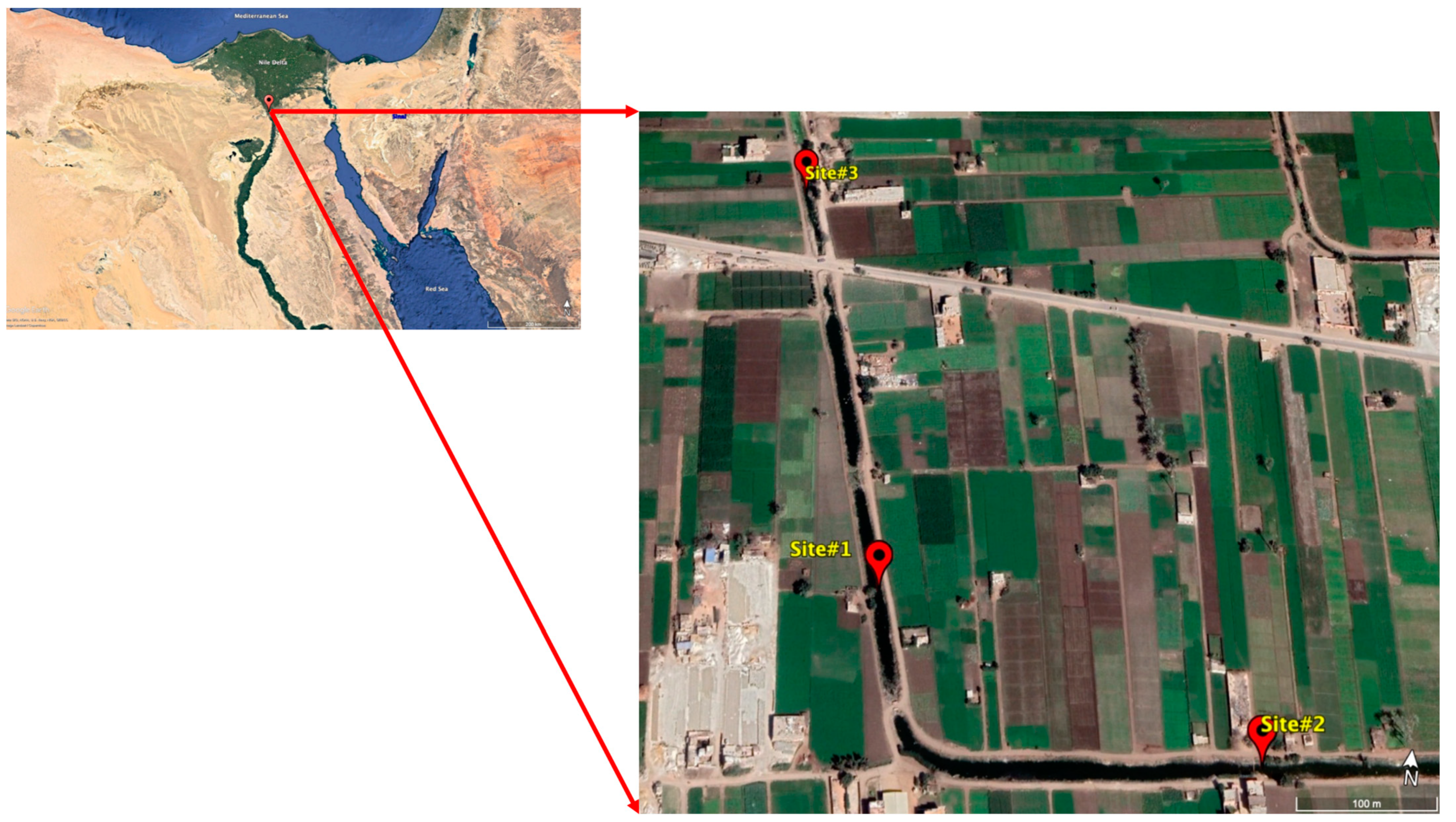
 ).
).
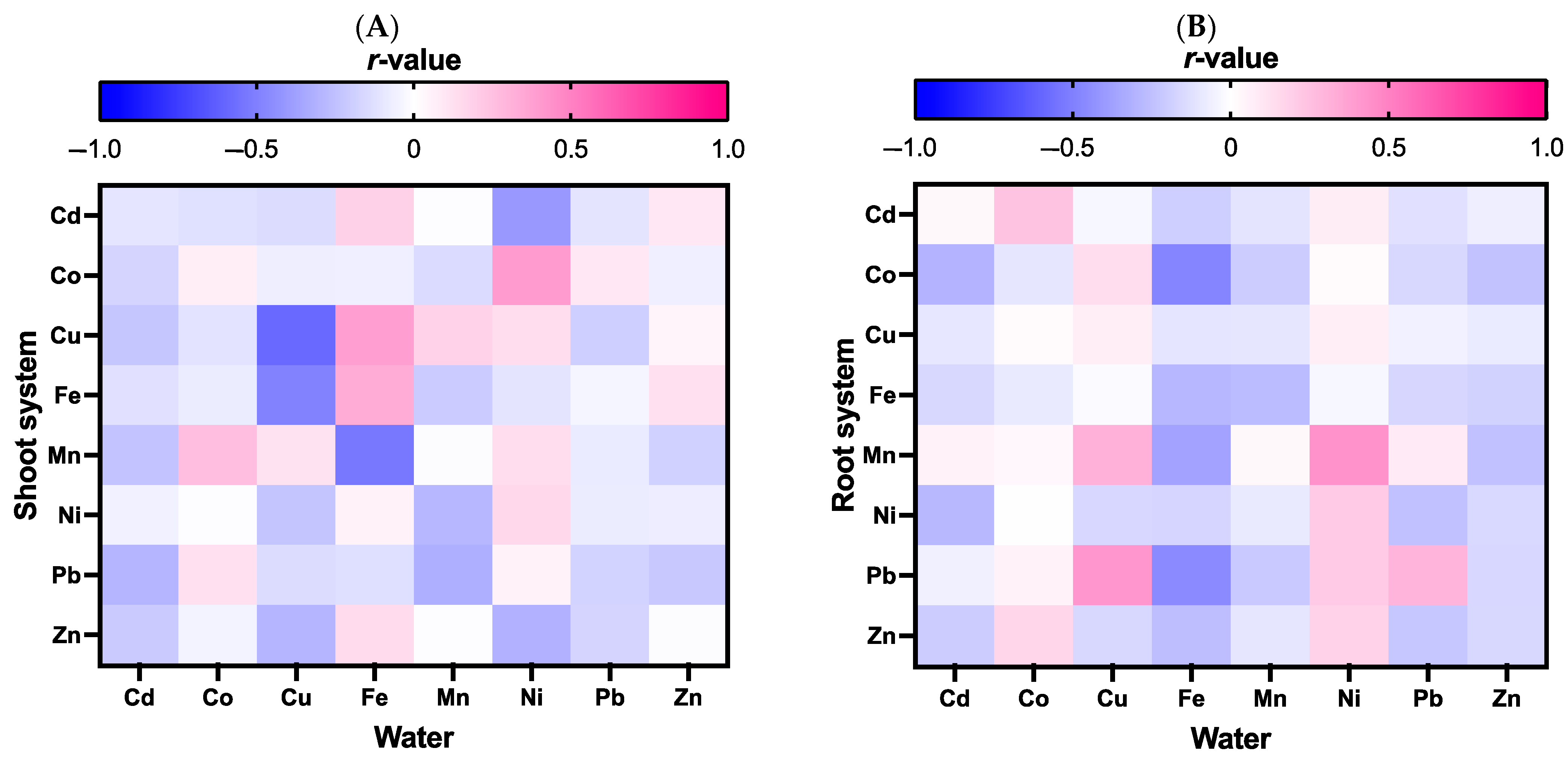
).
).
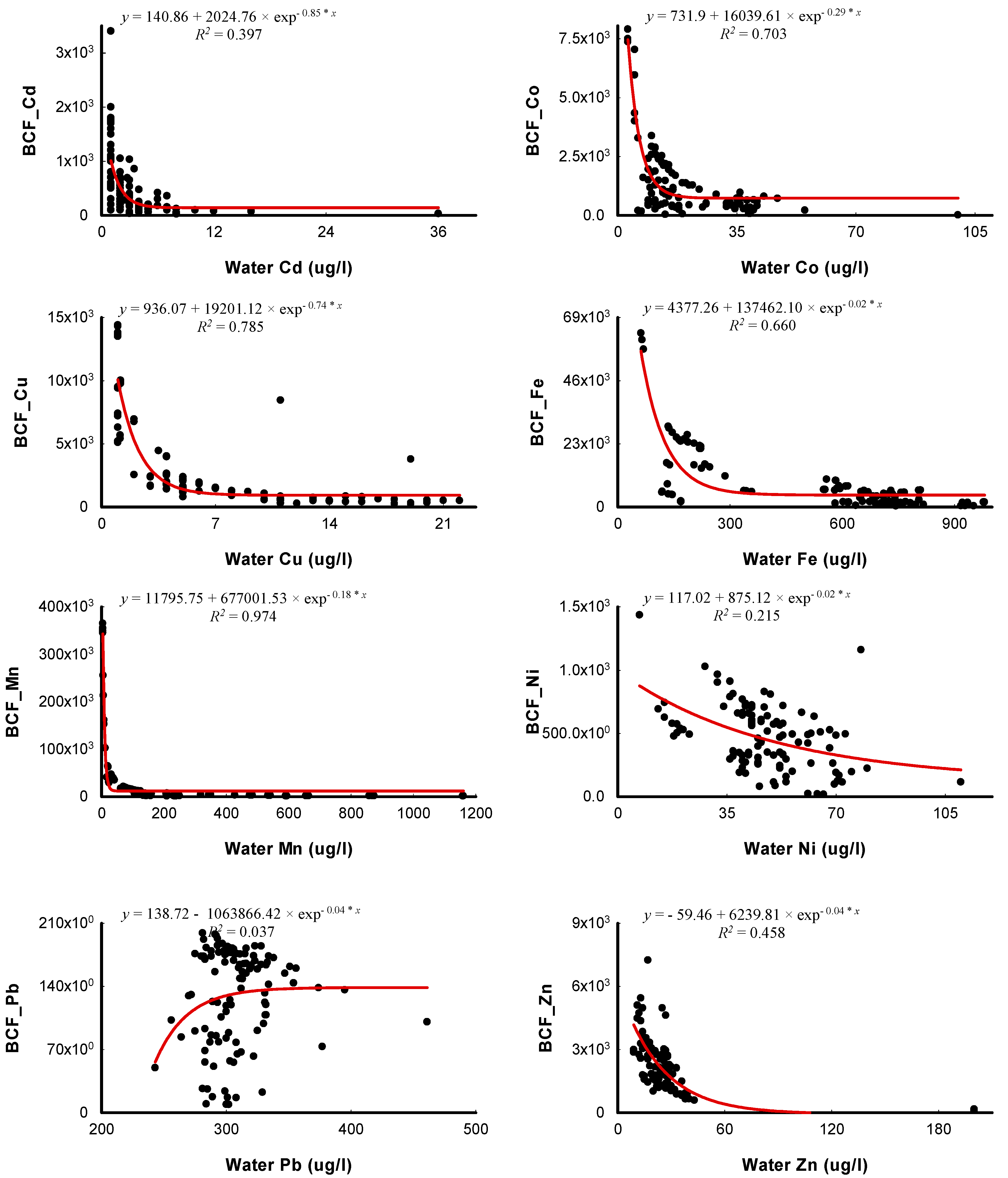

| Value | pH | PTE Concentration (μg/L) | |||||||
|---|---|---|---|---|---|---|---|---|---|
| Cd | Co | Cu | Fe | Mn | Ni | Pb | Zn | ||
| Minimum | 7.0 | 1.0 | 3.0 | 1.0 | 62.0 | 4.0 | 7.0 | 243.0 | 9.0 |
| Maximum | 8.9 | 36.0 | 100.0 | 22.0 | 980.0 | 1160.0 | 110.0 | 461.0 | 200.0 |
| Mean (n = 108) | 7.5 | 3.5 | 20.0 | 8.2 | 523.6 | 234.7 | 47.3 | 308.2 | 26.5 |
| CV (%) | 5.7 | 120.9 | 70.7 | 75.4 | 52.3 | 112.9 | 34.6 | 9.2 | 95.1 |
| Tissue | Value | PTE Concentration (mg/kg) | |||||||
|---|---|---|---|---|---|---|---|---|---|
| Cd | Co | Cu | Fe | Mn | Ni | Pb | Zn | ||
| Shoot system | Minimum | 0.1 | 0.2 | 2.0 | 35.0 | 105.7 | 0.1 | 1.2 | 18.9 |
| Maximum | 3.5 | 13.5 | 200.3 | 3272.0 | 852.5 | 50.6 | 73.1 | 113.9 | |
| Mean (n = 108) | 0.9 | 5.2 | 55.5 | 974.1 | 331.5 | 6.8 | 42.0 | 37.1 | |
| CV (%) | 87.1 | 65.7 | 93.8 | 89.5 | 59.3 | 120.3 | 41.7 | 46.5 | |
| Root system | Minimum | 0.1 | 0.5 | 3.3 | 288.0 | 200.5 | 1.1 | 2.7 | 20.4 |
| Maximum | 3.4 | 35.2 | 93.0 | 5637.0 | 1474.4 | 90.6 | 60.5 | 124.7 | |
| Mean (n = 108) | 1.0 | 17.6 | 10.0 | 2511.0 | 1160.7 | 20.4 | 39.8 | 48.2 | |
| CV (%) | 66.5 | 55.8 | 105.8 | 63.4 | 33.5 | 59.5 | 42.6 | 40.9 | |
| t-value | 0.4 ns | 12.5 *** | 8.8 *** | 8.4 *** | 26.2 *** | 11.0 *** | 0.9 ns | 4.4 *** | |
| Phytotoxic range ‡ | 5–30 | 15–50 | 20–100 | >1000 | 400–1000 | 40–246 | 30–300 | 100–500 | |
| PTE | BCF | TF |
|---|---|---|
| Cd | 520.7 ± 52.3a | 2.1 ± 0.4b |
| Co | 1418.3 ± 151.6a | 0.6 ± 0.1a |
| Cu | 2990.3 ± 368.3a | 7.1 ± 0.8c |
| Fe | 8974.2 ± 1136.9a | 0.7 ± 0.1a |
| Mn | 39,642.5 ± 8247.3b | 0.3 ± 0.0a |
| Ni | 471.7 ± 24.6a | 0.4 ± 0.1a |
| Pb | 128.7 ± 5.2a | 1.9 ± 0.3b |
| Zn | 2316.3 ± 119.3a | 0.9 ± 0.1ab |
| F-value | 20.9 *** | 50.7 *** |
| Equation | R2 | ME | MNAE | Student’s t-Test | |
|---|---|---|---|---|---|
| t-Value | p | ||||
| Shoot system | |||||
| Cd = 7.74 − 0.14 × Cdwater − 0.83 × pH | 0.299 *** | 0.664 | 0.336 | 0.738 | 0.465 |
| Co = 29.70 + 0.18 × Cowater − 3.71 × pH | 0.325 *** | 0.716 | 0.254 | 0.728 | 0.471 |
| Cu = 257.25 − 4.77 × Cuwater − 21.58 × pH | 0.518 *** | 0.748 | 0.215 | 0.378 | 0.708 |
| Fe = 4531.40 + 0.67 × Fewater − 529.12 × pH | 0.279 *** | 0.605 | 0.382 | 0.954 | 0.347 |
| Mn = −1863.31 + 0.06 × Mnwater + 289.66 × pH | 0.592 *** | 0.811 | 0.179 | 0.121 | 0.904 |
| Ni = 20.94 + 0.09 × Niwater − 2.69 × pH | 0.225 *** | 0.575 | 0.472 | 1.361 | 0.182 |
| Pb = 113.52 − 0.20 × Pbwater − 1.07 × pH | 0.186 *** | 0.569 | 0.575 | 1.433 | 0.161 |
| Zn = −28.60 + 0.21 × Znwater + 8.05 × pH | 0.157 *** | 0.386 | 0.591 | 1.800 | 0.080 |
| Root system | |||||
| Cd = 7.37 − 0.04 × Cdwater − 0.86 × pH | 0.294 *** | 0.625 | 0.351 | 0.953 | 0.346 |
| Co = −27.23 − 0.17 × Cowater + 6.53 × pH | 0.253 *** | 0.581 | 0.433 | 1.329 | 0.192 |
| Cu = 3.90 − 0.11 × Cuwater + 0.74 × pH | 0.147 *** | 0.367 | 0.628 | 1.969 | 0.057 |
| Fe = 8457.90 − 2.44 × Fewater − 628.29 × pH | 0.212 *** | 0.571 | 0.512 | 1.387 | 0.173 |
| Mn = −482.67 + 0.16 × Mnwater + 213.23 × pH | 0.173 *** | 0.445 | 0.585 | 1.734 | 0.092 |
| Ni = 9.66 + 0.23 × Niwater + 0.16 × pH | 0.177 *** | 0.492 | 0.584 | 1.562 | 0.127 |
| Pb = −157.31 + 0.29 × Pbwater + 14.22 × pH | 0.405 *** | 0.742 | 0.248 | 0.663 | 0.512 |
| Zn = −51.83 − 0.08 × Znwater + 13.50 × pH | 0.263 *** | 0.600 | 0.431 | 0.960 | 0.343 |
Publisher’s Note: MDPI stays neutral with regard to jurisdictional claims in published maps and institutional affiliations. |
© 2021 by the authors. Licensee MDPI, Basel, Switzerland. This article is an open access article distributed under the terms and conditions of the Creative Commons Attribution (CC BY) license (https://creativecommons.org/licenses/by/4.0/).
Share and Cite
Eid, E.M.; Dakhil, M.A.; Hassan, L.M.; Salama, S.G.; Galal, T.M. Uptake Prediction of Eight Potentially Toxic Elements by Pistia stratiotes L. Grown in the Al-Sero Drain (South Nile Delta, Egypt): A Biomonitoring Approach. Sustainability 2021, 13, 5276. https://doi.org/10.3390/su13095276
Eid EM, Dakhil MA, Hassan LM, Salama SG, Galal TM. Uptake Prediction of Eight Potentially Toxic Elements by Pistia stratiotes L. Grown in the Al-Sero Drain (South Nile Delta, Egypt): A Biomonitoring Approach. Sustainability. 2021; 13(9):5276. https://doi.org/10.3390/su13095276
Chicago/Turabian StyleEid, Ebrahem M., Mohammed A. Dakhil, Loutfy M. Hassan, Shaimaa G. Salama, and Tarek M. Galal. 2021. "Uptake Prediction of Eight Potentially Toxic Elements by Pistia stratiotes L. Grown in the Al-Sero Drain (South Nile Delta, Egypt): A Biomonitoring Approach" Sustainability 13, no. 9: 5276. https://doi.org/10.3390/su13095276
APA StyleEid, E. M., Dakhil, M. A., Hassan, L. M., Salama, S. G., & Galal, T. M. (2021). Uptake Prediction of Eight Potentially Toxic Elements by Pistia stratiotes L. Grown in the Al-Sero Drain (South Nile Delta, Egypt): A Biomonitoring Approach. Sustainability, 13(9), 5276. https://doi.org/10.3390/su13095276

