


Achieving Socioeconomic Development Fuelled by Globalization: An Analysis of 146 Countries



Abstract
1. Introduction
- The association (both nature and degree) between globalization and dimensions of socio-economic development.
- Change in spatiotemporal trends of efficiency of globalization towards socioeconomic development dimensions as the outcome.
- Decomposing factors that are driving globalization efficiency.
- The possibility of achieving socioeconomic development whilst increasing the efficiency of globalization.
2. Materials and Methods
2.1. Assessment of Globalization
2.2. Assessment of Socioeconomic Development
2.3. Data Envelopment Analysis
2.4. Malmquist Index
2.5. Returns to Scale
3. Results
3.1. Relationship of Globalization and Socio-Economic Development
3.2. Efficiency Score Stability (Jackknifing Analysis)
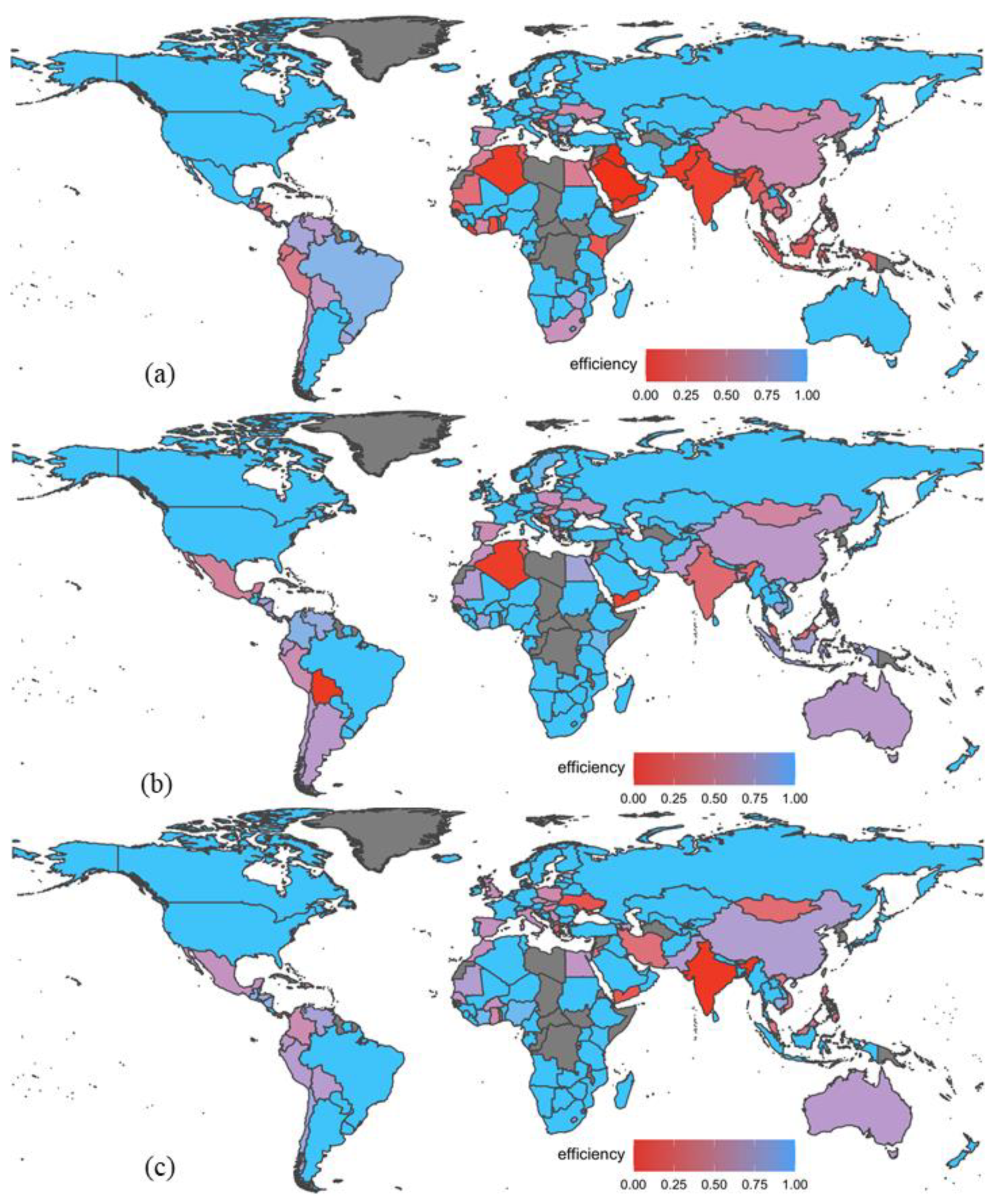
3.3. Efficiency of Globalization
3.4. Socioeconomic Development—Through the ‘Just Operating Space’ Lens
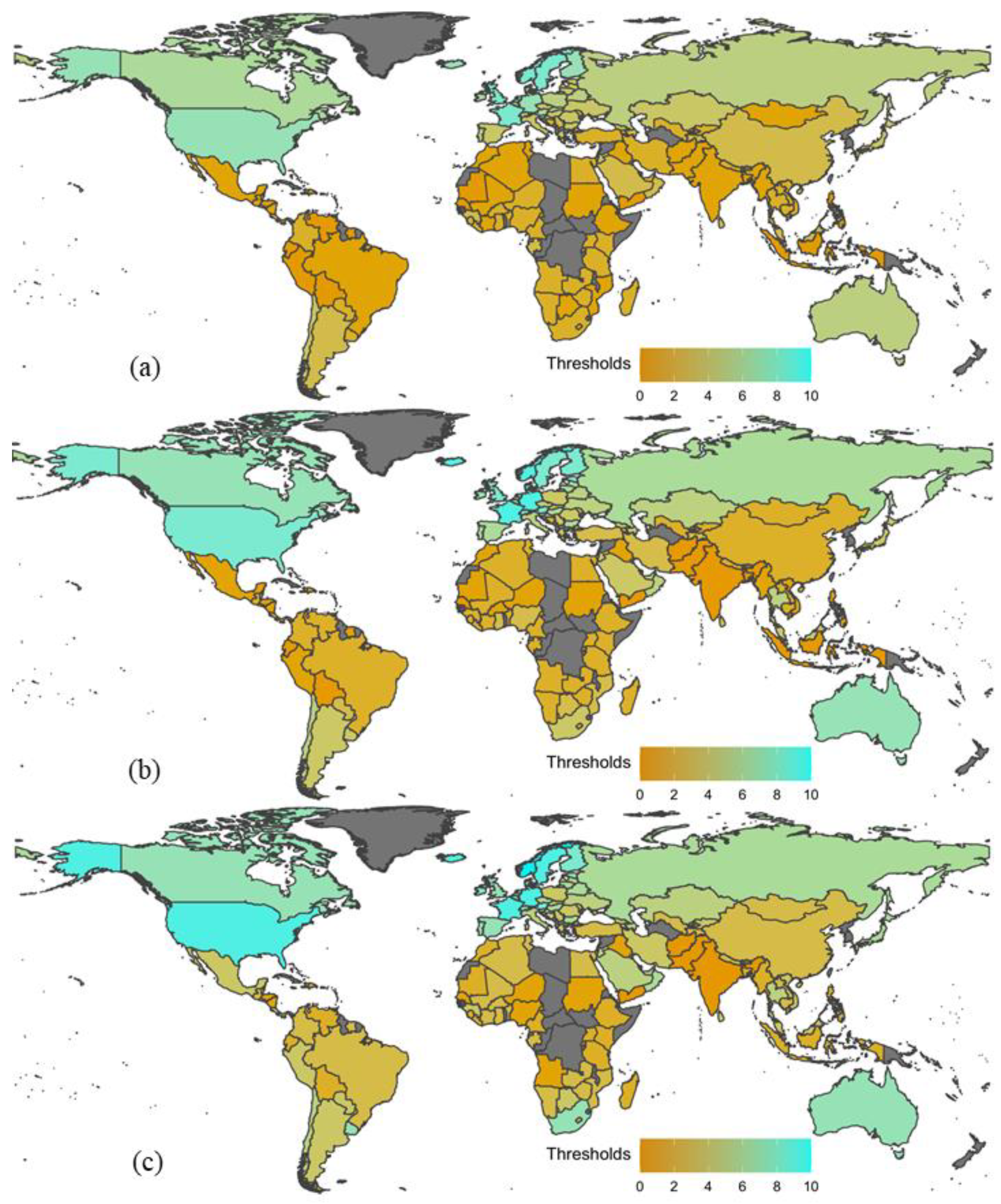
3.5. Improvement Targets of Globalization Efficiency
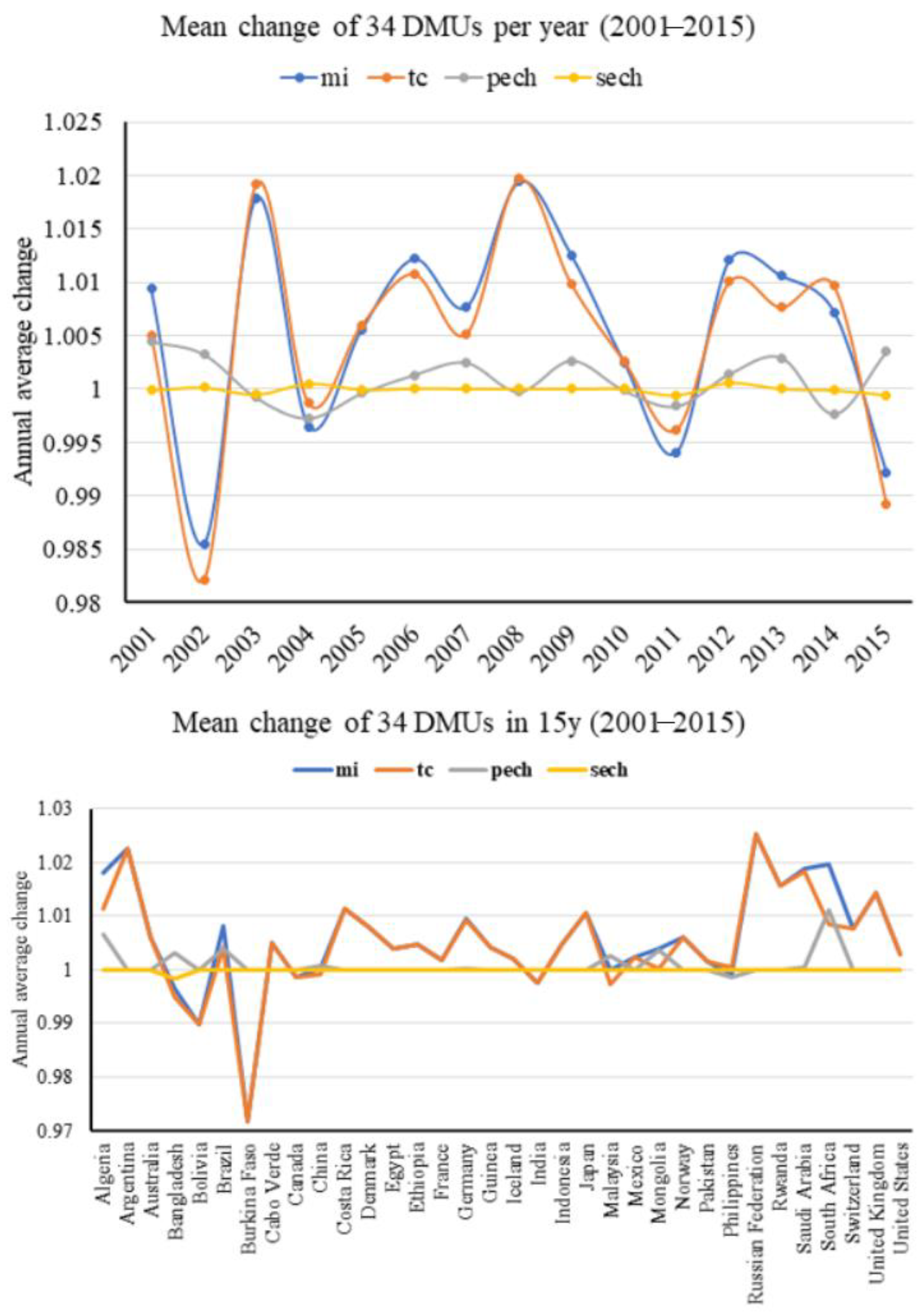
3.6. Malmquist Index
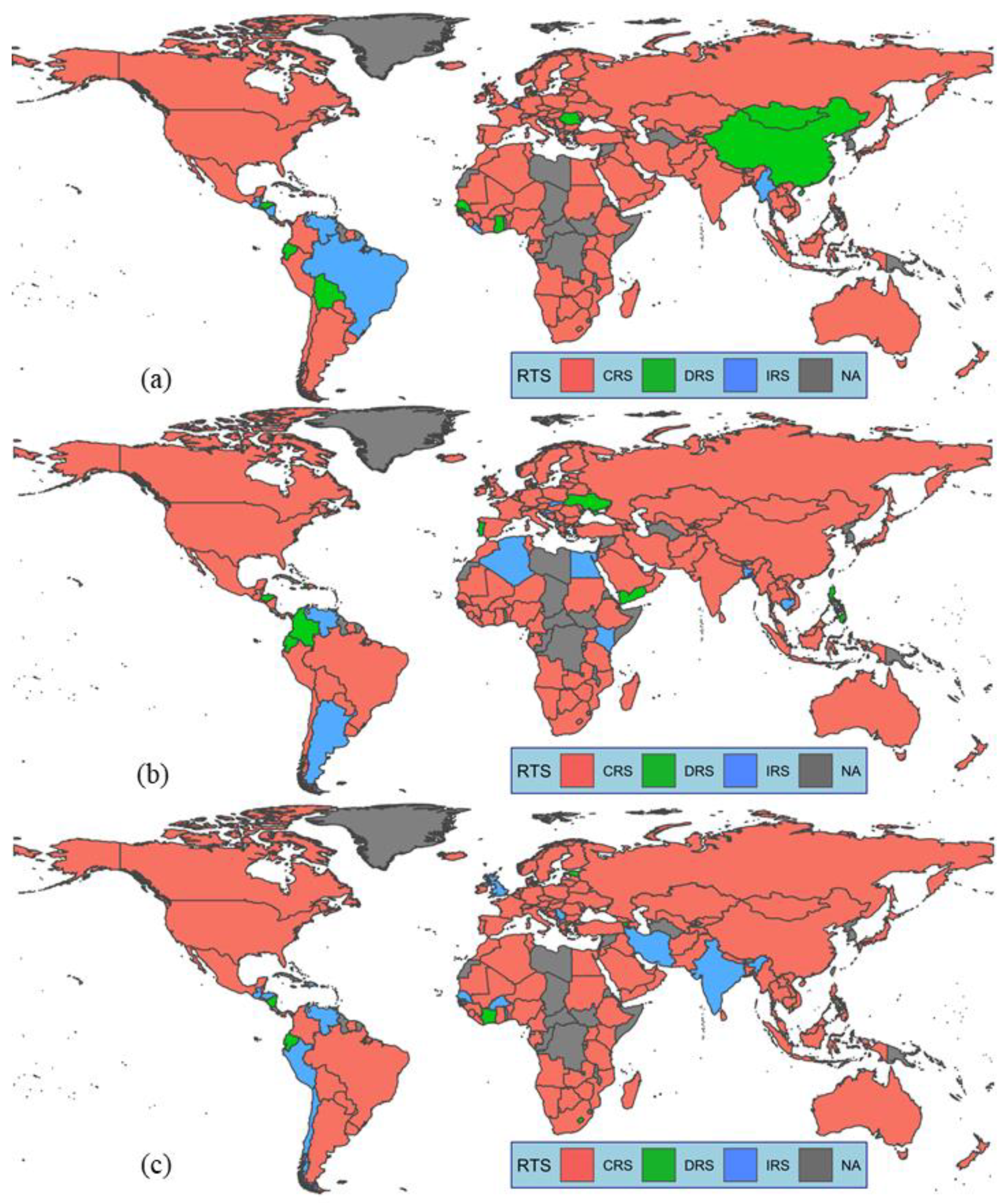
3.7. Return to Scale
3.8. Dual Achievement
4. Discussion
5. Conclusions
Supplementary Materials
Author Contributions
Funding
Institutional Review Board Statement
Informed Consent Statement
Data Availability Statement
Conflicts of Interest
References
- McMillan, M.; Rodrik, D. Globalization, Structural Change and Productivity Growth; NBER Working Paper 17143; National Bureau of Economic Research: Cambridge, MA, USA, 2011; p. 17143. [Google Scholar] [CrossRef] [Scilit]
- Harrison, A. Globalization and Poverty. Glob. Poverty 2006, 12347. [Google Scholar] [CrossRef] [Scilit]
- Burbules, N.C.; Torres, C.A. Globalization and Education: Critical Perspectives; Routledge: New York, NY, USA, 2000. [Google Scholar]
- Martens, P.; Akin, S.-M.; Maud, H.; Mohsin, R. Is globalization healthy: A statistical indicator analysis of the impacts of globalization on health. Glob. Health 2010, 6, 16. [Google Scholar] [CrossRef] [Scilit] [PubMed]
- Lee, E. Globalization and employment: Is anxiety justified? Int. Lab. Rev. 1996, 135, 485. [Google Scholar]
- Danish; Saud, S.; Baloch, M.A.; Lodhi, R.N. The nexus between energy consumption and financial development: Estimating the role of globalization in Next-11 countries. Environ. Sci. Pollut. Res. 2018, 25, 18651–18661. [Google Scholar] [CrossRef] [Scilit] [PubMed]
- Shahbaz, M.; Lahiani, A.; Abosedra, S.; Hammoudeh, S. The role of globalization in energy consumption: A quantile cointegrating regression approach. Energy Econ. 2018, 71, 161–170. [Google Scholar] [CrossRef] [Scilit]
- Menezes, F. Food Sovereignty: A vital requirement for food security in the context of globalization. Development 2001, 44, 29–33. [Google Scholar] [CrossRef] [Scilit]
- Potrafke, N.; Ursprung, H.W. Globalization and gender equality in the course of development. Eur. J. Political Econ. 2012, 28, 399–413. [Google Scholar] [CrossRef] [Scilit]
- Hassoun, N.; Sechrest, E.T. Globalization and Global Justice. In The Wiley Blackwell Encyclopedia of Race, Ethnicity, and Nationalism; Wiley: New York, NY, USA, 2015. [Google Scholar] [CrossRef] [Scilit]
- Eichengreen, B.; LeBlang, D. Democracy and globalization. Econ. Politics 2008, 20, 289–334. [Google Scholar] [CrossRef] [Scilit]
- Lee, E.; Vivarelli, M. The social impact of globalization in the developing countries. Int. Lab. Rev. 2006, 145, 167–184. [Google Scholar] [CrossRef] [Scilit]
- Absalyamova, S.; Absalyamov, T.; Khusnullova, A.; Mukhametgalieva, C. The impact of corruption on the sustainable development of human capital. J. Phys. Conf. Ser. 2016, 738, 12009. [Google Scholar] [CrossRef] [Scilit]
- Huang, X.; Zhang, J. Research on the financial sustainable growth of the listed companies on GEM. Int. Bus. Manag. 2015, 10, 32–37. [Google Scholar] [CrossRef]
- Saha, S.; Gounder, R. Corruption and economic development nexus: Variations across income levels in a non-linear framework. Econ. Model. 2013, 31, 70–79. [Google Scholar] [CrossRef] [Scilit]
- Borowsky, P.F. Environmental pollution as a threat to the ecology and development in Guinea Conakry. Environ. Prot. Nat. Resour. 2017, 28, 27–32. [Google Scholar] [CrossRef] [Scilit]
- Farzanegan, M.R.; Markwardt, G. Development and pollution in the Middle East and North Africa: Democracy matters. J. Policy Model. 2018, 40, 350–374. [Google Scholar] [CrossRef] [Scilit]
- Borowski, P.F. Nexus between water, energy, food and climate change as challenges facing the modern global, European and Polish economy. AIMS Geosci. 2020, 6, 397–421. [Google Scholar] [CrossRef] [Scilit]
- O’Brien, K.L.; Leichenko, R.M. Double exposure: Assessing the impacts of climate change within the context of economic globalization. Glob. Environ. Chang. 2000, 10, 221–232. [Google Scholar] [CrossRef] [Scilit]
- Bu, M.; Lin, C.; Zhang, B. Globalization and climate change: New empirical panel data evidence. J. Econ. Surv. 2016, 30, 577–595. [Google Scholar] [CrossRef] [Scilit]
- McMichael, A.J. Globalization, Climate Change, and Human Health. N. Engl. J. Med. 2013, 368, 1335–1343. [Google Scholar] [CrossRef] [Scilit]
- Curtis, F. Peak globalization: Climate change, oil depletion and global trade. Ecol. Econ. 2009, 69, 427–434. [Google Scholar] [CrossRef] [Scilit]
- Barkin, J.S. The Counterintuitive Relationship between Globalization and Climate Change. Glob. Environ. Politics 2003, 3, 8–13. [Google Scholar] [CrossRef] [Scilit]
- Gygli, S.; Haelg, F.; Potrafke, N.; Sturm, J.-E. The KOF Globalisation Index—revisited. Rev. Int. Organ. 2019, 14, 543–574. [Google Scholar] [CrossRef] [Scilit]
- Altman, S.A.; Ghemawat, P.; Bastian, P. DHL Global Connectedness Index 2018. Available online: https://www.dhl.com/global-en/spotlight/globalization/global-connectedness-index.html (accessed on 26 April 2021).
- Raworth, K. A Doughnut for the Anthropocene: Humanity’s compass in the 21st century. Lancet Planet. Health 2017, 1, e48–e49. [Google Scholar] [CrossRef] [Scilit]
- Dreher, A. Does globalization affect growth? Evidence from a new index of globalization. Appl. Econ. 2006, 38, 1091–1110. [Google Scholar] [CrossRef] [Scilit]
- Dreher, A.; Gaston, N.; Martens, P. Measuring Globalization: Gauging Its Consequences; Springer: New York, NY, USA, 2008; ISBN 978-0-387-74069-0. [Google Scholar]
- Charnes, A.; Cooper, W.W.; Rhodes, E. Measuring the efficiency of decision making units. Eur. J. Oper. Res. 1978, 2, 429–444. [Google Scholar] [CrossRef] [Scilit]
- Thore, S.; Tarverdyan, R. Using data envelopment analysis to screen the possibility of a fair globalization. Port. J. Manag. Stud. 2008, 13, 129–152. Available online: http://hdl.handle.net/10400.5/10017 (accessed on 26 April 2021).
- Charnes, A.; Cooper, W.W.; Li, S. Using data envelopment analysis to evaluate efficiency in the economic performance of Chinese cities. Socio-Econ. Plan. Sci. 1989, 23, 325–344. [Google Scholar] [CrossRef] [Scilit]
- Zhu, J. Data envelopment analysis vs. principal component analysis: An illustrative study of economic performance of Chinese cities. Eur. J. Oper. Res. 1998, 111, 50–61. [Google Scholar] [CrossRef] [Scilit]
- Despotis, D.K. A reassessment of the human development index via data envelopment analysis. J. Oper. Res. Soc. 2005, 56, 969–980. [Google Scholar] [CrossRef] [Scilit]
- Zhao, L.; Zha, Y.; Zhuang, Y.; Liang, L. Data envelopment analysis for sustainability evaluation in China: Tackling the economic, environmental, and social dimensions. Eur. J. Oper. Res. 2019, 275, 1083–1095. [Google Scholar] [CrossRef] [Scilit]
- Tone, K. A slacks-based measure of efficiency in data envelopment analysis. Eur. J. Oper. Res. 2001, 130, 498–509. [Google Scholar] [CrossRef] [Scilit]
- R Core Team. R: A Language and Environment for Statistical Computing; R Foundation for Statistical Computing: Vienna, Austria. Available online: https://www.R-project.org (accessed on 26 April 2021).
- Banker, R.D.; Charnes, A.; Cooper, W.W.; Swarts, J.; Thomas, D.A. An introduction to data envelopment analysis with some of its models and their uses. Res. Gov. Non-Profit Account. 1989, 5, 125–163. [Google Scholar]
- Malmquist, S. Index numbers and indifference surfaces. Trab. Estad. 1953, 4, 209–242. [Google Scholar] [CrossRef] [Scilit]
- Seiford, L.M.; Zhu, J. An investigation of returns to scale in data envelopment analysis. Omega 1999, 27, 1–11. [Google Scholar] [CrossRef] [Scilit]
- Mogha, S.K.; Yadav, S.P.; Singh, S.P. Slack based measure of efficiencies of public sector hospitals in Uttarakhand (India). Benchmarking Int. J. 2015, 22, 1229–1246. [Google Scholar] [CrossRef] [Scilit]
- Mostafa, M.M. Evaluating the competitive market efficiency of top listed companies in Egypt. J. Econ. Stud. 2007, 34, 430–452. [Google Scholar] [CrossRef] [Scilit]
- Young, O.R.; Berkhout, F.; Gallopin, G.C.; Janssen, M.A.; Ostrom, E.; van der Leeuw, S. The globalization of socio-ecological systems: An agenda for scientific research. Glob. Environ. Chang. 2006, 16, 304–316. [Google Scholar] [CrossRef] [Scilit]
- Entrena, F.; Gömez-Mateos, J. Globalization and socio-economic restructuring in Andalusia. Challenges and possible alternatives. Eur. Sociol. Rev. 2000, 16, 93–114. [Google Scholar] [CrossRef] [Scilit]
- Mishra, S.K.; Nayak, P. Socio-Economic Dimensions of Globalization in India. SSRN Electron. J. 2006, 5, 63–80. [Google Scholar] [CrossRef] [Scilit]
- Orozalieva, K. Impact of Globalization on Socio-Economic and Political Development of the Central Asian Countries. Master’s Thesis, University of South Florida, Tampa, FL, USA, 2010. Available online: https://scholarcommons.usf.edu/etd/1730 (accessed on 26 April 2021).
- Mgonja, B.E.S.; Malipula, M. Globalisation, Governmentality and Socio-Economic Development: Reflections from Tanzania. Int. J. Dev. Soc. 2012, 1, 53–60. [Google Scholar] [CrossRef]
- Abutalibov, R.; Guliyev, S.M. Globalization and Social-Economic Development: Progress or Regress. SSRN Electron. J. 2013. [Google Scholar] [CrossRef] [Scilit]
- Nwokah, N.G.; Adiele, K. The Socio-Economic Impact of Globalization in Nigeria. J. Econ. Sustain. Dev. 2015, 6, 238–246. Available online: https://www.iiste.org/Journals/index.php/JEDS/article/view/22689 (accessed on 26 April 2021).
- Zaporozhtseva, L.; Kleimenov, D.; Kuznetsova, E.; Orekhov, A.; Tkacheva, Y. Transformation of socio-economic development scenarios of Russian rural areas in the context of globalization. IOP Conf. Ser. Earth Environ. Sci. 2019, 341, 012029. [Google Scholar] [CrossRef] [Scilit]
- Kokodey, T.A.; Lomachenko, T.I.; Maidanevych, Y.P.; Nekhaychuk, D.V.; Romanova, Y.A. Effect of World Economy Globalization and Supply Chain Upon Socio-Economic Processes at the National Level. Int. J. Supply Chain Manag. 2020, 9, 822–828. Available online: https://ojs.excelingtech.co.uk/index.php/IJSCM/article/view/4723 (accessed on 26 April 2021).
- Diaconu, L.; Bayer, Y. Globalization and socio-economic development in post-transition European Union countries: Panel causality and regression analyses. East. J. Eur. Stud. 2020, 11, 45–61. Available online: https://ejes.uaic.ro/EJES2020_vol11_issue1.htm (accessed on 26 April 2021).

| Types | Dimensions | Indicators | Abbreviations | UN SDGs |
|---|---|---|---|---|
| Input | Globalization | KOF Globalization index | KOFGI | |
| Global connectedness index | GCI | |||
| Output | Education | Mean years of schooling for the adult population | MYS | SDG 4 |
| Employment | Vulnerable employment (% of total) | VEMP | SDG 8 | |
| Energy | Renewable energy consumption (% of total) | REC | SDG 7 | |
| Food | Food supply (kcal person−1 day−1) | FS | SDG 2 | |
| Gender equality | Female labour force (% of total) | FLF | SDG 5 | |
| Health | Out-of-pocket expenditure (% of current health expenditure) | OPE | SDG 3 | |
| Networks | Mobile cellular subscriptions (per 100 people) | MCS | SDG 9 | |
| Justice | Rule of law | RL | SDG 16 | |
| Political voice | Voice and accountability index | VAI | SDG 6, 11, 13, 16 | |
| Water and Sanitation | Open defecation rate (% of the population) | OD | SDG 6 |
| Cases | Sum of Squares | df | Mean Square | F | p |
|---|---|---|---|---|---|
| Year | 0.472 | 2 | 0.236 | 3.664 | 0.026 |
| Income group | 1.124 | 3 | 0.375 | 5.817 | <0.001 |
| Year ✻ Income group | 1.291 | 6 | 0.215 | 3.342 | 0.003 |
| Residuals | 27.428 | 426 | 0.064 |
Publisher’s Note: MDPI stays neutral with regard to jurisdictional claims in published maps and institutional affiliations. |
© 2021 by the authors. Licensee MDPI, Basel, Switzerland. This article is an open access article distributed under the terms and conditions of the Creative Commons Attribution (CC BY) license (https://creativecommons.org/licenses/by/4.0/).
Share and Cite
Roy, A.; Basu, A.; Dong, X. Achieving Socioeconomic Development Fuelled by Globalization: An Analysis of 146 Countries. Sustainability 2021, 13, 4913. https://doi.org/10.3390/su13094913
Roy A, Basu A, Dong X. Achieving Socioeconomic Development Fuelled by Globalization: An Analysis of 146 Countries. Sustainability. 2021; 13(9):4913. https://doi.org/10.3390/su13094913
Chicago/Turabian StyleRoy, Ajishnu, Aman Basu, and Xuhui Dong. 2021. "Achieving Socioeconomic Development Fuelled by Globalization: An Analysis of 146 Countries" Sustainability 13, no. 9: 4913. https://doi.org/10.3390/su13094913
APA StyleRoy, A., Basu, A., & Dong, X. (2021). Achieving Socioeconomic Development Fuelled by Globalization: An Analysis of 146 Countries. Sustainability, 13(9), 4913. https://doi.org/10.3390/su13094913

