Article

Hybrid Approach to Corporate Sustainability Performance in Indonesia’s Cement Industry
1
Department of Leisure Industry Management, National Chin-Yi University of Technology, Taichung 411030, Taiwan
2
Institute of Innovation and Circular Economy, Asia University, Taichung 41345, Taiwan
3
Department of Business Administration, Asia University, Taichung 41345, Taiwan
4
Department of Management, Universitas Airlangga, Surabaya 60115, Jawa Timur, Indonesia
5
Department of Medical Research, China Medical University Hospital, China Medical University, Taichung 404333, Taiwan
*
Authors to whom correspondence should be addressed.
Sustainability 2021, 13(24), 14039; https://doi.org/10.3390/su132414039
Submission received: 20 October 2021 / Revised: 5 December 2021 / Accepted: 12 December 2021 / Published: 20 December 2021

Abstract

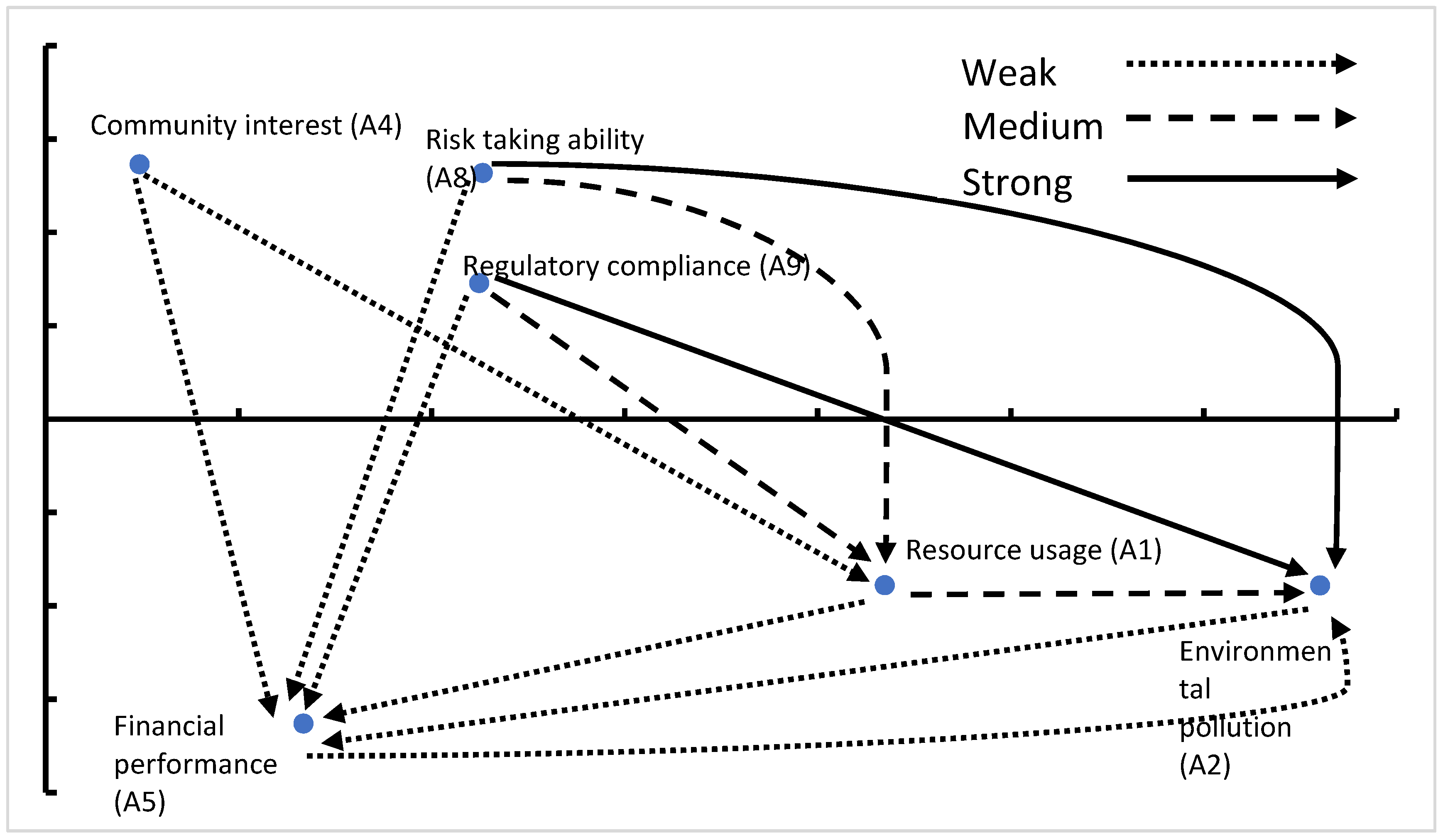
This study aimed to create a solid framework for decision-making in Indonesia’s cement industry, emphasizing those factors which bring about the most impactful results. The framework was developed using the fuzzy Delphi method, the fuzzy decision-making trial and evaluation laboratory, and a fuzzy Kano model. This study builds a hierarchical structure to approach the impact of corporate sustainability performance. We classify important factors into causes or effects and further identify those factors which are critical to improving the performance of Indonesia’s cement industry. Although corporate sustainability performance is a crucial topic in today’s business environment, sustainability strategies remain underrated in Indonesia. We confirm the validity of 19 factors within the following dimensions: environmental impact, social sustainability, economic gain, technological feasibility, and institutional compliance. The sub-dimensions of community interest, risk-taking ability, and regulatory compliance were identified as causes of perceived risks and benefits. In contrast, the following factors were identified as critical to improving corporate sustainability performance: renewable energy resources, contributions to charity, the perception of management regarding technology as a differentiator, and firm readiness to collaborate with high-tech companies.
Keywords: corporate sustainability performance; technological feasibility; cement industry; fuzzy Kano model; fuzzy decision-making trial and evaluation laboratory corporate sustainability performance; technological feasibility; cement industry; fuzzy Kano model; fuzzy decision-making trial and evaluation laboratory