Article

Estimation of Travel Demand for Bangkok–Chiang Mai Hyperloop Using Traveler Surveys
by
Paras Agrawal
* and
Surachet Pravinvongvuth
Transportation Engineering, School of Engineering and Technology, Asian Institute of Technology, Klong Luang 12120, Thailand
*
Author to whom correspondence should be addressed.
Sustainability 2021, 13(24), 14037; https://doi.org/10.3390/su132414037
Submission received: 15 October 2021 / Revised: 16 December 2021 / Accepted: 16 December 2021 / Published: 20 December 2021
(This article belongs to the Special Issue Adaptive Policymaking for Sustainable Transport and Mobility)

Abstract

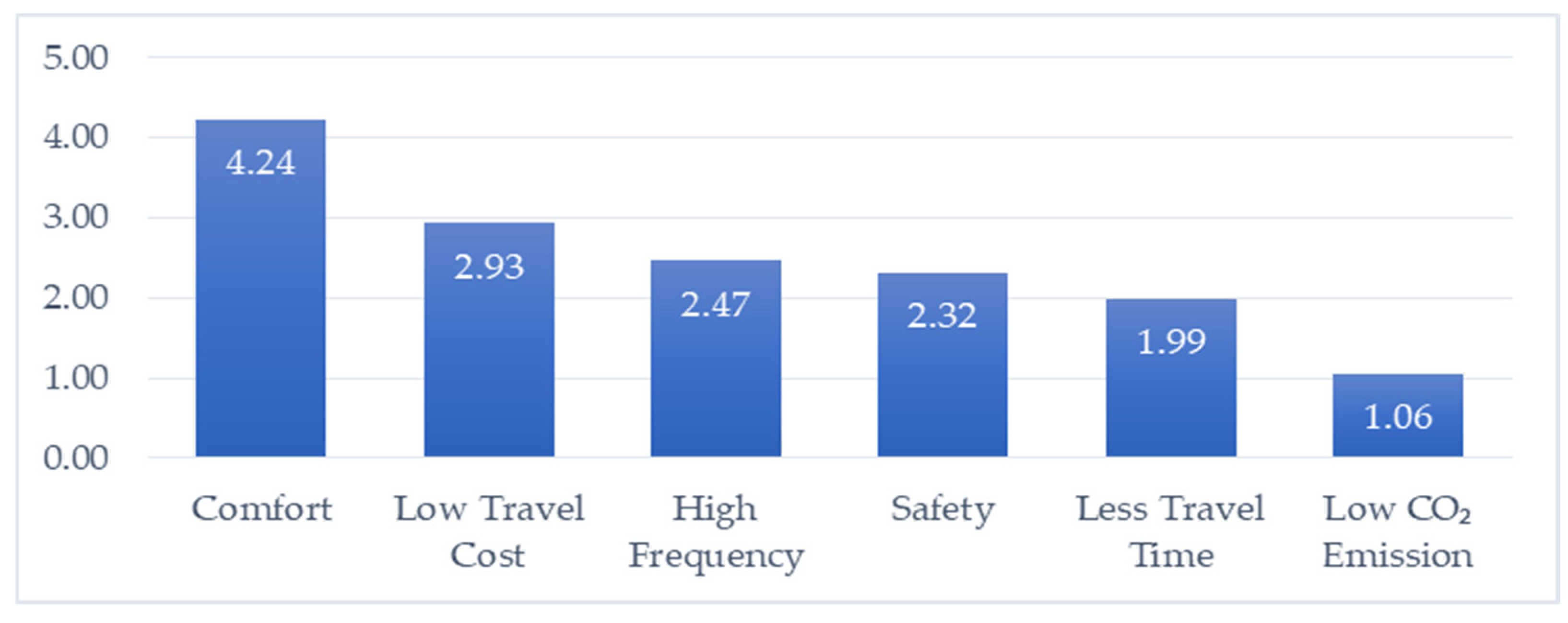
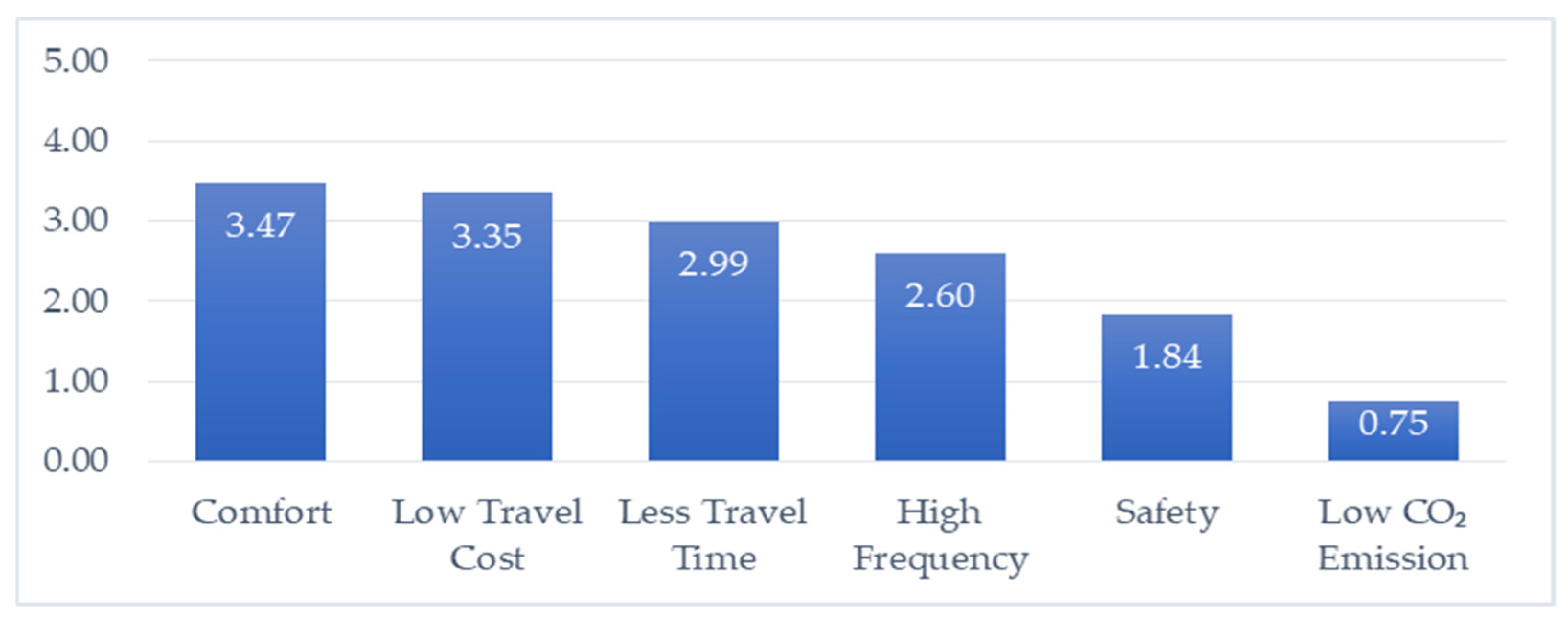
Hyperloop, projected as fast and efficient, and envisaged as the future of high-speed transportation, does not have much published information about its demand estimation. This paper aims to estimate the willingness of air and car passengers to shift to hyperloop. A nested logit model was used to analyze stated preference data gathered from the air and car travelers along the Bangkok–Chiang Mai sector in Thailand. The variables contributing the most to the modal shift towards hyperloop are total travel cost, total travel time, monthly income, gender, education level, bearer of trip expenses, and number of trips in the last 6 months and duration of stay at the destination. The highest value of elasticity for hyperloop is obtained for the total travel cost followed by total travel time and monthly income. It is concluded that hyperloop will be the predominant mode of transportation between the Bangkok–Chiang Mai sectors with a modal share of almost 50% by the year 2025. Survey results also revealed that the preferences of the passengers in order of priorities for long distance travel are comfort, low travel cost, less travel time, safety, high frequency of travel mode and low CO2 emission. The main contribution of this paper is to provide an insight on factors that may contribute towards a possible shift in mode from car and air to hyperloop. The study will be beneficial to policy makers in developing a strategy for a more efficient mass transportation system using new and emerging technologies.
Keywords: traveler’s mode choice; nested logit model; stated preference survey; hyperloop; intercity travel; NLOGIT; Thailand traveler’s mode choice; nested logit model; stated preference survey; hyperloop; intercity travel; NLOGIT; Thailand