Article

Convergence or Divergence? Emission Performance in the Regional Comprehensive Economic Partnership Countries

1
Program in Industry Security Governance, Inha University, Incheon 22212, Korea
2
Business School, Shandong University, Weihai 264309, China
*
Authors to whom correspondence should be addressed.
Sustainability 2021, 13(18), 10135; https://doi.org/10.3390/su131810135
Submission received: 13 August 2021 / Revised: 6 September 2021 / Accepted: 7 September 2021 / Published: 10 September 2021

Abstract

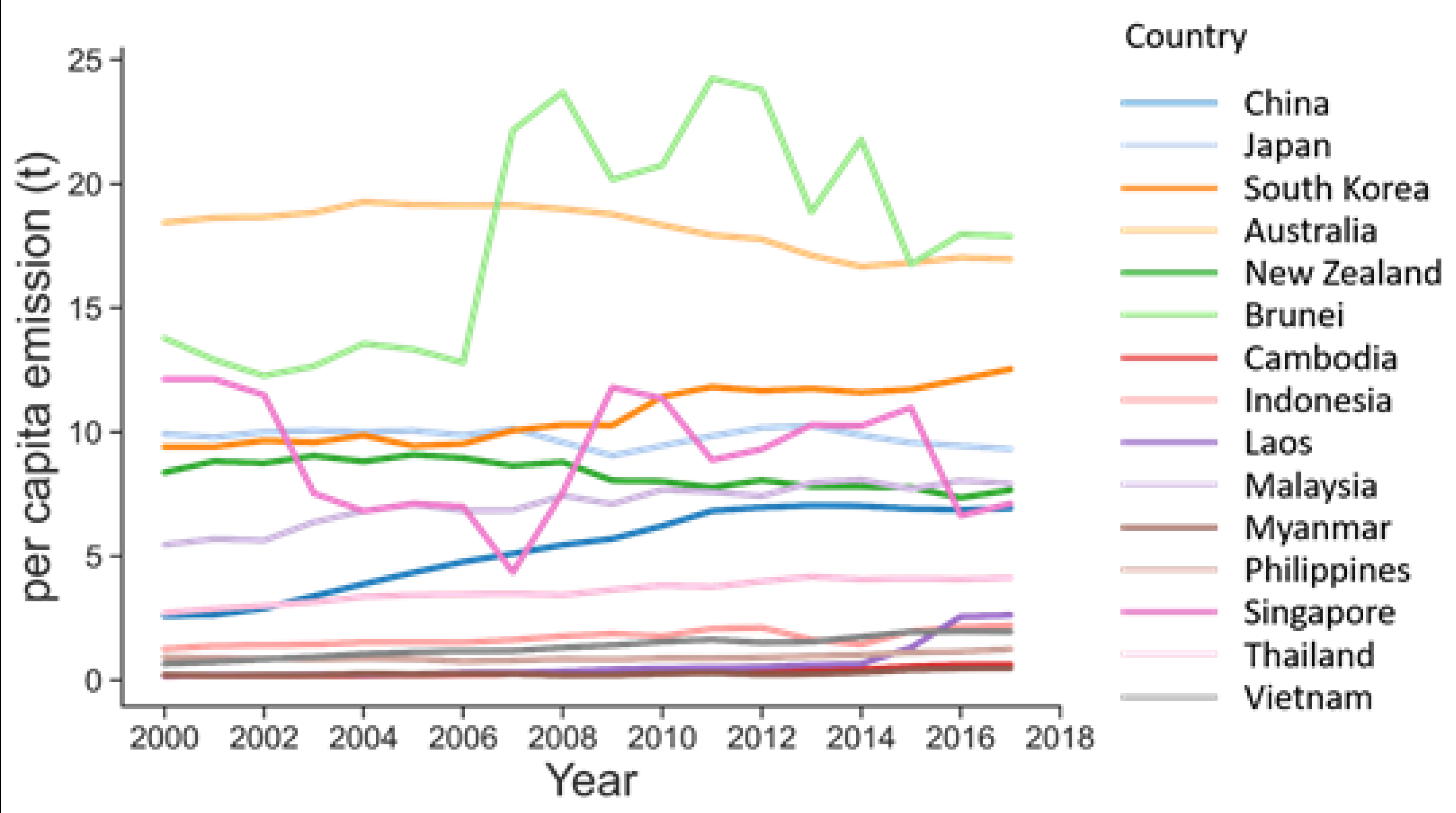
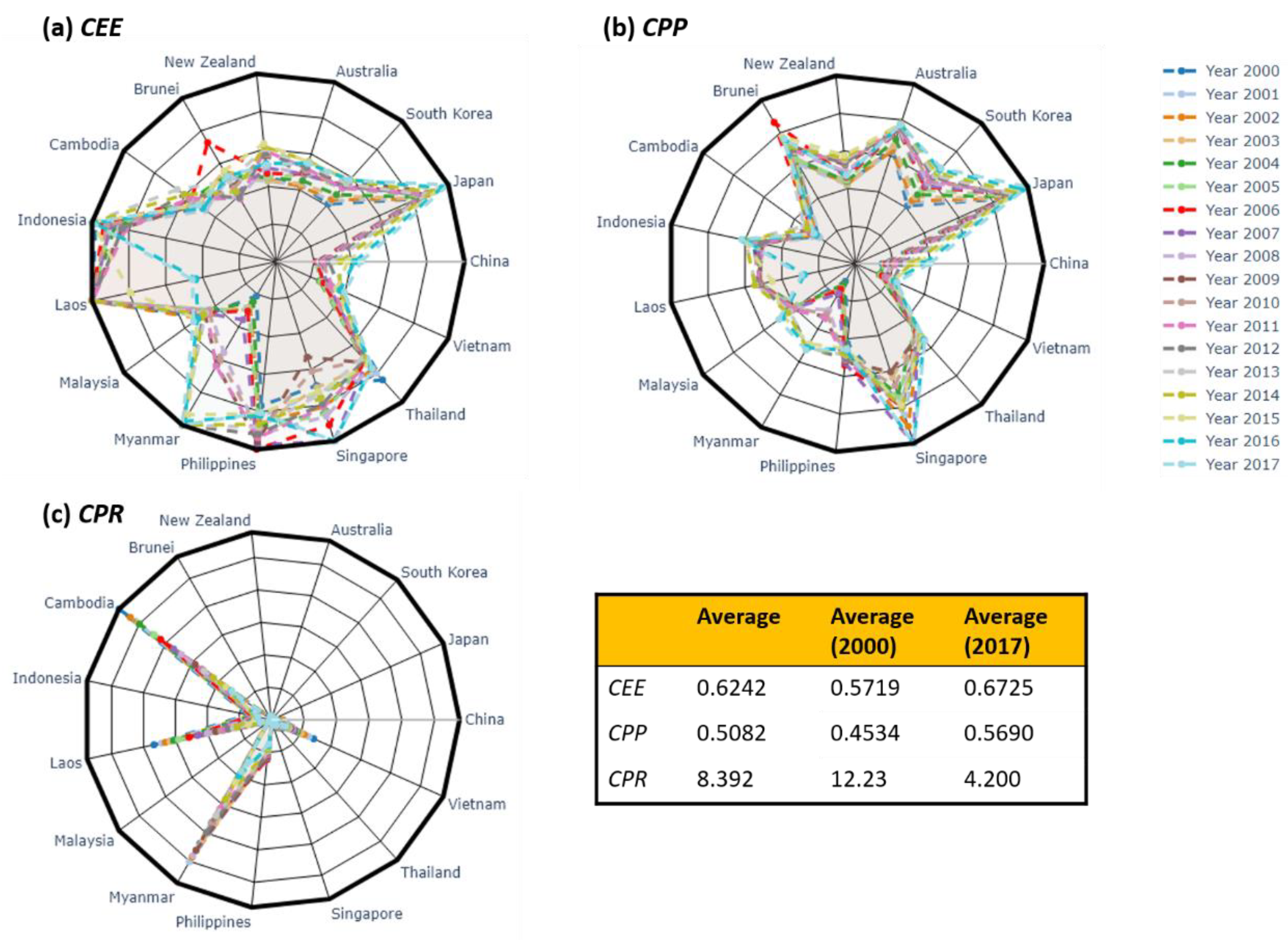
Emission convergence is a fundamental ground for cooperative CO2 emission mitigation. We investigate the emission convergence in the Regional Comprehensive Economic Partnership (RCEP) countries using a modified dynamic β-convergence model. From 2000 to 2017, the per capita emissions of the RCEP countries and its subgroups show a statistically significant diverging pattern. Nonetheless, upon accounting for multiple inputs and outputs using data envelopment analysis, we find that two out of the three emission performance indicators show statistically significant absolute convergence. The carbon emission efficiency (CEE) of the 15 RCEP countries grew from 0.5719 in 2000 to 0.6725 in 2017 and will converge at a value of 0.8187, while the carbon–population performance (CPP) increases from 0.4534 to 0.5690 and will converge at 0.7831. Furthermore, using a conditional β-convergence model, we find that trade volume has no significant effect on the growth rates of CEE and CPP, but can accelerate their speed of convergence, which indicates that the establishment of the RCEP may facilitate the convergence of its 15 member countries on CEE and CPP. Our findings suggest that emission mitigation agreement in the RCEP countries is feasible. CEE- or CPP-based indicators can be used for emission budget allocation.
Keywords: Regional Comprehensive Economic Partnership; carbon emission convergence; data envelopment analysis; dynamic β-convergence; emission efficiency Regional Comprehensive Economic Partnership; carbon emission convergence; data envelopment analysis; dynamic β-convergence; emission efficiency