Incentives for Corporate Environmental Information Disclosure in China: Public Media Pressure, Local Government Supervision and Interactive Effects
Abstract
1. Introduction
2. Literature Review and Hypothesis
2.1. Public Media Pressure and EID
2.2. Government Regulatory Pressure and EID
2.3. The Interactive Impact of Media and Government Supervision on EID
3. Methodology
3.1. Data Collection
3.2. Variables
3.2.1. Environmental Information Disclosure (EID)
3.2.2. Interaction Effect Variables
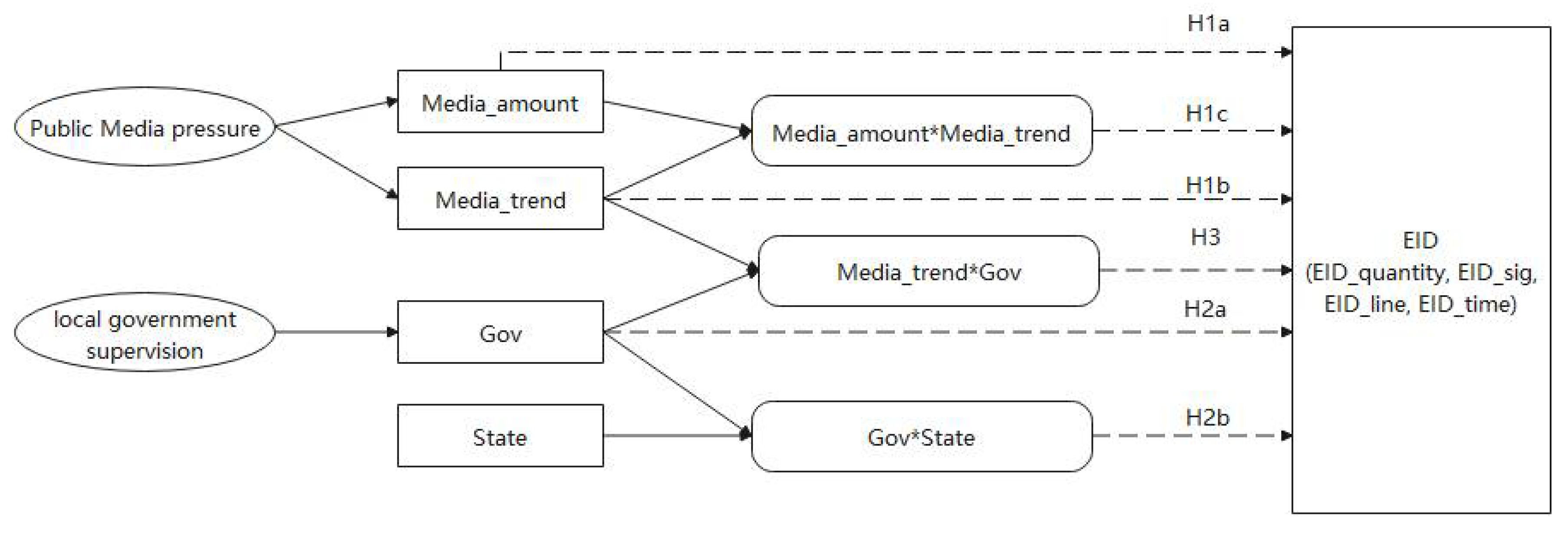
- The amount of media coverage (Media_amount). The media amount of the listed firms is measured by the natural logarithms of media coverage, including the positive, negative and neutral reports. The amount of media coverage is derived from the Institute of Public and Environmental Affairs database (IPE).
- The tendency of media coverage (Media_trend). The Janis-Fadner coefficient is used to measure the tendency of media coverage in this research. The Janis-Fadner coefficient is an index for content analysis method proposed by Janis and Fadner (1965). It was first introduced into the study of corporate legitimacy by Deephouse (1996). Since then, Clarkson (2011) used the Janis-Fadner coefficient as a measure of the pressure on corporate legitimacy caused by public opinion supervision [6]. The formula is calculated as follows:where e is the number of positive media coverage, c is the number of negative media coverage and t is the total amount of the positive and negative media coverage. The value of the J-F coefficient is between −1.0 and +1.0. The more positive media coverage of listed firms, the closer the J–F coefficient value is to +1. On the contrary, the more negative media coverage, the closer the J–F coefficient value is to −1.
- Government supervision degree (Gov). In this study, the Pollution Information Transparency Index (PITI index) is used as a supervised index to measure the local government’s supervision degree for corporate environmental performance. PITI Index is created by two independent research institutions, namely the Institute of Public and Environmental Affairs (IPE) and the National Research and Development Council (NRDC). This index collects EID information of 113 cities in China and evaluates the environmental regulation of local governments. Additionally, the referenced factors of PITI index mainly include the following aspects, respectively, the enterprise exceeds the standard violation, the letter and petition complaint handling situation, the EIA acceptance and environmental acceptance publicity. Furthermore, this indicator is quantitatively and qualitatively analyzed from the four aspects of government supervision: systemic, timeliness, integrity and user-friendliness. In China, the PITI index is the most comprehensive and objective evaluation for local government to reflect the implementation of the environmental supervision policies. Thus, this study defined the PITI index as the degree of local government supervision for corporate environmental performance.
3.2.3. Control Variables
3.3. Regression Model
4. Empirical Results
4.1. Descriptive Statistics and Correlations
4.2. Regression Results
4.3. Residual Analysis
5. Discussion and Implications
6. Conclusions and Limitations
Author Contributions
Funding
Institutional Review Board Statement
Informed Consent Statement
Data Availability Statement
Conflicts of Interest
References
- Bergh, D.D.; Connelly, B.L.; Ketchen, D.J.; Shannon, L.M. Signalling Theory and Equilibrium in Strategic Management Research: An Assessment and a Research Agenda. J. Manag. Stud. 2014, 51, 1334–1360. [Google Scholar] [CrossRef] [Scilit]
- Cai, B.; Geng, Y.; Yang, W.; Yan, P.; Chen, Q.; Li, D.; Cao, L. How scholars and the public perceive a “low carbon city” in China. J. Clean. Prod. 2017, 149, 502–510. [Google Scholar] [CrossRef] [Scilit]
- Haque, F.; Ntim, C. Environmental Policy, Sustainable Development, Governance Mechanisms and Environmental Performance. Bus. Strat. Environ. 2017, 27, 415–435. [Google Scholar] [CrossRef] [Scilit]
- Francis, J.R.; Khurana, I.K.; Martin, X.; Pereira, R. The relative importance offirm incentives versus country factors in the demand for assurance services by private entities. J. Contemp. Account. Res. 2011, 28, 487–516. [Google Scholar] [CrossRef] [Scilit]
- Gao, S.; Ling, S.; Liu, W. The Role of Social Media in Promoting Information Disclosure on Environmental Incidents: An Evolutionary Game Theory Perspective. Sustainability 2018, 10, 4372. [Google Scholar] [CrossRef] [Scilit]
- He, G.; Yang, J.; Lu, Y.; Wang, S.; Chen, B.; Hayat, T.; Alsaedi, A.; Ahmad, B. Ternary energetic environmental performance auditing of a typical industrial park in Beijing. J. Clean. Prod. 2017, 163, 128–135. [Google Scholar] [CrossRef] [Scilit]
- Franco, F.; Urcan, O.; Vasvari, F.P. Corporate Diversification and the Cost of Debt: The Role of Segment Disclosures. Account. Rev. 2015, 91, 1139–1165. [Google Scholar] [CrossRef] [Scilit]
- Du, X.; Chang, Y.; Zeng, Q.; Du, Y.; Pei, H. Corporate environmental responsibility (CER) weakness, media coverage, and corporate philanthropy: Evidence from China. Asia Pac. J. Manag. 2015, 33, 551–581. [Google Scholar] [CrossRef] [Scilit]
- Feng, L.; Xiao, X.; Cheng, X. Effect of corporate social responsibility on firm risk: Based on the economic conditions of China. J. Nankai Bus. Rev. 2016, 19, 141–154. [Google Scholar]
- Huang, Z.; Liao, G.; Li, Z. Loaning scale and government subsidy for promoting green innovation. Technol. Forecast. Soc. Chang. 2019, 144, 148–156. [Google Scholar] [CrossRef] [Scilit]
- Kim, E.-H.; Lyon, T.P. Strategic environmental disclosure: Evidence from the DOE’s voluntary greenhouse gas registry. J. Environ. Econ. Manag. 2011, 61, 311–326. [Google Scholar] [CrossRef] [Scilit]
- Kolk, A. The social responsibility of international business: From ethics and the environment to CSR and sustainable development. J. World Bus. 2016, 51, 23–34. [Google Scholar] [CrossRef] [Scilit]
- Joshi, P.L.; Gao, S.S. Multinational corporations’ corporate social and environmental disclosures (CSED) on web sites. Int. J. Commer. Manag. 2009, 19, 27–44. [Google Scholar] [CrossRef] [Scilit]
- Liu, X.; Anbumozhi, V. Determinant factors of corporate environmental information disclosure: An empirical study of Chinese listed companies. J. Clean. Prod. 2009, 17, 593–600. [Google Scholar] [CrossRef] [Scilit]
- Monfort, A.; Villagra, N.; Sánchez, J. Economic impact of corporate foundations: An event analysis approach. J. Bus. Res. 2020, 122, 159–170. [Google Scholar] [CrossRef] [Scilit]
- Fan, L.; Yang, K.; Liu, L. New media environment, environmental information disclosure and firm valuation: Evidence from high-polluting enterprises in China. J. Clean. Prod. 2020, 277, 123253. [Google Scholar] [CrossRef] [Scilit]
- Rivera, J.; Oh, C.H. Environmental Regulations and Multinational Corporations’ Foreign Market Entry Investments. Policy Stud. J. 2013, 41, 243–272. [Google Scholar] [CrossRef] [Scilit]
- Wong, C.W.; Miao, X.; Cui, S.; Tang, Y. Impact of Corporate Environmental Responsibility on Operating Income: Moderating Role of Regional Disparities in China. J. Bus. Ethics 2016, 149, 363–382. [Google Scholar] [CrossRef] [Scilit]
- Matei, I. Is financial development good for economic growth? Empirical insights from emerging European countries. Quant. Financ. Econ. 2020, 4, 653–678. [Google Scholar] [CrossRef] [Scilit]
- Noradiva, H.; Parastou, A.; Azlina, A. The Effects of Managerial Ownership on the Relationship between Intellectual Capital Performance and Firm Value. Int. J. Soc. Sci. Humanit. 2016, 6, 514–518. [Google Scholar] [CrossRef] [Scilit]
- Walls, J.L.; Berrone, P.; Phan, P. Corporate governance and environmental performance: Is there really a link? Strat. Manag. J. 2012, 33, 885–913. [Google Scholar] [CrossRef] [Scilit]
- Weber, O. Environmental, Social and Governance Reporting in China. Bus. Strat. Environ. 2013, 23, 303–317. [Google Scholar] [CrossRef] [Scilit]
- Tapver, T. CSR reporting in banks: Does the composition of the board of directors matter? Quant. Financ. Econ. 2019, 3, 286–314. [Google Scholar] [CrossRef] [Scilit]
- Trumpp, C.; Guenther, T.W. Too Little or too much? Exploring U-shaped Relationships between Corporate Environmental Performance and Corporate Financial Performance. Bus. Strat. Environ. 2015, 26, 49–68. [Google Scholar] [CrossRef] [Scilit]
- Tseng, M.-L.; Ha, N.T.T.; Lin, C.-W.; Nguyen, T.T.H.; Lim, M.K. Environmental responsibility drives board structure and financial and governance performance: A cause and effect model with qualitative information. J. Clean. Prod. 2020, 258, 120668. [Google Scholar] [CrossRef] [Scilit]
- Zhang, L.; Mol, A.P.; He, G. Transparency and information disclosure in China’s environmental governance. Curr. Opin. Environ. Sustain. 2015, 18, 17–24. [Google Scholar] [CrossRef] [Scilit]
- Zhang, X.; Ma, M.; Chen, J. Regulation effect of external pressure to the enterprise environment disclosure. J. Soft Sci. 2016, 30, 74–78. [Google Scholar]
- Cheng, J.; Liu, Y. The effects of public attention on the environmental performance of high-polluting firms: Based on big data from web search in China. J. Clean. Prod. 2018, 186, 335–341. [Google Scholar] [CrossRef] [Scilit]
- Clarkson, P.M.; Li, Y.; Richardson, G.D.; Vasvari, F.P. Revisiting the relation between environmental performance and environmental disclosure: An empirical analysis. Account. Organ. Soc. 2008, 33, 303–327. [Google Scholar] [CrossRef] [Scilit]
- Lee, K.-H. Does Size Matter? Evaluating Corporate Environmental Disclosure in the Australian Mining and Metal Industry: A Combined Approach of Quantity and Quality Measurement. Bus. Strat. Environ. 2015, 26, 209–223. [Google Scholar] [CrossRef] [Scilit]
- Li, D.; Zheng, M.; Cao, C.; Chen, X.; Ren, S.; Huang, M. The impact of legitimacy pressure and corporate profitability on green innovation: Evidence from China top 100. J. Clean. Prod. 2017, 141, 41–49. [Google Scholar] [CrossRef] [Scilit]
- Wu, B.; Jin, C.; Monfort, A.; Hua, D. Generous charity to preserve green image? Exploring linkage between strategic donations and environmental misconduct. J. Bus. Res. 2020, 131, 839–850. [Google Scholar] [CrossRef] [Scilit]
- Zeghal, D.; Ahmed, S.A. Comparison of Social Responsibility Information Disclosure Media Used by Canadian Firms. Account. Audit. Account. J. 1990, 3. [Google Scholar] [CrossRef] [Scilit]
- Zhao, X.; Sun, B. The influence of Chinese environmental regulation on corporation innovation and competitiveness. J. Clean. Prod. 2016, 112, 1528–1536. [Google Scholar] [CrossRef] [Scilit]
- He, R.; He, N. The Reduction of Facial Feature Based on Granular Computing. In Electronics and Signal Processing; Springer: Berlin/Heidelberg, Germany, 2011; Volume 97, pp. 1015–1021. [Google Scholar]
- Luo, W.; Guo, X.; Zhong, S.; Wang, J. Environmental information disclosur equality, media attention and debt financing costs: Evidence from Chinese heavy-polluting listed companies. J. Clean. Prod. 2019, 231, 268–277. [Google Scholar] [CrossRef] [Scilit]
- Clarkson, P.M.; Overell, M.B.; Chapple, L. Environmental Reporting and its Relation to Corporate Environmental Performance. Abacus 2011, 47, 27–60. [Google Scholar] [CrossRef] [Scilit]
- Connelly, B.L.; Certo, S.T.; Ireland, R.D.; Reutzel, C.R. Signaling Theory: A Review and Assessment. J. Manag. 2010, 37, 39–67. [Google Scholar] [CrossRef] [Scilit]
- Deegan, C.; Islam, M. An exploration of NGO and media efforts to influence workplace practices and associated accountability within global supply chains. Br. Account. Rev. 2014, 46, 397–415. [Google Scholar] [CrossRef] [Scilit]
- Fornes, G.; Monfort, A.; Ilie, C.; Koo, C.K.; Cardoza, G. Ethics, Responsibility, and Sustainability in MBAs. Understanding the Motivations for the Incorporation of ERS in Less Traditional Markets. Sustainability 2019, 11, 7060. [Google Scholar] [CrossRef] [Scilit]
- Henri, J.-F.; Boiral, O.; Roy, M.-J. Strategic cost management and performance: The case of environmental costs. Br. Account. Rev. 2016, 48, 269–282. [Google Scholar] [CrossRef] [Scilit]
- Iatridis, G.E. Environmental disclosure quality: Evidence on environmental performance, corporate governance and value relevance. J. Emerg. Mark. Rev. 2013, 14, 55–75. [Google Scholar] [CrossRef] [Scilit]
- Jegadeesh, N.; Wu, A.D. Word power: A new approach for content analysis. J. Financ. Econ. 2013, 110, 712–729. [Google Scholar] [CrossRef] [Scilit]
- Liu, L.; Wu, T.; Li, S.; de Jong, M.; Sun, Y. The drivers of local environmental policy in China: An analysis of Shenzhen’s environmental performance management system. J. Clean. Prod. 2017, 165, 656–666. [Google Scholar] [CrossRef] [Scilit]
- Li, Y.; Zeng, B.; Wu, T.; Hao, H. Effects of urban environmental policies on improving firm efficiency: Evidence from Chinese new energy vehicle firms. J. Clean. Prod. 2019, 215, 600–610. [Google Scholar] [CrossRef] [Scilit]
- Costantini, V.; Crespi, F. Environmental regulation and the export dynamics of energy technologies. Ecol. Econ. 2008, 66, 447–460. [Google Scholar] [CrossRef] [Scilit]
- Tripathy, N. Does measure of financial development matter for economic growth in India? Quant. Financ. Econ. 2019, 3, 508–525. [Google Scholar] [CrossRef] [Scilit]



| Content | Description |
|---|---|
| Project | Environmental protection policy and annual environmental protection expectation achievements. |
| Consumption | Total annual resource consumption of an enterprise. |
| Hardware and software support | Enterprise environmental protection investment and technology development. |
| Sustainability | Waste treatment, recycling and comprehensive utilization. |
| Expenditure | Environmental protection expenses. |
| Others | Additional disclosures such as industry comparisons and rankings. |
| EID | Scoring Standard | |
|---|---|---|
| Quantity | Number of lines related to EID in the annual report. | |
| Quality | Sig | One score: disclosure only in the non-financial part. Two scores: disclosure only in the financial part. Three scores: disclosure both in the financial and non-financial part. |
| Line | One score: text description only. Two scores: quantitative description only. Tree scores: monetary description. | |
| Time | One score: only current information. Two scores: only future information. Three scores: current and future information. | |
| Variable | Definition |
|---|---|
| EID | The quality of corporate environmental information disclosure. |
| EID_quantity | The scores of the quantity of corporate environmental performance. |
| EID_sig | The scores of the content of corporate environmental performance. |
| EID_line | The scores of the description of corporate environmental reporting. |
| EID_time | The scores of the update of the corporate environmental reporting. |
| Media_amount | Ln function of the amount of the media reporting. |
| Media_trend | Janis-Fadner coefficient of the media tendency. |
| Gov | PITI index to measure the degree of local government supervision. |
| State | A dummy variable that is equal to 1 if the firm is a state-owned firm and 0 otherwise. |
| Big4 | A dummy variable that is equal to q if the audit institution of firm is PWC, DTT, KPMG and EY institutions and 0 otherwise. |
| ROA | Fiscal year-end net income/year-end total assets. |
| LEV | Total debt/year-end total assets. |
| TobinQ | TobinQ is a measure based market, and is measured by firm’s market value/total assets. |
| Mean | Median | Min | Max | Std | |
|---|---|---|---|---|---|
| EID | 44.266 | 43.616 | 19.554 | 89.003 | 12.818 |
| EID_quantity | 15.234 | 14.531 | 0.8333 | 26.953 | 4.294 |
| EID_sig | 18.999 | 17.930 | 5.800 | 41.660 | 6.539 |
| EID_line | 8.440 | 8.388 | 1.776 | 14.408 | 1.983 |
| EID_time | 1.593 | 1.0938 | 0.000 | 7.875 | 1.540 |
| Media_amount | 6.395 | 6.378 | 0.693 | 9.505 | 1.113 |
| Media_trend | 0.502 | 0.577 | −0.277 | 0.864 | 0.253 |
| Gov | 66.633 | 67.500 | 56.300 | 78.800 | 5.526 |
| State | 0.429 | 0.000 | 0.000 | 1.000 | 0.497 |
| Big4 | 0.025 | 0.000 | 0.000 | 1.000 | 0.157 |
| ROA | 0.043 | 0.043 | −0.270 | 0.209 | 0.058 |
| LEV | 0.466 | 0.477 | 0.031 | 0.908 | 0.176 |
| TobinQ | 1.553 | 1.266 | 0.793 | 5.110 | 0.787 |
| EID | EID_Quantity | EID_Sig | EID_Line | EID_Time | Media_Amount | Media_Trend | Gov | State | Big4 | |
|---|---|---|---|---|---|---|---|---|---|---|
| EID | 1.000 | 0.920 | 0.954 | 0.758 | 0.731 | 0.135 | 0.034 | 0.081 | 0.253 | 0.452 |
| EID_quantity | 0.920 | 1.000 | 0.791 | 0.728 | 0.573 | 0.107 | −0.049 | 0.104 | 0.219 | 0.367 |
| EID_sig | 0.954 | 0.791 | 1.000 | 0.611 | 0.701 | 0.151 | 0.067 | 0.067 | 0.213 | 0.418 |
| EID_line | 0.758 | 0.728 | 0.611 | 1.000 | 0.397 | 0.050 | 0.058 | 0.020 | 0.243 | 0.454 |
| EID_time | 0.731 | 0.573 | 0.701 | 0.397 | 1.000 | 0.116 | 0.062 | 0.070 | 0.276 | 0.381 |
| Media_amount | 0.135 | 0.107 | 0.151 | 0.050 | 0.116 | 1.000 | 0.351 | −0.050 | 0.059 | 0.199 |
| Media_trend | 0.034 | −0.049 | 0.067 | 0.058 | 0.062 | 0.351 | 1.000 | −0.130 | 0.191 | 0.095 |
| Gov | 0.081 | 0.104 | 0.067 | 0.020 | 0.070 | −0.050 | −0.130 | 1.000 | −0.124 | 0.025 |
| State | 0.253 | 0.219 | 0.213 | 0.243 | 0.276 | 0.059 | 0.191 | −0.124 | 1.000 | 0.077 |
| Big4 | 0.452 | 0.367 | 0.418 | 0.454 | 0.381 | 0.199 | 0.095 | 0.025 | 0.077 | 1.000 |
| Model 1 | Model 2 | Model 3 | |
|---|---|---|---|
| Variable | EID | EID | EID |
| Media_amount | 0.688 (0.69) | −2.122 (−1.48) | −2.228 * (−1.56) |
| Media_trend | −3.314 (−0.76) | −55.445 ** (−2.76) | −123.945 ** (−2.43) |
| Gov | −0.070 (−0.31) | −0.09 (−0.42) | −0.583 * (−1.46) |
| Media_amount ∗ Media_trend | 8.153 *** (2.65) | 8.235 *** (2.69) | |
| Media_trend ∗ Gov | 1.009 * (1.46) | ||
| Gov ∗ State | 0.937 ** (2.36) | 0.854 ** (2.20) | 0.795 ** (2.04) |
| State ∗ Big4 | −22.221 * (−1.63) | −24.918 * (−1.87) | −24.718 ** (−1.86) |
| _cons | 42.607 ** (2.55) | 61.844 *** (3.47) | 95.800 *** (3.27) |
| N | 360 | 360 | 360 |
| Multiple R-Squared | 0.3159 | 0.3570 | 0.3693 |
| Adjusted R-squared | 0.2727 | 0.3103 | 0.3172 |
| Variable | (1) | (2) | (3) | (4) |
|---|---|---|---|---|
| EID_Quantity | EID_Sig | EID_Line | EID_Time | |
| Media_amount | −0.648 (−1.28) | −0.888 (−1.17) | −0.136 (−0.57) | −0.555 *** (−3.30) |
| Media_trend | −55.108 *** (−3.05) | −48.282 ** (−1.78) | −5.906 (−0.69) | −14.649 ** (−2.43) |
| Gov | −0.247 * (−1.74) | −0.248 (−1.17) | −0.052 (−0.78) | −0.04 (−0.77) |
| Media_amount ∗ Media_trend | 2.644 ** (2.44) | 3.732 ** (2.30) | 0.104 (0.21) | 1.756 *** (4.87) |
| Media_trend ∗ Gov | 0.532 ** (2.17) | 0.352 (0.96) | 0.077 (0.67) | 0.048 (0.59) |
| Gov ∗ State | 0.157 (1.14) | 0.472 ** (2.29) | 0.078 (1.20) | 0.089 ** (1.94) |
| State ∗ Big4 | −6.485 (−1.38) | −13.992 ** (−1.99) | −1.144 (−0.65) | −2.799 * (−1.79) |
| _cons | 36.154 *** (3.49) | 40.109 *** (2.58) | 12.328 *** (2.53) | 7.209 ** (2.09) |
| N | 360 | 360 | 360 | 360 |
| Multiple R-Squared | 0.2955 | 0.3185 | 0.2699 | 0.3930 |
| Adjusted R-Squared | 0.2373 | 0.2623 | 0.2097 | 0.3429 |
Publisher’s Note: MDPI stays neutral with regard to jurisdictional claims in published maps and institutional affiliations. |
© 2021 by the authors. Licensee MDPI, Basel, Switzerland. This article is an open access article distributed under the terms and conditions of the Creative Commons Attribution (CC BY) license (https://creativecommons.org/licenses/by/4.0/).
Share and Cite
Xue, J.; He, Y.; Liu, M.; Tang, Y.; Xu, H. Incentives for Corporate Environmental Information Disclosure in China: Public Media Pressure, Local Government Supervision and Interactive Effects. Sustainability 2021, 13, 10016. https://doi.org/10.3390/su131810016
Xue J, He Y, Liu M, Tang Y, Xu H. Incentives for Corporate Environmental Information Disclosure in China: Public Media Pressure, Local Government Supervision and Interactive Effects. Sustainability. 2021; 13(18):10016. https://doi.org/10.3390/su131810016
Chicago/Turabian StyleXue, Jia, Youshi He, Ming Liu, Yin Tang, and Hanyang Xu. 2021. "Incentives for Corporate Environmental Information Disclosure in China: Public Media Pressure, Local Government Supervision and Interactive Effects" Sustainability 13, no. 18: 10016. https://doi.org/10.3390/su131810016
APA StyleXue, J., He, Y., Liu, M., Tang, Y., & Xu, H. (2021). Incentives for Corporate Environmental Information Disclosure in China: Public Media Pressure, Local Government Supervision and Interactive Effects. Sustainability, 13(18), 10016. https://doi.org/10.3390/su131810016