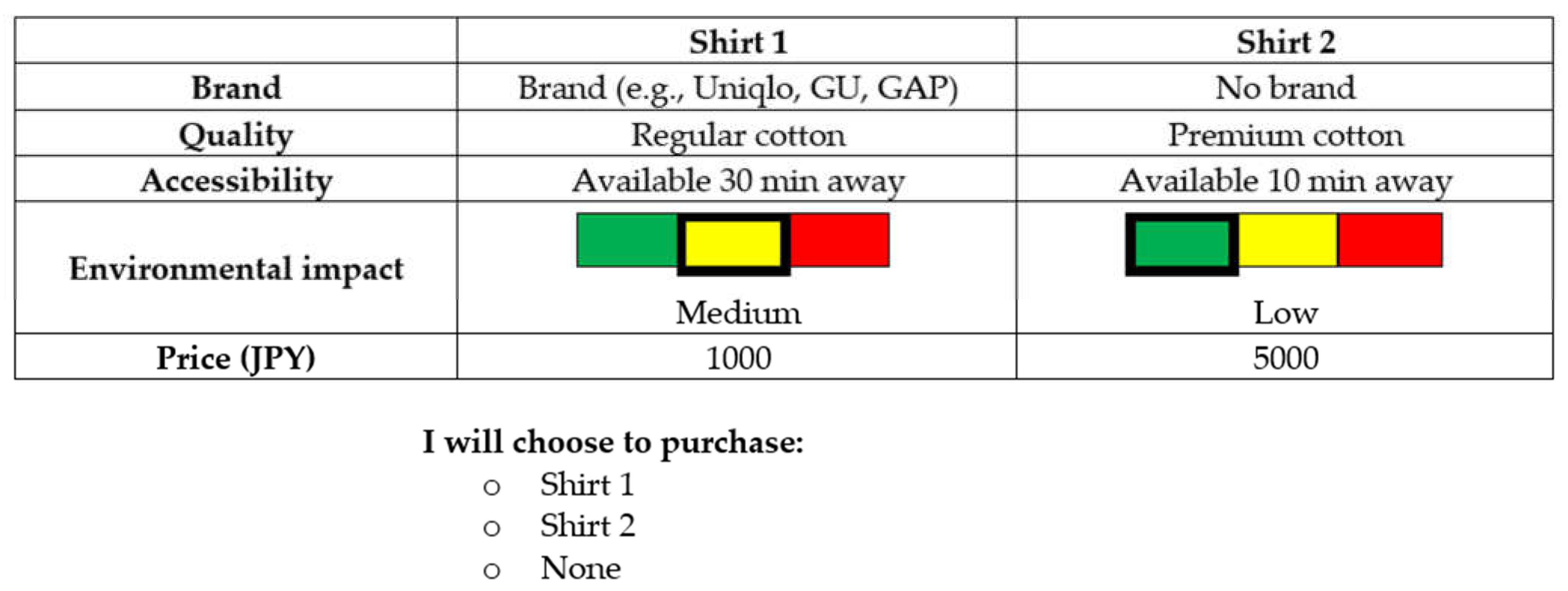
Green Attributes in Young Consumers’ Purchase Intentions: A Cross-Country, Cross-Product Comparative Study Using a Discrete Choice Experiment


Abstract
Share and Cite
Dinh, C.T.; Uehara, T.; Tsuge, T. Green Attributes in Young Consumers’ Purchase Intentions: A Cross-Country, Cross-Product Comparative Study Using a Discrete Choice Experiment. Sustainability 2021, 13, 9825. https://doi.org/10.3390/su13179825
Dinh CT, Uehara T, Tsuge T. Green Attributes in Young Consumers’ Purchase Intentions: A Cross-Country, Cross-Product Comparative Study Using a Discrete Choice Experiment. Sustainability. 2021; 13(17):9825. https://doi.org/10.3390/su13179825
Chicago/Turabian StyleDinh, Chi Thao, Takuro Uehara, and Takahiro Tsuge. 2021. "Green Attributes in Young Consumers’ Purchase Intentions: A Cross-Country, Cross-Product Comparative Study Using a Discrete Choice Experiment" Sustainability 13, no. 17: 9825. https://doi.org/10.3390/su13179825
APA StyleDinh, C. T., Uehara, T., & Tsuge, T. (2021). Green Attributes in Young Consumers’ Purchase Intentions: A Cross-Country, Cross-Product Comparative Study Using a Discrete Choice Experiment. Sustainability, 13(17), 9825. https://doi.org/10.3390/su13179825