


Political Agroecology in Senegal: Historicity and Repertoires of Collective Actions of an Emerging Social Movement


Abstract
1. Introduction
1.1. Agroecology, a Driver of Food System Transformation in Africa?
1.2. Agroecology as a Counter-Hegemonic Force for Rural Social Movements
1.3. Political Agroecology and the Tensions between Reformist, Progressist, and Radicalist Prospects
1.4. The Rise of Agroecology in Sub-Saharan Africa and Senegal
1.5. Political Agroecology and the Repertoires of Collective Action
2. Materials and Methods
3. Results
3.1. The Senegalese Agrarian Regime and the Emergence of Environmental Awareness
3.2. Agroecology in Senegal: From a Pioneering Social Movement to Partial Formalization
3.3. Collective Actions of Agroecological Advocacy Coalitions in Senegal
3.3.1. Practical and Technical Support at the Farm Level
3.3.2. Territorial Governance at the Landscape Level
3.3.3. Alternative Food Networks at the National and Sub-National Levels
3.3.4. Policy Dialogue and Advocacy
4. Discussion and Conclusions
4.1. Progress and Primary Limits of the Agroecological Social Movements in Senegal
4.2. The Senegalese “Projectorate”: An Agrarian Regime under Foreign Dependency
4.3. An NGO-Led Movement
4.4. Territorial Governance Repertoires: A Core Challenge for AE Transformations in SSA
5. Conclusions
Author Contributions
Funding
Institutional Review Board Statement
Informed Consent Statement
Data Availability Statement
Acknowledgments
Conflicts of Interest
Abbreviations
| AAC | Agroecological Advocacy Coalition |
| AE | Agroecology |
| AFN | Alternative Food Networks |
| AGRA | Alliance for a Green Revolution in Africa |
| AGRECOL | An international NGO supporting agroecological programs |
| Agrisud | An international NGO supporting agroecological program |
| ASD | Agriculture Saine et Durable |
| ASPAB | Senegalese Association to Promote Organic and Biodynamic Agriculture |
| ASPRODEB | Association Sénégalaise pour la Promotion du Développement de Base |
| ASPSP | Association of Peasant Seeds Producers |
| CAADP | Comprehensive Africa Agriculture Development Program |
| CIRAD | French Agricultural Research and International Cooperation Organization |
| CNCR (Comité national de concertation des ruraux du Sénégal) | National Consultation Committee of Rural people of Senegal |
| CNOP | Coordination Nationale des Organisations Paysannes du Mali |
| CRAFS (Cadre de Réflexion et d’Action sur le Foncier au Sénégal) | Think tank and action framework for land tenure in Senegal |
| DyTAES (Dynamique pour une Transition Agro-Ecologique au Sénégal) | Dynamic for agroecological transition in Senegal |
| ECOWAS | Economic Community of West African States |
| ENDA Tiers Monde (Environment Development Action in the Third World) | An international NGO |
| ENDA-PRONAT | The most influent NGO leading the agroecological movement in Senegal (originally the environmental division of ENDA Tiers Monde) |
| FAPD | Federation of Diender Agropastoralists (Fédération des Agropasteurs de Diender) |
| FENAB (Fédération Nationale pour l’Agriculture Biologique) | National Federation of Organic Agriculture |
| GOANA (Grande Offensive pour la Nourriture et l’Abondance) | Great Agricultural Offensive for Food and Abundance |
| IFOAM | International Federation of Organic Agriculture Movements |
| ILO | International Labor Organization |
| IRD | French Institute for Research for Development |
| LVC | La Via Campesina |
| MAELA | Movimiento Agroecológico de América Latina y el Caribe |
| NASAN | New Alliance for Food Security and Nutrition |
| NEPAD | New Partnership for Africa’s Development |
| ONCAD | National Office of Cooperation and Development Assistance |
| PATAE | Agroecological Transition Support Project in West Africa |
| PFONGUE | Federation of European NGOs |
| PGS | Participatory Guarantee Systems |
| PNIASAN | Agricultural Investment Program for Food Security and Nutrition |
| PSE (Plan Sénégal Émergent) | Senegal Emerging Plan |
| REVA (Retour Vers l’Agriculture) | Back to Agriculture plan |
| ROPPA | Réseau des organisations paysannes et de producteurs de l’Afrique de l’Ouest |
| ROPPA | Réseau des Organisations Paysannes et des Producteurs Agricoles de l’Afrique de l’Ouest, Network of Peasant Organizations of West Africa |
| SSA | Sub-Saharan Africa |
| TAFAE | Task Force Agroécologie |
| UCAD | Cheikh Anta Diop University of Dakar |
References
- FAO. The State of Food Insecurity in the World; FAO: Rome, Italy, 2015. [Google Scholar]
- Anseeuw, W.; Alden Wily, L.; Cotula, L.; Taylor, M. Land Rights and the Rush for Land. Findings of the Global Commercial Pressures on Land Research Project; ILC: Rome, Italy, 2012. [Google Scholar]
- Edelman, M.; Oya, C.; Borras, S.M., Jr. Global land grabs: Historical processes, theoretical and methodological implications and current trajectories. Third World Q. 2013, 34, 1517–1531. [Google Scholar] [CrossRef]
- Borras, S.M.; Franco, J.C., Jr. Global land grabbing and trajectories of agrarian change: A preliminary analysis. J. Agrar. Chang. 2012, 12, 34–59. [Google Scholar] [CrossRef]
- FAO. Final Report of the Regional Meeting on Agroecology in Sub-Saharan Africa; FAO: Dakar, Senegal, 2016. [Google Scholar]
- Tittonell, P.; Scopel, E.; Andrieu, N.; Posthumus, H.; Mapfumo, P.; Corbeels, M.; van Halsema, G.E.; Lahmar, R.; Lugandu, S.; Rakotoarisoa, J.; et al. Agroecology-based aggradation-conservation agriculture (abaco): Targeting innovations to combat soil degradation and food insecurity in semi-arid africa. Field Crop. Res. 2012, 132, 168–174. [Google Scholar] [CrossRef]
- Altieri, M.A.; Toledo, V.M. The agroecological revolution in latin america: Rescuing nature, ensuring food sovereignty and empowering peasants. J. Peasant Stud. 2011, 38, 587–612. [Google Scholar] [CrossRef]
- Figueroa-Helland, L.; Thomas, C.; Aguilera, A.P. Decolonizing food systems: Food sovereignty, indigenous revitalization, and agroecology as counter-hegemonic movements. Perspect. Glob. Dev. Technol. 2018, 17, 173–201. [Google Scholar] [CrossRef]
- Coolsaet, B. Towards an agroecology of knowledges: Recognition, cognitive justice and farmers’ autonomy in france. J. Rural Stud. 2016, 47, 165–171. [Google Scholar] [CrossRef]
- Martínez-Torres, M.E.; Rosset, P.M. La vía campesina: The birth and evolution of a transnational social movement. J. Peasant Stud. 2010, 37, 149–175. [Google Scholar] [CrossRef]
- Sabatier, P. An advocacy coalition framework of policy change and the role of policy-oriented learning therein. In Public theories Models and Concepts. Ananthology; Cool, D.C.M., Ed.; Prentice Hall: Hoboken, NJ, USA, 1995; pp. 339–370. [Google Scholar]
- Giller, K.E.; Witter, E.; Corbeels, M.; Tittonell, P. Conservation agriculture and smallholder farming in africa: The heretics’ view. Field Crop. Res. 2009, 114, 23–34. [Google Scholar] [CrossRef]
- Wezel, A.; Bellon, S.; Dioré, T.; Francis, C.; Vallod, D.; David, C. Agroecology as a science, a movement and a practice. A review. Agron. Sustain. Dev. 2009, 29, 503–515. [Google Scholar] [CrossRef]
- Dumont, A.M.; Vanloqueren, G.; Stassart, P.M.; Baret, P.V. Clarifying the socioeconomic dimensions of agroecology: Between principles and practices. Agroecol. Sustain. Food Syst. 2016, 40, 24–47. [Google Scholar] [CrossRef]
- McCune, N.; Rosset, P.M.; Salazar, T.C.; Moreno, A.S.; Morales, H. Mediated territoriality: Rural workers and the efforts to scale out agroecology in nicaragua. J. Peasant Stud. 2017, 44, 354–376. [Google Scholar] [CrossRef]
- McCune, N. Pedagogical mediators and the territorialization of agroecology. Rev. Prax. Educ. 2017, 13, 252–280. [Google Scholar]
- Giraldo, O.F.; McCune, N. Can the state take agroecology to scale? Public policy experiences in agroecological territorialization from latin america. Agroecol. Sustain. Food Syst. 2019, 43, 785–809. [Google Scholar] [CrossRef]
- Rosset, P.M.; Martínez-Torres, M.E. Rural social movements and agroecology: Context, theory, and process. Ecol. Soc. 2012, 17, 17. [Google Scholar] [CrossRef]
- Van der Ploeg, J.D. The peasantries of the twenty-first century: The commoditisation debate revisited. J. Peasant Stud. 2010, 37, 1–30. [Google Scholar] [CrossRef]
- Gonzalez de Molina, M. Agroecology and politics. How to get sustainability? About the necessity for a political agroecology. Agroecol. Sustain. Food Syst. 2013, 37, 45–59. [Google Scholar]
- Dupre, L.; Lamine, C.; Navarrete, M. Short food supply chains, long working days: Active work and the construction of professional satisfaction in french diversified organic market gardening. Sociol. Rural. 2017, 57, 396–414. [Google Scholar] [CrossRef]
- Dahlin, A.S.; Rusinamhodzi, L. Yield and labor relations of sustainable intensification options for smallholder farmers in sub-saharan africa. A meta-analysis. Agron. Sustain. Dev. 2019, 39, 1–18. [Google Scholar] [CrossRef]
- Rosset, P.M.; Altieri, M.A. Agroecology versus input substitution: A fundamental contradiction of sustainable agriculture. Soc. Nat. Resour. 1997, 10, 283–295. [Google Scholar] [CrossRef]
- Bellon, S.; Ollivier, G. Institutionalizing agroecology in france: Social circulation changes the meaning of an idea. Sustainability 2018, 10, 1380. [Google Scholar] [CrossRef]
- Giraldo, O.F.; Rosset, P.M. Agroecology as a territory in dispute: Between institutionality and social movements. J. Peasant Stud. 2018, 45, 545–564. [Google Scholar] [CrossRef]
- Holt Giménez, E.; Shattuck, A. Food crises, food regimes and food movements: Rumblings of reform or tides of transformation? J. Peasant Stud. 2011, 38, 109–144. [Google Scholar] [CrossRef] [PubMed]
- Clement, F. For critical social-ecological system studies: Integrating power and discourses to move beyond the right institutional fit. Environ. Conserv. 2013, 40, 1–4. [Google Scholar] [CrossRef]
- Tilzey, M. Food regimes, capital, state, and class: Friedmann and mcmichael revisited. Sociol. Rural. 2019, 59, 230–254. [Google Scholar] [CrossRef]
- Bottazzi, P.; Boillat, S.; Marfurt, F.; Seck, S.M. Channels of labour control in organic farming: Toward a just agroecological transition for sub-saharan africa. Land 2020, 9, 205. [Google Scholar] [CrossRef]
- Newell, P.; Mulvaney, D. The political economy of the ‘just transition’. Geogr. J. 2013, 179, 132–140. [Google Scholar] [CrossRef]
- Holt-Giménez, E.; Altieri, M.A. Agroecology, food sovereignty, and the new green revolution. Agroecol. Sustain. Food Syst. 2013, 37, 90–102. [Google Scholar]
- Smith, A.; Raven, R. What is protective space? Reconsidering niches in transitions to sustainability. Res. Policy 2012, 41, 1025–1036. [Google Scholar] [CrossRef]
- Levidow, L.; Pimbert, M.; Vanloqueren, G. Agroecological research: Conforming—Or transforming the dominant agro-food regime? Agroecol. Sustain. Food Syst. 2014, 38, 1127–1155. [Google Scholar] [CrossRef]
- Martín, V.O.M.; Darias, L.M.J.; Fernández, C.S.M. Agrarian reforms in africa 1980–2016: Solution or evolution of the agrarian question? Africa 2019, 89, 586–607. [Google Scholar] [CrossRef]
- Koopman, J. Land grabs, government, peasant and civil society activism in the senegal river valley. Rev. Afr. Political Econ. 2012, 39, 655–664. [Google Scholar] [CrossRef]
- Dawson, N.; Martin, A.; Sikor, T. Green revolution in sub-saharan africa: Implications of imposed innovation for the wellbeing of rural smallholders. World Dev. 2016, 78, 204–218. [Google Scholar] [CrossRef]
- Boillat, S.; Bottazzi, P. Agroecology as a pathway to resilience justice: Peasant movements and collective action in the niayes coastal region of senegal. Int. J. Sustain. Dev. World Ecol. 2020, 27, 1–16. [Google Scholar] [CrossRef]
- Carmona, A.R. El Proyectorado: Bolivia Tras 20 Años De Ayuda Externa; Intermón Oxfam Editorial: Madrid, Spain, 2008; Volume 16. [Google Scholar]
- Hermans, F.; Stuiver, M.; Beers, P.; Kok, K. The distribution of roles and functions for upscaling and outscaling innovations in agricultural innovation systems. Agric. Syst. 2013, 115, 117–128. [Google Scholar] [CrossRef]
- Isgren, E.; Ness, B. Agroecology to promote just sustainability transitions: Analysis of a civil society network in the rwenzori region, western uganda. Sustainability 2017, 9, 1357. [Google Scholar] [CrossRef]
- Tilly, C. Regimes and Repertoires; University of Chicago Press: Chicago, IL, US, 2010. [Google Scholar]
- Johnson, V. Changing repertoires of collective action: American general strikes 1877–1946. Res. Political Sociol. 2008, 17, 101–134. [Google Scholar]
- Gliessman, S. Transforming food systems with agroecology. Agroecol. Sustain. Food Syst. 2016, 40, 187–189. [Google Scholar] [CrossRef]
- Meillassoux, C. Femmes, Greniers Et Capitaux; Maspero: Paris, France, 1982; p. 218. [Google Scholar]
- Ela, J.-M. Quand L’etat Pénètre En Brousse--: Les Ripostes Paysannes À La Crise; KARTHALA Editions: Paris, France, 1990. [Google Scholar]
- Bernstein, H. Notes on capital and peasantry. Rev. Afr. Political Econ. 1977, 4, 60–73. [Google Scholar] [CrossRef]
- Jacob, J.-P. La décentralisation comme distance. Réflexions sur la mise en place des collectivités territoriales en milieu rural ouest-africain. Polit. Afr. 1998, 71, 133–147. [Google Scholar]
- Diop, A.M. Sénégal: Dynamiques Paysannes Et Souveraineté Alimentaire-Le Procès De Production, La Tenue Foncère Et La Naissance D’un Mouvement Paysan; Harmattan: Dakar, Senegal, 2016. [Google Scholar]
- Bernstein, H.; Byres, T.J. From peasant studies to agrarian change. J. Agrar. Chang. 2001, 1, 1–56. [Google Scholar] [CrossRef]
- Oya, C. Stories of rural accumulation in africa: Trajectories and transitions among rural capitalists in senegal. J. Agrar. Chang. 2007, 7, 453–493. [Google Scholar] [CrossRef]
- Oya, C.; Ba, C.O. Les Politiques Agricoles 2000–2012: Entre Volontarisme Et Incohérence; unpublished work; 2013. [Google Scholar]
- Baglioni, E. Labour control and the labour question in global production networks: Exploitation and disciplining in senegalese export horticulture. J. Econ. Geogr. 2017, 18, 111–137. [Google Scholar] [CrossRef]
- Rochegude, A. Foncier et décentralisation: Réconcilier la légalité et la légitimité des pouvoirs domaniaux et fonciers. In Retour Au Foncier; Le Roy, E., Ed.; Bulletin De Liaison: Paris, France, 2001; Volume 26, pp. 13–34. [Google Scholar]
- Brun, L. L’accaparement Des Terres, Une Menace Pour Lamise À L’échelle De L’agroécologie Au Sénégal; Numero Spécial Farming Matters: Agripade, India, 2018; pp. 26–31. [Google Scholar]
- Pesche, D. Construction du mouvement paysan et élaboration des politiques agricoles en afrique subsaharienne. Le cas du sénégal. Polit. Afr. 2009, 114, 139–155. [Google Scholar]
- Hrabanski, M. Internal dynamics, the state, and recourse to external aid: Towards a historical sociology of the peasant movement in senegal since the 1960s. Rev. Afr. Political Econ. 2010, 37, 281–297. [Google Scholar] [CrossRef]
- IPAR. Subventions Des Intrants Agricoles Au Sénégal: Controverses Et Réalités; Initiative Prospective Agricole: Dakar, Senegal, 2015. [Google Scholar]
- MAER. Programme D’accélération De La Cadence De L’agriculture Sénégalaise (Pracas); Ministère de l’Agriculture et du Développement Rural, MAER: Dakar, Senegal, 2014.
- German, P.; Thiam, A. Les Pesticides Au Senegal: Une Menace? ENDA: Dakar, Senegal, 1993. [Google Scholar]
- Fare, Y.; Dufumier, M.; Loloum, M.; Miss, F.; Pouye, A.; Khastalani, A.; Fall, A. Analysis and diagnosis of the agrarian system in the niayes region, northwest senegal (west africa). Agriculture 2017, 7, 59. [Google Scholar] [CrossRef]
- Grimaud, L. L’agroécologie Au Sénégal: Entre Diversité D’acteurs Et D’initiatives; Université de Bordeaux: Bordeaux, France, 2020. [Google Scholar]
- Ostrom, E. Governing The Commons: The Evolution of Institutions for Collective Action; Cambridge University Press: Cambridge, UK, 1990; p. 281. [Google Scholar]
- Fonseca, M.F.; Wilkinson, J.; Egelyng, H.; Mascarenhas, G. The Institutionalization of Participatory Guarantee Systems (pgs) in Brazil: Organic and Fair Trade Initiatives. In Proceedings of the Second Scientific Conference of the International Society of Organic Agriculture Research (ISOFAR), Modena, Italy, 18–20 June 2008. [Google Scholar]
- Dytaes. Contribution Aux Politiques Nationales Pour Une Transition Agroécologique Au Sénégal; Dytaes: Dakar, Senegal, 2020. [Google Scholar]
- Oya, C. Large-and middle-scale farmers in the groundnut sector in senegal in the context of liberalization and structural adjustment. J. Agrar. Chang. 2001, 1, 124–163. [Google Scholar] [CrossRef]
- Darnhofer, I. Socio-technical transitions in farming: Key concepts. In Transition Pathways Towards Sustainability in Agriculture. Case Studies from Europe; Wilson, G.A., Zagata, L., Darnhofer, I., Sutherland, L.-A., Eds.; University of Plymouth: Plymouth, UK, 2015; pp. 17–31. [Google Scholar]
- IPES-Food. Mettre En Lumière Des Alternatives Agroécologiques En Afrique De L’ouest; IPES: Dakar, Senegal, 2018. [Google Scholar]
- De Schutter, O. Agroecology and the Right to Food. Available online: https://leisaindia.org/wp-content/uploads/2014/07/LEISA-India-June-2014-Page-18-19.pdf (accessed on 29 May 2021).
- Lang, T.; Barling, D. Food security and food sustainability: Reformulating the debate. Geogr. J. 2012, 178, 313–326. [Google Scholar] [CrossRef]
- Hardin, S. Charging responsibility for the repercussions of pesticide usage in post-war francophone africa. Environ. Hist. 2021, 27, 37–63. [Google Scholar] [CrossRef]
- Kremen, C.; Iles, A.; Bacon, C. Diversified farming systems: An agroecological, systems-based alternative to modern industrial agriculture. Ecol. Soc. 2012, 17, 1–19. [Google Scholar] [CrossRef]
- Schoonhoven, Y.; Runhaar, H. Conditions for the adoption of agro-ecological farming practices: A holistic framework illustrated with the case of almond farming in andalusia. Int. J. Agric. Sustain. 2018, 16, 442–454. [Google Scholar] [CrossRef]
- Pélissier, P. Les Paysans Du Sénégal; Imprimerie Fabrègue: Saint Yrieux, France, 1966. [Google Scholar]
- CRAFS. Document De Position Du Cadre De Réflexion Et D’action Sur Le Foncier Sur La Réforme Foncière Au Sénégal; CRAFS: Dakar, Senegal, 2016. [Google Scholar]
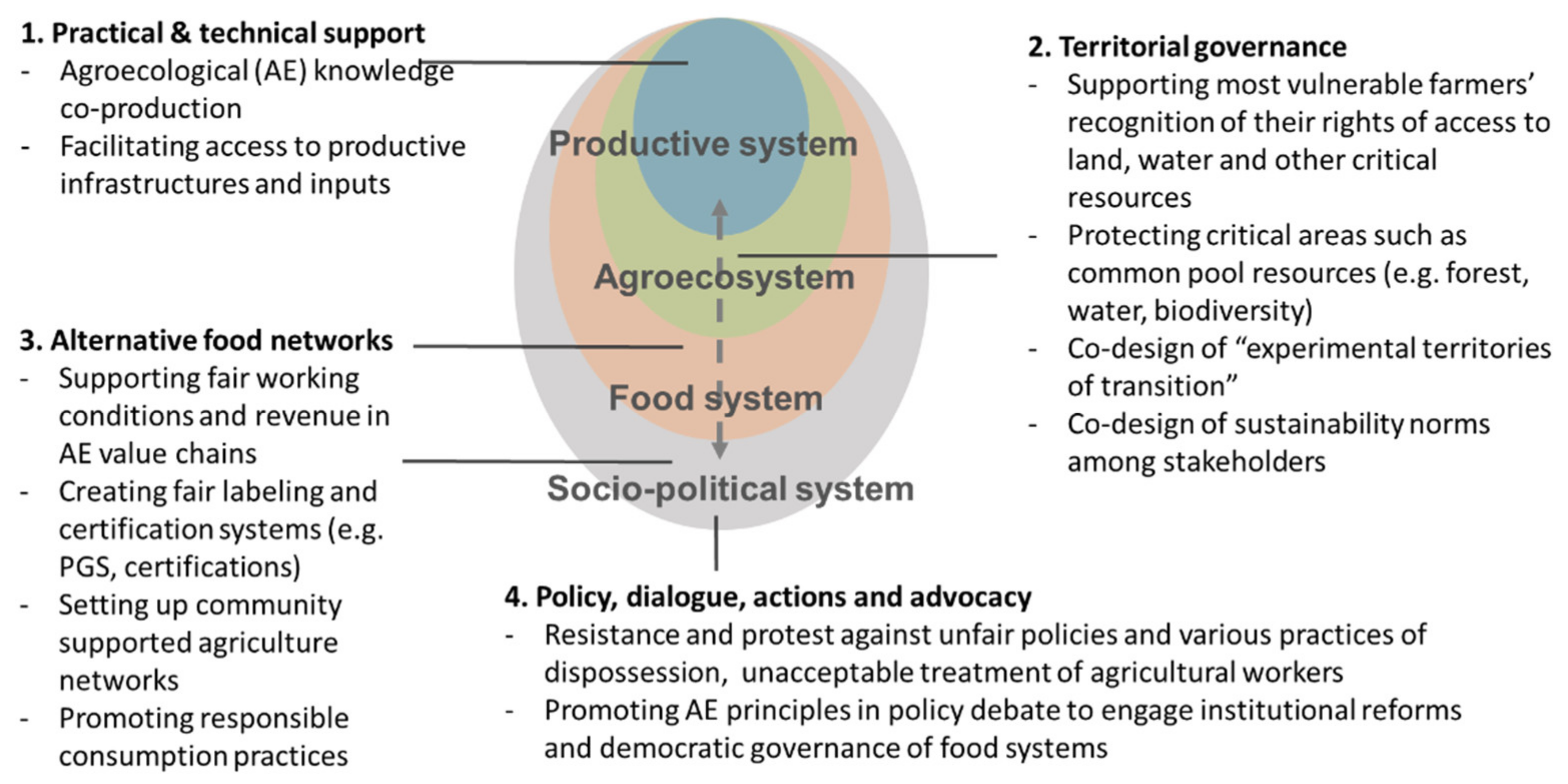

| Repertoires of Collective Action | Actors | Progress and Achievements in Senegal | Main Limitations and Challenges |
|---|---|---|---|
| 1. Practical and technical support | NGOs, research organizations, farmers’ organizations | Co-production and sharing of agroecological (AE) knowledge and techniques Promotion of agroecology by proving its practical efficacy Provision of inputs and infrastructure | Low rate of AE adoption and high rate of abandonment Lack of financial return on AE products Technical innovation limited to the plot and over-technicization of agroecology High work effort for farmers and “labor grabbing” by agribusiness Farmers becoming demonstrators of good farming practices rather than actors of sociopolitical change Contradictory policies, such as chemical inputs subsidies |
| 2. Territorial governance | NGOs, municipalities, research organizations, international cooperation, farmers’ organizations | Stakeholder dialogue to set up territorial governance mechanisms Municipality engagement in three pilot areas “experimental AE transition territories” Ecological restoration activities Land security program Participatory mapping, technical (GIS), and legal training of local animators among farmers | High cost of collective action processes Resistance of agribusiness and other industries Lack of clarity of tenure regime and governance institutions Limited administrative capacities at the municipal level Property-based governance regime Elite capture and lack of transparency Precariousness of landless workers, women, and migrants |
| 3. Alternative food networks | NGOs, consumer association, farmers’ organizations | Multiple cases of community-supported agriculture led by NGOs and private partners (Sell Sellal, Agrecol, Toubab Dialaw, Yoonu Suf) Set up participatory guarantee systems (ASD, BioSenegal, NatBi) Promotion of AE products in classical marketplaces (Dakar farmer’s market) | Too small of a niche market reserved for an elite consumer Lack of popular recognition for AE products Lack of consensus and conflict among labeling actors Poor monitoring instruments Domination of third-party cert. in the export industry Corporate interest in organic input industry |
| 4. Policy dialogue, actions, and advocacy | NGOs, national farmers’ organizations, municipalities, public actors, research organizations, IOs | Participation in national advocacy meetings and actions Setting up and connecting (inter)national platforms and networks (Dytaes, Tafae, 3AO, ROPPA) Proposing concrete action plans for AE transition Demonstration and protest against human rights abuse, dispossession Media diffusion (video clips, documentaries, short announcements, TV shows) | Domination of international actors and NGOs Weak participation of farmer organizations Political instrumentalization of agroecological discourse by the government Agroecology presented as a reforestation program (“PSE-Vert”) and sustainable intensification Subsidies to industrial organic fertilizers (input substitution industry) and conventionalization “Projectorate”: agrarian regime under the influence of externally funded programs (PATAE, FAO, etc.) |
Publisher’s Note: MDPI stays neutral with regard to jurisdictional claims in published maps and institutional affiliations. |
© 2021 by the authors. Licensee MDPI, Basel, Switzerland. This article is an open access article distributed under the terms and conditions of the Creative Commons Attribution (CC BY) license (https://creativecommons.org/licenses/by/4.0/).
Share and Cite
Bottazzi, P.; Boillat, S. Political Agroecology in Senegal: Historicity and Repertoires of Collective Actions of an Emerging Social Movement. Sustainability 2021, 13, 6352. https://doi.org/10.3390/su13116352
Bottazzi P, Boillat S. Political Agroecology in Senegal: Historicity and Repertoires of Collective Actions of an Emerging Social Movement. Sustainability. 2021; 13(11):6352. https://doi.org/10.3390/su13116352
Chicago/Turabian StyleBottazzi, Patrick, and Sébastien Boillat. 2021. "Political Agroecology in Senegal: Historicity and Repertoires of Collective Actions of an Emerging Social Movement" Sustainability 13, no. 11: 6352. https://doi.org/10.3390/su13116352
APA StyleBottazzi, P., & Boillat, S. (2021). Political Agroecology in Senegal: Historicity and Repertoires of Collective Actions of an Emerging Social Movement. Sustainability, 13(11), 6352. https://doi.org/10.3390/su13116352

