Article

Multilevel Annoyance Modelling of Short Environmental Sound Recordings

1
Grup de recerca en Tecnologies Mèdia, La Salle—URL, Quatre Camins, 30, 08022 Barcelona, Spain
2
Institute for Environmental Design and Engineering, The Bartlett, University College London (UCL), Central House, 14 Upper Woburn Place, London WC1H 0NN, UK
3
ISGlobal, Parc de Recerca Biomèdica de Barcelona (PRBB), Doctor Aiguader, 88, 08003 Barcelona, Spain
4
Universitat Pompeu Fabra (UPF), 08018 Barcelona, Spain
5
CIBER Epidemiología y Salud Pública (CIBERESP), 28029 Madrid, Spain
6
PHAGEX Research Group, Blanquerna School of Health Science, Universitat Ramon Llull, 08025 Barcelona, Spain
*
Author to whom correspondence should be addressed.
These authors contributed equally to this work and share the first author position.
Sustainability 2021, 13(11), 5779; https://doi.org/10.3390/su13115779
Submission received: 22 April 2021 / Revised: 14 May 2021 / Accepted: 17 May 2021 / Published: 21 May 2021
(This article belongs to the Special Issue Urban Noise Analysis and Management in Smart Cities)

Abstract

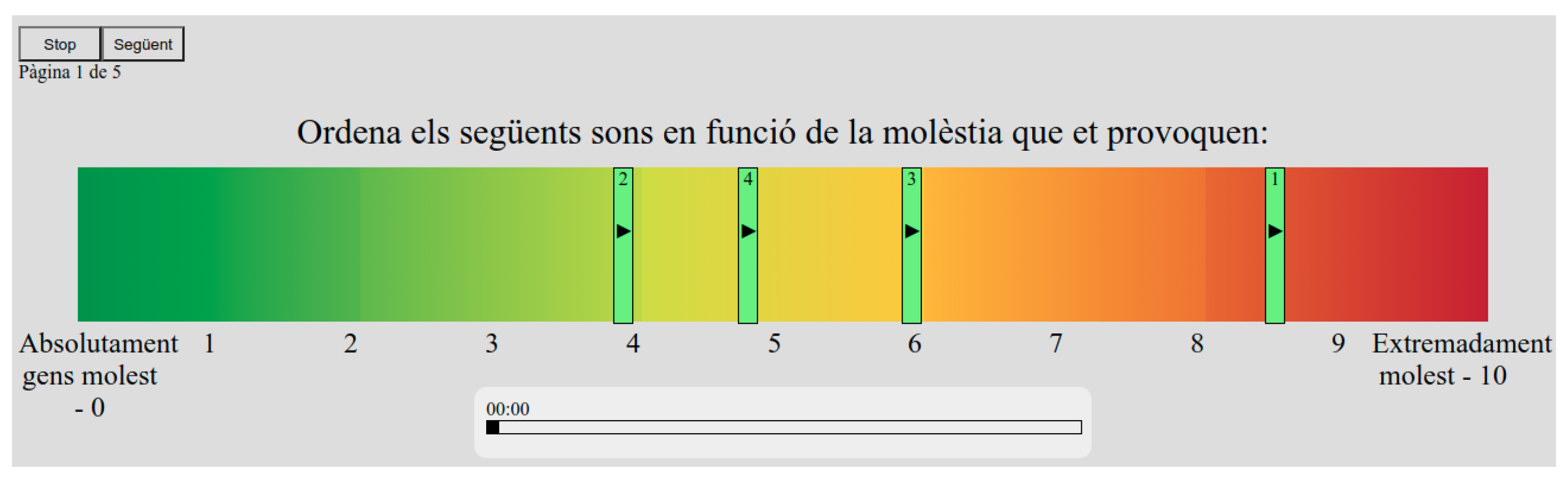
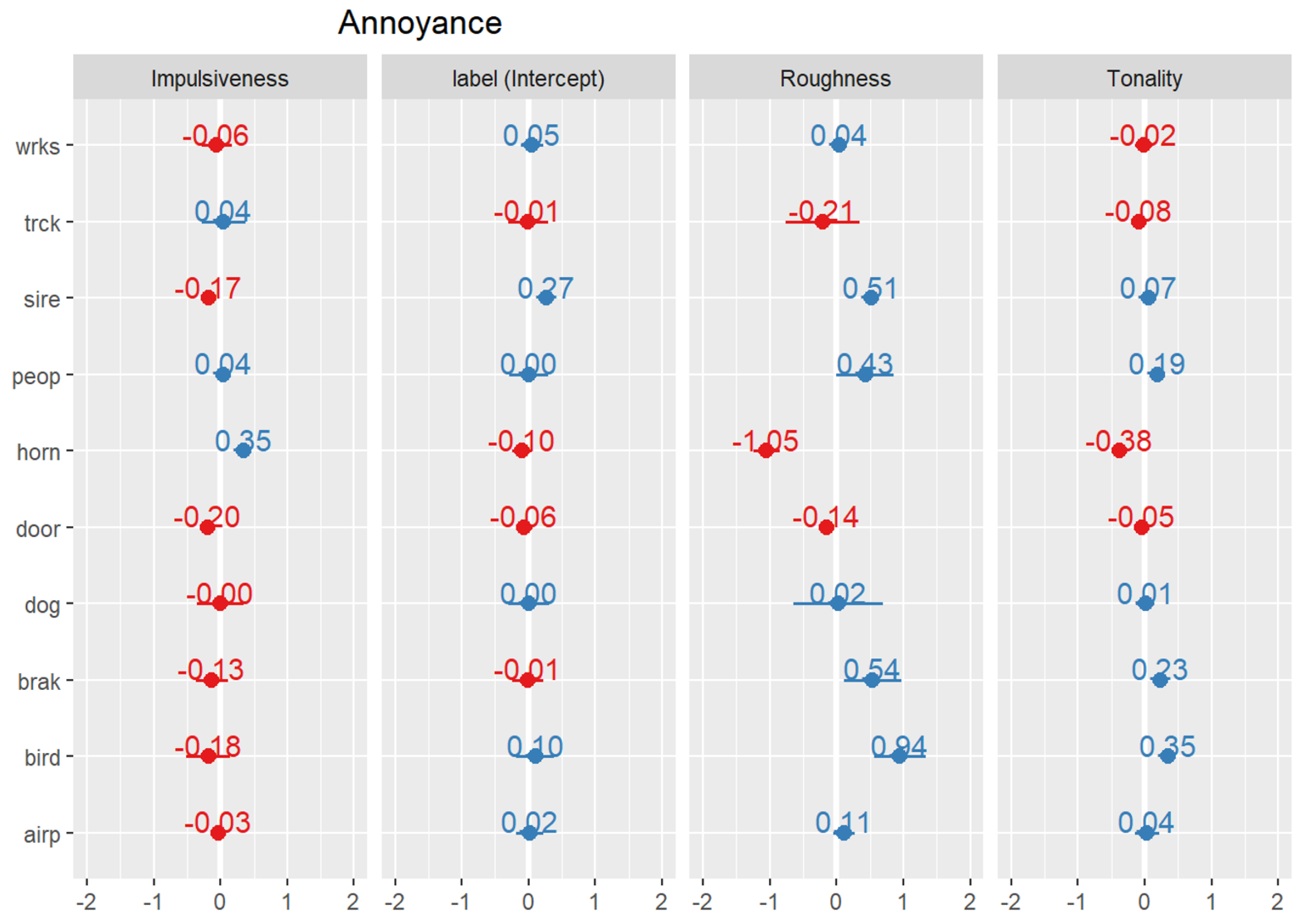
The recent development and deployment of Wireless Acoustic Sensor Networks (WASN) present new ways to address urban acoustic challenges in a smart city context. A focus on improving quality of life forms the core of smart-city design paradigms and cannot be limited to simply measuring objective environmental factors, but should also consider the perceptual, psychological and health impacts on citizens. This study therefore makes use of short (1–2.7 s) recordings sourced from a WASN in Milan which were grouped into various environmental sound source types and given an annoyance rating via an online survey with N=100 participants. A multilevel psychoacoustic model was found to achieve an overall R2=0.64 which incorporates Sharpness as a fixed effect regardless of the sound source type and Roughness, Impulsiveness and Tonality as random effects whose coefficients vary depending on the sound source. These results present a promising step toward implementing an on-sensor annoyance model which incorporates psychoacoustic features and sound source type, and is ultimately not dependent on sound level.
Keywords: noise; annoyance evaluation; citizen; perceptive test; smart-city; annoyance modelling; wireless acoustic sensor network noise; annoyance evaluation; citizen; perceptive test; smart-city; annoyance modelling; wireless acoustic sensor network