Article

Fostering Workplace Innovation through CSR and Authentic Leadership: Evidence from SME Sector
1
School of Management, Wuhan University of Technology, Wuhan 430000, China
2
International Exchange College, Hankou University, Wuhan 430212, China
3
Admission Unit, Hankou University, Wuhan 430212, China
4
Jiyang College of Zhejiang, A&F University, Zhuji 311800, China
5
School of Medicine, Wuhan University, Wuhan 430071, China
*
Authors to whom correspondence should be addressed.
Sustainability 2021, 13(10), 5388; https://doi.org/10.3390/su13105388
Submission received: 10 April 2021 / Revised: 28 April 2021 / Accepted: 30 April 2021 / Published: 12 May 2021
(This article belongs to the Special Issue Sustainable Corporate Social Responsibility Management and Innovation)

Abstract

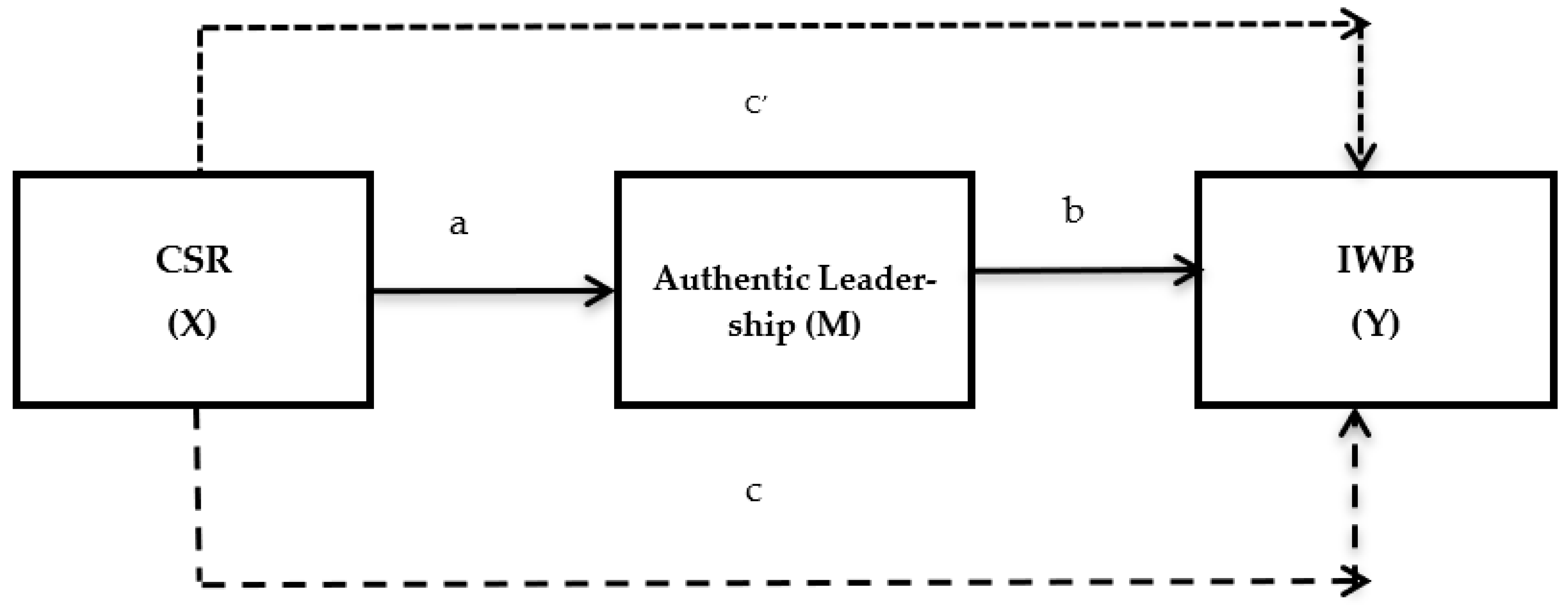
The cut-throat situation of competitiveness in almost every business sector, followed by globalization, shortened product life cycles, and rapid technological changes have raised the importance of innovation to overrun the rivals. Scholars have established that appropriate leadership style is a key enabler for organizational success. However, it is not clear in existing literature how the concept of authentic leadership is related to innovative work behavior (IWB). Likewise, the role of corporate social responsibility (CSR) to induce IWB is also vague in current literature. Thus, the basic purpose of the current study was to test the relationship of CSR and IWB with the mediating effect of authentic leadership. The proposed model was tested in the small and medium-sized enterprises (SMEs) sector of China. The data were collected through a questionnaire that was distributed among different respondents of the current survey. The data were obtained from a dyad of supervisor and subordinate serving in different SMEs in Wuhan city of China. The study used the structural equation modeling (SEM) technique to validate different hypotheses. The empirical results confirm that CSR positively relates to IWB while authentic leadership partially mediates this relationship. The findings of the current survey will be helpful for policymakers to recognize employees as a source of innovation through CSR and authentic leadership.
Keywords: corporate social responsibility; SME; authentic leadership; sustainability; innovative work behavior corporate social responsibility; SME; authentic leadership; sustainability; innovative work behavior