Article

Crop Pollination in Small-Scale Agriculture in Tanzania: Household Dependence, Awareness and Conservation


1
Faculty of Environmental Sciences and Natural Resource Management, Norwegian University of Life Sciences (NMBU), P.O.BOX 5003, NO-1432 Ås, Norway
2
Department of Landscape and Biodiversity, NIBIO—Norwegian Institute of Bioeconomy Research, P.O. Box. 115, 1431 Ås, Norway
3
Centre for Ecological and Evolutionary Synthesis (CEES), Department of Biosciences, University of Oslo, P.O. Box 1066, Blindern, 0316 Oslo, Norway
*
Author to whom correspondence should be addressed.
Sustainability 2020, 12(6), 2228; https://doi.org/10.3390/su12062228
Submission received: 8 February 2020 / Revised: 7 March 2020 / Accepted: 9 March 2020 / Published: 12 March 2020
(This article belongs to the Special Issue Biodiversity 2020: Agriculture, Environment and Wellbeing)

Abstract

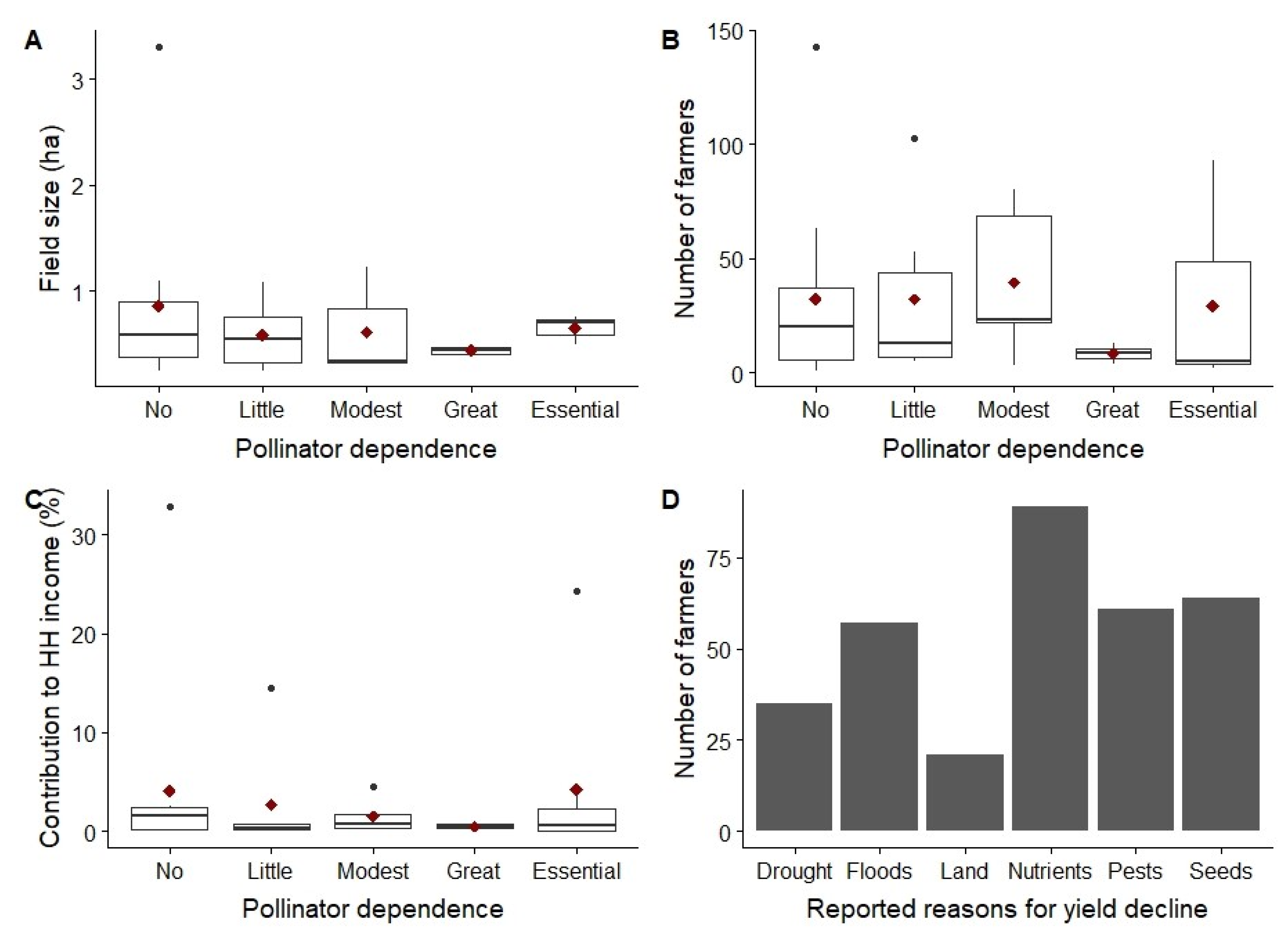
Global economic value of agriculture production resulting from animal pollination services has been estimated to be $235–$577 billion. This estimate is based on quantification of crops that are available at the global markets, and mainly originates from countries with precise information about quantities of agriculture production, exports, and imports. In contrast, knowledge about the contribution of pollinators to household food and income in small-scale farming at local and regional scales is still lacking, especially for developing countries where the availability of agricultural statistics is limited. Although the global decline in pollinator diversity and abundance has received much attention, relatively little effort has been directed towards understanding the role of pollinators in small-scale farming systems, which feed a substantial part of the world’s population. Here, we have assessed how local farmers in northern Tanzania depend on insect-pollinated crops for household food and income, and to what extent farmers are aware of the importance of insect pollinators and how they can conserve them. Our results show that local farmers in northern Tanzania derived their food and income from a wide range of crop plants, and that 67% of these crops depend on animal pollination to a moderate to essential degree. We also found that watermelon—for which pollination by insects is essential for yield—on average contributed nearly 25% of household income, and that watermelons were grown by 63% of the farmers. Our findings indicate that local farmers can increase their yields from animal pollinated crops by adopting more pollinator-friendly farming practices. Yet, we found that local farmers’ awareness of pollinators, and the ecosystem service they provide, was extremely low, and intentional actions to conserve or manage them were generally lacking. We therefore urge agriculture authorities in Tanzania to act to ensure that local farmers become aware of insect pollinators and their important role in agriculture production.
Keywords: ecosystem services; Small-scale farming; insect pollinators; pollinator conservation; agricultural intensification ecosystem services; Small-scale farming; insect pollinators; pollinator conservation; agricultural intensification