Article

Planning the Flows of Residual Biomass Produced by Wineries for the Preservation of the Rural Landscape

by
Canio Manniello
1,
Dina Statuto
1,*,
Andrea Di Pasquale
2,
Gerardo Giuratrabocchetti
3 and
Pietro Picuno
1
1
SAFE School of Agricultural, Forest, Food and Environmental Sciences, University of Basilicata via dell’Ateneo Lucano 10, 85100 Potenza, Italy
2
Innova Consorzio per l’Informatica e la Telematica srl, III Trav. G.B. Pirelli, snc Z.I. La Martella, 75100 Matera (MT), Italy
3
Cantine del Notaio soc. agr. ar. l., Via Roma 159, 85028 Rionero in Vulture (PZ), Italy
*
Author to whom correspondence should be addressed.
Sustainability 2020, 12(3), 847; https://doi.org/10.3390/su12030847
Submission received: 12 November 2019 / Revised: 10 January 2020 / Accepted: 20 January 2020 / Published: 23 January 2020
(This article belongs to the Special Issue Rural Landscape Analysis, Planning and Management)

Abstract

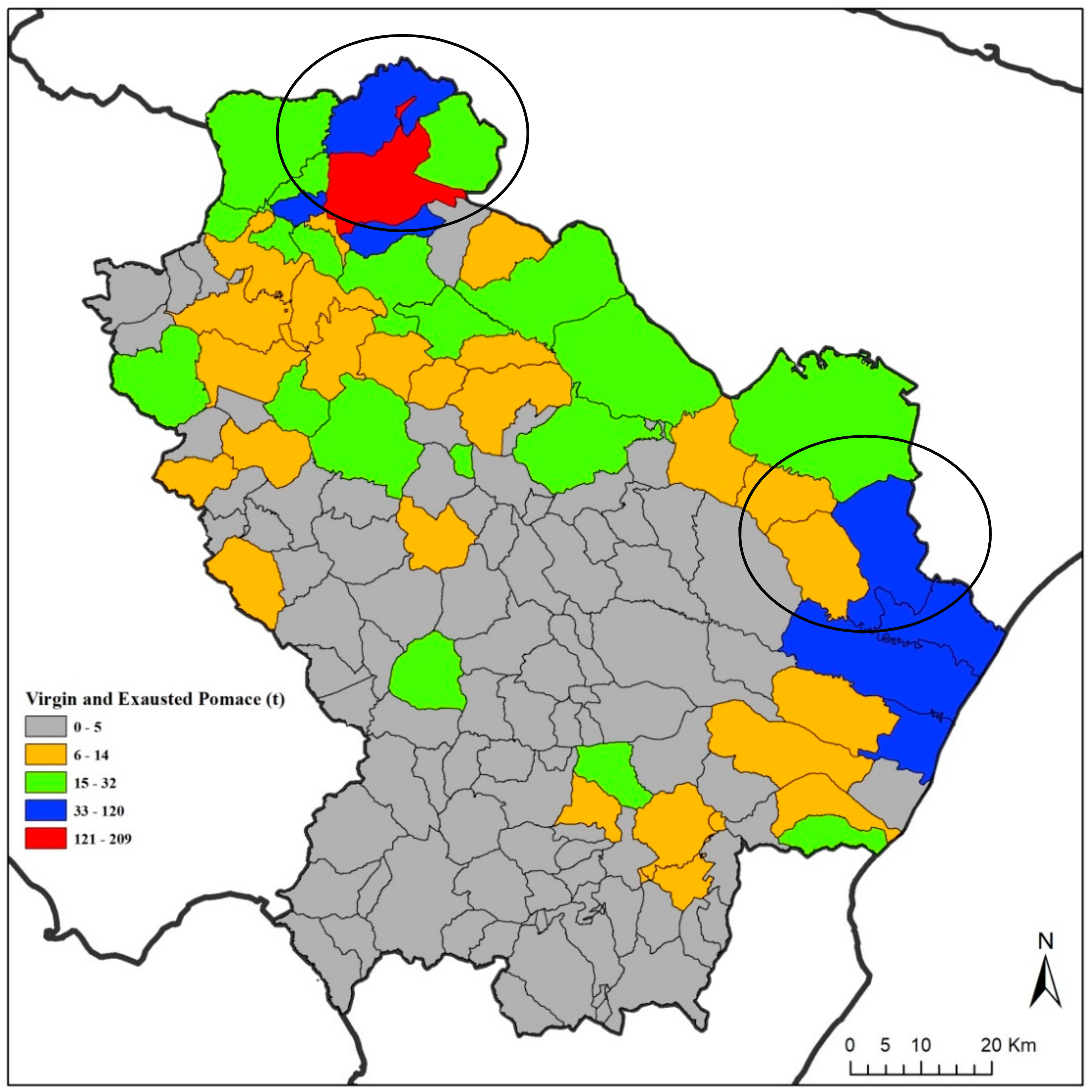
Circular economy aims to create a system that allows an optimal reuse of products and materials. According to an appropriate planning hierarchy, agricultural and agro-food co-products, by-products and wastes should be primarily employed to re-balance soil fertility, and afterwards valorized as new secondary raw materials used in the same agricultural sector or in different industrial chains (e.g., cosmetics, nutraceuticals, etc.). Finally, only at the end of this process, they could be conveyed to energy production through co-generation. In this paper, different residues generated by the wine production chain have been considered with reference to the Basilicata region (Southern Italy). These biomasses have been quantitatively assessed and qualitatively classified, in order to find the most rational and convenient solution for their valorization from a technical, economic and environmental point of view. From the spatial analysis—elaborated by implementing a Geographic Information System—some thematic maps have been obtained, which allow us to highlight the areas with the highest concentration of residues. In this way, focusing the analysis on these areas, some possible strategies for their management and valorization have been proposed, so as to restore soil fertility and contribute to the sustainable preservation of the rural landscape.
Keywords: rural landscape; agricultural biomass; winery pomace; Geographic Information System; soil organic matter; circular bioeconomy rural landscape; agricultural biomass; winery pomace; Geographic Information System; soil organic matter; circular bioeconomy