Article

New Express Delivery Service and Its Impact on CO2 Emissions


by
Dragan Lazarević
1,*,
Libor Švadlenka
2,
Valentina Radojičić
1 and
Momčilo Dobrodolac
1
1
Faculty of Transport and Traffic Engineering, University of Belgrade, 11000 Belgrade, Serbia
2
Jan Perner Transport Faculty, University of Pardubice, 532 10 Pardubice, Czech Republic
*
Author to whom correspondence should be addressed.
Sustainability 2020, 12(2), 456; https://doi.org/10.3390/su12020456
Submission received: 2 December 2019 / Revised: 23 December 2019 / Accepted: 6 January 2020 / Published: 7 January 2020

Abstract

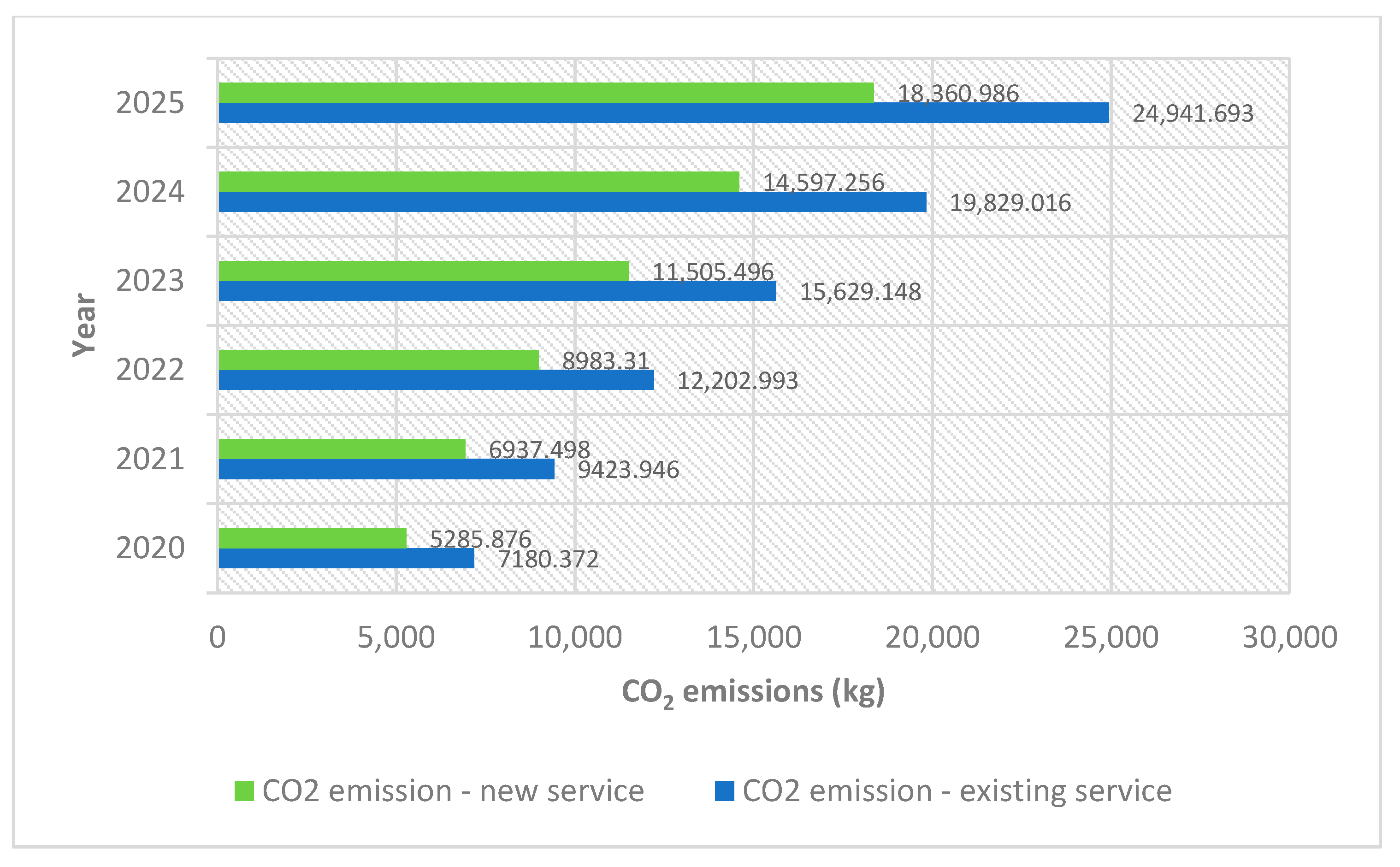
A rapid development of Internet technologies creates new opportunities for e-commerce, which is one of the fastest-growing segments of the entire economy. For policymakers, the most important aspects of e-commerce are related to the cost reduction in transportation, facilitation of administration and communication, innovations at the market level, and environmental issues. An unavoidable part of the e-commerce production process is related to the postal service. New market expectations of modern society lead to the consideration of upgrading the traditional express delivery service in terms of time availability. In this paper, we propose a new 24-h availability of postal and courier service so-called “post express nonstop”. To assess the potential demand for this kind of service, we propose a forecasting procedure based on the Bass diffusion model. In particular, the research is directed toward the examination of environmental issues, considering both types of services—traditional and the proposed new one. A comparison is done by analyzing CO2 emissions in the last-mile delivery of goods to the users’ addresses. The experiment was carried out in the city of Belgrade, simulating the last-mile delivery under realistic conditions and controlling the fuel consumption and CO2 emissions. In accordance with the results of this experiment and the forecasted number of postal items, a projection of CO2 emissions for the new service from 2020 to 2025 was carried out. The results show a significant contribution of the proposed new express delivery service to environmental well-being and sustainability.
Keywords: postal items forecasting; express delivery service; social change; time availability; fuel consumption; CO2 emissions postal items forecasting; express delivery service; social change; time availability; fuel consumption; CO2 emissions