

Sustainable Management Systems Standards (SMSS): Structures, Roles, and Practices in Corporate Sustainability

 ,
,  ,
, 
 ,
,  and
and
Abstract
1. Introduction
- Have the last standards’ editions reinforced the interconnection of the ISO MSS with sustainability management?
- After the transition process to current standards’ editions, did companies recognize the opportunity to integrate sustainability practices once they upgraded their IMS?
- What areas could be identified with more synergies and interactions between IMS and corporate sustainability?
- What are the primary methodologies and practices implemented in the IMS that most contribute to promoting the integration of sustainability in the business model?
2. Literature Review
2.1. Corporate Sustainability Management (CSM)
2.2. Management Systems Standards (MSS): Quality, Environment, and Safety
2.3. Sustainability Management and Integrated Management Systems (IMS)
3. Methodology
- represent different industry and services sectors;
- have at least two certifications managed as an Integrated System, namely, ISO 9001:2015, ISO 14001:2015, and OH&S such as OHSAS 18001:2007/NP 4397:2008/ISO 45001:2018;
- face sustainability as one of the business model’s pillars with some degree of acknowledgment in the industry;
- be conveniently geographically located, as data were intended to be collected based on the companies’ premises.
4. Case Studies
4.1. Company A
4.2. Company B
4.3. Company C
4.4. Company D
5. Analysis and Discussion of Results
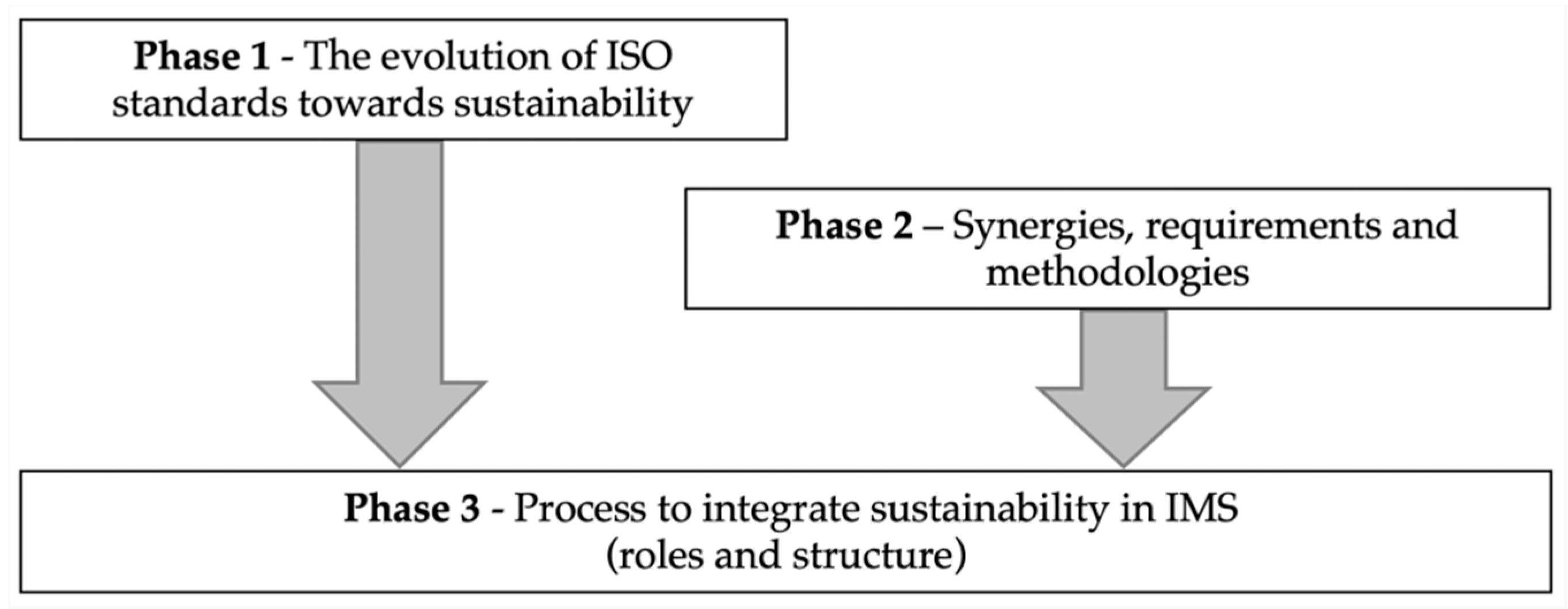
5.1. Phase 1 of Content Analysis—The Evolution of ISO Standards Towards Sustainability
- Have the last editions of ISO MSS reinforced the interconnection with sustainability management?
- After the transition to current editions, did companies recognize the opportunity to integrate sustainability practices once they upgraded their IMS?
5.2. Phase 2 of Content Analysis—Synergies and Practices
5.3. Phase 3 of Content Analysis—A Process to Integrate Sustainability in IMS (Structures and Roles)
- (I)
- Structures
- (II)
- Inputs and outputs
- (III)
- Roles
6. Conclusions
6.1. Theoretical Contributions and Practical Implications
6.2. Limitations and Future Research
Author Contributions
Funding
Acknowledgments
Conflicts of Interest
Appendix A

| PDCA Cycle | Requirements of Annex SL ISO | Company A: Practices/Methods | Company B: Practices/Methods | Company C: Practices/Methods | Company D: Practices/Methods |
|---|---|---|---|---|---|
| PLAN | 4—Context of the organization: 4.2 Understand the needs and expectations of interested parts | At the level of manager stakeholders, the IMS coordinator highlights the employees, the group, customers, suppliers, investors, legal institutions, as the more relevant stakeholders. The communication management with stakeholders is made in several ways. For example, daily meetings are held with suppliers, “(...) we want to involve the suppliers in our practices, they visit our facilities to participate in our production process for them to understand our problems and be involved” (EC01). | This company identifies the stakeholders, as well as their needs and expectations in the Balanced Scorecard. Communication with stakeholders is managed through meetings, newsletters, internal communications, intranet, external meetings, and through the representation of Company B in associations with other companies. | Stakeholders’ management has been improved with the ISO imposition, being done now in a more systematic way. The communication with stakeholders is managed in several ways: the company communicates systematically with all customers through a digital magazine containing the news, and the standards that should be met are delivered to suppliers. Within the scope of social responsibility, sessions are held every year with the local community to assess stakeholders’ relevance. The analysis of the organizational context is implemented through sessions with external people. The company opens once a year to let the community understand what Company C does, demonstrating that there is nothing to hide. Also, customers come to Company C every month. | Company D seeks to have a close relationship with the local authority to have the lowest impact on the population and reduce the quarry’s visual impact. Together, they promote social activity seeking to achieve well-being, social and economic development. It organizes two events annually, namely the week of open doors for the population, universities and schools, and the Children’s Day, where various activities are carried out. |
| 5—Leadership 5.1 Leadership and commitment 5.2 Policy | Definition of the Policy “The protection of natural resources and the prevention of environmental damage are the cornerstone of the mission and the business model”. The policies are available for consultation, “we have a kiosk with a computer where people can check, both in terms of safety, quality and the environment purpose” (EC01) | The interviewee states that sustainability is integrated into the vision. “Company B imagines a more efficient world with intelligent energies that promote sustainable mobility and encourage the progress of society”. Sustainability is one of Company B´s values: “build future mobility by focusing on innovative and environmentally friendly solutions, and we want to build a better world for future generations.” (EC03) | CSM is considered an important aspect integrated into the Company C business model and strategic management. It all starts with the certification in quality, environment and, more latter, to social responsibility, to encompass everything that surrounds the company. “The top management looks at these standards as a strategic management tool, which allows helping manage the company” (EC04) since the whole strategy involves quality, environment, research development, innovation, and social responsibility. The dissemination of the sustainability strategy, policies, and actions come from top management, considering aspects of social and environmental responsibility to prevent, mitigate, or minimize the negative impacts, promoting environmental protection. | Company D has as principles the prevention and minimization of environmental impacts and health and safety risks of its operations. Together with the education, training, and commitment of its employees and suppliers promote quality, environmental, health, safety, and social responsibility issues. | |
| 6—Planning 6.1 Actions to address risks and opportunities | Risk management is an important tool for the analysis of the organization’s impact. The employees now have more awareness. It is carried out in a process approach. SWOT analysis is carried out to identify risks, opportunities, weaknesses, and strengths. “Following the process approach to identify the risks and opportunities, we have all the environmental, and social factors there, then we define actions and we are mitigating the impacts.” (EC01) | This company also performs SWOT analysis, identifying strengths, weaknesses, opportunities, and threats, which is discussed at the start of each year. “We have a map, a document, where it is divided by tasks, by business units, and we manage the risk for each of these tasks” (EC03). The interviewee agrees that the risk management approach promotes concern about the impacts of the organization’s activity from a long-term perspective, and, therefore, concerns future generations. | The tool used to manage risk is the SWOT analysis in all processes. The SWOT analysis starts with strategic management and, consequently, each of the areas—Quality, Environment, and Social Responsibility—is responsible for carrying out the corresponding SWOT. Risk management is an important tool for the analyzing of the organization’s impact and was the most important and worthwhile tool. The risk management approach promotes concern about the impacts of the organization’s activity in a long-term perspective, and, therefore, concerns future generations. | Risk management was already carried out by Company D through SWOT analysis. But, the development of this management area with the introduction of this clause IMS allows the company to act more responsibly. The company believes that risk management is an important tool for the analysis of the company´s impacts. Besides, this approach promotes concern about the impacts of the organization’s activity in a long-term perspective, and, in this way, with concern for future generations. | |
| Do | 7—Support 7.3 Awareness | “The employees’ training starts on the first day in the factory. The design of the training includes the transmission of safety, environment, and quality goals. There is a welcoming manual, and we have different visual information available for consulting of the people”. (EC01) Company A is concerned with involving employees in the sustainable actions implemented. The employee involvement in IMS policies is promoted through a system for recognizing suggestions for improvements, and every month there are recognition meetings. “We have a daily communication system, meetings on the shop floor to let know if there was a quality alert if there was a safety alert or an environmental alert” (EC01). | Company B is concerned with involving employees in the sustainable actions implemented, namely in beach cleaning events, reconstruction of abandoned houses, among other actions. | The company demonstrated its concern to involve employees in the sustainable actions implemented. It also has projects in the social responsibility area through active collaboration with the outside community. “(...) for example, some social organizations that have problems, we built a team with the Company C employees to help with whatever is necessary” (EC04). Employee involvement with the IMS is high, and this is promoted through the disclosure of policies and indicators. | According to the interviewee, Company D is concerned with involving employees in sustainable actions through a policy of transparency towards them. |
| 8—Operation 8.1—Operational planning and control 8.3—Design and development of products and services (ISO 9001:2015) | The design products/process phase (internal or with suppliers), always involves a staff coming from the safety and environment areas to try to comply with legal requirements. | Company B had to design its life cycle and subsequently analyze it for each product or service. | In the product design and development phase, Company C has two main concerns, environmental and quality. When implementing a new raw material in the design, Company C is concerned with environmental and social responsibility impacts. All waste of production is reused. “We are at that stage where we almost need to break material to incorporate it since we have already reused 100% Waste” (EC04). The company trains its customers in renovation context, encouraging them to reuse the broken pieces, giving specific indications of what can be done with them to prevent placing them in landfills. | In the development of new products, environmental awareness and social concerns are elements present in the projects, trying to meet the customer’s needs and the contribution of the lowest ecological footprint. Besides, the product life cycle is also considered at this stage. | |
| CHECK | 9—Performance Evaluation 9.1 Monitoring, measurement, analysis and evaluation | In terms of results, the quality manager affirms that the company has set goals that are broken down into indicators: quality, social, and environmental. | Company B uses the Balanced Scorecard, in which it has defined indicators and goals. The IMS also has a departmental BSC with safety, quality, and environment indicators. In the management review, the sustainability strategy and the results achieved are always analyzed and discussed. | The strategic group meets every three months to check if the objectives are being achieved. The information resulting from the IMS review is transmitted to all departments, communicating the information to employees in each area. | At Company D, the objectives are set yearly considering each of the standards—quality, environment and safety, and monitoring monthly. In the environmental dimension, this company has developed efficient techniques to control emissions into the atmosphere to guarantee legal compliance and a reduced impact. In the social vector, Company D streamlines and helps the local community, for example, through campaigns to collect caps for the pediatric hospital and participation in actions to support firefighters |
| ACT | 10—Improvement 10.3 Continual Improvement | At the innovation level, the company has been investing in robotic systems to promote risk reduction. “Whenever some opportunity is detected, we proceed with viability study to implement innovative situations” (EC01) | The improvement actions promoted by IMS integrate actions that promote sustainable development. “We have an innovation department which requests transversal ideas for the three areas (QES), promote the competition, and the three best ideas win a prize and are implemented.” (EC03) The actions that B Energy develops in the area of sustainability include, for example, making gas stations more suitable for cyclists, installing large washing machines. The Bio section started with the net collection of used oils, which were incorporated into the biodiesel production. | The company has been invested in eco-innovation in the construction sector to contribute to a sustainable future, which means considering environmental protection, energy efficiency, preservation of health and well-being, and greater architectural integration. Company C had two projects to reduce water consumption: purchased equipment to dry rectification, i.e., do not use water on the product rectification stage, “This project is in a very advanced phase, and it aims at eliminating the water in this process. In other words, all this is sustainability; we are thinking about it” (EC04). The improvement actions promoted through the Company C IMS integrate actions that promote sustainable development, namely reducing the number of pallets. The packaging used is recycled and promotes the reduction of plastics. | The continual improvement promoted through the Company D IMS encompasses actions that promote sustainable development, namely a water management program. |
References
- Sroufe, R. Integration and organizational change towards sustainability. J. Clean. Prod. 2017, 162, 315–329. [Google Scholar] [CrossRef] [Scilit]
- Blackburn, W.R. The Sustainability Handbook. The Complete Management Guide to Achieving Social, Economic And Environmental Responsability; Earthsca: London, UK; New York, NY, USA, 2007. [Google Scholar]
- Gianni, M.; Gotzamani, K.; Tsiotras, G. Multiple perspectives on integrated management systems and corporate sustainability performance. J. Clean. Prod. 2017, 168, 1297–1311. [Google Scholar] [CrossRef] [Scilit]
- Mustapha, M.A.; Manan, Z.A.; Wan Alwi, S.R. Sustainable Green Management System (SGMS)—An integrated approach towards organisational sustainability. J. Clean. Prod. 2017, 146, 158–172. [Google Scholar] [CrossRef] [Scilit]
- Vázquez, P.; Del Río, J.A.; Cedano, K.G.; Martínez, M.; Jensen, H.J. An Entangled Model for Sustainability Indicators. PLoS ONE 2015, 10, e0135250. [Google Scholar] [CrossRef] [Scilit]
- Menezes, J.R. Referenciais para a gestão da cadeia de abastecimento sustentável [Standards for sustained supply chain management]. In Logística e Gestão da Cadeia de Abastecimento [Logistics and Supply chain management]; Carvalho, J., Ed.; Edições Sílabo: Lisboa, Portugal, 2010. [Google Scholar]
- Kennedy, S.; Whiteman, G.; van den Ende, J. Radical Innovation for Sustainability: The Power of Strategy and Open Innovation. Long Range Plann. 2017, 50, 712–725. [Google Scholar] [CrossRef] [Scilit]
- Ranängen, H. Stakeholder management in reality: Moving from conceptual frameworks to operational strategies and interactions. Sustain. Prod. Consum. 2015, 3, 21–33. [Google Scholar] [CrossRef] [Scilit]
- IPQ. ISO 9001:2015, Quality Management Systems — Requirements; ISO: Geneva, Switzerland, 2015. [Google Scholar]
- IPQ. ISO 14001:2015, Environmental Management Systems—Requirements with Guidance for Use; ISO: Geneva, Switzerland, 2015. [Google Scholar]
- IPQ. ISO 45001:2018, Occupational Health and Safety Management Systems—Requirements with Guidance for Use; ISO: Geneva, Switzerland, 2018. [Google Scholar]
- IPQ. ISO 50001:2018, Energy Management Systems—Requirements with Guidance for Use; ISO: Geneva, Switzerland, 2018. [Google Scholar]
- IPQ. ISO 22000:2018, Food Safety Management Systems—Requirements for Any Organization in the Food Chain; ISO: Geneva, Switzerland, 2018. [Google Scholar]
- IPQ. ISO/IEC 27001:2013, Information Technology—Security Techniques—Information Security Management Systems—Requirements; ISO: Geneva, Switzerland, 2013. [Google Scholar]
- IPQ. ISO/IEC 20000-1:2018, Information Technology—Service Management—Part 1: Service Management System Requirements; ISO: Geneva, Switzerland, 2018. [Google Scholar]
- IPQ. NP 4457:2007, Gestão da Investigação, Desenvolvimento e Inovação (IDI); Requisitos do Sistema de Gestão da IDI [Management of Research, Development and Innovation (RDI)—Management System Requirements of RDI]; IPQ: Caparica, Portugal, 2007. [Google Scholar]
- Darnall, N.; Jolley, G.J.; Handfield, R. Environmental management systems and green supply chain management: Complements for sustainability? Bus. Strateg. Environ. 2008, 17, 30–45. [Google Scholar] [CrossRef] [Scilit]
- Bernardo, M.; Gianni, M.; Gotzamani, K.; Simon, A. Is there a common pattern to integrate multiple management systems? A comparative analysis between organizations in Greece and Spain. J. Clean. Prod. 2017, 151, 121–133. [Google Scholar] [CrossRef] [Scilit]
- Savino, M.M.; Batbaatar, E. Investigating the resources for Integrated Management Systems within resource-based and contingency perspective in manufacturing firms. J. Clean. Prod. 2015, 104, 392–402. [Google Scholar] [CrossRef] [Scilit]
- Siva, V.; Gremyr, I.; Bergquist, B.; Garvare, R.; Zobel, T.; Isaksson, R. The support of quality management to sustainable development: A literature review. J. Clean. Prod. 2016, 138, 148–157. [Google Scholar] [CrossRef] [Scilit]
- Rebelo, M.F.; Silva, R.; Santos, G.; Mendes, P. Model based integration of management systems (MSs)-case study. TQM J. 2016, 28, 907–932. [Google Scholar] [CrossRef] [Scilit]
- Fresner, J.; Engelhardt, G. Experiences with integrated management systems for two small companies in Austria. J. Clean. Prod. 2004, 12, 623–631. [Google Scholar] [CrossRef] [Scilit]
- Oskarsson, K.; von Malmborg, F. Integrated management systems as a corporate response to sustainable development. Corp. Soc. Responsib. Environ. Manag. 2005, 12, 121–128. [Google Scholar] [CrossRef] [Scilit]
- Rocha, M.; Searcy, C.; Karapetrovic, S. Integrating Sustainable Development into Existing Management Systems. Total Qual. Manag. Bus. Excell. 2007, 18, 83–92. [Google Scholar] [CrossRef] [Scilit]
- Nunhes, T.; Motta, L.; Oliveira, O. Evolution of integrated management systems research on the Journal of Cleaner Production: Identification of contributions and gaps in the literature. J. Clean. Prod. 2016, 139, 1234–1244. [Google Scholar] [CrossRef] [Scilit]
- Nunhes, T.V.; Oliveira, O.J. Analysis of integrated management systems research: Identifying core themes and trends for future studies. Total Qual. Manag. Bus. Excell. 2018. [Google Scholar] [CrossRef] [Scilit]
- Beckmerhagen, I.A.; Berg, H.P.; Karapetrovic, S.V.; Willborn, W.O. Integration of management systems: Focus on safety in the nuclear industry. Int. J. Qual. Reliab. Manag. 2003, 20, 210–228. [Google Scholar] [CrossRef] [Scilit]
- Hernandez-Vivanco, A.; Bernardo, M.; Cruz-Cázares, C. Sustainable innovation through management systems integration. J. Clean. Prod. 2018, 196, 1176–1187. [Google Scholar] [CrossRef] [Scilit]
- World Commission on Environment and Development. Our Common Future; Oxford University Press: Oxford, UK, 1987. [Google Scholar]
- Govindan, K.; Khodaverdi, R.; Jafarian, A. A fuzzy multi criteria approach for measuring sustainability performance of a supplier based on triple bottom line approach. J. Clean. Prod. 2013, 47, 345–354. [Google Scholar] [CrossRef] [Scilit]
- Baumgartner, R.J.; Rauter, R. Strategic perspectives of corporate sustainability management to develop a sustainable organization. J. Clean. Prod. 2017, 140, 81–92. [Google Scholar] [CrossRef] [Scilit]
- Elkington, J. Partnerships fromcannibals with forks: The triple bottom line of 21st-century business. Environ. Qual. Manag. 1998, 8, 37–51. [Google Scholar] [CrossRef] [Scilit]
- Elkington, J. Cannibals with Forks—The Triple Bottom Line of the 21st Century; Capstone Publishing Lts.: Oxford, UK, 1997. [Google Scholar]
- Dyllick, T.; Hockerts, K. Beyond the business case for corporate sustainability. Bus. Strateg. Environ. 2002, 11, 130–141. [Google Scholar] [CrossRef] [Scilit]
- Lozano, R.; Carpenter, A.; Huisingh, D. A review of ‘theories of the firm’ and their contributions to Corporate Sustainability. J. Clean. Prod. 2015, 106, 430–442. [Google Scholar] [CrossRef] [Scilit]
- Searcy, C. Corporate Sustainability Performance Measurement Systems: A Review and Research Agenda. J. Bus. Ethics 2012, 107, 239–253. [Google Scholar] [CrossRef] [Scilit]
- Asif, M.; Searcy, C. Towards a standardised management system for corporate sustainable development. TQM J. 2014, 26, 411–430. [Google Scholar] [CrossRef] [Scilit]
- Bhanot, N.; Rao, P.V.; Deshmukh, S.G. An integrated approach for analysing the enablers and barriers of sustainable manufacturing. J. Clean. Prod. 2017, 142, 4412–4439. [Google Scholar] [CrossRef] [Scilit]
- Silva, C.S.; Gouveia, J.B. International Management Conference. In Proceedings of the A Implementação da Sustentabilidade na Gestão das Organizações: Análise de Relatórios de Sustentabilidade [Sustainability Implementation in Organisations Management: Sustainability Reports Analysis], Aveiro, Portugal, 26 June 2015; pp. 45–54. [Google Scholar]
- Zeng, S.X.; Shi, J.J.; Lou, G.X. A synergetic model for implementing an integrated management system: An empirical study in China. J. Clean. Prod. 2007, 15, 1760–1767. [Google Scholar] [CrossRef] [Scilit]
- BSI. OHSAS 18001—Occupational Health and Safety Management; BSI: London, UK, 2007. [Google Scholar]
- IPQ. NP 4397:2008 Sistemas de gestão da segurança e saúde do trabalho—Requisitos [Occupational health and safety management systems—Requirements]; IPQ: Caparica, Portugal, 2008. [Google Scholar]
- IPAC Base de Dados Nacional—Sistemas de Gestão Certificados [National Database—Certified management systems]. Available online: http://www.ipac.pt/pesquisa/pesq_empcertif.asp (accessed on 27 June 2020).
- Santos, G.; Almeida, L.M.; Ramos, D.G.; Carvalho, F.J.; de Sá, J.C.; Baptista, J.S.; Carnide, M. Sistemas Integrados de Gestão—Qualidade, Ambiente e Eegurança [Integrated Management Systems—Quality, Environment, Safety], 3rd ed.; Publindústria: Porto, Portugal, 2018. [Google Scholar]
- Fernandes, A.C.; Sampaio, P.; Sameiro, M.; Truong, H.Q. Supply chain management and quality management integration: A conceptual model proposal. Int. J. Qual. Reliab. Manag. 2017, 34, 53–67. [Google Scholar] [CrossRef] [Scilit]
- Borella, I.L.; de Carvalho Borella, M.R. Environmental Impact and Sustainable Development: An Analysis in the Context of Standards ISO 9001, ISO 14001, and OHSAS 18001. Environ. Qual. Manag. 2016, 25, 67–83. [Google Scholar] [CrossRef] [Scilit]
- Saqid, N. OHSAS 18001 Step by Step: A Practical Guide; IT Governance Publishing: Ely, UK, 2012. [Google Scholar]
- IPQ. NP EN ISO 9004 Gestão da Qualidade Qualidade de uma Organização Linhas de Orientação para Atingir o Sucesso Sustentado [ISO 9004:2018 Quality Management—Quality of an Organization—Guidance To Achieve Sustained Success]; IPQ: Caparica, Portugal, 2019. [Google Scholar]
- ISO 9001:2008—Quality Management Systems—Requirements. Available online: https://www.iso.org/standard/46486.html (accessed on 18 July 2020).
- Fonseca, L. From quality gurus and TQM to ISO 9001:2015: A review of several quality paths. Int. J. Qual. Res. 2015, 9, 167–180. [Google Scholar]
- Rebelo, M.F.; Santos, G.; Silva, R. Integration of management systems: Towards a sustained success and development of organizations. J. Clean. Prod. 2016, 127, 96–111. [Google Scholar] [CrossRef] [Scilit]
- Poltronieri, C.F.; Gerolamo, M.C.; Dias, T.C.M.; Carpinetti, L.C.R. Instrument for evaluating IMS and sustainable performance. Int. J. Qual. Reliab. Manag. 2018, 35, 373–386. [Google Scholar] [CrossRef] [Scilit]
- Asif, M.; Searcy, C.; Zutshi, A.; Fisscher, O.A.M. An integrated management systems approach to corporate social responsibility. J. Clean. Prod. 2013, 56, 7–17. [Google Scholar] [CrossRef] [Scilit]
- Nawaz, W.; Koç, M. Development of a systematic framework for sustainability management of organizations. J. Clean. Prod. 2018, 171, 1255–1274. [Google Scholar] [CrossRef] [Scilit]
- Nunhes, T.V.; Motta Barbosa, L.C.F.; de Oliveira, O.J. Identification and analysis of the elements and functions integrable in integrated management systems. J. Clean. Prod. 2017, 142, 3225–3235. [Google Scholar] [CrossRef] [Scilit]
- Souza, J.; Silva, M.; Alves, J. Corporate Sustainability Management System View project Design e Educação View project Quality Improvement in the Aerospace Industry: Investigation of the Main Characteristics. Int. Rev. Mech. Eng. 2014, 8. [Google Scholar] [CrossRef] [Scilit]
- Souza, J.P.E.; Alves, J.M. Lean-integrated management system: A model for sustainability improvement. J. Clean. Prod. 2018, 172, 2667–2682. [Google Scholar] [CrossRef] [Scilit]
- Mesquida, A.L.; Mas, A. Integrating IT service management requirements into the organizational management system. Comput. Stand. Interfaces 2015, 37, 80–91. [Google Scholar] [CrossRef] [Scilit]
- Yin, R.K. Estudo de Caso: Planejamento e Métodos [Case Study Research]; Bookman: Porto Alegre, Brazil, 2015. [Google Scholar]
- Flick, U. Doing Triangulation and Mixed Methods; SAGE Publications Ltd.: London, UK, 2020. [Google Scholar]
- Strauss, A.L.; Corbin, J.M. Basics of Qualitative Research: Grounded Theory Procedures and Techniques; SAGE: London, UK, 1990. [Google Scholar]
- Bogdan, R.C.; Biklen, S.K. Investigação Qualitativa em Educação-Uma Introdução à Teoria e aos Métodos [Qualitative Research for Education—An Introduction to Theories and Methods]; Porto Editora: Porto, Portugal, 2013; ISBN 978-972-0-34112-9. [Google Scholar]
- Bastas, A.; Liyanage, K. Integrated quality and supply chain management business diagnostics for organizational sustainability improvement. Sustain. Prod. Consum. 2019, 17, 11–30. [Google Scholar] [CrossRef] [Scilit]
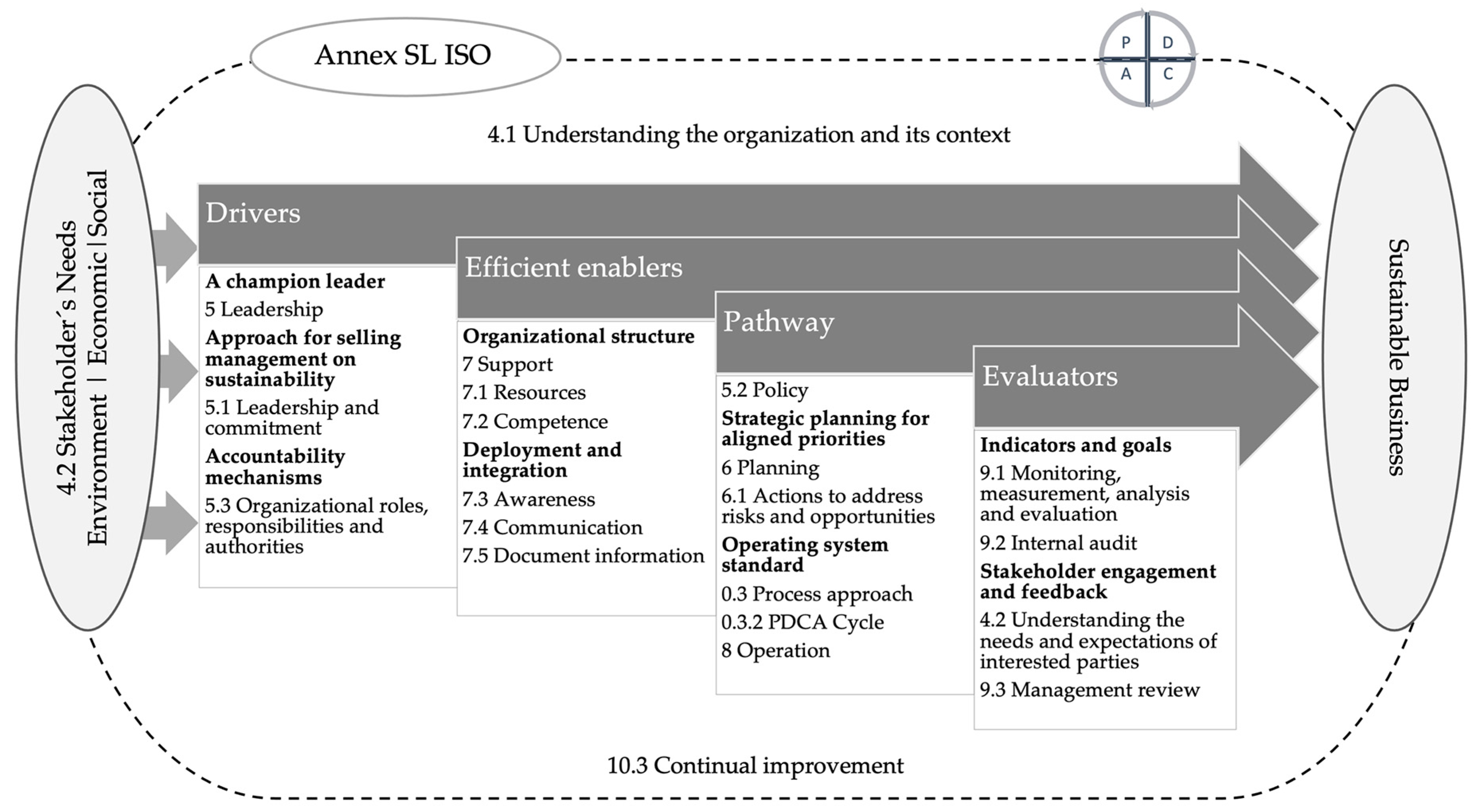
| Drivers | Efficient Enablers | Pathway | Evaluators |
|---|---|---|---|
| A Champion/Leader | Organizational structure | Vision, values, and policy | Indicators and goals |
| Approach for selling management on sustainability | Deployment and integration | Operating system standard | Measuring and reporting progress |
| Accountability mechanisms | Strategic planning for aligned priorities | Stakeholder engagement and feedback |
| Certification | Management System | 2016 | 2017 | 2018 | 2019 |
|---|---|---|---|---|---|
| ISO 9001 | Quality | 5589 | 5837 | 5743 | 5827 |
| ISO 14001 | Environmental | 1123 | 1174 | 1174 | 1202 |
| ISO 45001 | Health and safety | 561 | 734 | 674 | 645 |
| OHSAS 18001 | |||||
| NP 4397 | |||||
| ISO 22000 | Food Safety | 295 | 298 | 296 | 294 |
| ISO 50001 | Energy | 0 | 27 | 31 | 30 |
| ISO/IEC 27001 | Information technology | 35 | 46 | 63 | 87 |
| ISO/IEC 20000-1 | Information | 0 | 10 | 11 | 6 |
| NP 4457 | Innovation | 170 | 164 | 161 | 157 |
| Structure of ISO 9001:2008 | Structure of ISO 9001:2015—Annex SL | Key Changes |
|---|---|---|
| 1—Scope 4—Quality management system | 4—Context of the organization | Organizations must analyze both internal and external context (new clause) |
| Stakeholders management must be determined (new clause) | ||
| Includes risk management (new clause) | ||
| Fit this information with the Management System scope | ||
| 5—Management responsibility | 5—Leadership | The concept “Management” was replaced by “Leadership” |
| Enhanced leadership for the involvement and commitment to the MSS | ||
| 5.4.2 Quality management system planning 8.5.3 Preventive Action | 6—Planning | Plan to manage the risk and opportunities (new clause). Risks and opportunities have replaced preventive action |
| Link risk management to processes management approach | ||
| Focus on results—strategic plan to achieve the management system goals, monitoring, and communication of results | ||
| 6—Resource management 5.5.3 Internal communication | 7—Support | Human resources management based on transparency, ethics, and being socially responsible |
| Add the organizational knowledge management (new clause) | ||
| Enhanced communication requirement | ||
| 7—Product realization | 8—Operation | Emphasize its applicability to services |
| Enhance change management (new clause). Involvement of customers and users in the design and development process. | ||
| 8—Measurement, analysis, and improvement | 9—Performance evaluation | Integrate the new information that comes up from context changes, stakeholders’ management, and risk management. |
| 8.5 Improvement | 10—Improvement | Take into account the future stakeholders’ expectations and context changes as input for improvements |
| Add innovation as an improvement mechanism |
| Interviewed Companies’ Codes | Job Position | Date | Duration (min) | Companies |
|---|---|---|---|---|
| EC01 | Engineer and Quality Manager | 30-05-2019 | 75 | Company A |
| EC02 | Coordinator for IMS QES | 30-05-2019 | 75 | |
| EC03 | Responsible for IMS QES | 31-05-2019 | 90 | Company B |
| EC04 | Coordinator for IMS QES | 10-07-2019 | 120 | Company C |
| EC05 | Optimization Manager | 22-07-2019 | 120 | Company D |
| Requirements | Key Elements | Studies |
|---|---|---|
| 1—Scope (IMS) | Triple Bottom Line | Elkington [32] |
| Quality (ISO 9001:2015) | ||
| Environmental (ISO 14001:2015) | ||
| Occupational Health and Safety (ISO 45001:2018) | ||
| 4.1—Understanding the organization and its context | Systematic, holistic, and open perspective | Dyllick & Hockerts [34]; Lozano et al. [35] |
| 4.2—Understanding the needs and expectations of interested parties | Stakeholder-oriented | Elkington [32]; Dyllick [34] |
| 5—Leadership | Follow a sustainable strategy feeding a culture guided by economic, environmental, and social results. | Silva & Gouveia [39] |
| 6—Planning | Future/long-term perspective | UN [29]; Silva & Gouveia [39] |
| 6.1—Actions to address risks and opportunities | Risk-based thinking | Silva & Gouveia [39] |
| 7.3—Awareness | Transparency and involvement | Elkington [32]; |
| 7.4—Communication | Cyclical systematic process—Communication | Silva & Gouveia [39] |
| 8—Operation | Sustainable production | Asif & Searcy [37]; Bhanot et al. [38]; Silva & Gouveia [39] |
| 9—Performance evaluation | Systematic cyclical process—Monitoring | Silva & Gouveia [39] |
| 10—Improvement | Systematic cyclical process | Silva & Gouveia [39] |
© 2020 by the authors. Licensee MDPI, Basel, Switzerland. This article is an open access article distributed under the terms and conditions of the Creative Commons Attribution (CC BY) license (http://creativecommons.org/licenses/by/4.0/).
Share and Cite
Silva, C.; Magano, J.; Moskalenko, A.; Nogueira, T.; Dinis, M.A.P.; Pedrosa e Sousa, H.F. Sustainable Management Systems Standards (SMSS): Structures, Roles, and Practices in Corporate Sustainability. Sustainability 2020, 12, 5892. https://doi.org/10.3390/su12155892
Silva C, Magano J, Moskalenko A, Nogueira T, Dinis MAP, Pedrosa e Sousa HF. Sustainable Management Systems Standards (SMSS): Structures, Roles, and Practices in Corporate Sustainability. Sustainability. 2020; 12(15):5892. https://doi.org/10.3390/su12155892
Chicago/Turabian StyleSilva, Cláudia, José Magano, Anna Moskalenko, Teresa Nogueira, Maria Alzira Pimenta Dinis, and Hélder Fernando Pedrosa e Sousa. 2020. "Sustainable Management Systems Standards (SMSS): Structures, Roles, and Practices in Corporate Sustainability" Sustainability 12, no. 15: 5892. https://doi.org/10.3390/su12155892
APA StyleSilva, C., Magano, J., Moskalenko, A., Nogueira, T., Dinis, M. A. P., & Pedrosa e Sousa, H. F. (2020). Sustainable Management Systems Standards (SMSS): Structures, Roles, and Practices in Corporate Sustainability. Sustainability, 12(15), 5892. https://doi.org/10.3390/su12155892

