Next Article in Journal
Subjective Well-Being and Psychosocial Adjustment: Examining the Effects of an Intervention Based on the Sport Education Model on Children
Next Article in Special Issue
Integrating a Cross-Reference List and Customer Journey Map to Improve Industrial Design Teaching and Learning in “Project-Oriented Design Based Learning”
Previous Article in Journal
University as Change Manager of Attitudes towards Environment (The Importance of Environmental Education)
Previous Article in Special Issue
Teaching towards Design-Based Learning in Manufacturing Technology Course: Sino–Australia Joint Undergraduate Program
Article

Student Perceptions of Formative Assessment and Cooperative Work on a Technical Engineering Course


1
Department of Civil Engineering, University of Burgos, 09001 Burgos, Spain
2
Department of Construction, University of Burgos, 09001 Burgos, Spain
*
Author to whom correspondence should be addressed.
Sustainability 2020, 12(11), 4569; https://doi.org/10.3390/su12114569
Received: 8 May 2020 / Revised: 31 May 2020 / Accepted: 1 June 2020 / Published: 3 June 2020
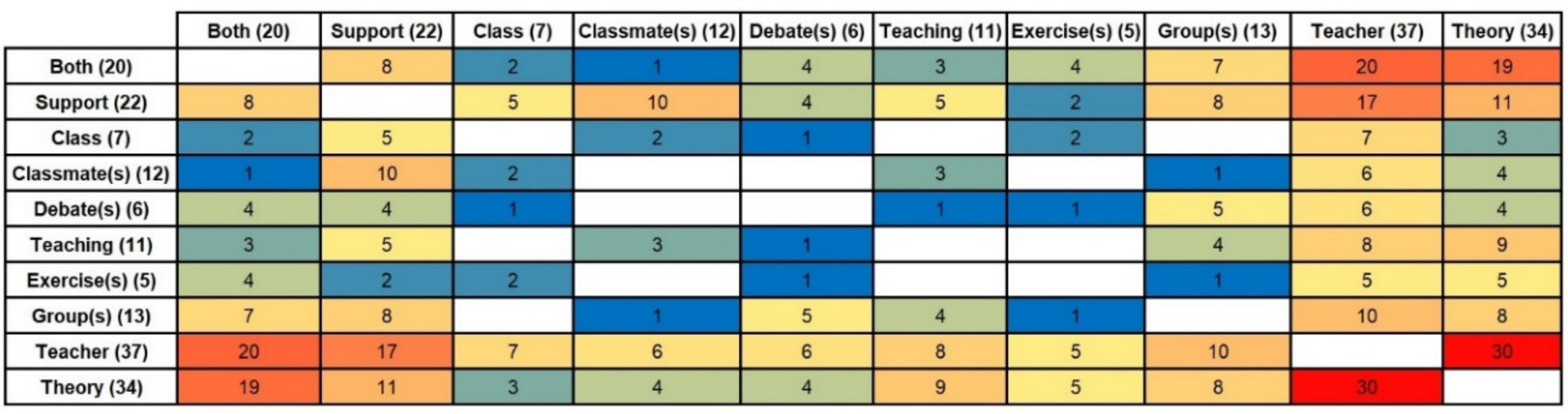
Formative Assessment and Cooperative Work (FACW) is a teaching methodology that promotes student learning based on peer support, both in solving problems and identifying the mistakes made through feedback. The perceptions of 49 mechanical engineering students at the University of Burgos are analyzed in this article with regard to their first practical experience of FACW methodology in a technical subject, characterized by a highly complex content and a strong link between theoretical and practical concepts. The responses of the students to two blocks of open questions were evaluated in a qualitative, mixed, and statistical analysis. Various aspects that the students raised in relation to FACW could therefore be studied, such as their points of view towards: (1) The usefulness of FACW teaching modality; and (2) their preferences regarding the optimum teaching modality. The results showed that, although the students expressed favorable opinions towards FACW, they did not consider, in general, that teamwork was necessary for optimal learning, revealing a clear dependence on formal classroom presentations for the explanation of theoretical concepts. Students considered that theoretical concepts could not be autonomously acquired. Therefore, the application of the FACW teaching methodology to these courses could be especially beneficial to favor autonomous learning and to develop teamwork skills, training engineers with the right knowledge and skills today for tomorrow’s world. View Full-Text
Keywords: formative assessment and cooperative work; active and collaborative learning; student-centered learning environments; technical engineering subject; mixed analysis; autonomy; teamwork skills; teaching guidance formative assessment and cooperative work; active and collaborative learning; student-centered learning environments; technical engineering subject; mixed analysis; autonomy; teamwork skills; teaching guidance
Show Figures

Figure 1

MDPI and ACS Style

Revilla-Cuesta, V.; Skaf, M.; Manso, J.M.; Ortega-López, V. Student Perceptions of Formative Assessment and Cooperative Work on a Technical Engineering Course. Sustainability 2020, 12, 4569. https://doi.org/10.3390/su12114569

AMA Style

Revilla-Cuesta V, Skaf M, Manso JM, Ortega-López V. Student Perceptions of Formative Assessment and Cooperative Work on a Technical Engineering Course. Sustainability. 2020; 12(11):4569. https://doi.org/10.3390/su12114569
Chicago/Turabian Style

Revilla-Cuesta, Víctor, Marta Skaf, Juan M. Manso, and Vanesa Ortega-López. 2020. "Student Perceptions of Formative Assessment and Cooperative Work on a Technical Engineering Course" Sustainability 12, no. 11: 4569. https://doi.org/10.3390/su12114569
Find Other Styles
Note that from the first issue of 2016, MDPI journals use article numbers instead of page numbers. See further details here.

Article Access Map by Country/Region

1
Back to TopTop