Multi-Criteria Decision Making for Sustainability and Value Assessment in Early PSS Design


Abstract
1. Introduction
2. Research Design
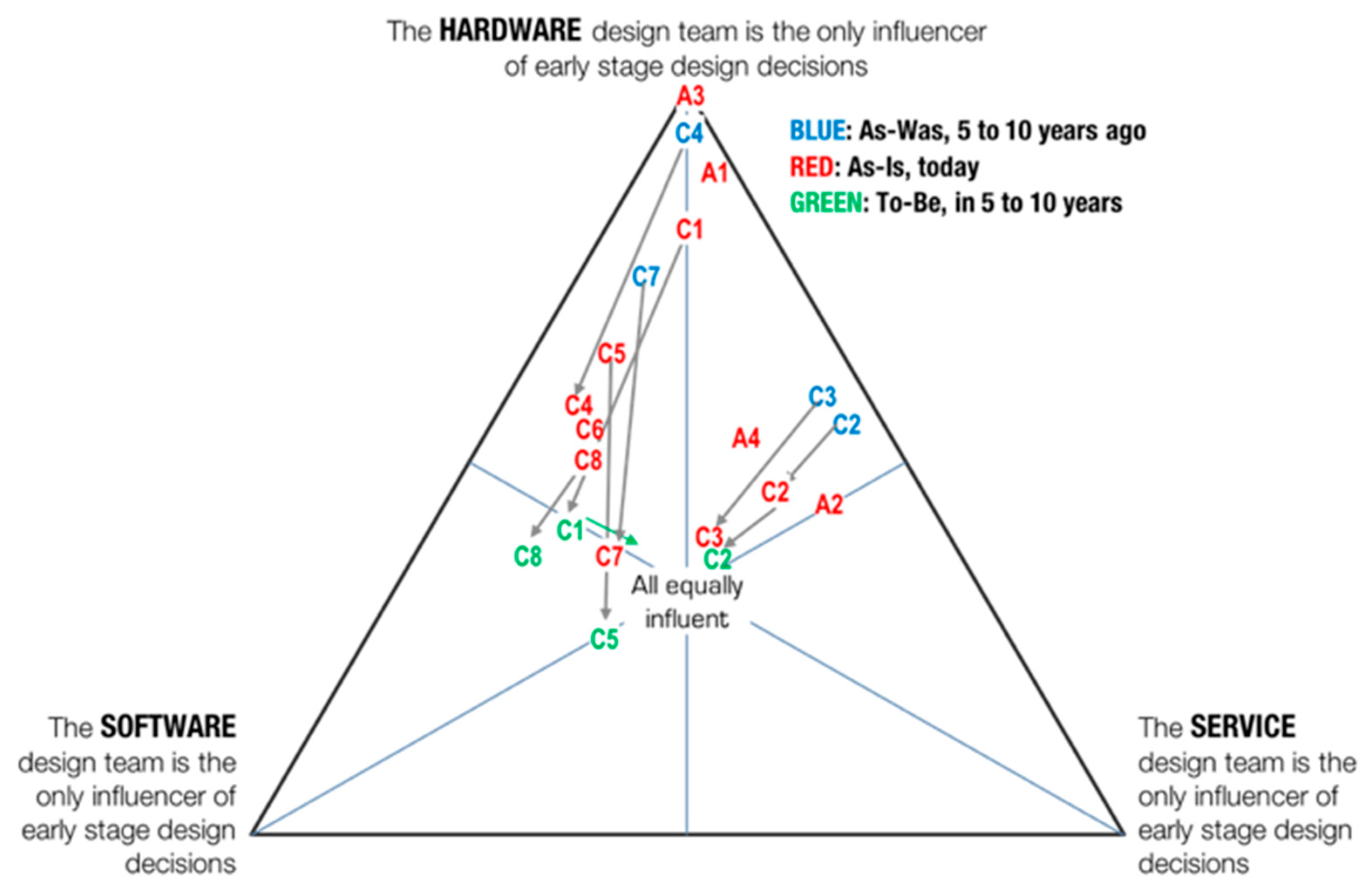
- The design process and design concepts generation;
- Decision making in cross-functional teams for new products/services;
- Value analysis; and
- Sustainability assessment and sustainability compliance.
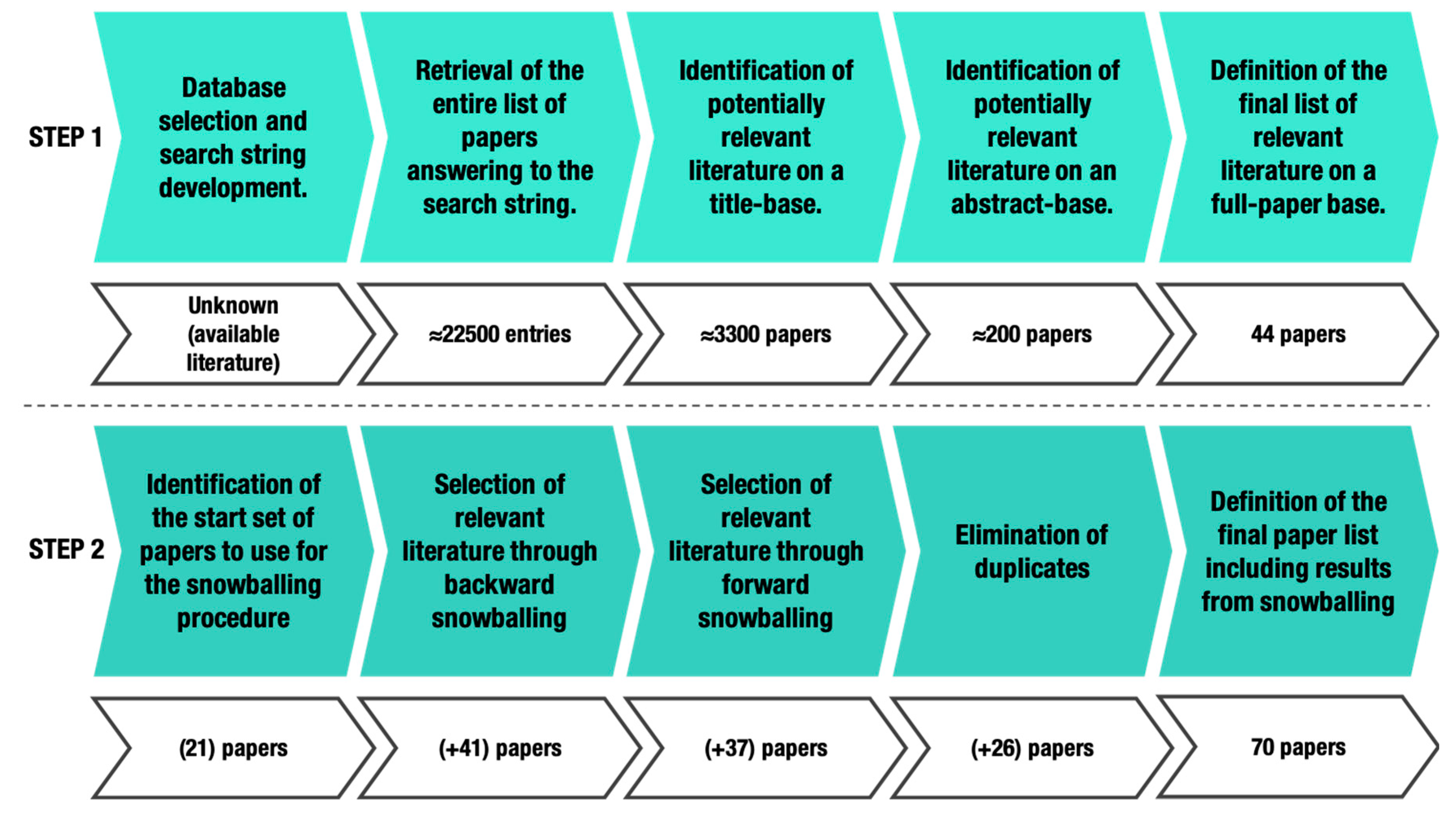
3. Sustainability and Value Assessment in PSS Design: A Systematic Literature Review
TITLE-ABS-KEY (Value* AND Sustainab* AND (engineer* OR innovat* OR design* OR develop*) AND (system* OR technolog* OR offer* OR product* OR service*)) AND PUBYEAR > 2006 AND (LIMIT-TO(DOCTYPE, “ar”) OR LIMIT-TO(DOCTYPE, “re”) OR LIMIT-TO(DOCTYPE, “ch”))
Systematic Literature Review Results
4. Empirical Study Findings
4.1. Describing and Assessing Early-Stage PSS Concepts
“(in an early stage) …It could be a few lines of text… It could be something written down on a meeting… It could be a software thing, it could be a hardware thing, it could be… it could be really anything. (…) If you are good in simulations… it is probably the way are going to do it, to present ideas. If you are a CAD, a mechanical engineer, you would probably go directly to make a 3D model.”
4.2. Decision Criteria for Early Stage PSS Assessment
… we are so busy that we do not have time to dig in and to understand all these details… simplicity is very important. Otherwise, people would just say “it is too complex; I do not care”
4.3. Displaying Sustainability and Value Assessment Results
“They (sustainability and value) go hand in hand, they are kind of the same (thing). It depends on the customer but also on the market you are. For some customers, sustainability is directly customer value.”
“I think (sustainability) is more a contributing factor… it is not in this dimension… Customer value is for us, and I think will still be more important. But sustainability is something that you need to control in a good way.”
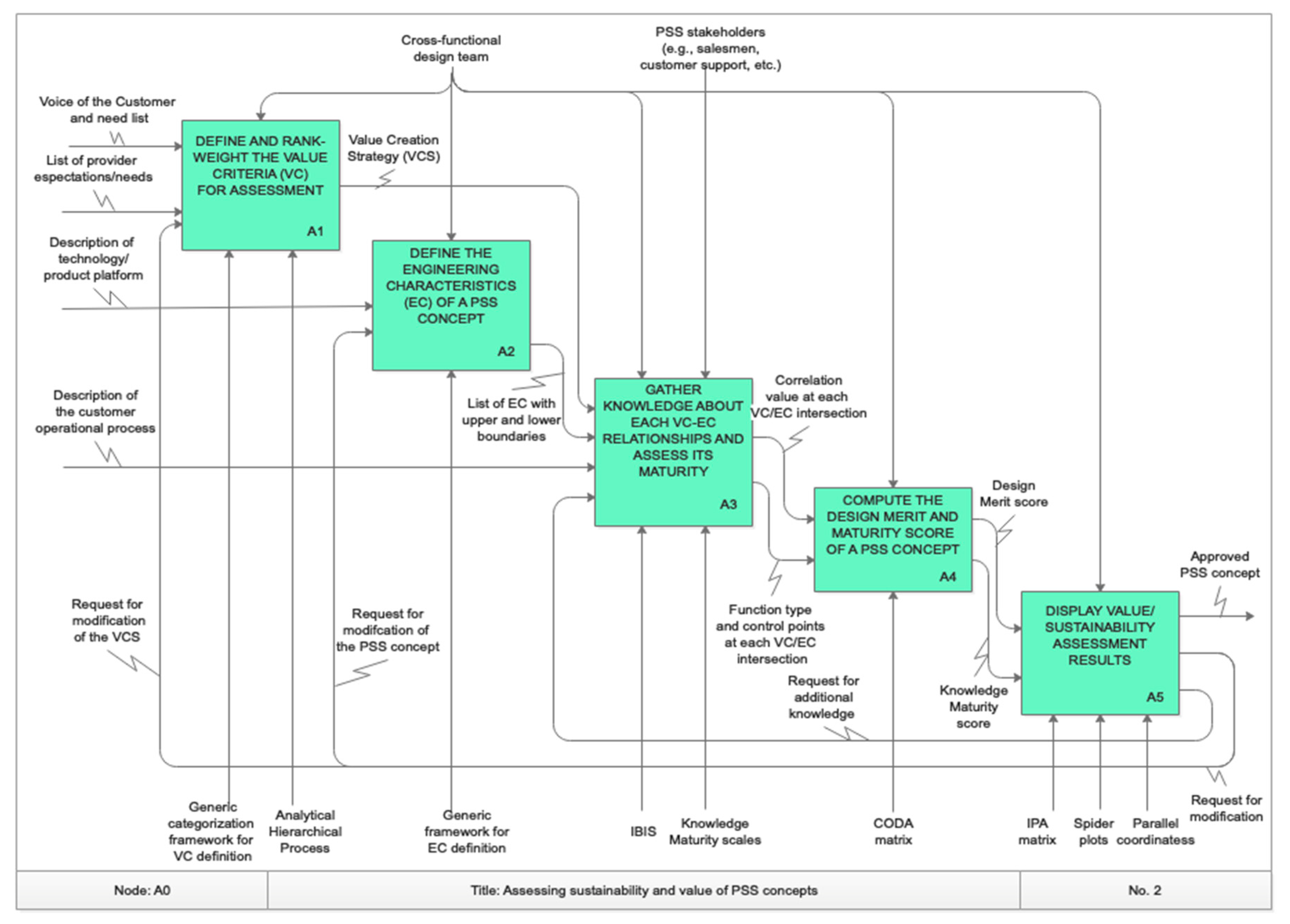
5. Prescriptive Study Findings: An MCDM Process for Sustainability and Value Assessment
5.1. Define and Rank-Weight the Value Criteria for Assessment
5.2. Define the Engineering Characteristics of a PSS Concept
5.3. Gather Knowledge about VC vs. EC Relationships
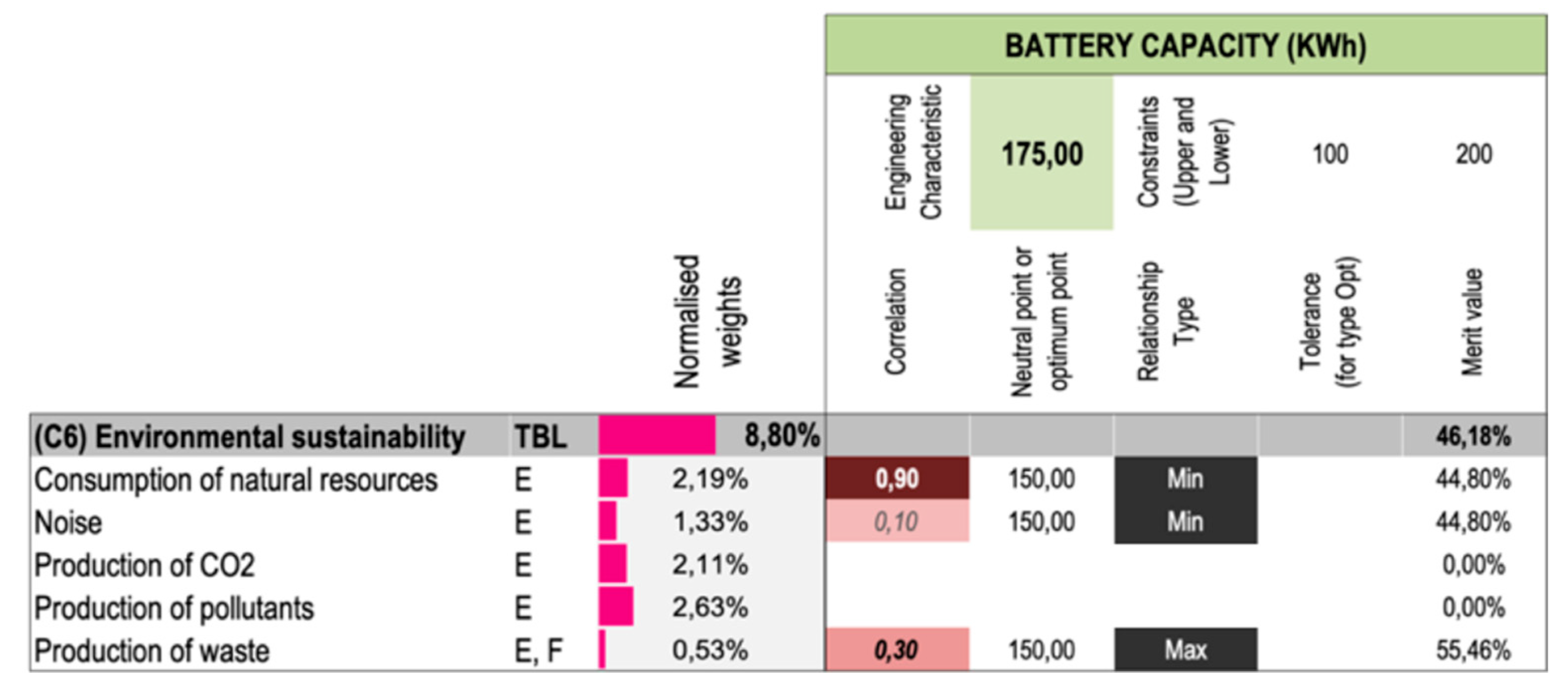
5.4. Compute the Design Merit and Maturity Score of a PSS Concept
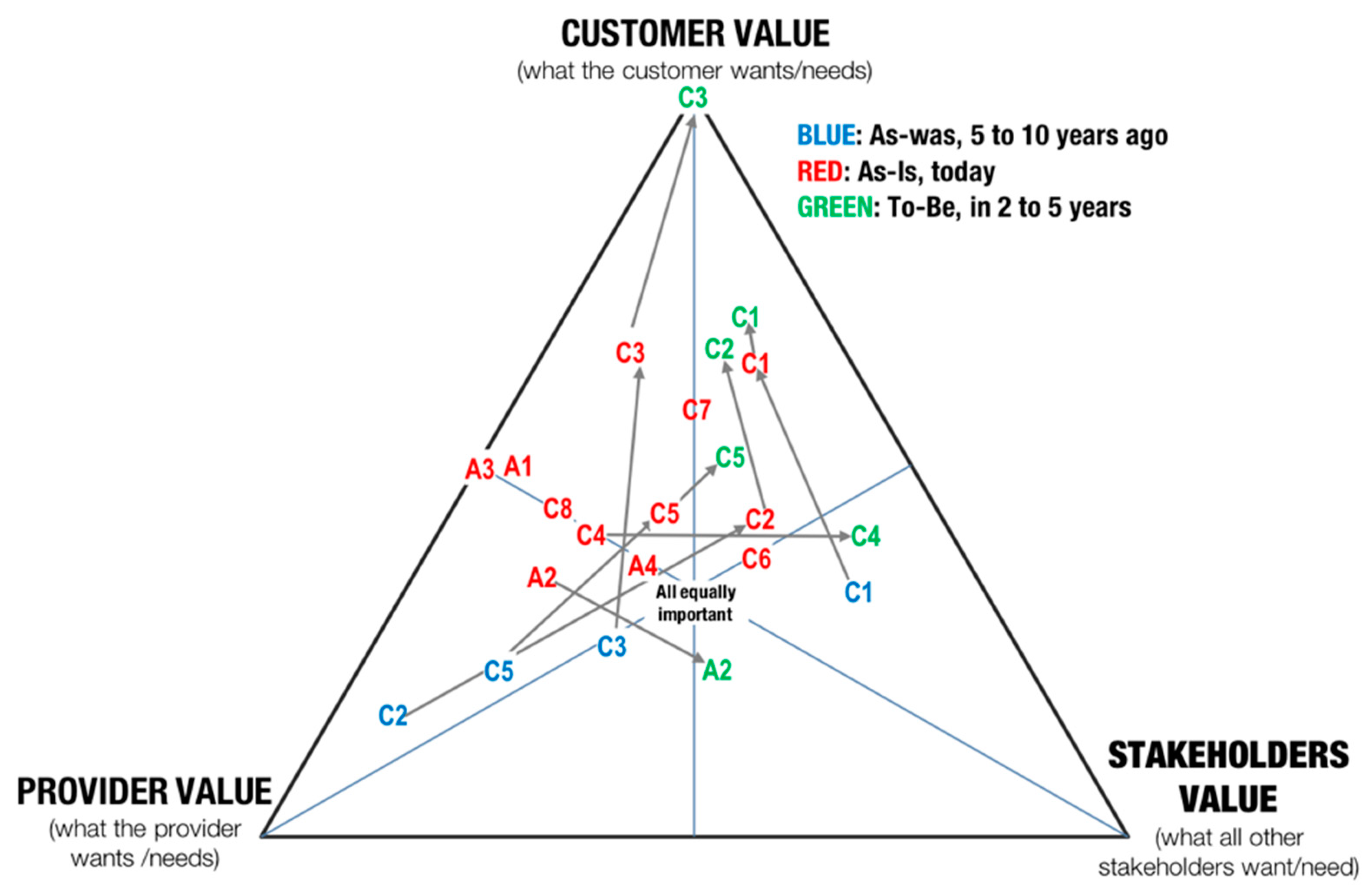
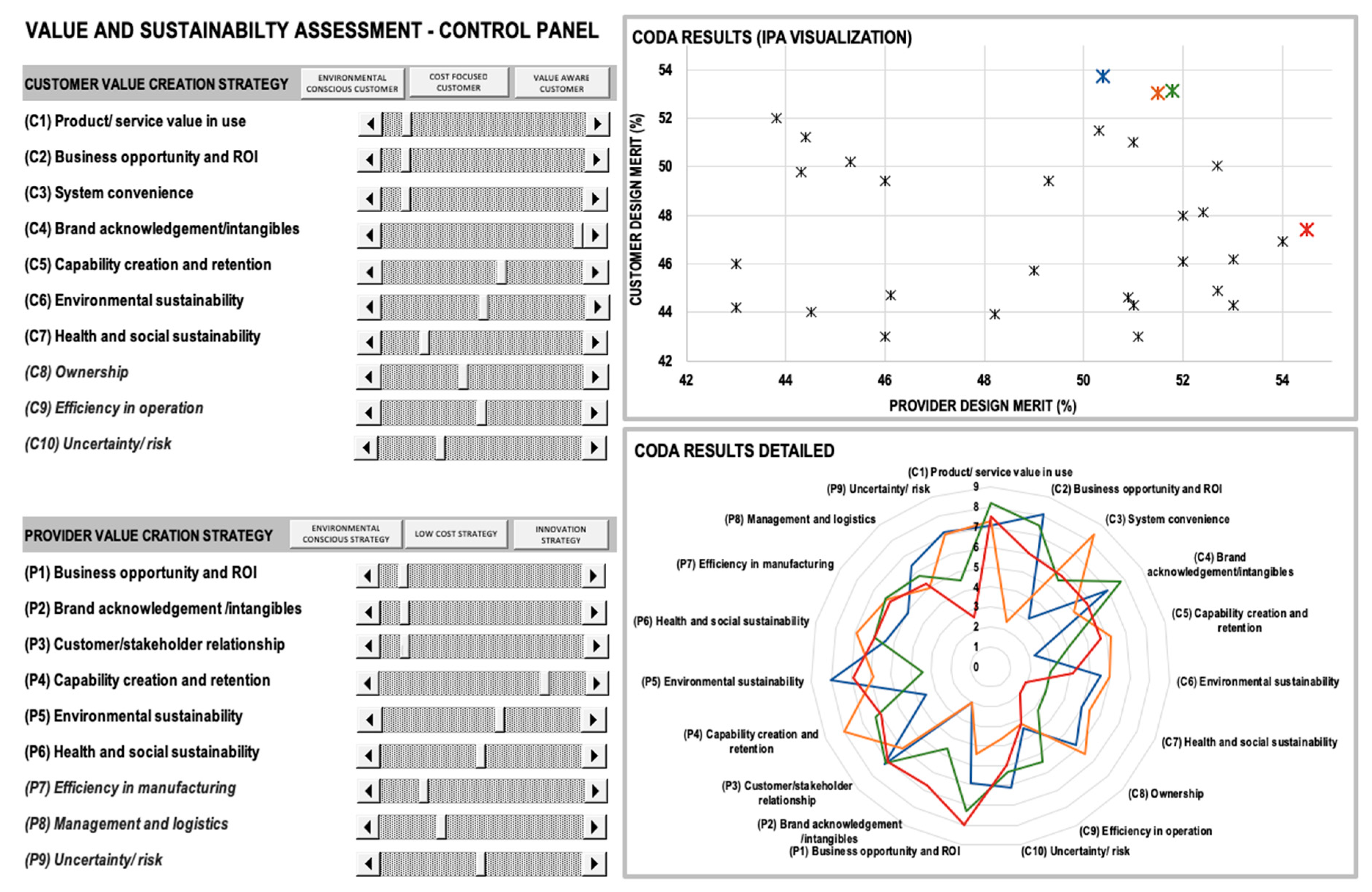
5.5. Display Value/Sustainability Assessment Results
6. Case Study
7. Discussion
8. Conclusions
- A systematic and iterative process for PSS concept assessment that seamlessly incorporates sustainability considerations when defining value criteria for a system.
- An MCDM approach for converging the sustainability and value discussion and to synthesize the sustainability-value trade-off in a unique figure for design merit, for each design.
- A visualization approach that highlights the trade-off between provider vs. customer value in the assessment of sustainability-oriented solutions.
Funding
Conflicts of Interest
Appendix A

| Buildings | Business Models | Materials | Products and Services | Projects and Processes | Organizations and Enterprises | |
|---|---|---|---|---|---|---|
| AHP | [57] [58] [59] [60] | [61][62] [63] [64] [65] [66] | [67][68] | [13] [69][70] [71] | [72][73] | [74][75] |
| ANP | [76] | [66] | [77][78] [79] [80] | [81] | ||
| DEA | [82] [83] | [84] [85] [86] | ||||
| DEMATEL | [51] [87] [88] [89] | [90] | ||||
| GRA | [91] [92] | [93] [94][95] | ||||
| Pugh method | [96] | [20] [97] [36] | [98] [99] | [100] | ||
| QFD | [65] [101] [102] | [13] [103][80] [104] [105] [106] [107] [108] [109] [110] [111] [112] [113] [114] | [115] | |||
| TOPSIS | [62] [64] [65] [116] | [68] | [98] [99] | [90] [117] [118] | [119][75] | |
| Other MCDM methods | [58,120] | [121] [122][123] [124] | [72][125] [126] |
Appendix B
| Customer Value (CV) | Provider Value (PV) | ||
|---|---|---|---|
| Value Criteria | TBL Dimension | Value Criteria | TBL Dimension |
| (C1) Product/service value in use | (P1) Business opportunity and ROI | ||
| Availability | F | Revenue stabilization | F |
| Productivity | F | Alignment with company strategy | F |
| Maneuverability | F | New customers acquisition and generation | F |
| Gradeability | F | Opportunity loss | F |
| Set-up | F | (P2) Brand acknowledgments and intangibles | |
| Transportability | E, F | Aesthetic appeal | F |
| Ease of use | F | Technology leadership | F |
| Customizability | F | (P3) Customer and stakeholder relationship | |
| (C2) Business opportunity | Exploitation of value chain alliances | F | |
| Revenue generation opportunity | F | Strategic positioning in the value chain | F |
| Partnership opportunity | F | Efficiency of stakeholders’ network | F |
| New markets opportunity | F | (P4) Capability creation and retention | |
| Opportunity loss | F | Empowerment of resources competences | S, F |
| (C3) Systems convenience | Data and knowledge sharing with customers | F | |
| Fleet management | F | Attract external expertise | F |
| Logistic of machine | F | Design reuse | F |
| Applications flexibility | F | (P5) Environmental sustainability | |
| Obsolescence | F | Use of scarce materials in production | E, F |
| (C4) Brand acknowledgments and intangibles | Use of water in production | E, F | |
| Aesthetic appeal | F | Use of Grey listed materials | E |
| Technology leadership | F | Use of materials in REACH list | E |
| (C5) Capability creation and retention | CO2 production in transportation and logistic | E | |
| Data and knowledge sharing with the provider | F | CO2 production in manufacturing | E |
| Availability of human resources | S, F | Waste management in manufacturing | E, F |
| Empowerment of competences | S, F | (P6) Health and social sustainability | |
| Attract external expertise | F | Use of conflict materials | S |
| (C6) Environmental sustainability | Impact on workers and labor | S | |
| Consumption of natural resources | E | Impact on local communities | S |
| Noise | E | (P7) Efficiency in manufacturing | |
| Production of CO2 | E | Efficiency of machining operations | F |
| Production of pollutants | E | Efficiency of painting operations | F |
| Production of waste | E, F | Efficiency of assembling operations | F |
| (C7) Health and social sustainability | Training of workforce | S, F | |
| Quality of life of workers and labor | S | Commonality in manufacturing | F |
| Quality of life of local communities | S | Resources (assets/employees) flexibility | F |
| Health of workers and labor | S | (P8) Management and logistics | |
| (C8) Ownership | Ability to return equipment to provider | E, F | |
| Infrastructure | F | Ability to disassemble the system | F |
| Equipment | F | Ability to recondition the system | E, F |
| Shipping | F | Ability to recover materials | E, F |
| Setup | F | Ability to minimize landfill waste | E, F |
| (C9) Efficiency in operation | Ability to manage internal logistic flows | F | |
| Efficient use of labor | S, F | Ability to manage external logistic flows | F |
| Efficient use of energy | E, F | Ability to manage the infrastructure | F |
| Efficient use of consumables | E, F | (P9) Uncertainty and risk | |
| (C10) Uncertainty and risk | Development lead time | F | |
| Troubleshooting | F | Manufacturing lead time | F |
| Maintainability of the PSS hardware (planned) | F | Supplier availability | F |
| Maintainability of the PSS hardware (unplanned) | F | Supplier delivery time | F |
| Maintainability of the infrastructure (planned) | F | Manufacturing quality | F |
| Maintainability of the infrastructure (unplanned) | F | Financial risk | F |
References
- Kalish, D.; Burek, S.; Costello, A.; Schwartz, L.; Taylor, J. Integrating Sustainability into New Product Development: Available tools and frameworks can help companies ensure that sustainability is embedded as a fundamental building block of new product development. Res. Technol. Manag. 2018, 61, 37–46. [Google Scholar] [CrossRef] [Scilit]
- Metz, P.; Burek, S.; Hultgren, T.R.; Kogan, S.; Schwartz, L. The Path to Sustainability-Driven Innovation: Environmental sustainability can be the foundation for increasing competitive advantage and the basis for effective innovation. Res. Technol. Manag. 2016, 59, 50–61. [Google Scholar] [CrossRef] [Scilit]
- Dangelico, R.M.; Pujari, D.; Pontrandolfo, P. Green product innovation in manufacturing firms: A sustainability-oriented dynamic capability perspective. Bus. Strateg. Environ. 2017, 26, 490–506. [Google Scholar] [CrossRef] [Scilit]
- Charter, M.; Tischner, U. Sustainable Solutions: Developing Products & Services for the Future; Greenleaf Publishing: Sheffield, UK, 2001. [Google Scholar]
- Birkeland, J. Design for Sustainability: A Sourcebook of Integrated Ecological Solutions; Earthscan Publication Limited: London, UK, 2012. [Google Scholar]
- Bhamra, T.; Lofthouse, V. Design for Sustainability: A Practical Approach; Routledge: New York, NY, USA, 2016. [Google Scholar]
- Vezzoli, C.; Kohtala, C.; Srinivasan, A.; Xin, L.; Fusakul, M.; Sateesh, D.; Diehl, J.C. Product-Service System Design for Sustainability; Routledge: New York, NY, USA, 2017. [Google Scholar]
- Manzini, E.; Vezzoli, C. A strategic design approach to develop sustainable product service systems: Examples taken from the ‘environmentally friendly innovation’ Italian prize. J. Clean. Prod. 2003, 11, 851–857. [Google Scholar] [CrossRef] [Scilit]
- Tan, A.R.; Matzen, D.; McAloone, T.C.; Evans, S. Strategies for designing and developing services for manufacturing firms. CIRP J. Manuf. Sci. Technol. 2010, 3, 90–97. [Google Scholar] [CrossRef] [Scilit]
- Vandermerwe, S.; Rada, J. Servitization of business: Adding value by adding services. Eur. Manag. J. 1988, 6, 314–324. [Google Scholar] [CrossRef] [Scilit]
- Sundin, E.; Lindahl, M.; Ijomah, W. Product Design for Product/service Systems: Design Experiences from Swedish Industry. J. Manuf. Technol. Manag. 2009, 20, 723–753. [Google Scholar] [CrossRef] [Scilit]
- Szwejczewski, M.; Goffin, K.; Anagnostopoulos, Z. Product Service Systems, after-Sales Service and New Product Development. Int. J. Prod. Res. 2015, 53, 5334–5353. [Google Scholar] [CrossRef] [Scilit]
- Mourtzis, D.; Doukas, M.; Fotia, S. Classification and mapping of PSS evaluation approaches. IFAC-Papersonline 2016, 49, 1555–1560. [Google Scholar] [CrossRef] [Scilit]
- Qu, M.; Yu, S.; Chen, D.; Chu, J.; Tian, B. State-of-the-art of design, evaluation, and operation methodologies in product service systems. Comput. Ind. 2016, 77, 1–14. [Google Scholar] [CrossRef] [Scilit]
- Vasantha, G.V.; Roy, R.; Lelah, A.; Brissaud, D. A review of product–service systems design methodologies. J. Eng. Des. 2012, 23, 635–659. [Google Scholar] [CrossRef] [Scilit]
- Bertoni, A.; Bertoni, M.; Panarotto, M.; Johansson, C.; Larsson, T.C. Value-driven product service systems development: Methods and industrial applications. CIRP J. Manuf. Sci. Technol. 2016, 15, 42–55. [Google Scholar] [CrossRef] [Scilit]
- Zetterlund, H.; Hallstedt, S.; Broman, G. Implementation potential of sustainability-oriented decision support in product development. Procedia CIRP 2016, 50, 287–292. [Google Scholar] [CrossRef] [Scilit]
- Robèrt, K.H.; Schmidt-Bleek, B.; De Larderel, J.A.; Basile, G.; Jansen, J.L.; Kuehr, R.; Thomas, P.P.; Suzuki, M.; Hawken, P.; Wackernagel, M. Strategic sustainable development—Selection, design and synergies of applied tools. J. Clean. Prod. 2002, 10, 197–214. [Google Scholar] [CrossRef] [Scilit]
- de Pádua Pieroni, M.; Pigosso, D.C.; McAloone, T.C. Sustainable qualifying criteria for designing circular business models. Procedia CIRP 2018, 69, 799–804. [Google Scholar] [CrossRef] [Scilit]
- Kim, K.J.; Lim, C.H.; Heo, J.Y.; Lee, D.H.; Hong, Y.S.; Park, K. An evaluation scheme for product-service system models: Development of evaluation criteria and case studies. Serv. Bus. 2016, 10, 507–530. [Google Scholar] [CrossRef] [Scilit]
- Sousa-Zomer, T.T.; Miguel, P.A. A QFD-based approach to support sustainable product-service systems conceptual design. Int. J. Adv. Manuf. Technol. 2017, 88, 701–717. [Google Scholar] [CrossRef] [Scilit]
- Thomke, S.; Fujimoto, T. The effect of “front-loading” problem-solving on product development performance. J. Prod. Innov. Manag. 2000, 17, 128–142. [Google Scholar] [CrossRef] [Scilit]
- Bertoni, M.; Hallstedt, S.I.; Isaksson, O. A model-based approach for sustainability and value assessment in the aerospace value chain. Adv. Mech. Eng. 2015, 7, 1–19. [Google Scholar] [CrossRef] [Scilit]
- Hallstedt, S.I.; Bertoni, M.; Isaksson, O. Assessing sustainability and value of manufacturing processes: A case in the aerospace industry. J. Clean. Prod. 2015, 108, 169–182. [Google Scholar] [CrossRef] [Scilit]
- Pujari, D.; Peattie, K.; Wright, G. Organizational antecedents of environmental responsiveness in industrial new product development. Ind. Mark. Manag. 2004, 33, 381–391. [Google Scholar] [CrossRef]
- Waage, S.A. Re-considering product design: A practical “road-map” for integration of sustainability issues. J. Clean. Prod. 2007, 15, 638–649. [Google Scholar] [CrossRef] [Scilit]
- Blessing, L.T.; Chakrabarti, A. DRM: A Design Research Methodology; Springer: London, UK, 2009. [Google Scholar]
- Yin, R.K. Case Study Research and Applications: Design and Methods; SAGE Publications: Thousand Oaks, CA, USA, 2017. [Google Scholar]
- Voss, C. Case research in operations management. In Researching Operations Management; Routledge: New York, NY, USA, 2010; pp. 176–209. [Google Scholar]
- Warren, C.A. Qualitative Interviewing. Handbook of Interview Research: Context and Method; SAGE Publications: Thousands Oaks, CA, USA, 2002. [Google Scholar]
- Miles, M.B.; Huberman, A.M.; Saldana, J. Qualitative Data Analysis: A Methods Sourcebook; SAGE Publications: Thousand Oaks, CA, USA, 2013. [Google Scholar]
- Fontana, A.; Frey, J. Interviewing: The Art of Science. In Handbook of Qualitative Research; Denzin, N., Lincoln, Y., Eds.; SAGE Publications: Thousand Oaks, CA, USA, 1994; pp. 361–376. [Google Scholar]
- Lockwood, T. Design Thinking: Integrating Innovation, Customer Experience, and Brand Value; Allworth Press: New York, NY, USA, 2009. [Google Scholar]
- Elkington, J. Partnerships from cannibals with forks: The triple bottom line of 21st-century business. Environ. Qual. Manag. 1998, 8, 37–51. [Google Scholar] [CrossRef] [Scilit]
- Kuosmanen, T.; Kuosmanen, N. How not to measure sustainable value (and how one might). Ecol. Econ. 2009, 69, 235–243. [Google Scholar] [CrossRef] [Scilit]
- Chou, C.J.; Chen, C.W.; Conley, C. An approach to assessing sustainable product-service systems. J. Clean. Prod. 2015, 86, 277–284. [Google Scholar] [CrossRef] [Scilit]
- Bidwell, R.; Verfaillie, H.A. Measuring Eco-Efficiency: A Guide to Reporting Company Performance; World Business Council on Sustainable Development: Geneva, Switzerland, 2000; pp. 2–37. [Google Scholar]
- Bertoni, M.; Rondini, A.; Pezzotta, G. A systematic review of value metrics for PSS design. Procedia CIRP 2017, 64, 289–294. [Google Scholar] [CrossRef] [Scilit]
- Pahl, G.; Beitz, W. Engineering Design: A Systematic Approach; Springer Science & Business Media: Darmstadt, Germany, 2013. [Google Scholar]
- Osterwalder, A.; Pigneur, Y.; Bernarda, G.; Smith, A. Value Proposition Design: How to Create Products and Services Customers Want; John Wiley & Sons: Hoboken, NJ, USA, 2014. [Google Scholar]
- Leavy, B. Design thinking—A new mental model of value innovation. Strateg. Leadersh. 2010, 38, 5–14. [Google Scholar] [CrossRef] [Scilit]
- Isaksson, O.; Kossmann, M.; Bertoni, M.; Eres, M.H.; Monceaux, A.; Bertoni, A.; Wiseall, S.; Zhang, X. Value-Driven Design—A methodology to link expectations to technical requirements in the extended enterprise. In Proceedings of the INCOSE International Symposium, Philadelphia, PA, USA, 24–27 June 2013; pp. 803–819. [Google Scholar]
- Benítez, J.; Izquierdo, J.; Pérez-García, R.; Ramos-Martínez, E. A simple formula to find the closest consistent matrix to a reciprocal matrix. Appl. Math. Model. 2014, 38, 3968–3974. [Google Scholar] [CrossRef] [Scilit]
- Evans, S.; Partidário, P.J.; Lambert, J. Industrialization as a key element of sustainable product-service solutions. Int. J. Prod. Res. 2007, 45, 4225–4246. [Google Scholar] [CrossRef] [Scilit]
- Eres, M.H.; Bertoni, M.; Kossmann, M.; Scanlan, J. Mapping customer needs to engineering characteristics: An aerospace perspective for conceptual design. J. Eng. Des. 2014, 25, 64–87. [Google Scholar] [CrossRef] [Scilit]
- Chirumalla, K.; Bertoni, A.; Ericson, Å.; Isaksson, O. Knowledge-sharing network for product-service system development: Is it atypical? In The Philosopher’s Stone for Sustainability; Springer: Berlin, Germany, 2013; pp. 109–114. [Google Scholar]
- Bertoni, M.; Larsson, A. Engineering, 2.0: An approach to support cross-functional teams in overcoming knowledge-sharing barriers in PSS design. Int. J. Prod. Dev. 2011, 15, 115–134. [Google Scholar] [CrossRef] [Scilit]
- Kunz, W.; Rittel, H.W. Issues as Elements of Information Systems; Institute of Urban and Regional Development, University of California: Berkeley, CA, USA, 1970. [Google Scholar]
- Tan, K.C.; Shen, X.X. Integrating Kano’s model in the planning matrix of quality function deployment. Total Qual. Manag. 2000, 11, 1141–1151. [Google Scholar] [CrossRef] [Scilit]
- Johansson, C.; Hicks, B.; Larsson, A.C.; Bertoni, M. Knowledge maturity as a means to support decision making during product-service systems development projects in the aerospace sector. Proj. Manag. J. 2011, 42, 32–50. [Google Scholar] [CrossRef] [Scilit]
- Geng, X.; Chu, X. A new importance–performance analysis approach for customer satisfaction evaluation supporting PSS design. Expert Syst. Appl. 2012, 39, 1492–1502. [Google Scholar] [CrossRef] [Scilit]
- Walsh, C.L.; Glendinning, S.; Dawson, R.J.; England, K.; Martin, M.; Watkins, C.L.; Wilson, R.; McLoughlin, A.; Glenis, V.; Parker, D. Collaborative platform to facilitate engineering decision-making. Eng. Sustain. 2013, 166, 98–107. [Google Scholar] [CrossRef] [Scilit]
- White, D.D.; Wutich, A.Y.; Larson, K.L.; Lant, T. Water management decision makers’ evaluations of uncertainty in a decision support system: The case of WaterSim in the Decision Theater. J. Environ. Plan. Manag. 2015, 58, 616–630. [Google Scholar] [CrossRef] [Scilit]
- Bertoni, M.; Wall, J.; Bertoni, A. Model Driven Decision Arena: An aerospace study. In Proceedings of the International Design Conference, Dubrovnik, Croatia, 21–24 May 2018; pp. 171–182. [Google Scholar]
- Wall, J.; Larsson, T. A model-driven decision arena: Augmenting decision making in early design. In Proceedings of the NordDesign, Linköping, Sweden, 14–17 August 2018. [Google Scholar]
- Bertoni, M. Introducing sustainability in value models to support design decision making: A systematic review. Sustainability 2017, 9, 994. [Google Scholar] [CrossRef] [Scilit]
- del Caño, A.; Gómez, D.; de la Cruz, M.P. Uncertainty analysis in the sustainable design of concrete structures: A probabilistic method. Constr. Build. Mater. 2012, 37, 865–873. [Google Scholar] [CrossRef] [Scilit]
- Gervásio, H.; Da Silva, L.S. A probabilistic decision-making approach for the sustainable assessment of infrastructures. Expert Syst. Appl. 2012, 39, 7121–7131. [Google Scholar] [CrossRef] [Scilit]
- Cuadrado, J.; Zubizarreta, M.; Rojí, E.; Larrauri, M.; Álvarez, I. Sustainability assessment methodology for industrial buildings: Three case studies. Civ. Eng. Environ. Syst. 2016, 33, 106–124. [Google Scholar] [CrossRef] [Scilit]
- Rehman, O.U.; Ryan, M.J. A framework for design for sustainable future-proofing. J. Clean. Prod. 2018, 170, 715–726. [Google Scholar] [CrossRef] [Scilit]
- Chuang, L.M. A reconceptualization of manufacturers’ sustainable product-service business models: Triple bottom line perspective. Adv. Manag. Appl. Econ. 2019, 9, 47–66. [Google Scholar]
- Chiu, M.C.; Kuo, M.Y.; Kuo, T.C. A systematic methodology to develop business model of a Product Service System. Int. J. Ind. Eng. 2015, 22, 369–381. [Google Scholar]
- Stefano, N.M.; Casarotto Filho, N.; Barichello, R.; Sohn, A.P. Hybrid fuzzy methodology for the evaluation of criteria and sub-criteria of product-service system (PSS). Procedia CIRP 2015, 30, 439–444. [Google Scholar] [CrossRef] [Scilit]
- Metaxas, I.N.; Koulouriotis, D.E.; Spartalis, S.H. A multicriteria model on calculating the Sustainable Business Excellence Index of a firm with fuzzy AHP and TOPSIS. Benchmark. Int. J. 2016, 23, 1522–1557. [Google Scholar] [CrossRef] [Scilit]
- Song, W.; Sakao, T. A customization-oriented framework for design of sustainable product/service system. J. Clean. Prod. 2017, 140, 1672–1685. [Google Scholar] [CrossRef] [Scilit]
- Zhao, X.; Chen, L.; Pan, W.; Lu, Q. AHP-ANP–fuzzy integral integrated network for evaluating performance of innovative business models for sustainable building. J. Constr. Eng. Manag. 2017, 143, 1–14. [Google Scholar] [CrossRef] [Scilit]
- Henry, M.; Kato, Y. An assessment framework based on social perspectives and Analytic Hierarchy Process: A case study on sustainability in the Japanese concrete industry. J. Eng. Technol. Manag. 2011, 28, 300–316. [Google Scholar] [CrossRef] [Scilit]
- Bakhoum, E.S.; Brown, D.C. An automated decision support system for sustainable selection of structural materials. Int. J. Sustain. Eng. 2015, 8, 80–92. [Google Scholar] [CrossRef] [Scilit]
- Hassan, M.F.; Saman, M.Z.; Sharif, S.; Omar, B. Sustainability evaluation of alternative part configurations in product design: Weighted decision matrix and artificial neural network approach. Clean Technol. Environ. 2016, 18, 63–79. [Google Scholar] [CrossRef] [Scilit]
- Song, W.; Ming, X.; Han, Y.; Wu, Z. A rough set approach for evaluating vague customer requirement of industrial product-service system. Int. J. Prod. Res. 2013, 51, 6681–6701. [Google Scholar] [CrossRef] [Scilit]
- Biju, P.L.; Shalij, P.R.; Prabhushankar, G.V. An evaluation tool for sustainable new product development using analytic hierarchy process approach. Int. J. Innov. Sust. Dev. 2017, 11, 393–413. [Google Scholar] [CrossRef] [Scilit]
- Singh, S.; Olugu, E.U.; Musa, S.N.; Mahat, A.B.; Wong, K.Y. Strategy selection for sustainable manufacturing with integrated AHP-VIKOR method under interval-valued fuzzy environment. Int. J. Adv. Manuf. Technol. 2016, 84, 547–563. [Google Scholar] [CrossRef] [Scilit]
- Mendoza, G.A.; Prabhu, R. Evaluating multi-stakeholder perceptions of project impacts: A participatory value-based multi-criteria approach. Int. J. Sustain. Dev. World 2009, 16, 177–190. [Google Scholar] [CrossRef] [Scilit]
- Harik, R.; El Hachem, W.; Medini, K.; Bernard, A. Towards a holistic sustainability index for measuring sustainability of manufacturing companies. Int. J. Prod. Res. 2015, 53, 4117–4139. [Google Scholar] [CrossRef] [Scilit]
- Wang, X.; Durugbo, C. Analysing network uncertainty for industrial product-service delivery: A hybrid fuzzy approach. Expert Syst. Appl. 2013, 40, 4621–4636. [Google Scholar] [CrossRef] [Scilit]
- Ozcan Deniz, G. An analytic network process (ANP) model to examine LEED-certified buildings’ operational performance. Built Environ. Proj. Asset Manag. 2017, 7, 366–376. [Google Scholar] [CrossRef] [Scilit]
- Jayakrishna, K.; Vimal, K.E.; Vinodh, S. ANP based sustainable concept selection. J. Model. Manag. 2015, 10, 118–136. [Google Scholar]
- Lee, S.; Geum, Y.; Lee, S.; Park, Y. Evaluating New Concepts of PSS based on the Customer Value: Application of ANP and Niche Theory. Expert Syst. Appl. 2015, 42, 4556–4566. [Google Scholar] [CrossRef] [Scilit]
- Tseng, M.L.; Wu, K.J.; Chiu, A.S.; Lim, M.K.; Tan, K. Service innovation in sustainable product service systems: Improving performance under linguistic preferences. Int. J. Prod. Econ. 2018, 203, 414–425. [Google Scholar] [CrossRef] [Scilit]
- Fargnoli, M.; Haber, N. A practical ANP-QFD methodology for dealing with requirements’ inner dependency in PSS development. Comput. Ind. Eng. 2019, 27, 536–548. [Google Scholar] [CrossRef] [Scilit]
- Xu, Z.; Elomri, A.; Pokharel, S.; Ming, X.G. Product-service supplier pre-evaluation with modified fuzzy ANP reducing decision information distortion. Int. J. Comput. Integr. Manuf. 2017, 30, 738–754. [Google Scholar] [CrossRef] [Scilit]
- Prakash, A.; Mohanty, R.P. DEA and Monte Carlo simulation approach towards green car selection. Benchmark. Int. J. 2017, 24, 1234–1252. [Google Scholar] [CrossRef] [Scilit]
- Geng, X.; Chu, X.; Xue, D.; Zhang, Z. A systematic decision-making approach for the optimal product–service system planning. Expert Syst. Appl. 2011, 38, 11849–11858. [Google Scholar] [CrossRef] [Scilit]
- Egilmez, G.; Kucukvar, M.; Tatari, O. Sustainability assessment of US manufacturing sectors: An economic input output-based frontier approach. J. Clean. Prod. 2013, 53, 91–102. [Google Scholar] [CrossRef] [Scilit]
- Zhou, X.; Pedrycz, W.; Kuang, Y.; Zhang, Z. Type-2 fuzzy multi-objective DEA model: An application to sustainable supplier evaluation. Appl. Soft Comput. 2016, 46, 424–440. [Google Scholar] [CrossRef] [Scilit]
- Zhou, X.; Xu, Z.; Yao, L.; Tu, Y.; Lev, B.; Pedrycz, W. A novel Data Envelopment Analysis model for evaluating industrial production and environmental management system. J. Clean. Prod. 2018, 170, 773–788. [Google Scholar] [CrossRef] [Scilit]
- Song, W.; Cao, J. A rough DEMATEL-based approach for evaluating interaction between requirements of product-service system. Comput. Ind. Eng. 2017, 110, 353–363. [Google Scholar] [CrossRef] [Scilit]
- Liu, Z.; Ming, X. A framework with revised rough-DEMATEL to capture and evaluate requirements for smart industrial product-service system of systems. Int. J. Prod. Res. 2019, 13, 1–9. [Google Scholar] [CrossRef] [Scilit]
- Song, W.; Sakao, T. An environmentally conscious PSS recommendation method based on users’ vague ratings: A rough multi-criteria approach. J. Clean. Prod. 2018, 172, 1592–1606. [Google Scholar] [CrossRef] [Scilit]
- Orji, I.J.; Wei, S. A decision support tool for sustainable supplier selection in manufacturing firms. J. Ind. Eng. Manag. 2014, 7, 1293–1315. [Google Scholar] [CrossRef] [Scilit]
- Chiu, M.C.; Chu, C.Y.; Chen, C.C. An integrated product service system modelling methodology with a case study of clothing industry. Int. J. Prod. Res. 2018, 56, 2388–2409. [Google Scholar] [CrossRef] [Scilit]
- Kim, S.; Moon, S.K. Sustainable platform identification for product family design. J. Clean. Prod. 2017, 143, 567–581. [Google Scholar] [CrossRef] [Scilit]
- Wu, K.J.; Liao, C.J.; Tseng, M.; Chiu, K.K. Multi-attribute approach to sustainable supply chain management under uncertainty. Ind. Manag. Data Syst. 2016, 116, 777–800. [Google Scholar] [CrossRef] [Scilit]
- Rao, C.; Goh, M.; Zheng, J. Decision mechanism for supplier selection under sustainability. Int. J. Inf. Technol. Decis. 2017, 16, 87–115. [Google Scholar] [CrossRef] [Scilit]
- Bai, C.; Sarkis, J.; Wei, X.; Koh, L. Evaluating ecological sustainable performance measures for supply chain management. Supply Chain Manag. 2012, 17, 78–92. [Google Scholar] [CrossRef] [Scilit]
- Kamari, A.; Corrao, R.; Kirkegaard, P.H. Sustainability focused decision-making in building renovation. Int. J. Sustain. Built Environ. 2017, 6, 330–350. [Google Scholar] [CrossRef] [Scilit]
- Rondini, A.; Matschewsky, J.; Pezzotta, G.; Bertoni, M. A simplified approach towards customer and provider value in PSS for small and medium-sized enterprises. Procedia CIRP 2018, 73, 61–66. [Google Scholar] [CrossRef] [Scilit]
- Rondini, A.; Lagorio, A.; Pinto, R.; Pezzotta, G. A multi-criteria decision making approach for prioritising product-service systems implementation in smart cities. Int. J. Manag. Decis. 2018, 17, 415–446. [Google Scholar] [CrossRef] [Scilit]
- Rondini, A.; Bertoni, M.; Pezzotta, G. At the origins of Product Service Systems: Supporting the concept assessment with the Engineering Value Assessment method. CIRP J. Manuf. Sci. Technol. 2018. [Google Scholar] [CrossRef] [Scilit]
- Varsei, M.; Soosay, C.; Fahimnia, B.; Sarkis, J. Framing sustainability performance of supply chains with multidimensional indicators. Supply Chain Manag. 2014, 19, 242–257. [Google Scholar] [CrossRef] [Scilit]
- Peruzzini, M.; Marilungo, E.; Germani, M. Structured requirements elicitation for product-service system. Int. J. Agile Syst. Manag. 2015, 8, 189–218. [Google Scholar] [CrossRef] [Scilit]
- Li, T.; He, T.; Wang, Z.; Zhang, Y. A QFD-based evaluation method for business models of product service systems. Math. Probl. Eng. 2016, 2016, 8532607. [Google Scholar] [CrossRef] [Scilit]
- Salari, M.; Bhuiyan, N. A new model of sustainable product development process for making trade-offs. Int. J. Adv. Manuf. Technol. 2018, 94, 1–11. [Google Scholar] [CrossRef] [Scilit]
- An, Y.; Lee, S.; Park, Y. Development of an integrated product-service roadmap with QFD: A case study on mobile communications. Int. J. Serv. Ind. Manag. 2008, 19, 621–638. [Google Scholar] [CrossRef] [Scilit]
- Zhang, Z.; Chu, X. A new approach for conceptual design of product and maintenance. Int. J. Comput. Integr. Manuf. 2010, 23, 603–618. [Google Scholar] [CrossRef] [Scilit]
- Ojanen, V.; Ahonen, T.; Reunanen, M.; Hanski, J. Towards availability and sustainability in customer value assessment of asset management services. Int. J. Innov. Sustain. Dev. 2012, 6, 368–391. [Google Scholar] [CrossRef] [Scilit]
- Bilge, P.; Badurdeen, F.; Seliger, G.; Jawahir, I.S. A novel manufacturing architecture for sustainable value creation. CIRP Ann. 2016, 65, 455–458. [Google Scholar] [CrossRef] [Scilit]
- Peruzzini, M.; Marilungo, E. Design for Sustainability in PSS: Evidences of QFD-Based Method Application. Adv. Transdiscip. Eng. 2016, 4, 97–106. [Google Scholar]
- Pezzotta, G.; Pirola, F.; Rondini, A.; Pinto, R.; Ouertani, M.Z. Towards a methodology to engineer industrial product-service system–Evidence from power and automation industry. CIRP J. Manuf. Sci. Technol. 2016, 15, 19–32. [Google Scholar] [CrossRef] [Scilit]
- Fargnoli, M.; Sakao, T. Uncovering differences and similarities among quality function deployment-based methods in Design for X: Benchmarking in different domains. Qual. Eng. 2017, 29, 690–712. [Google Scholar] [CrossRef] [Scilit]
- Fargnoli, M.; Costantino, F.; Di Gravio, G.; Tronci, M. Product service-systems implementation: A customized framework to enhance sustainability and customer satisfaction. J. Clean. Prod. 2018, 188, 387–401. [Google Scholar] [CrossRef] [Scilit]
- Haber, N.; Fargnoli, M.; Sakao, T. Integrating QFD for product-service systems with the Kano model and fuzzy AHP. Total Qual. Manag. Bus. 2018, 4, 1–26. [Google Scholar] [CrossRef] [Scilit]
- Scafà, M.; Carbonari, S.; Papetti, A.; Rossi, M.; Germani, M. A new method for Product Service System: The case of urban waste management. Procedia CIRP 2018, 73, 67–72. [Google Scholar] [CrossRef] [Scilit]
- Song, W. Customization-Oriented Design of Product-Service System; Springer: Singapore, 2019. [Google Scholar]
- Vinodh, S.; Arvind, K.R.; Somanaathan, M. Tools and techniques for enabling sustainability through lean initiatives. Clean Technol. Environ. 2011, 13, 469–479. [Google Scholar] [CrossRef] [Scilit]
- Wang, X.; Chen, X.; Durugbo, C.; Cai, Z. Manage risk of sustainable product–service systems: A case-based operations research approach. Ann. Open Res. 2018. [Google Scholar] [CrossRef] [Scilit]
- Ighravwe, D.E.; Ayoola Oke, S. Ranking maintenance strategies for sustainable maintenance plan in manufacturing systems using fuzzy axiomatic design principle and fuzzy-TOPSIS. J. Manuf. Technol. Manag. 2017, 28, 961–992. [Google Scholar] [CrossRef] [Scilit]
- Orji, I.J.; Wei, S. Dynamic modeling of sustainable operation in green manufacturing environment. J. Manuf. Technol. Manag. 2015, 26, 1201–1217. [Google Scholar] [CrossRef] [Scilit]
- Afful-Dadzie, A.; Afful-Dadzie, E.; Turkson, C. A TOPSIS extension framework for re-conceptualizing sustainability measurement. Kybernetes 2016, 45, 70–86. [Google Scholar] [CrossRef] [Scilit]
- Jensen, P.A.; Maslesa, E. Value based building renovation–A tool for decision-making and evaluation. Build. Environ. 2015, 92, 1–9. [Google Scholar] [CrossRef] [Scilit]
- Gheorghe, R.; Xirouchakis, P. Decision-based methods for early phase sustainable product design. Int. J. Eng. Educ. 2007, 23, 1065–1080. [Google Scholar]
- Montelisciani, G.; Gabelloni, D.; Fantoni, G. Developing integrated sustainable product-process-service systems at the early product design stages. Int. J. Sustain. Manuf. 2015, 3, 310–332. [Google Scholar] [CrossRef] [Scilit]
- Weißfloch, U.; Geldermann, J. Assessment of product-service systems for increasing the energy efficiency of compressed air systems. Eur. J. Ind. Eng. 2016, 10, 341–366. [Google Scholar] [CrossRef] [Scilit]
- Bai, C.; Shah, P.; Zhu, Q.; Sarkis, J. Green product deletion decisions: An integrated sustainable production and consumption approach. Ind. Manag. Data Syst. 2018, 118, 349–389. [Google Scholar] [CrossRef] [Scilit]
- Mateus, R.J.; Costa, J.C.; Matos, P.V. Supporting multicriteria group decisions with MACBETH tools: Selection of sustainable brownfield redevelopment actions. Group Decis. Negot. 2017, 26, 495–521. [Google Scholar] [CrossRef] [Scilit]
- Prakash, R.; Singhal, S.; Agarwal, A. An integrated fuzzy-based multi-criteria decision-making approach for the selection of an effective manufacturing system: A case study of Indian manufacturing company. Benchmark. Int. J. 2018, 25, 280–296. [Google Scholar] [CrossRef] [Scilit]


| Customer Value (CV) | Provider Value (PV) | ||
|---|---|---|---|
| GAINS | PAINS | GAINS | PAINS |
| (C1) Product/service value in use | (C8) Ownership | (P1) Business opportunity and ROI | (P7) Efficiency in manufacturing |
| (C2) Business opportunity and Return On Investment (ROI) | (C9) Efficiency in operation | (P2) Brand acknowledgment and intangibles | (P8) Management and logistics |
| (C3) System convenience | (C10) Uncertainty/risk | (P3) Customer and stakeholder relationship | (P9) Uncertainty/risk |
| (C4) Brand acknowledgment and intangibles | (P4) Capability creation and retention | ||
| (C5) Capability creation and retention | (P5) Environmental sustainability | ||
| (C6) Environmental sustainability | (P6) Health and social sustainability | ||
| (C7) Health and social sustainability | |||
© 2019 by the author. Licensee MDPI, Basel, Switzerland. This article is an open access article distributed under the terms and conditions of the Creative Commons Attribution (CC BY) license (http://creativecommons.org/licenses/by/4.0/).
Share and Cite
Bertoni, M. Multi-Criteria Decision Making for Sustainability and Value Assessment in Early PSS Design. Sustainability 2019, 11, 1952. https://doi.org/10.3390/su11071952
Bertoni M. Multi-Criteria Decision Making for Sustainability and Value Assessment in Early PSS Design. Sustainability. 2019; 11(7):1952. https://doi.org/10.3390/su11071952
Chicago/Turabian StyleBertoni, Marco. 2019. "Multi-Criteria Decision Making for Sustainability and Value Assessment in Early PSS Design" Sustainability 11, no. 7: 1952. https://doi.org/10.3390/su11071952
APA StyleBertoni, M. (2019). Multi-Criteria Decision Making for Sustainability and Value Assessment in Early PSS Design. Sustainability, 11(7), 1952. https://doi.org/10.3390/su11071952