Article

Mathematical Analysis of Environmental Effects of Forming a Platoon of Smart Vehicles


1
Department of Hotel and Tourism Management, Sejong University, Seoul 05006, Korea
2
School of Industrial Engineering, Purdue University; West Lafayette, IN 47907, USA
3
Department of Industrial Engineering, Daejin University; Pocheon 11159, Korea
*
Author to whom correspondence should be addressed.
Sustainability 2019, 11(3), 571; https://doi.org/10.3390/su11030571
Submission received: 6 December 2018 / Revised: 1 January 2019 / Accepted: 18 January 2019 / Published: 22 January 2019
(This article belongs to the Section Sustainable Transportation)

Abstract

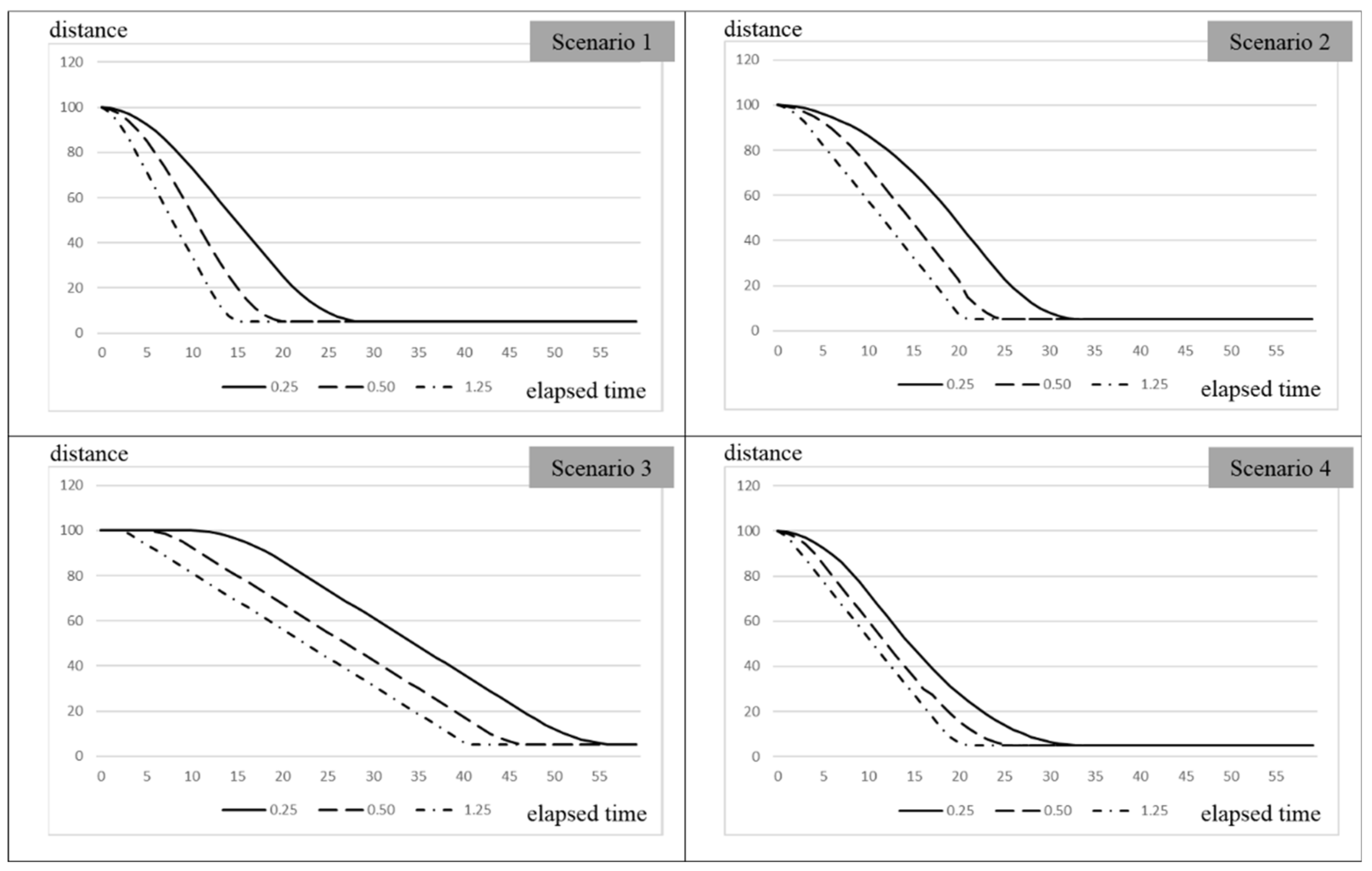
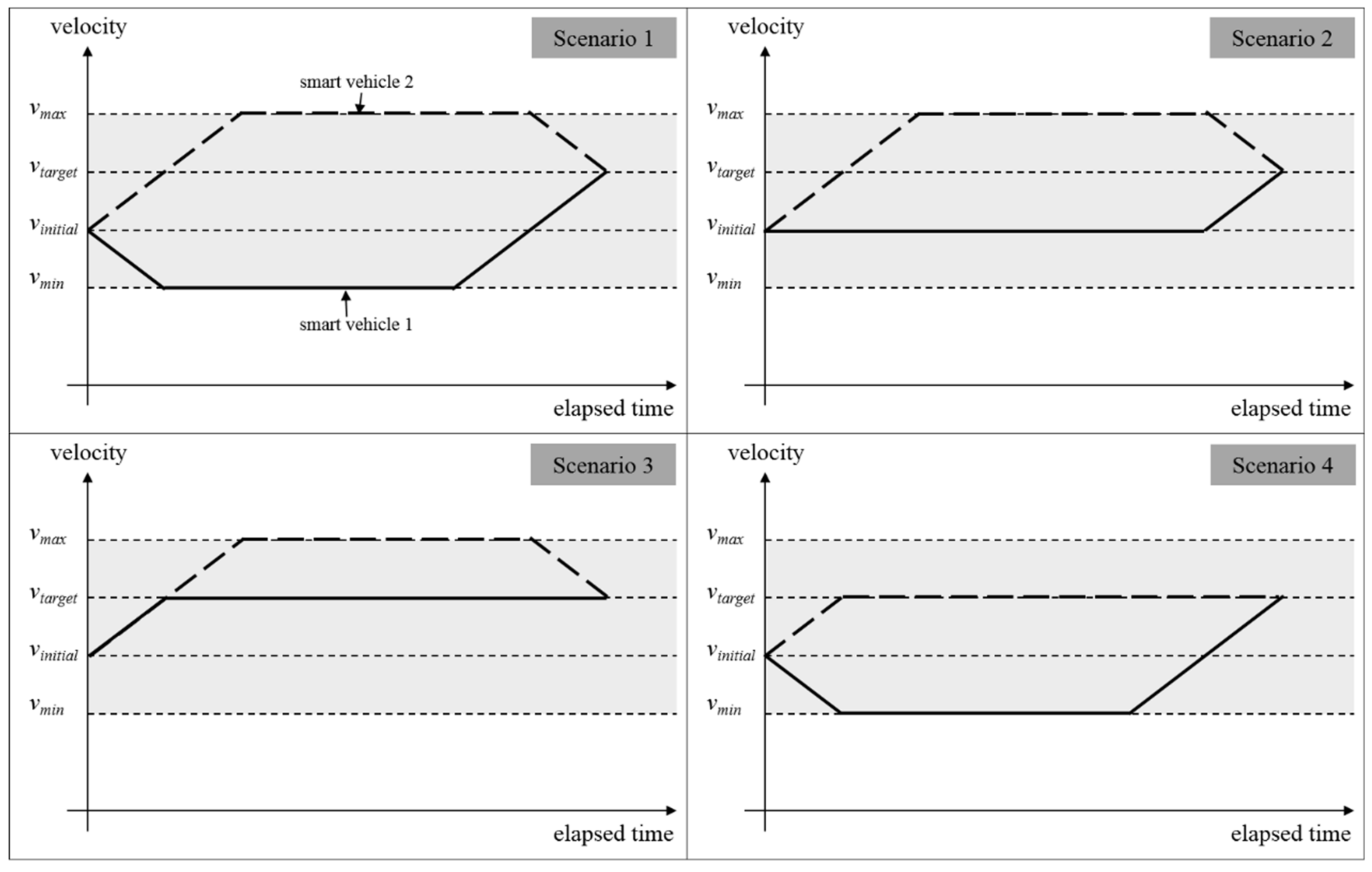
The platooning of autonomous smart vehicles in a high-speed driving environment is a technology that can be achieved in the near future, and some similar driving-assistive technologies have already been put in practice. There are a variety of advantages to platooning, and one of them is the environmental aspect. This study endeavored to perform a mathematical analysis of the environmental aspect of forming a platoon of smart vehicles. For that, a mathematical experiment was designed with four kinds of scenarios, and each scenario had a different operation profile in terms of the velocity and acceleration of each smart vehicle. The power consumption and both forming distance and time were derived variously according to each scenario through mathematical experiments, and it was observed that the length of the acceleration period and the average operation velocity of the smart vehicles had a significant impact on the environmental effect of platoon formation. It is hoped that this study will be a touchstone for various kinds of platooning algorithm research considering the environment.
Keywords: environmental effect; smart vehicle; platooning; power modeling; power consumption environmental effect; smart vehicle; platooning; power modeling; power consumption