

Response of Anatidae Abundance to Environmental Factors in the Middle and Lower Yangtze River Floodplain, China


Abstract
1. Introduction
2. Materials and Methods
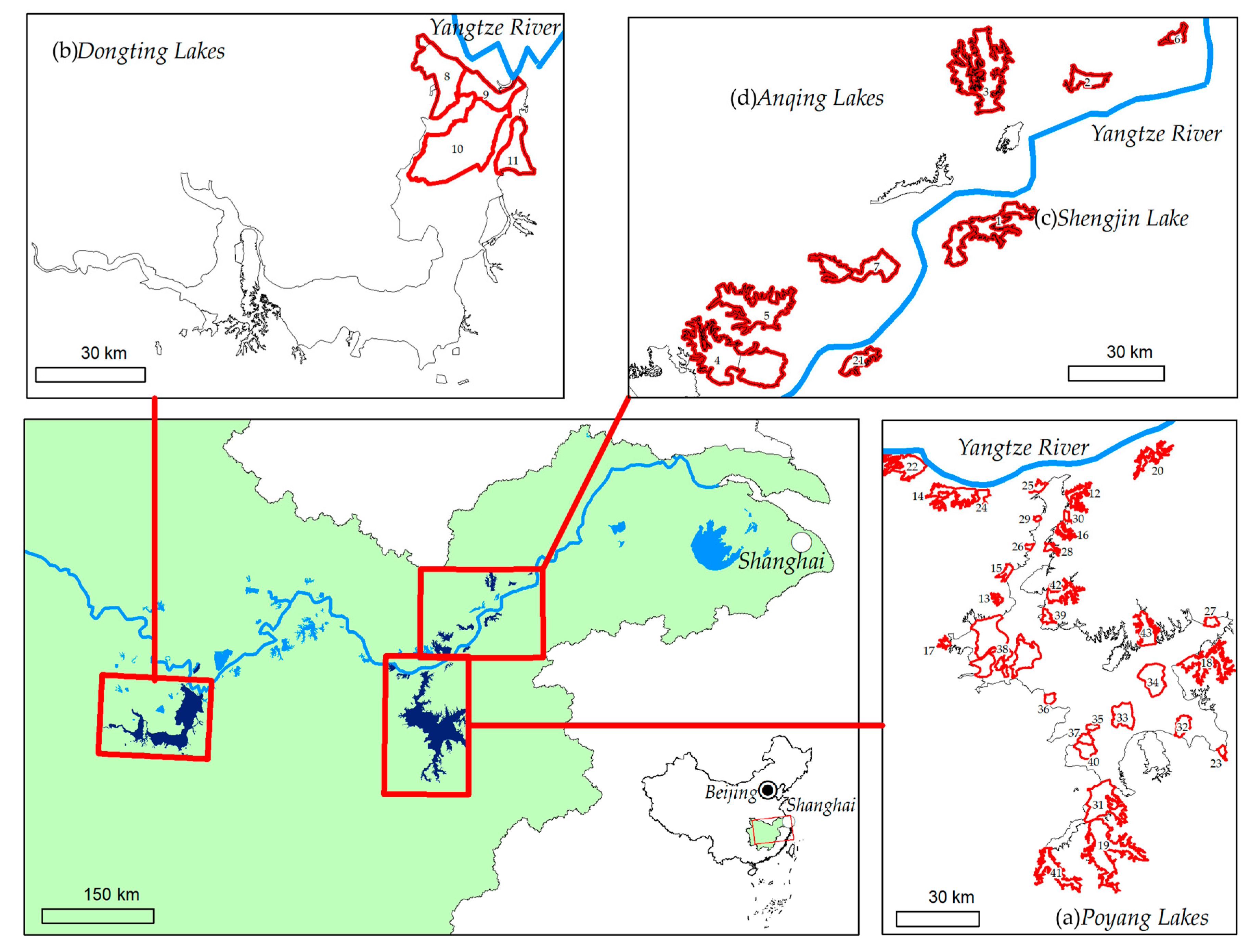
2.1. Study Area
2.2. Census Data
2.3. Environmental Data
2.4. Statistical Analysis
3. Results
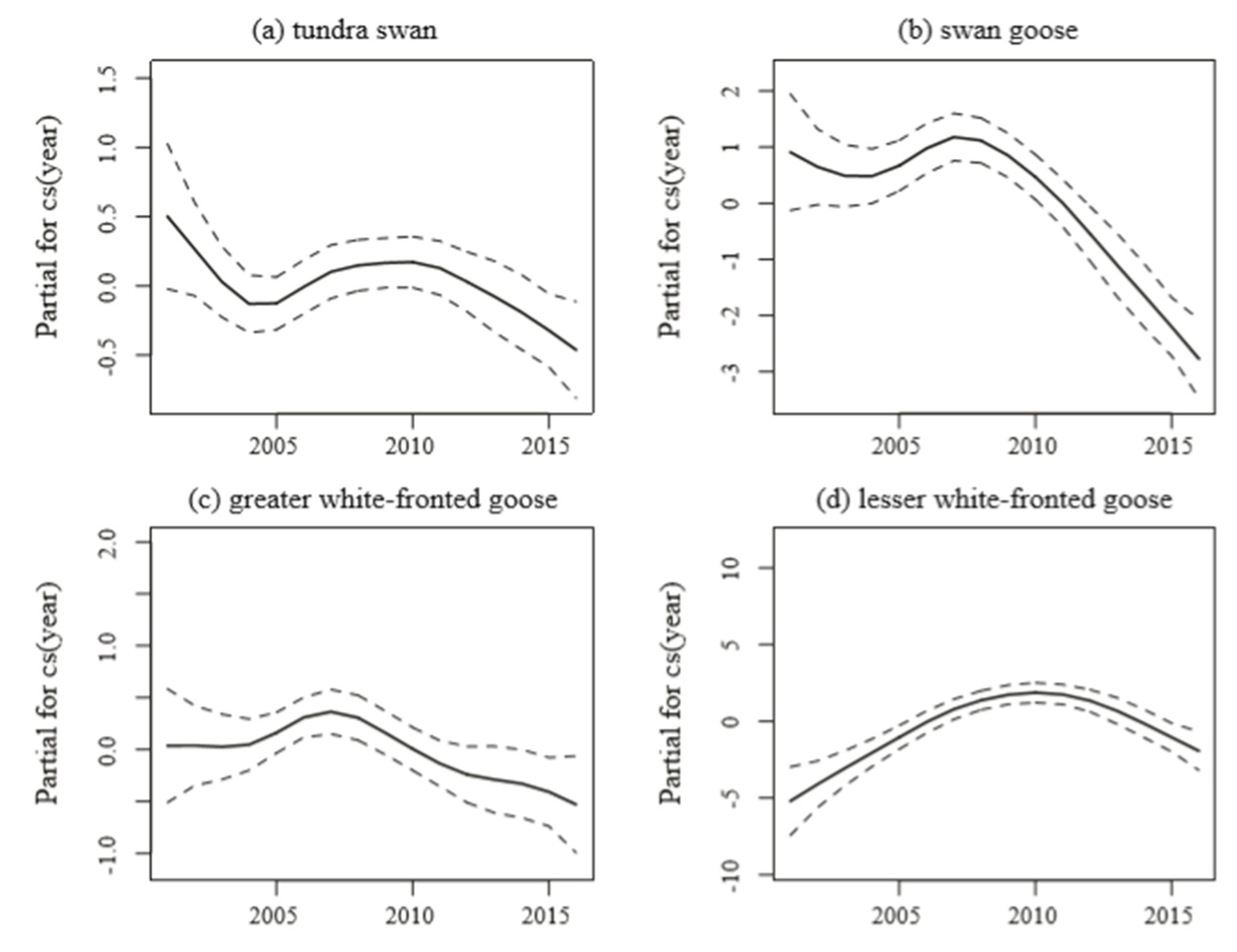
3.1. Population Trends
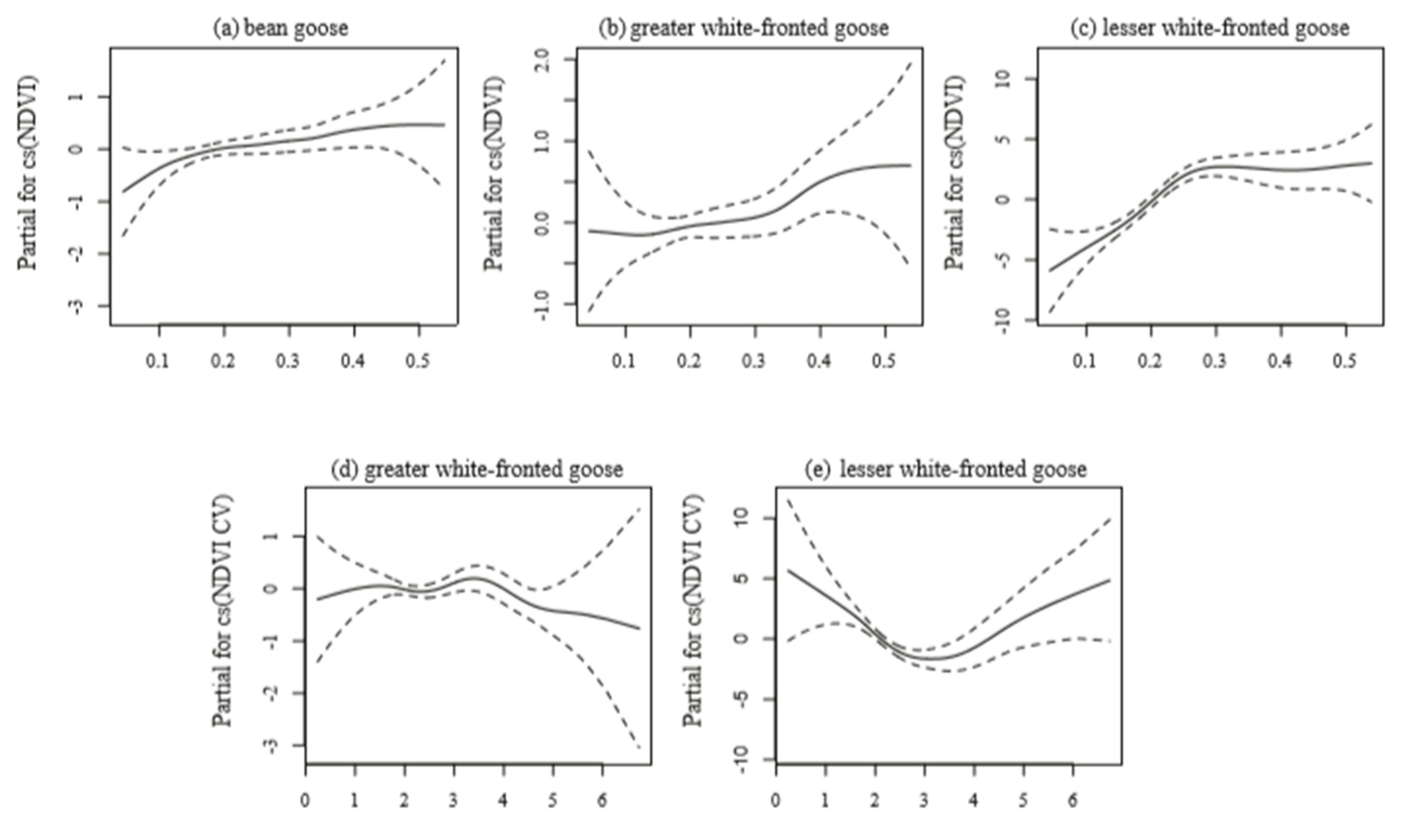
3.2. Impacts of Habitat-Related Variables
3.3. Effects of Climatic Variables
4. Discussion
Supplementary Materials
Author Contributions
Funding
Acknowledgments
Conflicts of Interest
References
- De Boer, W.F.; van Langevelde, F.; Prins, H.H.; de Ruiter, P.C.; Blanc, J.; Vis, M.J.; Gaston, K.J.; Hamilton, I.D. Understanding spatial differences in African elephant densities and occurrence, a continent-wide analysis. Biol. Conserv. 2013, 159, 468–476. [Google Scholar] [CrossRef] [Scilit]
- Wen, L.; Rogers, K.; Saintilan, N.; Ling, J. The influences of climate and hydrology on population dynamics of waterbirds in the lower Murrumbidgee River floodplains in Southeast Australia: Implications for environmental water management. Ecol. Model. 2011, 222, 154–163. [Google Scholar] [CrossRef] [Scilit]
- Pavón-Jordán, D.; Fox, A.D.; Clausen, P.; Dagys, M.; Deceuninck, B.; Devos, K.; Hearn, R.D.; Holt, C.A.; Hornman, M.; Keller, V.; et al. Climate-driven changes in winter abundance of a migratory waterbird in relation to EU protected areas. Divers. Distrib. 2015, 21, 571–582. [Google Scholar] [CrossRef] [Scilit]
- Cao, L.; Fox, A.D. Birds and people both depend on China’s wetlands. Nature 2009, 460, 173. [Google Scholar] [CrossRef] [Scilit]
- Cao, L.; Zhang, Y.; Barter, M.; Lei, G. Anatidae in eastern China during the non-breeding season: Geographical distributions and protection status. Biol. Conserv. 2010, 143, 650–659. [Google Scholar] [CrossRef] [Scilit]
- Jia, Q.; Koyama, K.; Choi, C.Y.; Kim, H.J.; Cao, L.; Gao, D.; Liu, G.; Fox, A.D. Population estimates and geographical distributions of swans and geese in East Asia based on counts during the non-breeding season. Bird Conserv. Int. 2016, 26, 397–417. [Google Scholar] [CrossRef] [Scilit]
- De Boer, W.F.; Cao, L.; Barter, M.; Wang, X.; Sun, M.; Van Oeveren, H.; De Leeuw, J.; Barzen, J.; Prins, H.H.T. Comparing the community composition of European and Eastern Chinese waterbirds and the influence of human factors on the China waterbird community. Ambio 2011, 40, 68–77. [Google Scholar] [CrossRef] [Scilit]
- Zhang, Y.; Jia, Q.; Prins, H.H.T.; Cao, L.; De Boer, W.F. Individual-area relationship best explains goose species density in wetlands. PLoS ONE 2015, 10, e0124972. [Google Scholar] [CrossRef] [Scilit]
- Guan, L.; Lei, J.; Zuo, A.; Zhang, H.; Lei, G.; Wen, L. Optimizing the timing of water level recession for conservation of wintering geese in Dongting Lake, China. Ecol. Eng. 2016, 88, 90–98. [Google Scholar] [CrossRef] [Scilit]
- Zhang, Y.; Jia, Q.; Prins, H.; Cao, L.; de Boer, W. Effect of conservation efforts and ecological variables on waterbird population sizes in wetlands of the Yangtze River. Sci. Rep. 2015, 5, 17136. [Google Scholar] [CrossRef] [Scilit]
- Zhang, Y.; Cao, L.; Barter, M.; Fox, A.D.; Zhao, M.; Meng, F.; Shi, H.; Jiang, Y.; Zhu, W. Changing distribution and abundance of Swan Goose Anser cygnoides in the Yangtze River floodplain: The likely loss of a very important wintering site. Bird Conserv. Int. 2011, 21, 36–48. [Google Scholar] [CrossRef] [Scilit]
- Fox, A.D.; Cao, L.; Zhang, Y.; Barter, M.; Zhao, M.J.; Meng, F.J.; Wang, S.L. Declines in the tuber-feeding waterbird guild at Shengjin Lake National Nature Reserve, China—A barometer of submerged macrophyte collapse. Aquat. Conserv. Mar. Freshw. Ecosyst. 2011, 21, 82–91. [Google Scholar] [CrossRef] [Scilit]
- Si, Y.; Skidmore, A.K.; Wang, T.; de Boer, W.F.; Toxopeus, A.G.; Schlerf, M.; Oudshoorn, M.; Zwerver, S.; Jeugd, H.V.D.; Exo, K.M.; et al. Distribution of barnacle geese Branta leucops is in relation to food resources, distance to roosts, and the location of refuges. Ardea 2011, 99, 217–226. [Google Scholar] [CrossRef] [Scilit]
- Koh, C.N.; Lee, P.F.; Lin, R.S. Bird species richness patterns of northern Taiwan: Primary productivity, human population density, and habitat heterogeneity. Divers. Distrib. 2006, 12, 546–554. [Google Scholar] [CrossRef] [Scilit]
- Heuermann, N.; van Langevelde, F.; van Wieren, S.E.; Prins, H.H. Increased searching and handling effort in tall swards lead to a Type IV functional response in small grazing herbivores. Oecologia 2011, 166, 659–669. [Google Scholar] [CrossRef] [Scilit] [PubMed]
- Bos, D.; Van De Koppel, J.; Weissing, F.J. Dark-bellied brent geese aggregate to cope with increased levels of primary production. Oikos 2004, 107, 485–496. [Google Scholar] [CrossRef] [Scilit]
- Searle, K.R.; Vandervelde, T.; Hobbs, N.T.; Shipley, L.A. Gain functions for large herbivores: Tests of alternative models. J. Anim. Ecol. 2005, 74, 181–189. [Google Scholar] [CrossRef] [Scilit]
- Shipley, L.A. The influence of bite size on foraging at larger spatial and temporal scales by mammalian herbivores. Oikos 2007, 116, 1964–1974. [Google Scholar] [CrossRef] [Scilit]
- Tews, J.; Brose, U.; Grimm, V.; Tielborger, K.; Wichmann, M.C.; Schwager, M.; Jeltsch, F. Animal species diversity driven by habitat heterogeneity/diversity: The importance of keystone structures. J. Biogeogr. 2004, 31, 79–92. [Google Scholar] [CrossRef] [Scilit]
- Meehan, T.D.; Jetz, W.; Brown, J.H. Energetic determinants of abundance in winter landbird communities. Ecol. Lett. 2004, 7, 532–537. [Google Scholar] [CrossRef] [Scilit]
- Root, T. Energy Constraints on Avian Distributions and Abundances. Ecology 1988, 69, 330–339. [Google Scholar] [CrossRef] [Scilit]
- Milchunas, D.G.; Lauenroth, W.K. Quantitative effects of grazing on vegetation and soils over a global range of environments. Ecol. Monogr. 1993, 63, 327–366. [Google Scholar] [CrossRef] [Scilit]
- Nolet, B.A.; Fuld, V.N.; van Rijswijk, M.E.C. Foraging costs and accessibility as determinants of giving-up densities in a swan-pondweed system. Oikos 2006, 112, 353–362. [Google Scholar] [CrossRef] [Scilit]
- Zenzal, T.J.; Contina, A.J.; Kelly, J.F.; Moore, F.R. Temporal migration patterns between natal locations of ruby-throated hummingbirds (Archilochus colubris) and their Gulf Coast stopover site. Mov. Ecol. 2018, 6, 2. [Google Scholar] [CrossRef] [Scilit] [PubMed]
- La Sorte, F.A.; Tingley, M.W.; Hurlbert, A.H. The role of urban and agricultural areas during avian migration: An assessment of within-year temporal turnover. Glob. Ecol. Biogeogr. 2014, 23, 1225–1234. [Google Scholar] [CrossRef] [Scilit]
- Qi, S.; Brown, D.G.; Tian, Q.; Jiang, L.; Zhao, T.; Bergen, K.M. Inundation Extent and Flood Frequency Mapping Using LANDSAT Imagery and Digital Elevation Models. GIsci. Remote Sens. 2009, 46, 101–127. [Google Scholar] [CrossRef] [Scilit]
- Huang, Q.; Sun, Z.; Opp, C.; Lotz, T.; Jiang, J.; Lai, X. Hydrological Drought at Dongting Lake: Its Detection, Characterization, and Challenges Associated With Three Gorges Dam in Central Yangtze, China. Water Resour. Manag. 2014, 28, 5377–5388. [Google Scholar] [CrossRef] [Scilit]
- Bibby, C.J. Bird Census Techniques; Elsevier: Amsterdam, The Netherlands, 2000; ISBN 0120958317. [Google Scholar]
- Wood, K.A.; Stillman, R.A.; Coombs, T.; Mcdonald, C.; Daunt, F.; O’Hare, M.T. The role of season and social grouping on habitat use by Mute Swans (Cygnus olor ) in a lowland river catchment. Bird Study 2013, 60, 229–237. [Google Scholar] [CrossRef] [Scilit]
- Barter, M.; Cao, L.; Chen, L.; Lei, G. Results of a survey for waterbirds in the lower Yangtze floodplain, China, in January-February 2004. Forktail 2005, 21, 1–7. [Google Scholar]
- Claverie, M.; Vermote, E.F.; Franch, B.; Masek, J.G. Evaluation of the Landsat-5 TM and Landsat-7 ETM+surface reflectance products. Remote Sens. Environ. 2015, 169, 390–403. [Google Scholar] [CrossRef] [Scilit]
- Scaramuzza, P.; Micijevic, E.; Chander, G. SLC Gap-Filled Products Phase one Methodology. 2004. Available online: https://landsat.usgs.gov/sites/default/files/documents/SLC_Gap_Fill_Methodology.pdf (accessed on 10 September 2014).
- Mantero, P.; Moser, G.; Serpico, S.B. Partially supervised classification of remote sensing images through SVM-based probability density estimation. IEEE Trans. Geosci. Remote Sens. 2005, 43, 559–570. [Google Scholar] [CrossRef] [Scilit]
- Joseph, L.N.; Elkin, C.; Martin, T.G.; Possingham, H.P. Modeling abundance using N-mixture models: The importance of considering ecological mechanisms. Ecol. Appl. 2009, 19, 631–642. [Google Scholar] [CrossRef] [Scilit] [PubMed]
- Whittingham, M.J.; Stephens, P.A.; Bradbury, R.B.; Freckleton, R.P. Why do we still use stepwise modelling in ecology and behaviour? J. Anim. Ecol. 2006, 75, 1182–1189. [Google Scholar] [CrossRef] [Scilit] [PubMed]
- R Core Team. R Foundation for Statistical Computing. 2016. Available online: https://www.R-project.org/ (accessed on 15 August 2016).
- Rigby, R.A.; Stasinopoulos, D.M.; Akantziliotou, C. A framework for modelling overdispersed count data, including the Poisson-shifted generalized inverse Gaussian distribution. Comput. Stat. Data Anal. 2008, 53, 381–393. [Google Scholar] [CrossRef] [Scilit]
- State Forestry Administration. Outcomes of the second national wetland resource survey. L. Green. 2014, 2, 6–7. [Google Scholar]
- Ministry of Ecology and Environmental of PRC List of Natural Reserves. Available online: http://www.mee.gov.cn/stbh/zrbhq/qgzrbhqml/201611/P020161125559865886359.pdf (accessed on 8 November 2016).
- Zhao, M.; Cong, P.; Barter, M.; Fox, A.D.; Cao, L. The changing abundance and distribution of Greater White-fronted Geese Anser albifrons in the Yangtze River floodplain: Impacts of recent hydrological changes. Bird Conserv. Int. 2012, 22, 135–143. [Google Scholar] [CrossRef] [Scilit]
- Wang, X.; Fox, A.D.; Cong, P.; Cao, L. Food constraints explain the restricted distribution of wintering Lesser White-fronted Geese Anser erythropus in China. IBIS 2013, 155, 576–592. [Google Scholar] [CrossRef] [Scilit]
- Zhao, M.; Cao, L.; Klaassen, M.; Zhang, Y.; Fox, A.D. Avoiding Competition? Site Use, Diet and Foraging Behaviours in Two Similarly Sized Geese Wintering in China. Ardea 2015, 103, 27–39. [Google Scholar] [CrossRef] [Scilit]
- Connor, E.F.; Courtney, A.C.; Yoder, J.M.; Mar, N.; Connor, E.; Yder, J.M. Individuals-Area Relationships: The Relationship between Animal Population Density and Area. Ecology 2007, 81, 734–748. [Google Scholar]
- Bell, R.H.V. The use of the herb layer by grazing ungulates in the Serengeti. In Animal Populations in Relation to Their Food Resources; Blackwell Scientific: Oxford, UK, 1970; Volume 10, pp. 111–124. [Google Scholar]
- Jarman, P. The social organisation of antelope in relation to their ecology. Behaviour 1974, 48, 215–267. [Google Scholar] [CrossRef] [Scilit]
- Fleishman, E.; Ray, C.; Sjögren-Gulve, P.; Boggs, C.L.; Murphy, D.D. Assessing the roles of patch quality, area, and isolation in predicting metapopulation dynamics. Conserv. Biol. 2002, 706–716. [Google Scholar] [CrossRef] [Scilit]
- Prugh, L.R.; Hodges, K.E.; Sinclair, A.R.E.; Brasharesa, J.S. Effect of habitat area and isolation on fragmented animal populations. Proc. Natl. Acad. Sci. USA 2008, 105, 20770–20775. [Google Scholar] [CrossRef] [Scilit] [PubMed]

| Predictor | Estimate | Standard Error | t-Value | p | Model Performance | ||
|---|---|---|---|---|---|---|---|
| Global Deviance | GAIC | Pseudo R2 | |||||
| Tundra Swan | |||||||
| (Intercept) | 60.69 | 29.24 | 2.08 | 0.04 * | |||
| Year | −0.03 | 0.01 | −1.85 | 0.07 | |||
| Precipitation | 0.00 | 0.00 | 0.31 | 0.76 | 4492.74 | 4582.03 | 0.46 |
| Swan goose | |||||||
| (Intercept) | 488.73 | 61.19 | 7.99 | 0.00 ** | |||
| Year | −0.24 | 0.03 | −7.91 | 0.00 ** | |||
| Temperature | −0.05 | 0.07 | −0.67 | 0.51 | 4360.53 | 4462.05 | 0.38 |
| Bean goose | |||||||
| (Intercept) | 6.49 | 0.23 | 28.39 | 0.00 ** | |||
| NDVI CV | −0.05 | 0.06 | −0.76 | 0.45 | |||
| NDVI | 2.12 | 0.64 | 3.31 | 0.00 ** | |||
| Precipitation | 0.00 | 0.00 | −1.39 | 0.17 | 4688.96 | 4789.68 | 0.59 |
| Greater white-fronted goose | |||||||
| (Intercept) | 91.43 | 33.97 | 2.69 | 0.01 * | |||
| Year | −0.04 | 0.02 | −2.50 | 0.01 * | |||
| NDVI | 1.64 | 0.76 | 2.14 | 0.03 * | 2859.72 | 2943.25 | 0.44 |
| Lesser white-fronted goose | |||||||
| (Intercept) | −313.56 | 113.15 | −2.77 | 0.01 * | |||
| Year | 0.15 | 0.06 | 2.73 | 0.01 * | |||
| NDVI CV | −0.66 | 0.32 | −2.09 | 0.04 * | |||
| NDVI | 19.86 | 2.68 | 7.42 | 0.00 ** | 1271.61 | 1375.50 | 0.42 |
© 2019 by the authors. Licensee MDPI, Basel, Switzerland. This article is an open access article distributed under the terms and conditions of the Creative Commons Attribution (CC BY) license (http://creativecommons.org/licenses/by/4.0/).
Share and Cite
Jia, Q.; Zhang, Y.; Cao, L. Response of Anatidae Abundance to Environmental Factors in the Middle and Lower Yangtze River Floodplain, China. Sustainability 2019, 11, 6814. https://doi.org/10.3390/su11236814
Jia Q, Zhang Y, Cao L. Response of Anatidae Abundance to Environmental Factors in the Middle and Lower Yangtze River Floodplain, China. Sustainability. 2019; 11(23):6814. https://doi.org/10.3390/su11236814
Chicago/Turabian StyleJia, Qiang, Yong Zhang, and Lei Cao. 2019. "Response of Anatidae Abundance to Environmental Factors in the Middle and Lower Yangtze River Floodplain, China" Sustainability 11, no. 23: 6814. https://doi.org/10.3390/su11236814
APA StyleJia, Q., Zhang, Y., & Cao, L. (2019). Response of Anatidae Abundance to Environmental Factors in the Middle and Lower Yangtze River Floodplain, China. Sustainability, 11(23), 6814. https://doi.org/10.3390/su11236814

