Renewable Energy Prosumers in Mediterranean Viticulture Social–Ecological Systems


Abstract
1. Introduction
1.1. Social–Ecological Systems Resilience Framework and the Alentejo Wine SES
2. Materials and Methods
2.1. Multi-Method Approach
3. Results
3.1. Needs Assessment Workshop: Constraints and Enablers
3.2. Field Notes: A Holistic Perspective
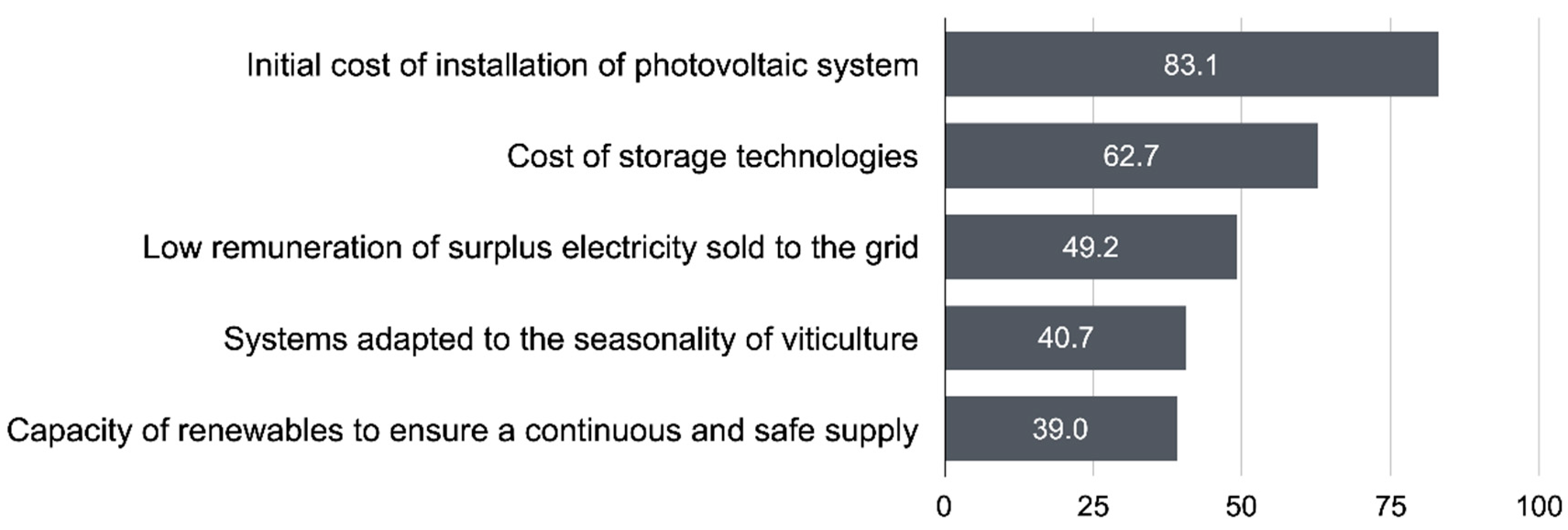
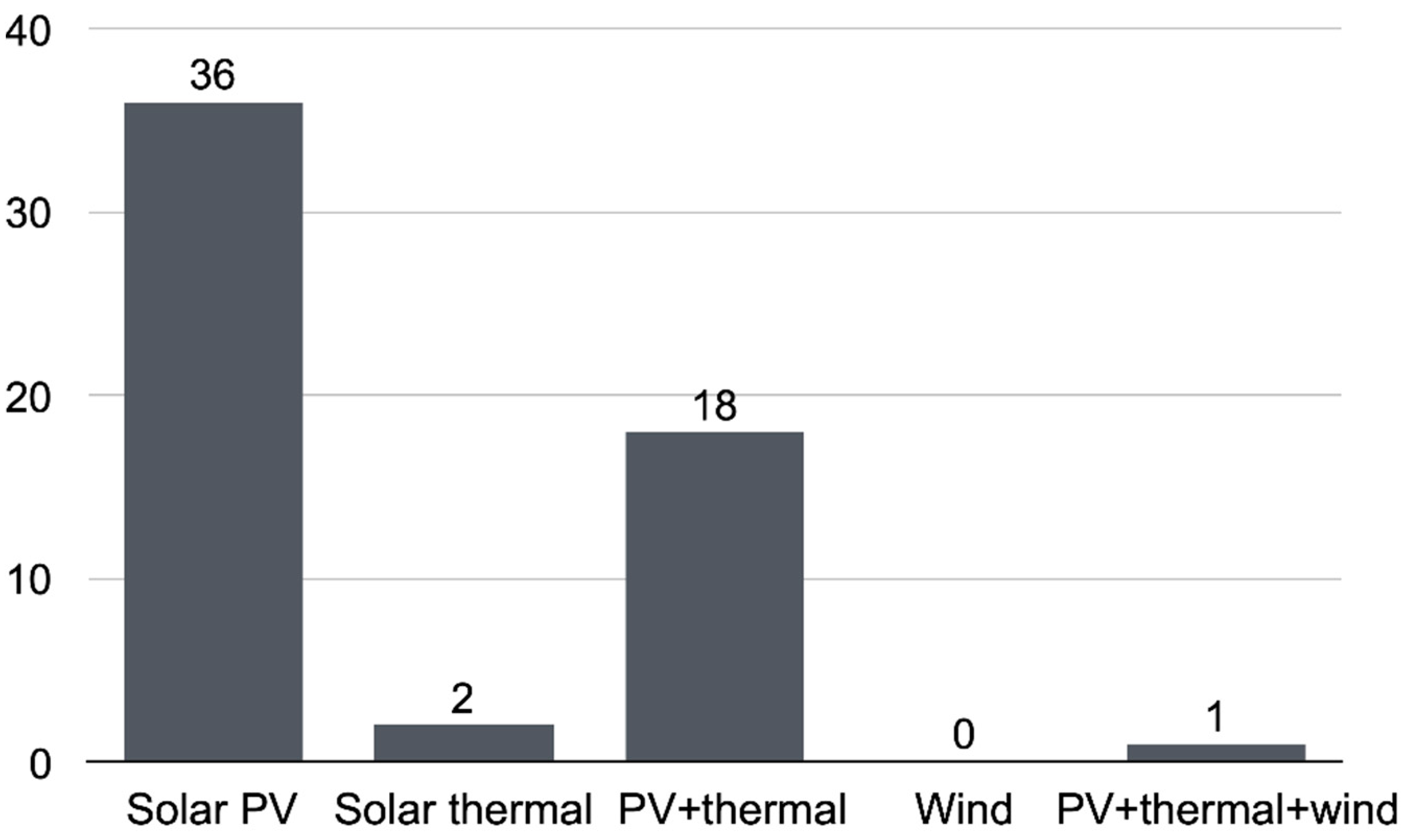
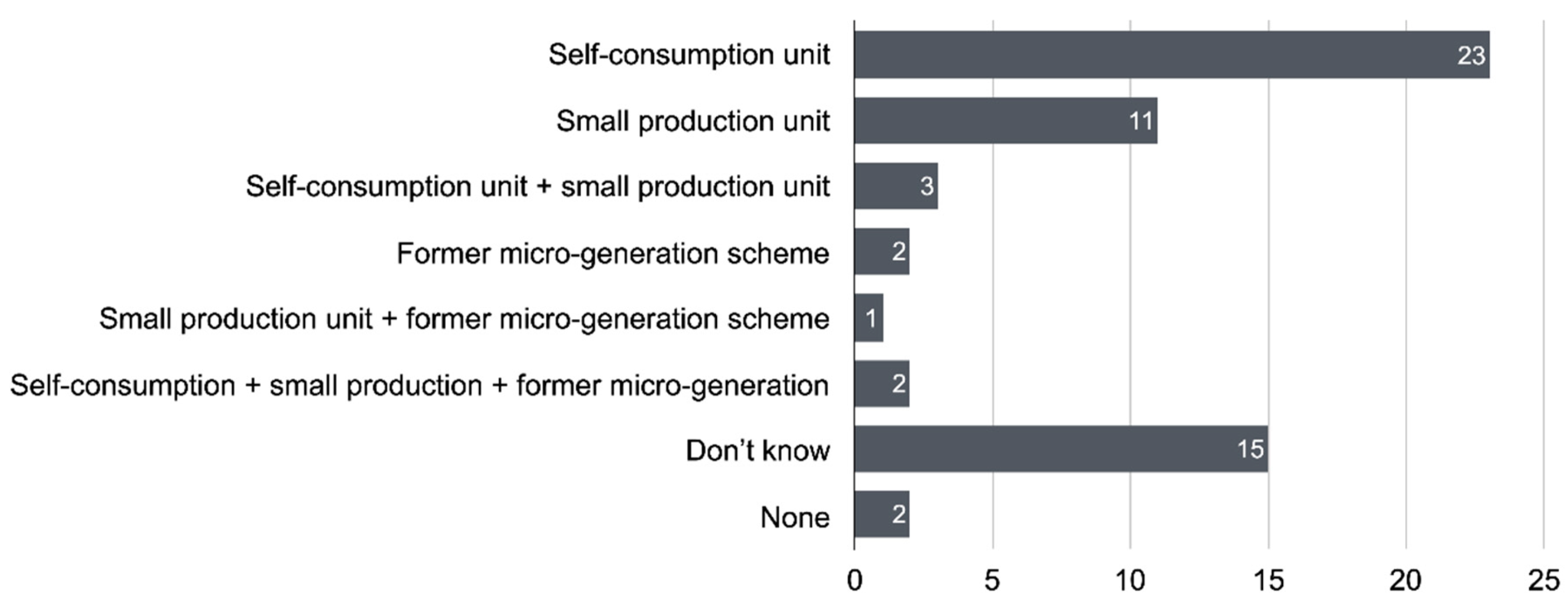
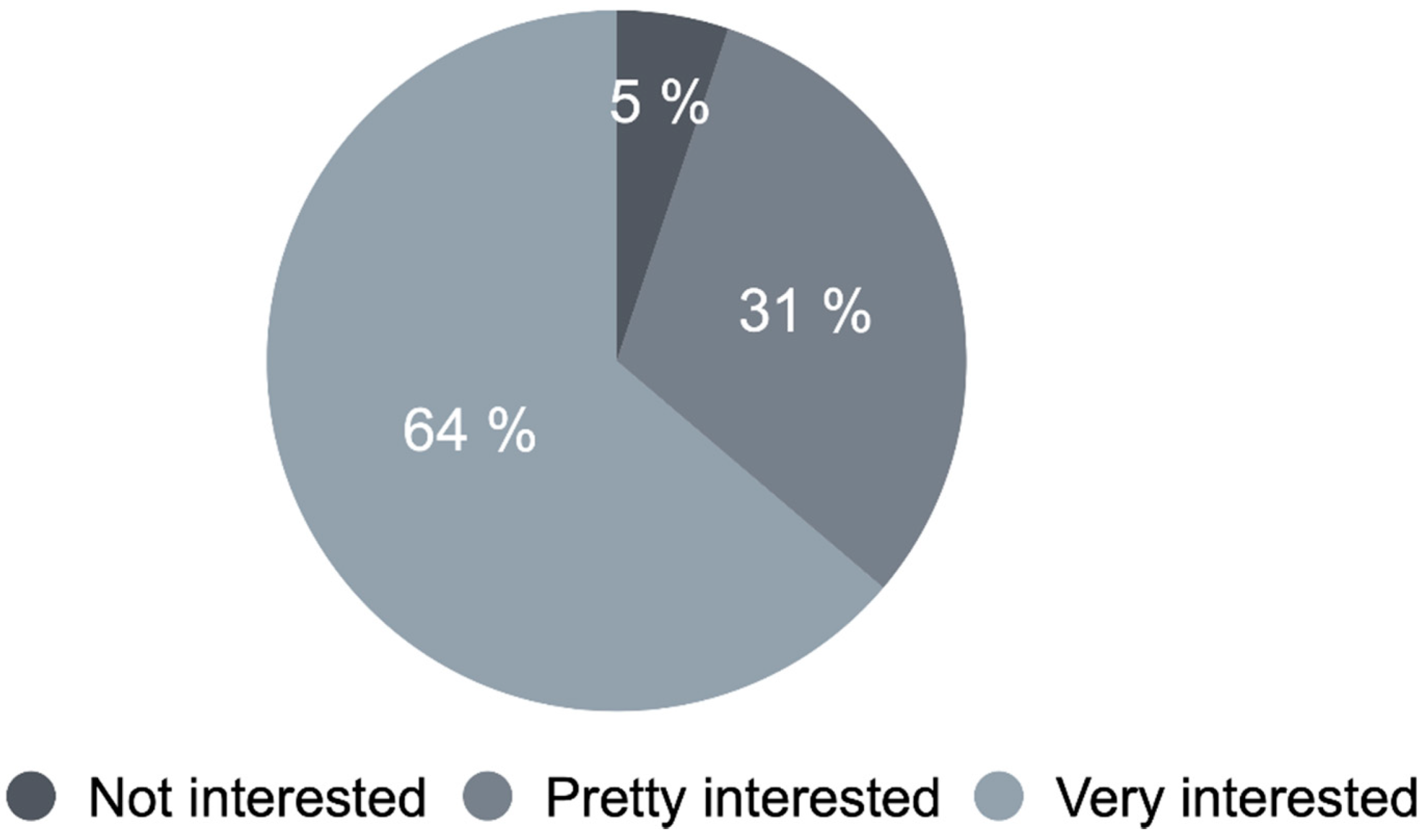
3.3. Questionnaire on Barriers and Opportunities
3.4. Triangulation of Results
4. Discussion
5. Conclusions
Supplementary Materials
Author Contributions
Funding
Acknowledgments
Conflicts of Interest
References
- De Vries, G.W.; Boon, W.P.C.; Peine, A. User-led innovation in civic energy communities. Environ. Innov. Soc. Transit. 2016, 19, 51–65. [Google Scholar] [CrossRef] [Scilit]
- Butenko, A. User-Centered Innovation and Regulatory Framework: Energy Prosumers’ Market Access in EU Regulation. 2016. Available online: http://dx.doi.org/10.2139/ssrn.2797545 (accessed on 30 May 2019).
- Bellekom, S.; Arentsen, M.; van Gorkum, K. Prosumption and the distribution and supply of electricity. Energy Sustain. Soc. 2016, 6, 22. [Google Scholar] [CrossRef] [Scilit]
- CE Delft. The Potential of Energy Citizens in the European Union; CE Delft: Delft, The Netherlands, September 2016; Available online: https://www.cedelft.eu/publicatie/the_potential_of_energy_citizens_in_the_european_union/1845 (accessed on 25 August 2019).
- Van der Schoor, T. Local Citizen Initiatives and Transitions to Energy Sustainability. Available online: https://research.hanze.nl/ws/portalfiles/portal/3444082/107.Local_citizen_initiatives_SB13_Oulu_vdSchoor_1_.pdf (accessed on 25 July 2019).
- Newbery, D.M. Towards a green energy economy? The EU Energy Union’s transition to a low-carbon zero subsidy electricity system—Lessons from the UK’s Electricity Market Reform. Appl. Energy 2016, 179, 1321–1330. [Google Scholar] [CrossRef] [Scilit]
- Morstyn, T.; Farrell, N.; Darby, S.J.; McCulloch, M.D. Using peer-to-peer energy-trading platforms to incentivize prosumers to form federated power plants. Nat. Energy 2018, 3, 94. [Google Scholar] [CrossRef] [Scilit]
- Dóci, G.; Vasileiadou, E.; Petersen, A.C. Exploring the transition potential of renewable energy communities. Futures 2015, 66, 85–95. [Google Scholar] [CrossRef] [Scilit]
- Croonenbroeck, C.; Lowitzsch, J. From Fossil to Renewable Energy Sources. In Energy Transition: Financing Consumer Co-Ownership in Renewables; Lowitzsch, J., Ed.; Springer International Publishing: Cham, Switzerland, 2019; pp. 29–58. ISBN 978-3-319-93518-8. [Google Scholar]
- Smyth, M.; Russell, J. ‘From graft to bottle’—Analysis of energy use in viticulture and wine production and the potential for solar renewable technologies. Renew. Sustain. Energy Rev. 2009, 13, 1985–1993. [Google Scholar] [CrossRef] [Scilit]
- Garcia-Casarejos, N.; Gargallo, P.; Carroquino, J. Introduction of Renewable Energy in the Spanish Wine Sector. Sustainability 2018, 10, 3157. [Google Scholar] [CrossRef] [Scilit]
- Galbreath, J.; Charles, D.; Oczkowski, E. The Drivers of Climate Change Innovations: Evidence from the Australian Wine Industry. J. Bus. Ethics 2016, 135, 217–231. [Google Scholar] [CrossRef] [Scilit]
- Fraga, H.; García de Cortázar Atauri, I.; Malheiro, A.C.; Santos, J.A. Modelling climate change impacts on viticultural yield, phenology and stress conditions in Europe. Glob. Change Biol. 2016, 22, 3774–3788. [Google Scholar] [CrossRef] [Scilit]
- Fraga, H.; Malheiro, A.C.; Moutinho-Pereira, J.; Santos, J.A. An overview of climate change impacts on European viticulture. Food Energy Secur. 2012, 1, 94–110. [Google Scholar] [CrossRef] [Scilit]
- Malheiro, A.; Santos, J.; Fraga, H.; Pinto, J. Climate change scenarios applied to viticultural zoning in Europe. Clim. Res. 2010, 43, 163–177. [Google Scholar] [CrossRef] [Scilit]
- Costa, J.M.; Vaz, M.; Escalona, J.; Egipto, R.; Lopes, C.; Medrano, H.; Chaves, M.M. Modern viticulture in southern Europe: Vulnerabilities and strategies for adaptation to water scarcity. Agric. Water Manag. 2016, 164, 5–18. [Google Scholar] [CrossRef] [Scilit]
- Mozell, M.R.; Thach, L. The impact of climate change on the global wine industry: Challenges & solutions. Wine Econ. Policy 2014, 3, 81–89. [Google Scholar]
- Galitsky, C.; Worrell, E.; Radspieler, A.; Healy, P.; Zechiel, S. BEST Winery Guidebook: Benchmarking and Energy and Water Savings Tool for the Wine Industry; Lawrence Berkeley National Laboratory: Berkeley, CA, USA, 2005. [Google Scholar]
- FAO. The State of Food and Agriculture. Climate Change, Agriculture and Food Security; FAO: Rome, Italy, 2016. [Google Scholar]
- Dressler, M. Prosumers in the wine market: An explorative study. Wine Econ. Policy 2016, 5, 24–32. [Google Scholar] [CrossRef] [Scilit]
- Folke, C. Resilience: The emergence of a perspective for social-ecological systems analyses. Glob. Environ. Change 2006, 16, 253–267. [Google Scholar] [CrossRef] [Scilit]
- Johnson, V.; Hall, S. Community energy and equity: The distributional implications of a transition to a decentralised electricity system. People Place Policy Online 2014, 8, 149–167. [Google Scholar] [CrossRef] [Scilit]
- Haukipuro, L.; Väinämö, S.; Hyrkäs, P. Innovation Instruments to Co-Create Needs-Based Solutions in a Living Lab. Technol. Innov. Manag. Rev. 2018, 8, 22–35. [Google Scholar] [CrossRef] [Scilit]
- Campos, I.S.; Alves, F.M.; Dinis, J.; Truninger, M.; Vizinho, A.; Penha-Lopes, G. Climate adaptation, transitions, and socially innovative action-research approaches. Ecol. Soc. 2016, 21. [Google Scholar] [CrossRef] [Scilit]
- Schaffers, H.; Guzman, J.G.; Merz, C. An Action Research Approach to Rural Living Labs Innovation. 2008. Available online: https://www.semanticscholar.org/paper/An-Action-Research-Approach-to-Rural-Living-Labs-Schaffers-Guzm%C3%A1n/4c8d3706527ee4b0752e17c014da6362b7b25b26?citationIntent=background#citing-papers (accessed on 25 August 2019).
- Schumacher, J.; Feurstein, K. Living Labs–the user as co-creator. In Proceedings of the 2007 IEEE International Technology Management Conference (ICE), Sophia-Antipolis, France, 4–6 June 2007; pp. 1–6. [Google Scholar]
- Santonen, W.T.; Creazzo, L.; Griffon, A.; Bódi, Z.; Aversano, P. Cities as Living Labs–Increasing the Impact of Investment in the Circular Economy for Sustainable Cities. 2017. Available online: https://ec.europa.eu/research/openvision/pdf/rise/cities_as_living_labs.pdf (accessed on 26 August 2019).
- Armitage, D.R.; Plummer, R.; Berkes, F.; Arthur, R.I.; Charles, A.T.; Davidson-Hunt, I.J.; Diduck, A.P.; Doubleday, N.C.; Johnson, D.S.; Marschke, M.; et al. Adaptive co-management for social–ecological complexity. Front. Ecol. Environ. 2009, 7, 95–102. [Google Scholar] [CrossRef] [Scilit]
- Liu, J.; Dietz, T.; Carpenter, S.R.; Alberti, M.; Folke, C.; Moran, E.; Pell, A.N.; Deadman, P.; Kratz, T.; Lubchenco, J.; et al. Complexity of Coupled Human and Natural Systems. Science 2007, 317, 1513–1516. [Google Scholar] [CrossRef] [Scilit]
- McGinnis, M.D.; Ostrom, E. Social-ecological system framework: initial changes and continuing challenges. Ecol. Soc. 2014, 19, art30. [Google Scholar] [CrossRef] [Scilit]
- Ostrom, E. A General Framework for Analyzing Sustainability of Social-Ecological Systems. Science 2009, 325, 419–422. [Google Scholar] [CrossRef] [Scilit] [PubMed]
- Folke, C.; Carpenter, S.R.; Walker, B.; Scheffer, M.; Chapin, T.; Rockström, J. Resilience Thinking: Integrating Resilience, Adaptability and Transformability. Ecol. Soc. 2010, 15. [Google Scholar] [CrossRef] [Scilit]
- Garmestani, A.S.; Benson, M.H. A Framework for Resilience-based Governance of Social-Ecological Systems. Ecol. Soc. 2013, 18, art9. [Google Scholar] [CrossRef] [Scilit]
- Correia, T.P. Threatened landscape in Alentejo, Portugal: the ‘montado’ and other ‘agro-silvo-pastoral’ systems. Landsc. Urban Plan. 1993, 24, 43–48. [Google Scholar] [CrossRef] [Scilit]
- Guimarães, M.H.; Guiomar, N.; Surová, D.; Godinho, S.; Pinto Correia, T.; Sandberg, A.; Ravera, F.; Varanda, M. Structuring wicked problems in transdisciplinary research using the Social–Ecological systems framework: An application to the montado system, Alentejo, Portugal. J. Clean. Prod. 2018, 191, 417–428. [Google Scholar] [CrossRef] [Scilit]
- Jones, N.; de Graaff, J.; Rodrigo, I.; Duarte, F. Historical review of land use changes in Portugal (before and after EU integration in 1986) and their implications for land degradation and conservation, with a focus on Centro and Alentejo regions. Appl. Geogr. 2011, 31, 1036–1048. [Google Scholar] [CrossRef] [Scilit]
- Campos, I.; Vizinho, A.; Truninger, M.; Penha Lopes, G. Converging for deterring land abandonment: a systematization of experiences of a rural grassroots innovation. Community Dev. J. 2016, 51, 552–570. [Google Scholar] [CrossRef] [Scilit]
- Huntjens, P.; Pahl-Wostl, C.; Rihoux, B.; Schlüter, M.; Flachner, Z.; Neto, S.; Koskova, R.; Dickens, C.; Nabide Kiti, I. Adaptive Water Management and Policy Learning in a Changing Climate: A Formal Comparative Analysis of Eight Water Management Regimes in Europe, Africa and Asia: Adaptive Water Management and Policy Learning in a Changing Climate. Environ. Policy Gov. 2011, 21, 145–163. [Google Scholar] [CrossRef] [Scilit]
- Sadras, V.; Moran, M.; Petrie, P. Resilience of grapevine yield in response to warming. OENO ONE 2017, 51. [Google Scholar] [CrossRef] [Scilit]
- Baêta, S.A. de A. Promoção Do Uso Eficiente De Água E Energia Em Unidades De Produção Vitivinícola: Estudos De Caso Da Adega Mayor E Granacer. Ph.D. Thesis, Lisbon University, Lisboa, Portugal, 2016. [Google Scholar]
- Lopes, C.W. Promoção Do Uso Eficiente De Água E Energia Em Unidades De Produção Vitivinícola: Estudos De Caso Da Adega Cooperativa De Vidigueira, Cuba E Alvito, Herdade Das Servas E Roquevale. Ph.D. Thesis, Lisbon University, Lisboa, Portugal, 2017. [Google Scholar]
- Mendonça, A.M.R. Promoção Do Uso Eficiente De Água E De Energia Em Unidades De Produção Vitivinícola: Estudo Dos Casos Da Herdade Dos Grous E Herdade Da Mingorra. Ph.D. Thesis, Lisbon University, Lisboa, Portugal, 2016. [Google Scholar]
- Gómez-Lorente, D.; Rabaza, O.; Aznar-Dols, F.; Mercado-Vargas, M. Economic and Environmental Study of Wineries Powered by Grid-Connected Photovoltaic Systems in Spain. Energies 2017, 10, 222. [Google Scholar] [CrossRef] [Scilit]
- Hall, S.; Roelich, K. Business model innovation in electricity supply markets: The role of complex value in the United Kingdom. Energy Policy 2016, 92, 286–298. [Google Scholar] [CrossRef] [Scilit]
- Grimstad, S.; Burgess, J. Environmental sustainability and competitive advantage in a wine tourism micro-cluster. Manag. Res. Rev. 2014, 37, 553–573. [Google Scholar] [CrossRef] [Scilit]
- Carrasco, I.; Castillo-Valero, J.-S.; Pérez-Luño, A. Wine Tourism and Wine Vacation as a Cultural and Creative Industry: The Case of the Bullas Wine Route. In Cultural and Creative Industries; Peris-Ortiz, M., Cabrera-Flores, M.R., Serrano-Santoyo, A., Eds.; Springer International Publishing: Cham, Switzerland, 2019; pp. 181–195. ISBN 978-3-319-99589-2. [Google Scholar] [CrossRef] [Scilit]
- Olsson, P.; Folke, C. Local Ecological Knowledge and Institutional Dynamics for Ecosystem Management: A Study of Lake Racken Watershed, Sweden. Ecosystems 2001, 4, 85–104. [Google Scholar] [CrossRef] [Scilit]
- Berkes, F.; Folke, C.; Gadgil, M. Traditional Ecological Knowledge, Biodiversity, Resilience and Sustainability. In Biodiversity Conservation: Problems and Policies; Perrings, C.A., Mäler, K.-G., Folke, C., Holling, C.S., Jansson, B.-O., Eds.; Springer: Dordrecht, The Netherlands, 1994; Volume 4, pp. 269–287. ISBN 978-0-7923-3140-7. [Google Scholar] [CrossRef] [Scilit]
- Folke, C. Traditional Knowledge in Social–Ecological Systems. Ecol. Soc. 2004, 9, art7. [Google Scholar] [CrossRef] [Scilit]
- Moller, H.; Berkes, F.; Lyver, P.O.; Kislalioglu, M. Combining Science and Traditional Ecological Knowledge: Monitoring Populations for Co-Management. Ecol. Soc. 2004, 9. [Google Scholar] [CrossRef] [Scilit]
- Barber, N. Consumers’ Intention to Purchase Environmentally Friendly Wines: A Segmentation Approach. Int. J. Hosp. Tour. Adm. 2012, 13, 26–47. [Google Scholar] [CrossRef] [Scilit]
- Carmichael, B.A.; Senese, D.M. Competitiveness and Sustainability in Wine Tourism Regions: The Application of a Stage Model of Destination Development to Two Canadian Wine Regions. In The Geography of Wine; Dougherty, P.H., Ed.; Springer: Dordrecht, The Netherlands, 2012; pp. 159–178. ISBN 978-94-007-0463-3. [Google Scholar]
- Zambon, I.; Colantoni, A.; Cecchini, M.; Mosconi, E. Rethinking Sustainability within the Viticulture Realities Integrating Economy, Landscape and Energy. Sustainability 2018, 10, 320. [Google Scholar] [CrossRef] [Scilit]
- Marshall, R.S.; Akoorie, M.E.M.; Hamann, R.; Sinha, P. Environmental practices in the wine industry: An empirical application of the theory of reasoned action and stakeholder theory in the United States and New Zealand. J. World Bus. 2010, 45, 405–414. [Google Scholar] [CrossRef] [Scilit]
- Cordano, M.; Marshall, R.S.; Silverman, M. How Do Small and Medium Enterprises Go “Green”? A Study of Environmental Management Programs in the U.S. Wine Industry. J. Bus. Ethics 2010, 92, 463–478. [Google Scholar] [CrossRef] [Scilit]
- Boo, E.; Molinero, S.; Vicente, E.S. Novel Business Models and Main Barriers in the EU Energy System. 2016. Available online: https://zenodo.org/record/3479275#.Xd-httURXIU (accessed on 25 August 2019).
- Dóci, G.K. Renewable Energy Communities. A Comprehensive study of Local Energy Initiatives in the Netherlands and Germany. Ph.D. Thesis, Vrije Universiteit Amsterdam, Amsterdam, The Netherlands, 2017. [Google Scholar]
- Riedner, L.; Mair, C.; Zimek, M.; Brudermann, T.; Stern, T. E-mobility in agriculture: differences in perception between experienced and non-experienced electric vehicle users. Clean Technol. Environ. Policy 2019, 21, 55–67. [Google Scholar] [CrossRef] [Scilit]
- Nigro, N.; Frades, M. Business Models for Financially Sustainable EV Charging Networks. 2015. Available online: https://www.c2es.org/site/assets/uploads/2015/03/business-models-ev-charging-infrastructure-03-15.pdf (accessed on 25 August 2019).
- Ford, R.; Stephenson, J.; Whitaker, J. Prosumer Collectives: A Review; New Zealand’s Smart Grid Forum; Centre for Sustainability, University of Otago: Dunedin, New Zealand, 2016; pp. 1–28. [Google Scholar]
- Koirala, B.P.; Koliou, E.; Friege, J.; Hakvoort, R.A.; Herder, P.M. Energetic communities for community energy: A review of key issues and trends shaping integrated community energy systems. Renew. Sustain. Energy Rev. 2016, 56, 722–744. [Google Scholar] [CrossRef] [Scilit]
- Herbes, C.; Brummer, V.; Rognli, J.; Blazejewski, S.; Gericke, N. Responding to policy change: New business models for renewable energy cooperatives – Barriers perceived by cooperatives’ members. Energy Policy 2017, 109, 82–95. [Google Scholar] [CrossRef] [Scilit]
- Schäufele, I.; Hamm, U. Consumers’ perceptions, preferences and willingness-to-pay for wine with sustainability characteristics: A review. J. Clean. Prod. 2017, 147, 379–394. [Google Scholar] [CrossRef] [Scilit]


| Question | Response Options |
|---|---|
| No, we do not have systems installed, nor intend to No, but we intend to have RES systems installed in the future Yes, we have installed RES systems |
| 1.1. Why? | Open question (optional) |
| We do not intend to produce renewable energies Solar photovoltaics (PV) Solar Thermal Wind Energy Biogas Other |
| We do not intend to produce renewable energies Self-consumption unit Small-production unit Former micro-generation scheme Do not know Other |
| Thermal storage Electricity storage Smart meters Demand-side management systems Not applicable Other |
| On a scale from 1 (not interested) to 6 (very interested) |
| Systems adapted to the seasonality of viticulture Cost of storage technologies Capacity of current storage technologies Cost of electric vehicles Initial cost of installation of photovoltaic system Cost of renewable technologies Low remuneration of surplus electricity sold to the grid Limitation of 250 kW of installed capacity in small production units Capacity of renewables to ensure a continuous and safe supply Adapting viticulture to the impacts of climate change in Alentejo Changes in landscape due to renewables Difficulty in accessing relevant information |
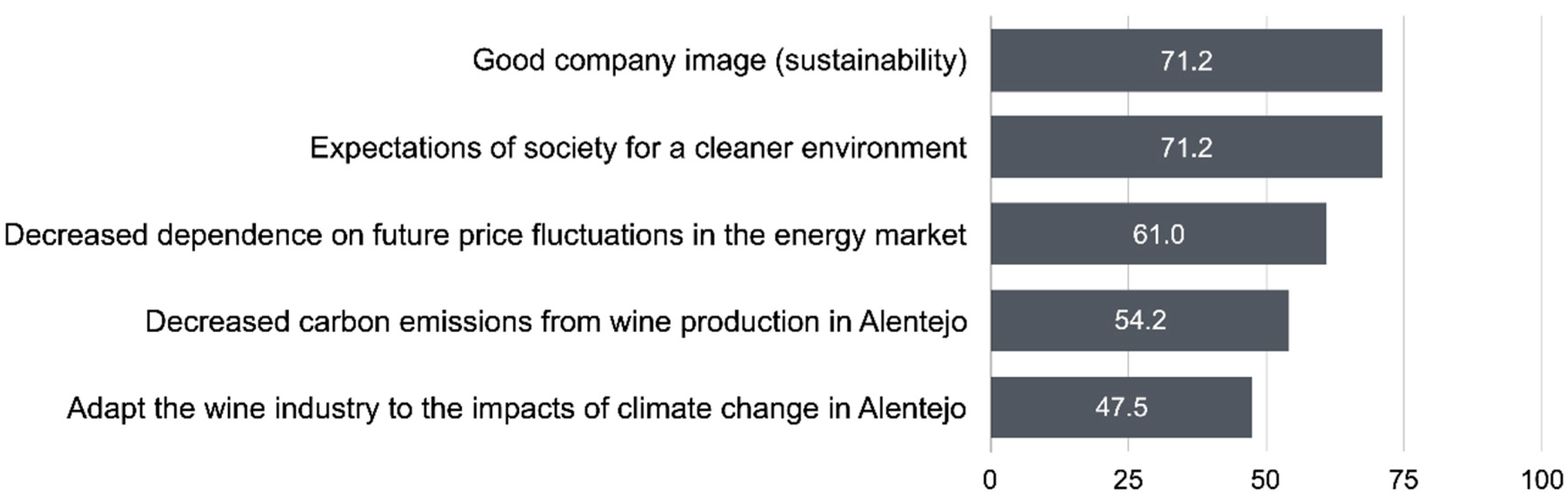
| Capacity of installing and using renewable technologies Transition to electric mobility (e.g., introducing electric vehicles in grape harvesting) Rises in oil prices Decrease in the prices of renewables Decreased dependence on future price fluctuations in the energy market Possibility of selling excess energy to the grid New green jobs Good company image (sustainability) Expectations of society for a cleaner environment Decrease carbon emissions from wine production in Alentejo Adapt the wine industry to the impacts of climate change in Alentejo Other |
© 2019 by the authors. Licensee MDPI, Basel, Switzerland. This article is an open access article distributed under the terms and conditions of the Creative Commons Attribution (CC BY) license (http://creativecommons.org/licenses/by/4.0/).
Share and Cite
Campos, I.; Marín-González, E.; Luz, G.; Barroso, J.; Oliveira, N. Renewable Energy Prosumers in Mediterranean Viticulture Social–Ecological Systems. Sustainability 2019, 11, 6781. https://doi.org/10.3390/su11236781
Campos I, Marín-González E, Luz G, Barroso J, Oliveira N. Renewable Energy Prosumers in Mediterranean Viticulture Social–Ecological Systems. Sustainability. 2019; 11(23):6781. https://doi.org/10.3390/su11236781
Chicago/Turabian StyleCampos, Ines, Esther Marín-González, Guilherme Luz, João Barroso, and Nuno Oliveira. 2019. "Renewable Energy Prosumers in Mediterranean Viticulture Social–Ecological Systems" Sustainability 11, no. 23: 6781. https://doi.org/10.3390/su11236781
APA StyleCampos, I., Marín-González, E., Luz, G., Barroso, J., & Oliveira, N. (2019). Renewable Energy Prosumers in Mediterranean Viticulture Social–Ecological Systems. Sustainability, 11(23), 6781. https://doi.org/10.3390/su11236781