Article

Users’ Awareness, Attitudes, and Perceptions of Health Risks Associated with Excessive Lighting in Night Markets: Policy Implications for Sustainable Development

by
Thi Phuoc Lai Nguyen
1,* and
Antonio Peña-García
2,3
1
Department of Development and Sustainability, School of Environment, Resources and Development, Asian Institute of Technology, Pathum Thani 12120, Thailand
2
Department of Civil Engineering, University of Granada, 18071 Granada, Spain
3
Reserarch Group “Lighting Technology for Safety and Sustainability”, 18071 Granada, Spain
*
Author to whom correspondence should be addressed.
Sustainability 2019, 11(21), 6091; https://doi.org/10.3390/su11216091
Submission received: 5 September 2019 / Revised: 24 October 2019 / Accepted: 25 October 2019 / Published: 1 November 2019
(This article belongs to the Special Issue Lighting at the Frontiers of Sustainable Development)

Abstract

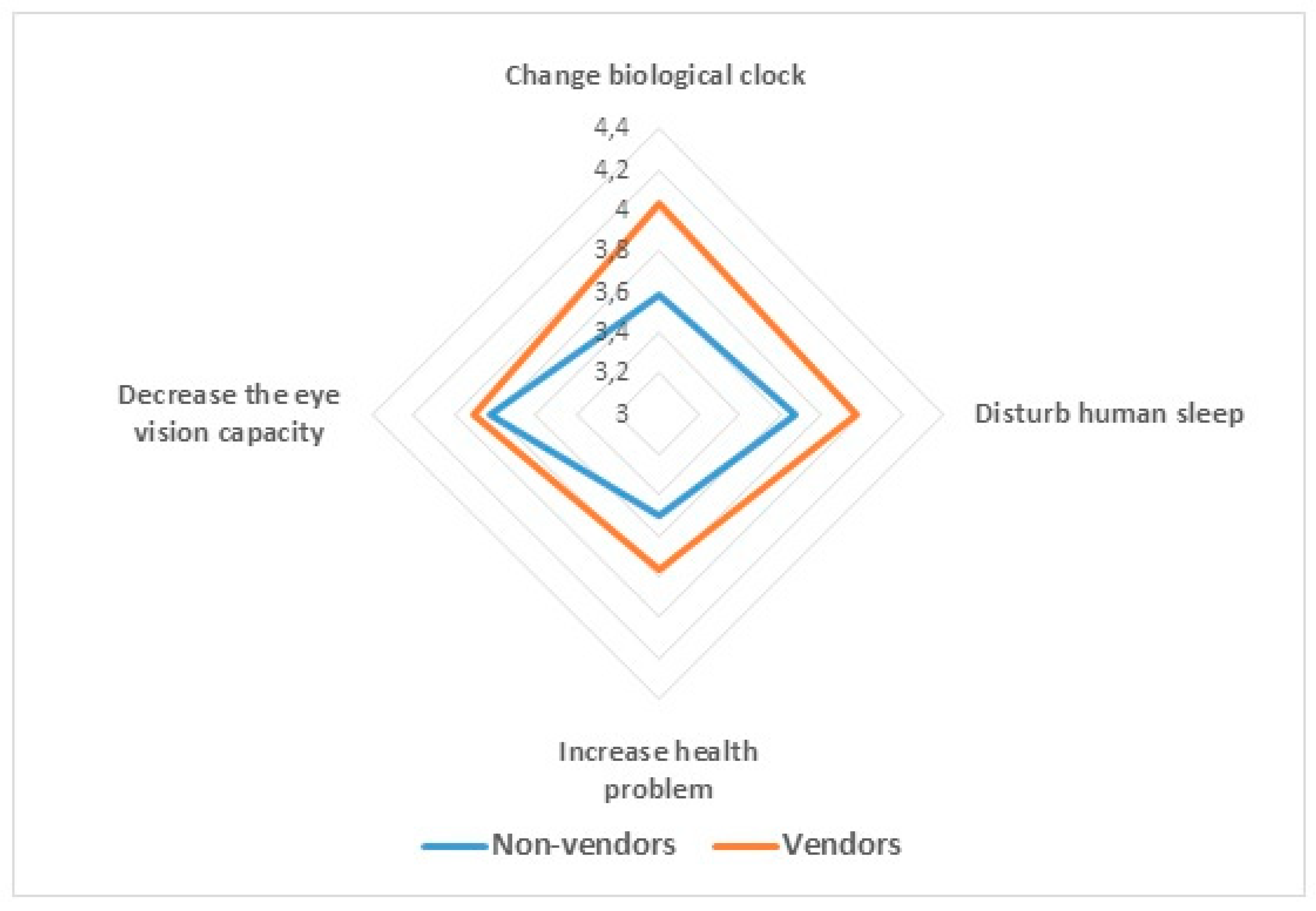
The introduction of artificial lighting has dramatically transformed nighttime activities, becoming a very positive but also disruptive factor that must be optimized and adapted according to the guidelines of sustainable policies. In this framework, night markets in Thailand are definitely popular destinations among locals and tourists that are found in every town and city in the whole country, being the source of livelihoods for many people. It is well-known that shops in night markets frequently use colorful light sources, emitting high levels of illumination to attract customers. Since previous research has shown environmental risks of inappropriate lighting on human health and well-being, as well as on ecosystems, excessive lighting in night markets could have adverse effects on vendors’ health if they are exposed to high illumination levels during long hours every night. This is a risk for people, but also for their attachment to their lands, traditions, culture, and way of life. This study was designed to explore whether excessive illumination of night markets has impacts on vendors’ health and well-being. The research was conducted through an empirical study in a night market in the center of Surin province (Thailand), using observations and a questionnaire survey of 205 vendors and clients (non-vendors). The results show that night markets’ vendors were more likely to suffer from eye- and sleep-related problems than non-vendors. Women were affected more than men. The results also revealed that the majority of both vendors and non-vendors tended to have awareness about excessive lighting impacts on human health, with more vendors tending to agree with the fact than non-vendors. Although night markets’ are their main source of income, the majority of vendors were more unlikely to agree about the contribution of night markets to local livelihoods and development than non-vendors. These findings have implications for the Thai Authority in setting up appropriate lighting policies and regulations for night markets. The target is not only energy savings, but also to protect the public’s health, culture, and traditional livelihoods, in a way that supports sustainable development.
Keywords: sustainable development; lighting policy; public health; energy savings; Thailand sustainable development; lighting policy; public health; energy savings; Thailand