

Towards Systems-Oriented Energy Solutions: A Multilevel Analysis of a Low-Income Energy Efficiency Program in Brazil


Abstract
1. Introduction
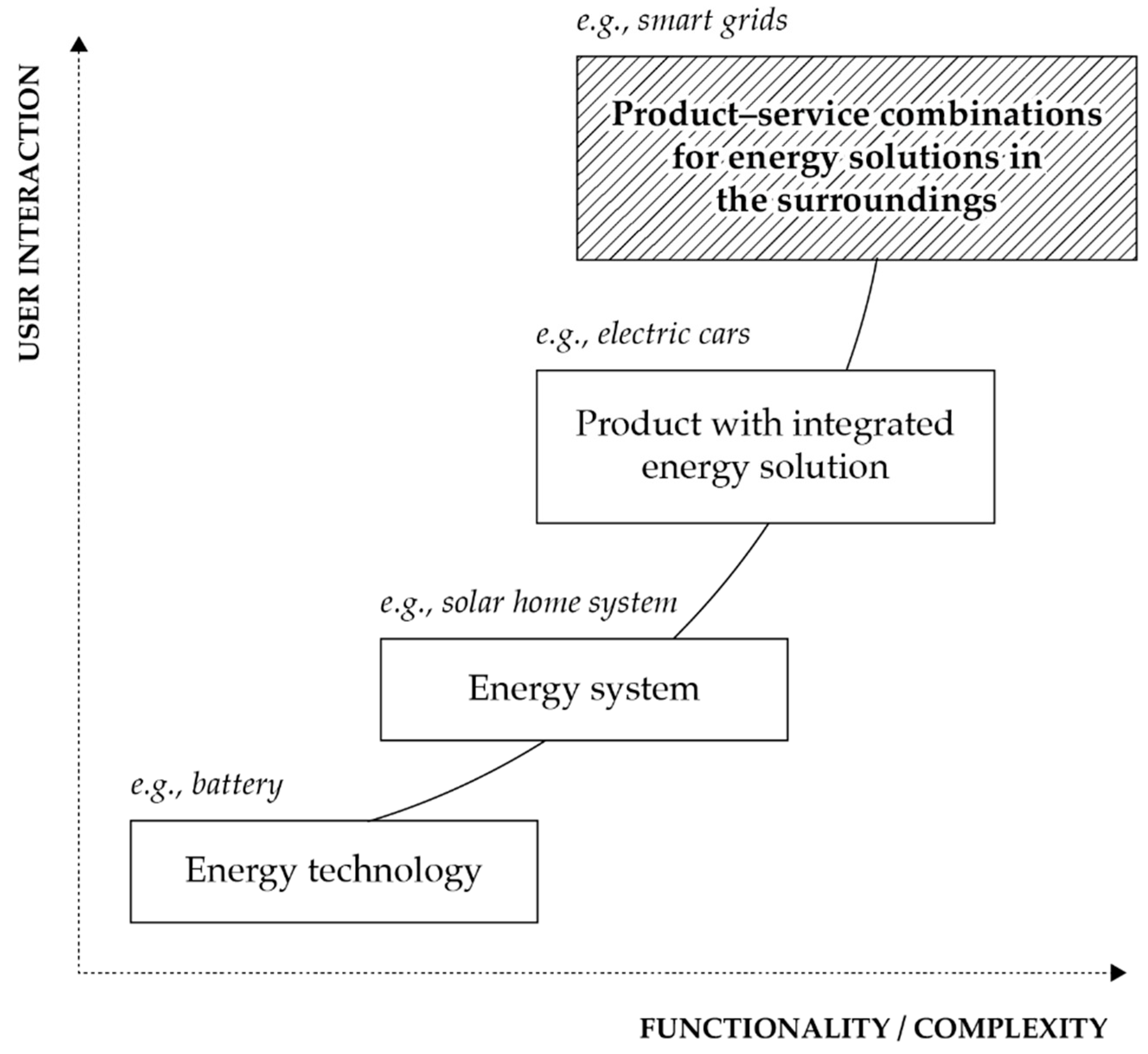
2. Energy Solutions in Low-Income Markets
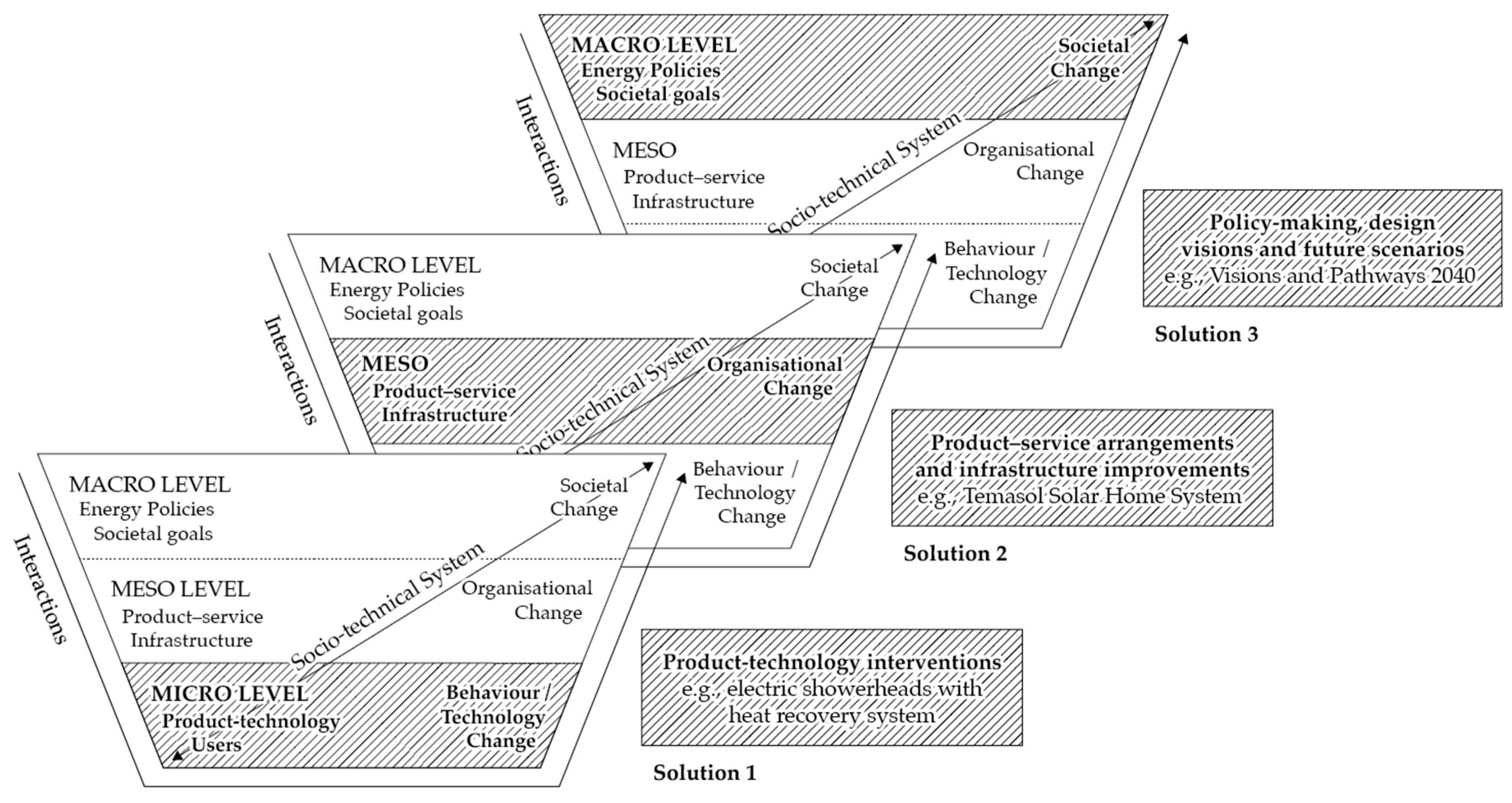
3. A Multilevel Perspective on Energy Product–Service Systems
3.1. Micro Level: Solution 1—Electric Showerhead With Heat Recovery
3.2. Meso Level: Solution 2—Solar Home Systems by Temasol
3.3. Macro Level: Solution 3—Visions and Pathways for Low-Carbon Resilient Futures in Australian Cities
4. Methodology for the Case Study
Data Collection and Analysis
5. Multilevel Analysis of a Low-Income Energy Efficiency Program in Brazil
5.1. Macro Level: Energy Policies for Low-Income Markets
5.2. Meso Level: Stakeholder Motivations and Collaboration
5.3. Micro Level: Affordability, Efficiency, and Awareness
6. Discussion of Findings from the Multilevel Analysis
6.1. Towards Systems-Oriented Energy Solutions
6.2. Recommendations for the Improvement of PEE Energy Solutions
7. Conclusions
Author Contributions
Funding
Acknowledgments
Conflicts of Interest
Appendix A. Educational Methodology for Energy Efficiency Applied to Early Childhood Education
Appendix B. Agent COELBA. Energy Efficiency Program for Low-Income Communities in Bahia
Appendix C. ECOELCE. Exchanging Recyclable Waste for a Discount in the Energy Bill
References
- Modi, V.; McDade, S.; Lallement, D.; Saghir, J. Energy Services for the Millennium Development Goals: Achieving the Millennium Development Goals; Energy Sector Management Assistance Programme, United Nations Development Programme, UN Millennium Project, and World Bank: New York, NY, USA, 2005. [Google Scholar]
- Nissing, C.; von Blottnitz, H. Renewable energy for sustainable urban development: Redefining the concept of energisation. Energy Policy 2010, 38, 2179–2187. [Google Scholar] [CrossRef]
- Bradbrook, A.J.; Gardam, J.G. Placing Access to Energy Services within a Human Rights Framework. Hum. Rights Q. 2006, 28, 389–415. [Google Scholar] [CrossRef]
- Kaygusuz, K. Energy for Sustainable Development: Key Issues and Challenges. Energy Sources Part B Econ. Plan. Policy 2007, 2, 73–83. [Google Scholar] [CrossRef]
- Bhattacharyya, S.C. Energy access programmes and sustainable development: A critical review and analysis. Energy Sustain. Dev. 2012, 16, 260–271. [Google Scholar] [CrossRef]
- Giannini Pereira, M.; Sena, J.A.; Vasconcelos Freitas, M.A.; da Silva, N.F. Evaluation of the impact of access to electricity: A comparative analysis of South Africa, China, India and Brazil. Renew. Sustain. Energy Rev. 2011, 15, 1427–1441. [Google Scholar] [CrossRef]
- Sevaldson, B. Giga-mapping: Visualisation for complexity and systems thinking in design. In Proceedings of the Nord 11 4th Nord Design Research Conference, Helsinki, Finland, 29–31 May 2011; pp. 37–156. [Google Scholar]
- Sevaldson, B. Systems Oriented Design: The emergence and development of a designerly approach to address complexity. In Proceedings of the 2nd International Conference for Design Education Researchers, Olslo, Norway, 14–17 May 2013; pp. 1–22. [Google Scholar]
- Sevaldson, B.; Hensel, M.U.; Frostell, B. Systems-oriented design and sustainability. In Proceedings of the Sustainability in Design—Now! Challenges and Opportunities for Design Research, Education and Practice in the XXI Century; Ceschin, F., Vezzoli, C., Zhang, J., Eds.; Greenleave Publishers: Bangalore, India, 2010; pp. 465–474. [Google Scholar]
- Elzen, B.; Geels, F.W.; Green, K. System Innovation and the Transition to Sustainability; Edward Elgar Publishing: Cheltenham, UK, 2004; ISBN 9781845423421. [Google Scholar]
- Geels, F.W. Technological Transitions and System Innovations: A Co-Evolutionary and Socio-Technical Analysis; Edward Elgar Publishing: Cheltenham, UK, 2005; ISBN 1845420098. [Google Scholar]
- Bandinelli, R.; Gamberi, V. Servitization in oil and gas sector: Outcomes of a case study research. J. Manuf. Technol. Manag. 2011, 23, 87–102. [Google Scholar] [CrossRef]
- Bartolomeo, M.; dal Maso, D.; de Jong, P.; Eder, P.; Groenewegen, P.; Hopkinson, P.; James, P.; Nijhuis, L.; Örninge, M.; Scholl, G.; et al. Eco-efficient producer services—What are they, how do they benefit customers and the environment and how likely are they to develop and be extensively utilised? J. Clean. Prod. 2003, 11, 829–837. [Google Scholar] [CrossRef]
- Emili, S.; Ceschin, F.; Harrison, D. Energy for Sustainable Development Product—Service System applied to Distributed Renewable Energy: A classification system, 15 archetypal models and a strategic design tool. Energy Sustain. Dev. 2016, 32, 71–98. [Google Scholar] [CrossRef]
- Friebe, C.A.; Von Flotow, P.; Täube, F.A. Exploring the link between products and services in low-income markets—Evidence from solar home systems. Energy Policy 2013, 52, 760–769. [Google Scholar] [CrossRef]
- Vezzoli, C.; Delfino, E.; Ambole, L.A. System Design for Sustainable Energy for all. A new challenging role for design to foster sustainable development. FORMakademisk 2014, 7, 1–27. [Google Scholar] [CrossRef]
- Vezzoli, C.; Ceschin, F.; Diehl, J.C. Sustainable Product-Service System Design applied to Distributed Renewable Energy fostering the goal of sustainable energy for all. J. Clean. Prod. 2015, 97, 134–136. [Google Scholar] [CrossRef]
- Vezzoli, C.; Ceschin, F.; Osanjo, L.; Moalosi, R.; Nakazibwe, V.; Diehl, J.C. An african-european network of design universities fostering the goal of sustainable energy for all: An innovative teaching approach based on the combination of Distributed Renewable Energy and design for Sustainable Product-Service Systems. In Proceedings of the Kampala International Design Conforence (KIDEC), Kampala, Uganda, 21–24 July 2015. [Google Scholar]
- da Costa Junior, J.; Diehl, J.C.; Secomandi, F. Educating for a systems design approach to complex societal problems. J. Eng. Des. 2018, 29, 65–86. [Google Scholar] [CrossRef]
- Reinders, A.; Diehl, J.C.; Brezet, H. The Power of Design: Product Innovation in Sustainable Energy Technologies; Wiley: London, UK, 2012; ISBN 9781118308677. [Google Scholar]
- Schaeffer, R.; Szklo, A.S.; Cima, F.M.; Machado, G. Indicators for sustainable energy development: Brazil’s case study. Nat. Resour. Forum 2005, 29, 284–297. [Google Scholar] [CrossRef]
- Giannini Pereira, M.; Vasconcelos Freitas, M.A.; da Silva, N.F. The challenge of energy poverty: Brazilian case study. Energy Policy 2011, 39, 167–175. [Google Scholar] [CrossRef]
- Sadorsky, P. Renewable energy consumption and income in emerging economies. Energy Policy 2009, 37, 4021–4028. [Google Scholar] [CrossRef]
- Salim, R.A.; Rafiq, S. Why do some emerging economies proactively accelerate the adoption of renewable energy? Energy Econ. 2012, 34, 1051–1057. [Google Scholar] [CrossRef]
- United Nations Sustainable Energy for All Initiative. Available online: http://www.se4all.org/ (accessed on 10 December 2015).
- Filippo Filho, G.; Marotta Cassula, A.; Roberts, J.J. Non-technical Losses in Brazil: Subsidies for Implementation of Smart-Grid. J. Energy Power Eng. 2014, 8, 1301–1308. [Google Scholar]
- Jannuzzi, G.M. Energy Efficiency Programs for Low-Income Household Consumers in Brazil: Considerations for a Refrigerator-Replacement Program; University of Campinas: São Paulo, Brazil, 2007. [Google Scholar]
- Borger, F.G.; João, B.N.; Serralvo, F.A.; Cardoso, O.O. Social Innovation and Sustainability: Case studies for the bottom of the pyramid in Brazil. J. Acad. Bus. Econ. 2011, 10, 101–107. [Google Scholar]
- Geller, H.; Schaeffer, R.; Szklo, A.; Tolmasquim, M. Policies for advancing energy efficiency and renewable energy use in Brazil. Energy Policy 2004, 32, 1437–1450. [Google Scholar] [CrossRef]
- Goldemberg, J.; La Rovere, E.L.; Coelho, S.T. Expanding access to electricity in Brazil. Energy Sustain. Dev. 2004, 8, 86–94. [Google Scholar] [CrossRef]
- MME. National Plan of Energy 2030; Ministry of Mines and Energy: Brasília, Brazil, 2007.
- MMA. Plano Nacional Sobre Mudanca do Clima—PNMC; Ministry of the Environment: Brasilia, Brazil, 2008.
- Geels, F.W. Understanding System Innovations: A Critical Literature Review and a Conceptual Synthesis. In System Innovation and the Transition to Sustainability; Edward Elgar Publishing: Cheltenham, UK, 2004; pp. 19–47. ISBN 9781843766834. [Google Scholar]
- Da Costa Junior, J.; dos Santos, A.L.R.; Diehl, J.C. Introducing systems oriented design for complex societal contexts in design engineering education. FormAkademisk Forsk. Des. Og Des. 2017, 10, 1–20. [Google Scholar] [CrossRef]
- Goedkoop, M.; Van Halen, C.; Te Riele, H.; Rommens, P. Product Service Systems, Ecological and Economic Basics; The Report No. 1999/36 Submitted to Ministerje van Volkshuisvesting; Ruimtelijke Ordening en Milieubeheer: Hague, The Netherlands, 1999. [Google Scholar]
- UNEP. Product-Service Systems and Sustainability: Opportunities for Sustainable Solutions; United Nations Environmental Programme: Paris, France, 2002. [Google Scholar]
- Eight19—Flexible Plastic Solar Cells and Organic Photovoltaic Materials. Available online: http://eight19.com/overview/indigo-pay-you-go-solar (accessed on 1 February 2017).
- Manzini, E.; Vezzoli, C. A strategic design approach to develop sustainable product service systems: Examples taken from the ‘environmentally friendly innovation’ Italian prize. J. Clean. Prod. 2003, 11, 851–857. [Google Scholar] [CrossRef]
- UNEP. The Role of Product Service Systems in a Sustainable Society; United Nations Environmental Programme: Paris, France, 2001. [Google Scholar]
- Ceschin, F. The Introduction and Scaling up of Sustainable Product-Service Systems: A New Role for Strategic Design for Sustainability. Ph.D. Thesis, Politecnico di Milano, Milan, Italy, March 2012. [Google Scholar]
- Ceschin, F. Sustainable Product-Service Systems: Between Strategic Design and Transition Studies; SpringerBriefs in Applied Sciences and Technology; Springer International Publishing: Cham, Switzerland, 2014; ISBN 978-3-319-03794-3. [Google Scholar]
- Emili, S. Designing Product-Service Systems applied to Distributed Renewable Energy in Low-Income and Developing Contexts: A Strategic Design Toolkit. Ph.D. Thesis, Brunel University London, London, UK, 2017. [Google Scholar]
- Gaziulusoy, A.İ. A critical review of approaches available for design and innovation teams through the perspective of sustainability science and system innovation theories. J. Clean. Prod. 2015, 107, 366–377. [Google Scholar] [CrossRef]
- Santos, A.L.R. Mind the Gap: Designing Sustainable Healthcare in Humanitarian Aid. Ph.D. Thesis, University of Technology, Delft, The Nertherlands, 2015. [Google Scholar]
- Briceno, T.; Stagl, S. The role of social processes for sustainable consumption. J. Clean. Prod. 2006, 14, 1541–1551. [Google Scholar] [CrossRef]
- Coley, F.J.S.; Lemon, M. Exploring the design and perceived benefit of sustainable solutions: A review. J. Eng. Des. 2009, 20, 543–554. [Google Scholar] [CrossRef][Green Version]
- Geum, Y.; Park, Y. Designing the sustainable product-service integration: A product-service blueprint approach. J. Clean. Prod. 2011, 19, 1601–1614. [Google Scholar] [CrossRef]
- Lindahl, M.; Sundin, E.; Sakao, T.; Shimomura, Y. Integrated Product and Service Engineering versus Design for Environment—A Comparison and Evaluation of Advantages and Disadvantages. In Advances in Life Cycle Engineering for Sustainable Manufacturing Businesses; Takata, S., Umeda, Y., Eds.; Springer: London, UK, 2007; pp. 137–142. ISBN 978-1-84628-934-7. [Google Scholar]
- Mukaze, S.; Velásquez, D.C.V. Product Service System: Co-Designing for Social Impact; School of Engineering Blekinge Institute of Technology Karlskrona: Karlskrona, Sweden, 2012. [Google Scholar]
- Cavalieri, S.; Pezzotta, G. Product–Service Systems Engineering: State of the art and research challenges. Comput. Ind. 2012, 63, 278–288. [Google Scholar] [CrossRef]
- Vasantha, G.V.A.; Roy, R.; Lelah, A.; Brissaud, D. A review of product–service systems design methodologies. J. Eng. Des. 2012, 23, 635–659. [Google Scholar] [CrossRef]
- Afshar, M.; Wang, D. Systems thinking for designing sustainable product service systems: A case study using a system dynamics approach. Des. Princ. Pract. 2010, 4, 259–273. [Google Scholar] [CrossRef]
- Brezet, H. Dynamics in ecodesign practice. Ind. Environ. 1997, 20, 21–24. [Google Scholar]
- Jones, P.H. Systemic Design Principles for Complex Social Systems. In Social Systems and Design; Metcalf, G.S., Ed.; Translational Systems Sciences; Springer: Tokyo, Japan, 2014; pp. 91–128. ISBN 978-4-431-54477-7. [Google Scholar]
- Geels, F.W. The multi-level perspective on sustainability transitions: Responses to seven criticisms. Environ. Innov. Soc. Transit. 2011, 1, 24–40. [Google Scholar] [CrossRef]
- Geels, F.W. Technological transitions as evolutionary reconfiguration processes: A multi-level perspective and a case-study. Res. Policy 2002, 31, 1257–1274. [Google Scholar] [CrossRef]
- Gaziulusoy, A.İ. System Innovation for Sustainability: A Scenario Method and a Workshop Process for Product Development Teams. Ph.D. Thesis, University of Auckland, Auckland, New Zealand, 2010. [Google Scholar]
- Gaziulusoy, A.İ.; Brezet, H. Design for system innovations and transitions: A conceptual framework integrating insights from sustainablity science and theories of system innovations and transitions. J. Clean. Prod. 2015, 108, 558–568. [Google Scholar] [CrossRef]
- Ceschin, F. Critical factors for implementing and diffusing sustainable product-Service systems: Insights from innovation studies and companies’ experiences. J. Clean. Prod. 2012, 45, 74–88. [Google Scholar] [CrossRef]
- Joore, P. The V—Cycle for system innovation translating a broad societal need into concrete product service solutions: The multifunctional centre Apeldoorn case. J. Clean. Prod. 2008, 16, 1153–1162. [Google Scholar] [CrossRef]
- Joore, P. New to Improve-The Mutual Influence Between New Products and Societal Change Processes. Ph.D. Thesis, University of Technology, Delft, The Netherlands, 2010. [Google Scholar]
- Joore, P.; Brezet, H. A Multilevel Design Model: The mutual relationship between product-service system development and societal change processes. J. Clean. Prod. 2015, 97, 92–105. [Google Scholar] [CrossRef]
- da Costa Junior, J.; Diehl, J.C.; Snelders, D. A framework for a systems design approach to complex societal problems. Des. Sci. 2019, 5, e2. [Google Scholar] [CrossRef]
- Mulder, K.F.; Segalàs, J.; Ferrer-Balas, D. How to educate engineers for/in sustainable development. Int. J. Sustain. High. Educ. 2012, 13, 211–218. [Google Scholar] [CrossRef]
- Ghisi, E.; Gosch, S.; Lamberts, R. Electricity end-uses in the residential sector of Brazil. Energy Policy 2007, 35, 4107–4120. [Google Scholar] [CrossRef]
- Passos, L.; Cardemil, J.M.; Colle, S. Feasibility study of using domestic solar hot water systems as alternative to reduce the electricity peak demand in Brazil. Energy Procedia 2014, 57, 2487–2495. [Google Scholar] [CrossRef]
- Allali, B. TEMASOL: Providing Energy Access to Remote Rural Households in Morocco; United Nations Development Programme: New York, NY, USA, 2011. [Google Scholar]
- Ryan, C.; Gaziulusoy, I.; Mccormick, K.; Trudgeon, M.; McKormick, K.; Trudgeon, M.; Mccormick, K.; Trudgeon, M. Virtual City Experimentation: A Critical Role for Design Visioning. In The Experimental City; Evans, J., Karvonen, A., Raven, R., Eds.; Routledge: Abingdon, UK, 2016; pp. 1–18. ISBN 978-1-138-85620-2. [Google Scholar]
- Patrzyk, F.; De Medeiros, L. Desenvolvimento de metodologia educacional de eficiência energética aplicada ao ensino infantil. In Proceedings of the EDUCERE—XIII Congresso Nacional de Educação; Pontifícia Universidade Católica do Paraná (PUCPR), Curitiba, Brazil, 21 October 2015. [Google Scholar]
- Patrzyk, F. Desenvolvimento de Metodologia Educacional de Eficiência Energética Aplicada ao Ensino Infantil; Instituto de Tecnologia Para o Desenvolvimento—Institutos Lactec: Curitiba, Brazil, 2014. [Google Scholar]
- Matos, S.; Silvestre, B.S. Managing stakeholder relations when developing sustainable business models: The case of the Brazilian energy sector. J. Clean. Prod. 2013, 45, 61–73. [Google Scholar] [CrossRef]
- Gradl, C.; Knobloch, C. Energize the BoP! Energy Business Model Generator for Low-Income Markets; Endeva - Enterprise solutions for development: Berlin, Germany, 2011. [Google Scholar]
- Cleff, T.; Rennings, K. Determinants of environmental product and process innovation. Eur. Environ. 1999, 9, 191–201. [Google Scholar] [CrossRef]
- The World Bank. World Development Indicators; The World Bank: Washington, WA, USA, 2014; ISBN 9780821387092. [Google Scholar]
- Schäfer, M.; Jaeger-Erben, M.; Santos, A. Leapfrogging to Sustainable Consumption? An Explorative Survey of Consumption Habits and Orientations in Southern Brazil. J. Consum. Policy 2011, 34, 175–196. [Google Scholar] [CrossRef]
- COELBA Coelba—Companhia de Eletricidade do Estado da Bahia. Available online: http://www.coelba.com.br/ (accessed on 2 August 2015).
- AVSI Foundation. Case Study: COELBA Community Agent Program for Slum Electrification and Energy Efficiency in Salvador, Bahia, Brazil; The World Bank: Washington, WA, USA, 2010. [Google Scholar]
- Lima, C.A.F.; Gradvohl, A.B.; Carvalho, T.; Ricardo, J.; Navas, P.; Arruda, O.S. Programa Ecoelce de Troca de Resíduos por Bônus na Conta de Energia. In Proceedings of the Anais do V Congresso de Inovação Tecnológica em Energia Elétrica—V CITENEL, Belém, Brazil, 22–24 June 2009; pp. 1–8. [Google Scholar]
- COELCE Program Ecoelce. Available online: https://www.coelce.com.br/coelcesociedade/programas-e-projetos/ecoelce.aspx (accessed on 2 August 2015).
- COELCE Coelce—Companhia Energética do Ceará. Available online: https://www.coelce.com.br/ (accessed on 2 August 2015).

| Sociotechnical Systems Components | Low-Income Market Constraints | Examples of Constraints |
|---|---|---|
| Market and user practices (e.g., user preferences, electricity consumption patterns) | User | High illiteracy rate among stakeholders |
| Culture and its symbolic meanings (e.g., ways of living, individual and collective habits) | ||
| Maintenance and distribution network (e.g., maintenance services, repair shops, local electrician, hardware stores) | Technical | Unskilled technical personnel, lack of energy-saving features, poor heating and insulation standards (dwelling) |
| Infrastructure (e.g., electrical grid, housing conditions, shared products and facilities) | ||
| Knowledge production and transfer (e.g., universities, research institutions, R&D, capacity building) | Institutional | Lack of trust between stakeholders (e.g., between low-income population and state-owned utilities) |
| Stakeholder relationships (e.g., hierarchy, economic classes, political position) | Socioethical | Electricity access as a campaign tool to attract votes from minorities. |
| Regulatory and economic instruments (e.g., policies, energy efficiency and electrification programs, subsidy, social tariff) | Economic | High dependency on subsidies. |
| Regulatory | Lack of policies relevant to energy poverty | |
| Resources (e.g., fossil fuel, renewables) | Environmental | Lack of environmental awareness |
| Description | MICRO | MESO | MACRO |
|---|---|---|---|
| Core Idea/Focus | Improving existing or developing new technologies, products, services and behaviors. | Improving existing or developing new integrated product–service combinations, infrastructure, and new business models. | Promoting change on how societal needs are fulfilled, to support the transition to a new sociotechnical system. |
| Primary agent fostering the change | Individuals, households, and communities. | Organizations, institutions, and companies. | Governments and world Organizations. |
| Scale of change | Behavior, surroundings, and technological change. | Infrastructure and Organizational change. | Societal change. |
| Types of interventions | Product technology and services. | Product–service systems. | Systems-oriented PSSs, designs, visions and future scenarios |
| Case | Description | Research Techniques | Main Demand-Side Management Strategies (DSM) Adopted |
|---|---|---|---|
| 1 | Program COPEL: Energy efficiency for low-income communities of Parana | Review of available reports, databases, scientific papers, field observations, interview with a key informant, and focus group discussion with relevant stakeholders. | Affordability: guidance to the utilization of government subsidies; Educational actions: a cycle of lectures on the topic of efficient and rational use of electricity; Energy efficient diagnosis: diagnostics to identify energy waste and determine the technological upgrade suitable for each residential consumer unit; Nontechnical losses: regularization of illegal connections; Solar thermal devices: some households receive a solar thermal heating system; Surveys: conduction of socioeconomic and user behavior surveys; Technology/product replacement: replacement of energy inefficient appliances and devices. |
| 2 | Program Agent COELBA: Energy efficiency for low-income communities of Bahia | Review of available reports, databases, and scientific papers (secondary data). | Affordability: adjust energy consumption (bills) of the customer to their ability to pay and increase utilization of government subsidies; Educational actions: guidance by community agents on the topic of safe and efficient use of electricity; Income generation: training and employment of local community agents. Nontechnical losses: regularization of illegal connections; Stakeholders relationship: improve customer relationship through the mediation of agents embedded in the communities. |
| 3 | Program ECOELCE: Exchanging recyclable waste for a discount in the energy bill | Review of available reports, databases, and scientific papers (secondary data). | Affordability: provide discounts to the energy bills of customers in exchange for solid waste with market value and increased utilization of government subsidies; Educational actions: a cycle of lectures on the topic of environmental sustainability and rational use of electricity; Nontechnical losses: regularization of illegal connections; Stakeholders relationship: promote the collaboration between recyclers, associations, government agencies, and private companies; Surveys: conduct socioeconomic, environmental, and user behavior surveys. |
| Stakeholder | Drivers |
|---|---|
| Energy utility | Reduce commercial losses from nonpaying legally grid-connected customers and the number of illegal connections; Increase the utilization of government subsidies; Invest in customer relationships. |
| Users | Achieve higher living standards through access to clean and modern sources of energy; Find alternatives to afford electricity services; Benefit from low-income energy efficiency programs (e.g., technological upgrade and infrastructure improvements at household level). |
| NGO’s | Increase wellbeing of the low-income population through electricity services; Facilitate the interaction between government, private companies, and end-consumers; Stimulate entrepreneurship and create employment conditions in low-income communities. |
| Government | Increase access, quality, and affordability of energy solutions; Support income generation capacity in rural remote and low-income areas; Increase access to information to improve energy efficiency and conservation at household level; Promote the use of renewable energy resources. |
© 2019 by the authors. Licensee MDPI, Basel, Switzerland. This article is an open access article distributed under the terms and conditions of the Creative Commons Attribution (CC BY) license (http://creativecommons.org/licenses/by/4.0/).
Share and Cite
Costa Junior, J.d.; Diehl, J.C.; Secomandi, F. Towards Systems-Oriented Energy Solutions: A Multilevel Analysis of a Low-Income Energy Efficiency Program in Brazil. Sustainability 2019, 11, 5799. https://doi.org/10.3390/su11205799
Costa Junior Jd, Diehl JC, Secomandi F. Towards Systems-Oriented Energy Solutions: A Multilevel Analysis of a Low-Income Energy Efficiency Program in Brazil. Sustainability. 2019; 11(20):5799. https://doi.org/10.3390/su11205799
Chicago/Turabian StyleCosta Junior, Jairo da, Jan Carel Diehl, and Fernando Secomandi. 2019. "Towards Systems-Oriented Energy Solutions: A Multilevel Analysis of a Low-Income Energy Efficiency Program in Brazil" Sustainability 11, no. 20: 5799. https://doi.org/10.3390/su11205799
APA StyleCosta Junior, J. d., Diehl, J. C., & Secomandi, F. (2019). Towards Systems-Oriented Energy Solutions: A Multilevel Analysis of a Low-Income Energy Efficiency Program in Brazil. Sustainability, 11(20), 5799. https://doi.org/10.3390/su11205799

