Article

Social Capital and Self-Rated Health among Older Adults Living in Urban China: A Mediation Model


1
Department of Social Work and Social Policy, School of Sociology and Population Studies, Renmin University of China, Beijing 100872, China
2
Sau Po Centre on Ageing, The University of Hong Kong, Hong Kong
3
Department of Sociology, School of Philosophy and Sociology, Jilin University, Changchun 130012, China
4
Institute of Gender and Culture, Changchun Normal University, Changchun 130052, China
*
Author to whom correspondence should be addressed.
Sustainability 2019, 11(20), 5566; https://doi.org/10.3390/su11205566
Submission received: 25 August 2019 / Revised: 30 September 2019 / Accepted: 2 October 2019 / Published: 10 October 2019
(This article belongs to the Special Issue Aging: Healthcare, Inequalities, Challenges and Trends)

Abstract

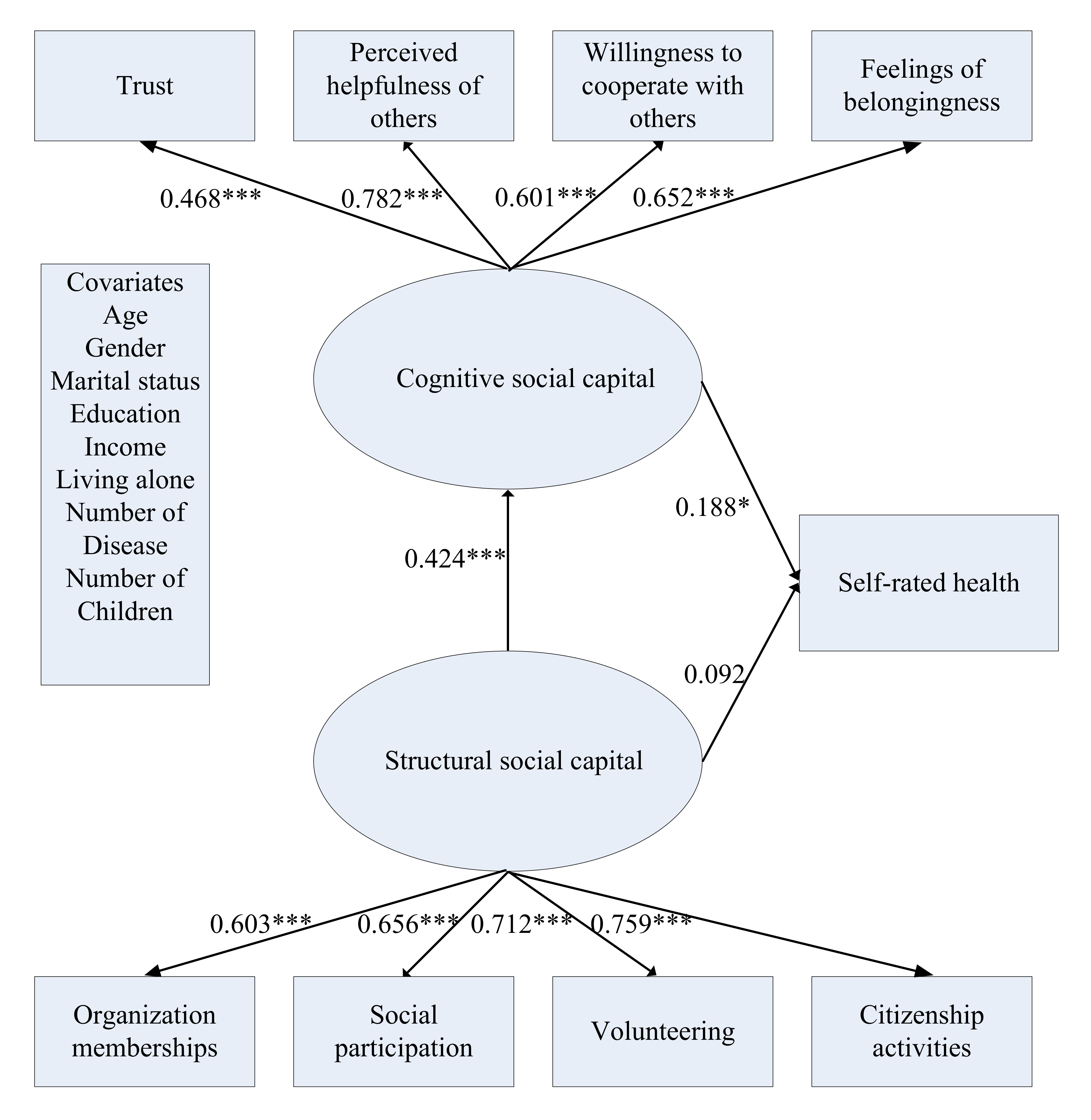
Social capital and healthy aging are both crucial for social sustainability in China. The present study tested the role of structural social capital in self-rated health among older urban Chinese adults and the influence of cognitive social capital on this relationship. A sample of 456 older adults aged 60 or older in Suzhou, China, were recruited and completed the survey in 2015. Structural equation modeling was used to test the proposed model. Cognitive social capital had larger effects on self-rated health than structural social capital. The relationship between structural social capital and self-rated health was fully mediated by cognitive social capital, when sociodemographic characteristics, socioeconomic status, physical health conditions, and living arrangements were controlled. The culturally sensitive latent construct of community-based social capital proved to be a valid instrument in urban Chinese contexts. Structural social capital likely indirectly affects self-rated health through cognitive social capital. Policy and intervention implications are discussed.
Keywords: structural social capital; cognitive social capital; self-rated health structural social capital; cognitive social capital; self-rated health