

Effects of Vegetation Pattern and Spontaneous Succession on Remediation of Potential Toxic Metal-Polluted Soil in Mine Dumps



Abstract
1. Introduction
2. Materials and Methods
2.1. Study Area
2.2. Data Collection
2.2.1. Ground Vegetation Surveys
2.2.2. Soil Fertility
2.2.3. Levels of Potential Toxic Metals in Soil
2.3. Data Analysis
2.3.1. Diversity
2.3.2. Potential Toxic Metal Pollution Index
2.3.3. Soil Property Index
2.3.4. Statistical Analysis
3. Results
3.1. Growth Situation and Diversity of Two Vegetation Patterns with Different Durations
3.2. Soil Fertility Changes
3.3. Potential Toxic Metal Pollution Remediation
4. Discussion
4.1. Effect of Vegetation Pattern on Remediation Efficiency of Soil Potential Toxic Metals
4.2. Research Limitation and Future Work
5. Conclusions
Author Contributions
Funding
Acknowledgments
Conflicts of Interest
References
- Wang, S.; Li, R.H.; Zhang, Z.Q.; Feng, J.; Shen, F. Assessment of the heavy metal pollution and potential ecological hazardous in agricultural soils and crops of Tongguan, Shaanxi Province. China Environ. Sci. 2014, 34, 2313–2320. [Google Scholar] [CrossRef]
- Li, N.; Li, R.H.; Feng, J.; Zhang, Z.Q.; Shen, F. Remediation effects of heavy metals contaminated farmland using fly ash based on bioavailability test. Trans. Chin. Soc. Agric. Eng. 2015, 31, 213–219. [Google Scholar] [CrossRef]
- Mahar, A.; Wang, P.; Ronghua, L.I.; Zhang, Z. Immobilization of Lead and Cadmium in Contaminated Soil Using Amendments: A Review. Pedosphere 2015, 25, 555–568. [Google Scholar] [CrossRef]
- Xiao, R.; Sun, X.; Wang, J.; Feng, J.; Li, R.; Zhang, Z.; Wang, J.; Amjad, A. Characteristics and phytotoxicity assay of biochars derived from a Zn-rich antibiotic residue. J. Anal. Appl. Pyrol. 2015, 113, 575–583. [Google Scholar] [CrossRef]
- Dipu, S.; Kumar, A.A.; Thanga, S.G. Effect of chelating agents in phytoremediation of heavy metals. Remediat. J. 2012, 22, 133–146. [Google Scholar] [CrossRef]
- Koptsik, G.N. Problems and prospects concerning the phytoremediation of heavy metal polluted soils: A review. Eurasian Soil Sci. 2014, 47, 923–939. [Google Scholar] [CrossRef]
- Mahar, A.; Wang, P.; Ali, A.; Awasthi, M.K.; Lahori, A.H.; Wang, Q.; Li, R.; Zhang, Z. Challenges and opportunities in the phytoremediation of heavy metals contaminated soils: A review. Ecotoxicol. Environ. Saf. 2016, 126, 111–121. [Google Scholar] [CrossRef]
- Karami, A.; Shamsuddin, Z.H. Phytoremediation of heavy metals with several efficiency enhancer methods. Afr. J. Biotechnol. 2010, 9, 3689–3698. [Google Scholar] [CrossRef]
- Mukhopadhyay, S.; Maiti, S.K. Phytoremediation of metal enriched mine waste: A review. Am.-Eurasian J. Agric. Environ. Sci. 2010, 9, 560–575. [Google Scholar]
- Ali, Q.; Ahsan, M.; Khaliq, I.; Elahi, M.; Ali, S.; Ali, F.; Naees, M. Role of rhizobacteria in phytoremediation of heavy metals: An overview. Int. Res. J. Plant Sci. 2011, 2, 220–230. [Google Scholar]
- Ramamurthy, A.; Memarian, R. Phytoremediation of mixed soil contaminants. Water Air Soil Pollut. 2012, 223, 511–518. [Google Scholar] [CrossRef]
- Antony, V.D.E.; Baker, A.J.M.; Reeves, R.D.; Pollard, A.; Schat, H. Hyperaccumulators of metal and metalloid trace elements: Facts and fiction. Plant Soil 2013, 362, 319–334. [Google Scholar] [CrossRef]
- Basharat, Z.; Novo, L.; Yasmin, A. Genome editing weds CRISPR: What is in it for phytoremediation? Plants 2018, 7, 51. [Google Scholar] [CrossRef]
- Bhargava, A.; Carmona, F.F.; Bhargava, M.; Srivastava, S. Approaches for enhanced phytoextraction of heavy metals. J. Environ. Manag. 2012, 105, 103. [Google Scholar] [CrossRef] [PubMed]
- Ali, H.; Khan, E.; Sajad, M. Phytoremediation of heavy metals—Concepts and applications. Chemosphere 2013, 91, 869–881. [Google Scholar] [CrossRef] [PubMed]
- Marín Sanleandro, P.; Sánchez Navarro, A.; Díaz-Pereira, E.; Bautista Zuñiga, F.; Romero Muñoz, M.; Delgado Iniesta, M. Assessment of heavy metals and color as indicators of contamination in street dust of a city in SE Spain: Influence of traffic intensity and sampling location. Sustainability 2018, 10, 4105. [Google Scholar] [CrossRef]
- Sheoran, V.; Sheoran, A.S.; Poonia, P. Phytomining: A review. Miner. Eng. 2009, 22, 1007–1019. [Google Scholar] [CrossRef]
- Novo, L.A.B.; Castro, P.M.L.; Alvarenga, P.; da Silva, E.F. Phytomining of Rare and Valuable Metals. In Phytoremediation: Management of Environmental Contaminants; Ansari, A.A., Gill, S.S., Gill, R., Lanza, G., Newman, L., Eds.; Springer International Publishing: Cham, Switzerland, 2017; Volume 5, pp. 469–486. [Google Scholar]
- Craig, M.D.; Stokes, V.L.; Hardy, G.E.; Hobbs, R. Edge effects across boundaries between natural and restored jarrah (Eucalyptus marginata) forests in southwestern Australia. Aust. Ecol. 2015, 40, 186–197. [Google Scholar] [CrossRef]
- George, S.J.; Kelly, R.N.; Greenwood, P.F.; Tibbett, M. Soil carbon and litter development along a reconstructed biodiverse forest chronosequence of South-Western Australia. Biogeochemistry 2010, 101, 197–209. [Google Scholar] [CrossRef]
- Tibbett, M.; Batty, L.C.; Hallberg, K.B. Large-Scale Mine Site Restoration of Australian Eucalypt Forests after Bauxite Mining: Soil Management and Ecosystem Development; Cambridge University Press: Cambridge, UK, 2010; pp. 309–326. [Google Scholar]
- Koch, J.M. Alcoa’s mining and restoration process in south western Australia. Restor. Ecol. 2007, 15, S11–S16. [Google Scholar] [CrossRef]
- Wei, S.H.; Li, Y.; Zhou, Q.; Srivastava, M.; Chiu, S.; Jie, Z.; Wu, Z.; Sun, T. Effect of fertilizer amendments on phytoremediation of Cd-contaminated soil by a newly discovered hyperaccumulator Solanum nigrum L. J. Hazard. Mater. 2010, 176, 269–273. [Google Scholar] [CrossRef] [PubMed]
- Komínková, D.; Fabbricino, M.; Gurung, B.; Race, M.; Tritto, C.; Ponzo, A. Sequential application of soil washing and phytoremediation in the land of fires. J. Environ. Manag. 2018, 206, 1081–1089. [Google Scholar] [CrossRef] [PubMed]
- Hua, L.; Yang, X.; Liu, Y.; Tan, X.; Yang, Y. Spatial distributions, pollution assessment, and qualified source apportionment of soil heavy metals in a typical mineral mining city in China. Sustainability 2018, 10, 3115. [Google Scholar] [CrossRef]
- Food and Agriculture Organization (FAO). Global Forest Resources Assessment 2000 Main Report; FAO: Rome, Italy, 2010. [Google Scholar]
- Kanninen, M. Plantation Forests: Global Perspectives; Earthscan: London, UK, 2010. [Google Scholar]
- Bautista, S.; Mayor, A.G.; Bourakhouadar, J.; Bellot, J. Plant spatial pattern predicts hillslope runoff and erosion in a semiarid mediterranean landscape. Ecosystems 2007, 10, 987–998. [Google Scholar] [CrossRef]
- Boix-Fayos, C.; Martínez-Mena, M.; Calvo-Cases, A.; Arnau-Rosalén, E.; Albaladejo, J.; Castillo, V. Causes and underlying processes of measurement variability in field erosion plots in Mediterranean conditions. Earth Surf. Process. Landf. 2010, 32, 85–101. [Google Scholar] [CrossRef]
- Hou, J.; Fu, B.; Wang, S.; Zhu, H. Comprehensive analysis of relationship between vegetation attributes and soil erosion on hillslopes in the Loess Plateau of China. Environ. Earth Sci. 2014, 72, 1721–1731. [Google Scholar] [CrossRef]
- Van, B. Transgenic plants for enhanced phytoremediation of toxic explosives. Curr. Opin. Biotechnol. 2009, 20, 231–236. [Google Scholar] [CrossRef]
- Bao, S.D. Soil and Agricultural Chemistry Analysis; China Agriculture Press: Beijing, China, 2000. [Google Scholar]
- Ahmadi, M.; Jorfi, S.; Azarmansuri, A.; Jafarzadeh, N.; Mahvi, H.; Soltani, R.; Akbari, H. Zoning of heavy metal concentrations including Cd, Pb and as in agricultural soils of Aghili plain, Khuzestan province, Iran. Data Brief 2017, 14, 20–27. [Google Scholar] [CrossRef] [PubMed]
- Hill, M.O. Diversity and evenness: A unifying notation and its consequences. Ecology 1973, 54, 427–432. [Google Scholar] [CrossRef]
- Chen, X. Study on the spatial distribution and pollution evaluation of heavy metal in urban soil of China. Environ. Sci. Technol. 2011, 34, 60–65. [Google Scholar] [CrossRef]
- National Standard of the People’s Republic of China. GB15618-1995: Environmental Quality Standard for Soils; MEP, China Standard Press: Beijing, China, 1996. [Google Scholar]
- Dawson, S.K.; Warton, D.; Kingsford, R.T.; Berney, P.; Keith, D.A.; Catford, J.A. Plant traits of propagule banks and standing vegetation reveal flooding alleviates impacts of agriculture on wetland restoration. J. Appl. Ecol. 2017, 6, 1907–1918. [Google Scholar] [CrossRef]
- Yannelli, F.A.; Koch, C.; Jeschke, J.M.; Kollmann, J. Limiting similarity and Darwins naturalization hypothesis: Understanding the drivers of biotic resistance against invasive plant species. Oecologia 2017, 183, 775–784. [Google Scholar] [CrossRef] [PubMed]
- Li, S.S.; Wang, M.; Zhao, Z.Q.; Ma, C.B.; Chen, S. Adsorption and desorption of Cd by soil amendment: Mechanisms and environmental implications in field-soil remediation. Sustainability 2018, 10, 2337. [Google Scholar] [CrossRef]
- Tongway, D.; Valentin, C.; Seghieri, J. Banded Vegetation Patterning in Arid and Semiarid Environments Ecological Processes and Consequences for Management; Springer: New York, NY, USA, 2001. [Google Scholar]
- Franz, T.E.; King, E.G.; Caylor, K.K.; Robinson, D.A. Coupling vegetation organization patterns to soil resource heterogeneity in a central Kenyan dryland using geophysical imagery. Water Resour. Res. 2011, 47, W07531. [Google Scholar] [CrossRef]
- Schleicher, J.; Meyer, K.; Wiegand, K.; Schurr, F.; Ward, D. Disentangling facilitation and seed dispersal from environmental heterogeneity as mechanisms generating associations between savanna plants. J. Veg. Sci. 2011, 22, 1038–1048. [Google Scholar] [CrossRef]
- Akasaka, M.; Takamura, N.; Mitsuhashi, H.; Kadono, Y. Effects of land use on aquatic macrophyte diversity and water quality of ponds. Freshw. Biol. 2010, 55, 909–922. [Google Scholar] [CrossRef]
- Alahuhta, J.; Kanninen, A.; Vuori, M. Response of macrophyte communities and status metrics to natural gradients and land use in boreal lakes. Aquat. Bot. 2012, 103, 106–114. [Google Scholar] [CrossRef]
- Nielsen, A.; Trolle, D.; Sondergaard, M.; Lauridsen, T.; Bjerring, R.; Olesen, J.; Jeppesen, E. Watershed land use effects on lake water quality in Denmark. Ecol. Appl. 2012, 22, 1187–1200. [Google Scholar] [CrossRef] [PubMed]
- Zhang, S.T.; Zhang, J.Z.; Liu, Y.C.; Liu, Y.; Wang, Z.K. The effects of vegetation distribution pattern on overland flow. Water Environ. J. 2018, 32, 392–403. [Google Scholar] [CrossRef]
- Guo, F.Q.; Zhang, C.; Zhang, H.; Zhou, X.; Zhai, H.; Zhu, L.Y.; Sun, H.D. Effect of hillside fields managing patterns on the vegetation and soil environment in the Loess Plateau, China. Bangladesh J. Bot. 2018, 47, 785–794. [Google Scholar]
- Liu, Y.; Yang, Y.; Li, C.X.; Ni, X.; Ma, W.; Wei, H. Assessing Soil Metal Levels in an Industrial Environment of Northwestern China and the Phytoremediation Potential of Its Native Plants. Sustainability 2018, 10, 2686. [Google Scholar] [CrossRef]
- Cammeraat, E.; Beek, R.V.; Kooijman, A. Vegetation succession and its consequences for slope stability in SE Spain. Plant Soil 2005, 278, 135–147. [Google Scholar] [CrossRef]
- Lesschen, J.P.; Cammeraat, L.H.; Kooijman, A.M.; Bvan, W. Development of spatial heterogeneity in vegetation and soil properties after land abandonment in a semi-arid ecosystem. J. Arid Environ. 2008, 72, 2082–2092. [Google Scholar] [CrossRef]
- Nadal-Romero, E.; Cammeraat, E.; Pérez-Cardiel, E.; Lasanta, T. Effects of secondary succession and afforestation practices on soil properties after cropland abandonment in humid Mediterranean mountain areas. Agric. Ecosyst. Environ. 2016, 228, 91–100. [Google Scholar] [CrossRef]
- Obade, V.; Lal, R. Towards a standard technique for soil quality assessment. Geoderma 2016, 265, 96–102. [Google Scholar] [CrossRef]
- Yan, X.; Liu, M.; Zhong, J.; Guo, J.; Wu, W. How human activities affect heavy metal contamination of soil and sediment in a long-term reclaimed area of the Liaohe river delta, north China. Sustainability 2018, 10, 338. [Google Scholar] [CrossRef]
- Bu, W.; Zang, R.; Ding, Y. Functional diversity increases with species diversity along successional gradient in a secondary tropical lowland rainforest. Trop. Ecol. 2014, 55, 393–401. [Google Scholar] [CrossRef]
- Kollmann, J.; Rasmussen, K.K. Succession of a degraded bog in NE Denmark over 164 years—Monitoring one of the earliest restoration experiments. Tuexenia 2012, 32, 67–86. [Google Scholar] [CrossRef]
- Woziwoda, B.; Kopeć, D. Afforestation or natural succession? Looking for the best way to manage abandoned cut-over peatlands for biodiversity conservation. Ecol. Eng. 2014, 63, 143–152. [Google Scholar] [CrossRef]
- Li, N.; Shao, T.Y.; Zhu, T.S.; Long, X.H.; Gao, X.M.; Liu, Z.P.; Shao, H.B.; Rengel, Z. Vegetation succession influences soil carbon sequestration in coastal alkali-saline soils in southeast China. Sci. Rep. 2018, 8, 12. [Google Scholar] [CrossRef]
- Rusterholz, H.P.; Schneuwly, J.; Baur, B. Invasion of the alien shrub Prunus laurocerasus in suburban deciduous forests: Effects on native vegetation and soil properties. Acta Oecol.-Int. J. Ecol. 2018, 92, 44–51. [Google Scholar] [CrossRef]
- Li, H.X.; Li, Y.R.; Lee, M.K.; Liu, Z.W.; Miao, C.H. Spatiotemporal analysis of heavy metal water pollution in transitional China. Sustainability 2015, 7, 9067–9087. [Google Scholar] [CrossRef]
- Montanarella, L. Agricultural policy: Govern our soils. Nature 2015, 528, 32–33. [Google Scholar] [CrossRef] [PubMed]
- Keesstra, S.; Bouma, J.; Wallinga, J.; Tittonell, P.; Smith, P.; Cerda, A.; Montanarella, L.; Quinton, J.; Pachepsky, Y.; Wim, P. The significance of soils and soil science towards realization of the United Nations Sustainable Development Goals. EGU Gen. Assem. Conf. 2016, 2, 39–45. [Google Scholar] [CrossRef]
- Buzzard, V.; Hulshof, C.M.; Birt, T.; Violle, C.; Enquist, B.J. Regrowing a tropical dry forest: Functional plant trait composition and community assembly during succession. Funct. Ecol. 2016, 30, 1006–1013. [Google Scholar] [CrossRef]
- Ulrich, W.; Zaplata, K.; Winter, S.; Schaaf, W.; Fischer, A.; Soliveres, S.; Gotelli, N. Species interactions and random dispersal rather than habitat filtering drive community assembly during early plant succession. Oikos 2016, 125, 698–707. [Google Scholar] [CrossRef]
- Laine, C.M.; Kettenring, K.M.; Roper, B.B. An assessment of metrics to measure seasonal variation in and grazing effects on riparian plant communities. West. N. Am. Nat. 2008, 75. [Google Scholar] [CrossRef]
- Chaeho, B.; Blois, S.D.; Brisson, J. Plant functional group identity and diversity determine biotic resistance to invasion by an exotic grass. J. Ecol. 2013, 101, 128–139. [Google Scholar] [CrossRef]
- Zhao, Z.; Shahrour, I.; Bai, Z.; Fan, W.; Feng, L.; Li, H. Soils development in opencast coal mine spoils reclaimed for 1–13 years in the West-Northern Loess Plateau of China. Eur. J. Soil Biol. 2013, 55, 40–46. [Google Scholar] [CrossRef]
- Zhao, Z.; Wang, L.; Bai, Z.; Pan, Z.; Wang, Y. Development of population structure and spatial distribution patterns of a restored forest during 17-year succession (1993–2010) in Pingshuo opencast mine spoil, China. Environ. Monit. Assess. 2015, 187, 1–13. [Google Scholar] [CrossRef]
- Novo, L.A.B.; Castro, P.M.L.; Alvarenga, P.; da Silva, E.F. Plant growth–promoting rhizobacteria-assisted phytoremediation of mine soils. In Bio-Geotechnologies for Mine Site Rehabilitation; Elsevier: Amsterdam, The Netherlands, 2018; pp. 281–295. [Google Scholar]
- Schantz, M.; Espeland, E.; Duke, S. Measuring succession: Methods for establishing long-term vegetation monitoring sites. Plant Ecol. 2017, 218, 1201–1212. [Google Scholar] [CrossRef]
- Bhaskar, R.; Dawson, T.; Balvanera, P. Community assembly and functional diversity along succession post management. Funct. Ecol. 2015, 28, 1256–1265. [Google Scholar] [CrossRef]
- Luzuriaga, A.L.; González, J.M.; Escudero, A. Annual plant community assembly in edaphically heterogeneous environments. J. Veg. Sci. 2015, 26, 866–875. [Google Scholar] [CrossRef]
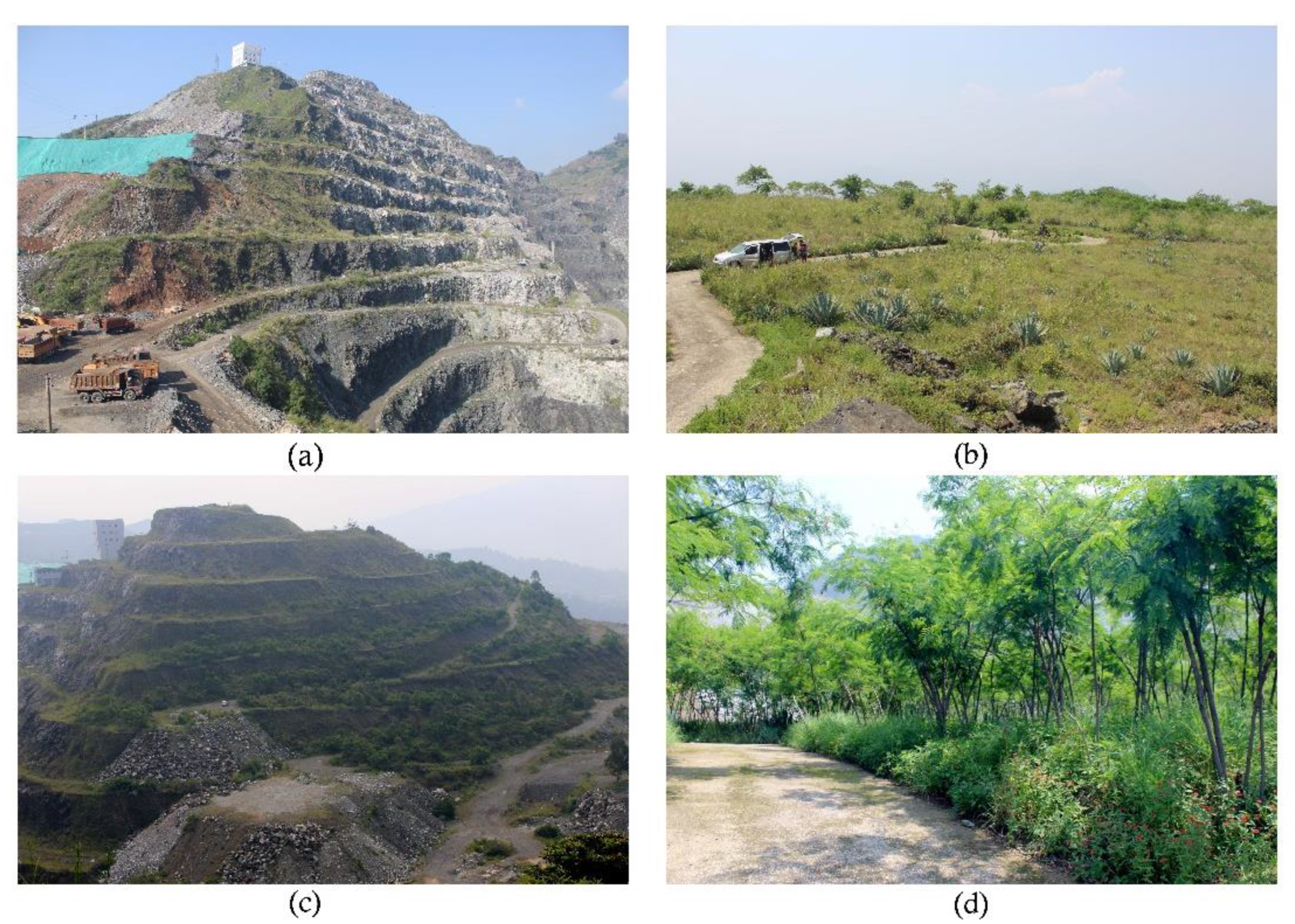

| Time | Vegetation Pattern | Characteristic |
|---|---|---|
| 10-year dump | RP&LP (rehabilitative plant and local plant) | To ensure that the restoration effects of the landscape and the recovery of potential toxic metals are completed simultaneously, rehabilitative plants and native plants are cultivated in the area. |
| RP (rehabilitative plant) | Only vegetation for restoration. | |
| LP (local plant) | There is no mining disturbance in the native plant natural growth area. | |
| 17-year dump | RP&LP (rehabilitative plant and local plant) | In the early stage, plants were only planted for restoration. The natural invasion of native plants resulted in succession. |
| LP (local plant) | There is no mining disturbance in the native plant natural growth area. |
| Soil Property | pH | pH | TN | TP | TK | AN | AP | AK | SOM |
|---|---|---|---|---|---|---|---|---|---|
| >7.0 | <7.0 | g/kg | mg/kg | g/kg | |||||
| Xa | 9 | 4.5 | 0.75 | 0.7 | 10 | 60 | 5 | 50 | 10 |
| Xc | 8 | 5.5 | 1.00 | 1.5 | 15 | 90 | 10 | 100 | 20 |
| Xp | 7 | 6.5 | 1.50 | 2.0 | 20 | 150 | 20 | 150 | 30 |
| Years | Vegetation Pattern | Species | Height (cm) | Number of Stems | Diversity Index |
|---|---|---|---|---|---|
| 10 | RP&LP | Agave sisalana | 57.83 ± 7.87 | 5 | 8.06 |
| Neyraudia reynaudiana | 109.17 ± 10.72 | 11 | |||
| Taxus chinensis | 380.00 ± 18.83 | 4 | |||
| Artemisia argyi | 75.83 ± 6.11 | 4 | |||
| Zinnia elegans | 54.67 ± 5.34 | 10 | |||
| Amaranthus viridis | 57.62 ± 11.15 | 3 | |||
| Stipa capillata | 44.33 ± 3.66 | 3 | |||
| RP | Agave sisalana | 96.80 ± 3.41 | 6 | 2.12 | |
| Neyraudia reynaudiana | 157.00 ± 3.87 | 18 | |||
| LP | Neyraudia reynaudiana | 90.00 ± 3.85 | 5 | 3.23 | |
| Artemisia argyi | 69.00 ± 3.61 | 3 | |||
| Zinnia elegans | 50.00 ± 8.12 | 4 | |||
| 17 | RP&LP | Agave sisalana | 43.00 ± 4.79 | 3 | 9.21 |
| Neyraudia reynaudiana | 97.75 ± 10.28 | 6 | |||
| Taxus chinensis | 563.50 ± 65.82 | 4 | |||
| Artemisia argyi | 121.25 ± 11.12 | 5 | |||
| Zinnia elegans | 35.00 ± 4.89 | 7 | |||
| Lespedeza bicolor | 111.50 ± 11.98 | 4 | |||
| Patrinia scabiosaelia | 36.20 ± 8.70 | 5 | |||
| Lantana camara | 54.00 ± 10.71 | 3 | |||
| LP | Artemisia argyi | 53.25 ± 6.68 | 4 | 2.09 | |
| Zinnia elegans | 42.00 ± 11.79 | 4 |
| Years of Rehabilitation | 10 Years | 17 Years | |||
|---|---|---|---|---|---|
| Vegetation Pattern | RP&LP | RP | LP | RP&LP | LP |
| SOM (g/kg) | 22.9 ± 1.25cB | 4.83 ± 0.33a | 10.76 ± 1.25bA | 14.44 ± 0.90aA | 18.95 ± 1.28aB |
| TN (mg/kg) | 1468.57 ± 50.21bA | 270.00 ± 10.29a | 1103.33 ± 48.33bA | 861.25 ± 32.21aA | 1265.00 ± 45.13bA |
| TP (mg/kg) | 1155.71 ± 33.11aA | 1083.00 ± 58.32a | 3036.67 ± 45.26bA | 3842.50 ± 98.24aB | 4320.00 ± 98.32aB |
| TK (mg/kg) | 2754.29 ± 31.32bA | 1150.00 ± 33.33a | 2303.33 ± 46.01bA | 1633.75 ± 68.32aA | 2405.00 ± 56.22bA |
| AN (mg/kg) | 47.84 ± 4.11aA | 42.67 ± 3.34a | 60.60 ± 4.18bA | 73.26 ± 8.92bB | 60.64 ± 8.26aA |
| AP (mg/kg) | 8.16 ± 1.26bA | 3.14 ± 0.27a | 3.76 ± 0.52aA | 9.71 ± 0.32aA | 8.33 ± 0.90aB |
| AK (mg/kg) | 112.00 ± 4.21aA | 203.63 ± 25.23c | 158.52 ± 9.40bA | 174.05 ± 10.12bB | 129.90 ± 10.12aA |
| pH | 7.61 ± 0.96aB | 7.68 ± 0.66b | 7.85 ± 0.61cA | 7.54 ± 0.33aA | 7.24 ± 0.19aA |
| soil fertility index | 0.64 | 0.50 | 0.63 | 0.67 | 0.73 |
| Years of Rehabilitation | 10 Years | 17 Years | |||
|---|---|---|---|---|---|
| Vegetation Pattern | RP&LP | RP | LP | RP&LP | LP |
| Cu (mg/kg) | 306.50 ± 59.32bA | 191.24 ± 8.25a | 223.57 ± 18.33abB | 225.72 ± 18.14bA | 134.72 ± 10.24aA |
| Mn (mg/kg) | 1863.90 ± 87.47aA | 1691.21 ± 51.21a | 1802.06 ± 51.15aA | 1791.77 ± 34.97aA | 1685.50 ± 58.27aA |
| Cd (mg/kg) | 0.31 ± 0.01bA | 0.11 ± 0.12a | 0.12 ± 0.01aA | 0.21 ± 0.01aA | 0.20 ± 0.01aB |
| Cr (mg/kg) | 494.50 ± 41.21bB | 19.70 ± 2.14a | 69.17 ± 5.23aA | 78.41 ± 3.24aA | 76.75 ± 5.21aA |
| Ni (mg/kg) | 353.00 ± 51.24bB | 13.55 ± 1.89a | 21.30 ± 0.12aA | 77.58 ± 4.54aA | 133.80 ± 7.25bB |
| Zn (mg/kg) | 133.29 ± 10.21cA | 97.05 ± 7.24a | 117.67 ± 10.26bA | 146.55 ± 8.21aA | 112.30 ± 9.22aA |
| Pb (mg/kg) | 9.70 ± 1.25bA | 1.86 ± 0.21a | 15.37 ± 1.90cB | 8.21 ± 1.02aA | 6.76 ± 0.57aA |
| As (mg/kg) | 1.45 ± 0.17bA | 0.77 ± 0.01a | 1.54 ± 0.22bB | 1.13 ± 0.90aA | 1.02 ± 0.21aA |
| Fe (g/kg) | 117.36 ± 12.15bA | 86.63 ± 5.54a | 108.86 ± 8.54bA | 102.67 ± 7.25aA | 121.63 ± 9.21aA |
| Pollution index | 884.68 | 802.56 | 855.25 | 850.35 | 800.02 |
© 2019 by the authors. Licensee MDPI, Basel, Switzerland. This article is an open access article distributed under the terms and conditions of the Creative Commons Attribution (CC BY) license (http://creativecommons.org/licenses/by/4.0/).
Share and Cite
Chen, F.; Yang, Y.; Mi, J.; Liu, R.; Hou, H.; Zhang, S. Effects of Vegetation Pattern and Spontaneous Succession on Remediation of Potential Toxic Metal-Polluted Soil in Mine Dumps. Sustainability 2019, 11, 397. https://doi.org/10.3390/su11020397
Chen F, Yang Y, Mi J, Liu R, Hou H, Zhang S. Effects of Vegetation Pattern and Spontaneous Succession on Remediation of Potential Toxic Metal-Polluted Soil in Mine Dumps. Sustainability. 2019; 11(2):397. https://doi.org/10.3390/su11020397
Chicago/Turabian StyleChen, Fuyao, Yongjun Yang, Jiaxin Mi, Run Liu, Huping Hou, and Shaoliang Zhang. 2019. "Effects of Vegetation Pattern and Spontaneous Succession on Remediation of Potential Toxic Metal-Polluted Soil in Mine Dumps" Sustainability 11, no. 2: 397. https://doi.org/10.3390/su11020397
APA StyleChen, F., Yang, Y., Mi, J., Liu, R., Hou, H., & Zhang, S. (2019). Effects of Vegetation Pattern and Spontaneous Succession on Remediation of Potential Toxic Metal-Polluted Soil in Mine Dumps. Sustainability, 11(2), 397. https://doi.org/10.3390/su11020397

