

Accounting for Regional Heterogeneity of Agricultural Sustainability in Spain



Abstract
1. Introduction
2. Materials and Methods
2.1. Indicator Selection and Data Collection
2.2. Data Analysis and Statistical Methods
3. Results and Discussion
4. Conclusions
Author Contributions
Acknowledgments
Conflicts of Interest
Appendix A.

| Sustainability Dimension | Sustainability Indicator Code | Indicator Definition | Indicator Measurement | Data Source |
|---|---|---|---|---|
| Economic | EC1 | Agricultural productivity | Ratio of gross value added in agriculture, livestock and fisheries, and work units per year, AWU (€/AWU). | National Statistical Institute (NSI) and Agricultural Census 2009. http://www.ine.es/CA/Inicio.do?locale=en_US |
| EC2 | Capital stock | Market value of tangible assets in agriculture per labour unit (€/AWU). | Sources: BBVA Foundation, NSI | |
| EC3 | Rural development | Share of public support allocated to rural development programmes (2008), in %. | [62] | |
| EC4 | Agricultural labour intensity index | Number of annual agricultural work units per 100 ha of tilled farmland (AWU/100 ha). | Agricultural Census 2009, NSI | |
| EC5 | Full time farmers | Ratio of full time farmers whose main professional activity takes place in the farm to the total number of registered farmers (in %). | Agricultural Census 2009, NSI | |
| EC6 | Agricultural machinery intensity index | Agricultural machines density per 100 ha of cultivated area. | Census of machinery 2010, MAPAMA. http://www.mapama.gob.es/es/agricultura/temas/medios-de-produccion/maquinaria-agricola/estadisticas/ | |
| EC7 | Variation in per capita Gross Domestic Product | Index base 100 in constant prices: | NSI: http://www.ine.es/dyngs/INEbase/es/operacion.htm?c=Estadistica_C&cid=1254736167628&menu=resultados&idp=1254735576581 | |
| EC8 | Investment in R&D | Ratio of investment in research and development per Gross Domestic Product | 2013, BBVA-IVIE and NSI | |
| Social | SO1 | Farmers aging index | Ratio of farmers older than 55 years to the total number of farmers (in %). The value of this indicator has been reversed (100—indicator value) in order to be additive to other indicators positively related to sustainability. | Agricultural Census 2009, NSI |
| SO2 | Non-farm enterprises | Percentage of non-farm enterprises in total. | Agricultural Census 2009, and Central Business Directory 2009, NSI: http://www.ine.es/dynt3 /inebase/en/index.htm?padre=51&dh=1 | |
| SO3 | Small farms | Percentage of farms with an acreage of less than 10 ha. The value of this indicator has been reversed (100—indicator value) in order to be additive to other indicators positively related to sustainability. | Agricultural Census 2009, NSI | |
| SO4 | Salaried labour | Share of paid work units in total work units per year. | Agricultural Census 2009, NSI | |
| SO5 | Quality areas | Share of agricultural area and grasslands under Protected Designations of Origin and Protected Geographical Indications. | MAPAMA: http://www.mapama.gob.es/es/cartografia-y-sig/ide/descargas/ | |
| Environmental | EN1 | Agricultural land | Share of agricultural and grassland area in total area. | Copernicus Land Monitoring Services (2016). Pan-European. CORINE-Land Cover, CLC 2012. 18.5 version. http://land.copernicus.eu/pan-european/corine-land-cover/clc-2012/view Accessed 26 June 2018 and GIS data (Total surface—of each province) |
| EN2 | Variation of agricultural land | Variation of agricultural land and grassland between 2006 and 2012. The difference is quantified relative to 100 (100=base index value CLC2006 surface). | CORINE Land Cover maps 2006 and 2012 | |
| EN3 | Organic farming | Share of organic land in total agricultural land (CLC 2012). | MAPAMA, 2012 and CLC 2012 | |
| EN4 | Livestock pressure | This indicator can be interpreted from different perspectives. From the environmental point of view, we have considered it as positive: livestock keeps a less dense vegetation cover, hence the wildfire risk is lower. | Agricultural Census 2009, NSI for Animal Units and CLC2006 for Permanent Pastures Area | |
| EN5 | Burned agricultural area | Percentage of the burned agricultural area (BAA) between 2006 and 2012 with respect to the total agricultural land (AL): The value of this indicator has been reversed (100—indicator value) in order to be additive to other indicators positively related to sustainability. | CLC 2012 and European Forest Fire Information System—EFFIS http://effis.jrc.ec.europa.eu, European Commission Joint Research Centre, [63] | |
| EN6 | Terrestrial protected areas | Percentage of terrestrial protected areas (Nationally Designated Spaces and Biosphere Reserves) located in agricultural areas over the total arable land | Database of Biodiversity (MARM-Ministry of Environment), GIS of Europarc-Spain and GIS data, CLC 2012 | |
| EN7 | Natura 2000 network | Percentage of area occupied by areas under Natura 2000 network (Special Protection Areas for Birds, SPA, Sites of Community Importance, SCI, Habitats of Community Importance priority) in agricultural areas over arable land | Database of Biodiversity (MARM-Ministry of Environment), GIS of Europarc-Spain and GIS data, CLC 2012 | |
| EN8 | Soil erosion | Percentage of geographical area (ha) affected by intense or extremely intense laminar and gully erosion (>25 ton/ha/year) in total erodible surface. The value of this indicator was reversed (100—indicator value) in order to be additive to other indicators positively related to sustainability. | National Inventory of Soil Erosion and statements erosive map (1987–2002) | |
| EN9 | Carbon stock | First we calculated the CO2 sequestration made by the agricultural ecosystems and grasslands of each province taking into account the surface area of each class of CORINE Land Cover 2012 (LC). Then, we applied a coefficient of CO2 density (D)—tons/ha ([64,65,66] and our modification). Second we considered emissions (E) related to agricultural management in 2012 [54] in each province based on the area occupied by these ecosystems. The indicator is the ratio: The target value is dynamic looking for at least the balance between CO2 emissions and sequestration in each province. | CLC 2012, [67] (http://www.fao.org/faostat/en/#country/203) |
Appendix B. Provincial Distribution of Composite Sustainability Indices
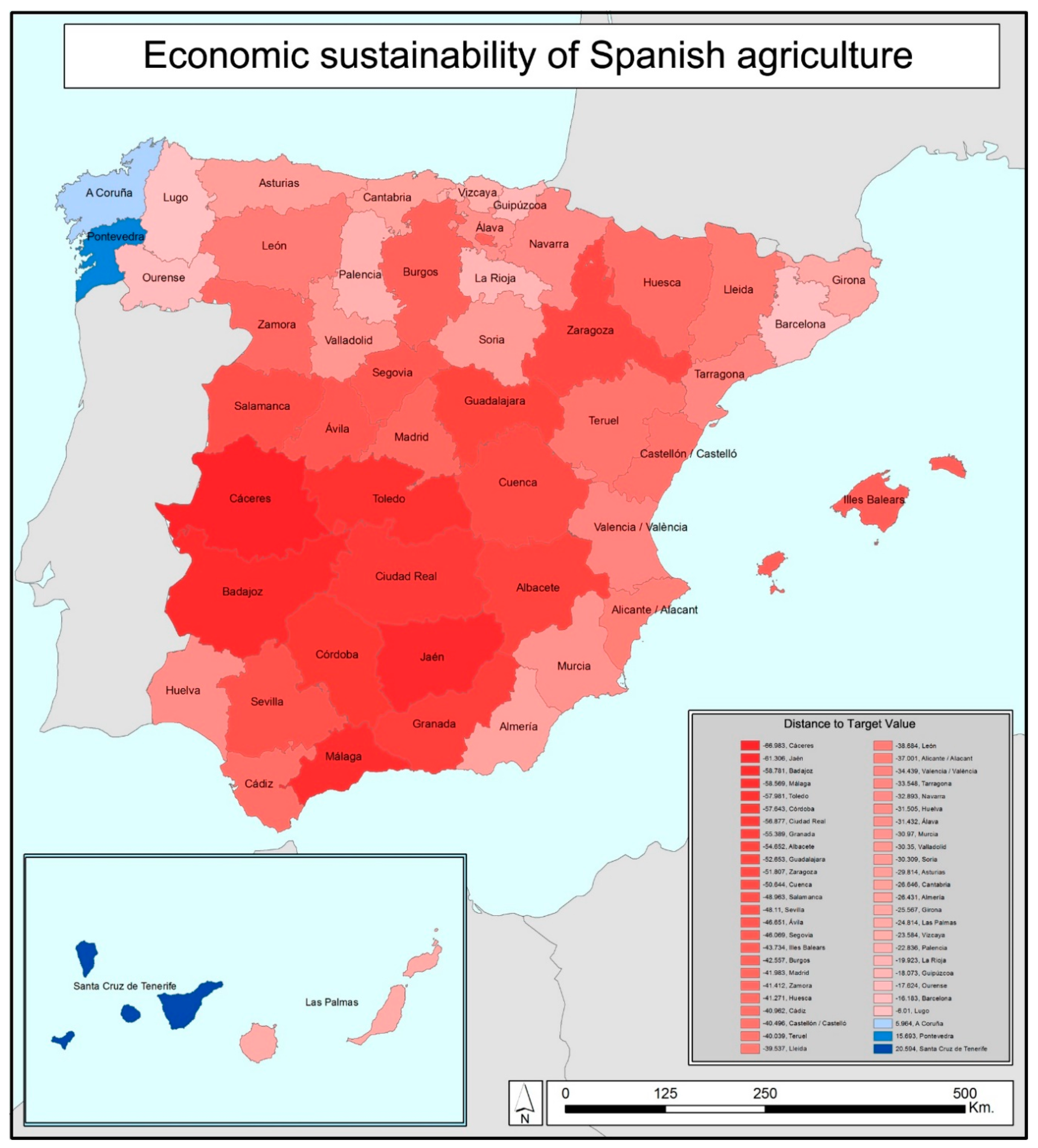
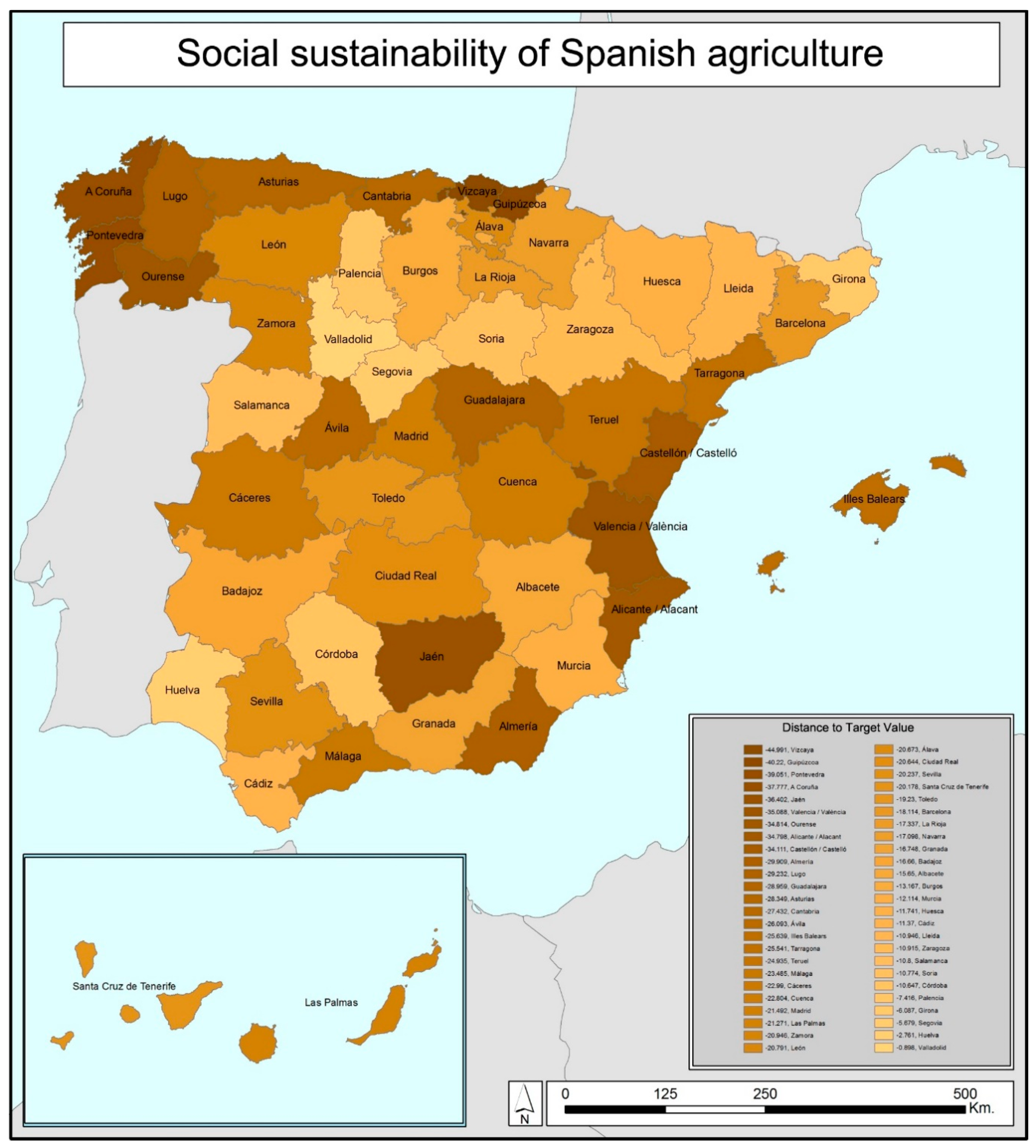
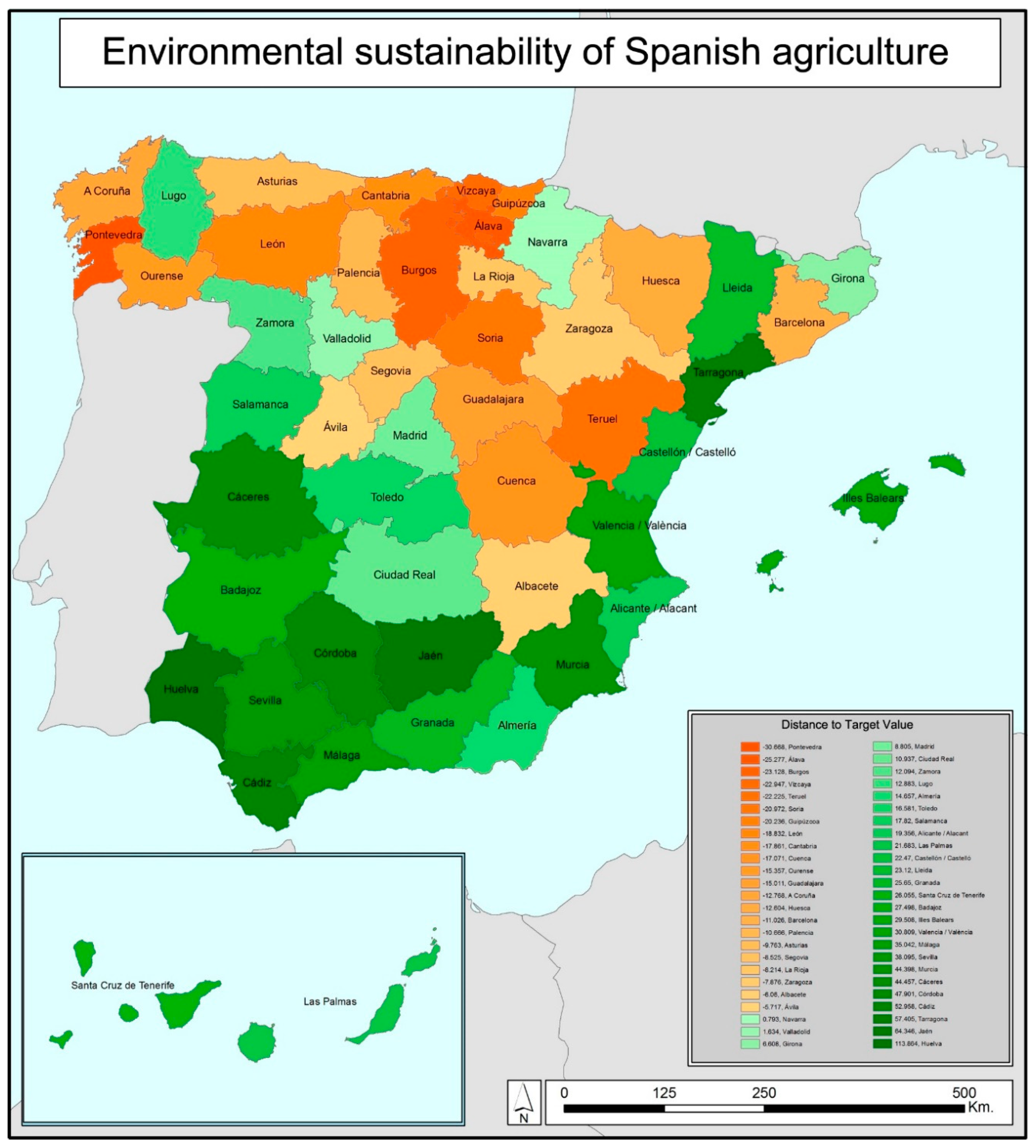
References
- World Commission on Environment and Development. Our Common Future; Oxford University Press: Oxford, UK, 1987; Available online: http://www.un-documents.net/our-common- future.pdf (accessed on 15 January 2018).
- Pretty, J. Agricultural sustainability: Concepts, principles and evidence. Philos. Trans. R. Soc. B 2008, 363, 447–465. [Google Scholar] [CrossRef] [PubMed]
- Darnhofer, I.; Fairweather, J.; Moller, H. Assessing a farm’s sustainability: Insights from resilience thinking. Int. J. Agric. Sustain. 2010, 8, 186–198. [Google Scholar] [CrossRef]
- DeLonge, M.S.; Miles, A.; Carlisle, L. Investing in the transition to sustainable agriculture. Environ. Sci. Policy 2016, 55, 266–273. [Google Scholar] [CrossRef]
- European Commission. Statistical Factsheet Spain; European Commission, DG Agriculture and Rural Development: Brussels, Belgium, 2018. Available online: https://ec.europa.eu/agriculture/sites/agriculture/files/statistics/factsheets/pdf/es_en.pdf (accessed on 11 June 2018).
- Salazar-Ordóñez, M.; Rodríguez-Entrena, M.; Sayadi, S. Agricultural Sustainability from a Societal View: An Analysis of Southern Spanish Citizens. J. Agric. Environ. Ethics 2013, 26, 473–490. [Google Scholar] [CrossRef]
- Slätmo, E.; Fischer, K.; Röös, E. The Framing of Sustainability in Sustainability Assessment Frameworks for Agriculture. Sociol. Rural. 2017, 57, 378–395. [Google Scholar] [CrossRef]
- European Commission. Overview of CAP Reform 2014–2020. Agricultural Policy Perspectives Brief; European Commission, DG Agriculture and Rural Development: Brussels, Belgium, 2013; Volume 5. Available online: https://eige.europa.eu/resources/05_en.pdf (accessed on 20 February 2018).
- European Commission. CAP Reform—An Explanation of the Main Elements; MEMO/13/937; European Commission, DG Agriculture and Rural Development: Brussels, Belgium, 2013. Available online: http://europa.eu/rapid/press-release_MEMO-13-621_en.htm (accessed on 5 April 2018).
- International Centre for Trade and Sustainable Development. The European Union CAP: Towards Public Money for Public Goods? ICTSD: Geneva, Switzerland, 2015; Available online: https://www.ictsd.org/sites/default/files/The%20EU%20CAP%20-Towards%20Public%20Money%20for%20Public%20Goods_1.pdf (accessed on 15 December 2017).
- Mili, S.; Júdez, L.; de Andrés, R. Investigating the impacts of EU CAP reform 2014-20 and developments in sustainable olive farming systems. New Medit. 2017, 16, 2–10. Available online: http://newmedit.iamb.it/edizioni_new_medit,229,229,2017,168,1107,investigating-the-impacts-of-eu-cap-reform-2014-20-and-developments-in-sustainable-olive-farming-systems-.htm (accessed on 22 June 2018).
- OECD. OECD Agricultural Policy Monitoring and Evaluation 2018; OECD: Paris, France, 2018; Available online: http://www.oecd.org/tad/agricultural-policies/monitoring-and-evaluation.htm (accessed on 27 September 2018).
- European Commission. The Future of Food and Farming: Communication from the Commission to the European Parliament, the Council, the European Economic and Social Committee and the Committee of the Regions; European Commission: Brussels, Belgium, 2017. Available online: https://ec.europa.eu/agriculture/sites/agriculture/files/future-of-cap/future_of_food_and_farming_communication_en.pdf (accessed on 14 March 2018).
- Ness, B.; Urbel-Piirsalu, E.; Anderberg, S.; Olsson, L. Categorising tools for sustainability assessment. Ecol. Econ. 2007, 60, 498–508. [Google Scholar] [CrossRef]
- Schader, C.; Grenz, J.; Meier, M.S.; Stolze, M. Scope and precision of sustainability assessment approaches to food systems. Ecol. Soc. 2014, 19, 42. [Google Scholar] [CrossRef]
- Wustenberghs, H.; Coteur, I.; Debruyne, L.; Marchand, F. TempAg Pilot Activity 1.1. 1. Survey of Sustainability Assessment Methods; Institute for Agricultural and Fisheries Research ILVO: Merelbeke, Belgium, 2015. [Google Scholar]
- Schader, C.; Grovermann, C.; Frick, R.; Grenz, J.; Stolze, M. Towards a New Public Goods Payment Model for Remunerating Farmers under the CAP Post-2020. Potential of Sustainability Assessment tools for Improving the Effectiveness, Efficiency, and Acceptance of the CAP; Research Institute of Organic Agriculture FIBL: Frick, Switzerland, 2017; Available online: https://www.ifoam-eu.org/sites/default/files/towards_a_new_public_goods_payment_model_for_remunerating_farmers_under_the_cap_post-2020_report_by_fibl.pdf (accessed on 10 April 2018).
- FAO. Sustainability Assessment of Food and Agriculture systems (SAFA); Food and Agriculture Organization of the United Nations (FAO): Rome, Italy, 2014; Available online: http://www.fao.org/nr/sustainability/sustainability-assessments-safa/en/ (accessed on 13 June 2018).
- Schader, C.; Baumgart, L.; Landert, J.; Muller, A.; Ssebunya, B.; Blockeel, J.; Weisshaidinger, R.; Petrasek, R.; Mészáros, D.; Padel, S.; et al. Using the Sustainability Monitoring and Assessment Routine (SMART) for the Systematic 4. Analysis of Trade-Offs and Synergies between Sustainability Dimensions and Themes at Farm Level. Sustainability 2016, 8, 274. [Google Scholar] [CrossRef]
- Binder, C.R.; Feola, G.; Steinberger, J.K. Considering the normative, systemic and procedural dimensions in indicator-based sustainability assessments in agriculture. Environ. Impact Assess. 2010, 30, 71–81. [Google Scholar] [CrossRef]
- Binder, C.R.; Feola, G. Normative, systemic and procedural aspects: A review of indicator-based sustainability assessments in agriculture. In Methods and Procedures for Building Sustainable Farming Systems; Marta-Costa, A.A., Silva, E., Eds.; Springer: New York, NY, USA, 2013; pp. 33–46. [Google Scholar]
- Latruffe, L.; Diazabakana, A.; Bockstaller, C.; Desjeux, Y.; Finn, J.; Kelly, E.; Ryan, M.; Uthes, S. Measurement of sustainability in agriculture: A review of indicators. Stud. Agric. Econ. 2016, 118, 123–130. [Google Scholar] [CrossRef]
- Rigby, D.; Woodhouse, P.; Young, T.; Burton, M. Constructing a farm level indicator of sustainable agricultural practice. Ecol. Econ. 2001, 39, 463–478. [Google Scholar] [CrossRef]
- Santiago-Brown, I.; Metcalfe, A.; Jerram, C.; Collins, C. Sustainability Assessment in Wine-Grape Growing in the New World: Economic, Environmental, and Social Indicators for Agricultural Businesses. Sustainability 2015, 7, 8178–8204. [Google Scholar] [CrossRef]
- Torres, J.; Valera, D.L.; Belmonte, L.J.; Herrero-Sánchez, C. Economic and Social Sustainability through Organic Agriculture: Study of the Restructuring of the Citrus Sector in the “Bajo Andarax” District (Spain). Sustainability 2016, 8, 918. [Google Scholar] [CrossRef]
- Reed, M.S.; Fraser, E.D.G.; Dougill, A.J. An adaptive learning process for developing and applying sustainability indicators with local communities. Ecol. Econ. 2006, 59, 406–418. [Google Scholar] [CrossRef]
- Gómez-Limón, J.A.; Sanchez-Fernandez, G. Empirical evaluation of agricultural sustainability using composite indicators. Ecol. Econ. 2010, 69, 1062–1075. [Google Scholar] [CrossRef]
- Garrido, A. (Ed.) Indicadores de Sostenibilidad de la Agricultura y Ganadería Españolas; Fundación Cajamar: Almería, Spain, 2011; Available online: http://www.publicacionescajamar.es/pdf/series-tematicas/sostenibilidad/indicadores-de-sostenibilidad.pdf (accessed on 13 November 2017).
- Gómez-Limón, J.A.; Reig Martínez, E. (Eds.) La Sostenibilidad de la Agricultura española; Cajamar Caja Rural: Almería, Spain, 2013; Available online: http://www.publicacionescajamar.es/pdf/series-tematicas/sostenibilidad/la-sostenibilidad-de-la-agricultura.pdf (accessed on 14 December 2017).
- Galdeano, E.; Aznar, J.A.; Pérez Mesa, J.C. Contribuciones Económicas, Sociales y Medioambientales de la Agricultura Intensiva de Almería. Un Análisis de Sinergias Entre las Dimensiones de Sostenibilidad; Cajamar Caja Rural: Almería, Spain, 2016; Available online: http://www.publicacionescajamar.es/series-tematicas/sostenibilidad/contribuciones-economicas-sociales-y-medioambientales-de-la-agricultura-intensiva-de-almeria-un-analisis-de-las-sinergias-entre-las-dimensiones-de-la-sostenibilidad/ (accessed on 9 July 2018).
- de Olde, E.M.; Oudshoorn, F.W.; Sørensen, C.A.G.; Bokkers, E.A.M.; de Boer, I.J.M. Assessing sustainability at farm-level: Lessons learned from a comparison of tools in practice. Ecol. Indic. 2016, 66, 391–404. [Google Scholar] [CrossRef]
- Coteur, I.; Marchand, F.; Debruyne, L.; Dalemans, F.; Lauwers, L. A framework for guiding sustainability assessment and on-farm strategic decision making. Environ. Impact Assess. 2016, 60, 16–23. [Google Scholar] [CrossRef]
- de Olde, E.M.; Sautier, M.; Whitehead, J. Comprehensiveness or implementation: Challenges in translating farm-level sustainability assessments into action for sustainable development. Ecol. Indic. 2018, 85, 1107–1112. [Google Scholar] [CrossRef]
- Poppe, K.; Vrolijk, H. Microdata: A critical source for policy evaluation. EuroChoices 2018, 17, 28–35. [Google Scholar] [CrossRef]
- Costanza, R.; d’Arge, R.; de Groot, R.; Farber, S.; Grasso, M.; Hannon, B.; Limburg, K.; Naeem, S.; O’Neill, R.V.; Paruelo, J.; et al. The value of the world’s ecosystem services and natural capital. Nature 1997, 387, 253–260. [Google Scholar] [CrossRef]
- Spangenberg, J. Sustainability Indicators. A Compass on the Road towards Sustainability; Wuppertal Institute: Wuppertal, Germany, 1998; Available online: https://epub.wupperinst.org/frontdoor/deliver/index/docId/721/file/WP81.pdf (accessed on 18 October 2017).
- European Commission. Communication to the Council and the European Parliament. Development of Agri-Environmental Indicators for Monitoring the Integration of Environmental Concerns into the Common Agricultural Policy. COM (2006) 508 Final; European Commission: Brussels, Belgium, 2006.
- Pintus, F.; Giraud, J.P. Measuring agricultural and rural development. In Mediterra 2009: Rethinking Rural Development in the Mediterranean; Hervieu, B., Thibault, H.L., Eds.; Presses de Sciences Po: Paris, France, 2009; pp. 333–351. [Google Scholar]
- Rametsteiner, E.; Pülzl, H.; Alkan-Olsson, J.; Frederiksen, P. Sustainability indicator development-science or political negotiation? Ecol. Indic. 2011, 11, 61–70. [Google Scholar] [CrossRef]
- Pülzl, H.; Prokofieva, I.; Berg, S.; Rametsteiner, E.; Aggestam, F.; Wolfslehner, B. Indicator development in sustainability impact assessment: Balancing theory and practice. Eur. J. For. Res. 2012, 131, 35–46. [Google Scholar] [CrossRef]
- Kniivilä, M.; Bäckman, S.; Horne, P.; Martinez-Vega, J.; Mili, S.; Pyykkönen, P. Frameworks for Sustainable Agriculture and Forestry: Applications to Finland and Spain; PTT: Helsinki, Finland, 2012; Available online: http://www.ptt.fi/julkaisut-ja-hankkeet/kaikki-julkaisut/frameworks-for-sustainable-agriculture-and-forestry-applications-to-finland-and-spain.html (accessed on 20 February 2017).
- Martínez-Vega, J.; Mili, S.; Echavarría, P. Assessing forest sustainability: Evidence from Spanish provinces. Geoforum 2016, 70, 1–10. [Google Scholar] [CrossRef]
- Morse, S.; Fraser, E.D.G. Making “dirty” nations look clean? The nation state and the problem of selecting and weighting indices as tools for measuring progress towards sustainability. Geoforum 2005, 36, 625–640. [Google Scholar] [CrossRef]
- Maes, W.H.; Fontaine, M.; Rongé, K.; Hermy, M.; Muys, B. A quantitative indicator framework for stand level evaluation and monitoring of environmentally sustainable forest management. Ecol. Indic. 2011, 11, 468–479. [Google Scholar] [CrossRef]
- Prieto, F.; Ruiz, P. Prospectiva 2030 en los Cambios de Ocupación del Suelo en España y sus Impactos en el Ciclo Hidrológico: Algunas Ideas Para un Futuro Sostenible; Expo Zaragoza 2008: Zaragoza, Spain, 2008; Available online: https://www.zaragoza.es/contenidos/medioambiente/cajaAzul/13S5-P2-PRIETO RUIZ_ACC.pdf (accessed on 15 May 2018).
- Böhringer, C.; Jochem, P.E.P. Measuring the inmeasurable. A survey of sustainability indices. Ecol. Econ. 2007, 63, 1–8. [Google Scholar] [CrossRef]
- Bockstaller, C.; Guichard, L.; Makowski, D.; Aveline, A.; Girardin, P.; Plantureux, S. Agri-environmental indicators to assess cropping and farming systems. A review. Agron. Sustain. Dev. 2008, 28, 139–149. [Google Scholar] [CrossRef]
- Nardo, M.; Saisana, M.; Saltelli, A.; Tarantola, S. Tools for Composite Indicators Building; European Commission, Institute for the Protection and Security of the Citizen, JRC: Ispra, Italy, 2005.
- Talukder, B.; Hipel, K.W.; vanLoon, G.W. Developing Composite Indicators for Agricultural Sustainability Assessment: Effect of Normalization and Aggregation Techniques. Resources 2017, 6, 66. [Google Scholar] [CrossRef]
- Sajeva, M.; Gatelli, D.; Tarantola, S.; Hollanders, H. Methodology Report on European Innovation Scoreboard 2005; European Commission, Enterprise Directorate-General: Brussels, Belgium, 2005.
- Salzman, J. Methodological Choices Encountered in the Construction of Composite Indices of Economic and Social Well-Being; Center for the Study of Living Standards: Ottawa, ON, Canada, 2003. [Google Scholar]
- Tate, E. Social vulnerability indices: A comparative assessment using uncertainty and sensitivity analysis. Nat. Hazards 2012, 63, 325–347. [Google Scholar] [CrossRef]
- Esty, D.C.; Levy, M.; Srebotnjak, T.; de Sherbinin, A. Environmental Sustainability Index: Benchmarking National Environmental Stewardship; Yale Center for Environmental Law & Policy: New Haven, CT, USA, 2005; Available online: http://archive.epi.yale.edu/files/2005_esi_report.pdf (accessed on 16 January 2018).
- Salvati, L.; Carlucci, M. A composite index of sustainable development at the local scale: Italy as a case study. Ecol. Indic. 2014, 43, 162–171. [Google Scholar] [CrossRef]
- Moldan, B.; Svatava, J.; Hák, T. How to understand and measure environmental sustainability: Indicators and targets. Ecol. Indic. 2012, 17, 4–13. [Google Scholar] [CrossRef]
- Trexler, J.C.; Goss, C.W. Aquatic fauna as indicators for Everglades restoration: Applying dynamic targets in assessments. Ecol. Indic. 2009, 9, s108–s119. [Google Scholar] [CrossRef]
- OECD. Handbook on Constructing Composite Indicators. Methodology and User Guide; OECD: Paris, France, 2008; Available online: http://www.oecd.org/sdd/42495745.pdf (accessed on 16 November 2017).
- Rodrigues, G.S.; Rodrigues, I.A.; Buschinelli, C.C.A.; de Barros, I. Integrated farm sustainability assessment for the environmental management of rural activities. Environ. Impact Assess. 2010, 30, 229–239. [Google Scholar] [CrossRef]
- Parris, T.; Kates, R. Characterizing and measuring sustainable development. Annu. Rev. Environ. Resour. 2003, 28, 559–586. [Google Scholar] [CrossRef]
- Hák, T.; Janousková, S.; Moldan, B. Sustainable Development Goals: A need for relevant indicators. Ecol. Indic. 2016, 60, 565–573. [Google Scholar] [CrossRef]
- Reig Martínez, E.; Gómez-Limón, J.A. La sostenibilidad de la agricultura actual. In La Sostenibilidad de la Agricultura Española; Gómez-Limón, J.A., Reig Martínez, E., Eds.; Cajamar Caja Rural: Almería, Spain, 2013; pp. 37–86. [Google Scholar]
- Sineiro, F.; Lorenzana, R.; Vázquez González, I. Distribución territorial de las ayudas. In Apoyo Público a la Agricultura Española 2003–2010; García Álvarez-Coque, J.M., Sineiro, F., Eds.; Ministerio de Medio Ambiente y Medio Rural y Marino MARM: Madrid, Spain, 2011; pp. 157–198. Available online: http://www.usc.es/ecoagra/arquivos//2011-cap%C3%ADtulo-de-livro-Sineiro-Garc%C3%ADa-Lorenzana-Fern%C3%A1ndez-e-V%C3%A1zquez-Gonz%C3%A1lez-Distribuci%C3%B3n-territorial-de-las-ayudas-PAC.pdf (accessed on 28 February 2018).
- San Miguel-Ayanz, J.; Schulte, E.; Schmuck, G.; Camia, A.; Strobl, P.; Libertà, G.; Giovando, C.; Boca, R.; Sedano, F.; Kempeneers, P.; et al. Comprehensive monitoring of wildfires in Europe: The European Forest Fire Information System (EFFIS). In Approaches to Managing Disaster—Assessing Hazards, Emergencies and Disaster Impacts; Tiefenbacher, J., Ed.; InTech: London, UK, 2012; pp. 87–105. [Google Scholar]
- Cruickshank, M.M.; Tomlinson, R.W.; Trew, S. Application of CORINE land-cover mapping to estimate carbon stored in the vegetation of Ireland. J. Environ. Manag. 2000, 58, 269–287. [Google Scholar] [CrossRef]
- Molin, P.G. Estimation of Vegetation Carbon Stock in Portugal Using Land Use/Land Cover Data; University of Nova Lisboa: Lisbon, Portugal, 2010; Available online: https://run.unl.pt/bitstream/10362/2730/3/TGEO0028.pdf (accessed on 22 March 2018).
- OSE. Biodiversidad en España. Base de la Sostenibilidad ante el Cambio Global; Observatorio de la Sostenibilidad (OSE) en España: Madrid, Spain, 2011; Available online: https://www.researchgate.net/publication/280528506_Biodiversidad_en_Espana_Base_para_la_sostenibilidad_ante_el_cambio_global (accessed on 18 May 2018).
- FAO. Spain, Country Indicators, Emissions; Food and Agriculture Organization of the United Nations (FAO): Rome, Italy, 2018; Available online: http://www.fao.org/faostat/en/#country/203 (accessed on 21 September 2018).
| Sustainability Dimension | Code | Indicator | Lowest Value (LV) | Highest Value (HV) | Target Value (TV) | |
|---|---|---|---|---|---|---|
| Value | Criterion Used | |||||
| Economic | EC1 | Agricultural productivity | 11,892.93 | 86,723.98 | 40,488.53 | 85th percentile of data set |
| EC2 | Capital stock | 1006.20 | 11,242.17 | 7551.18 | 85th percentile of data set | |
| EC3 | Rural development | 1.53 | 39.49 | 23.83 | 85th percentile of data set | |
| EC4 | Agricultural labour intensity index | 0.72 | 63.28 | 12.68 | 85th percentile of data set | |
| EC5 | Full-time farmers | 0.45 | 20.51 | 9.13 | 85th percentile of data set | |
| EC6 | Agricultural machinery intensity index | 1.72 | 63.77 | 23.34 | 85th percentile of data set | |
| EC7 | Variation in per capita Gross Domestic Product (GDP) | 76.27 | 105.76 | 100 | 100 (no loss in per capita GDP) | |
| EC8 | Investment in R&D | 0.0035 | 0.0190 | 0.0149 | 85th percentile of data set | |
| Social | SO1 | Farmers aging index | 28.56 | 58.83 | 50.47 | 85th percentile of data set |
| SO2 | Non-farm enterprises | 35.66 | 98.41 | 68.00 | Median of data set, in this case 68.00 | |
| SO3 | Small farms | 4.06 | 81.06 | 62.40 | 85th percentile of data set | |
| SO4 | Salaried labour | 3.47 | 80.61 | 53.18 | 85th percentile of data set | |
| SO5 | Quality areas | 28.62 | 100.00 | 100.00 | Best of the serial data—value already reached by more than 50% of provinces | |
| Environmental | EN1 | Agricultural land | 14.14 | 81.20 | 45.00 | According to Prieto and Ruiz [45], it is expected that the agricultural area of Spain will be equivalent to 45% of the total area in 2030 |
| EN2 | Variation of agricultural land | 80.35 | 100.35 | 100.00 | 100 (no loss in agricultural land) | |
| EN3 | Organic farming | 0.10 | 43.55 | 10.30 | 85th percentile of data set | |
| EN4 | Livestock pressure | 0.30 | 5.52 | 1.80 | 85th percentile of data set | |
| EN5 | Burned agricultural area | 96.95 | 100.00 | 99.80 | We hypothesize that 0.2% of agricultural area will be burned by 2030, the same proportion expected for forest area according the Spanish Forestry Plan 2002–2032 | |
| EN6 | Terrestrial protected areas | 0.08 | 65.17 | 17.00 | In the Convention on Biological Diversity, Goal 11 of Aichi proposes that by 2020 at least 17% of terrestrial and inland water areas must be protected | |
| EN7 | Natura 2000 network | 2.51 | 34.56 | 17.00 | Idem EN6 | |
| EN8 | Soil erosion | 37.60 | 96.11 | 90.45 | 85th percentile of data set | |
| EN9 | Carbon stock | 53,881.16 | 9,639,114.83 | Dynamic | TV is dynamic in each province searching for at least a balance between CO2 emissions and captures | |
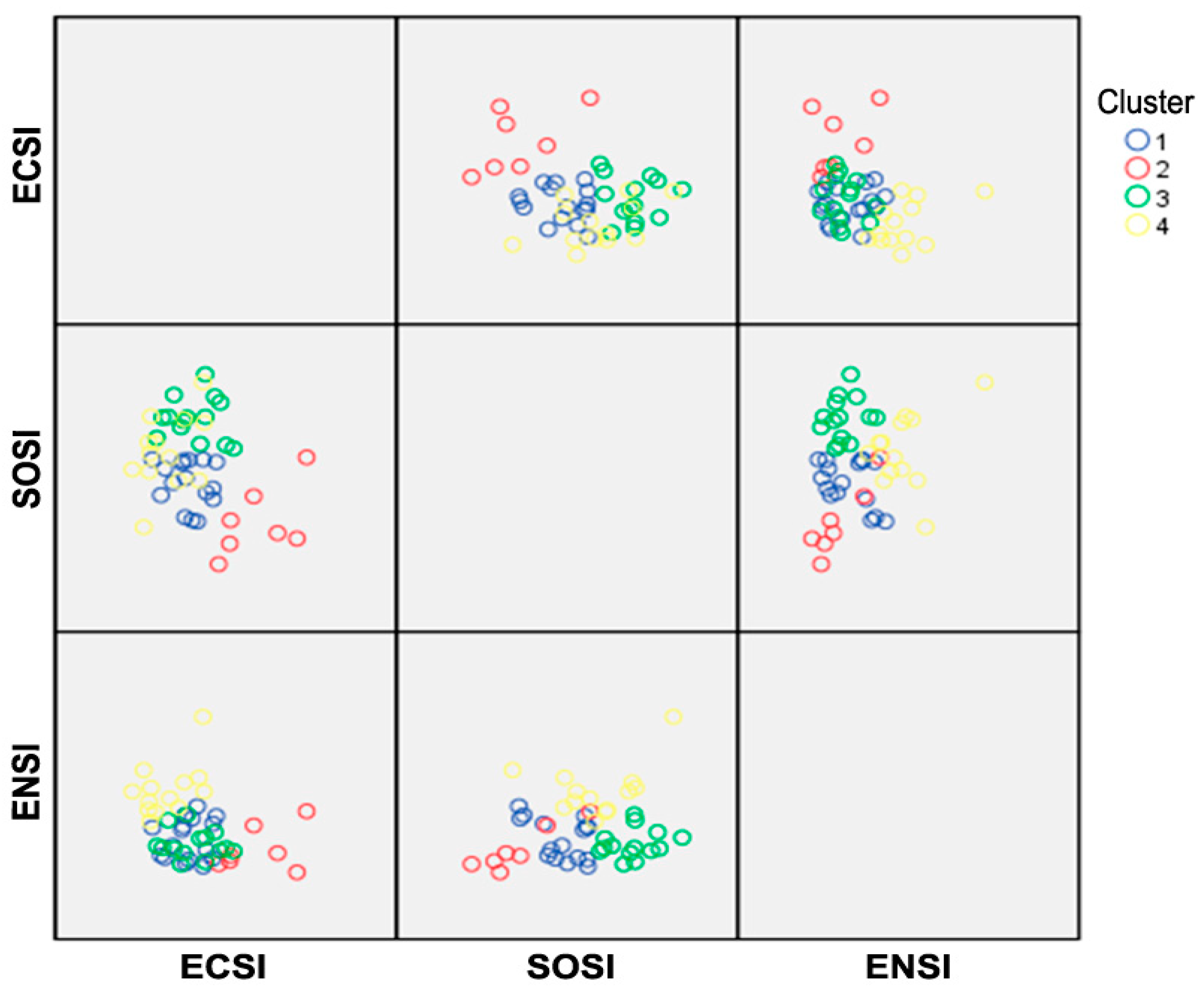
| Cluster | Province Name | Z-ECSI | Z-SOSI | Z-ENSI |
|---|---|---|---|---|
| 1 | Álava | 0.23567 | 0.06047 | −1.21002 |
| Alicante | −0.06283 | −1.30247 | 0.33438 | |
| Almería | 0.50368 | −0.83074 | 0.17179 | |
| Asturias | 0.32236 | −0.68014 | −0.67319 | |
| Ávila | −0.57997 | −0.46249 | −0.53317 | |
| Cantabria | 0.49215 | −0.59168 | −0.95342 | |
| Castellón | −0.25010 | −1.23613 | 0.44213 | |
| Ciudad Real | −1.12803 | 0.06333 | 0.04305 | |
| Cuenca | −0.79398 | −0.14511 | −0.92607 | |
| Guadalajara | −0.90163 | −0.73908 | −0.85478 | |
| León | −0.15300 | 0.04910 | −0.98702 | |
| Madrid | −0.32981 | −0.01857 | −0.03073 | |
| Palmas, Las | 0.59035 | 0.00284 | 0.41489 | |
| Teruel | −0.22561 | −0.35073 | −1.10441 | |
| Valencia | 0.07453 | −1.33040 | 0.73070 | |
| Zamora | −0.29918 | 0.03415 | 0.08309 | |
| 2 | Coruña, A | 2.23977 | −1.58990 | −0.77717 |
| Guipúzcoa | 0.95158 | −1.82564 | −1.03559 | |
| Lugo | 1.59810 | −0.76542 | 0.11038 | |
| Ourense | 0.97567 | −1.30399 | −0.86675 | |
| Pontevedra | 2.76118 | −1.71282 | −1.39656 | |
| Santa Cruz de Tenerife | 3.02382 | 0.10824 | 0.56617 | |
| Vizcaya | 0.65626 | −2.28596 | −1.12941 | |
| 3 | Albacete | −1.00878 | 0.54521 | −0.54505 |
| Barcelona | 1.05291 | 0.30746 | −0.71691 | |
| Burgos | −0.36056 | 0.78483 | −1.13567 | |
| Girona | 0.54998 | 1.46797 | −0.10676 | |
| Huesca | −0.29163 | 0.92242 | −0.77150 | |
| Lleida | −0.19873 | 0.99908 | 0.46460 | |
| Navarra | 0.15733 | 0.40545 | −0.30797 | |
| Palencia | 0.69634 | 1.33972 | −0.70445 | |
| Rioja, La | 0.85245 | 0.38243 | −0.61960 | |
| Salamanca | −0.70390 | 1.01322 | 0.28122 | |
| Segovia | −0.54879 | 1.50733 | −0.63035 | |
| Soria | 0.29586 | 1.01569 | −1.06106 | |
| Valladolid | 0.29364 | 1.96862 | −0.27887 | |
| Zaragoza | −0.85630 | 1.00210 | −0.60789 | |
| 4 | Badajoz | −1.23007 | 0.44775 | 0.61609 |
| Baleares | −0.42362 | −0.41867 | 0.68566 | |
| Cáceres | −1.66964 | −0.16310 | 1.20293 | |
| Cádiz | −0.27508 | 0.95820 | 1.49708 | |
| Córdoba | −1.16906 | 1.02796 | 1.32213 | |
| Granada | −1.04827 | 0.43923 | 0.55216 | |
| Huelva | 0.23172 | 1.78891 | 3.60461 | |
| Jaén | −1.36536 | −1.45722 | 1.89115 | |
| Málaga | −1.21869 | −.21087 | 0.87715 | |
| Murcia | 0.26039 | 0.88636 | 1.20089 | |
| Sevilla | −0.65818 | 0.10259 | 0.98278 | |
| Tarragona | 0.12225 | −0.40924 | 1.65097 | |
| Toledo | −1.18717 | 0.19971 | 0.23835 |
| Cluster | ||||
|---|---|---|---|---|
| 1 | 2 | 3 | 4 | |
| Z-ECSI | −0.15659 | 1.74377 | −0.00501 | −0.74083 |
| Z-SOSI | −0.46735 | −1.33935 | 0.97582 | 0.24551 |
| Z-ENSI | −0.31580 | −0.64699 | −0.48145 | 1.25554 |
| Nº provinces | 16 | 7 | 14 | 13 |
© 2019 by the authors. Licensee MDPI, Basel, Switzerland. This article is an open access article distributed under the terms and conditions of the Creative Commons Attribution (CC BY) license (http://creativecommons.org/licenses/by/4.0/).
Share and Cite
Mili, S.; Martínez-Vega, J. Accounting for Regional Heterogeneity of Agricultural Sustainability in Spain. Sustainability 2019, 11, 299. https://doi.org/10.3390/su11020299
Mili S, Martínez-Vega J. Accounting for Regional Heterogeneity of Agricultural Sustainability in Spain. Sustainability. 2019; 11(2):299. https://doi.org/10.3390/su11020299
Chicago/Turabian StyleMili, Samir, and Javier Martínez-Vega. 2019. "Accounting for Regional Heterogeneity of Agricultural Sustainability in Spain" Sustainability 11, no. 2: 299. https://doi.org/10.3390/su11020299
APA StyleMili, S., & Martínez-Vega, J. (2019). Accounting for Regional Heterogeneity of Agricultural Sustainability in Spain. Sustainability, 11(2), 299. https://doi.org/10.3390/su11020299

