

Supporting Europe’s Energy Policy Towards a Decarbonised Energy System: A Comparative Assessment

 , ,
, , 
Abstract
1. Introduction
2. Materials and Methods
2.1. Overview of the Methodological Approach
2.2. Problem Formulation
2.2.1. Alternative Transformation Pathways
2.2.2. Evaluation Criteria
2.3. Selection of the MCDM Method
2.3.1. The PROMETHEE Method
2.3.2. Literature Review on PROMETHEE and Energy Policy
2.3.3. MCDM and Fuzzy Set Theory
- Addition (+):
- Subtraction (-):
- Multiplication (×):
- Division (/):
- It is worth noting that (−) 0, (/) 1, where 0,1 depict fuzzy numbers (0, 0, 0) and (1, 1, 1), respectively. Therefore, solution of the fuzzy equation 2 = (–) 1 is not, contrary to what is expected, equal to = 1 (+) 2 [91].
- Notably, the computational results of multiplication (iii) and division (iv) are not TFNs; however, these computational results can be approximated by TFNs. This study adopts a triangular fuzzy number, which is the most common membership function shape. [92].
- v.
- Function Implementation (f):
2.3.4. Literature Review on MCDM Methods and Fuzzy Logic
Fuzzy AHP
Fuzzy TOPSIS
Fuzzy SAW
Fuzzy PROMETHEE
2.3.5. Implementation Steps of Fuzzy PROMETHEE
- Criteria Weights;
- Rating of the alternatives by the DMs;
- Parameters/Configurations for each scenario, which are the DMs’ contributions and the threshold values.
3. Results
- 1st Scenario (reference): DMs are considered to be equal (33.33%) and their opinions contribute to the same extent in the final ranking.
- 2nd–4th Scenarios: In these scenarios, greater emphasis is placed on the opinion of one DM each time (60%), while the views of the other two contribute secondarily to the final ranking (20% each).
4. Discussion
5. Conclusions
Author Contributions
Funding
Acknowledgments
Conflicts of Interest
References
- European Commission. A Policy Framework for Climate and Energy in the Period from 2020 to 2030; COM (2014) 15 final: Brussels, Belgium, 2014; p. 18. [Google Scholar]
- European Commission. Directive (EU) 2018/2001 of the European Parliament and of the Council of 11 December 2018 on the Promotion of the Use of Energy from Renewable Sources; Official Journal of the European Union: Luxembourg, 2018; p. 128. [Google Scholar]
- European Commission. A Roadmap for Moving to a Competitive Low Carbon Economy in 2050; COM(2011) 112 final: Brussels, Belgium, 2011; p. 15. [Google Scholar]
- European Commission. Renewable Energy Progress Report; COM (2015) 574 final: Brussels, Belgium, 2015; p. 46. [Google Scholar]
- European Commission. Investing in the Development of Low Carbon Technologies (SET-Plan); COM (2009) 519/4: Brussels, Belgium, 2009; p. 15. [Google Scholar]
- Moss, R.H.; Edmonds, J.A.; Hibbard, K.A.; Manning, M.R.; Rose, S.K.; Van Vuuren, D.P.; Carter, T.R.; Emori, S.; Kainuma, M.; Kram, T.; et al. The next generation of scenarios for climate change research and assessment. Nature 2010, 463, 747–756. [Google Scholar] [CrossRef] [PubMed]
- Star, J.; Rowland, E.L.; Black, M.E.; Enquist, C.A.; Garfin, G.; Hoffman, C.; Hartmann, H.; Jacobs, K.L.; Moss, R.H.; Waple, A.M. Supporting adaptation decisions through scenario planning: Enabling the effective use of multiple methods. Clim. Risk Manag. 2016, 13, 88–94. [Google Scholar] [CrossRef]
- Nakicenovic, N.; Alcamo, J.; Davis, G.; de Vries, B.; Fenhann, J.; Gaffin, S.; Kermeth, G.; Griibler, A.; Yong Jung, T.; Kram, T.; et al. Special Report on Emissions Scenarios (SRES); A special report of Working Group III of the intergovernmental panel on climate change; Cambridge University Press: Cambridge, UK; New York, NY, USA, 2000. [Google Scholar]
- Fisher, B.S.; Nakicenovic, N.; Alfsen, K.; Corfee Morlot, J.; de la Chesnaye, F.; Hourcade, J.C.; Jiang, K.; Kainuma, M.; La Rovere, E.; Matysek, A.; et al. Issues related to mitigation in the long term context. In Climate Change: Mitigation; Contribution of Working Group III to the Fourth Assessment Report of the Inter-governmental Panel on Climate Change; Metz, B., Davidson, O.R., Bosch, P.R., Dave, R., Meyer, L.A., Eds.; Cambridge University Press: Cambridge, UK; New York, NY, USA, 2007. [Google Scholar]
- Ghanadan, R.; Koomey, J.G. Using energy scenarios to explore alternative energy pathways in California. Energy Policy 2005, 33, 1117–1142. [Google Scholar] [CrossRef]
- Kowalski, K.; Stagl, S.; Madlener, R.; Omann, I. Sustainable energy futures: Methodological challenges in combining scenarios and participatory multi-criteria analysis. Eur. J. Oper. Res. 2009, 197, 1063–1074. [Google Scholar] [CrossRef]
- Brown, M.A.; Levine, M.D.; Short, W.; Koomey, J.G. Scenarios for a clean energy future. Energy Policy 2001, 29, 1179–1196. [Google Scholar] [CrossRef]
- Raskin, P.D.; Electris, C.; Rosen, R.A. The century ahead: Searching for sustainability. Sustainability 2010, 2, 2626–2651. [Google Scholar] [CrossRef]
- Riahi, K.; Dentener, F.; Gielen, D.; Grubler, A.; Jewell, J.; Klimont, Z.; Krey, V.; McCollum, D.L.; Pachauri, S.; Rao, S.; et al. Energy Pathways for Sustainable Development. In Global Energy Assessment-Toward a Sustainable Future; Johanson, T.B., Patwardhan, A., Nakicenovic, N., Gomez-Echeverri, L., Eds.; Cambridge University Press: Cambridge, UK; New York, NY, USA, 2012. [Google Scholar]
- Schwartz, P. The Art of the Long View: Planning for the Future in an Uncertain World; Crown Business: New York, NY, USA, 2012; ISBN 0385267320. [Google Scholar]
- Behzadian, M.; Kazemzadeh, R.B.; Albadvi, A.; Aghdasi, M. PROMETHEE: A comprehensive literature review on methodologies and applications. Eur. J. Oper. Res. 2010, 200, 198–215. [Google Scholar] [CrossRef]
- Doukas, H.; Nikas, A.; González-Eguino, M.; Arto, I.; Anger-Kraavi, A. From integrated to integrative: Delivering on the Paris Agreement. Sustainability 2018, 10, 2299. [Google Scholar] [CrossRef]
- Kiker, G.A.; Bridges, T.S.; Varghese, A.; Seager, T.P.; Linkov, I. Application of multicriteria decision analysis in environmental decision making. Integr. Environ. Asses. 2005, 1, 95–108. [Google Scholar] [CrossRef]
- Klauer, B.; Drechsler, M.; Messner, F. Multicriteria analysis under uncertainty with IANUS—method and empirical results. Environ. Plann. C 2006, 24, 235–256. [Google Scholar] [CrossRef]
- Doukas, H.; Karakosta, C.; Psarras, J. A linguistic TOPSIS model to evaluate the sustainability of renewable energy options. Int. J. Glob. Energy 2009, 32, 102–118. [Google Scholar] [CrossRef]
- Karakosta, C. A holistic approach for addressing the issue of effective technology transfer in the frame of climate change. Energies 2016, 9, 503. [Google Scholar] [CrossRef]
- Karakosta, C.; Psarras, J. Fuzzy TOPSIS approach for understanding a country’s development priorities within the scope of climate technology transfer. In Advances in Energy Research; Acosta, M.J., Ed.; Nova Science Publishers: Hauppauge, NY, USA, 2012; Volume 9, pp. 123–149. ISBN 978–1-61470–485–0. [Google Scholar]
- Papadogeorgos, I.; Papapostolou, A.; Karakosta, C.; Doukas, H. Multicriteria assessment of alternative policy scenarios for achieving EU RES target by 2030. In Strategic Innovative Marketing; Kavoura, A., Sakas, D., Tomaras, P., Eds.; Springer Proceedings in Business and Economics; Springer: Cham, Switzerland, 2017. [Google Scholar]
- Papapostolou, A.; Karakosta, C.; Doukas, H. Analysis of policy scenarios for achieving renewable energy sources targets: A fuzzy TOPSIS approach. Energy Environ. 2017, 28, 88–109. [Google Scholar] [CrossRef]
- Papapostolou, A.; Karakosta, C.; Marinakis, V.; Flamos, A. Assessment of RES cooperation framework between the EU and North Africa: A multicriteria approach based on UTASTAR. Int. J. Energy Sect. Manag. 2016, 10, 402–426. [Google Scholar] [CrossRef]
- Papapostolou, A.; Karakosta, C.; Nikas, A.; Psarras, J. Exploring opportunities and risks for RES-E deployment under Cooperation Mechanisms between EU and Western Balkans: A multi-criteria assessment. Renew Sustain. Energy Rev. 2017, 80, 519–530. [Google Scholar] [CrossRef]
- Andreopoulou, Z.; Koliouska, C.; Galariotis, E.; Zopounidis, C. Renewable energy sources: Using PROMETHEE II for ranking websites to support market opportunities. Technol. Soc. 2018, 131, 31–37. [Google Scholar] [CrossRef]
- Nikas, A.; Doukas, H.; López, L.M. A group decision making tool for assessing climate policy risks against multiple criteria. Heliyon 2018, 4, e00588. [Google Scholar] [CrossRef]
- Vujosevic, M.L.; Popovic, M.J. The comparison of the energy performance of hotel buildings using PROMETHEE decision-making method. Science 2016, 20, 197–208. [Google Scholar] [CrossRef]
- Xenarios, S.; Polatidis, H. Alleviating climate change impacts in rural Bangladesh: A PROMETHEE outranking-based approach for prioritizing agricultural interventions. Environ. Dev. Sustain. 2015, 17, 963–985. [Google Scholar] [CrossRef]
- Panagiotidou, N.; Stavrakakis, G.S.; Diakaki, C. Sustainable urban solid waste management planning with the use of an advanced interactive decision support system based on the PROMETHEE II method. Int. J. 2015, 1, 294–324. [Google Scholar] [CrossRef]
- Lerche, N.; Geldermann, J. Integration of prospect theory into PROMETHEE-a case study concerning sustainable bioenergy concepts. Int. J. Multicrit. Decis. Mak. 2015, 5, 309–333. [Google Scholar] [CrossRef]
- Vinodh, S.; Girubha, R.J. PROMETHEE based sustainable concept selection. Appl. Math. Model 2012, 36, 5301–5308. [Google Scholar] [CrossRef]
- Dubois, D.J.; Prade, H. Fuzzy Sets and Systems: Theory and Applications. In Mathematics in Science and Engineering; Academic Press: New York, NY, USA, 1980; Volume 144. [Google Scholar]
- Oberschmidt, J.; Geldermann, J.; Ludwig, J.; Schmehl, M. Modified PROMETHEE approach for assessing energy technologies. Int. J. Energy Sect. Manag. 2010, 4, 183–212. [Google Scholar] [CrossRef]
- Kahraman, C. Computational Intelligent Systems in Industrial Engineering. In Computational Intelligence Systems in Industrial Engineering; Kahraman, C., Ed.; Atlantis Computational Intelligence Systems, Atlantis Press: Paris, France, 2012; Volume 6, ISBN 978-94-91216-77-0. [Google Scholar]
- Gul, M.; Celik, E.; Gumus, A.T.; Guneri, A.F. A fuzzy logic based PROMETHEE method for material selection problems. Beni Suef Univ. J. Basic Appl. Sci. 2018, 7, 68–79. [Google Scholar] [CrossRef]
- Kahraman, C.; Onar, S.C.; Oztaysi, B. Fuzzy multicriteria decision-making: A literature review. Int. J. Comput. Int. Syst. 2015, 8, 637–666. [Google Scholar] [CrossRef]
- Goumas, M.; Lygerou, V. An extension of the PROMETHEE method for decision making in fuzzy environment: Ranking of alternative energy exploitation projects. Eur. J. Oper. Res. 2000, 123, 606–613. [Google Scholar] [CrossRef]
- Chou, W.C.; Lin, W.T.; Lin, C.Y. Application of fuzzy theory and PROMETHEE technique to evaluate suitable ecotechnology method: A case study in Shihmen Reservoir Watershed, Taiwan. Ecol. Eng. 2007, 31, 269–280. [Google Scholar] [CrossRef]
- Geldermann, J.; Spengler, T.; Rentz, O. Fuzzy outranking for environmental assessment. Case study: Iron and steel making industry. Fuzzy Sets Syst. 2000, 115, 45–65. [Google Scholar] [CrossRef]
- Crespo Del Granado, P.; Welisch, M.; Hartner, M.; Resch, G.; Lumbreras, S.; Olmos, L.; Ramos, A.; Sensfuss, F.; Bernath, C.; Herbst, A.; et al. Decarbonising the EU’s Energy System: Policy Implications and Priorities from Modelling in the SET-Nav Project; SET-Nav Deliverable D9.5, European Commission H2020 Project Number 691843; European Commission: Brussels, Belgium, 2019. [Google Scholar]
- Karakosta, C.; Fujiwara, N. Scaling Up and Intensifying Stakeholders Engagement for Evidence-Based Policymaking: Lessons Learned. In Reference Module in Materials Science and Materials Engineering; Hashmi, S., Bayraktar, E., Batalha, G., Brabazon, D., Buggy, M., Choudhury, I.A., Diamond, D., Haseeb, A.S.M.A., Mridha, S., Olabi, A., et al., Eds.; Elsevier: Amsterdam, The Netherlands, 2018; ISBN 978-0-12-803581-8. [Google Scholar]
- Ioannou, A.; Angus, A.; Brennan, F. Risk-based methods for sustainable energy system planning: A review. Renew. Sustain. Energy Rev. 2017, 74, 602–615. [Google Scholar] [CrossRef]
- Burger, M.; Graeber, B.; Schindlmayr, G. Managing Energy Risk: A Practical Guide for Risk Management in Power, Gas and Other Energy Markets, 2nd ed.; John Wiley & Sons, Ltd.: Chichester, UK, 2014; pp. 1–54. ISBN 978-1-118-61850-9. [Google Scholar]
- UNEP DTIE. Financial Risk Management Instruments for Renewable Energy Projects—Summary Document; UNEP DTIE: Geneva, Switzerland, 2004; Available online: http://hdl.handle.net/20.500.11822/9450 (accessed on 10 October 2018).
- UNEP DELC. Raising Awareness of Climate Change: A Handbook for Government Focal Points; UNEP DELC: Geneva, Switzerland, 2006; Available online: http://apps.unep.org/redirect.php?file=/publications/pmtdocuments/unep_cc_handbook.pdf (accessed on 10 October 2018).
- Siskos, Y. Decision Models: Operational Research Methodology, Multicriteria Analysis Theory, Applications in Businesses and Organisations; New Tech Pub: Athens, Greece, 2008. [Google Scholar]
- Brans, J.P.; Vincke, P.; Mareschal, B. How to select and how to rank projects: The PROMETHEE method. Eur. J. Oper. Res. 1986, 24, 228–238. [Google Scholar] [CrossRef]
- Brans, J.P. L’ingénierie de la Décision: L’élaboration D’instruments D’aide a la Décision; Université Laval, Faculté des sciences de l’administration: Québec, QC, Canada, 1982. [Google Scholar]
- Brans, J.P.; Vincke, P. A preference ranking organisation method: (The PROMETHEE method for multiple criteria decision-making). Manag. Sci. 1985, 31, 647–656. [Google Scholar] [CrossRef]
- Brans, J.P.; Mareschal, B. Promethee V: MCDM problems with segmentation constraints. Inf. Syst. Oper. Res. 1992, 30, 85–96. [Google Scholar] [CrossRef]
- Brans, J.P.; Mareschal, B. The PROMETHEE VI procedure. How to differentiate hard from soft multicriteria problems. J. Decis. Syst. 1995, 4, 213–223. [Google Scholar] [CrossRef]
- Macharis, C.; Brans, J.P.; Mareschal, B. The GDSS PROMETHEE procedure—A PROMETHEE-GAIA based procedure for group decision support. J. Decis. Syst. 1998, 7, 283–307. [Google Scholar]
- Geldermann, J.; Rentz, O. Multi-criteria analysis for technique assessment case study from industrial coating. J. Ind. Ecol. 2005, 9, 127–142. [Google Scholar] [CrossRef]
- Velasquez, M.; Hester, P.T. An analysis of multi-criteria decision making methods. IJOR 2013, 10, 56–66. [Google Scholar]
- Gavade, R.K. Multi-criteria decision making: An overview of different selection problems and methods. IJCSIT 2014, 5, 5643–5646. [Google Scholar]
- Strantzali, E.; Aravossis, K.; Livanos, G.A. Evaluation of future sustainable electricity generation alternatives: The case of a Greek island. Renew. Sustain. Energy Rev. 2017, 76, 775–787. [Google Scholar] [CrossRef]
- Turcksin, L.; Bernardini, A.; Macharis, C. A combined AHP-PROMETHEE approach for selecting the most appropriate policy scenario to stimulate a clean vehicle fleet. Procedia Soc. Behav. 2011, 20, 954–965. [Google Scholar] [CrossRef]
- Diakoulaki, D.; Georgiou, P.; Tourkolias, C.; Georgopoulou, E.; Lalas, D.; Mirasgedis, S.; Sarafidis, Y. A multicriteria approach to identify investment opportunities for the exploitation of the clean development mechanism. Energy Policy 2007, 35, 1088–1099. [Google Scholar] [CrossRef]
- Diakoulaki, D.; Karangelis, F. Multi-criteria decision analysis and cost-benefit analysis of alternative scenarios for the power generation sector in Greece. Renew. Sustain. Energy Rev. 2007, 11, 716–727. [Google Scholar] [CrossRef]
- Doukas, H.; Patlitzianas, D.K.; Iatropoulos, K.; Psarras, J. Intelligent building energy management system using rule sets. Build. Environ. 2006, 42, 3562–3569. [Google Scholar] [CrossRef]
- Madlener, R.; Kowalski, K.; Stagl, S. New ways for the integrated appraisal of national energy scenarios: The case of renewable energy use in Austria. Energy Policy 2007, 35, 6060–6074. [Google Scholar] [CrossRef]
- Karakosta, C. Multi-Criteria Decision Making Methods for Technology Transfer; LAP LAMBERT Academic Publishing: Riga, Latvia, 2018; ISBN 978-613-9-86527-7. [Google Scholar]
- Doukas, H.; Nikas, A. Decision support models in climate policy. Eur. J. Oper. Res. 2019, in press. [Google Scholar] [CrossRef]
- Beynon, M.J.; Wells, P. The lean improvement of the chemical emissions of motor vehicles based on preference ranking: A PROMETHEE uncertainty analysis. Omega 2008, 36, 384–394. [Google Scholar] [CrossRef]
- Kapepula, K.M.; Colson, G.; Sabri, K.; Thonart, T. A multiple criteria analysis for household solid waste management in the urban community of Dakar. Waste Manag. 2007, 27, 1690–1705. [Google Scholar] [CrossRef] [PubMed]
- Linkov, L.; Satterstrom, F.K.; Kiker, G.; Seager, T.P.; Bridges, T.; Gardner, K.H.; Rogers, S.H.; Belluck, D.A.; Meyer, A. Multicriteria decision analysis: A comprehensive decision approach for management of contaminated sediments. Risk Anal. 2006, 26, 61–78. [Google Scholar] [CrossRef] [PubMed]
- Palma, J.; Graves, A.R.; Burgess, P.J.; van der Werf, W.; Herzog, F. Integrating environmental and economic performance to assess modern silvoarable agroforestry in Europe. Ecol. Econ. 2007, 63, 759–767. [Google Scholar] [CrossRef]
- Cavallaro, F. Multi-criteria decision aid to assess concentrated solar thermal technologies. Renew. Energy 2009, 34, 1678–1685. [Google Scholar] [CrossRef]
- Doukas, H.; Patlitzianas, D.K.; Papadopoulou, A.; Psarras, J. Foresight of innovative energy technologies through a multi criteria approach. Int. J. Energy Technol. Policy 2008, 6, 381–394. [Google Scholar] [CrossRef]
- Ghafghazi, S.; Sowlati, T.; Sokhansanj, S.; Melin, S. A multicriteria approach to evaluate district heating system options. Appl. Energy 2010, 87, 1134–1140. [Google Scholar] [CrossRef]
- Haralambopoulos, D.A.; Polatidis, H. Renewable energy projects: Structuring a multicriteria group decision-making framework. Renew. Energy 2003, 28, 961–973. [Google Scholar] [CrossRef]
- Ren, H.; Gao, W.; Zhou, W.; Nakagami, K. Multi-criteria evaluation for the optimal Adoption of distributed residential energy systems in Japan. Energy Policy 2009, 37, 5484–5493. [Google Scholar] [CrossRef]
- Pohekar, S.D.; Ramachandran, M. Application of multi-criteria decision making to sustainable energy planning—A review. Renew. Sustain. Energy Rev. 2004, 8, 365–381. [Google Scholar] [CrossRef]
- Tsoutsos, T.; Drandaki, M.; Frantzeskaki, N.; Iosifidis, E.; Kiosses, I. Sustain.ainable energy planning by using multi-criteria analysis application in the island of Crete. Energy Policy 2009, 37, 1587–1600. [Google Scholar] [CrossRef]
- Vaillancourt, K.; Waaub, J.P. Equity in international greenhouse gases abatement scenarios: A multicriteria approach. Eur. J. Oper. Res. 2004, 153, 489–505. [Google Scholar] [CrossRef]
- Mergias, I.; Moustakas, K.; Papadopoulos, A.; Loizidou, M. Multi-criteria decision aid approach for the selection of the best compromise management scheme for ELVs: The case of Cyprus. J. Hazard. Mater. 2007, 147, 706–717. [Google Scholar] [CrossRef]
- Queiruga, D.; Walther, G.; Gonzalez-Benito, J.; Spengler, T. Evaluation of sites for the location of WEEE recycling plants in Spain. Waste Manag. 2008, 28, 181–190. [Google Scholar] [CrossRef]
- Vego, G.; Kučar-Dragičević, S.; Koprivanac, N. Application of multi-criteria decision-making on strategic municipal solid waste management in Dalmatia, Croatia. Waste Manag. 2008, 28, 2192–2201. [Google Scholar] [CrossRef]
- Hyde, K.; Maier, R.H.; Colby, C. Incorporating uncertainty in the PROMETHEE MCDA method. J. Multi Criteria Decis. Anal. 2003, 12, 245–259. [Google Scholar] [CrossRef]
- Madlener, R.; Stagl, S. Sustainability-guided promotion of renewable electricity generation. Ecol. Econ. 2005, 53, 147–167. [Google Scholar] [CrossRef]
- Bellman, R.E.; Zadeh, L.A. Decision-making in a fuzzy environment. Manag. Sci. 1970, 17, B-141–B-164. [Google Scholar] [CrossRef]
- Chen, C.T. A fuzzy approach to select the location of the distribution center. Fuzzy Sets Syst. 2001, 118, 65–73. [Google Scholar] [CrossRef]
- Herrera, F.; Herrera-Viedma, E.; Verdegay, J.L. A model of consensus in group decision making under linguistic assessments. Fuzzy Sets Syst. 1996, 78, 73–87. [Google Scholar] [CrossRef]
- Hsu, H.M.; Chen, C.T. Fuzzy hierarchical weight analysis model for multicriteria decision problem. J. Chin. Inst. Eng. 1994, 11, 126–136. [Google Scholar]
- Chen, C.T.; Pai, P.F.; Hung, W.Z. An integrated methodology using linguistic PROMETHEE and maximum deviation method for third-party logistics supplier selection. Int. J. Comput. Int. Syst. 2010, 3, 438–451. [Google Scholar] [CrossRef]
- Zadeh, L.A. Fuzzy sets. Inf. Control 1965, 8, 338–353. [Google Scholar] [CrossRef]
- Van Laarhoven, P.J.M.; Pedrycz, W. A fuzzy extension of Saaty’s priority theory. Fuzzy Sets Syst. 1983, 11, 229–241. [Google Scholar] [CrossRef]
- Kaufman, A.; Gupta, M.M. Introduction to Fuzzy Arithmetic; Van Nostrand Reinhold Company: New York, NY, USA, 1991; ISBN 0442008996. [Google Scholar]
- Gani, A.N.; Assarudeen, S.M. A New Operation on Triangular Fuzzy Number for Solving Fuzzy Linear Programming Problem. Appl. Math Sci. 2012, 6, 525–532. [Google Scholar]
- Chen, Y.H.; Wang, T.C.; Wu, C.Y. Strategic decisions using the fuzzy PROMETHEE for IS outsourcing. Expert Syst. Appl. 2011, 38, 13216–13222. [Google Scholar] [CrossRef]
- Phillis, Y.A.; Andriantiatsaholiniaina, L. Sustainability: An ill-defined concept and its assessment using fuzzy logic. Ecol. Econ. 2001, 37, 435–456. [Google Scholar] [CrossRef]
- Ölçer, A.I.; Odabaşi, A.Y. A new fuzzy multiple attributive group decision making methodology and its application to propulsion/manoeuvring system selection problem. Eur. J. Oper. Res. 2005, 166, 93–114. [Google Scholar] [CrossRef]
- Wang, J.; Lin, Y.T. Fuzzy multicriteria group decision making approach to select configuration items for software development. Fuzzy Sets Syst. 2003, 134, 343–363. [Google Scholar] [CrossRef]
- Xu, Z.; Chen, J. On geometric aggregation over interval-valued intuitionistic fuzzy information. In Proceedings of the 4th International Conference on Fuzzy Systems and Knowledge Discovery, Haikou, Hainan, China, 24–27 August 2007; Lei, J., Yu, J., Zhou, S., Eds.; IEEE Computer Society: Los Alamitos, CA, USA, 2007. [Google Scholar]
- Chen, C.H.; Tzeng, G.H. Creating the aspired intelligent assessment systems for teaching materials. Expert Syst. Appl. 2011, 38, 12168–12179. [Google Scholar] [CrossRef]
- Chen, S.M.; Lee, L.W. Fuzzy multiple attributes group decision-making based on the interval type-2 TOPSIS method. Expert Syst. Appl. 2010, 37, 2790–2798. [Google Scholar] [CrossRef]
- Chen, Y.; Li, K.W.; Kilgour, D.M.; Hipel, K.W. A case-based distance model for multiple criteria ABC analysis. Comput. Oper Res 2008, 35, 776–796. [Google Scholar] [CrossRef]
- Chiou, H.K.; Tzeng, G.H.; Cheng, D.C. Evaluating sustainable fishing development strategies using fuzzy MCDM approach. Omega 2005, 3, 223–234. [Google Scholar] [CrossRef]
- Ding, J.F.; Liang, G.S.; Yeh, C.H.; Yeh, Y.C. A fuzzy multi-criteria decision-making model for the selection of courier service providers: An empirical study from shippers’ perspective in Taiwan. Marit. Econ. Logist. 2005, 7, 250–261. [Google Scholar] [CrossRef]
- Wang, T.C.; Chen, L.Y.; Chen, Y.H. Applying fuzzy PROMETHEE method for evaluating IS outsourcing suppliers. In Proceedings of the 5th International Conference on Fuzzy Systems and Knowledge Discovery, Jinan, Shandong, China, 18–20 October 2008; Ma, J., Yin, Y., Yu, J., Zhou, S., Eds.; IEEE Computer Society: Los Alamitos, CA, USA, 2008. [Google Scholar]
- Heo, E.; Kim, J.; Boo, K.J. Analysis of the assessment factors for renewable energy dissemination program evaluation using fuzzy AHP. Renew. Sustain. Energy Rev. 2010, 14, 2214–2220. [Google Scholar] [CrossRef]
- Kahraman, C.; Cebi, S.; Kaya, I. Selection among renewable energy alternatives using fuzzy axiomatic design: The case of Turkey. J. Univ. Comput. Sci. 2010, 16, 82–102. [Google Scholar] [CrossRef]
- Kaya, T.; Kahraman, C. Multicriteria renewable energy planning using an integrated fuzzy VIKOR & AHP methodology: The case of Istanbul. Energy 2010, 35, 2517–2527. [Google Scholar] [CrossRef]
- Luthra, S.; Mangla, S.K.; Kharb, R.K. Sustainable assessment in energy planning and management in Indian perspective. Renew. Sustain. Energy Rev. 2015, 47, 58–73. [Google Scholar] [CrossRef]
- Lee, A.H.I.; Chen, W.C.; Chang, C.J. A Fuzzy AHP and BSC approach for evaluating performance of IT department in the manufacturing industry in Taiwan. Expert Syst. Appl. 2008, 34, 96–107. [Google Scholar] [CrossRef]
- Lee, S.K.; Mogi, G.; Kim, J.W. 2009. Decision support for prioritizing energy technologies against high oil prices: A fuzzy analytic hierarchy process approach. J. Loss. Prev. Proc. 2009, 22, 915–920. [Google Scholar] [CrossRef]
- Kahraman, C.; Cebeci, U.; Ulukan, Z. Multi-criteria supplier selection using fuzzy AHP. Logist. Inf. Manag. 2003, 16, 382–394. [Google Scholar] [CrossRef]
- Yang, C.; Chen, B. Supplier selection using combined analytical hierarchy process and grey relational analysis. J. Manuf. Technol. Manag. 2006, 17, 926–941. [Google Scholar] [CrossRef]
- Khaled, A.A.; Paul, S.K.; Chakraborty, R.K.; Ayuby, S. Selection of suppliers through different multi-criteria Decision making techniques. Glob. J. Manag. Bus. Res. 2011, 11, 1–11. [Google Scholar]
- Gurung, S.; Phipon, R. Multi-criteria decision making for supplier selection using AHP and TOPSIS method. Int. J. Eng. Invent. 2016, 6, 13–17. [Google Scholar]
- Gumus, A.T. Evaluation of hazardous waste transportation firms by using a two step fuzzy-AHP and TOPSIS methodology. Expert Syst. Appl. 2009, 36, 4067–4074. [Google Scholar] [CrossRef]
- Lee, S.K.; Mogi, G.; Lee, S.K.; Kim, J.W. Prioritizing the weights of hydrogen energy technologies in the sector of the hydrogen economy by using a fuzzy AHP approach. Int. J. Hydrog. Energy 2011, 36, 1897–1902. [Google Scholar] [CrossRef]
- Vidal, L.A.; Marle, F.; Bocquet, J.C. Measuring project complexity using the analytic hierarchy process. Int. J. Proj. Manag. 2011, 29, 718–727. [Google Scholar] [CrossRef]
- Sagbas, A.; Mazmanoglu, A. Use of multicriteria decision analysis to assess alternative wind power plants. J. Eng. Res. Kuwait 2014, 2, 148–161. [Google Scholar]
- Moayeri, M.; Shahvarani, A.; Behzadi, M.H.; Hosseinzadeh-Lotfi, F. Comparison of Fuzzy AHP and Fuzzy TOPSIS methods for math teachers selection. Indian J. Sci. Technol. 2015, 8. [Google Scholar] [CrossRef]
- Kaya, T.; Kahraman, C. Multicriteria decision making in energy planning using a modified fuzzy TOPSIS methodology. Expert Syst. Appl. 2011, 38, 6577–6585. [Google Scholar] [CrossRef]
- Cavallaro, F. Fuzzy TOPSIS approach for assessing thermal-energy storage in concentrated solar power (CSP) systems. Appl. Energy 2010, 87, 496–503. [Google Scholar] [CrossRef]
- Doukas, H.; Karakosta, C.; Psarras, J. Computing with words to assess the Sustainability of renewable energy options. Expert Syst. Appl. 2010, 37, 5491–5497. [Google Scholar] [CrossRef]
- Yan, G.; Ling, Z.; Dequn, Z. Performance Evaluation of coal enterprises energy conservation and reduction of pollutant emissions base on GRD-TOPSIS. Enrrgy Proced. 2011, 5, 535–539. [Google Scholar] [CrossRef]
- Şengül, Ü.; Eren, M.; Shiraz, S.E.; Gezder, V.; Şengül, A.B. Fuzzy TOPSIS method for ranking renewable energy supply systems in Turkey. Renew. Energy 2015, 75, 617–625. [Google Scholar] [CrossRef]
- Ekmekcioglu, M.; Kaya, T.; Kahraman, C. Fuzzy multi-criteria disposal method and site selection for municipal solid waste. Waste Manag. 2010, 30, 1729–1736. [Google Scholar] [CrossRef]
- Chu, C.M. A preliminary method for estimating the effective plume chimney height above a forced draft air-cooled heat exchanger operating under natural convection. Heat Transf. Eng. 2002, 23, 3–12. [Google Scholar] [CrossRef]
- Vahdani, B.; Hadipour, H. Extension of the ELECTRE method based on interval-valued fuzzy sets. Soft Comput. 2011, 15, 569–579. [Google Scholar] [CrossRef]
- Awasthi, A.; Chauhan, S.S.; Goyal, S.K. A fuzzy multicriteria approach for evaluating environmental performance of suppliers. Int. J. Prod. Econ. 2010, 126, 370–378. [Google Scholar] [CrossRef]
- Wang, J.W.; Cheng, C.H.; Kun-Cheng, H. Fuzzy hierarchical TOPSIS for supplier selection. Appl. Soft Comput. 2009, 9, 377–386. [Google Scholar] [CrossRef]
- Kelemenis, A.; Ergazakis, K.; Askounis, D. Support managers’ selection using an extension of fuzzy TOPSIS. Expert Syst. Appl. 2011, 38, 2774–2782. [Google Scholar] [CrossRef]
- Saremi, M.; Mousavi, S.F.; Sanayei, A. TQM consultant selection in SMEs with TOPSIS under fuzzy environment. Expert Syst. Appl. 2009, 36, 2742–2749. [Google Scholar] [CrossRef]
- Sagar, M.K.; Jayaswal, P.; Kushwah, K. Exploring fuzzy SAW method for maintenance strategy selection problem of material handling equipment. Int. J. Curr. Eng. Technol. 2013, 3, 600–605. [Google Scholar]
- Rajaie, H.; Hazrati, A.; Rashidi, A. Evaluation of construction contractors in developing countries using fuzzy SAW method. In Proceedings of the 13th International Conference on Computing in Civil and Building Engineering, Nottingham, UK, 29 June–2 July 2010; Tizani, W., Ed.; Nottingham University Press: Nottingham, UK, 2010; Paper 142, pp. 283–294. [Google Scholar]
- Deni, W.; Sudana, O.; Sasmita, A. Analysis and implementation fuzzy multi-attribute decision making SAW method for selection of high achieving students in faculty level. Int. J. Comput. Sci. 2013, 10, 674–680. [Google Scholar]
- Cavallaro, F.; Ciraolo, L. Sustainability assessment of solar technologies based on linguistic information. In Assessment and Simulation Tools for Sustain.ainable Energy Systems; Cavallaro, F., Ed.; Springer: London, UK, 2013; pp. 3–25. ISBN 978-1-4471-5143-2. [Google Scholar]
- Chen, L.; Pan, W. A BIM-integrated fuzzy multi-criteria decision making model for selecting low-carbon building measures. Procedia Eng. 2015, 118, 606–613. [Google Scholar] [CrossRef]
- Geldermann, J.; Rentz, O. Integrated technique assessment with imprecise information as a support for the identification of best available techniques (BAT). OR Spektrum 2001, 23, 137–157. [Google Scholar] [CrossRef]
- Tavakkoli-Moghaddam, R.; Sotoudeh-Anvari, A.; Siadat, A. A multi-criteria group decision-making approach for facility location selection using PROMETHEE under a fuzzy environment. In Outlooks and Insights on Group Decision and Negotiation; Kamiński, B., Kersten, G.E., Szapiro, T., Eds.; Springer: Cham, Switzerland, 2015; pp. 145–156. ISBN 978-3-319-19515-5. [Google Scholar]
- Chen, S.J.; Hwang, C.L. Fuzzy multiple attribute decision making methods. In Fuzzy Multiple Attribute Decision Making; Springer: Berlin/Heidelberg, Germany, 1992; pp. 289–486. [Google Scholar]
- Ross, T.J. Fuzzy Logic with Engineering Applications, 3rd ed.; Chichester: John Wiley & Sons: Chichester, UK, 2010; ISBN 978-0-470-74376-8. [Google Scholar]
- Nazari-Shirkouhi, S.; Keramati, A. Modelling customer satisfaction with new product design using a flexible fuzzy regression-data envelopment analysis algorithm. Appl. Math. Model 2017, 50, 755–771. [Google Scholar] [CrossRef]
- Microsoft Azure Notebooks. Available online: https://notebooks.azure.com/ (accessed on 10 October 2018).
- Wallace, S.W. Decision making under uncertainty: Is sensitivity analysis of any use? Oper. Res. 2000, 48, 20–25. [Google Scholar] [CrossRef]
- Wainwright, J.; Mulligan, M. Environmental Modelling: Finding Simplicity in Complexity, 2nd ed.; Wainwright, J., Mulligan, M., Eds.; John Wiley & Sons: Chichester, UK, 2013; ISBN 978-0-470–74911–1. [Google Scholar]
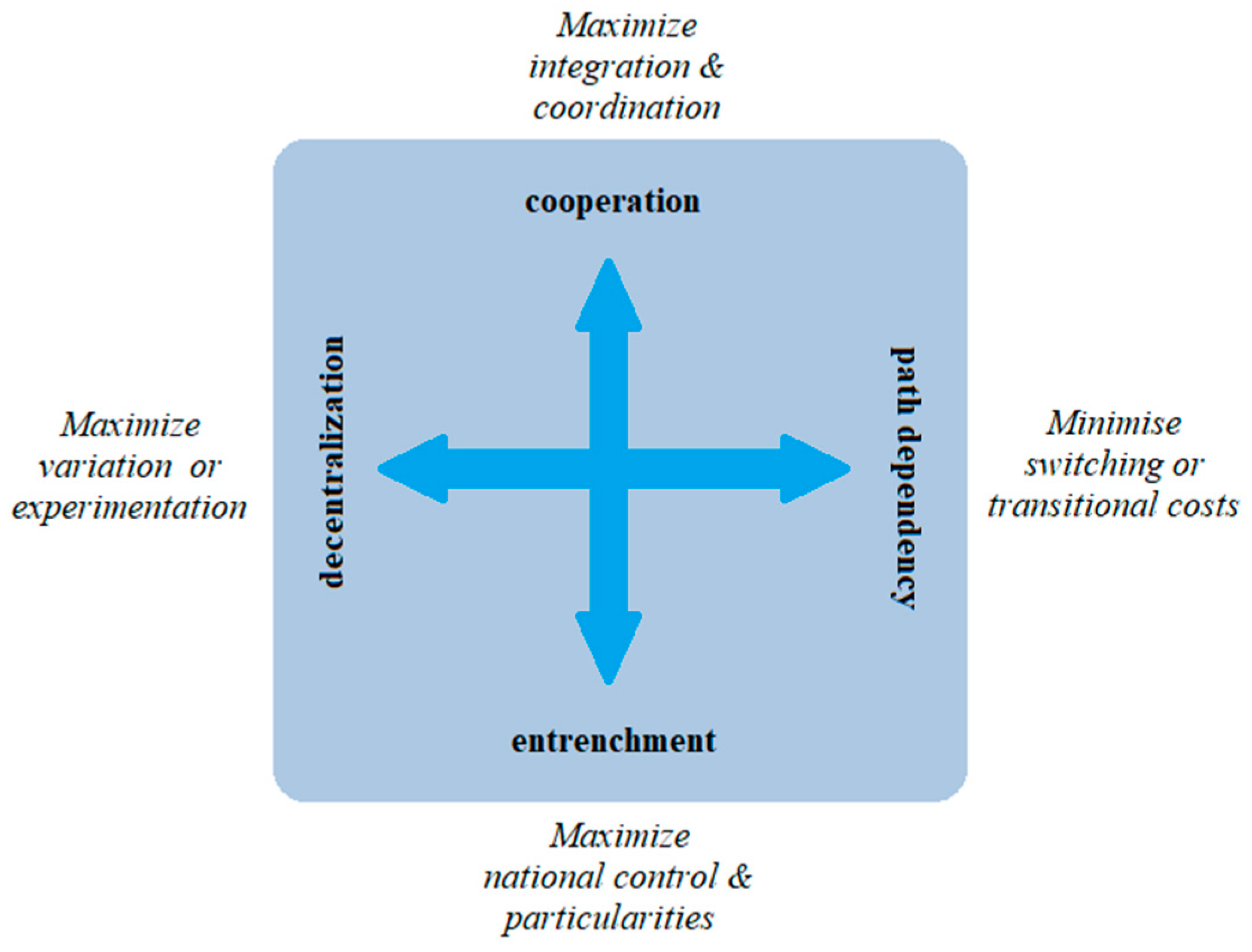
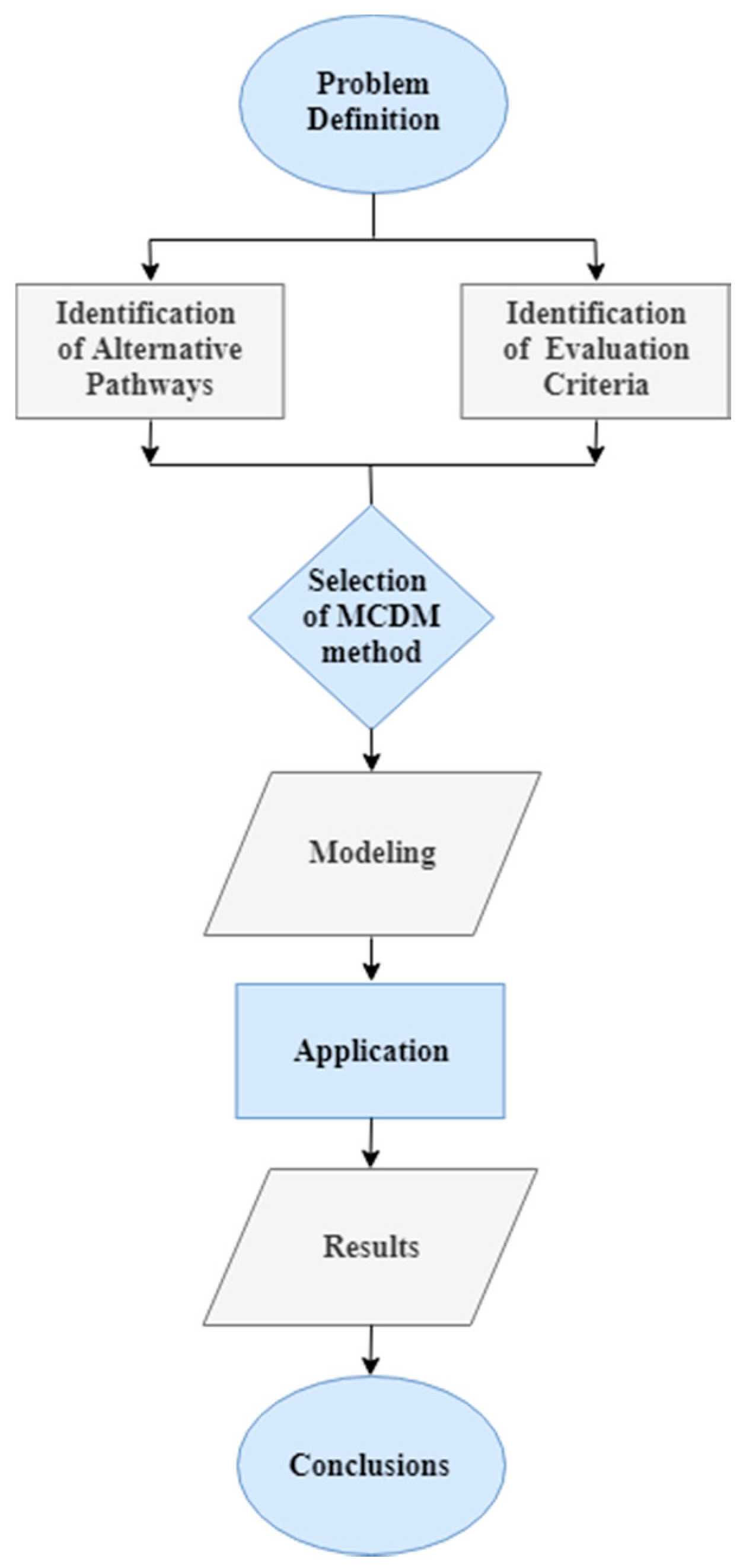
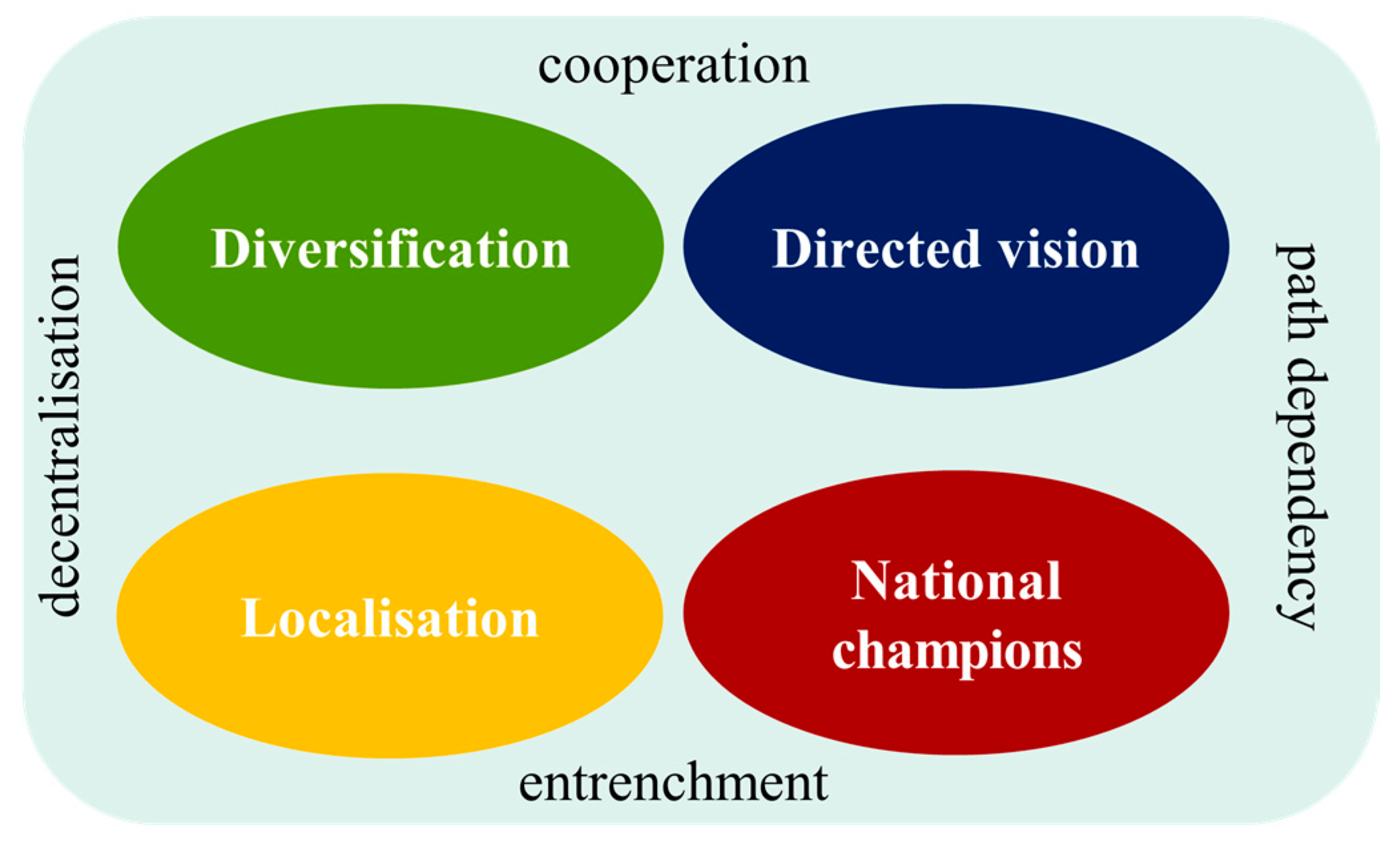
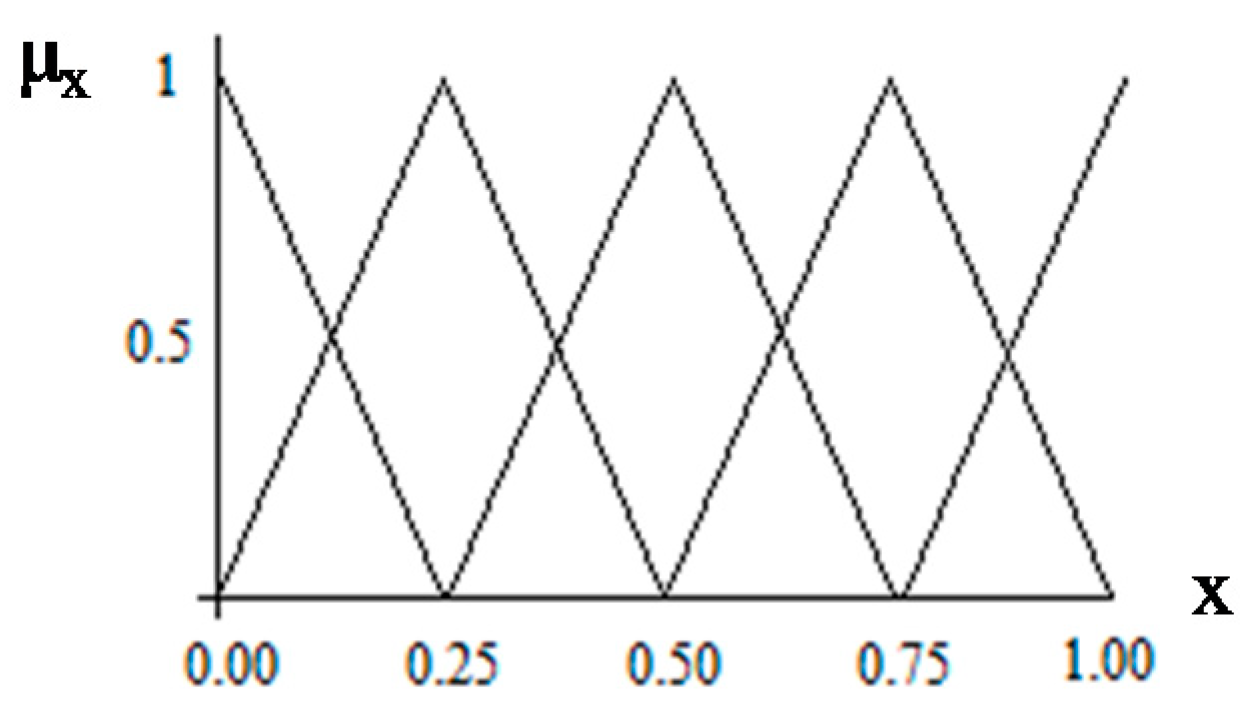
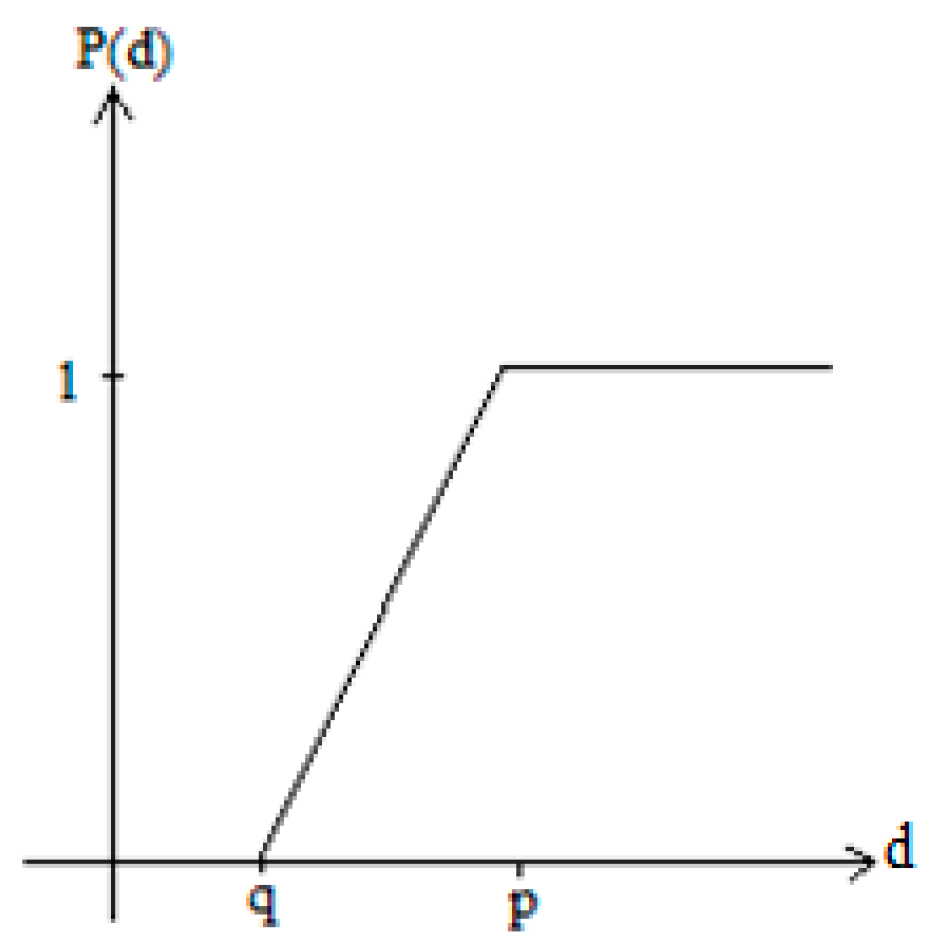

| Studies | Application Area |
|---|---|
| Beynon & Wells, 2008; Kapepula et al., 2007; Linkov et al., 2006; Palma et al., 2007 [66,67,68,69] | Environmental Impact Assessment |
| Cavallaro, 2009; Diakoulaki & Karangelis, 2007; Doukas et al., 2006; 2008, Ghafghazi et al., 2010; Goumas & Lygerou, 2000; Haralambopoulos & Polatidis, 2003; Ren et al., 2009; Pohekar and Ramachandran, 2004; Tsoutsos et al., 2009 [39,61,62,70,71,72,73,74,75,76] | Selection & Assessment of Sustainable and Environmental Friendly Technological Options for Energy Generation |
| Diakoulaki et al., 2007, Vaillancourt & Waaub, 2004 [60,77] | Monitoring GHG Reduction Potential in a Country Level |
| Geldermann & Rentz, 2005, Mergias et al., 2007 | Life Cycle Analysis |
| Queiruga et al., 2008, Vego et al., 2008 [55,78,79,80] | Waste Management |
| Hyde et al. (2003); Madlener and Stagl (2005) [81,82] | Ranking renewable energy technologies and scenarios |
| Weights of Criteria | Fuzzy Number | Ratings of Alternatives |
|---|---|---|
| Very Low (VL) | (0.00, 0.00, 0.25) | Worst (W) |
| Low (L) | (0.00, 0.25, 0.50) | Poor (P) |
| Medium (M) | (0.25, 0.50, 0.75) | Fair (F) |
| High (H) | (0.50, 0.75, 1.00) | Good (G) |
| Very High (VH) | (0.75, 1.00, 1.00) | Best (B) |
| Decision-Makers | Weights | |||
|---|---|---|---|---|
| C1 | C2 | C3 | C4 | |
| D1 | VH | M | VH | M |
| D2 | H | VH | M | M |
| D3 | M | M | VH | VH |
| DM | Criteria | Alternatives | |||
|---|---|---|---|---|---|
| A1 | A2 | A3 | A4 | ||
| D1 | C1 | F | B | G | B |
| C2 | P | F | G | B | |
| C3 | P | G | F | F | |
| C4 | G | G | P | F | |
| D2 | C1 | F | B | G | G |
| C2 | P | G | B | B | |
| C3 | F | G | F | G | |
| C4 | G | F | P | G | |
| D3 | C1 | G | B | G | B |
| C2 | P | G | G | B | |
| C3 | P | G | F | P | |
| C4 | B | F | P | F | |
| Iterations | Criteria | Thresholds | |
|---|---|---|---|
| p | q | ||
| No thresholds | C1 | 1.00 | 0.25 |
| C2 | 1.00 | 0.00 | |
| C3 | 1.00 | 0.00 | |
| C4 | 1.00 | 0.00 | |
| With thresholds | C1 | 0.65 | 0.60 |
| C2 | 0.65 | 0.35 | |
| C3 | 0.65 | 0.35 | |
| C4 | 0.65 | 0.35 | |
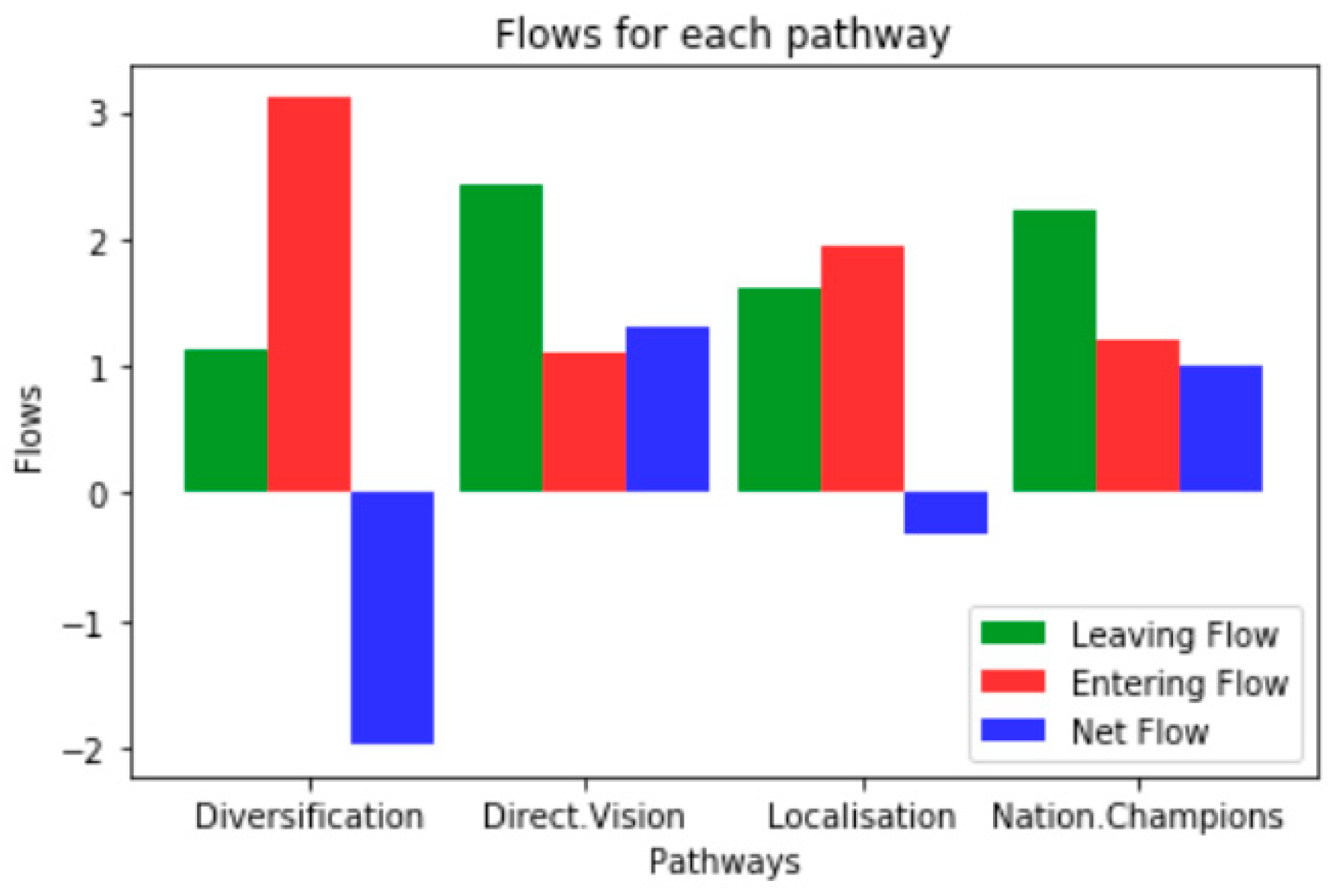
| Scenario 1 equal DMs–R = [0.33, 0.33, 0.33] | ||||
| Flows | Alternatives | |||
| A1 | A2 | A3 | A4 | |
| Leaving | 1.14 | 2.42 | 1.61 | 2.22 |
| Entering | 3.11 | 1.12 | 1.94 | 1.22 |
| Net | −1.97 | 1.3 | −0.33 | 1 |
| Scenario 2 priority on D1–R = [0.6, 0.2, 0.2] | ||||
| Flows | Alternatives | |||
| A1 | A2 | A3 | A4 | |
| Leaving | 1.04 | 2.49 | 1.56 | 2.22 |
| Entering | 3.14 | 1.04 | 1.94 | 1.2 |
| Net | −2.1 | 1.46 | −0.38 | 1.02 |
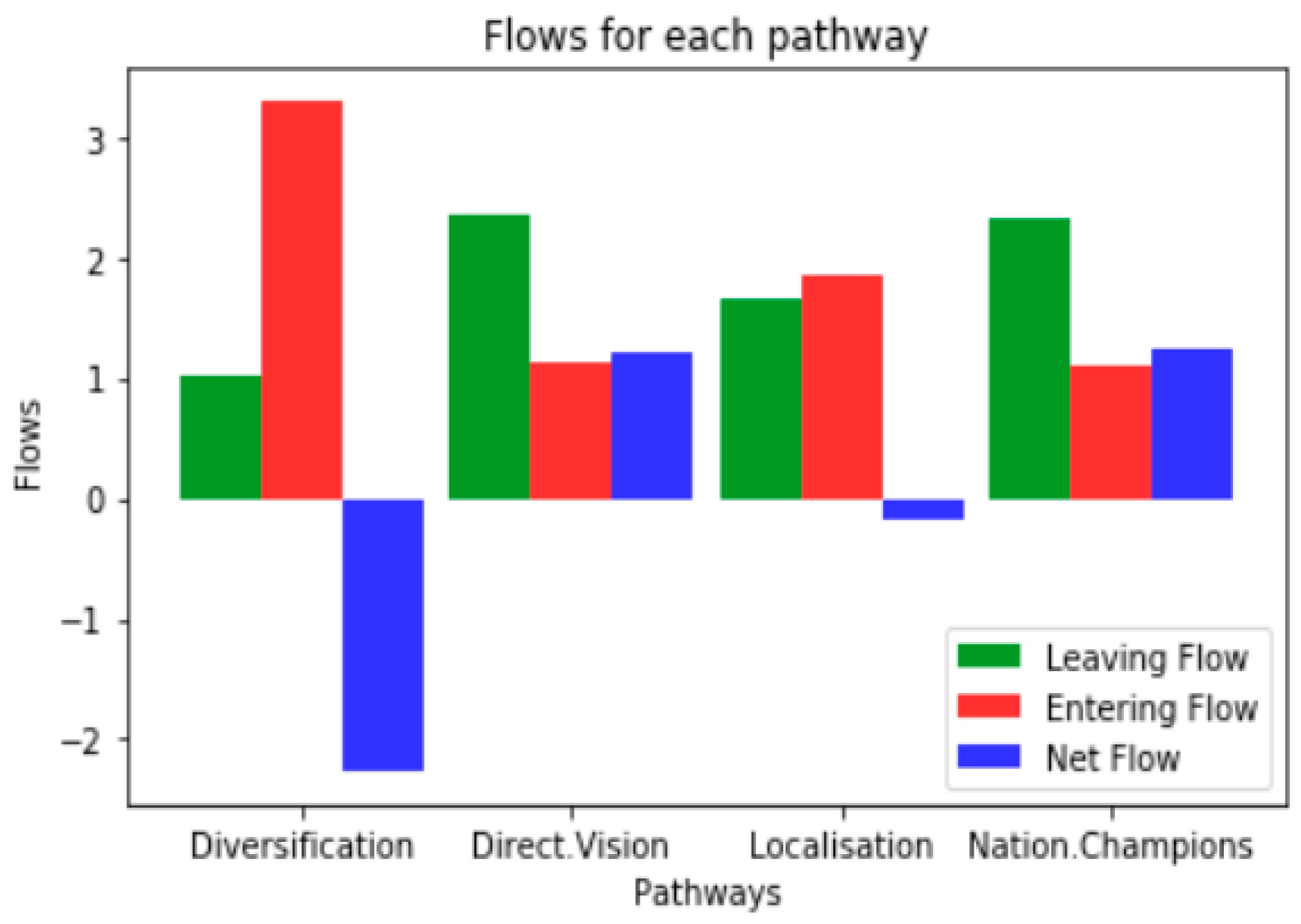
| Scenario 3 priority on D2–R = [0.2, 0.6, 0.2] | ||||
| Flows | Alternatives | |||
| A1 | A2 | A3 | A4 | |
| Leaving | 1.02 | 2.35 | 1.67 | 2.34 |
| Entering | 3.29 | 1.13 | 1.86 | 1.1 |
| Net | −2.26 | 1.22 | −0.19 | 1.23 |
| Scenario 4 priority on D3–R = [0.2, 0.2, 0.6] | ||||
| Flows | Alternatives | |||
| A1 | A2 | A3 | A4 | |
| Leaving | 1.38 | 2.42 | 1.64 | 2.11 |
| Entering | 2.9 | 1.19 | 2.05 | 1.41 |
| Net | −1.52 | 1.23 | −0.41 | 0.7 |
| Scenario 1 equal DMs–R = [0.33, 0.33, 0.33] | ||||
| Flows | Alternatives | |||
| A1 | A2 | A3 | A4 | |
| Leaving | 1.01 | 2.13 | 1.49 | 1.99 |
| Entering | 3.2 | 0.94 | 1.53 | 0.95 |
| Net | −2.19 | 1.19 | −0.03 | 1.04 |
| Scenario 2 priority on D1–R = [0.6, 0.2, 0.2] | ||||
| Flows | Alternatives | |||
| A1 | A2 | A3 | A4 | |
| Leaving | 0.89 | 2.25 | 1.46 | 1.95 |
| Entering | 3.18 | 0.82 | 1.53 | 1.01 |
| Net | −2.29 | 1.43 | −0.07 | 0.94 |
| Scenario 3 priority on D2–R = [0.2, 0.6, 0.2] | ||||
| Flows | Alternatives | |||
| A1 | A2 | A3 | A4 | |
| Leaving | 0.93 | 2.07 | 1.46 | 2.01 |
| Entering | 3.39 | 0.86 | 1.45 | 0.77 |
| Net | −2.46 | 1.22 | 0.01 | 1.23 |
| Scenario 4 priority on D3–R = [0.2, 0.2, 0.6] | ||||
| Flows | Alternatives | |||
| A1 | A2 | A3 | A4 | |
| Leaving | 1.21 | 2.15 | 1.53 | 1.94 |
| Entering | 3.08 | 1 | 1.63 | 1.12 |
| Net | 22121.87 | 1.15 | −0.09 | 0.82 |
| Alternatives | Scenarios | |||||||
|---|---|---|---|---|---|---|---|---|
| No Threshold | With Threshold | |||||||
| 1st | 2nd | 3rd | 4th | 1st | 2nd | 3rd | 4th | |
| A1 | 4 | 4 | 4 | 4 | 4 | 4 | 4 | 4 |
| A2 | 1 | 1 | 2 | 1 | 1 | 1 | 2 | 1 |
| A3 | 3 | 3 | 3 | 3 | 3 | 3 | 3 | 3 |
| A4 | 2 | 2 | 1 | 2 | 2 | 2 | 1 | 2 |
© 2019 by the authors. Licensee MDPI, Basel, Switzerland. This article is an open access article distributed under the terms and conditions of the Creative Commons Attribution (CC BY) license (http://creativecommons.org/licenses/by/4.0/).
Share and Cite
Papapostolou, A.; Karakosta, C.; Kourti, K.-A.; Doukas, H.; Psarras, J. Supporting Europe’s Energy Policy Towards a Decarbonised Energy System: A Comparative Assessment. Sustainability 2019, 11, 4010. https://doi.org/10.3390/su11154010
Papapostolou A, Karakosta C, Kourti K-A, Doukas H, Psarras J. Supporting Europe’s Energy Policy Towards a Decarbonised Energy System: A Comparative Assessment. Sustainability. 2019; 11(15):4010. https://doi.org/10.3390/su11154010
Chicago/Turabian StylePapapostolou, Aikaterini, Charikleia Karakosta, Kalliopi-Anastasia Kourti, Haris Doukas, and John Psarras. 2019. "Supporting Europe’s Energy Policy Towards a Decarbonised Energy System: A Comparative Assessment" Sustainability 11, no. 15: 4010. https://doi.org/10.3390/su11154010
APA StylePapapostolou, A., Karakosta, C., Kourti, K.-A., Doukas, H., & Psarras, J. (2019). Supporting Europe’s Energy Policy Towards a Decarbonised Energy System: A Comparative Assessment. Sustainability, 11(15), 4010. https://doi.org/10.3390/su11154010

