Integrative Assessment of Land Use Conflicts

Abstract
1. Introduction
2. Materials and Methods
2.1. Theoretical Aspects of the Integrated Landscape Management
- -
- Several sectors claim land for their activities in the same territory.
- -
- There is only one landscape space, which is to be accepted by each sector.
- -
- Activities use the landscape, but are in conflict.
- -
- Conflicts cause environmental, economic and other problems.
- -
- To solve conflicts an integrated approach is needed for management of land resources [32].
- forestry—manages the forests;
- agriculture—manages the agricultural land;
- water management—manages the waters and watersheds;
- nature conservation—manages the conservation areas and protected objects;
- recreation—manages the recreational activities and areas;
- urbanization and communal sphere—manages the built-up areas and communal areas;
- industry—manages the industrial areas.
“Government on the appropriate level … should: Adopt planning and management systems that facilitate the integration of environmental components such as air, water, land and other natural resources, using landscape ecological planning (LANDEP) or other approaches that focus on, for example, ecosystem or a watershed.”
- of the whole territory without any missed areas;
- for all sectors requesting space in this territory.
- -
- Primary landscape structure (PLS): is a set of material elements of the landscape and their relationships that constitute the original foundation and condition for the other two structures. These are the abiotic elements—the geological base and subsoils, soils, waters, geo-relief, and air. The principles of their functions are not changeable. This aspect is decisive in evaluating and solving the conflicts of interest.
- -
- Secondary landscape structure (SLS): is constituted by man-influenced, reshaped and created elements of land-cover, which is the result of land-use. Here also belong the elements of real biota, man-made objects and constructions. A very frequent case of the conflict of interest is the disharmony between land-use and primary landscape structure.
- -
- Tertiary landscape structure (TLS): is a set intangible (non-material) socio-economic factors/phenomena displayed to the landscape space as the interests, manifestations and consequences of the activities of individual sectors that are relevant to landscape. These are the protection and other functional zones of nature and natural resources protection, hygienic and safety zones of industrial and infrastructure objects, declared zones of specific environmental measures, administrative boundaries, etc. They are defined in acts, plans and other development documents. Since they are of non-material character they often overlap. This fact is one of the main causes of conflicts of interest.
2.2. Methodical Approach
- -
- The PLS represents the space and the material natural resources used by sectors.
- -
- The SLS represents the current use of these resources.
- -
- The TLS represents the regulations and legal provisions for use of these resources.
2.2.1. Spatial Projection of the Interests of the Sectors to the Landscape Space
2.2.2. Analyses, Syntheses and Evaluation of the Spatial Encounters of the Interests of the Sectors
- Having a positive impact on the landscape and ecosystems. These are activities aimed at nature and landscape protection (conservation areas of different degrees) and natural resources protection (protected zones of geological, soil, water and forest resources). According to the division of ecosystem services [59] these zones usually provide protection for ecosystems which provide supportive, and in some cases even productive services; for example, the protection of soil resources is primarily focused on the use of production functions on high quality soils. When these activities are encountered with activities of other sectors (mainly with productive sectors) their execution is in most cases endangered.
- Having a negative impact on the landscape and ecosystems. These are activities of the stress factors that aggravate the quantity and quality of the landscape as a whole, as well as individual natural resources and, at the same time, they limit the use of their ecosystem services. These are activities from the industry, energy, mining, transport, and urbanization sectors. Negative impacts of human activities are manifested by spatial reduction of the areas of natural and semi-natural ecosystems and natural resources, reducing the overall ecological stability of the landscape, creating barriers to natural biota movement, producing contaminants, and degrading the environment; for example, damaged forest ecosystems and agri-ecosystems have reduced economic value and limited use due to stress factors. Contaminated soil is not hygienically suitable for growing crops for direct consumption. When these activities are encountered with activities of other sectors (mainly with protective sectors) they have the characteristic of endangering factors [60].
- Several sectoral activities are of a two-fold character. On one side they are important, or even crucial, for the provision of a high-quality environment or natural resources; on other side their execution endangers the optimum use of land, natural resources and ecosystem services.
2.2.3. Assessment of the Character of Encounters of Interests
- -
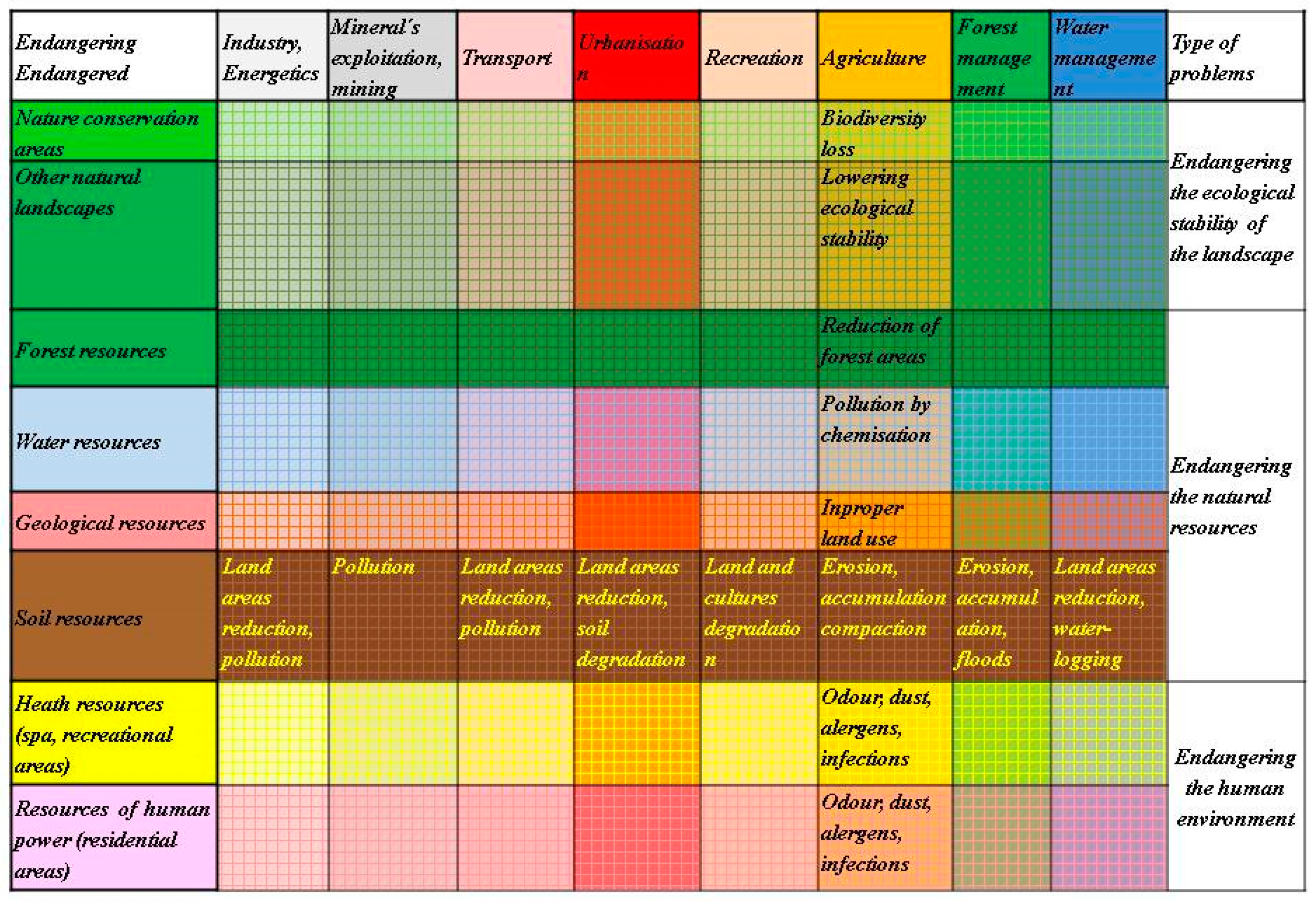
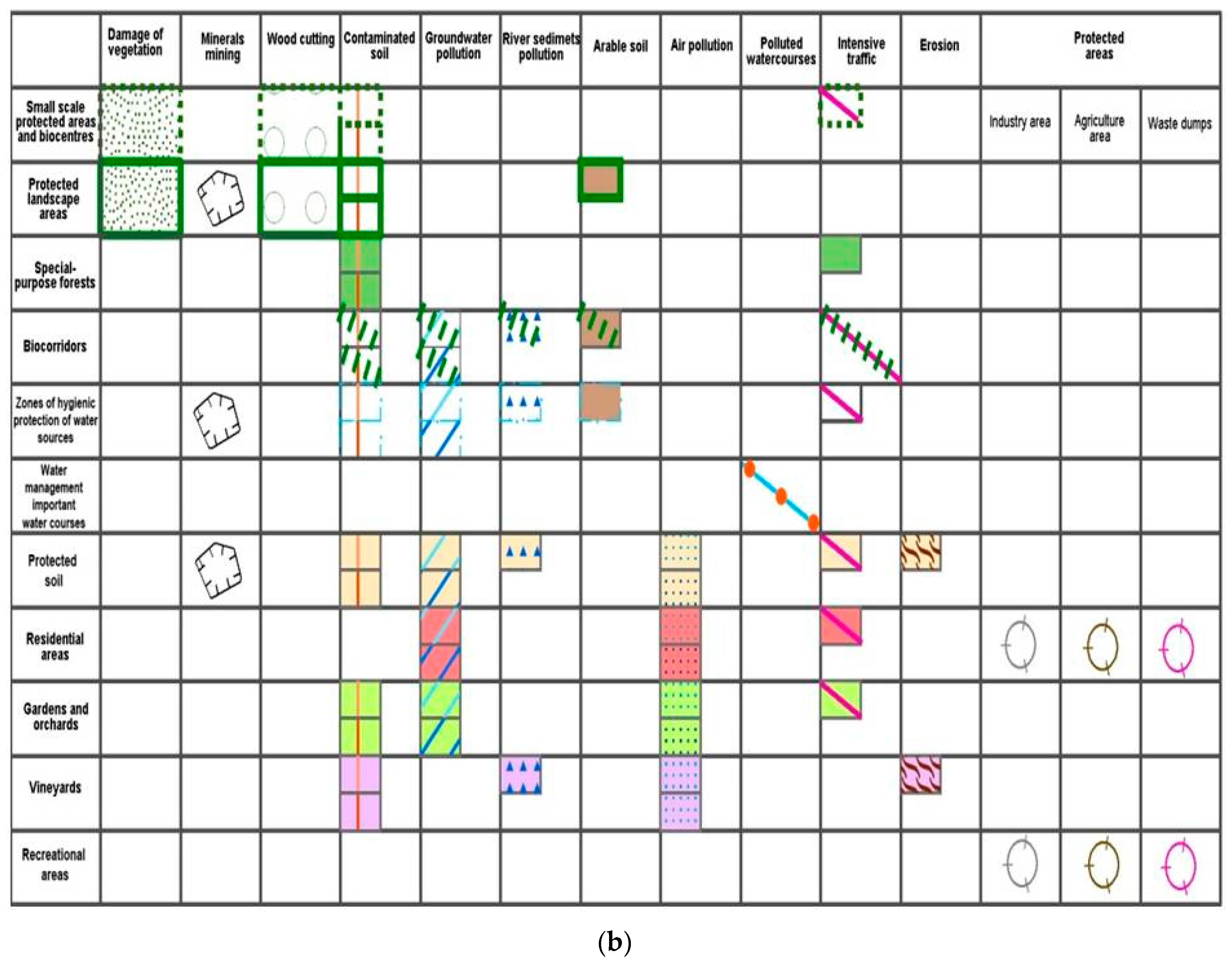
- Rows of the matrix incorporate those sectoral activities which aim toward the protection and conservation of nature and landscape, protection of natural resources and human environment. From the ecological point of view these activities can be considered as endangered by other sectors.
- -
- Columns of the matrix incorporate those sectoral activities which aim toward material production of goods and other technical services, such as industry, energy, mining, transport, urbanization, recreation, agriculture, forestry, and water management. From the ecological point of view these activities can be considered as endangering the sectors mentioned above.
- -
- The squares of the matrix represent the encounters of the interests of the sectors.
- -
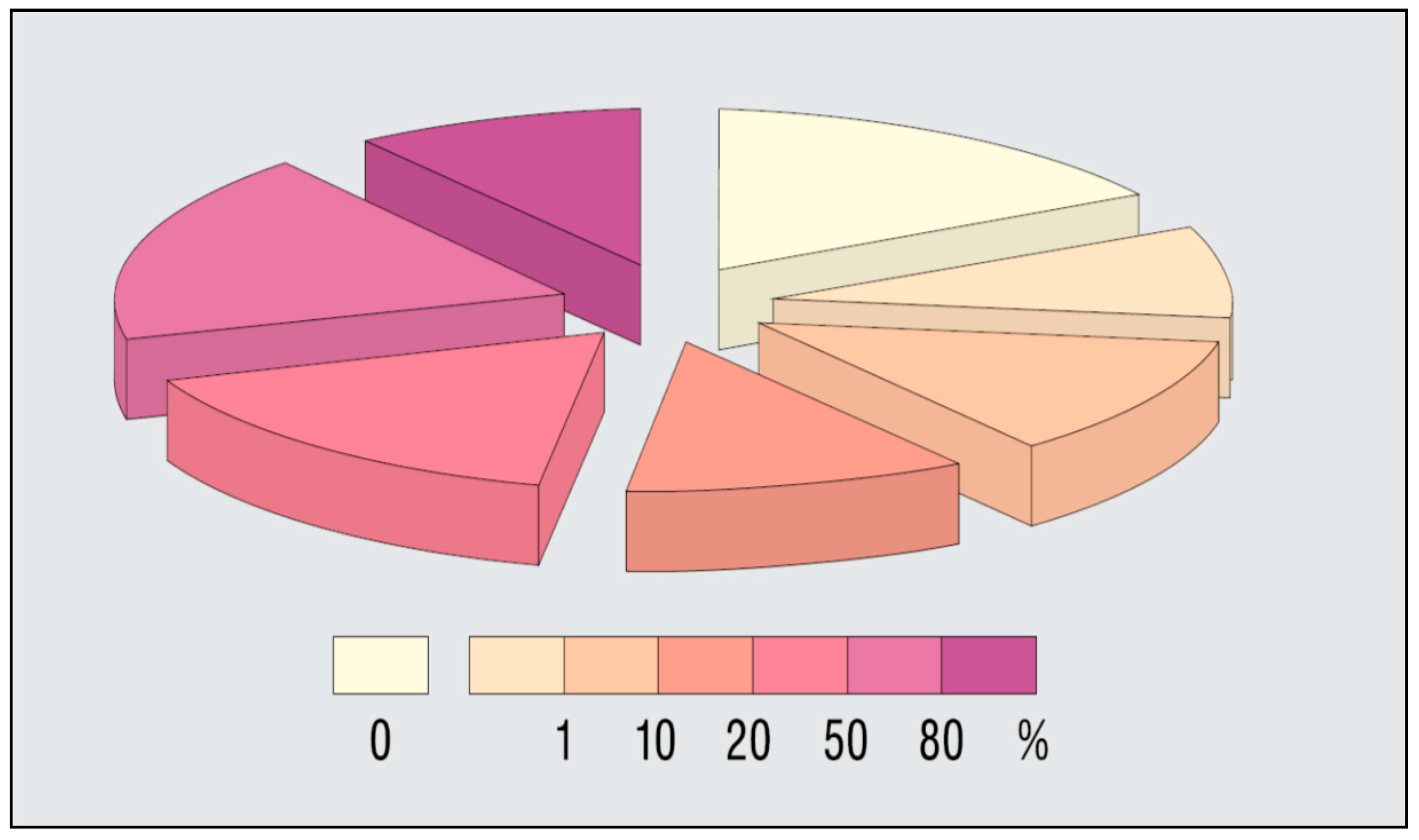
- By evaluation down the columns we ask: how does an endangering activity threaten the endangered factors? Figure 1 describes this mode using the example of the evaluation of how agriculture threatens the particular endangered factors.
- -
- By evaluation along the rows we ask: how is an endangered factor threatened by endangering activities? Figure 1 presents this mode using the example of the evaluation of how soil resources are threatened by particular endangering activities.
- (a)
- The overlap of productive sectors—mainly industry, energy, mining, transport and urbanization—with all other sectors represents real conflicts where the basic problem arises from the efforts of these sectors to broaden their respective territories. Thus, these sectoral activities change the land use, destroy biotopes and build barriers.This is the type of conflict when the sectors “fight” for land of other sectors.
- (b)
- Some overlap/encounters of sectoral interests have mutually supporting effects; e.g., the overlap of special-purpose forests with nature conservation, or of water protective zones with protective forests. These overlaps are actually just spatial encounters in the same area, rather than conflicts. On the other hand, the overlapping of productive forests with national parks, for example, represents real environmental conflicts for nature conservation. The designation and exclusive use of high quality soils exclusively for agricultural production can be clearly considered for protection of soil resources but, conversely, the overlapping of these soils with water protective zones causes real conflict because of the impacts on waterways of chemicals used in intensive agriculture.These types of conflicts can be considered as the encounters and conflicts when several sectors execute their activities on the same territory.
- (c)
- Few sectoral activities cause conflict with their own productive resources. These include the conflict of agricultural activities with the soil resources, or timber production activities with forest resources.This is the type of internal conflict of interest within the same sector.
- (d)
- The productive sectors—industry, energy, transport, agriculture—also produce pollution of the air and water, which does not respect any spatial limits. They cause real conflicts with the human environment and health resources, as well as conflicts with water, soil and forest resources [61].This is the type of real conflict of polluting activities with environment and natural resources.
- The matrix may be considered as a model (even qualitative) of all possible mutual conflicts of all sectors. Although the presented graphical form of the matrix in paper is two-dimensional, in a real territory there are encounters not only of pairs of endangered and endangering activities, but there may also be diverse combinations of several activities. So, the evaluation of encounters and conflicts is much more complex.
- In the present work we applied Geographic Information System (GIS) technology, which allows the assessment of the conflicts of several sectoral activities on the same area in a certain time, if they occur. Therefore, the matrix is actually multidimensional. GIS technology allows the analysis of each conflict of interest quantitatively, according to its area size, including the conflict of the land use (SLS) with natural conditions (PLS).
- In a real territory the general designations of the sectors, elements and factors are concretized and replaced by real existing elements of PLS, SLS and TLS (as an example, see the matrix on the Figure 8, Section 3.4).
- Conflicts of land use were previously quantitatively documented by statistical data which mirror the changes of areas of land use. Methodologically, it is a simple procedure, and the literature includes many examples. However, these statistics document the changes, in a certain time period and a certain area, of pairs of land-use forms. The list of all binate changes can be considered as an integrated picture of the changes, but they remain simply a set of binate data. The present paper did not consider this method as a priority. The present paper describes the assessment of the mutual conflicts of all sectors, and, at the same time, the assessment of their relationships/conflicts with all three defined landscape structures. Thereafter, it also provides the characteristics of these conflict. These characteristics are qualitative. The evaluation and assessment of the characteristics of sectoral activities presented above is given from an environmental/ecological point of view. If the same encounter were assessed by an industrialist, an agriculturist or a forester, they would identify endangered and endangering activities differently. For example, ecologists consider timber production a significant threat to nature conservation; in contrast, foresters consider as an endangering factor something which threatens forestry, even nature conservation [62].
2.2.4. Classification of the Problems Caused by Conflicts of Interest in the Landscape
2.3. Brief Description of the Model Territory
3. Results
3.1. Problems of Endangering of Ecological Stability of the Landscape
3.2. Problems of Endangering the Natural Resources
3.3. Problems of the Endangering of Human Environment
3.4. Integrated Assessment of the Conflicts of Interests in Trnava District
- -
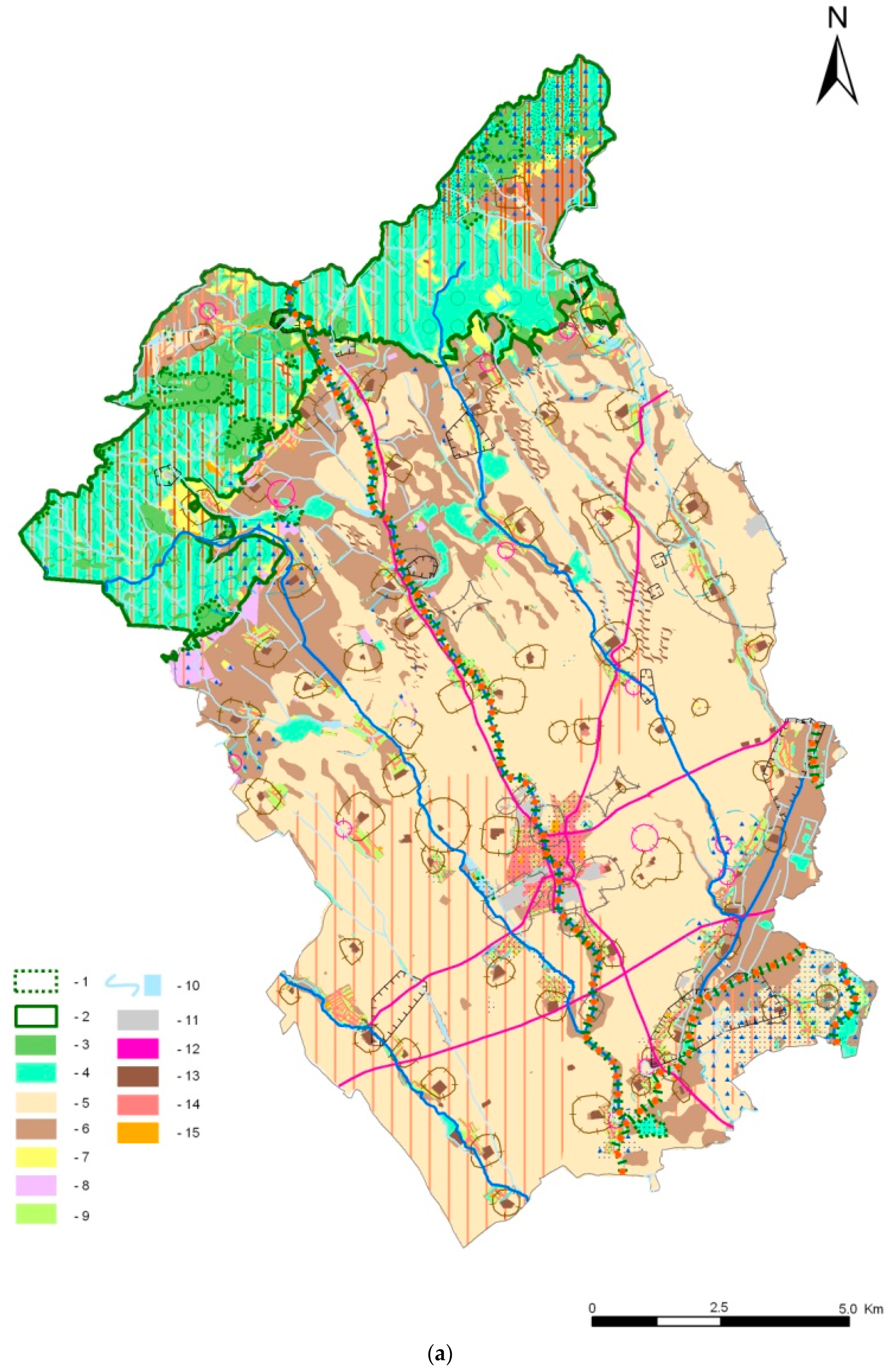
- The high quality and other productive soils are used as arable land (key 5 and 6). Moreover, the highest quality soils were declared for protected soils.
- -
- The nature conservation areas are declared for forests; thus, these forests were declared as special-purpose forests (key 1, 2, 3 and 4).
- -
- The industrial areas, agricultural objects, waste dumps are bound with their safety and hygienic zones, etc.
- -
- rows represent environmentally positive factors that are endangered by negative factors;
- -
- columns represent environmentally negative factors that endanger the positive factors;
- -
- squares represent the real existing encounters of positive and negative factors in the model territory.
4. Discussion
- (a)
- The sectors “fight” for land to broaden their own territory. This is expressed in the building of new objects for industry, transport and residential areas. An important specific problem of the district is that most of its soils are of the highest quality and productivity, so are protected. Nevertheless, developers are able to find ways to change existing territorial plans and gain land, even if they must pay compensation for the occupied land. The problem of occupation of the best soils for industry, shopping centers and residential complexes has been the topic of much research [94,95,96,97]. Another specific problem is the motorway, which creates a massive barrier against migration of the biota. This issue is to be addressed according to the result of the project of the Regional Territorial System of Ecological Stability of the district [98].
- (b)
- The sectors of forestry, agriculture, water management, nature conservation and recreation utilize large areas where their activities overlap. Characteristic of this group is the spatial overlap of the Protected Landscape Area Small Carpathians with special purpose and protective forest and water protective zones, which are mutually supportive. The opposite case is the spatial overlap of high quality soils in the water protective zones, which has a characteristic of conflict since the use of agrichemicals in order to exhaust the productivity potential endangers and pollutes water resources. This conflict should be mitigated by respecting the legal limitations for agriculture. Nevertheless, as the monitored data show, the pollution of water resources still occurs.
- (c)
- “Internal” conflicts within the sectors, i.e., conflict of the activity with its own land resources. This is a typical problem of Trnava district. Intensive agriculture on arable land on steep slopes and on shallow soils causes erosion. This problem is to be solved urgently by acceptance of projects for land consolidation, which also include a proposal for a local territorial system of ecological stability; this is, in fact, a detailed proposal for landscape greenery, which provides complex eco-stabilizing functions, including protection against erosion [99,100,101].
- (d)
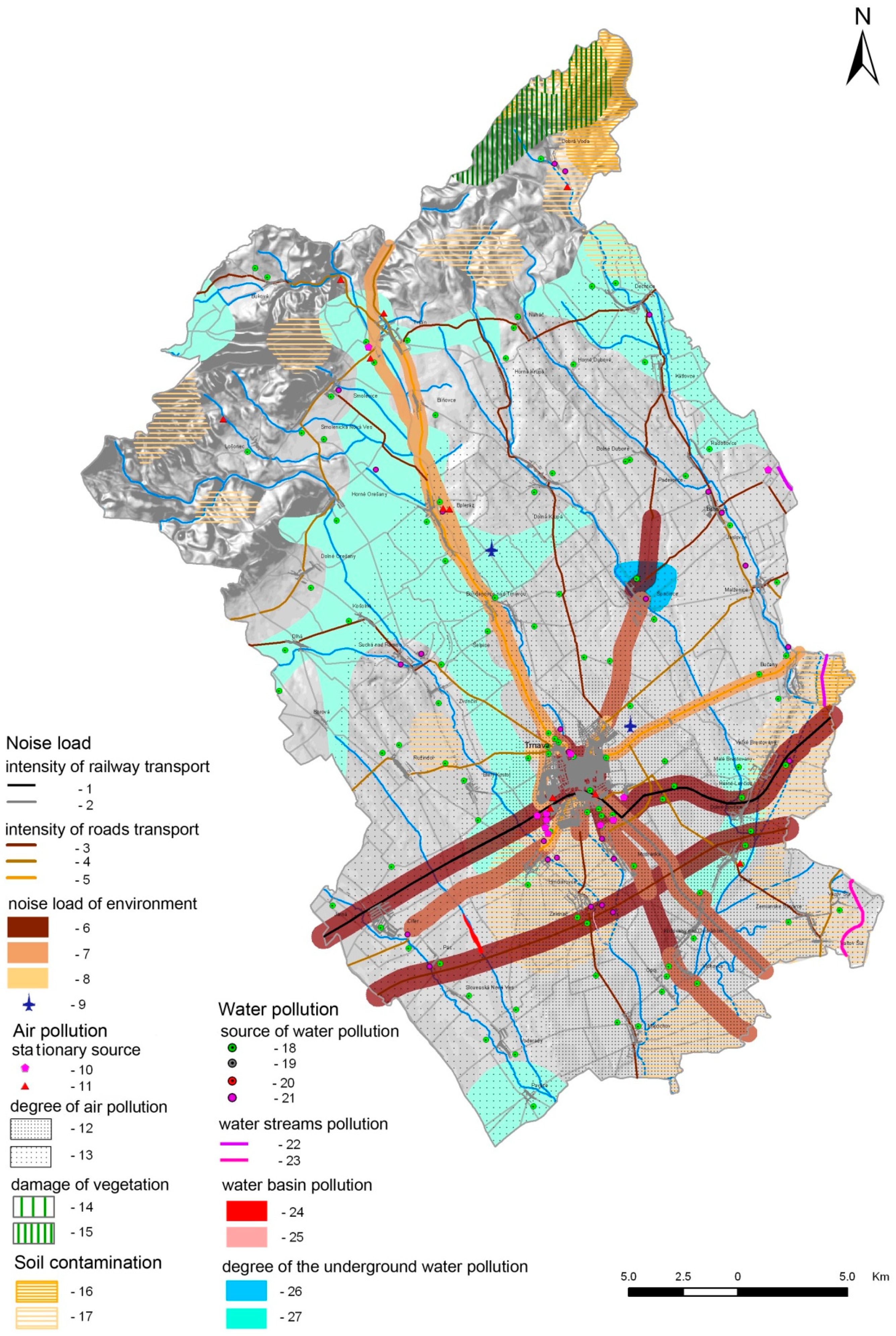
- Production of pollution: most typical are air pollution, which influences the residential and recreational areas, and water pollution, which endangers the water quality both of surface and underground water. A very specific feature of the district is the presence of the nuclear power plant, Jaslovské Bohunice. According to the Environmental Regionalization of the Slovak Republic, the territory of the district of Trnava belongs to the most environmentally burdened regions of Slovakia [77].
Some Characteristic Issues Concerning the Model Territory
5. Conclusions
Author Contributions
Funding
Acknowledgments
Conflicts of Interest
References
- Izakovičová, Z.; Mederly, P.; Petrovič, F. Long-term land use changes driven by urbanisation and their environmental effects (example of Trnava City, Slovakia). Sustainability 2017, 9, 553. [Google Scholar] [CrossRef]
- Munteanu, C.; Kuemmerle, T.; Boltiziar, M.; Butsic, V.; Gimmi, U.; Kaim, D.; Király, G.; Konkoly-Gyuró, É.; Kozak, J.; Lieskovský, J.; et al. Forest and agricultural land change in the Carpathian region—Ameta-analysis of long-term patterns and drivers of changes. Land Use Policy 2014, 38, 685–697. [Google Scholar] [CrossRef]
- Lieskovský, J.; Burgi, M. Persistence in cultural landscapes: A pan-European analysis. Reg. Environ. Chang. 2018, 18, 175–187. [Google Scholar] [CrossRef]
- EEA. The European Environment State and Outlook 2015. Assessment of Global Megatrends; European Environmental Agency Copenhagen: København, Denmark, 2015; p. 134. [Google Scholar]
- FAO. The State of the World’s Forests 2018—Forest Pathways to Sustainable Development; Licence: Rome, Italy, 2018. [Google Scholar]
- Mitchley, J.; Tzanopoulos, J.; Cooper, T. Reconciling conservation of biodiversity with declining agricultural use in the mountains of Europe. In Interdisciplinary Research and Management in Mountain Areas; Taylor, L., Ryall, A., Eds.; Banff Centre Canada: Banff, AB, Canada, 2005; pp. 61–65. [Google Scholar]
- The EU Biodiversity Strategy to 2020. Available online: http://ec.europa.eu/environment/nature/biodiversity/strategy/index_en.htm (accessed on 10 September 2018).
- Grunewald, K.; Bastian, O. (Eds.) Ecosystem Services. Concept, Methods and Case Studies; Springer: Berlin, Germany, 2015; p. 312. [Google Scholar]
- Fürst, C.; Helming, K.; Lorz, C.; Müller, F.; Verburg, P. Integrated land use and regional resource management—A cross-disciplinary dialogue on future perspectives for a sustainable development of regional resources. J. Environ. Manag. 2013, 127, 1–5. [Google Scholar] [CrossRef] [PubMed]
- Krcho, J. Structure and spatial differentiation of the physical-geographic sphere as a cybernetic system. Bratislava. Geogr. Čas. 1974, 26, 132–162. [Google Scholar]
- Haase, G. Izučenie topičeskich I choričeskich struktur, ich dinamiki I razvitija v landšaftnych sistemach. In Structura, Dinamika I Razvitije Landšaftov; Institut Geografii. AN SSSR: Moskva, Russia, 1980; pp. 57–81. [Google Scholar]
- Miklós, L.; Izakovičová, Z. Landscape as Geosystem; VEDA, SAV: Bratislava, Slovakia, 1997; p. 152. [Google Scholar]
- Miklós, L.; Izakovičová, Z.; Boltižiar, M.; Diviakova, A.; Grotkovská, L.; Hrnčiarová, T.; Imrichová, Z.; Kočická, E.; Kočický, D.; Kenderessy, O.; et al. Atlas of Representative Geosystem of Slovakia; UKE SAV: Bratislava, Slovakia, 2016; p. 123. ISBN 80-969272-4-8. [Google Scholar]
- Ružička, M.; Miklós, L. Landscape-ecological Planning (LANDEP) in the Process of Territorial Planning. Ecol. CSSR Cas. Ekologicke Probl. 1982, 1, 297–312. [Google Scholar]
- Miklós, L. Ecological Generel, ČSSR Part: SSR. I. Stage. Spatial Differentiation of the Area from the Ecological Point of View; ČSŽP Bratislava, ÚEBE CBEV SAV Bratislava, Stavoprojekt: Banská Bystrica, Slovakia, 1985; p. 125. [Google Scholar]
- Miklós, L.; Kozová, M.; Ružička, M. Ecological Plan for the Use of the East Slovak Lowland at 1:25,000. Ecological Optimization of Use of VSN; ÚEBE SAV: Bratislava, Slovakia, 1986; pp. 5–312. [Google Scholar]
- Izakovičová, Z. Ecological interpretations and evaluation of encounters of interests in landscape. Ekológia 1995, 14, 261–275. [Google Scholar]
- Izakovičová, Z. Evaluation of the stress factors in the landscape. Ekológia 2000, 19, 92–103. [Google Scholar]
- Izakovičová, Z. Integrated approach to the assessment of the agricultural landscape. Geogr. Rev. Geogr. Geoekologické Štúd. 2006, 2, 333–339. [Google Scholar]
- Izakovičová, Z. Integrated Landscape Management; Institute of Landscape Ecology, SAS: Bratislava, Slovakia, 2006; p. 232. [Google Scholar]
- Miklós, L.; Diviaková, A.; Izakovičová, Z. Ecological Networks and Territorial System of Ecological Stability; Springer International Publishing: Berlin, Germany, 2018; p. 159. [Google Scholar]
- Krcho, J. The natural part of the geosphere as a cybernetic system and its expression in the map. Geogr. Čas. 1968, 20, 115–130. [Google Scholar]
- Chorley, R.; Kennedy, B. Physical Geography—A System Approach; Prentice Hall Interantional: London, UK, 1971; p. 243. [Google Scholar]
- Demek, J. The landscape as a geosystem. Geoforum 1978, 9, 29–34. [Google Scholar] [CrossRef]
- Sochava, V.B. Vvedenie v Učenije o Geosistemach (An Introduction to the Science of Geosystems); Nauka: Novosibirsk, Russia, 1978; p. 319. [Google Scholar]
- Miklós, L.; Kočická, E.; Izakovičová, Z.; Kočický, D.; Špinerová, A.; Diviaková, A.; Miklósová, V. Landscape as a Geosystem; Springer International Publishing: Berlin, Germany, 2018; p. 245. [Google Scholar]
- Izakovičová, Z.; Miklós, L. New concept of nature protection in the Slovak Republic. In Nature Conservation Management: From Idea to Practical Results; Chmielewski, T.J., Ed.; PWZN Print 6; Lublin-Lódz-Helsinki: Aarhus, Denmark, 2007; pp. 86–98. ISBN 83-87414-98-0. [Google Scholar]
- Miklós, L.; Špinerová, A. Landscape-Ecological Planning LANDE; Springer: Berlin, Germany, 2018; p. 254. [Google Scholar]
- Izakovičová, Z.; Miklós, L.; Drdoš, J. Landscape-Ecological Conditions of Sustainable Development; Veda: Bratislava, Slovakia, 1997; p. 183. ISBN 80-224-0485-3. [Google Scholar]
- Kočická, E. Príklad Ohraničovania Komplexných Priestorových Jednotiek pre Krajinno-Ekologické Hodnotenia. Acta Facultatis Ecologiae 2011, 24–25, 55–65. Available online: https://fee.tuzvo.sk/sites/default/files/acta-fee-24-25-2011.pdf (accessed on 12 September 2018).
- Miklós, L.; Izakovičová, Z.; Oferrtálerová, M.; Miklósová, V. The institutional tools of integrated landscape management in Slovakia for mitigation of climate change and other natural disasters. Eur. Countrys. 2017, 9, 647–657. [Google Scholar] [CrossRef]
- AGENDA 21. United Nations Conference on Environment and Development. Rio de Janeiro (United Nations), A/Conf. l5l/4; 1992. Available online: https://sustainabledevelopment.un.org/outcomedocuments/agenda21 (accessed on 10 September 2018).
- Office for Official Publications of the European Communities. European Spatial Development Perspective ESDP. Towards Balanced and Sustainable Development of the Territory of the EU; Office for Official Publications of the European Communities: Luxembourg, 1999; ISBN 92-828-7658-6. [Google Scholar]
- Directive of the 2000/60/EC of the European Parliament and of the Council—Water Framework Directive. 2000. Available online: http://data.europa.eu/eli/dir/2000/60/oj (accessed on 10 September 2018).
- Council of Europe. European Landscape Convention; Council of Europe: Florence, Italy, 2000. [Google Scholar]
- United Nations. United Nations Millennium Declaration. Resolution Adopted by the General Assembly; A/55/L.2; United Nations: New York, NY, USA, 2000. [Google Scholar]
- Economic Comission for Europe. Spatial Planning: Key Instrument for Development and Effective Governance with Special Reference to Countries in Transition; ECE/HBP/146; UN Publication, Economic Comission for Europe: Geneva, Switzerland, 2008. [Google Scholar]
- United Nations. Transforming Our World: The 2030 Agenda for Sustainable Development; United Nations: New York, NY, USA, 2015; Available online: http://www.un.org/ga/search/view_doc.asp?symbol=A/RES/70/1&Lang=E (accessed on 10 September 2018).
- Bezák, P. Integrated approach to the evaluation landscape on the example of research in National Park Poloniny. In Integrated Landscape Management—Basic Tool of the Implementation of the Sustainable Development; Izakovičová, Z., Ed.; Slovak Academy of Sciences, Ministry of the Environment: Bratislava, Slovakia, 2006; pp. 125–130. [Google Scholar]
- Cairns, J., Jr.; Crawford, T.V.; Salwasser, H. (Eds.) Implementing Integrated Environmental Management; Virginia Polytechnic Institute and State University: Blacksburg, VA, USA, 1994; p. 137. [Google Scholar]
- Ružička, M.; Miklós, L. Basic premises and methods in landscape-ecological planning and optimisation. In Changing Landscapes: An Ecological Perspectives; Zonnenveld, I.S., Forman, R.T.T., Eds.; Springer: New York, NY, USA, 1990; pp. 233–260. [Google Scholar]
- Bezák, P.; Mederly, P.; Izakovičová, Z.; Špulerová, J.; Schleyer, C. Divergence and conflicts in landscape planning across spatial scales in Slovakia: An opportunity for an ecosystem services-based approach? Int. J. Biodivers. Sci. Ecosyst. Serv. Manag. 2017, 13, 119–135. [Google Scholar] [CrossRef]
- Miklós, L.; Kočická, E.; Diviaková, A.; Belaňová, E. Integrated Landscape Management. Institutional Tools; VKÚ. a.s.: Harmanec, Slovakia, 2011; p. 196. [Google Scholar]
- Estrada-Carmona, N.; Hart, A.K.; DeClerck, F.A.J.; Harvey, C.A.; Milder, J.C. Integrated landscape management for agriculture, rural livelihoods, and ecosystem conservation: An assessment of experience from Latin America and the Caribbean. Landsc. Urban Plan. 2014, 129, 1–11. [Google Scholar] [CrossRef]
- García-Martín, M.; Bieling, C.; Hart, A.; Plieninger, T. Integrated landscape initiatives in Europe: Multi-sector collaboration in multi-functional landscapes. Land Use Policy 2016, 58, 43–53. [Google Scholar] [CrossRef]
- Milder, J.C.; Hart, A.K.; Dobie, P.; Minai, J.; Zaleski, C. Integrated landscape initiatives for African agriculture, development, and conservation: A region-wide assessment. World Dev. 2014, 54, 68–80. [Google Scholar] [CrossRef]
- Scherr, S.J.; Heiner, K. Towards an Approach to Integrated Landscape Modeling for the SDGs; EcoAgriculture Partners: Washington, DC, USA, 2016. [Google Scholar]
- Scherr, S.J.; Shames, S.; Friedman, R. Defining Integrated Landscape Management for Policy Makers. Ecoagriculture Policy Focus No. 10. 2013. Available online: http://www.un.org/esa/ffd/wp-content/uploads/sites/2/2015/10/IntegratedLandscapeManagementforPolicymakers_Brief_Final_Oct24_2013_smallfile.pdf (accessed on 11 September 2018).
- Zanzanaini, C.; Tran, B.T.; Singh, C.; Hart, A.; Milder, J.; DeClerck, F. Integrated landscape initiatives for agriculture, livelihoods and ecosystem conservation: An assessment of experiences from South and Southeast Asia. Landsc. Urban Plan. 2017, 165, 11–21. [Google Scholar] [CrossRef]
- Act of the National Council of Slovak Republic No. 237/2000 Coll., Amending and Supplementing the Act No. 50/1976. On Territorial Planning and Building Code (Building Act). Available online: https://www.ujd.gov.sk/files/legislativa/145_2010_EN.pdf (accessed on 10 September 2018).
- UNCCD/Global Land Outlook Working Paper/Integrated Landscape Management. 2017. Available online: https://www.researchgate.net/publication/320211462 (accessed on 10 September 2018).
- Kočická, E.; Kočický, D. Database of abiotic complexes as a landscape and ecological basis for integrated landscape management in the Slovak Republic. Acta Fac. Ecol. 2014, 31, 35–50. [Google Scholar]
- Belaňová, E.; Kočická, E.; Diviaková, A. Implementation of Integrated Landscape Management Tools at Regional and Local Level; Vydavateľstvo Technickej Univerzity vo Zvolene: Zvolen, Slovakia, 2014; p. 117. [Google Scholar]
- Grunewald, K.; Bastian, O. Special issue: “Maintaining Ecosystem Services to Support Urban Needs”. Sustainability 2017, 9, 1647. [Google Scholar] [CrossRef]
- Antrop, M.; Van Eetvelde, V. Landscape Perspectives the Holistic Nature of Landscape (Landscape Series 23); Springer: Dordrecht, The Netherlands, 2017; p. 436. ISBN 9789402411812. [Google Scholar]
- Naveh, Z.; Lieberman, A.S. Landscape Ecology Theory and Applications, 2nd ed.; Springer: New York, NY, USA, 1993; p. 360. [Google Scholar]
- Mezősi, G.; Blanka, V.; Bata, T.; Ladanyi, Z.; Kemeny, G.; Meyer, B.C. Assessment of future scenarios for wind erosion sensitivity changes based on ALADIN and REMO regional climate model simulation data. Open Geosci. 2016, 8, 465–477. [Google Scholar] [CrossRef]
- Izakovičová, Z. Evaluation of the anthropogenic change of the landscape structure. Ekológia 1997, 16, 73–80. [Google Scholar]
- Haines-Young, R.; Potschin, M. Common International Classification of Ecosystem Services (CICES) Consultation on Version 4, August–December 2012. Available online: https://unstats.un.org/unsd/envaccounting/seearev/GCComments/CICES_Report.pdf (accessed on 10 September 2018).
- Izakovičová, Z.; Oszlányi, J. The impact of stress factors, landscape loads and human activities: Implications for sustainable development. Int. J. Environ. Waste Manag. 2013, 11, 111–128. [Google Scholar] [CrossRef]
- Chavez-Tafur, J.; Zagt, R.J. (Eds.) Towards Productive Landscapes; Tropenbos International: Wageningen, The Netherlands, 2014; Volume 56, p. 246. [Google Scholar]
- Sayer, J.A.; Campbell, B. Research to integrate productivity enhancement, environmental protection, and human development. Conserv. Ecol. 2001, 5, 32. [Google Scholar] [CrossRef]
- Miklós, L. The concept of the territorial system of ecological stability in Slovakia. In Ecological and Landscape Consequences of Land Use Change in Europe; Jongman, R.H.G., Ed.; ECNC: Tilburg, The Netherlands, 1996; pp. 385–406. [Google Scholar]
- Statistic Yearbook of Trnava District, 1st ed.; Úrad Geodézie, Kartografie a Katastra Slovenskej Republiky: Bratislava, Slovakia, 2018; ISBN 978-80-89831-06-7.
- Slovak Road Administration, 2015, Slovenská Správa Ciest, 2015. Available online: http://www.ssc.sk/sk/technicke-predpisy-rezortu/databaza-hydroizolacnych-systemov-na-mostoch/3-2015.ssc (accessed on 10 September 2018).
- Moyzeová, M.; Miklós, L.; Šatalová, B.; Izakovičová, Z.; Oszlányi, J.; Kenderessy, P.; Štefunková, D.; Krnáčová, Z. Quality of Environment Assessment for Rural Settlements (Example of Trnava District); ÚKE SAV: Bratislava, Slovakia, 2015; ISBN 978-80-89325-26-9. [Google Scholar]
- Čurlík, J.; Šefčík, P.; Jambor, P. Geochemical Atlas of the Slovak Republic. Part V, Soils; Ministry of the Environment of the Slovak Republic: Bratislava, Slovakia, 1999; ISBN 80-88833-14-0.
- Maňkovská, B.; Izakovičová, Z.; Oszlányi, J.; Frontasyeva, M. Temporal and spatial trends (1990–2010) of heavy metal accumulation in mosses in Slovakia. Boil. Divers. Conserv. 2017, 10, 28–32. [Google Scholar]
- Bezák, P.; Izakovičová, Z.; Miklós, L. Representative Types of Slovak Landscape; ÚKE SAV: Bratislava, Slovakia, 2010; p. 165. [Google Scholar]
- Izakovičová, Z.; Miklós, L.; Moyzeová, M.; Špilárová, I.; Kočický, D.; Halada, L.; Gajdoš, P.; Špulerová, J.; Baránková, Z.; Štefunková, D. Model of Representative Geo-Ecosystems on Regional Level; ÚKE SAV: Bratislava, Slovakia, 2011; p. 88. [Google Scholar]
- Miklós, L.; Izakovičová, Z.; Kanka, R.; Ivanič, B.; Kočický, D.; Špinerová, A.; David, S.; Piscová, V.; Štefunková, D.; Oszlányi, J. Geographic Information System of Ipel Basin; Slovak Academy of Sciences: Zvolen, Slovakia, 2011; p. 43. [Google Scholar]
- Dobrucká, A.; Mederly, P. Territorial System of Ecological Stability of Trnava Town—Actualisation; Atelier Dobrucka Ltd. Regioplan: Nitra, Slovakia, 2009; p. 366. [Google Scholar]
- Mederly, P.; Bezák, P.; Izakovičová, Z. Ecosystem services assessment methods—Examples and perspectives for planning and decision making. In Flows, Spaces and Societies in Central Europe; Comenius University: Bratislava, Slovakia, 2017; p. 62. ISBN 978-80-223-4350-3. [Google Scholar]
- Water Management in the Slovak Republic in 2012. Available online: http://www.vuvh.sk/Documents/vodne_hospodarstvo/MS2014EN.pdf (accessed on 10 September 2018).
- Hrnčiarová, T.; Kenderessy, P.; Špulerová, J.; Vlachovičová, M.; Piscová, V.; Dobrovodská, M. Status and outlook of hiking trails in the central part of the Low Tatra Mountains in Slovakia between 1980–1981 and 2013–2014. J. Mt. Sci. 2018, 15, 1615–1632. [Google Scholar] [CrossRef]
- National Agriculture and Food Center. Available online: http://www.vupop.sk/eng/index.php (accessed on 5 June 2018).
- Enviroportal of the Slovak Republic. Available online: https://www.enviroportal.sk/ (accessed on 30 July 2017).
- Šveda, M.; Vigašová, D. Land use changes in the hinterland of major Slovak cities. Geografie 2010, 115, 413–439. (In Slovak) [Google Scholar]
- Agency for Nature Conservation and Landscape Protection of the Czech Republic. Available online: http://www.ochranaprirody.cz/en/ (accessed on 10 September 2018).
- Moyzeová, M. Territorial development and social relationships. Ekologické Štúd. 2017, 8, 69–76. [Google Scholar]
- Environmental Status Report of Trnava District. 2002. Available online: https://www.enviroportal.sk/uploads/report/ktt02s.pdf (accessed on 10 September 2018).
- Izakovičová, Z.; Špulerová, J.; Petrovič, F. Integrated approach to sustainable land use management. Environ. Open Access J. Environ. Conserv. Technol. 2018, 5, 37. [Google Scholar] [CrossRef]
- Leadley, P.; Pereira, H.M.; Alkemade, R.; Fernandez-Manjarrés, J.F.; Proença, V.; Scharlemann, J.P.W.; Walpole, M.J. Biodiversity Scenarios: Projections of 21st Century Change. In Biodiversity and Associated Ecosystem Services; Technical Series No. 50; Secretariat of the Convention on Biological Diversity: Montreal, QC, Canada, 2010; p. 132. [Google Scholar]
- IEEP; Alterra; Ecologic; PBL; UNEP-WCMC. Scenarios and Models for Exploring Future Trends of Biodiversity and Ecosystem Services Changes; Institute for European Environmental Policy, Alterra Wageningen UR, Ecologic, Netherlands Environmental Assessment Agency, United Nations Environment Programme World Conservation Monitoring Centre: Wageningen, The Netherlands, 2009. [Google Scholar]
- Sachs, J.D.; Baillie, J.E.M.; Sutherland, W.J.; Armsworth, P.R.; Ash, N.; Beddington, J.; Blackburn, T.M.; Collen, B.; Gardiner, B.; Gaston, K.J.; et al. Biodiversity Conservation and the Millennium Development Goals. Science 2009, 325, 1502–1503. [Google Scholar] [CrossRef] [PubMed]
- UNDP. Human Development Report 2011, Sustainability and Equity: A Better Future for All; United Nations Development Programme: New York, NY, USA, 2011. [Google Scholar]
- CBD, Global Biodiversity Outlook 3. Available online: http://gbo3.cbd.int/ (accessed on 20 December 2010).
- EEA. Asessing Biodiversity in Europe—The 2010 Report. 2010. Available online: http://www.eea.europa.eu/publications/assessing-biodiversity-in-europe-84 (accessed on 12 December 2010).
- FAO—GFRA Global Forest Resource Assessment 2005. FAO Forest Report. Food and Agriculture Organization of the United States, 2006. Available online: http://www.fao.org/DOCREP/008/a0400e/a0400e00.htm (accessed on 10 September 2008).
- Mooney, H.; Larigauderie, A.; Cesario, M.; ELmquist, T.; Hoegh-Guldberg, O.; Lavorel, S.; Mace, G.T.; Palmer, M.; Scholes, R.; Yahara, T. Biodiversity, climate change and ecosystem services. Current Opinion in Environmental. Curr. Opin. Environ. Sustain. 2016, 1, 46–54. [Google Scholar] [CrossRef]
- Reid, W.V.; Mooney, H.A.; Cropper, A.; Capistrano, D.; Carpenter, S.R.; Chopra, K.; Dasgupta, P.; Dietz, T.; Duraiappah, A.K.; Hassan, R.; et al. Millenium Ecosystem Assesment—Ecosystems and Human Well-Being. Syntheses; Univerzita Karlova v Prahe: Praha, Czech Republic, 2005; p. 138. [Google Scholar]
- Sabo, P.; Urban, P.; Turisová, I.; Považan, R.; Herian, K. Threat and Protection of Biodiversity. Selected Chapters of Global Environmental Problems; Centrum Vedy a Výskumu., Inštitút Výskumu Krajiny a Regiónov, Univerzita Mateja Bela v Banskej Bystrici, Katedra Biológie a Ekológie, Fakulta Prírodných vied, Univerzita Mateja Bela v Banskej Bystrici & Občianske Združenie Živica: Banská Bystrica, Slovakia, 2011; p. 328. ISBN 978-80-968989-6-5. [Google Scholar]
- Yafei, L.; Gaohuan, L. Characterizing Spatiotemporal Pattern of Land Use Change and Its Driving Force Based on GIS and Landscape Analysis Techniques in Tianjin during 2000–2015. Sustainability 2017, 9, 894. [Google Scholar] [CrossRef]
- Kopecká, M.; Rosina, K. Identification of changes in urbanized landscape based on VHR satellite data: Study area of Trnava (in Slovak). Geogr. Čas. 2014, 66, 247–267. [Google Scholar]
- Izakovičová, Z.; Bezák, P.; Mederly, P. Implementing ecosystem services in planning and decision-making. In Gospodarka Przestrzenna, Stan Obecny i Wyzwania Przyszłości—Ujęcie Interdyscyplinarne; Uniwersytet Przyrodniczy we Wrocławiu: Wrocław, Poland, 2017; pp. 18–19. [Google Scholar]
- Izakovičová, Z.; Považan, R. Increasing pressure on ecosystems. In Global Megatrends: Evaluation and Challenges from the Perspective of the Slovak Republic; Centrum Spoločenských a Psychologických Vied, SAV: Staré Mesto-Bratislava, Slovakia, 2016; p. 327. [Google Scholar]
- Izakovičová, Z.; Moyzeová, M.; Oszlányi, J. Problems in Agricultural Landscape Management Arising from Conflicts of Interest—A Study in the Trnava Region, Slovak Republic. In Innovations in European Rural Landscapes; Wiggering, H., Ende, H.P., Knierim, A., Pintar, M., Eds.; Springer: Berlin/Heidelberg, Germany, 2010; pp. 77–95. [Google Scholar]
- Aurex. Territorial Plan of the Region Trnava. Self-Governing Region. Directional Part; TTSK: Trnava, Slovakia, 2014; p. 387. [Google Scholar]
- Muchová, Z.; Jusková, K. Stakeholders’ perception of defragmentation of new plots in a land consolidation project: Given the surprisingly different Slovak and Czech approaches. Land Use Policy 2017, 6, 356–363. [Google Scholar] [CrossRef]
- Pauditšová, E.; Slabeciusova, B. Modelling as a Platform for Landscape Planning. In Geoconference on Informatics. Geoinformatics and Remote Sensing; Stef92 Technology Ltd.: Sofia, Bulgaria, 2014; Volume III, pp. 753–760. [Google Scholar]
- Muchova, Z.; Leitmanova, M.; Petrovic, F. Possibilities of optimal land use as a consequence of lessons learned from land consolidation projects (Slovakia). Ecol. Eng. 2016, 90, 294–306. [Google Scholar] [CrossRef]
- Atlas of Slovak Landscape; MŽP SR, Bratislava, SAŽP: Banská Bystrica, Slovakia, 2002; p. 344. ISBN 80-88833-27-2.
- Poudevigne, I.; Alard, D. Agricultural landscape dynamic: A case study in the Odessa region, the Ukraine and comparative analysis with the Brionne basin case study France. Ekológia 1997, 16, 295–308. [Google Scholar]
- Matlovič, R. Transformation processes and their effects in intra-urban structures of post-communist cities (in Slovak). Acta Fac. Rerum Nat. Univ. Matthiae Belii 2001, 8, 73–81. [Google Scholar]
- Sýkora, L. Changes in the internal spatial structure of post-communist Prague. GeoJournal 1999, 49, 79–89. [Google Scholar] [CrossRef]
- Hirt, S. Landscapes of post-modernity: Changes in the built fabric of Belgrade and Sofia since the end of socialism. Urban Geogr. 2008, 29, 785–809. [Google Scholar] [CrossRef]
- Medvedkov, Y.; Medvedkov, O. Upscale housing in post-Soviet Moscow and its environs. In The Post-Socialist City: Urban Form and Space Transformations in Central and Eastern Europe after Socialism; Stanilov, K., Ed.; Springer: Dordrecht, The Netherlands, 2007; pp. 245–265. [Google Scholar]
- Feldman, M. Urban waterfront regeneration and local governance in Tallinn. Eur. Asia Stud. 2000, 52, 829–850. [Google Scholar] [CrossRef]
- Kiss, E. Spatial impacts of post-socialist industrial transformation in the major Hungarian cities. Eur. Urban Reg. Stud. 2004, 11, 81–87. [Google Scholar] [CrossRef]
- Sýkora, L.; Bouzarowski, S. Multiple Transformations: Conceptualising the Post-communist Urban Transition. Urban Stud. 2011, 49, 1–18. [Google Scholar] [CrossRef]
- Temelová, J.; Novák, J. From industrial neighbourhood to modern urban centre: Transformation in physical and functional environment of central Smíchov. Geogr-Sb. CGS 2007, 112, 315–333. [Google Scholar]
- Sýkora, L. Gentrification in post-communist cities. In The New Urban Colonialism: Gentrification in a Global Context; Atkinson, R., Bridge, G., Eds.; Routledge: London, UK, 2005; pp. 90–105. [Google Scholar]
- Forman, R.T.T.; Godron, M. Landscape Ecology; John Wiley and Sons: New York, NY, USA, 1986; p. 619. [Google Scholar]
- Mander, Ü.; Murka, M. Landscape coherence: A new criterion for evaluating impacts of land use changes. In Multifunctional Landscapes. Vol. III—Continuity and Change; Mander, Ü., Antrop, M., Eds.; WIT Press: Southampton, UK, 2003; pp. 15–32. [Google Scholar]
- Pauleit, S.; Ennos, R.; Golding, Y. Modelling the environmental impacts of urban land use and land cover change—A study in Merseyside, UK. Landsc. Urban Plan. 2005, 71, 295–310. [Google Scholar] [CrossRef]
- Haase, D.; Frantzeskaki, N.; Elmqvist, T. Ecosystem services in urban landscape. Practical applications and governance implications. Ambio 2014, 43, 407–412. [Google Scholar] [CrossRef] [PubMed]
- Haase, D.; Kabisch, N.; Haase, A. Endless Urban Growth? On the Mismatch of Population, Household and Urban Land Area Growth and Its Effects on the Urban Debate. PLoS ONE 2013, 8, e66531. [Google Scholar] [CrossRef] [PubMed]
- Albert, C.; Aronson, J.; Fürst, C.; Opdam, P. Integrating ecosystem services in landscape planning: Requirements, approaches, and impacts. Landsc. Ecol. 2014, 29, 1277–1285. [Google Scholar] [CrossRef]
- Haase, D.; Haase, A.; Kabisch, N.; Kabisch, S.; Rink, D. Actors and factors in land-use simulation: The challenge of urban shrinkage. Environ. Model. Softw. 2012, 35, 92–103. [Google Scholar] [CrossRef]
- Fei, Z.H.; Johnson, C.V. Assessment of Land-Cover/Land-Use Change and Landscape Patterns in the Two National Nature Reserves of Ebinur Lake Watershed, Xinjiang, China. Sustainability 2017, 9, 1553. [Google Scholar] [CrossRef]
- Bičík, I.; Jeleček, L.; Štěpánek, V. Land-Use Changes and their Social Driving Forces in Czech in the 19th and 20th Centuries. Land Use Policy 2001, 18, 65–73. [Google Scholar] [CrossRef]
- Mendel, M. Residential developers and investors in Central Europe: Boom and bust. Monu Mag. Urban. 2010, 12, 23–30. [Google Scholar]
- Václavík, T.; Rogan, J. Identifying Trends in Land Use/Land Cover Changes in the Context of Post-Socialist Transformation in Central Europe: A Case Study of the Greater Olomouc Region. GISci. Remote. Sens. 2006, 46, 54–76. [Google Scholar] [CrossRef]
- Nuissl, H.; Haase, D.; Wittmer, H.; Lanzendorf, M. Environmental impact assessment of urban land use transitions—A context-sensitive approach. Land Use Policy 2009, 26, 414–424. [Google Scholar] [CrossRef]
- Bariski, J. The consequences of changes of ownership for agricultural land use in Central European countries following the collapse of the Eastern Bloc. Land Use Policy 2017, 66, 120–130. [Google Scholar]
- Sroka, W.; Mikolajczyk, J.; Wojewodzic, T.; Kwoczynska, B. Agricultural Land vs. Urbanisation in Chosen Polish Metropolitan Areas: A Spatial Analysis Based on Regression Trees. Sustainability 2018, 10, 837. [Google Scholar] [CrossRef]
- Muchová, Z.; Hrnčiarová, T.; Petrovič, F. Local Territorial System of Ecological Stability for Land Consolidation; Slovenská Polnohospodárska Univerzita v Nitre: Nitra, Slovakia, 2013; p. 87. ISBN 978-80-552-1127-5. [Google Scholar]
- Izakovičová, Z.; Bezák, P.; Mederly, P.; Špulerová, J. Implementation of the ecosystem services concept in planning and management practice in the Slovak Republic—Results of the Open NESS project in Trnava case study. In Životné Prostredie; Institute of Landscape Ecology of Slovak Academy of Sciences: Bratislava, Slovakia, 2017; pp. 198–204. ISSN 0044-4863. [Google Scholar]
- Huang, D.; Jin, H.; Zhao, X.; Liu, S. Factors influencing the conversion of arable land to urban use and policy implications in Beijing, China. Sustainability 2015, 7, 180–194. [Google Scholar] [CrossRef]
- Mazzocchi, C.; Sali, G.; Corsi, S. Land use conversion in metropolitan areas and the permanence of agriculture: Sensitivity Index of Agricultural Land (SIAL), a tool for territorial analysis. Land Use Policy 2013, 35, 155–162. [Google Scholar] [CrossRef]
- Deng, X.; Huang, J.; Rozelle, S.; Zhang, J.; Li, Z. Impact of urbanization on cultivated land changes in China. Land Use Policy 2015, 45, 1–7. [Google Scholar] [CrossRef]


© 2018 by the authors. Licensee MDPI, Basel, Switzerland. This article is an open access article distributed under the terms and conditions of the Creative Commons Attribution (CC BY) license (http://creativecommons.org/licenses/by/4.0/).
Share and Cite
Izakovičová, Z.; Miklós, L.; Miklósová, V. Integrative Assessment of Land Use Conflicts. Sustainability 2018, 10, 3270. https://doi.org/10.3390/su10093270
Izakovičová Z, Miklós L, Miklósová V. Integrative Assessment of Land Use Conflicts. Sustainability. 2018; 10(9):3270. https://doi.org/10.3390/su10093270
Chicago/Turabian StyleIzakovičová, Zita, László Miklós, and Viktória Miklósová. 2018. "Integrative Assessment of Land Use Conflicts" Sustainability 10, no. 9: 3270. https://doi.org/10.3390/su10093270
APA StyleIzakovičová, Z., Miklós, L., & Miklósová, V. (2018). Integrative Assessment of Land Use Conflicts. Sustainability, 10(9), 3270. https://doi.org/10.3390/su10093270