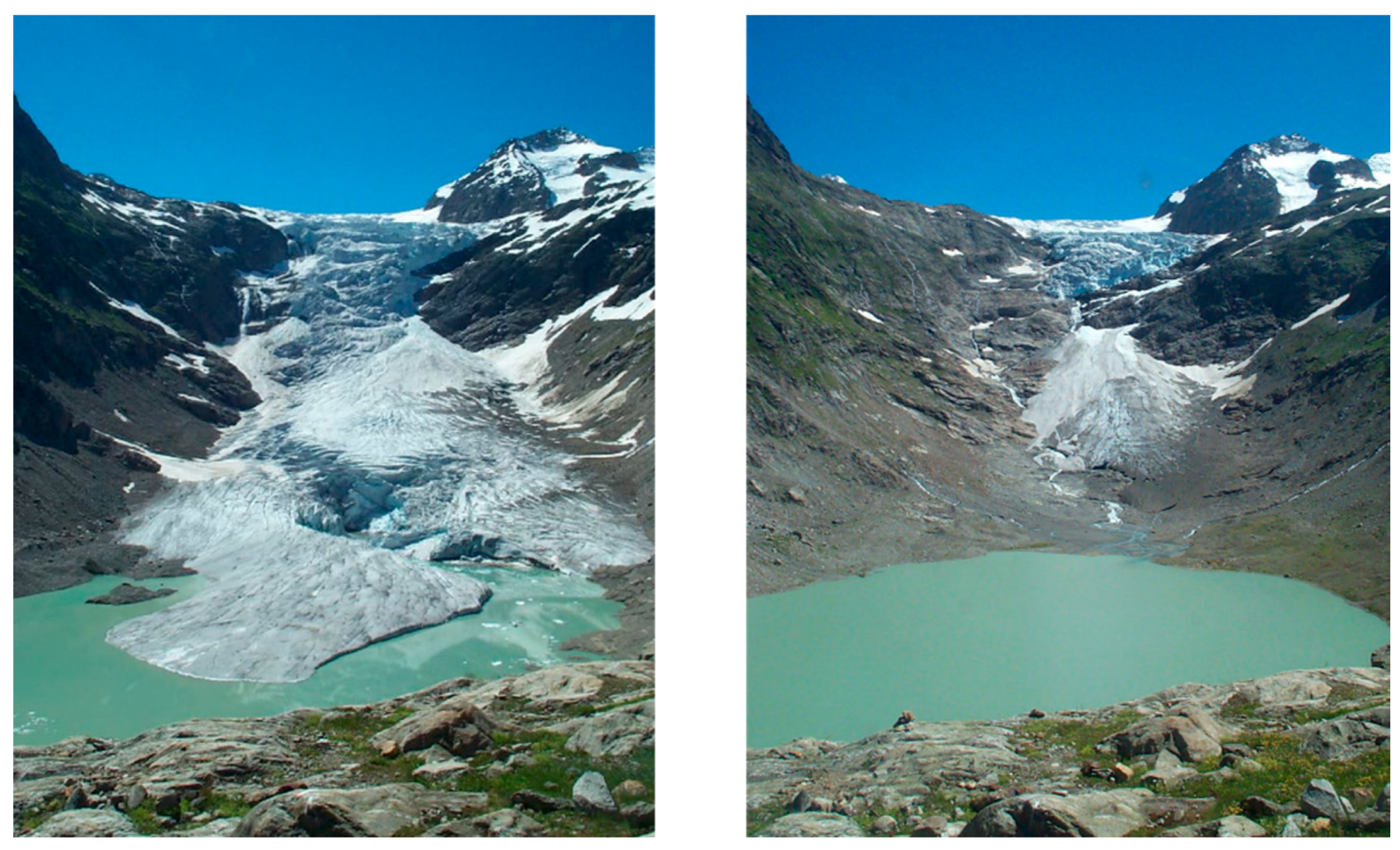
Hydropower Potential in the Periglacial Environment of Switzerland under Climate Change



Abstract
1. Introduction
2. Methods
2.1. Site Selection
2.2. Site Rating
2.2.1. Installed Capacity
2.2.2. Electricity Production
2.2.3. Investment Costs
- dam height: positive if less than 150 m;
- tunnel lengths (headrace tunnel and penstock/pressure shaft): positive if less than 2 km;
- HPP type: positive if run-of-river HPP or storage HPP (negative if pumped storage HPP);
- gross head: positive if less than 500 m (more degrees of freedom regarding turbine selection);
- surge shaft: positive if the ratio of total tunnel/penstock length to gross head is less than 4, because a maximum start-up time of 2.5 s to avoid a surge shaft according to IEC 60308 (International Electrotechnical Commission) [16] can then typically be met;
- distance to access road: positive if less than 2 km.
2.2.4. Runoff Evolution
2.2.5. Reservoir Sedimentation
2.2.6. Earthquake Vulnerability
2.2.7. Impulse Wave Vulnerability
2.2.8. Flood Protection
2.2.9. Flexibility and Storage Capacity
2.2.10. Visibility from Settlements
2.2.11. Environmental Flow
2.2.12. Sediment Continuity
2.2.13. Hydro- and Thermo-Peaking
2.2.14. Degree of Protection
2.2.15. Land Use
2.2.16. Tourism
2.3. Preliminary Design Study
- center of mass of reservoir is located at 40% of maximum reservoir depth below full supply level;
- overall constant roughness of 85 m1/3/s in both steel- and concrete-lined tunnels and penstocks;
- a surge shaft is needed whenever the start-up time is above 2.5 s (IEC 60308);
- pressure shaft length should be minimized, while pressure tunnel length should be maximized;
- optimum flow velocities of 3–4 m/s in pressure tunnel and 5–7 m/s in pressure shaft must be achieved;
- interactions with existing HPPs must be considered (for example, the new HPP at Aletsch Glacier has to release the water into Gebidem reservoir, from which the total runoff is turbined).
3. Results
4. Discussion
4.1. Uncertainties
- Runoff projections depend on climate change evolution and thus on the chosen scenario. Here, scenario RCP4.5 was chosen, which is a stabilization scenario that lies between the mitigation scenario RCP2.6 and the non-intervention scenario RCP8.5. For the time period 2017–2035, the annual runoff volumes 2% lower for RCP2.6 and 1% higher for RCP8.5 on average, compared to RCP4.5. These differences are negligible. By the end of the century (2090–2099), these differences will be 9% lower for RCP2.6 and 2% higher for RCP8.4, on average.
- The operation modes of the new HPPs depend on the evolution of new renewables as well as on political measures and market conditions. It was assumed that all new HPPs, which have CIR > 0.55, operate as seasonal storages to help reduce the winter season deficit imposed by the Energy Strategy 2050, with the phase-out of nuclear power plants providing base load. The need for multi-purpose reservoirs (for example for irrigation in dry and hot summers) and the demand for grid regulation and network stabilization, which may increase significantly (for example, when the share of volatile, weather-dependent new renewables increases), were neglected. Nevertheless, storage HPPs can support network stabilization by providing balance energy generated by turbine operation (or pumping operation in the case of pumped storage HPPs). Electrical and mechanical equipment should be selected with regards to this service.
- Reservoir volumes at today’s glacier sites were estimated using bed-rock topography derived from ground-penetrating radar (GPR) measurements, which have a horizontal resolution of ±25–50 m and are consequently affected with considerable uncertainties. The bed-rock level can be estimated with an accuracy in the order of ±10 m (D. Farinotti/VAW ETH Zurich, pers. comm.). Combined with the coarse horizontal resolution, uncertainties in the bed rock topography are relatively high. Reservoir volumes, dam heights and installed capacity are therefore subject to uncertainty.
- Assumptions of overall efficiency, full production hours, etc., were solely determined based on empirical values and experience. Furthermore, environmental flow regulations were not investigated in detail and it was assumed that the high portion of runoff from non-glaciated catchment will meet the requirements. Finally, water loss due to infiltration and quantitative cost estimates were neglected, and hydropower or energy strategies of the cantons concerned were not considered.
4.2. Challenges
4.3. Other Courses of Action
5. Conclusions
Author Contributions
Funding
Acknowledgments
Conflicts of Interest
References
- Schweizerische Elektrizitätsstatistik 2016 (‘Swiss Electricity Statistics 2016’). Swiss Federal Office of Energy (SFOE), 2017. Available online: http://www.bfe.admin.ch/php/modules/publikationen/stream.php?extlang=de&name=de_306571764.pdf&endung=Schweizerische%20Elektrizit%E4tsstatistik%202016 (accessed on 28 March 2018).
- Energiegesetz (‘Energy Act’). Swiss Confederation. Available online: https://www.admin.ch/opc/de/classified-compilation/20121295/201801010000/730.0.pdf (accessed on 28 March 2018).
- Climate Change 2013: The Physical Science Basis. Intergovernmental Panel on Climate Change (IPCC), 2013. Available online: http://www.climatechange2013.org/images/report/WG1AR5_ALL_FINAL.pdf (accessed on 28 March 2018).
- Brennpunkt Klima Schweiz. Grundlagen, Folgen und Perspektiven. (‘Focus Climate Switzerland. Basics, Consequences and Perspectives’). Swiss Academy of Sciences, 2016. Available online: http://www.naturalsciences.ch/uuid/289496e5-c703-5917-ad42-1abd05b8fe36?r=20161005181841_1484061355_0d8762b6-48e9-5186-a15e-a89c7ed607ff (accessed on 28 March 2018).
- Farinotti, D.; Usselmann, S.; Huss, M.; Bauder, A.; Funk, M. Runoff evolution in the Swiss Alps: Projections for selected high-alpine catchments based on ENSEMBLES scenarios. Hydrol. Process. 2012, 26, 1909–1924. [Google Scholar] [CrossRef]
- Addor, N.; Rössler, O.; Köplin, N.; Huss, M.; Weingartner, R.; Seibert, J. Robust changes and sources of uncertainty in the projected hydrological regimes of Swiss catchments. Water Resour. Res. 2014, 50, 7541–7562. [Google Scholar] [CrossRef]
- Huss, M.; Zemp, M.; Jörg, P.C.; Salzmann, N. High uncertainty in 21st century runoff projections from glacierized basins. J. Hydrol. 2014, 510, 35–48. [Google Scholar] [CrossRef]
- Schaefli, B.; Hingray, B.; Musy, A. Climate change and hydropower production in the Swiss Alps: Quantification of potential impacts and related modelling uncertainties. Hydrol. Earth Syst. Sci. Discuss. 2007, 11, 1191–1205. [Google Scholar] [CrossRef]
- Westaway, R. Modelling the potential effects of climate change on the Grande Dixence hydro-electricity scheme, Switzerland. Water Environ. J. 2000, 14, 179–185. [Google Scholar] [CrossRef]
- Micheletti, N.; Lane, S.N. Water yield and sediment export in small, partially glaciated Alpine watersheds in a warming climate. Water Resour. Res. 2016, 52, 4924–4943. [Google Scholar] [CrossRef]
- Haeberli, W.; Schleiss, A.; Linsbauer, A.; Künzler, M.; Bütler, M. Gletscherschwund und neue Seen in den Schweizer Alpen (‘Glacier retreat and new lakes in the Swiss Alps’). Wasser Energie Luft 2012, 104, 93–102. Available online: https://infoscience.epfl.ch/record/178376/files/2012-846_Haeberli_Schleiss_Linsbauer_K%C3%BCnzler_B%C3%BCtler_Gletscherschwund_und_neue_Seen_in_de_Schweizer_Alpen.pdf (accessed on 28 March 2018).
- Haeberli, W.; Bütler, M.; Huggel, C.; Schleiss, A. Neue Seen als Folge des Gletscherschwundes im Hochgebirge: Chancen und Risiken (‘New Lakes as a Consequence of Glacier Retreat in High Mountains: Chances and Risks’); National Research Programme NRP 61 “Sustainable Water Management”. 2013. Available online: https://infoscience.epfl.ch/record/197261/files/2013-911_Haeberli_Butler_Huggel_Muller_Schleiss_3534_Neue-Seen-als-Folge-des-Gletscherschwundes-im-Hochgebirge_OA.pdf (accessed on 28 March 2018).
- Linsbauer, A.; Paul, F.; Haeberli, W. Modeling glacier thickness distribution and bed topography over entire mountain ranges with GlabTop: Application of a fast and robust approach. J. Geophys. Res. Earth Surf. 2012, 117. [Google Scholar] [CrossRef]
- Huss, M.; Hock, R. A new model for global glacier change and sea-level rise. Front. Earth Sci. 2015, 3. [Google Scholar] [CrossRef]
- Farinotti, D.; Pistocchi, A.; Huss, M. From dwindling ice to headwater lakes: Could dams replace glaciers in the European Alps? Environ. Res. Lett. 2016, 11. [Google Scholar] [CrossRef]
- International Electrotechnical Commission (IEC). Hydraulic Turbines—Testing of Control Systems; IEC: Geneva, Switzerland, 2005; Volume IEC 60308:2005. [Google Scholar]
- Gurnell, A.; Hannah, D.; Lawler, D. Suspended sediment yield from glacier basins. In Erosion and Sediment Yield: Global and Regional Perspectives; Walling, D.E., Webb, B., Eds.; International Association of Hydrological Sciences (IAHS): Exeter, UK, 1996; pp. 97–104. ISBN 978-0-947571-89-4. [Google Scholar]
- Jenzer Althaus, J.M.I. Sediment Evacuation from Reservoirs through Intakes by Jet Induced Flow. Ph.D. Thesis, École Polytechnique Fédérale de Lausanne (EPFL), Lausanne, Switzerland, 2011. Available online: https://infoscience.epfl.ch/record/154766/files/EPFL_TH4927.pdf (accessed on 28 March 2018).
- Brune, G.M. Trap efficiency of reservoirs. Trans. Am. Geophys. Union 1953, 34, 407–418. [Google Scholar] [CrossRef]
- Jenzer Althaus, J.; De Cesare, G. Möglichkeiten und Anwendung einer Datenbank bezüglich der Stauraumverlandung von alpinen Speichern (‘Opportunities and application of a database on sedimentation of Alpine reservoirs’). Wasser Energie Luft 2006, 98, 202–206. Available online: https://infoscience.epfl.ch/record/103652/files/206-509_Jenzer_DeCesare_Alpreserv_Datenbank_wel.pdf?version=1 (accessed on 28 March 2018).
- Swiss Society of Engineers and Architects (SIA). Actions on Structures. Available online: http://iisee.kenken.go.jp/worldlist/50_Switzerland/50_Switzerland_Code.pdf (accessed on 28 March 2018).
- Rickli, C.; Bebi, P.; Graf, F.; Moos, C. Shallow landslides: Retrospective analysis of the protective effects of forest and conclusions for prediction. In Recent Advances in Geotechnical Research; Wu, W., Ed.; Springer: Cham, Switzerland, 2019; ISBN 978-3-319-89671-7. [Google Scholar]
- Boes, R.; Perzlmaier, S.; Schönlaub, H.; Linser, M.; Hofer, B. Flood retention by storage reservoirs and alpine water intakes. In Proceedings of the ICOLD Symposium “Operation, Rehabilitation and Upgrading of Dams”, Sofia, Bulgaria, 2–6 June 2008; pp. 1–20. [Google Scholar]
- Michalec, B. Evaluation of an empirical reservoir shape function to define sediment distributions in small reservoirs. Water 2015, 7, 4409–4426. [Google Scholar] [CrossRef]
- Bundesgesetz über den Schutz der Gewässer (‘Federal Act on the Protection of Waters’). Swiss Confederation. Available online: https://www.admin.ch/opc/de/classified-compilation/19910022/201701010000/814.20.pdf (accessed on 28 March 2018).
- Faktenblatt BLN—Das Bundesinventar der Landschaften und Naturdenkmäler (BLN) (‘Factsheet BLN—The Federal Inventory of Landscapes and Natural Monuments of National Importance’). 2017. Available online: https://tinyurl.com/ya8mgaa7 (accessed on 28 March 2018).
- Digital Elevation Model SwissALTI3D of Switzerland. Available online: https://shop.swisstopo.admin.ch/en/products/height_models/alti3D (accessed on 28 March 2018).
- Evers, F.M.; Schmocker, L.; Fuchs, H.; Schwegler, B.; Fankhauser, A.U.; Boes, R.M. Landslide generated impulse waves: Assessment and mitigation of hydraulic hazards. In Proceedings of the 26th ICOLD Congress, Vienna, Austria, 1–7 July 2018; pp. 679–694. [Google Scholar]
- Laufer, F.; Grötzinger, S.; Peter, M.; Schmutz, A. Ausbaupotential der Wasserkraft (‘Development Potential of Hydropower’). 2004. Available online: https://www.newsd.admin.ch/newsd/message/attachments/2663.pdf (accessed on 28 March 2018).
- Boes, R.M. Potenziale und Grenzen der Wasserkraft—Was bringen Anlagenoptimierungen? (‘Potential and limits of hydropower—What can be gained from optimization of schemes?’). Natur und Mensch, Sonderheft Quo Vadis Wasserkraft 2011, 53, 24–28. [Google Scholar]
- BFE. Wasserkraftpotential der Schweiz. Abschätzung des Ausbaupotenzials der Wasserkraftnutzung im Rahmen der Energiestrategie 2050 (‘Hydropower Potential in Switzerland. Estimation of Upgrade Potential of Hydropower in the Framework of Energy Strategy 2050’). 2012. Available online: http://www.news.admin.ch/NSBSubscriber/message/attachments/27057.pdf (accessed on 28 March 2018).
- Schleiss, A. Talsperrenerhöhungen in der Schweiz: Energiewirtschaftliche Bedeutung und Randbedingungen (‘Dam heightenings in Switzerland: Economical importance and boundary conditions’). Wasser Energie Luft 2012, 104, 199–203. Available online: https://infoscience.epfl.ch/record/181591/files/2012-881_Schleiss_Talsperrenerhohungen_in_der_Schweiz.pdf (accessed on 28 March 2018).
- Annandale, G.W. Policy considerations for sustainable hydropower: Reliability, climate change and sedimentation. In Proceedings of the HYDRO 2015, Bordeaux, France, 26–28 October 2015. [Google Scholar]
- Ehrbar, D. Hydropower Potential and Reservoir Sedimentation in the Periglacial Environment under Climate Change. Ph.D. Thesis, ETH Zurich, Zurich, Switzerland, 2018. [Google Scholar]



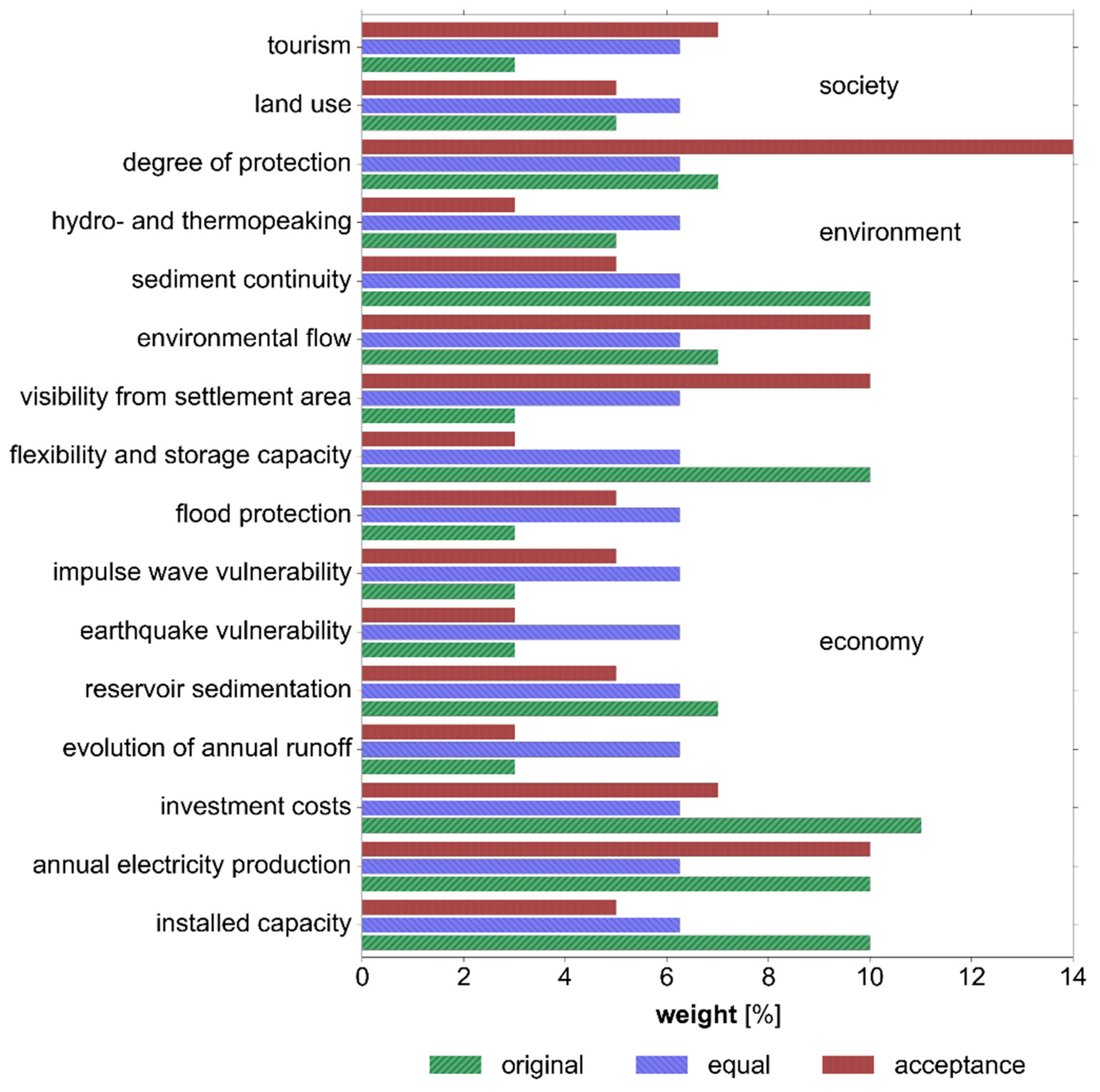
| Criterion | 1 Point If… | 2 Points If… | 3 Points If… | Weight |
|---|---|---|---|---|
| ECONOMY | 60% | |||
| installed capacity | <10 MW | 10–20 MW | >20 MW | 10% |
| electricity production | <50 GWh/year | 50–100 GWh/year | >100 GWh/year | 10% |
| investment costs | high | medium | low | 11% |
| runoff evolution | reduction > 25% | reduction < 25% | increase | 3% |
| reservoir sedimentation | infill time < 100 years | infill time 100–1000 years | infill time > 1000 years | 7% |
| earthquake vulnerability | Zone 3 (a and b) | Zone 2 | Zone 1 | 3% |
| impulse wave vulnerability | most slopes 30–45° | few slopes 30–45° | no slopes 30–45° | 3% |
| flood protection | daily storage | monthly storage | seasonal storage | 3% |
| flexibility and storage capacity | run-of-river HPP | storage HPP | pumped storage HPP | 10% |
| ENVIRONMENT | 25% | |||
| visibility from settlements | visible | not visible | use of natural lake | 3% |
| environmental flow | natural river | impaired river | artificial river | 7% |
| sediment continuity | trap efficiency > 90% | trap efficiency 50–90% | trap efficiency < 50% | 10% |
| hydro- and thermo-peaking | release into river | release into lake | pumped storage HPP | 5% |
| SOCIETY | 15% | |||
| degree of protection | high (BLN) | low (Emerald and others) | no protection | 7% |
| land use | settlement areas | agricultural area or forest | unproductive area | 5% |
| tourism | negative impacts | negligible impacts | positive impacts | 3% |
| Reservoir Location | |||||||
|---|---|---|---|---|---|---|---|
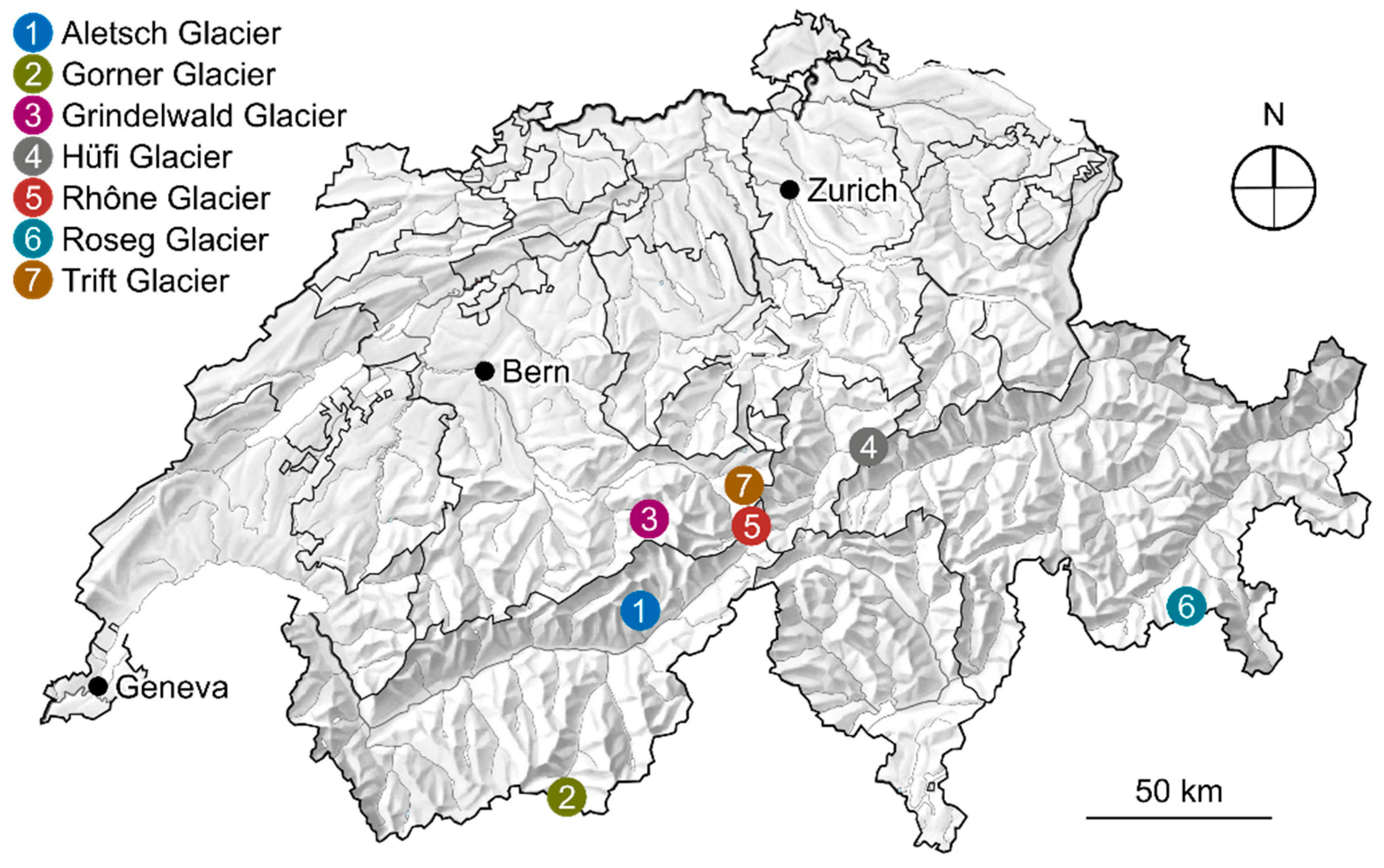
| Aletsch Glacier | 309 | 181 | 1880 | 435 | 73 | 218 | 396 |
| Gorner Glacier | 199 | 168 | 2300 | 650 | 78 | 235 | 199 |
| Grindelwald Glacier | 94 | 71 | 1520 | 520 | 28 | 85 | 64 |
| Hüfi Glacier | 44 | 36 | 1780 | 1260 | 35 | 105 | 86 |
| Rhône Glacier | 56 | 46 | 2300 | 550 | 19 | 57 | 75 |
| Roseg Glacier | 96 | 78 | 2260 | 1260 | 77 | 231 | 261 |
| Trift Glacier 1 | 154 | 85 | 1776 | 446 | 80 | 145 | 215 |
| Total | 390 | 1076 | 1296 |
| Weighting Model “Original” | Weighting Model “Equal” | Weighting Model “Acceptance” | ||||||
|---|---|---|---|---|---|---|---|---|
| Rank | Glacier | Score | Rank | Glacier | Score | Rank | Glacier | Score |
| 1 | Grindelwald | 213 | 1 | Grindelwald | 212.5 | 1 | Allalin * | 218 |
| 2 | Allalin * | 212 | Allalin * | 212.5 | 2 | Trift | 211 | |
| 3 | Aletsch | 211 | 3 | Trift | 206.25 | 3 | Grindelwald | 210 |
| 4 | Trift | 210 | Roseg | 206.25 | 4 | Roseg | 207 | |
| 5 | Oberaletsch * | 209 | Oberaletsch * | 206.25 | 5 | Palü ° | 204 | |
| 6 | Roseg | 206 | Schwarzberg ° | 206.25 | 6 | Corbassière * | 202 | |
| 7 | Turtmann ° | 205 | Gauli ° | 206.25 | Mellich * | 202 | ||
| 8 | Gorner | 204 | 8 | Aletsch | 200 | Schwarzberg ° | 202 | |
| 9 | Rhône | 201 | Corbassière * | 200 | 9 | Blüemlisalp | 200 | |
| Schwarzberg ° | 201 | Turtmann ° | 200 | 10 | Turtmann ° | 199 | ||
| 11 | Corbassière * | 200 | Palü ° | 200 | 11 | Aletsch | 198 | |
| 12 | Gauli ° | 197 | 12 | Hüfi | 193.75 | 12 | Hohlicht | 195 |
| 13 | Palü ° | 195 | 13 | Rhône | 193.75 | 13 | Gorner | 192 |
| 14 | Hüfi | 192 | 14 | Blüemlisalp | 193.75 | Oberaletsch * | 192 | |
| 15 | Fiescher ° | 190 | 15 | Theodul ° | 193.75 | 15 | Gauli ° | 191 |
| 16 | Mellich * | 189 | 16 | Gorner | 187.5 | 16 | Plaine Morte * | 191 |
| Tsanfleuron | 189 | 17 | Mellich * | 187.5 | 17 | Hüfi | 190 | |
| 18 | Findel | 188 | 18 | Tsanfleuron | 187.5 | Theodul ° | 190 | |
| Blüemlisalp | 188 | 19 | Otemma | 187.5 | Moming | 190 | ||
| 20 | Theodul ° | 187 | 20 | Silvretta | 187.5 | 20 | Rhône | 187 |
© 2018 by the authors. Licensee MDPI, Basel, Switzerland. This article is an open access article distributed under the terms and conditions of the Creative Commons Attribution (CC BY) license (http://creativecommons.org/licenses/by/4.0/).
Share and Cite
Ehrbar, D.; Schmocker, L.; Vetsch, D.F.; Boes, R.M. Hydropower Potential in the Periglacial Environment of Switzerland under Climate Change. Sustainability 2018, 10, 2794. https://doi.org/10.3390/su10082794
Ehrbar D, Schmocker L, Vetsch DF, Boes RM. Hydropower Potential in the Periglacial Environment of Switzerland under Climate Change. Sustainability. 2018; 10(8):2794. https://doi.org/10.3390/su10082794
Chicago/Turabian StyleEhrbar, Daniel, Lukas Schmocker, David F. Vetsch, and Robert M. Boes. 2018. "Hydropower Potential in the Periglacial Environment of Switzerland under Climate Change" Sustainability 10, no. 8: 2794. https://doi.org/10.3390/su10082794
APA StyleEhrbar, D., Schmocker, L., Vetsch, D. F., & Boes, R. M. (2018). Hydropower Potential in the Periglacial Environment of Switzerland under Climate Change. Sustainability, 10(8), 2794. https://doi.org/10.3390/su10082794