1. Introduction
Scholars of circular economy maintain that systemic changes are required across institutional spheres and that such changes should take place at the same time for them to be effective [
1,
2,
3]. Hence, understanding where innovations are likely to take place would be beneficial in promoting changes towards CE. Studies on innovation models focuses on different perspectives in innovation; e.g., the model of open innovation emphasises firm’s external and internal research process [
4,
5], while the Triple Helix model acknowledges the importance of the institutional spheres industry-government-university relations and knowledge production including shared concepts in innovation [
6,
7]. Moreover, Triple Helix systems are particularly interesting because they may contribute to systemic innovations that transcend the technologies and competences of their individual spheres [
7]. In the context of CE, the university sphere has specific importance in creating and putting new knowledge into practice, transforming it into innovations, patents and new business and organizational formats [
7] which can induce the systemic level transformation needed for CE to become reality [
1,
8,
9]. Thus, universities have an active role instead of merely being sources of knowledge for other spheres to use and develop [
7].
Scholars and practitioners alike consider CE as a promising way for continued yet more sustainable economic growth [
1,
3,
8,
9,
10,
11]. It is also seen as a new business opportunity promoting more sustainable futures [
12] and even heralded as the next socio-technical regime that solves global sustainability issues adequately [
8,
9,
10,
11]. In recent years, industries as well as policy-making and research fields have become active in advancing CE. The growing acceptance of the CE concept may prove to be the next step for industry in gaining legitimacy for sustainability innovations and ensuring increasingly important social support [
13] for corporate actors. CE is expected to become a mainstream business priority in the foreseeable future [
14], affecting public-private relations and innovation. Recent applications of the concept through policy programmes set priorities for innovation activities for industry in Europe [
15,
16] and even create government-led policies as in China [
8,
17].
Studies on innovation systems show that, to promote new innovations effectively, common understanding of central concepts eases their application [
6,
7,
18,
19]. Furthermore, interchange of information and knowledge can enrich innovation and assist novel solutions in new sectors [
5]. Earlier research [
15] indicates that parallel and complementary approaches and applications to CE exist and depend on actors’ institutional background; businesses emphasise different approaches as compared with policy organisations. Common understanding, i.e., a “consensus space”, requires common topics that extend beyond the interests of each institutional sphere. Such comparative innovation research in the CE field is, however, very limited (for an exception, see [
20]), and in this article we fill this knowledge gap by analysing CE debates originating from the institutional spheres of industry, government and university, which together comprise the Triple Helix model of innovation systems [
21].
In more concrete terms, we examine how institutional backgrounds are reflected in key documents on CE. This takes us outside the field of science proper and includes various science-influenced actors, such as think tanks, consultants, or industrial lobbies, as well as government agencies and policy-makers. Following the core ideas of the Triple Helix model we focus on the three institutional spheres, namely industry, government and university. By using natural language processing tools, we analyse empirically the content of CE outputs in all three helices, forming a unique overall picture of the circular economy conceptualisations, identifying a potential consensus space and observing differences between the industry, government and university spheres. Understanding this can enhance pragmatic transition towards circular economy by enabling different institutional actors to accomplish innovations which are beyond the capacities of individual spheres.
Applying the methodology of topic modelling [
22], we identify how CE topics are distributed across the examined spheres in a large text corpus consisting of key industrial reports, policy texts and abstracts of scientific articles. We examine how these domains differ in their take on CE, and how institutional backgrounds are reflected in the distribution of topics that describe how the concept is perceived in each sphere. At the same time, we show that there is a clear shared topic (“consensus space”) that unites the spheres. The importance of this finding is that there are promising opportunities for systemic change towards circular economy, which will be further addressed in the concluding discussion.
2. Circular Economy Concept across Institutional Spheres
As indicated above, our primary focus will be on what we call institutionalized ideas and their distribution across specialist spheres that together form the three corners of the Triple Helix innovation system [
21,
23]. This general model is typically used as an analytic tool in studying science and innovation policies or transfer of ideas from different knowledge producers to policy-making [
24,
25,
26]. In the original model, it was assumed that an effective innovation policy requires a “hybridization” or building of institutional overlap between the three main spheres instead of a system being dominated by one sphere or having an anarchic system without coordination between the spheres. A more developed version of the model [
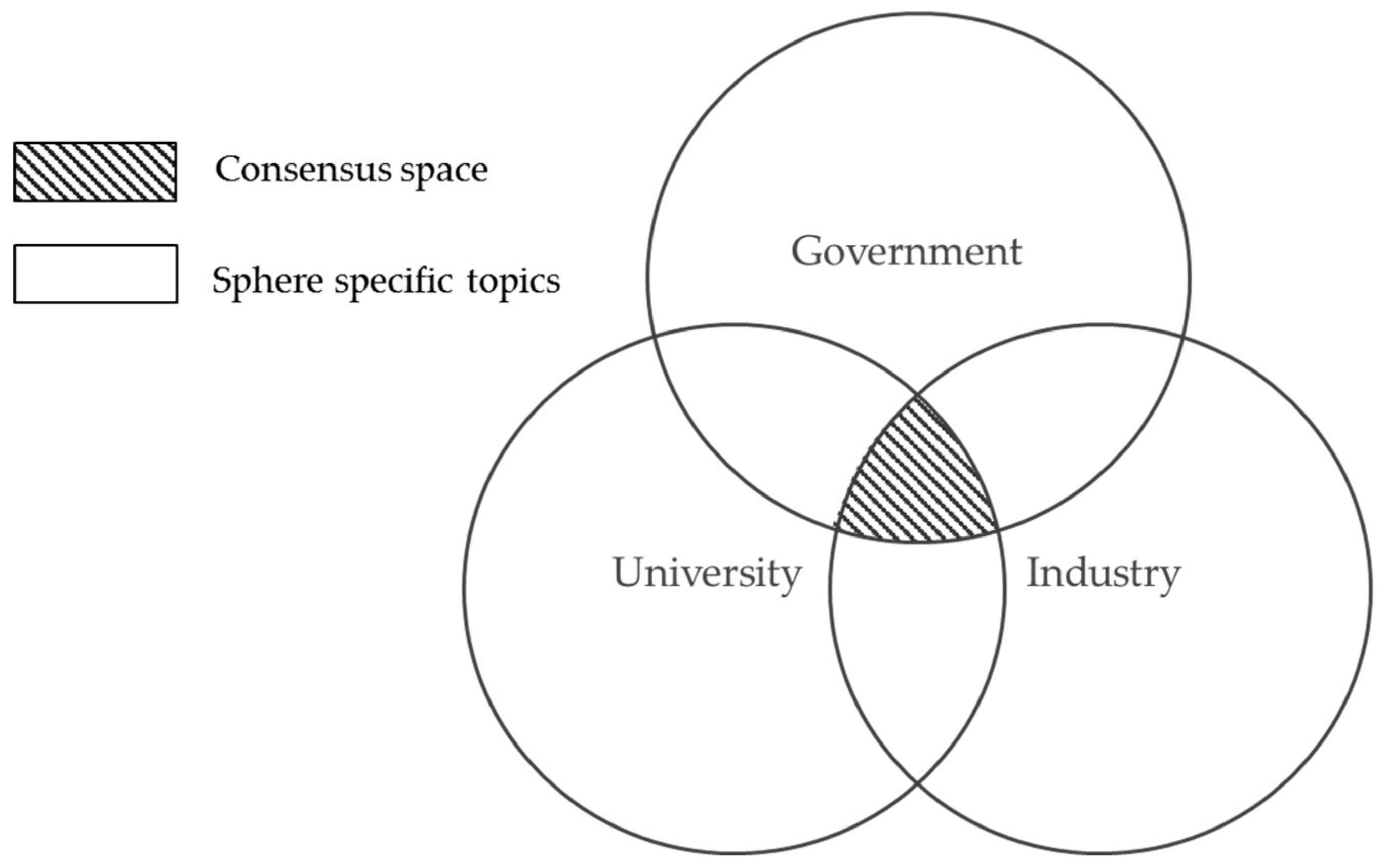
7] emphasises role differentiation between industries, governments and universities, with each sphere having a special role in contributing to new innovations. For this to take place successfully a “consensus space” is needed where the actors in the three spheres can come together in the spirit of mutual understanding and trust (see
Figure 1). Mechanisms such as technology transfer, collaboration and conflict moderation, leadership, and networking in the consensus space are considered to contribute to systemic innovations [
7].
Our research design falls readily within the model, although we depart from the usual applications in that we do not study flows of influence, patterns of interaction, or innovation policies as such. As our interest lies in the way relevant actors conceptualise a policy-relevant issue, namely circular economy, we aim at establishing conceptual commonalities and differences between the three spheres of the Triple Helix model. Furthermore, as we do this by analysing circular economy concepts used in industry, government and university spheres, we can show (and ground this in data) how these spheres differ when describing circular economy.
We assume that the three spheres engage differently in discussions on CE. This assumption is based on a general sociology of knowledge conception of social actors’ views on subjects close to them. We also draw on organisational studies on innovation systems to connect the actors’ views and the institutional system in which the actors operate. The spheres that constitute the institutional system are linked in many ways, which also contributes to a common conception that may transcend sphere boundaries. A common ground is important in promoting circular economy policies and related business models on equal footing with trust and social capital, as emphasised in earlier studies [
24,
25,
26].
Within the existing and fast-growing body of research, several scholars have analysed the concept of CE as such [
8,
9], or in comparison with bio-economy and green economy [
27], or the concept of sustainability [
2,
28]. Most of these studies are literature reviews of academic and, to some extent, interest group and policy documents. These studies argue that much of the CE literature concentrates on reduction, reuse and recycling of waste [
1]. In addition, sustainable business models for CE have been studied and developed in several studies [
10,
29]. Scholars [
30] recently analysed the largest US stock exchange companies’ understanding of and actions towards circular economy through keyword analysis of press releases. From policy analysis perspective, recent studies have evaluated EU policies [
31,
32], or combined broader literature reviews to analyse different approaches to CE [
1]. More than a few scholars have focused on China’s centralised policy approach to circular economy (for example, see [
33,
34]) or compared it with CE policies in the EU [
8]. Additionally, scholars investigated changes required in interorganisational practices and cooperation [
35,
36], brought up the social and institutional implications that society-wide transformation towards circular economy will require and cause [
11,
37,
38], and critically evaluated the limitations of current CE approaches [
39] and the underlying politics of it [
40]. Recent empirical research [
16] indicates that there is discrepancy between future expectations of consumers and current European policies on CE.
These studies are important as they will help us map the field and assess the potential of CE in different areas of society. However, they typically overlook empirical and systematic comparison of common and differing areas of interest groups that contribute to our understanding of CE. We already know that CE is far from being a uniform concept; scholars, interest group representatives, and government officials tend to emphasise different aspects of CE even when describing it in similar terms [
15]. These common terms can be seen as a sign of organisational learning across sphere boundaries, which can make transfer of knowledge a smooth process. On the other hand, conceptual differences may inhibit the transfer and create secluded spheres with fewer shared ideas. We have evidence of both similarities and dissimilarities. When taken into the Triple Helix system, it can be inferred that the consensus space that is needed for the CE to become mainstream not only requires mutual trust, as Ranga and Etzkowitz [
7] argued. It is also a matter of establishing a consensus space that directs the attention of actors to similar topics.
Thus, the spheres that define an innovation system generate a jointly identified object which is then shaped by selective use of words. For example, an industry representative may approach circular economy differently from a government official or a university professor, and it is conceivable that these actors generate different views of the same object. Spheres also borrow language from each other, produce overlaps and thereby create a consensus space. When looking into areas of interest empirically we review key documents from the institutional spheres of the Triple Helix and examine the topics they contain. The empirically observable topics may be shared by institutional spheres or belong exclusively to one sphere. However, spheres are seldom exclusive. They often overlap and share topics that constitute a consensus space.
Among the Triple Helix actors, scientists are characterised by formal access criteria and advanced specialisation. Members of industry are a more heterogeneous group who can access their professions from many different entry points and with varying credentials. Policy-making is also a heterogeneous sphere but consists mostly of specialists. Although professionalism is a key element in all three spheres, their actors’ motives differ. Scholars who study circular economy are often connected to businesses and policy-making through joint research projects or in their role as outside experts in policy hearings [
41], but equally well scientists can work on their own and according to problem formulations unique to their sphere. Industry organisations often have a role in mediating between policy-makers and scientists or using academic knowledge when communicating to policy arena(s). Depending on the institutional connections, industry can also assume the role of interest group representatives and become very selective in what is carried over into the policy-making process. Governmental policy-makers typically frame their ideas as expressions of the general good of society [
42]. In some cases, they include ideas generated in the science sphere but often the general good corresponds to particular interests depending on how successfully the industry representatives manage to penetrate policy-making processes and “restrict preferences” of key actors [
43].
Thus, policies are typically formulated as mixtures of expert knowledge and societal aims that policy-makers wish to promote. Circular economy is currently a rising issue in government policies. It combines a body of growing research activity with environmental and economic concerns. This makes circular economy a politically attractive field of knowledge production.
3. Research Design and Methodology
Our research applied topic modelling, which is a recent and increasingly common approach to computational text analysis method suitable for large corpora of text documents [
22,
44,
45]. The aim of topic modelling is to discover latent topics and their combinations in texts [
22,
44,
45]. As a method, it belongs to the broader field of probabilistic modelling [
44], and suits explorative and theory constructing research [
46]. In the context of social sciences, it has been used, for example, to analyse political frames held by decision-makers and media organisations [
46,
47], and for discovering similarities and differences of political logics in social movements [
45]. Here, it was applied to identify shared and specific topics in a large corpus of texts concerning circular economy in the context of the Triple Helix spheres of industry, government and university. The following section presents the data, i.e., the text corpus, used in the modelling, and is followed by a more detailed description of the methodology of topic modelling.
3.1. Data
Topics prevalent in the industry and government spheres were examined using key documents such as reports, position papers and varying kinds of policy documents that explicitly mention circular economy. We acknowledge that this leaves out prior texts belonging to the realms of circular economy that discuss, for example, issues such as industrial ecology or cradle-to-cradle design [
48]. This exclusion explains the relatively short time period of industry and government corpus compared to university corpus. Industry and government texts were collected from online sources, directly contacting relevant organizations, and through discussions with professionals and academics working in the CE field, until no additional texts appeared. In addition, academic articles [
1,
2,
8,
9,
28] were consulted to ensure the inclusion of key industry and government documents in the analysis. This process yielded a collection of 15 government and 24 industry documents in the English language, which are listed in the supplementary data. When framing circular economy in the Triple Helix, it can be argued that Europe has a steering approach towards circular economy, thereby creating a framework and action plans while leaving actions to be taken to markets, industries, universities and national governments [
7,
8]. This European approach provides room for the helix spheres to organise, cooperate, try out and developed diverse approaches [
1] to CE.
Accordingly, the most important industry and government documents have a wide range, including reports and initiatives as varied as the World Economic Forum report [
49], Ellen McArthur Foundation publications [
50,
51,
52] and accompanying reports published in cooperation with other organizations [
53], the EU circular economy action plan [
54], the Finnish Roadmap to CE [
55] and Dutch governmental programme [
56]. Thus, our data capture the extensive field of international and national level initiatives on circular economy in the chosen innovation framework. The large quantity of Chinese academic and other publications is beyond the scope of the data of this study due to the applied linguistic methodology of topic modelling. After data collection, two new EU level policy papers have been published on plastics [
57] and critical materials [
58]. It is very likely that these documents would fit into our model of topics as they comply with existing EU policy lines.
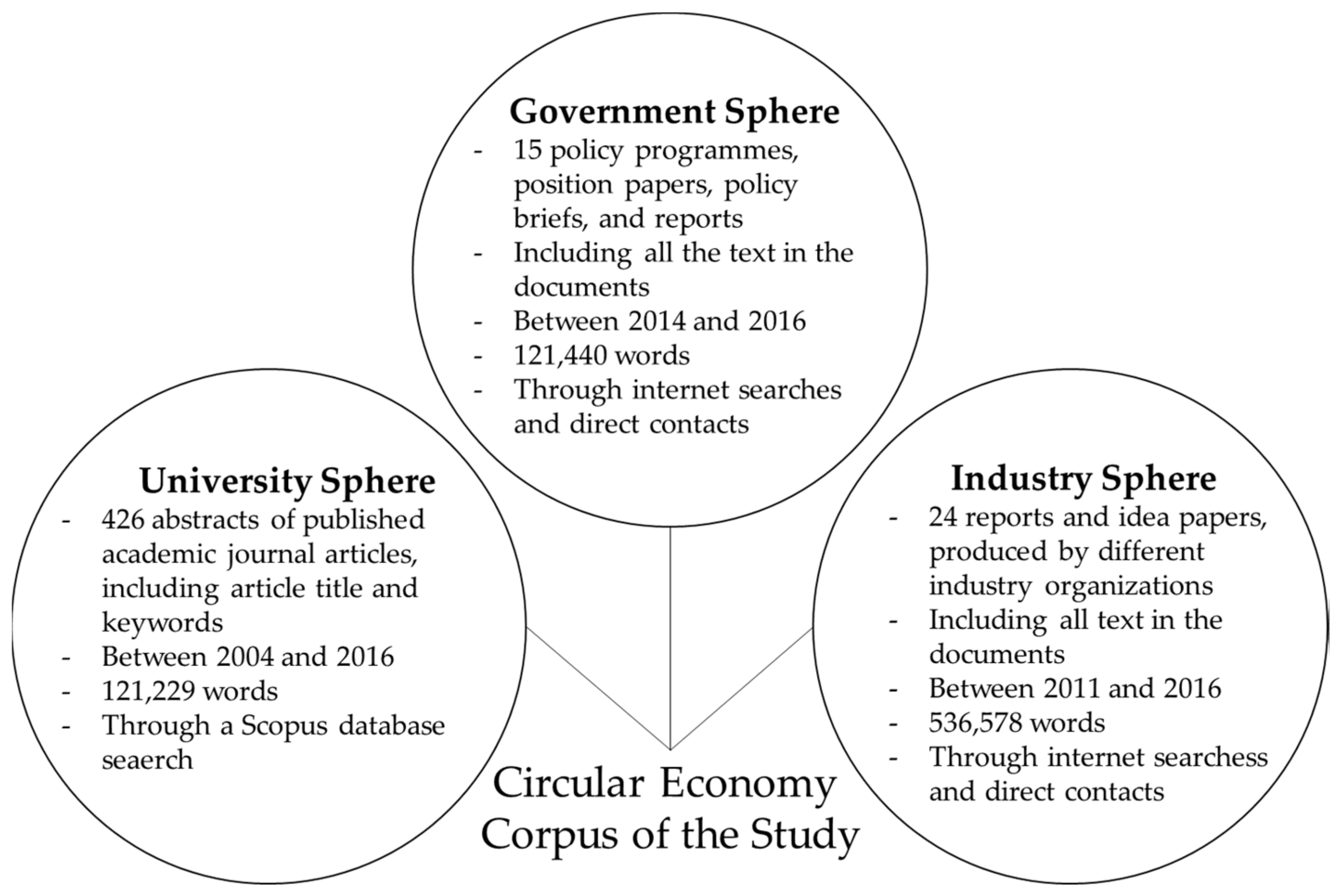
Documents examined in the university sphere were obtained through a Scopus search for published and in-press journal articles on circular economy. Searching titles, abstracts and keywords, and using a search string “circular economy” generated a collection of 426 scientific articles (Scopus database, 3 March 2017). The abstracts of the articles were used in the analysis as they present key findings of each article in a concise form. By the end of 2016 approximately one third of the articles were published in five key journals that focus on production, sustainability and waste: Journal of Cleaner Production (64 articles), Resources, Conservation and Recycling (26), Sustainability (21), Journal of Industrial Ecology (10), and Waste Management and Research (8).
Of the included articles, 80 per cent (342) were published during 2011–2016, ensuring overlap between the majority of the examined publications across the three spheres. The data further reflect the step-wise, chronological adoption of the concept of CE in the university, industry and government spheres. The examined data in each of the three spheres are presented in
Figure 2. We analysed the data through topic modelling, which we describe in the following section.
3.2. The Methodology of Topic Modelling
Topic modelling is a methodology suitable for organising and analysing large sets of unstructured textual documents. It enables scholars to discover hidden topical patterns and their combinations present across the collection of texts. Topics consist of clusters of words that frequently appear together [
44,
45,
59], and form meanings, i.e., topics. The key idea in topic modelling is that the examined sets of texts (a corpus) represent a collection of latent topics, and that the applied algorithms assist in identifying them. In topic modelling probabilistic algorithms go through the corpus and cluster words into topics [
22,
59]. The widely used topic modelling algorithm is the LDA (Latent Dirichlet Allocation) which was also applied in this study [
22].
Topic modelling is an iterative and qualitative research process in the sense that a scholar, based on his or her prior knowledge, needs to find an adequate number of topics in order to find the best fit with the corpus in question and for the research question at hand. When using a small number of topics, the algorithm fuses similar topics and makes analysis overly general. Vice versa, using too many topics for modelling might produce topics that are difficult to differentiate [
60,
61], thus having limited analytical strength. Therefore, we tried out several topics and finally opted for a solution of four topics. It turned out that topic modelling fit well to the task of comparing textual data from different institutional spheres [
62]. As the methodology of topic modelling performs better with larger corpora of texts, we further ensured the suitability of the methodology to the research task by merging the documents according to the three examined spheres. The method then both treats the corpus as a whole and distinguishes how its sphere-specific parts contribute to it. Topic modelling could also have been used to, for example, examine how topics evolve over time, but, in this case, it would have meant losing out on the rigidity of sphere-specific analysis due to use of smaller sub-sets of the corpus.
In the topic modelling, we used the MALLET toolkit, which is an open source software package for probabilistic natural language processing [
63]. The unstructured data from the three examined spheres were first converted to appropriate file formats. Upper-case letters were replaced with lower case letters and a standard set of English stop words (“a”, “an”, “the”, etc.) were removed from the corpus. Because the focus was on analysing topics of circular economy, both “circular” and “economy” were removed from the corpus as they would have appeared constantly in every topic.
We also used diagnostic tools available in the MALLET toolkit. The metrics are shown in
Table 1. Dirichlet parameter or topic weight expresses the overall proportion of the corpus assigned to a given topic. The token share of corpus (token count of a topic/the sum of token counts) tells the proportion of the corpus assigned to the topic in question. Document entropy calculates the probability for the distribution of a topic over documents. A topic with low entropy is concentrated in a few documents, while a topic with higher entropy is spread evenly over many documents. Coherence measures whether words in a topic tend to co-occur together across topics or in a particular topic. Large negative values indicate that words do not co-occur often; values closer to zero indicate that they do. Exclusivity measures the extent to which words in a topic do not appear in other topics. High exclusivity indicates topical specificity. When examining words within a single topic, it measures whether an individual word is specific to the observed topic or not. In the following section, we describe the four topics.
4. Shared and Sphere-Specific Topics of Circular Economy
Our modelling contributes to four distinct topics that are presented in
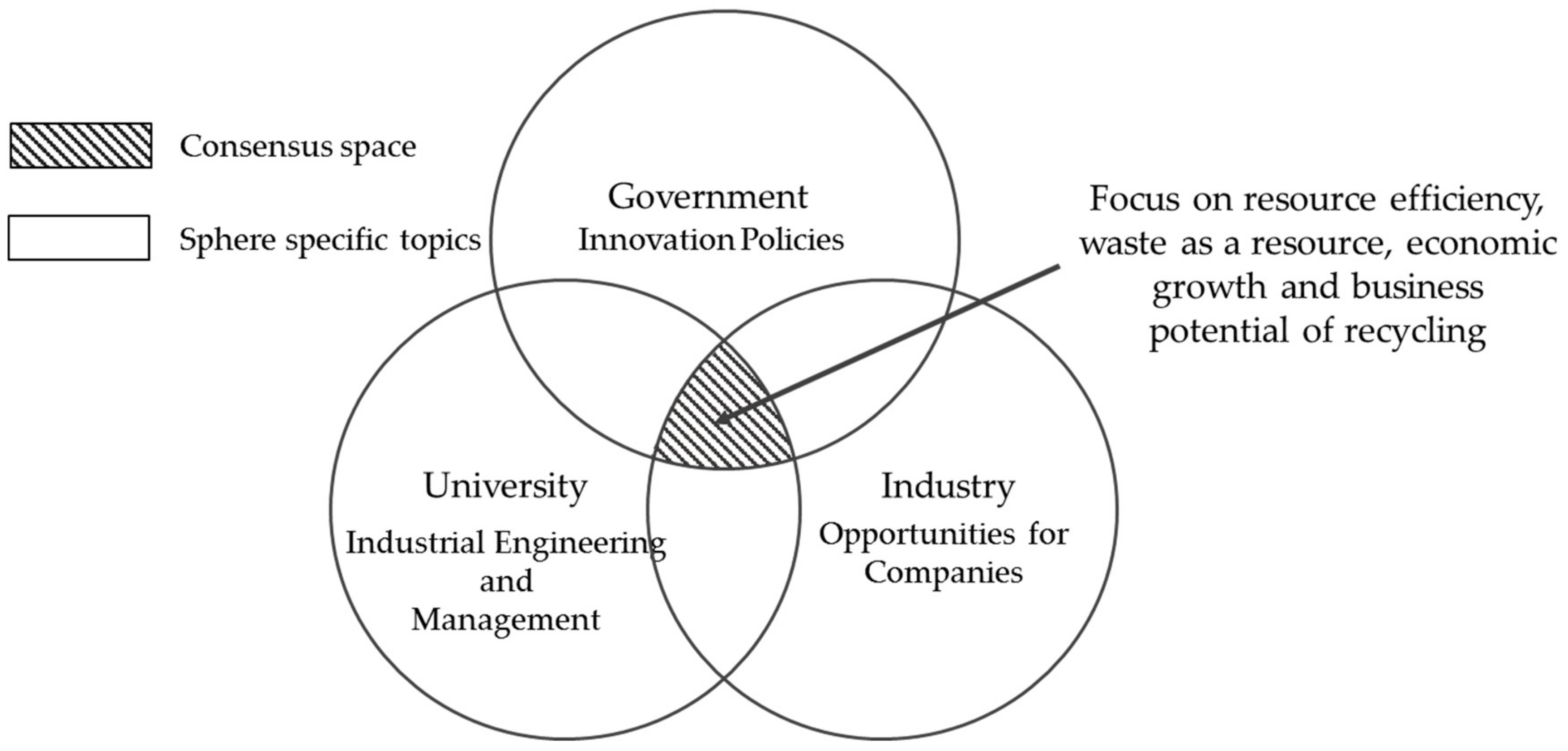
Table 1, together with their essential metrics. The results show, on the one hand, that there is a topically shared, common ground that could serve as a consensus space for CE across the spheres of industry, government and university, while all spheres also have specific topics (Industrial Engineering and Management; Governmental Innovation Policies; and Opportunities for Companies). The consensus space covers general aspects of circular economy, such as materials, waste, and resources. Each sphere-specific topic has characteristics of its own that are not shared, although there is some overlap between the industry and government spheres.
The observed consensus space mainly focuses on waste as resource, waste management and systemic change. The government sphere is centred on waste management and practical policy measures while industry points out business opportunities in circular economy, which is to some extent also considered in the government sphere. The university sphere mainly focuses on industrial processes and the environment. This indicates that all spheres see the basis of circular economy quite similarly, although each of them emphasises issues closest to their own institutional field.
Table 1 presents the key words, distributions and other metrics of the topics. 'The topics are described in greater detail in the upcoming
Section 4.1,
Section 4.2,
Section 4.3 and
Section 4.4.
4.1. Consensus Space for Circular Economy
This common ground across the spheres labelled the “Consensus Space for Circular Economy” is a key topic in all Triple Helix spheres (see
Table 1) for proportions of topics across the spheres. It is clearly the principal topic in the industry sphere (with a topic proportion of 68%), a leading topic in the government sphere (50%) and a key secondary topic in the university sphere (36%).
What is it then that all three spheres share when they approach circular economy? The circular economy conceptualisation appears to be focused on industrial production and waste as a resource regardless of the sphere in which they are examined. This topic is coherent, implying that the words in this topic co-occur more in the corpus than in other topics. Its entropy is the highest in the model (0.697), which verifies that the topic is present quite evenly across the corpus. This topic is centred on matter, that is, “materials” (most frequent word, 2738 occurrences) followed by the cluster “waste”, “products”, and “business” (frequencies over 2000). These words are shortly followed by the generic words “resource”, “material”, “economic”, “energy”, “product” and “food”. Together, these words point at the close connection between the use of raw materials and the generation of waste.
The core words in the topic continue to emphasise prevailing environmental and economic issues. Subsequently, key words in the topic (“recycling”, “potential”, “growth”, “industry”, “models”, “resources”, “production”, “system”, “costs” and “development”) advance concepts relating to the economic or business potential of recycling. Indeed, circular economy addresses systemic change of the industrial economy. What is absent, though, are the words connecting this topic to industrial design, let alone to social sustainability and lifestyle changes needed in transition towards CE. Therefore, we propose that three discussions dominate consensus space: firstly, a production focus on materials, waste and resources; secondly, a business orientation towards new industrial opportunities; and thirdly, a discourse on systemic change towards circular economy.
4.2. Industrial Engineering and Management
This characteristically separate “Industrial Engineering and Management” topic of the university sphere discusses issues that concern analysis and management of sustainability, waste and recycling in the context of industrial production and life-cycle analysis. These are issues closely related to industrial engineering and the natural sciences, while business oriented or social aspects of circular economy remained outside the most important words that form the topic. Industrial Engineering and Management is the dominant topic for the university sphere, with 64 per cent topic share attached to it. Furthermore, this topic has no significance in any of the other spheres; only a small volume of tokens in the corpus (13%) are attached to it, and over half of the key words are either moderately or highly exclusive to this topic (exclusivity > 0.5).
The foremost issue of this topic is about recycling of waste and environmental sustainability in the context of industrial processes. “Waste” (960 occurrences) and “environmental” (751 occurrences) centre this topic to these issues. They are frequently used words in the whole corpus and tend to co-occur often. The words “management” and “recycling” indicate the importance of waste management in proper recycling as well as use of waste as raw material for production. This is supported through co-occurrence with the above-mentioned waste and environment. “Sustainable” and “development” direct this topic towards broader environmental and sustainability concerns. Highly exclusive words, such as “analysis” and “study” (both with 0.812 exclusivity level) reveal the academic source of the topic’s documents. In addition, words such as “cycle”, “life”, “sustainability”, and “assessment” are exclusive to this topic, creating a strong connection to life-cycle assessment as a tool for resource efficient and sustainable industrial processes. Words such as “production”, “industrial”, “economic”, “energy”, “resource”, “efficiency”, “product”, and “process” indicate that the topic’s take on circular economy comes from a strong industrial process and production management perspective.
4.3. Governmental Innovation Policies
The third topic that we labelled “Governmental Innovation policies” is specific for the government sphere with a topic proportion of 49 per cent. It deals with innovation policies that could enable economy to renew itself and create resources from waste. What the government sphere emphasises is shared to a limited extent by the industry sphere (6%), but not by the university sphere (0%). The document entropy (0.031) points to a very limited distribution of words beyond the documents assigned to the government sphere. Words, such as “waste” and “recycling” are generic, but “measures” (0.81 exclusivity), “eco-innovation” (0.98), “innovation” (0.60), “government” (0.87), “investment” (0.80), “support” (0.76), and “public” (0.60) are all quite exclusive words to this topic, and accordingly to the government sphere.
Judging by exclusivity, the most distinct element in this topic concerns government-led innovation policies. “Waste” is by far the most dominant word in this topic as it also is in the consensus space similar to “recycling”. The likely interpretation of the dominant words can be reached through “innovation” (0.60 exclusivity, eco-innovation 0.98). A key word here is also “environmental” which this sphere shares with the university sphere (exclusivity only 0.31). However, the government sphere differs from that of the university by placing no emphasis on industrial engineering and management. Instead, the approach to circular economy policies is more abstract, involving innovations that can be supported by government action together with investments to companies. The words “energy” (0.31) and “efficiency” (0.43) are common in the corpus, but they show up as top words only in the government context. This implies that in the government sphere circular economy translates into energy efficiency and eco-innovation as a policy issue.
4.4. Opportunities for Companies
The industry specific topic “Opportunities for Companies” focuses on opportunities that CE creates for corporate entities. It can be understood as a way to build the “business case” for circular economy as it relates to opportunities and profits. It is a key topic for the industry sphere with a topic proportion of 25%, albeit it is relatively confined, as only 13.5% of tokens are assigned to it. It is by far the most exclusive of the four topics; among the 20 top words there are 14 that have an exclusivity coefficient higher than 0.7. The distribution of the words is much more even than in other topics, i.e., word frequencies do not vary much.
This topic excludes common words such as “waste”, “material” and “recycling” and focuses mostly on business opportunities. It is dominated by words such as “figure”, “report” and “foundation”, which point to the central influence of the Ellen McArthur Foundation as a promoter for CE. The foundation has produced numerous reports and regularly cooperates with organisations in many countries. However, the decisive core of the top words connects this topic to business (“company” and “companies”), promoting circular economy as a “global” and a “billion” dollar “opportunity” which could create “assets” and “savings” for industries. Likewise, concrete words such as “clothing” and “today” imply that CE is achievable and already an on-going development, and that there are ways to achieve it (“reverse” and “toolkit”).
It is noteworthy that this topic addresses the political sphere with words such as “policymakers” (0.97 exclusivity) and “labour” (0.88 exclusivity), which suggests closer connections between industrial and governmental spheres, and next to none with university. This closer interaction between industrial and governmental spheres is also supported by the six per cent topic proportion of the “Governmental Innovation Policies” topic in the industrial sphere. Industry tends to pay attention to political decision-makers to induce change towards desirable futures for their clientele.
5. Concluding Discussion
In this article we have analysed how the concept of circular economy is understood in the institutional spheres of industry, government and university, which together constitute the Triple Helix model of innovation systems. By using natural language processing, we have studied key documents on CE from the respective spheres. Our analysis shows that there is a clear and waste focused consensus space in Western economies on how circular economy is conceptualised across industry, government and university spheres, while there also exist circular economy topics specific to each of the spheres. Previous research [
15] has demonstrated that institutional actors, depending on their institutional roles, have varying approaches to CE. Our research contributes to this by identifying the consensus space for innovation in circular economy context. This picture is further deepened by depictions of the sphere specific CE topics in industry, government and university (
Figure 3).
The consensus space covers technological and economic development that aims for a more sustainable production and consumption of resources in the future. The common interest in waste and waste management as well as material efficiency has been widespread in studies on industrial processes and sustainability. What can be considered as a novelty is perhaps the message that industry proposes: circularity is a significant global opportunity for industries with novel business models that could also induce systemic change. This topic represents the backbone of the concept of CE. It is noteworthy that the environmental and social dimensions of sustainability are hardly noticeable in the consensus space, although CE is conceived as an economy that focuses on and operates within the ecological system boundaries [
1,
2,
8,
9]. This is in line with critical studies showing that the physical limits of economic growth and rebound effects of the changed consumption patterns [
39], as well as the political nature of circular economy [
40] are not taken into account properly. It is also noticeable that none of the topics include “reuse” or “reduce” among the most important words, unlike suggested in earlier research [
1].
According to the Triple Helix model [
7], a consensus space is required to accomplish systemic innovations. Our analyses show that while such a space does exist in circular economy, it mainly focuses on waste, recycling and waste management, and therefore is unlikely to prompt systemic innovations beyond this scope. Accordingly, the key promise of circular economy—changing economy from a linear model to a circular one—is unlikely to be fulfilled without systemic innovations’ taking place. Nevertheless, as stated by the Triple Helix model, each sphere has a flexible and evolving role in the innovation system, which further provides opportunities for novel innovations. In our case, the spheres indeed have distinct characteristics that reflect the institutional origins of their key documents.
Industry expects new business opportunities to be created in circular economy. Quite surprisingly, the CE discourse in the industry sphere is almost entirely business oriented although our data are not exclusively from organizations that promote business interests. The top words in the topic “Opportunities for Companies” circulate around business opportunities and cost savings. Sustainability and technological development required to achieve transformation are not present in the topic. Further, this topic illustrates the connection between industry and government spheres, although the strong consensus space is where the contacts and cooperation most likely take their shape.
In the government sphere, circular economy seems to be a specialty area that mainly serves governmental innovation policies, which are traditionally keen to renew industries and businesses and contribute to economic growth. Again, there is an institutional affinity between the topic labelled “Governmental Innovation Policies” and the sphere, namely the governments’ ability to influence new economic development by public expenditure. Funding is typically channelled through a country’s innovation system, and involves government encouraged cooperation between higher education institutions and business enterprises [
7]. The university sphere is dominated by the technical and engineering sciences and the industrial ecosystems perspective. The environment, life-cycles and sustainability are crucial parts of the respective topic “Industrial Engineering and Management”, unlike in the government or industry spheres. Hence, to achieve sustainability and resource efficiency improvements, the industry and government spheres might benefit from closer cooperation with the university sphere. Another interesting observation in our topic modelling is that, although consumers are often understood to have an important part to play in the circular economy equation, they are quite absent from these conceptualisations. It is quite likely that research on and actions towards circular economy would benefit from incorporating research questions, approaches and findings from sustainable consumption and life styles studies, especially because recent evidence shows that consumer expectations and the objectives of current circular policies lack congruence [
16].
Our analysis draws particular attention to the fields in which circular economy innovations are likely to take place. It also considers communication and networking between the spheres by showing the specific fields where consensus space could evolve, encouraging spheres to connect and further build on consensus. This, in turn, could extend the fields in which circular innovations are likely to emerge. Communication reconstructs common understandings and expands the space where innovations are expected to take place. However, further work on the issue is called for, as our study does not address how CE innovation systems develop, how consensus space is constructed and managed, nor which types of congruence are likely to emerge in the context of circular economy. Empirical case studies could improve our understanding of how circular economy innovation systems develop in practice and, in turn, help to develop varying policy approaches to accelerate the transition towards CE.
From our theoretical starting point in the discussions on the models of innovation, a wider topical consensus space would be beneficial for promoting a systemic change. Accordingly, inclusion of multiple perspectives will produce more comprehensive outcomes when dealing with complex issues such as transition towards circular economy. It would be useful for diverse research and professional approaches to ecological, economic and social sustainability to discuss and share actively their ideas, experience and findings, thereby better accumulating knowledge on how to enhance positive and alleviate negative impacts of circular transition. In our empirical analysis, we were able to show that a consensus space does currently exist, although it covers a limited conceptual area. These results can be used in further research on innovation system effectiveness. For example, considering the degree of conceptual consensus about circular economy is useful in comparative analyses of innovation output. National or industrial variation of system efficiency and success rate are naturally of great interest. Combining data on conceptual overlaps between the Triple Helix spheres of CE with data on new industrial patents, technologically driven private investments, public innovation funding and new business development including university spin-offs would give us new insights into how innovation systems operate. Our study can be used as the first step to such aims.