Impacts of Grading Rule on Urban Thermal Landscape Pattern Research


Abstract
1. Introduction
2. Data and Method
2.1. Study Area
2.2. Land Surface Temperature Data
2.3. Grading Methods
2.4. Thermal Landscape Analysis
3. Comparison of Grading Method
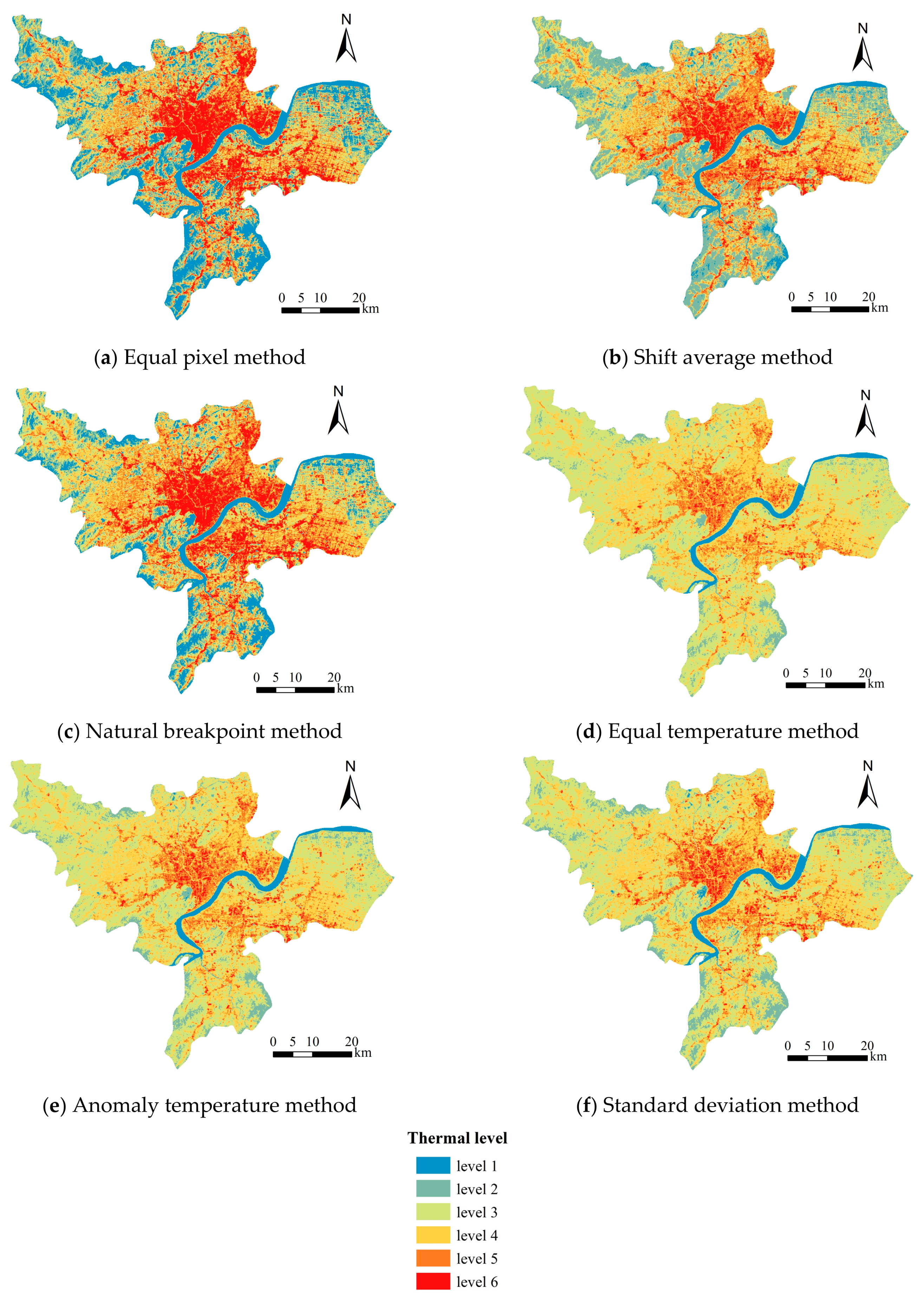
3.1. Grading Results
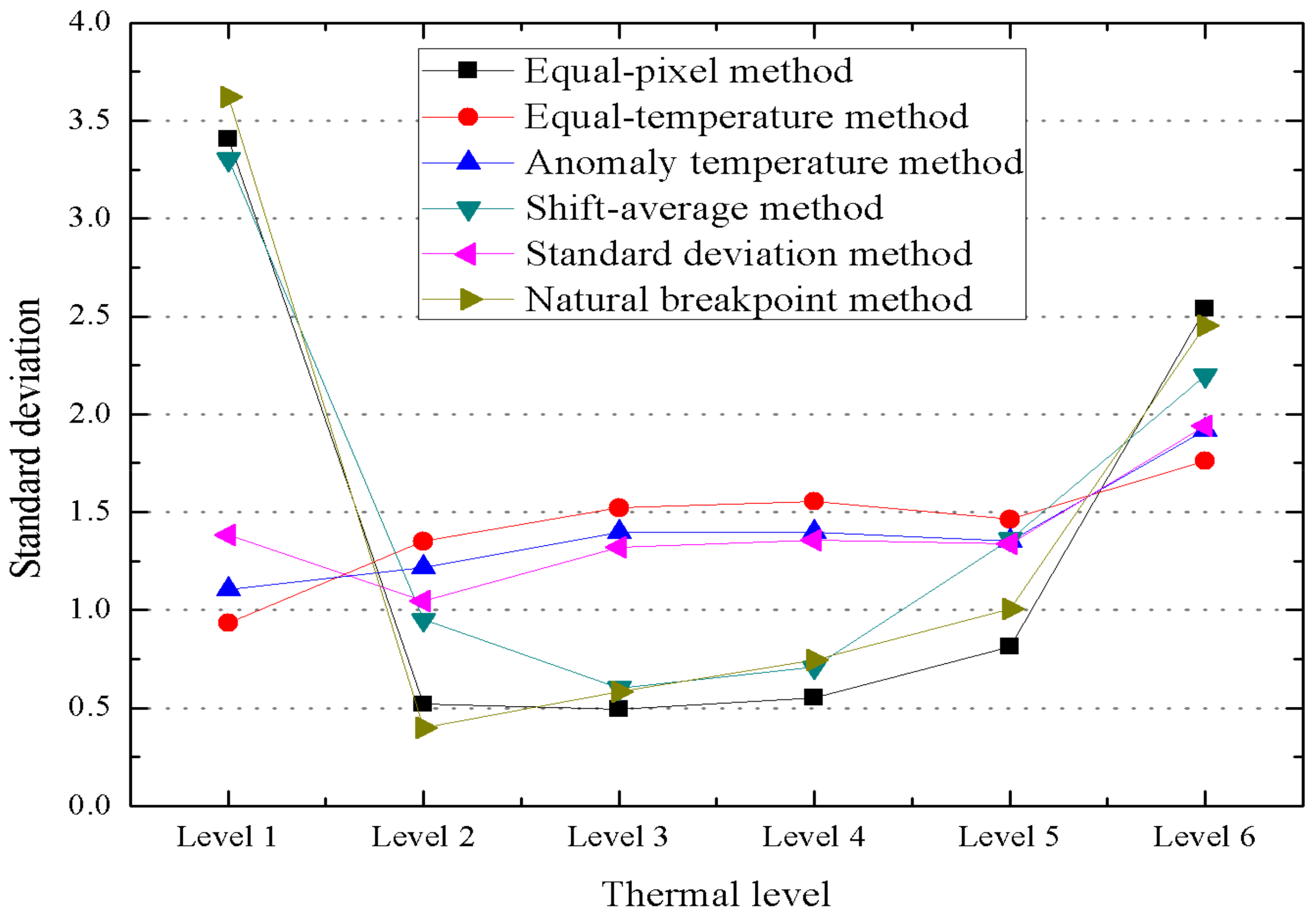
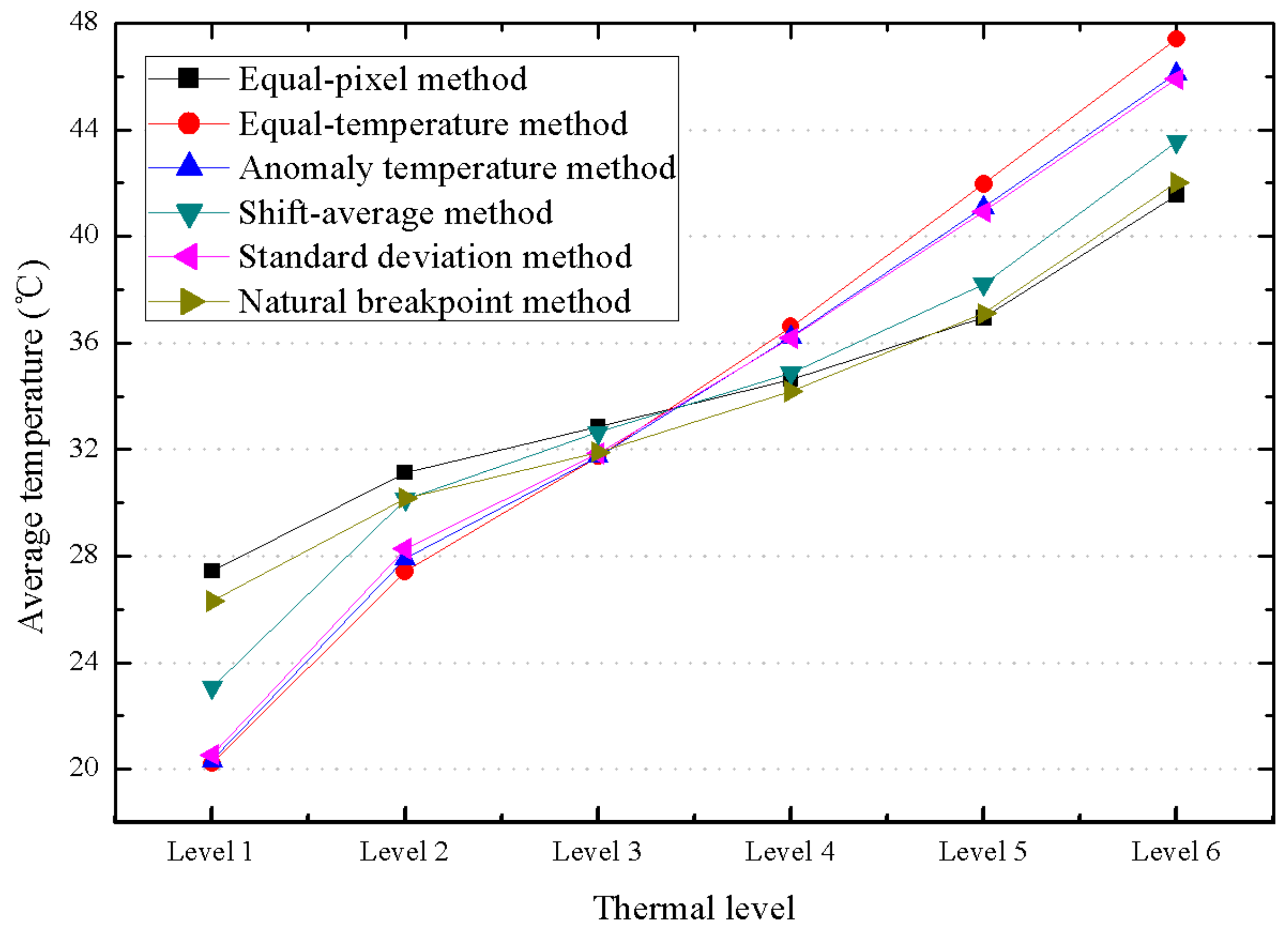
3.2. Statistical Feature
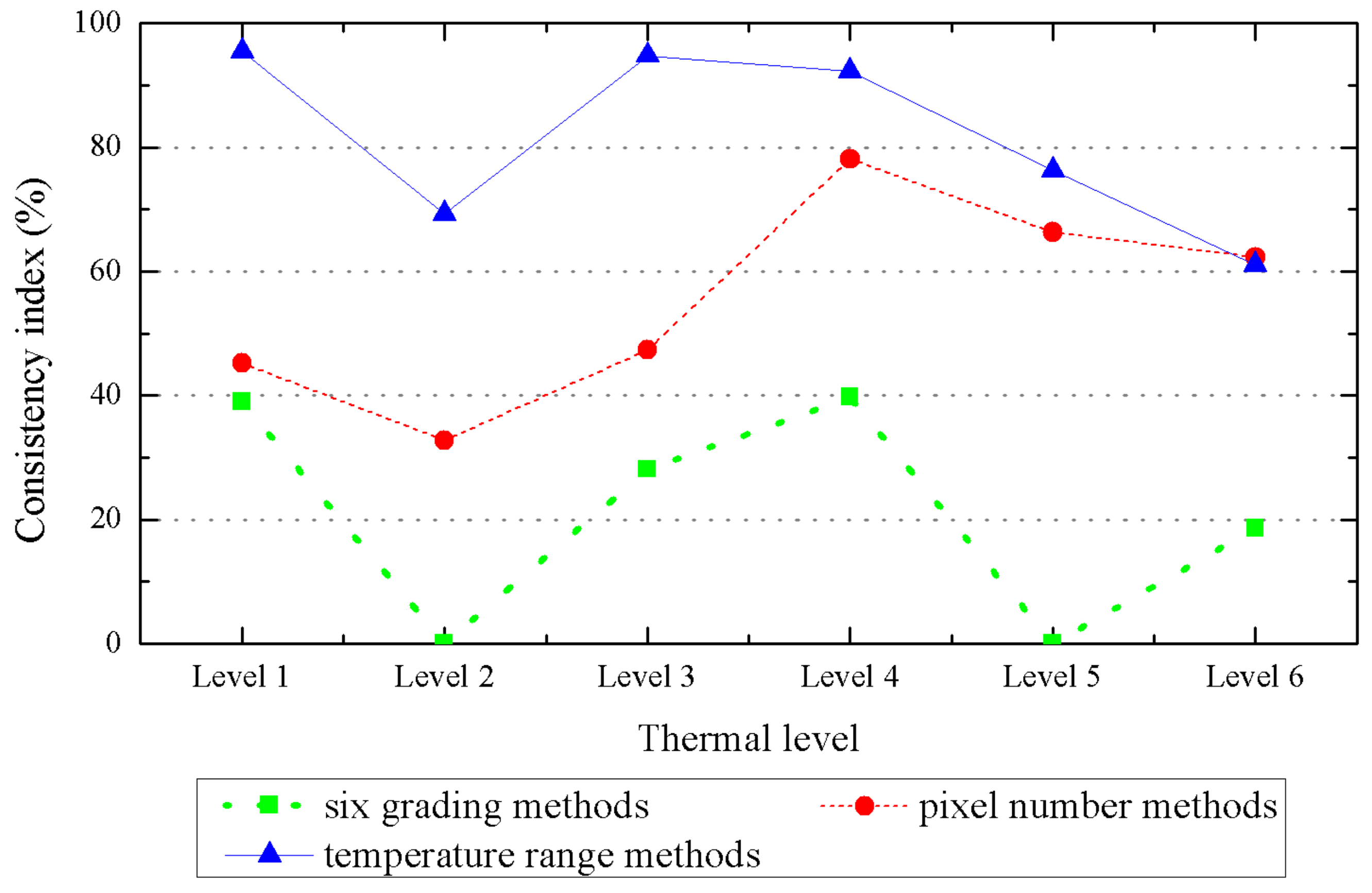
3.3. Consistency
3.4. Landscape Index
4. Sensitivity Analysis
4.1. Temperature Range Change
4.2. Level Number Change
5. Discussion
5.1. Implications
5.2. Limitations and Prospect
6. Conclusions
6.1. Effects of Grading Methods
6.2. Sensitivity Analyses
Author Contributions
Funding
Conflicts of Interest
References
- Gago, E.J.; Roldan, J.; Pacheco, T.R.; García, J.O. The city and urban heat islands: A review of strategies to mitigate adverse effects. Renew. Sustain. Energy Rev. 2013, 25, 749–758. [Google Scholar] [CrossRef]
- Chang, C.R.; Li, M.H.; Chang, S.D. A preliminary study on the local cool-island intensity of Taipei city parks. Landsc. Urban Plan. 2007, 80, 386–395. [Google Scholar] [CrossRef]
- Cheng, L.; Jiang, P.; Chen, W.; Li, M.; Wang, L.; Gong, Y.; Pian, Y.Z.; Xia, N.; Duan, Y.; Huang, Q. Farmland protection policies and rapid urbanization in China: A case study for Changzhou City. Land Use Policy 2015, 48, 552–566. [Google Scholar]
- Davy, R.; Esau, I.; Chernokulsky, A.; Outten, S.; Zilitinkevich, S. Diurnal asymmetry to the observed global warming. Int. J. Climatol. 2017, 37, 850–864. [Google Scholar] [CrossRef]
- Li, G.D.; Zhang, J.H.; Cheng, H.Y.; Zhao, L.P.; Tian, H.F. Urban Heat Island Effect against the Background of Global Warming and Urbanization. Adv. Meteorol. Sci. Technol. 2012, 2, 45–49. [Google Scholar]
- Zhou, W.; Qian, Y.; Li, X.; Li, W.; Li, H. Relationships between land cover and the surface urban heat island: Seasonal variability and effects of spatial and thematic resolution of land cover data on predicting land surface temperatures. Landsc. Ecol. 2014, 29, 153–167. [Google Scholar] [CrossRef]
- Rizwan, A.M.; Dennis, L.Y.C.; Liu, C. A review on the generation, determination and mitigation of Urban Heat Island. J. Environ. Sci. 2008, 20, 120–128. [Google Scholar] [CrossRef]
- Giannaros, T.M.; Melas, D. Study of the urban heat island in a coastal Mediterranean City: The case study of Thessaloniki, Greece. Atmos. Res. 2012, 118, 103–120. [Google Scholar] [CrossRef]
- Huang, W.; Li, J.; Guo, Q.; Huang, J. A stellite-derived climatological analysis of urban heat island over shanghai during 2000–2013. Remote Sens. 2017, 9, 641. [Google Scholar] [CrossRef]
- Nemunaitisberry, K.L.; Klein, P.M.; Basara, J.B.; Fedorovich, E. Sensitivity of predictions of the urban surface energy balance and heat island to variations of urban canopy parameters in simulations with the WRF model. J. Appl. Meteorol. Climatol. 2017, 56, 573–595. [Google Scholar] [CrossRef]
- Zhang, L.J.; Wen, X.P.; Wang, J.; Zhou, Y. Research on the relationship of surface temperature and urban heat island using the thermal infrared remote sensing image. Adv. Mater. Res. 2014, 889–890, 1634–1637. [Google Scholar] [CrossRef]
- Rotem-Mindali, O.; Michael, Y.; Helman, D.; Lensky, I.M. The role of local land-use on the urban heat island effect of Tel Aviv as assessed from satellite remote sensing. Appl. Geogr. 2015, 56, 145–153. [Google Scholar] [CrossRef]
- Gong, A.D.; Xu, J.; Zhao, J.; Li, J. A survey of study method for urban heat island. J. Nat. Disasters 2009, 17, 96–99. [Google Scholar]
- Chen, Y.H.; Shi, P.J.; Li, X.B. Research on spatial thermal environment in Shanghai city based on remote sensing and GIS. Acta Geod. Cartogr. Sin. 2002, 31, 139–144. [Google Scholar]
- Meng, D.; Wang, M.Y.; Li, X.; Gong, H.L. The dynamic change of the thermal environment landscape patterns in Beijing, Shanghai and Guangzhou in the recent past decade. Acta Ecol. Sin. 2013, 33, 1545–1558. [Google Scholar] [CrossRef]
- Sun, Q.Q.; Wu, Z.F.; Tan, J.J. Spatio-temporal Changes of Urban Thermal Environment with Thermal Centroid in Guangzhou. Sci. Geogr. Sin. 2010, 30, 620–623. [Google Scholar]
- Liu, H.; Weng, Q. Seasonal variations in the relationship between landscape pattern and land surface temperature in Indianapolis, USA. Environ. Monit. Assess. 2008, 144, 199–219. [Google Scholar] [CrossRef] [PubMed]
- Weng, Q.; Liu, H.; Lu, D. Assessing the effects of land use and land cover patterns on thermal conditions using landscape metrics in city of Indianapolis, United States. Urban Ecosyst. 2007, 10, 203–219. [Google Scholar] [CrossRef]
- Chen, Y.; Li, X.; Shi, P.J. Study on Spatial Pattern of Urban Heat Environment in Shanghai City. Sci. Geogr. Sin. 2002, 22, 317–323. [Google Scholar]
- Meng, D.; Yang, S.; Gong, H.; Li, X.; Zhang, J. Assessment of thermal environment landscape over five megacities in China based on Landsat 8. J. Appl. Remote Sens. 2016, 10, 026034. [Google Scholar] [CrossRef]
- Weng, Q. Thermal infrared remote sensing for urban climate and environmental studies: Methods, applications, and trends. ISPRS J. Photogram. Remote Sens. 2009, 64, 335–344. [Google Scholar] [CrossRef]
- Chen, A.L.; Sun, R.H.; Chen, L.D. Applicability of traditional landscape metrics in evaluating urban heat island effect. Chin. J. Appl. Ecol. 2012, 23, 2077–2086. [Google Scholar]
- Guo, G.H.; Chen, Y.B.; Wei, J.B.; Wu, Z.F.; Rong, X.Z. Impacts of grid sizes on urban heat island pattern analysis. Acta Ecol. Sin. 2012, 32, 3764–3772. [Google Scholar]
- Wang, W.W.; Li, G.L.; Xue, J. Spatial distribution of urban heat island in Hangzhou and its mitigation countermeasures. J. Nat. Disasters 2009, 18, 14–20. [Google Scholar]
- Jimenez-Munoz, J.C.; Jose, A.; Sobrino, S.D.; Cristóbal, J. Land Surface Temperature Retrieval Methods from Landsat-8 Thermal Infrared Sensor Data. IEEE Geosci. Remote Sens. Lett. 2014, 11, 1840–1843. [Google Scholar] [CrossRef]
- Wang, M.; Zhang, Z.; He, G.; Wang, G.; Long, T.; Peng, Y. An enhanced single-channel algorithm for retrieving land surface temperature from Landsat series data. J. Geophys. Res. 2016, 121, 712–722. [Google Scholar] [CrossRef]
- Maulik, U.; Saha, I. Modified differential evolution based fuzzy clustering for pixel classification in remote sensing imagery. Pattern Recogn. 2009, 42, 2135–2149. [Google Scholar] [CrossRef]
- Jaskowiak, P.A.; Moulavi, D.; Furtado, A.C.S.; Campello, R.G.J.; Zimek, A.; Sander, J. On strategies for building effective ensembles of relative clustering validity criteria. Knowl. Inf. Syst. 2015, 47, 1–26. [Google Scholar] [CrossRef]
- Chen, R. Simulating land use change by integrating ANN-CA model and landscape pattern indices. Geomat. Nat. Hazard. Risk 2016, 7, 1–15. [Google Scholar]
- Gong, J.; Liu, Y.; Xia, B. Spatial heterogeneity of urban land-cover landscape in Guangzhou from 1990 to 2005. J. Geogr. Sci. 2009, 19, 213–224. [Google Scholar] [CrossRef]
- He, J.F.; Liu, J.Y.; Zhuang, D.F.; Zhang, W.; Liu, M.L. Assessing the effect of land use/land cover change on the change of urban heat island intensity. Theor. Appl. Climatol. 2007, 90, 217–226. [Google Scholar] [CrossRef]
- Rinner, C.; Hussain, M. Toronto’s urban heat island-Exploring the relationship between land use and surface temperature. Remote Sens. 2011, 3, 1251–1265. [Google Scholar] [CrossRef]
- Li, J.; Wang, X.; Wang, X.; Ma, W.; Zhang, H. Remote sensing evaluation of urban heat island and its spatial pattern of the Shanghai metropolitan area. China Ecol. Complex. 2009, 6, 413–420. [Google Scholar] [CrossRef]
- Jia, K.; Li, Q.Z.; Tian, Y.C.; Wu, B.F. A review of classification methods of remote sensing imagery. Spectrosc. Spectr. Anal. 2011, 31, 2618–2623. [Google Scholar]
- Zhang, B.; Pu, L.J.; Huang, X.J.; Zhou, Q.; Lv, M.M.; Li, X.W. Land use change and driving mechanism research in city region: The Yangtze River delta as an example. Resour. Environ. Yangtze Basin 2005, 14, 28–33. [Google Scholar]
- Steeneveld, G.J.; Koopmans, S.; Heusinkveld, B.G.; Theeuwes, N.E. Refreshing the role of open water surfaces on mitigating the maximum urban heat island effect. Landsc. Urban Plan. 2014, 121, 92–96. [Google Scholar] [CrossRef]
- Hu, S.J.; Hu, D.Y.; Li, X.; Wang, R. An remote sensing- based analysis of the thermal environment spatial pattern of Beijing-Tianjin-Hebei metropolitan circle. Remote Sens. Land Resour. 2009, 21, 94–99. [Google Scholar]
- Pan, J.H.; Yang, W.M. Spatiotemporal pattern of urban heat island in Lanzhou of northwest China based on fractal net evolution approach and spectral mixture analysis. Chin. J. Ecol. 2013, 32, 178–185. [Google Scholar]
- Stewart, I.D. A systematic review and scientific critique of methodology in modern urban heat island literature. Int. J. Climatol. 2011, 31, 200–217. [Google Scholar] [CrossRef]



| Grading Method | Level 1 | Level 2 | Level 3 | Level 4 | Level 5 | Level 6 |
|---|---|---|---|---|---|---|
| Equal pixel | 17.50–30.24 | 30.24–31.99 | 31.99–33.74 | 33.74–35.64 | 35.64–38.52 | 38.52–51.20 |
| Shift average | 17.50–27.93 | 27.93–31.66 | 31.66–33.72 | 33.72–36.16 | 36.17–40.98 | 40.98–51.20 |
| Natural breakpoint | 17.50–29.43 | 29.43–30.92 | 30.92–32.93 | 32.93–35.53 | 35.53–39.08 | 39.08–51.20 |
| Equal temperature | 17.50–23.07 | 23.23–28.70 | 28.70–34.30 | 34.30–39.90 | 39.90–45.50 | 45.50–51.20 |
| Anomaly temperature | 17.50–24.02 | 24.12–29.09 | 29.09–34.09 | 34.09–39.09 | 39.09–44.09 | 44.09–51.20 |
| Standard deviation | 17.50–24.45 | 24.53–29.29 | 29.29–34.09 | 34.09–38.89 | 38.89–43.69 | 43.69–51.20 |
| No. | Landscape Indices | Code | Six Grading Methods | Temperature Range Methods | Pixel Number Methods |
|---|---|---|---|---|---|
| 1 | Patch density | PD | 48.23% | 8.62% | 20.10% |
| 2 | Largest patch index | LPI | 41.68% | 15.48% | 12.77% |
| 3 | Landscape shape index | LSI | 23.19% | 6.45% | 6.32% |
| 4 | Mean patch area | AREA_MN | 45.03% | 9.02% | 18.54% |
| 5 | Mean patch shape index | SHAPE_MN | 2.48% | 0.63% | 0.60% |
| 6 | Mean patch fractal dimension | FRAC_MN | 0.35% | 0.05% | 0.06% |
| 7 | Perimeter area ratio distribution | PARA_MN | 2.38% | 0.46% | 1.27% |
| 8 | Contiguity index distribution | CONTIG_MN | 7.23% | 1.26% | 4.28% |
| 9 | Perimeter area fractal dimension | PAFRAC | 3.01% | 0.47% | 0.84% |
| 10 | Mean Euclidean nearest neighbor distance distribution | ENN_MN | 12.73% | 1.66% | 3.92% |
| 11 | Contagion | CONTAG | 34.73% | 7.29% | 13.98% |
| 12 | Percentage of similar adjacencies | PLADJ | 11.66% | 2.34% | 4.27% |
| 13 | Interspersion and juxtaposition index | IJI | 21.14% | 5.79% | 7.19% |
| 14 | Patch cohesion index | COHESION | 2.63% | 0.18% | 2.04% |
| 15 | Landscape division index | DIVISION | 2.11% | 1.15% | 0.21% |
| 16 | Effective mesh size | MESH | 83.53% | 26.02% | 29.77% |
| 17 | Splitting index | SPLIT | 83.70% | 22.90% | 25.82% |
| 18 | Shannon’s diversity index | SHDI | 15.26% | 5.39% | 3.32% |
| 19 | Simpson’s diversity index | SIDI | 10.95% | 3.75% | 1.98% |
| 20 | Modified Simpson’s diversity index | MSIDI | 23.34% | 6.84% | 5.19% |
| 21 | Shannon’s evenness index | SHEI | 15.26% | 5.39% | 3.32% |
| 22 | Simpson’s evenness index | SIEI | 10.96% | 3.76% | 1.98% |
| 23 | Modified Simpson’s evenness index | MSIEI | 23.34% | 6.83% | 5.19% |
| 24 | Aggregation index | AI | 11.63% | 2.33% | 4.27% |
| Mean value | 22.36% | 6.00% | 7.38% | ||
| Range Setting | Level 1 | Level 2 | Level 3 | Level 4 | Level 5 | Level 6 |
|---|---|---|---|---|---|---|
| Turn up 1 °C (°C) | <−9 | −9–(−4) | −4–1 | 1–6 | 6–11 | >11 |
| Base range (°C) | <−10 | −10–(−5) | −5–0 | 0–5 | 5–10 | >10 |
| Turn down 1 °C (°C) | <−11 | −11–(–6) | −6–(−1) | −1–4 | 4–9 | >9 |
| Landscape Indices | Code | Turn Up 1 °C | Base Range | Turn Down 1 °C | CV |
|---|---|---|---|---|---|
| Patch density | PD | 3.75 | 3.85 | 3.69 | 2.20% |
| Largest patch index | LPI | 17.28 | 10.74 | 18.64 | 27.17% |
| Landscape shape index | LSI | 87.66 | 86.87 | 83.33 | 2.68% |
| Mean patch area | AREA_MN | 26.63 | 25.96 | 27.12 | 2.20% |
| Mean patch shape index | SHAPE_MN | 1.31 | 1.31 | 1.30 | 0.35% |
| Mean patch fractal dimension | FRAC_MN | 1.04 | 1.04 | 1.04 | 0.02% |
| Perimeter area ratio distribution | PARA_MN | 333.57 | 333.97 | 332.93 | 0.16% |
| Contiguity index distribution | CONTIG_MN | 0.22 | 0.22 | 0.22 | 0.34% |
| Perimeter area fractal dimension | PAFRAC | 1.50 | 1.50 | 1.49 | 0.22% |
| Mean Euclidean nearest neighbor distance distribution | ENN_MN | 308.97 | 307.04 | 309.55 | 0.43% |
| Contagion | CONTAG | 41.02 | 41.99 | 43.03 | 2.39% |
| Percentage of similar adjacencies | PLADJ | 72.85 | 73.10 | 74.21 | 0.99% |
| Interspersion and juxtaposition index | IJI | 50.63 | 50.59 | 48.86 | 2.02% |
| Patch cohesion index | COHESION | 99.04 | 98.80 | 99.07 | 0.15% |
| Landscape division index | DIVISION | 0.94 | 0.96 | 0.94 | 1.24% |
| Effective mesh size | MESH | 18,719.15 | 12,223.13 | 19,125.87 | 23.21% |
| Splitting index | SPLIT | 17.58 | 26.92 | 17.20 | 26.76% |
| Shannon’s diversity index | SHDI | 1.37 | 1.34 | 1.33 | 1.59% |
| Simpson’s diversity index | SIDI | 0.69 | 0.68 | 0.68 | 0.71% |
| Modified Simpson’s diversity index | MSIDI | 1.17 | 1.14 | 1.15 | 1.33% |
| Shannon’s evenness index | SHEI | 0.77 | 0.75 | 0.74 | 1.59% |
| Simpson’s evenness index | SIEI | 0.83 | 0.81 | 0.82 | 0.71% |
| Modified Simpson’s evenness index | MSIEI | 0.65 | 0.63 | 0.64 | 1.33% |
| Aggregation index | AI | 73.09 | 73.34 | 74.45 | 0.98% |
| Level Number | Level 1 | Level 2 | Level 3 | Level 4 | Level 5 | Level 6 | Level 7 |
|---|---|---|---|---|---|---|---|
| Five levels (°C) | <−9 | −9–(−3) | −3–3 | 3–9 | > 9 | -- | -- |
| Six levels (°C) | <−10 | −10–(−5) | −5–0 | 0–5 | 5–10 | >10 | -- |
| Seven levels (°C) | <−10 | −10–−6 | −6–(−2) | −2–2 | 2–6 | 6–10 | >10 |
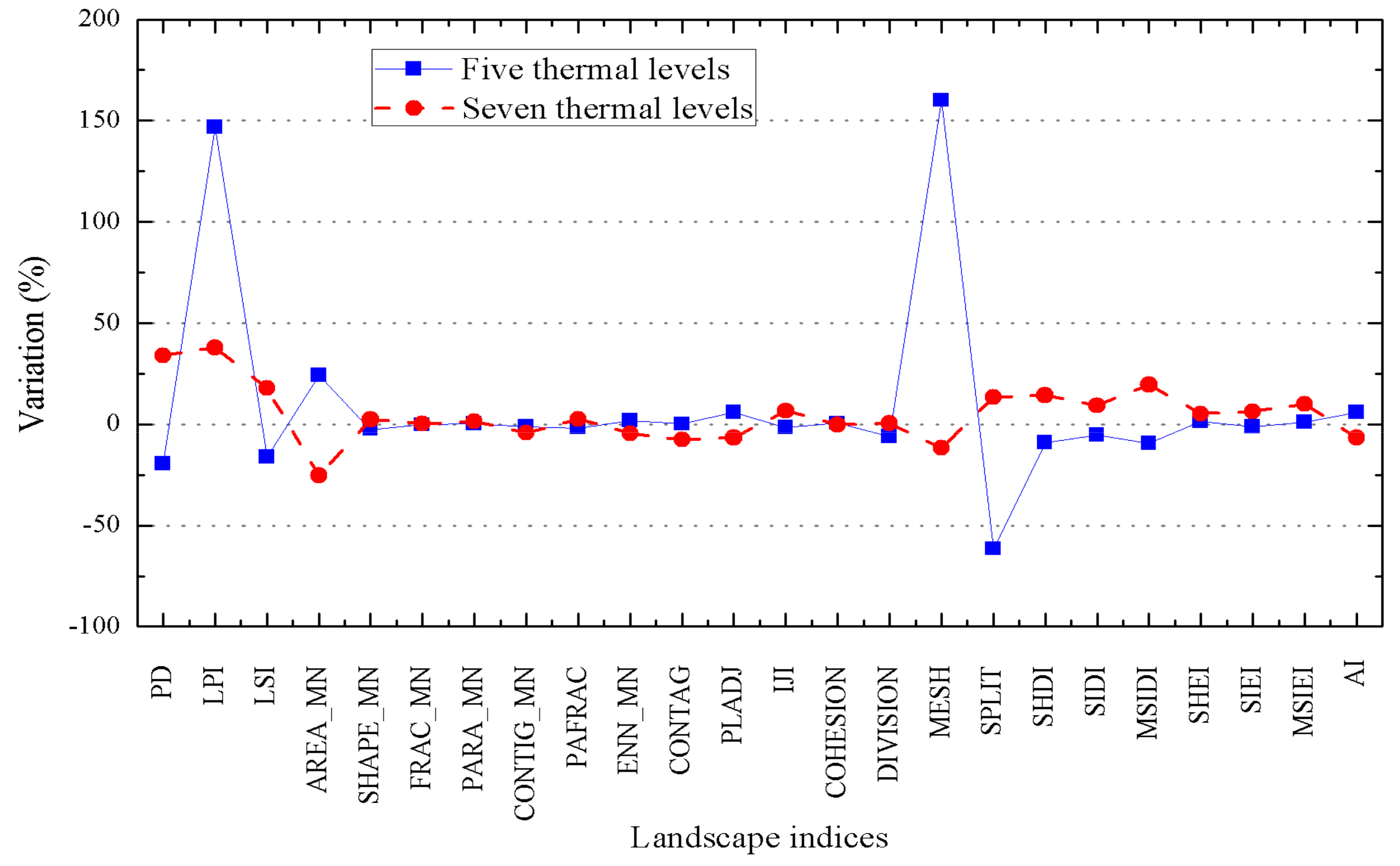
| Landscape Indices | Code | Five Levels | Six Levels | Seven Levels | CV |
|---|---|---|---|---|---|
| Patch density | PD | 3.10 | 3.85 | 5.16 | 25.79% |
| Largest patch index | LPI | 26.50 | 10.74 | 14.80 | 47.18% |
| Landscape shape index | LSI | 72.95 | 86.87 | 102.38 | 16.84% |
| Mean patch area | AREA_MN | 32.26 | 25.96 | 19.39 | 24.87% |
| Mean patch shape index | SHAPE_MN | 1.27 | 1.31 | 1.34 | 2.45% |
| Mean patch fractal dimension | FRAC_MN | 1.04 | 1.04 | 1.04 | 0.28% |
| Perimeter area ratio distribution | PARA_MN | 335.07 | 333.97 | 338.70 | 0.74% |
| Contiguity index distribution | CONTIG_MN | 0.22 | 0.22 | 0.21 | 2.16% |
| Perimeter area fractal dimension | PAFRAC | 1.47 | 1.50 | 1.54 | 2.18% |
| Mean Euclidean nearest neighbor distance distribution | ENN_MN | 312.48 | 307.04 | 293.38 | 3.23% |
| Contagion | CONTAG | 42.04 | 41.99 | 38.82 | 4.50% |
| Percentage of similar adjacencies | PLADJ | 77.46 | 73.10 | 68.23 | 6.34% |
| Interspersion and juxtaposition index | IJI | 49.76 | 50.59 | 53.94 | 4.30% |
| Patch cohesion index | COHESION | 99.28 | 98.80 | 98.49 | 0.40% |
| Landscape division index | DIVISION | 0.90 | 0.96 | 0.97 | 3.78% |
| Effective mesh size | MESH | 31,788.80 | 12,223.13 | 10,788.16 | 64.23% |
| Splitting index | SPLIT | 10.35 | 26.92 | 30.50 | 47.59% |
| Shannon’s diversity index | SHDI | 1.22 | 1.34 | 1.54 | 11.52% |
| Simpson’s diversity index | SIDI | 0.64 | 0.68 | 0.74 | 7.34% |
| Modified Simpson’s diversity index | MSIDI | 1.03 | 1.14 | 1.36 | 14.22% |
| Shannon’s evenness index | SHEI | 0.76 | 0.75 | 0.79 | 2.67% |
| Simpson’s evenness index | SIEI | 0.80 | 0.81 | 0.87 | 4.04% |
| Modified Simpson’s evenness index | MSIEI | 0.64 | 0.63 | 0.70 | 5.34% |
| Aggregation index | AI | 77.71 | 73.34 | 68.48 | 6.31% |
© 2018 by the authors. Licensee MDPI, Basel, Switzerland. This article is an open access article distributed under the terms and conditions of the Creative Commons Attribution (CC BY) license (http://creativecommons.org/licenses/by/4.0/).
Share and Cite
Zhang, W.; Chen, F. Impacts of Grading Rule on Urban Thermal Landscape Pattern Research. Sustainability 2018, 10, 2514. https://doi.org/10.3390/su10072514
Zhang W, Chen F. Impacts of Grading Rule on Urban Thermal Landscape Pattern Research. Sustainability. 2018; 10(7):2514. https://doi.org/10.3390/su10072514
Chicago/Turabian StyleZhang, Wei, and Feng Chen. 2018. "Impacts of Grading Rule on Urban Thermal Landscape Pattern Research" Sustainability 10, no. 7: 2514. https://doi.org/10.3390/su10072514
APA StyleZhang, W., & Chen, F. (2018). Impacts of Grading Rule on Urban Thermal Landscape Pattern Research. Sustainability, 10(7), 2514. https://doi.org/10.3390/su10072514