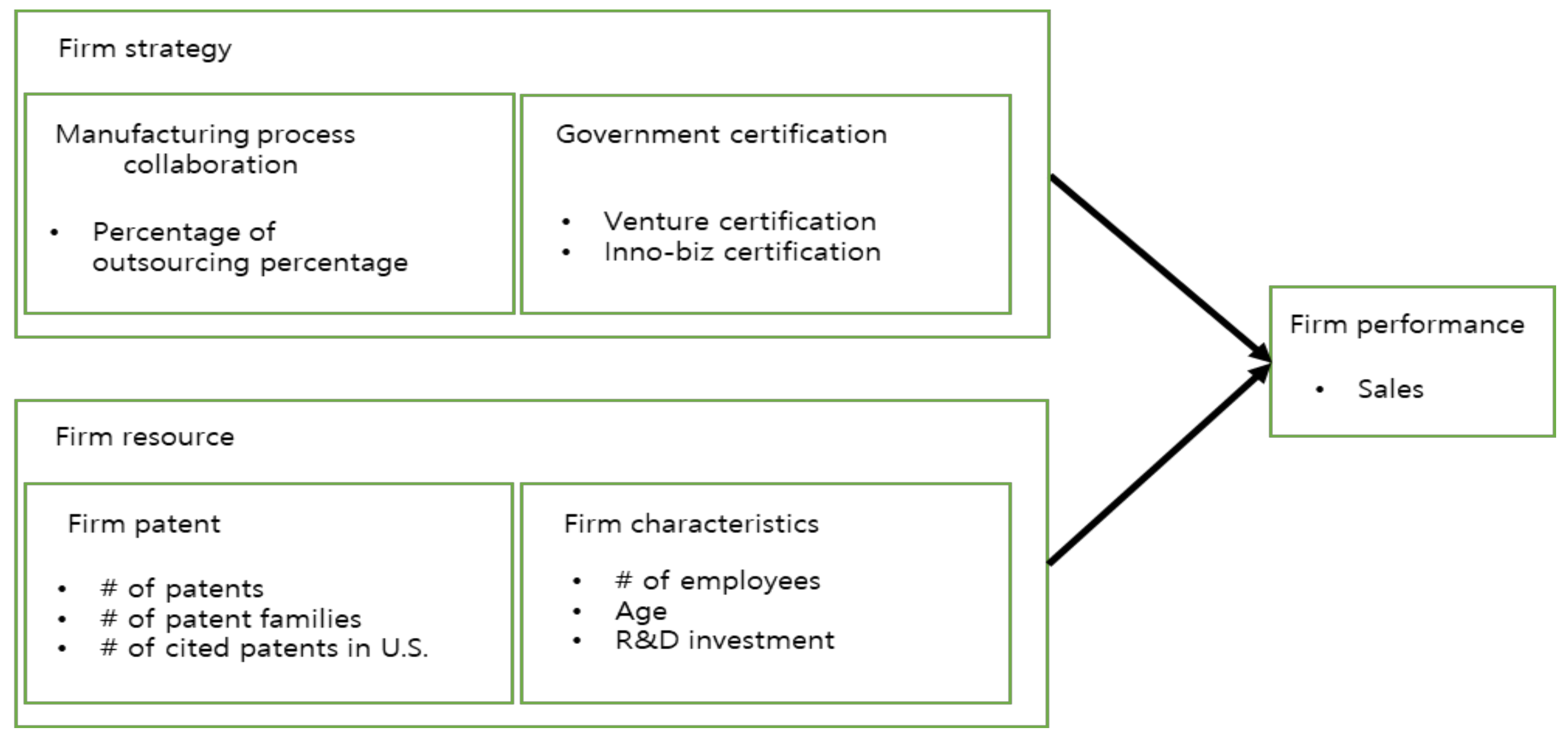
How an Open Innovation Strategy for Commercialization Affects the Firm Performance of Korean Healthcare IT SMEs

Abstract
1. Introduction
2. Research Framework and Hypotheses
2.1. Firm Strategy
2.1.1. Utilizing Outsourcing Strategy and Firm Performance
2.1.2. Utilizing a Government Certification System and Firm Performance
2.2. Firm Resources
2.2.1. Firm Patents and Firm Performance
2.2.2. Firm Characteristics and Firm Performance
3. Data and Econometric Specification
3.1. Variables
3.2. Data
3.3. Analysis Model
4. Summary of Findings
5. Discussion and Limitations
5.1. Discussion
5.2. Limitations
6. Conclusions
Author Contributions
Funding
Acknowledgments
Conflicts of Interest
Appendix A

| Dependent Variable | Variable | Number of Firms | Mean | Std. Dev. | Min | Max | |
| Firm performance | Sales (billion KRW) | 733 | 10.917 | 39.78653 | 0 | 674.867 | |
| Independent Variable | Variable | Number of Firms | Mean | Std. Dev. | Min | Max | |
| Firm strategy | Manufacturing process collaboration | Outsourcing | 733 | 27.43656 | 31.98263 | 0 | 100 |
| Government certification | Certification | 2.379263 | 1.292351 | 1 | 4 | 2.379263 | |
| Firm resources | Firm patents | # of patents | 1.178718 | 3.00112 | 0 | 44.66666 | 1.178718 |
| # of patent families | 2.581628 | 6.476984 | 0 | 80.33334 | 2.581628 | ||
| # of cited patents | 0.017735 | 0.134357 | 0 | 2.333333 | 0.017735 | ||
| Firm characteristics | Age | 733 | 10.51023 | 7.115093 | 1 | 58 | |
| # of employees | 733 | 36.65211 | 91.76058 | 1 | 1317 | ||
| R&D (million KRW) | 733 | 256.7136 | 1348.172 | 0 | 21169.52 |
| Dependent Variable | Variable | Number of Firms | Mean | Std. Dev. | Min | Max | |
| Firm performance | Sales (billion KRW) | 125 | 3.367852 | 10.60352 | 0 | 100.6813 | |
| Independent Variable | Variable | Number of Firms | Mean | Std. Dev. | Min | Max | |
| Firm strategy | Manufacturing process collaboration | Outsourcing | 125 | 2.44 | 12.33955 | 0 | 100 |
| Government certification | Certification | 125 | 1.792 | 1.145088 | 1 | 4 | |
| Firm resources | Firm patent | # of patents | 125 | 0.208 | 0.370663 | 0 | 1.666667 |
| # of patent families | 125 | 0.450667 | 0.71874 | 0 | 3.333333 | ||
| # of cited patents | 125 | 0 | 0 | 0 | 0 | ||
| Firm characteristics | Age | 125 | 7.312 | 5.19835 | 1 | 33 | |
| # of employees | 125 | 20.48 | 39.4019 | 1 | 256 | ||
| R&D (million KRW) | 125 | 6.871552 | 56.89774 | 0 | 621.464 |
References
- Firouzi, F.; Rahmani, A.M.; Mankodiya, K.; Badaroglu, M.; Merrett, G.V.; Wong, P.; Farahani, B. Internet-of-Things and big data for smarter healthcare: From device to architecture, applications and analytics. Future Gener. Comput. Syst. 2018, 78, 583–586. [Google Scholar] [CrossRef] [Scilit]
- Shin, D.C. ICT and Healthcare in Korea: Present and Perspectives. Jpn. Med. Assoc. J. 2014, 57, 75–83. [Google Scholar]
- Park, J.; Shim, W.; Lee, J. A study for Promoting Digital Healthcare in Korea through an Improved Regulatory System. Inf. Policy 2018, 25, 60–81. [Google Scholar]
- Hudson, M.; Smart, A.; Bourne, M. Theory and practice in SME performance measurement systems. Int. J. Oper. Prod. Manag. 2001, 21, 1096–1115. [Google Scholar] [CrossRef] [Scilit]
- Qian, G.; Li, L. Profitability of small-and medium-sized enterprises in high-tech industries: The case of the biotechnology industry. Strateg. Manag. J. 2003, 24, 881–887. [Google Scholar] [CrossRef] [Scilit]
- Grant, R.M. The resource-based theory of competitive advantage: Implications for strategy formulation. Knowl. Strategy 1999, 33, 114–135. [Google Scholar]
- Crawford, C.M. New product failure rates—Facts and fallacies. Res. Manag. 1979, 22, 9–13. [Google Scholar] [CrossRef] [Scilit]
- Berggren, E.; Nacher, T. Introducing new products can be hazardous to your company: Use the right new-solutions delivery tools. Acad. Manag. Executive 2001, 15, 92–101. [Google Scholar] [CrossRef] [Scilit]
- Eisenhardt, K.M.; Martin, J.A. Dynamic capabilities: What are they? Strateg. Manag. J. 2000, 21, 1105–1121. [Google Scholar] [CrossRef] [Scilit]
- Acs, Z.J.; Audretsch, D.B. Innovation in large and small firms: An empirical analysis. Am. Econ. Rev. 1988, 78, 678–690. [Google Scholar] [CrossRef] [Scilit]
- Nooteboom, B. Innovation and diffusion in small firms: Theory and evidence. Small Bus. Econ. 1994, 6, 327–347. [Google Scholar] [CrossRef] [Scilit]
- Barney, J. Firm resources and sustained competitive advantage. J. Manag. 1991, 17, 99–120. [Google Scholar] [CrossRef] [Scilit]
- Dierickx, I.; Cool, K. Asset stock accumulation and sustainability of competitive advantage. Manag. Sci. 1989, 35, 1504–1511. [Google Scholar] [CrossRef] [Scilit]
- Priem, R.L.; Butler, J.E. Is the resource-based “view” a useful perspective for strategic management research? Acad. Manag. Rev. 2001, 26, 22–40. [Google Scholar]
- Teece, D.J.; Pisano, G.; Shuen, A. Dynamic capabilities and strategic management. Strateg. Manag. J. 1997, 18, 509–533. [Google Scholar] [CrossRef] [Scilit]
- Wang, C.L.; Ahmed, P.K. Dynamic capabilities: A review and research agenda. Int. J. Manag. Rev. 2007, 9, 31–51. [Google Scholar] [CrossRef] [Scilit]
- Verona, G. A resource-based view of product development. Acad. Manag. Rev. 1999, 24, 132–142. [Google Scholar] [CrossRef] [Scilit]
- Trajtenberg, M. A penny for your quotes: Patent citations and the value of innovations. RAND J. Econ. 1990, 21, 172–187. [Google Scholar] [CrossRef] [Scilit]
- Harhoff, D.; Scherer, F.M.; Vopel, K. Citations, family size, opposition and the value of patent rights. Res. Policy 2003, 32, 1343–1363. [Google Scholar] [CrossRef] [Scilit]
- Song, X.M.; Parry, M.E. A cross-national comparative study of new product development processes: Japan and the United States. J. Mark. 1997, 61, 1–18. [Google Scholar] [CrossRef] [Scilit]
- Mitchell, V.L.; Zmud, R.W. The effects of coupling IT and work process strategies in redesign projects. Organ. Sci. 1999, 10, 424–438. [Google Scholar] [CrossRef] [Scilit]
- Ahuja, G. Collaboration networks, structural holes, and innovation: A longitudinal study. Adm. Sci. Q. 2000, 45, 425–455. [Google Scholar] [CrossRef] [Scilit]
- Zahra, S.A.; Nielsen, A.P. Sources of capabilities, integration and technology commercialization. Strateg. Manag. J. 2002, 23, 377–398. [Google Scholar] [CrossRef] [Scilit]
- Nieto, M.J.; Santamaría, L. The importance of diverse collaborative networks for the novelty of product innovation. Technovation 2007, 27, 367–377. [Google Scholar] [CrossRef] [Scilit]
- Ku, K.C.; Kao, H.P.; Gurumurthy, C.K. Virtual inter-firm collaborative framework—An IC foundry merger/acquisition project. Technovation 2007, 27, 388–401. [Google Scholar] [CrossRef] [Scilit]
- Klepper, S. Entry, exit, growth, and innovation over the product life cycle. Am. Econ. Rev. 1996, 86, 562–583. [Google Scholar]
- Martí, J.; Quas, A. A beacon in the night: Government certification of SMEs towards banks. Small Bus. Econ. 2018, 50, 397–413. [Google Scholar] [CrossRef] [Scilit]
- Lerner, J. The government as venture capitalist: The longrun impact of the SBIR program. J. Bus. 1999, 72, 285–318. [Google Scholar] [CrossRef] [Scilit]
- Lerner, J. When Bureaucrats Meet Entrepreneurs: The Design of Effective Public Venture Capital Programmes. Econ. J. 2002, 112, 73–84. [Google Scholar] [CrossRef] [Scilit]
- Luke, R.D.; Begun, J.W.; Pointer, D.D. Quasi firms: Strategic interorganizational forms in the health care industry. Acad. Manag. Rev. 1989, 14, 9–19. [Google Scholar] [CrossRef] [Scilit]
- Bossink, B.A. The development of co–innovation strategies: Stages and interaction patterns in interfirm innovation. R D Manag. 2002, 32, 311–320. [Google Scholar] [CrossRef] [Scilit]
- Arora, A.; Gambardella, A. Evaluating technological information and utilizing it: Scientific knowledge, technological capability, and external linkages in biotechnology. J. Econ. Behav. Organ. 1994, 24, 91–114. [Google Scholar] [CrossRef] [Scilit]
- Chesbrough, H. The logic of open innovation: Managing intellectual property. Calif. Manag. Rev. 2003, 45, 33–58. [Google Scholar] [CrossRef] [Scilit]
- Christensen, J.F.; Olesen, M.H.; Kjær, J.S. The industrial dynamics of Open Innovation—Evidence from the transformation of consumer electronics. Res. Policy 2005, 34, 1533–1549. [Google Scholar] [CrossRef] [Scilit]
- Lettl, C.; Herstatt, C.; Gemuenden, H.G. Users’ contributions to radical innovation: Evidence from four cases in the field of medical equipment technology. R D Manag. 2006, 36, 251–272. [Google Scholar] [CrossRef] [Scilit]
- West, J.; Gallagher, S. Challenges of open innovation: The paradox of firm investment in open-source software. R D Manag. 2006, 36, 319–331. [Google Scholar] [CrossRef] [Scilit]
- Enkel, E.; Gassmann, O.; Chesbrough, H. Open R&D and open innovation: Exploring the phenomenon. R D Manag. 2009, 39, 311–316. [Google Scholar]
- Chesbrough, H.; Crowther, A.K. Beyond high tech: Early adopters of open innovation in other industries. R D Manag. 2006, 36, 229–236. [Google Scholar] [CrossRef] [Scilit]
- Lichtenthaler, U.; Ernst, H. External technology commercialization in large firms: Results of a quantitative benchmarking study. R D Manag. 2007, 37, 383–397. [Google Scholar] [CrossRef] [Scilit]
- Becker, W.; Dietz, J. R&D cooperation and innovation activities of firms—Evidence for the German manufacturing industry. Res. Policy 2004, 33, 209–223. [Google Scholar]
- Faems, D.; Van Looy, B.; Debackere, K. Interorganizational collaboration and innovation: Toward a portfolio approach. J. Prod. Innov. Manag. 2005, 22, 238–250. [Google Scholar] [CrossRef] [Scilit]
- Vachon, S.; Klassen, R.D. Environmental management and manufacturing performance: The role of collaboration in the supply chain. Int. J. Prod. Econ. 2008, 111, 299–315. [Google Scholar] [CrossRef] [Scilit]
- Carpay, F.; Hang, C.C.; Yu, D. Management of outsourcing R&D in the era of open innovation. In Proceedings of the 5th International Symposium on Management of Technology, Hangzhou, China, 1–3 June 2007; pp. 252–266. [Google Scholar]
- Lichtenthaler, U. Open innovation in practice: An analysis of strategic approaches to technology transactions. IEEE Trans. Eng. Manag. 2008, 55, 148–157. [Google Scholar] [CrossRef] [Scilit]
- Tomlinson, P.R. Co-operative ties and innovation: Some new evidence for UK manufacturing. Res. Policy 2010, 39, 762–775. [Google Scholar] [CrossRef] [Scilit]
- Kroes, J.R.; Ghosh, S. Outsourcing congruence with competitive priorities: Impact on supply chain and firm performance. J. Oper. Manag. 2010, 28, 124–143. [Google Scholar] [CrossRef] [Scilit]
- Varadarajan, R. Outsourcing: Think more expansively. J. Bus. Res. 2009, 62, 1165–1172. [Google Scholar] [CrossRef] [Scilit]
- Kuo, C.-J.; Chen, C.-M.; Sung, C.-H. Evaluating guarantee fees for loans to small and medium-sized enterprises. Small Bus. Econ. 2011, 37, 205–218. [Google Scholar] [CrossRef] [Scilit]
- Busom, I.; Corchuelo, B.; Martínez-Ros, E. Tax incentives… or subsidies for Business R&D? Small Bus. Econ. 2014, 4, 571–596. [Google Scholar] [CrossRef] [Scilit]
- Nemet, G.F. Demand-pull, technology-push, and government-led incentives for non-incremental technical change. Res. Policy 2009, 38, 700–709. [Google Scholar] [CrossRef] [Scilit]
- Klaassen, G.; Miketa, A.; Larsen, K.; Sundqvist, T. The impact of R&D on innovation for wind energy in Denmark, Germany and the United Kingdom. Ecol. Econ. 2005, 54, 227–240. [Google Scholar]
- Shin, S.; Kim, M. The Effects of Innovation Type SME Certificates focused on the Financial Performance between the Inno biz and the Main biz. Korean Manag. Consult. Rev. 2013, 13, 193–217. [Google Scholar]
- Kwak, S.; Suh, C. A Comparison of Management Performance between Technology Innovation and Management Innovation Companies. Korean Prod. Oper. Manag. Soc. 2010, 21, 321–337. [Google Scholar]
- Rosenbusch, N.; Brinckmann, J.; Bausch, A. Is innovation always beneficial? A meta-analysis of the relationship between innovation and performance in SMEs. J. Bus. Ventur. 2011, 26, 441–457. [Google Scholar] [CrossRef] [Scilit]
- Pullen, A.J.; Weerd-Nederhof, P.C.; Groen, A.J.; Fisscher, O.A. Open innovation in practice: Goal complementarity and closed NPD networks to explain differences in innovation performance for SMEs in the medical devices sector. J. Prod. Innov. Manag. 2012, 29, 917–934. [Google Scholar] [CrossRef] [Scilit]
- Narin, F.; Noma, E.; Perry, R. Patents as indicators of corporate technological strength. Res. Policy 1987, 16, 143–155. [Google Scholar] [CrossRef] [Scilit]
- Griliches, Z. Patent statistics as economic indicators: A survey. In R&D and Productivity: The Econometric Evidence; University of Chicago Press: Chicago, IL, USA, 1998; pp. 287–343. [Google Scholar]
- Acs, Z.J.; Audretsch, D.B.; Feldman, M.P. Real effects of academic research: Comment. Am. Econ. Rev. 1992, 82, 363–367. [Google Scholar]
- Scherer, F.M. Firm size, market structure, opportunity, and the output of patented inventions. Am. Econ. Rev. 1965, 55, 1097–1125. [Google Scholar]
- Cormanor, W.S.; Scherer, F.M. Patent statistics as a measure of technical change. J. Political Econ. 1969, 77, 392–398. [Google Scholar] [CrossRef] [Scilit]
- Ernst, H. Patenting strategies in the German mechanical engineering industry and their relationship to company performance. Technovation 1995, 15, 225–240. [Google Scholar] [CrossRef] [Scilit]
- Chang, Y.H.; Yang, W.G.; Lai, K.K. Valuable patent or not? Depends on the combination of internal patent family and external citation. In Proceedings of the Technology Management for Global Economic Growth (PICMET), Phuket, Thailand, 18–22 July 2010; pp. 1–6. [Google Scholar]
- Agostini, L.; Caviggioli, F.; Filippini, R.; Nosella, A. Does patenting influence SME sales performance? A quantity and quality analysis of patents in Northern Italy. Eur. J. Innov. Manag. 2015, 18, 238–257. [Google Scholar] [CrossRef] [Scilit]
- Agostini, L.; Nosella, A.; Soranzo, B. The impact of formal and informal appropriability regimes on SME profitability in medium high-tech industries. Technol. Anal. Strateg. Manag. 2015, 27, 405–419. [Google Scholar] [CrossRef] [Scilit]
- Lin, B.W.; Chen, C.J.; Wu, H.L. Patent portfolio diversity, technology strategy, and firm value. IEEE Trans. Eng. Manag. 2006, 53, 17–26. [Google Scholar]
- Breitzman, A.; Thomas, P. Using patent citation analysis to target/value M&A candidates. Res.-Technol. Manag. 2002, 45, 28–36. [Google Scholar]
- Bruce, A.; Christopher, T. R&D intensity and acquisitions in high-technology industries: Evidence from the US electronic and electrical equipment industries. J. Ind. Econ. 2002, 48, 47–70. [Google Scholar]
- Song, S.-H. The relationships between types of firms and technical innovation influences in the telecommunication hardware industry: Configuration approach. KASBA 1995, 14, 65–111. (In Korean) [Google Scholar]
- Uotila, J.; Maula, M.; Keil, T.; Zahra, S.A. Exploration, exploitation, and financial performance: Analysis of S&P 500 corporations. Strateg. Manag. J. 2009, 30, 221–231. [Google Scholar]
- Loderer, C.F.; Waelchli, U. Firm Age and Performance. Available online: https://ssrn.com/abstract=1342248 (accessed on 13 June 2018).
- Paul, J.; Parthasarathy, S.; Gupta, P. Exporting challenges of SMEs: A review and future research agenda. J. World Bus. 2017, 52, 327–342. [Google Scholar] [CrossRef] [Scilit]
- Pavitt, K.; Robson, M.; Townsend, J. The size distribution of innovating firms in the UK: 1945–1983. J. Ind. Econ. 1987, 35, 297–316. [Google Scholar] [CrossRef] [Scilit]
- Cohen, W.M.; Klepper, S. A reprise of size and R&D. Econ. J. 1996, 106, 925–951. [Google Scholar]
- Rogers, M. Networks, firm size and innovation. Small Bus. Econ. 2004, 22, 141–153. [Google Scholar] [CrossRef] [Scilit]
- Ortega-Argilés, R.; Potters, L.; Vivarelli, M. R&D and productivity: Testing sectoral peculiarities using micro data. Empir. Econ. 2011, 41, 817–839. [Google Scholar]
- Lichtenberg, F.R.; Siegel, D. The impact of R&D investment on productivity–New evidence using linked R&D–LRD data. Econ. Inq. 1991, 29, 203–229. [Google Scholar]
- KHIDI. Development of Value Assessment Model for IT Converged Healthcare Services; Korea heath industry development institute (KHIDI): Seoul, Korea, 2013. [Google Scholar]
- Myers, R.H. Detecting and combating multicollinearity. In Classical and Modern Regression with Applications; ASA: Boston, MA, USA, 1990; pp. 368–423. [Google Scholar]
- Bozarth, C.; McDermott, C. Configurations in manufacturing strategy: A review and directions for future research. J. Oper. Manag. 1998, 16, 427–439. [Google Scholar] [CrossRef] [Scilit]
- Heikkila, J.; Cordon, C. Outsourcing: A core or non-core strategic management decision? Strateg. Chang. 2002, 11, 183–193. [Google Scholar] [CrossRef] [Scilit]
- Holcomb, T.R.; Hitt, M.A. Toward a model of strategic outsourcing. J. Oper. Manag. 2007, 25, 464–481. [Google Scholar] [CrossRef] [Scilit]
- Bertoni, F.; Tykvová, T. Does governmental venture capital spur invention and innovation? Evidence from young European biotech companies. Res. Policy 2015, 44, 925–935. [Google Scholar] [CrossRef] [Scilit]
- Grilli, L.; Murtinu, S. Government, venture capital and the growth of European high-tech entrepreneurial firms. Res. Policy 2014, 43, 1523–1543. [Google Scholar] [CrossRef] [Scilit]
- Alperovych, Y.; Groh, A.; Quas, A. When Can Government Venture Capital Funds Bridge the Equity Gap? Available online: http://papers.ssrn.com/abstract=2718061 (accessed on 12 December 2016).

| Dependent Variable | Variable | Explanation | Reference | |
| Firm performance | Financial performance | Sales | Firm’s sales | [75] |
| Independent Variable | Variable | Explanation | Reference | |
| Firm strategy | Manufacturing process collaboration | Outsourcing | The percentage of outsourcing in the manufacturing process | [47] |
| Government certification | Certification | Whether the firm has InnoBiz certification or venture certification or both | [52,53] | |
| Firm resources | Firm patents | # of patents | Number of registered patents | [60] |
| # of patent families | Number of family patents | [18] | ||
| # of cited patents | Number of cited patents | [65] | ||
| Firm characteristics | Age | Age of the firm | [54] | |
| # of employees | Number of employees | [74] | ||
| R&D investment | The amount of R&D investment | [76] |
| Dependent Variable | Variable | Number of Firms | Mean | Std. Dev. | Min | Max | |
| Firm performance | Sales (billion KRW) | 858 | 9.817185 | 37.08705 | 0 | 674.867 | |
| Independent Variable | Variable | Number of Firms | Mean | Std. Dev. | Min | Max | |
| Firm strategy | Manufacturing process collaboration | Outsourcing | 858 | 23.79487 | 31.20228 | 0 | 100 |
| Government certification | Certification | 858 | 2.293706 | 1.288123 | 1 | 4 | |
| Firm resources | Firm patents | # of patents | 858 | 1.037296 | 2.798271 | 0 | 44.66666 |
| # of patent families | 858 | 2.271173 | 6.039287 | 0 | 80.33334 | ||
| # of cited patents | 858 | 0.015152 | 0.12433 | 0 | 2.333333 | ||
| Firm characteristics | Age | 858 | 10.04429 | 6.958815 | 1 | 58 | |
| # of employees | 858 | 34.29604 | 86.3082 | 1 | 1317 | ||
| R&D (million KRW) | 858 | 220.3147 | 1249.283 | 0 | 21169.52 |
| VIF | Sales | EMP | Age | PatentA | PatentF | PatentC | I/V | Out | RND | |
|---|---|---|---|---|---|---|---|---|---|---|
| sales | 1.0000 | |||||||||
| EMP | 2.32 | 0.8648 | 1.0000 | |||||||
| Age | 1.14 | 0.0623 | 0.1903 | 1.0000 | ||||||
| PatentA | 6.43 | 0.3279 | 0.3192 | −0.0978 | 1.0000 | |||||
| PatentF | 8.88 | 0.3836 | 0.4257 | −0.0809 | 0.8862 | 1.0000 | ||||
| PatentC | 1.72 | 0.222 | 0.0779 | −0.1461 | 0.5301 | 0.4449 | 1.0000 | |||
| I/V | 1.28 | −0.2664 | −0.3143 | −0.2072 | 0.1447 | 0.1070 | 0.0911 | 1.0000 | ||
| Out | 1.05 | −0.03 | −0.1342 | −0.0341 | −0.0640 | −0.1005 | −0.0564 | 0.0167 | 1.0000 | |
| RND | 2.47 | 0.7428 | 0.5747 | −0.1109 | 0.5229 | 0.5432 | 0.4904 | 0.0341 | −0.1523 | 1.0000 |
| Variables | Model 1 | Model 2 | Model 3 | ||
|---|---|---|---|---|---|
| Firm strategy | Manufacturing process collaboration | Outsourcing | 0.0531 ** | 0.0518 ** | 0.0125 |
| (0.0208) | (0.0237) | (0.0177) | |||
| Government certification | InnoBiz certification | −2.808 | −4.494 | 40.48 *** | |
| (2.846) | (3.128) | (2.494) | |||
| Venture certification | −1.078 | −1.471 | 0.865 | ||
| (1.754) | (2.055) | (0.589) | |||
| InnoBiz certification + Venture certification | −4.788 *** | −5.131 ** | 0.578 | ||
| (1.824) | (2.063) | (0.850) | |||
| Firm resources | Firm patents | # of patents | 2.212 *** | 2.260 *** | 1.573 * |
| (0.442) | (0.475) | (0.799) | |||
| # of patent families | −1.289 *** | −1.327 *** | −0.742 * | ||
| (0.231) | (0.249) | (0.376) | |||
| # of cited patents in the U.S. | 49.84 *** | 50.36 *** | |||
| (13.91) | (14.90) | ||||
| Firm characteristics | # of employees | 0.281 *** | 0.287 *** | 0.128 *** | |
| (0.0107) | (0.0118) | (0.00684) | |||
| Age | 0.0885 | 0.0817 | 0.0128 | ||
| (0.119) | (0.132) | (0.0594) | |||
| R&D investment | 0.0091 *** | 0.0089 *** | 0.0454 *** | ||
| (0.000736) | (0.000791) | (0.00569) | |||
| Constant | −1.998 | −1.633 | −0.653 | ||
| (1.337) | (1.652) | (0.416) | |||
| Observations | 858 | 733 | 125 | ||
| R-squared | 0.745 | 0.746 | 0.953 | ||
© 2018 by the authors. Licensee MDPI, Basel, Switzerland. This article is an open access article distributed under the terms and conditions of the Creative Commons Attribution (CC BY) license (http://creativecommons.org/licenses/by/4.0/).
Share and Cite
Kim, H.; Kim, E. How an Open Innovation Strategy for Commercialization Affects the Firm Performance of Korean Healthcare IT SMEs. Sustainability 2018, 10, 2476. https://doi.org/10.3390/su10072476
Kim H, Kim E. How an Open Innovation Strategy for Commercialization Affects the Firm Performance of Korean Healthcare IT SMEs. Sustainability. 2018; 10(7):2476. https://doi.org/10.3390/su10072476
Chicago/Turabian StyleKim, Hana, and Eungdo Kim. 2018. "How an Open Innovation Strategy for Commercialization Affects the Firm Performance of Korean Healthcare IT SMEs" Sustainability 10, no. 7: 2476. https://doi.org/10.3390/su10072476
APA StyleKim, H., & Kim, E. (2018). How an Open Innovation Strategy for Commercialization Affects the Firm Performance of Korean Healthcare IT SMEs. Sustainability, 10(7), 2476. https://doi.org/10.3390/su10072476