Promoting a World Heritage Site through Social Media: Suwon City’s Facebook Promotion Strategy on Hwaseong Fortress (in South Korea)

Abstract
1. Introduction
- Q1.
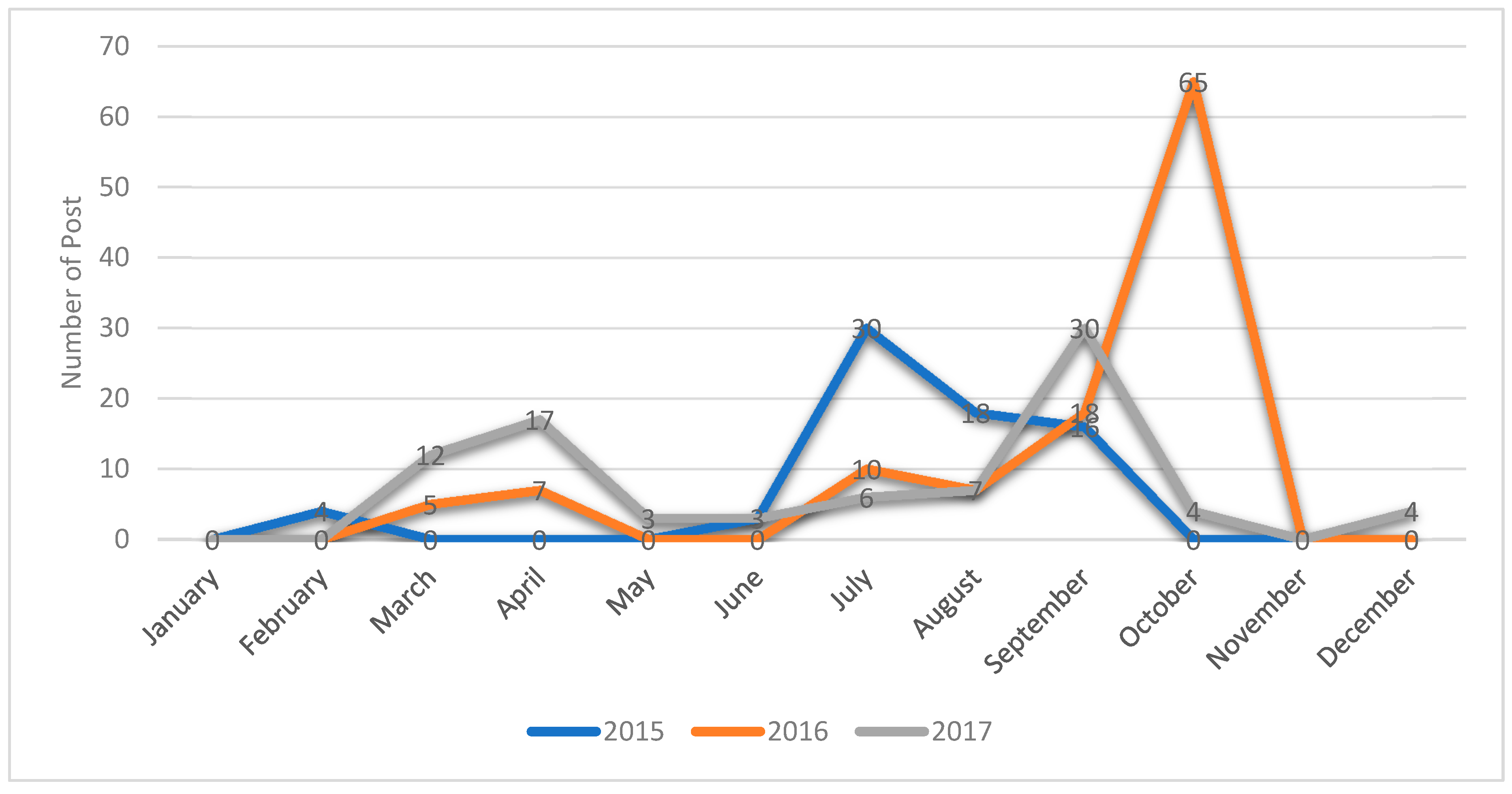
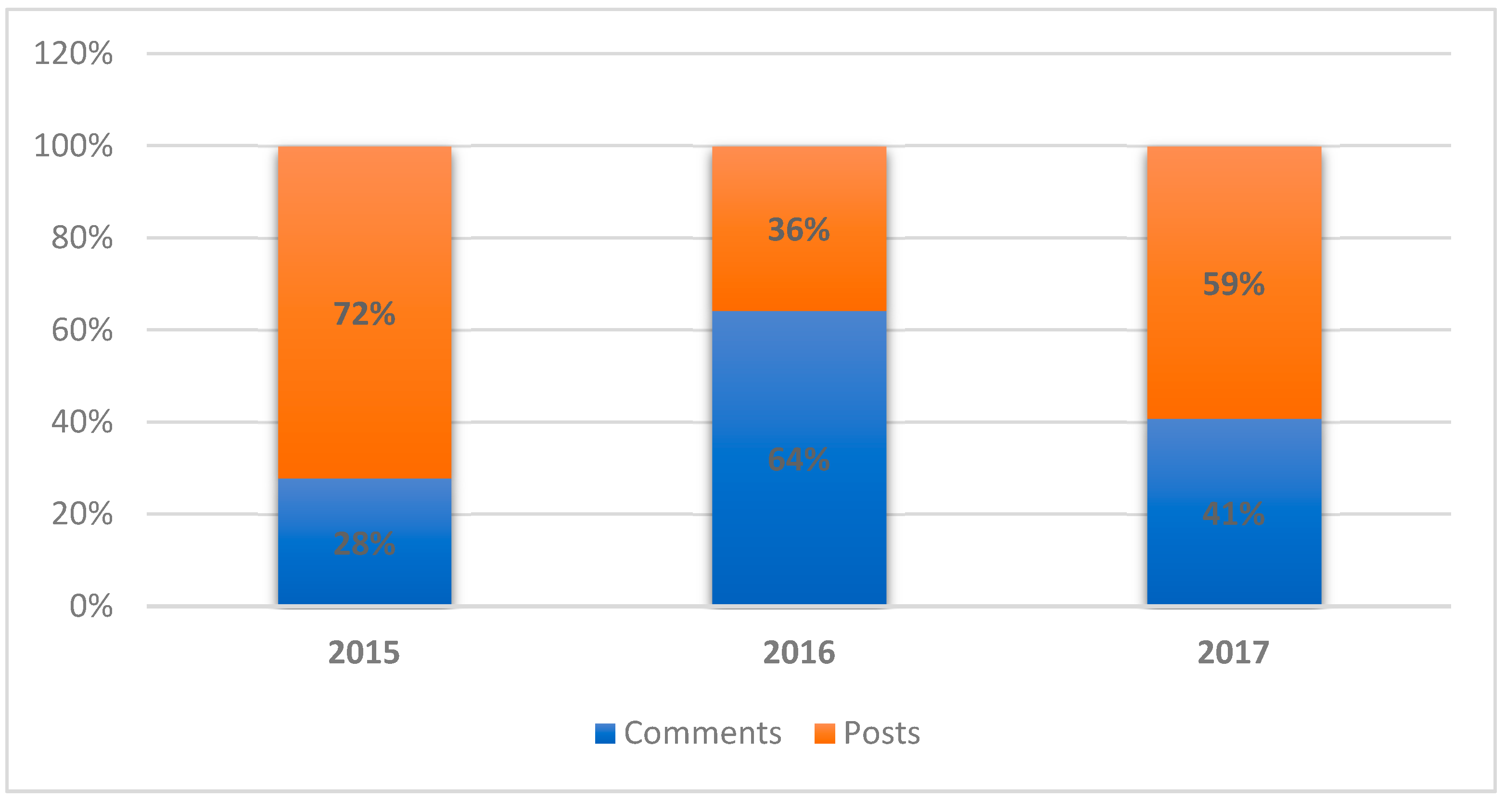
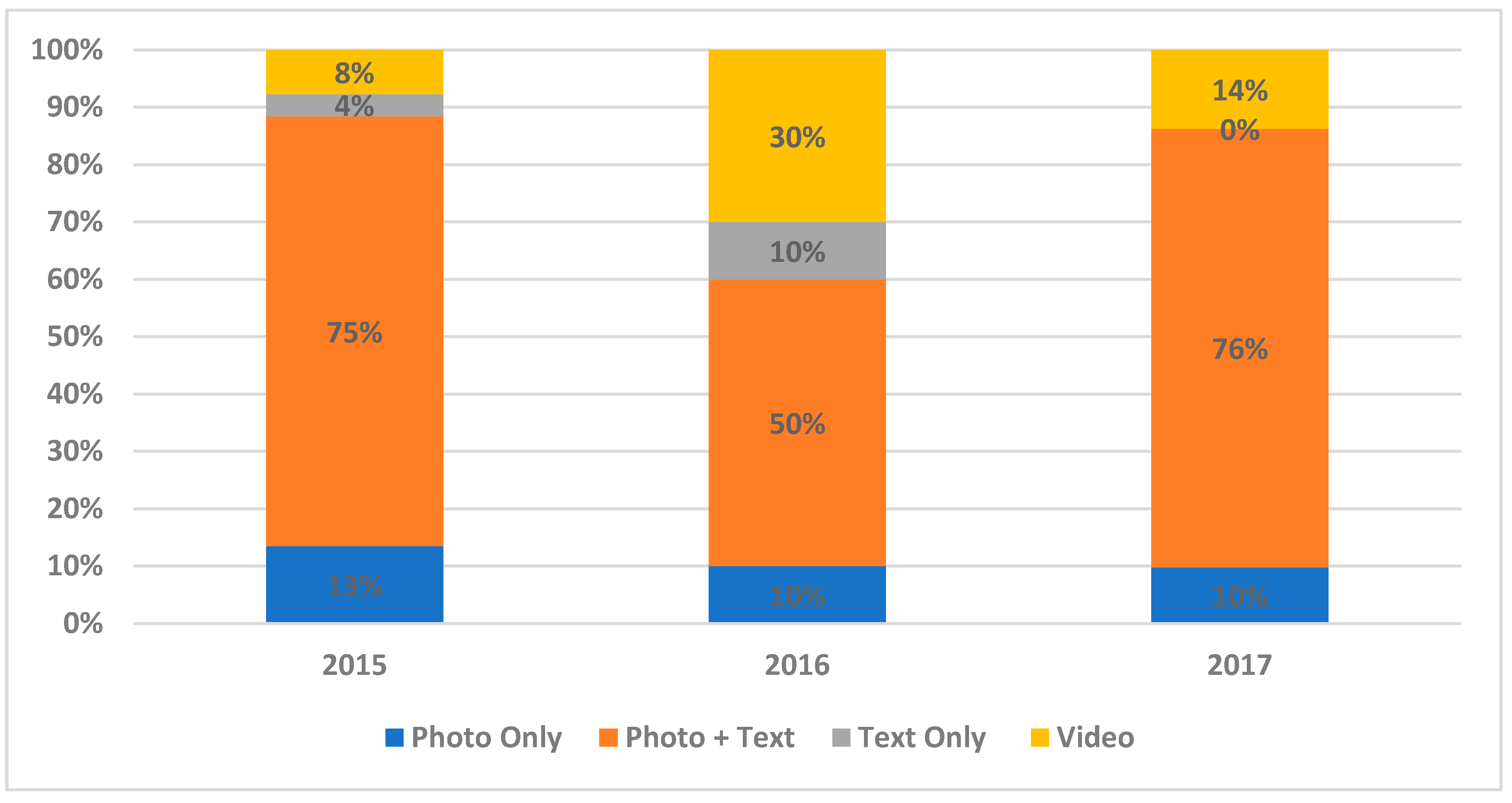
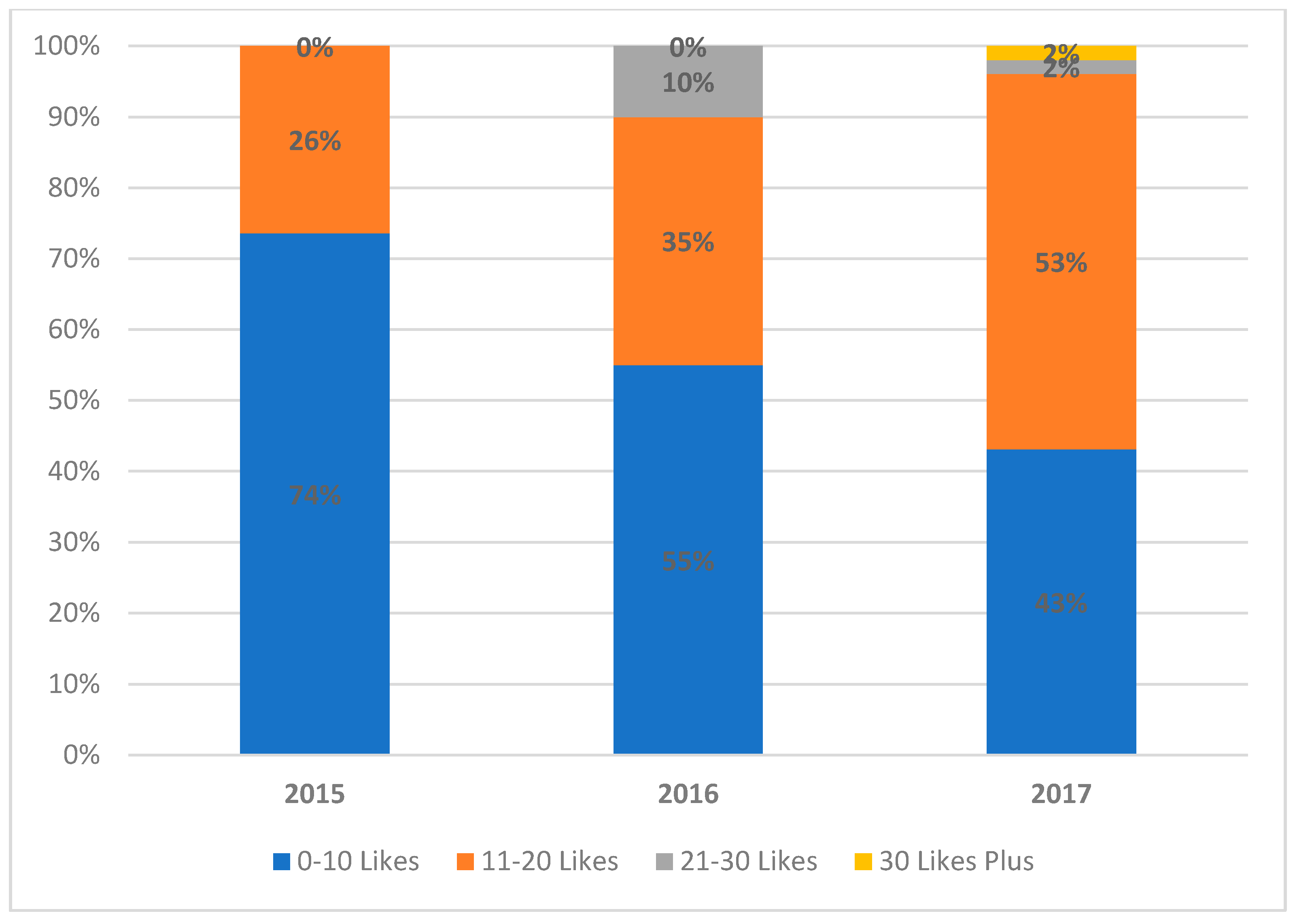
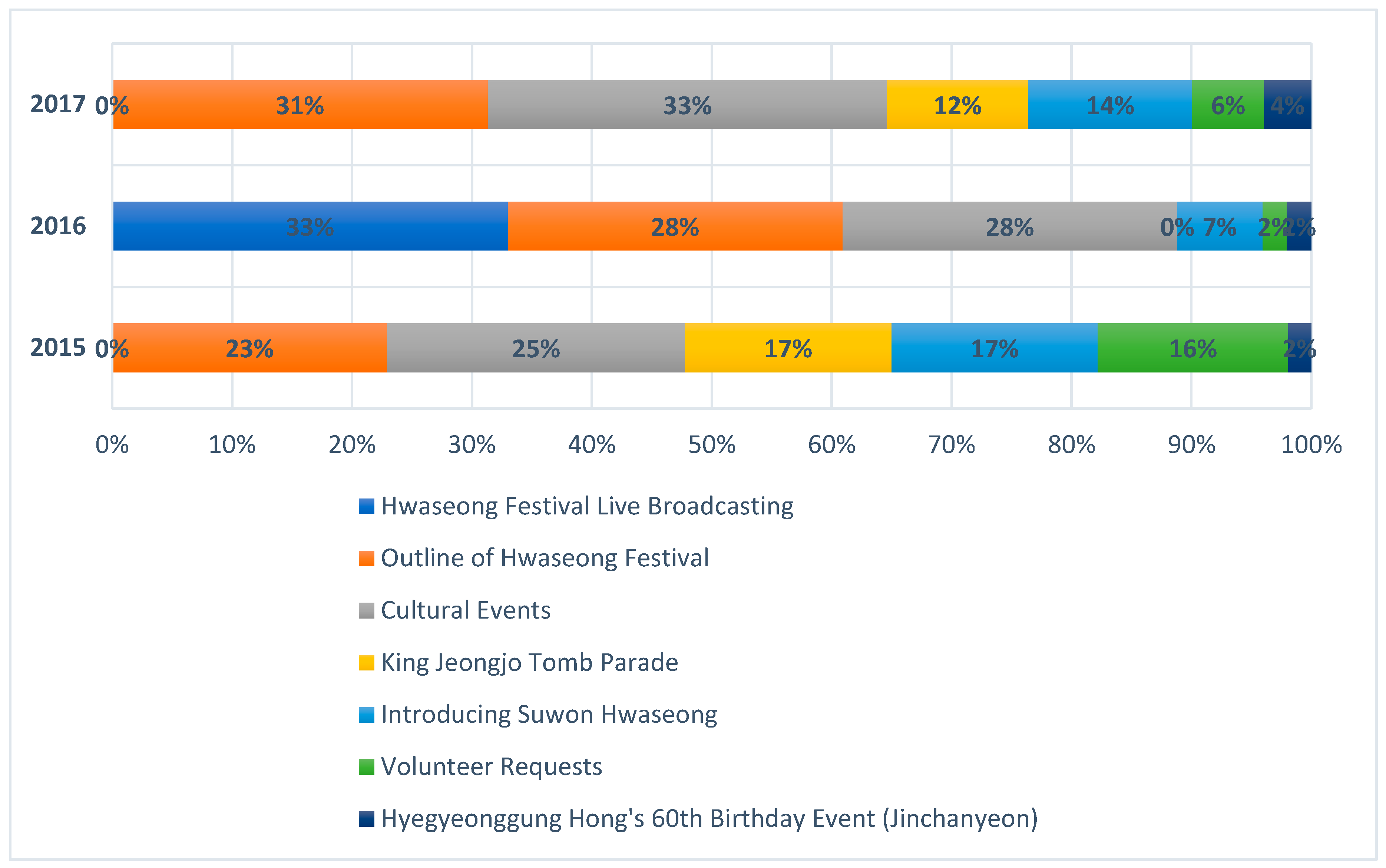
- What were the features of the postings on the Suwon Hwaseong Facebook fan page over the period from 2015 to 2017?
- Q2.
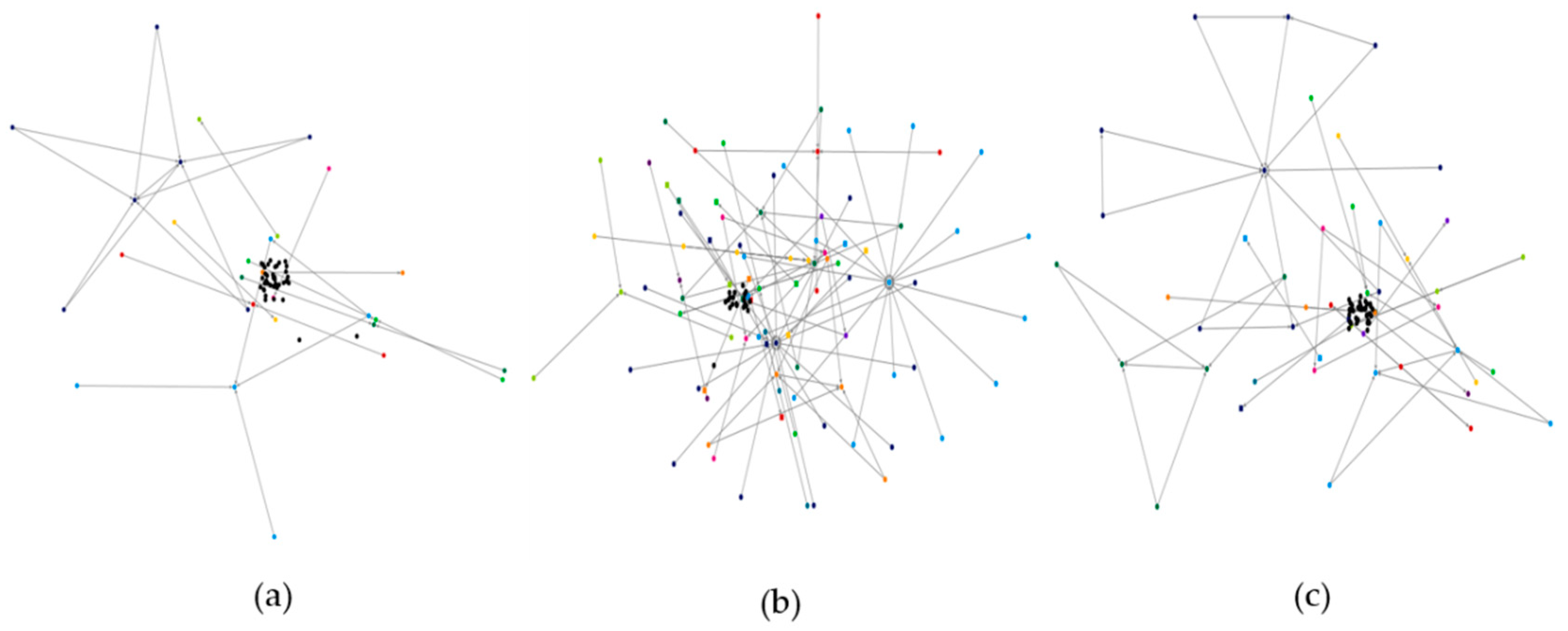
- How did the Suwon Hwaseong Facebook fan page form its social networks over the period from 2015 to 2017?
- Q3.
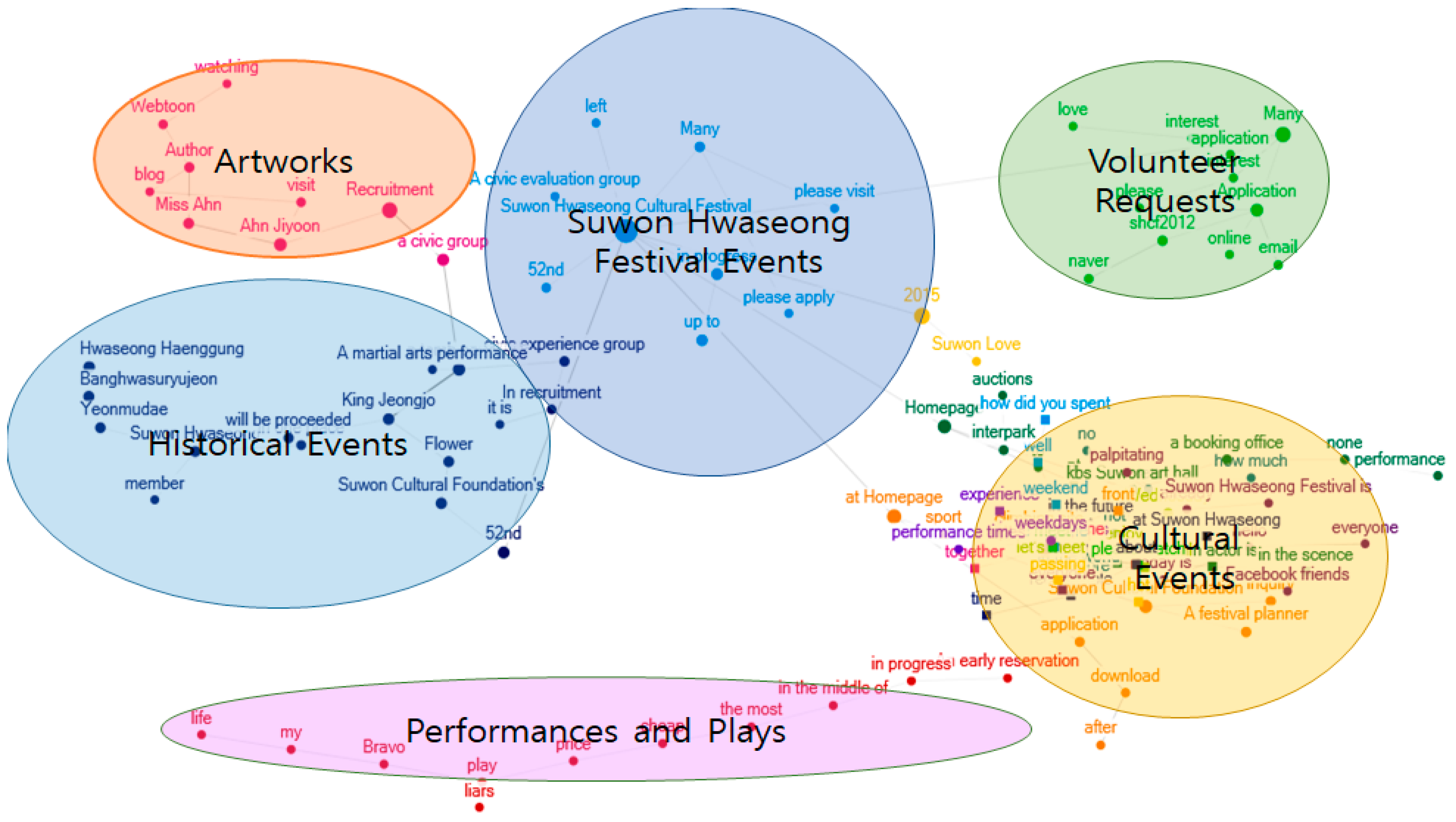
- What were the features of the structure of the semantic networks of the Suwon Hwaseong Facebook fan page over the period from 2015 to 2017?
2. Site Description
2.1. Suwon as a ‘Cultural’ City
2.2. Existing Studies on Suwon Hwaseong
3. Theoretical Framework
4. Materials and Methods
5. Results
5.1. Characteristics of Vertices and Edges
5.2. Network Centrality Measures of the Suwon Hwaseong Facebook Fan Pages
5.3. Visualised Social Networks and Semantic Networks
6. Discussion
7. Concluding Remarks
Author Contributions
Acknowledgments
Conflicts of Interest
References
- Kim, D.; Hwang, E. Light and Darkness of Urban Regeneration: Culture-centred City Regeneration of the Hoxton Region in London. In Proceedings of the 2013 International Conference of the Korean Association of Policy Studies, Yonsei University, Seoul, Korea, 14–15 June 2013; Volume 1, pp. 329–344. (In Korean) [Google Scholar]
- Korea Internet & Security Agency. Internet Usage Statistics. Available online: https://isis.kisa.or.kr/statistics/?pageId=020200 (accessed on 28 March 2018). (In Korean)
- Ministry of Science and Information Technology. Press Release, 2017 Internet Usage Statistics Released. Available online: http://www.msit.go.kr/web/msipContents/contentsView.do?cateId=mssw311&artId=1374306 (accessed on 28 March 2018). (In Korean)
- Kaplan, A.M.; Haenlein, M. Users of the World, Unite! The Challenges and Opportunities of Social Media. Bus. Horiz. 2010, 53, 59–68. [Google Scholar] [CrossRef] [Scilit]
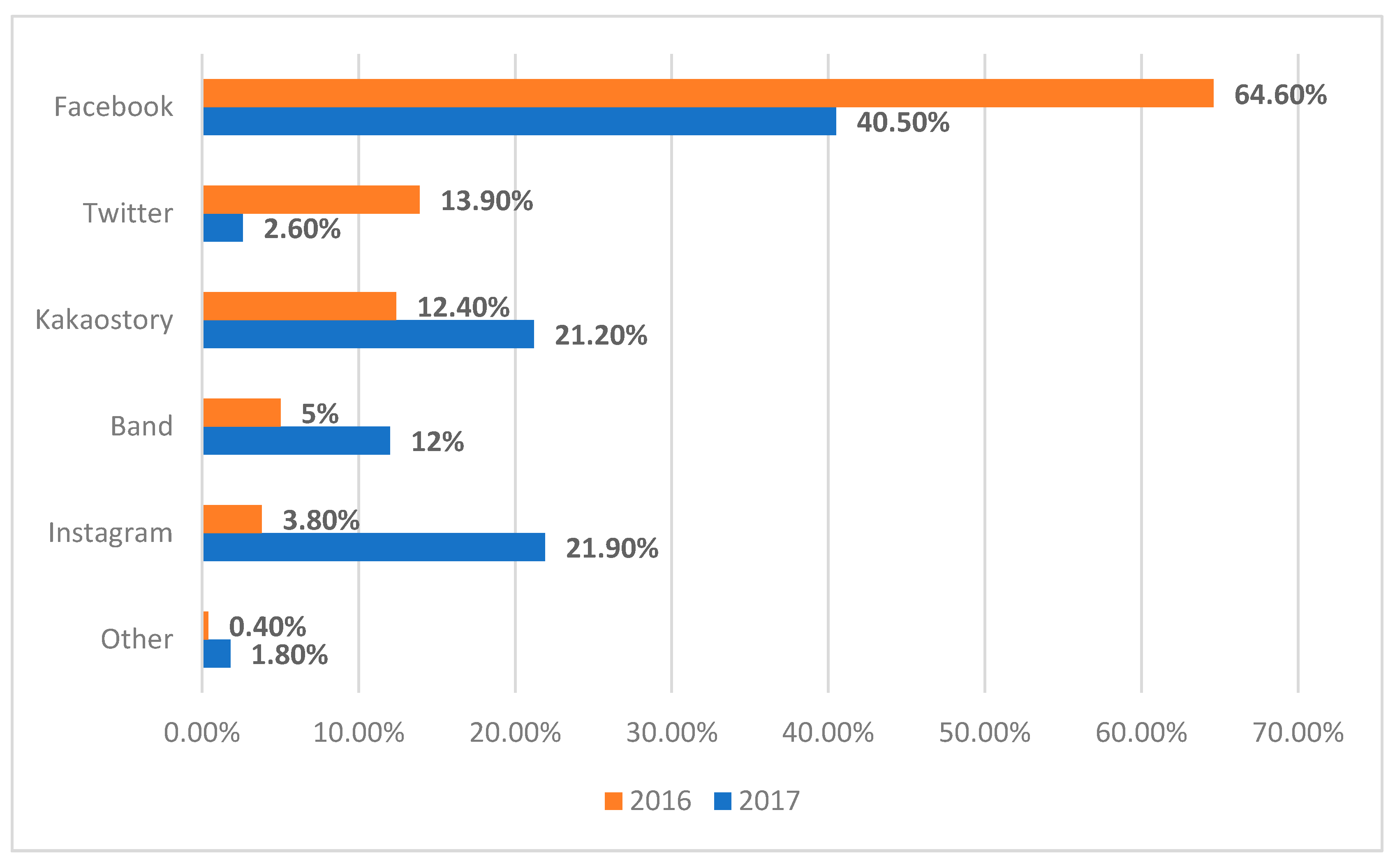
- eMarketer, eMarketer Chart. Primary Social Media Platform Used by Social Media Users in South Korea, 2016 & 2017 (% of Respondents). 23 August 2017. Available online: http://www.emarketer.com/Chart/Primary-Social-Media-Platform-Used-by-Social-Media-Users-South-Korea-2016-2017-of-respondents/210301 (accessed on 28 March 2018).
- UNESCO World Heritage Portal. Available online: http://whc.unesco.org/en/list/817 (accessed on 24 March 2018).
- Lee, E. Korean History 15: Cultural Monarch Jeongjo; Hangil-sa: Seoul, Korea, 2001; ISBN 8935651540. (In Korean) [Google Scholar]
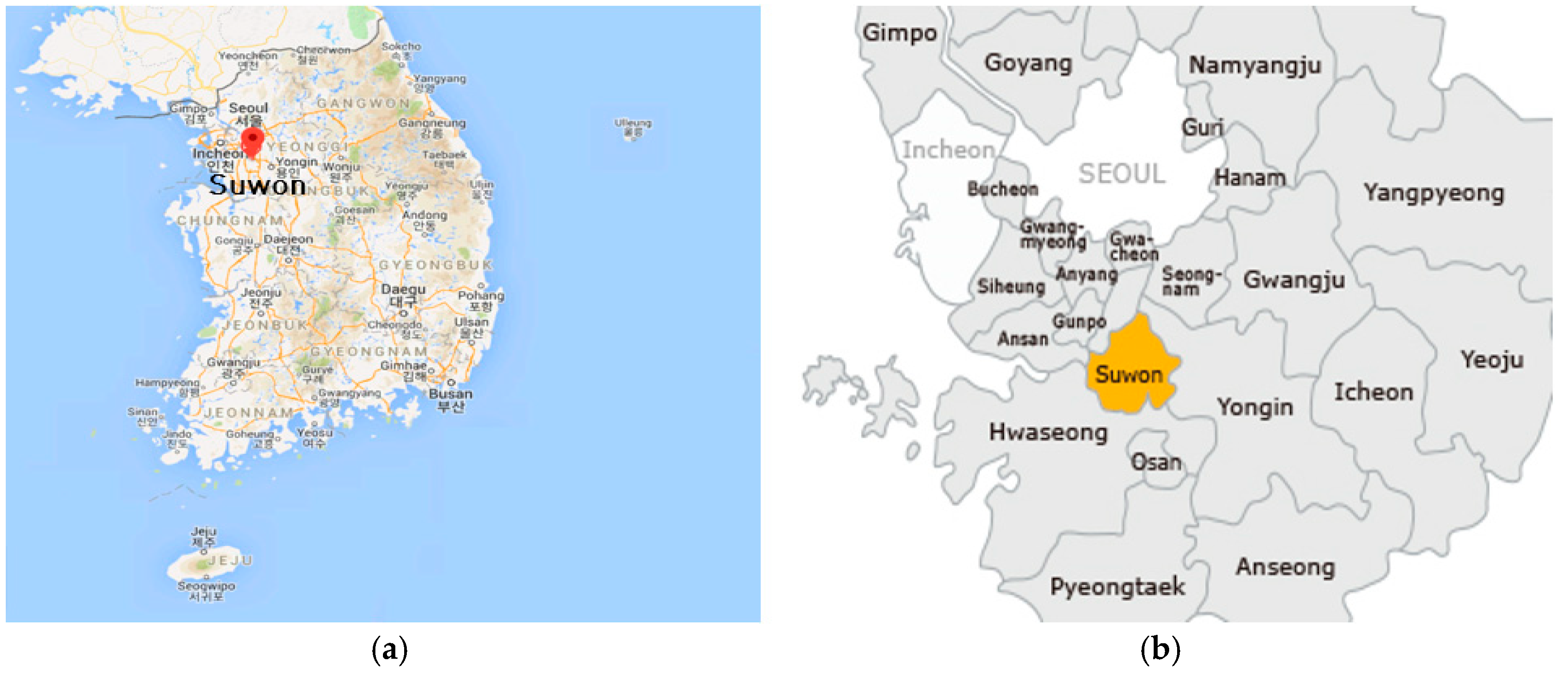
- Google Map. Suwon-si Gyeonggi-do. Available online: https://www.google.co.kr/maps/place/Suwon-si,+Gyeonggi-do/@35.8092304,127.0438222,7.18z/data=!4m5!3m4!1s0x357b430a20764611:0xf1373002ee5db4c9!8m2!3d37.2635727!4d127.0286009 (accessed on 6 May 2018).
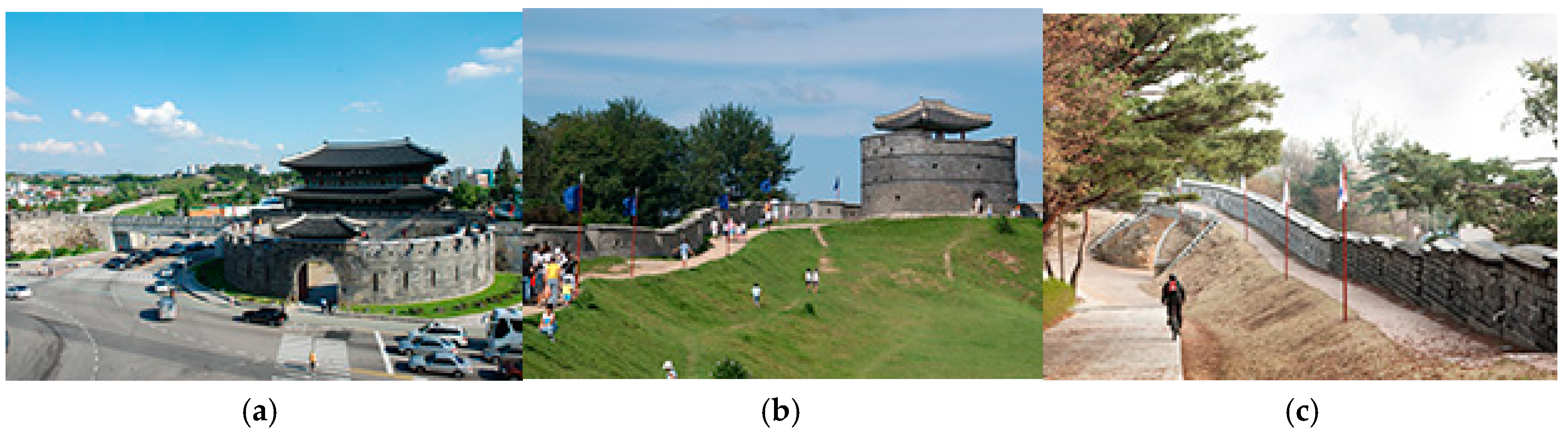
- Medical Korea. Attractions, Suwon Hwaseong Fortress. Available online: http://www.koreamedical.or.kr/en/gmeditour-tour/suwon-hwaseong-fortress/ (accessed on 6 May 2018).
- Hwaseong, How to Win the World Recognition? OhMyNews. 18 September 2006. Available online: http://www.ohmynews.com/NWS_Web/view/at_pg.aspx?CNTN_CD=A0000360523 (accessed on 28 May 2016). (In Korean)
- Kim, B. Kim’s Story on Korean Architecture 1; Dolbege: Seoul, Korea, 2006; ISBN 8971992328. (In Korean) [Google Scholar]
- Suwon Cultural Foundation. Hwaseong Fortress: Facility Information, Janganmun (the North Gate). Available online: http://english.swcf.or.kr/?p=34&mode=view&idx=328&rIdx=99999210 (accessed on 24 March 2018).
- Suwon Cultural Foundation. Available online: http://english.swcf.or.kr/?p=34&mode=view&idx=55&rIdx=99999837 (accessed on 24 March 2018).
- Suwon Cultural Foundation. Hwaseong Fortress: Introduction. Available online: http://english.swcf.or.kr/?p=31 (accessed on 24 March 2018).
- Kim, J. Activation of the Suwon Hwaseong Cultural Content Based on the Joseon Royal Records. Hum. Contents 2014, 34, 213–237. [Google Scholar]
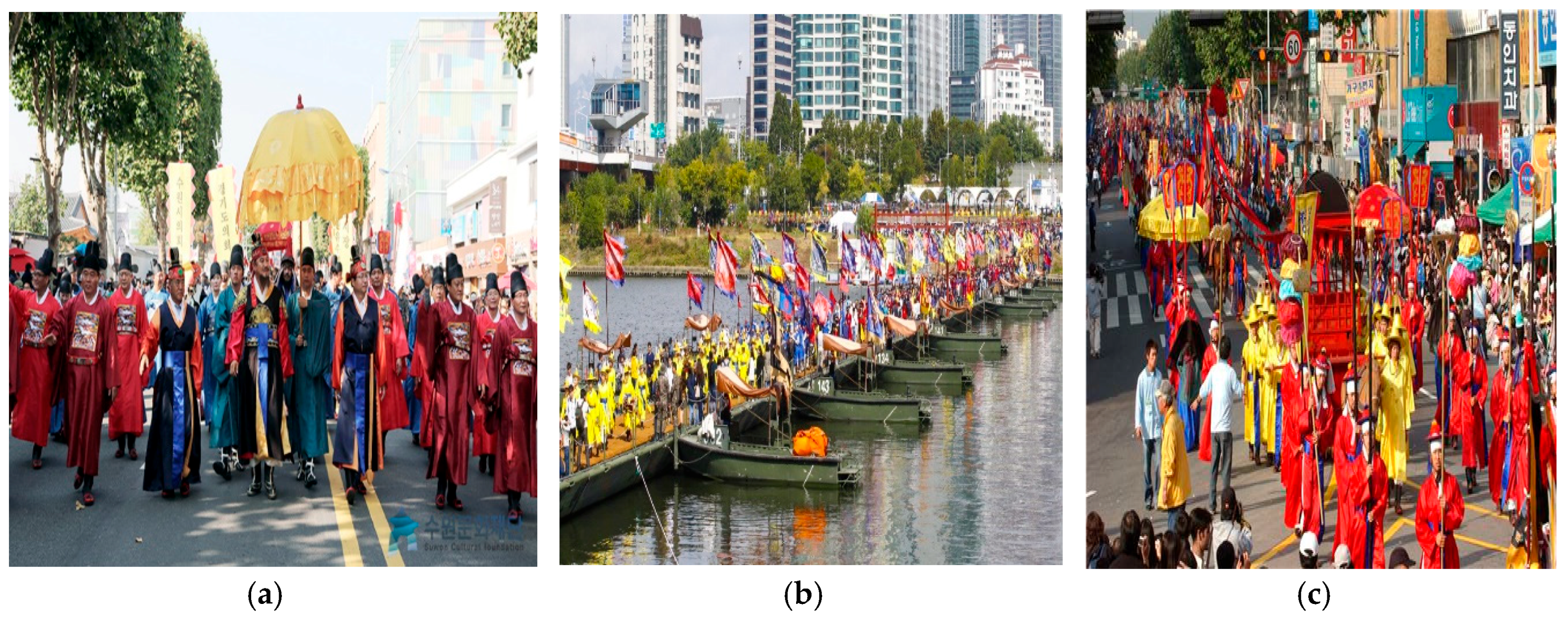
- Suwon Cultural Foundation. Suwon Hwaseong Festival. Available online: http://www.swcf.or.kr/?p=86 (accessed on 7 May 2018). (In Korean)
- Suwon Cultural Foundation. A Time Travel with King Jeongjo 220 Years ago, 52nd Suwon Hwaseong Festival Monarch Procession Volunteer Recruitment. Available online: http://blog.naver.com/PostView.nhn?blogId=swcf_kr&logNo=220407112645&parentCategoryNo=&categoryNo=31&viewDate=&isShowPopularPosts=true&from=search (accessed on 7 May 2018). (In Korean)
- Seoul Changdeokgung~Suwon Hwaseong—King Jeongjo Is here. Incheon Daily. 10 October 2016. Available online: http://www.incheonilbo.com/?mod=news&act=articleView&idxno=729910 (accessed on 7 May 2018). (In Korean)
- Reenacting the whole Route of Jeongjo Monarch Process, Seoul-Suwon-Hwaseong 59.2 km. Asia Economy. 23 September 2017. Available online: http://www.asiae.co.kr/news/view.htm?idxno=2017092114545156372 (accessed on 7 May 2018). (In Korean)
- Kang, I. A Study on the Characteristics of Planning of Hwa-sung from the Point of Water System. J. Korean Inst. Tradit. Landsc. Archit. 2011, 29, 137–147. (In Korean) [Google Scholar]
- Ahn, K. Suwon Hwaseong World Heritage Registration and Its History. Architecture 2015, 59, 48–55. (In Korean) [Google Scholar]
- Shim, S. Korea Culture’s honour and introspection in 21 Century. Hum. Contents 2006, 8, 197–213. (In Korean) [Google Scholar]
- Shim, S. The Meaning of Urban Regeneration through the Restoration and the Representation of Historical Spaces: Focusing on the Hwaseong Fortress. Hum. Contents 2012, 25, 39–67. (In Korean) [Google Scholar]
- Choi, H.; Noh, H. Revitalization Measures of Local Tourism Based on its Characteristics: Focused on Suwon Hwaseong Cultural Festival. J. Assoc. Korean Photo-Geogr. 2009, 19, 27–35. (In Korean) [Google Scholar]
- Hur, M.H.; Sa, Y.J.; Kim, W.S. Measurement of the Economic Benefits of Tourism Program for Suwon Hwaseong. J. KRSA 2009, 25, 23–46. [Google Scholar]
- Lee, J.; Cho, S. A Study on the Plan of the Historical and Cultural Trail Network Utilizing Old Roads of Hwaseong Fortress, Suwon City. J. Korean Inst. Tradit. Landsc. 2011, 9, 97–112. (In Korean) [Google Scholar]
- Kim, J. The Establishment of Suwon’s Identity and the Urban Regeneration Based on World Heritage of Suwon Hwaseong. Local Hist. Local Cult. 2016, 19, 39–70. (In Korean) [Google Scholar] [CrossRef] [Scilit]
- Hwang, H. Study on the Use of Region Branding of Historical Space: Focusing on the Suwon Hwaseong Temporary Palace Area. J. Korea Cult. Technol. 2011, 12, 139–161. (In Korean) [Google Scholar]
- Ahn, Y.; Park, S. Development of Elements for Locally Specialized Performance Contents based on the World Heritage, Suwon Hwaseong Fortress. Korean J. Dance 2015, 73, 71–92. (In Korean) [Google Scholar]
- Oh, S. The Investigation on Management Plan for the World Heritage ‘Suwon Hwaseong Fortress’ by Participant Observation. Int. J. Tour. Manag. Sci. 2013, 28, 237–257. (In Korean) [Google Scholar]
- Lee, H.; Kwon, J. Context Adaptive Mobile Cultural Tourism Contents Service: Experiments at the Hwaseong Castle of Suwon. J. Korean Inst. Inf. Technol. 2010, 8, 191–202. (In Korean) [Google Scholar]
- Nam, Y.; Um, S. Identifying potential markets to promote the mobile tourism application service at a tourist site. Int. J. Tour. Manag. Sci. 2014, 29, 237–255. (In Korean) [Google Scholar]
- Choi, H. A Study on the Development Plan Using Evaluation of Local Cultural Festival: Focused on Suwon Hwaseong Cultural Festival. Glob. Cult. Contents 2018, 32, 279–298. (In Korean) [Google Scholar]
- Kavaratzis, M.; Ashworth, G. City Branding: An Effective Assertion of Identity or a Transitory Marketing Trick? Tijdschr. Econ. Soc. Geogr. 2005, 96, 506–514. [Google Scholar] [CrossRef] [Scilit]
- Kavaratzis, M. From city marketing to city branding: Towards a theoretical framework for developing city brands. Place Brand. 2004, 1, 58–73. [Google Scholar] [CrossRef] [Scilit]
- Kavaratzis, M.; Braun, E.; Zenker, S. My City—My Brand: The Role of Residents in Place Branding. J. Place Manag. Dev. 2013, 6, 18–28. [Google Scholar] [CrossRef] [Scilit]
- Cleave, E.; Arku, G.; Sadler, R.; Kyeremeh, E. Place Marketing, Place Branding, and Social Media: Perspectives of Municipal Practitioners. Growth Chang. 2017, 48, 1012–1033. [Google Scholar] [CrossRef] [Scilit]
- Sevin, E. Branding Cities in the Age of Social Media Comparative Assessment of Local government performance. In Social Media and Local Governments: Theory and Practice; Sobaci, M., Ed.; Springer: Basel, Switzerand, 2016; ISBN 978-3-319-17721-2. [Google Scholar]
- Kavaratzis, M.; Hatch, M. The Dynamics of Place Brands: An Identity-based Approach to Place Branding Theory. Mark. Theory 2013, 13, 69–86. [Google Scholar] [CrossRef] [Scilit]
- Szondi, G. Branding Budapest. In City Branding: Theory and Cases; Dinnie, K., Ed.; Palgrave McMillan: New York, NY, USA, 2011; ISBN 978-0-230-24185-5. [Google Scholar]
- Wardrop, K. Edinburgh: Scotland’s Inspiring Capital. In City Branding: Theory and Cases; Dinnie, K., Ed.; Palgrave McMillan: New York, NY, USA, 2011; ISBN 978-0-230-24185-5. [Google Scholar]
- Kim, Y.; Kim, P. Seoul City Branding: The Case of Seoul’s International Brand Communication. In City Branding: Theory and Cases; Dinnie, K., Ed.; Palgrave McMillan: New York, NY, USA, 2011; ISBN 978-0-230-24185-5. [Google Scholar]
- Björner, E. International Positioning through online City Branding: The Case of Chengdu. J. Place Manag. Dev. 2013, 6, 203–226. [Google Scholar] [CrossRef] [Scilit]
- Sevin, E. Understanding Cities through City Brands: City Branding as a Social and Semantic Network. Cities 2014, 38, 47–56. [Google Scholar] [CrossRef] [Scilit]
- Hansen, D.; Shneiderman, B.; Smith, M.A. Analysing Social Media Networks with NodeXL: Insights from a Connected World; Morgan Kaufmann: Burlington, MA, USA, 2011; ISBN 978-0-12-382229-1. [Google Scholar]
- McPherson, E. Spot news versus reportage: Newspaper models, the distribution of newsroom credibility, and implications for democratic journalism in Mexico. Int. J. Commun. 2012, 6, 2301–2317. [Google Scholar]
- Node XL Korea. Catching Up NodeXL; Paradigm Book: Seoul, Korea, 2015; ISBN 979-11-955480-3-3. (In Korean) [Google Scholar]
- Burt, R. Brokerage and Closure; Oxford University Press: Oxford, UK, 2005; ISBN 0191622850. [Google Scholar]
- Burt, R. Structural Holes: The Social Structure of Competition; Harvard University Press: Cambridge, MA, USA, 1995; ISBN 0674843711. [Google Scholar]
- Suwon City and·‘2016 Visit Year Suwon Hwaseong’ Promotion Bureau. 2016 Visit Year Suwon Hwaseong White Paper: Jeongjo, Pursuing His Dream in Suwon; 2016. Available online: https://www.suwon.go.kr/common-upload/visitsuwon/2016visit_down.pdf (accessed on 26 May 2018). (In Korean)
- Kang, Y. The Assessment of Visit Year 2016 Suwon Hwaseong; Suwon Research Institute: Suwon, Korea, 2017; Available online: https://www.suwon.re.kr/board/board.php?bo_table=research_reports&wr_id=174 (accessed on 26 May 2018). (In Korean)
- Gyeonggi Cultural Foundation. Available online: http://www.ggcf.kr/archives/71192 (accessed on 26 May 2018).
- Suwon City Hall. Available online: http://www.suwon.go.kr/web/visitsuwon/pages/etc01/pages-05-03.do (accessed on 26 May 2018).





| Classification | Type | Description |
|---|---|---|
| Aggregate Network Metrics | Density | The number of relationships observed to be present in a network, divided by the total number of possible relationships that could be present. |
| Geodesic Distance | The distance of the shortest path between two people. The Average Geodesic Distance gives a sense of how close community members are from one another. | |
| Vertex-Specific Metrics | Degree Centrality | Gives the total number of links to a vertex, but does not indicate link quality. |
| In-Degree Centrality | The number of links to a vertex. | |
| Out-Degree Centrality | The number of links from a node to other vertices. | |
| Betweenness Centrality | The number of times a node lies in the shortest path between two other vertices. | |
| Closeness Centrality | The average length between a vertex and every other in the network. | |
| Eigenvector Centrality | In this measure, if a vertex has links to other nodes that are well connected, then the first node has a high value. |
| 2015 | 2016 | 2017 | |
|---|---|---|---|
| Vertices | 72 | 112 | 86 |
| Edges | 26 | 83 | 49 |
| 2015 | 2016 | 2017 | ||
|---|---|---|---|---|
| Aggregate Network Metrics | Density | 0.0051 | 0.0067 | 0.0067 |
| Average Geodesic Distance | 1.0598 | 1.5346 | 1.1515 | |
| Vertex-Specific Metrics | Average In-Degree Centrality | 0.361 | 0.741 | 0.570 |
| Average Out-Degree Centrality | 0.361 | 0.741 | 0.570 | |
| Average Betweenness Centrality | 0.5 | 4.411 | 0.977 | |
| Average Closeness Centrality | 0.183 | 0.244 | 0.238 | |
| Average Eigenvector Centrality | 0.014 | 0.009 | 0.012 | |
© 2018 by the authors. Licensee MDPI, Basel, Switzerland. This article is an open access article distributed under the terms and conditions of the Creative Commons Attribution (CC BY) license (http://creativecommons.org/licenses/by/4.0/).
Share and Cite
Yoon, S.-W.; Chung, S.W. Promoting a World Heritage Site through Social Media: Suwon City’s Facebook Promotion Strategy on Hwaseong Fortress (in South Korea). Sustainability 2018, 10, 2189. https://doi.org/10.3390/su10072189
Yoon S-W, Chung SW. Promoting a World Heritage Site through Social Media: Suwon City’s Facebook Promotion Strategy on Hwaseong Fortress (in South Korea). Sustainability. 2018; 10(7):2189. https://doi.org/10.3390/su10072189
Chicago/Turabian StyleYoon, Sung-Won, and Sae Won Chung. 2018. "Promoting a World Heritage Site through Social Media: Suwon City’s Facebook Promotion Strategy on Hwaseong Fortress (in South Korea)" Sustainability 10, no. 7: 2189. https://doi.org/10.3390/su10072189
APA StyleYoon, S.-W., & Chung, S. W. (2018). Promoting a World Heritage Site through Social Media: Suwon City’s Facebook Promotion Strategy on Hwaseong Fortress (in South Korea). Sustainability, 10(7), 2189. https://doi.org/10.3390/su10072189