SWAT-Simulated Streamflow Responses to Climate Variability and Human Activities in the Miyun Reservoir Basin by Considering Streamflow Components



Abstract
1. Introduction
2. Study Area and Dataset
2.1. Study Area Description
2.2. Datasets Used in This Study
3. Methodologies
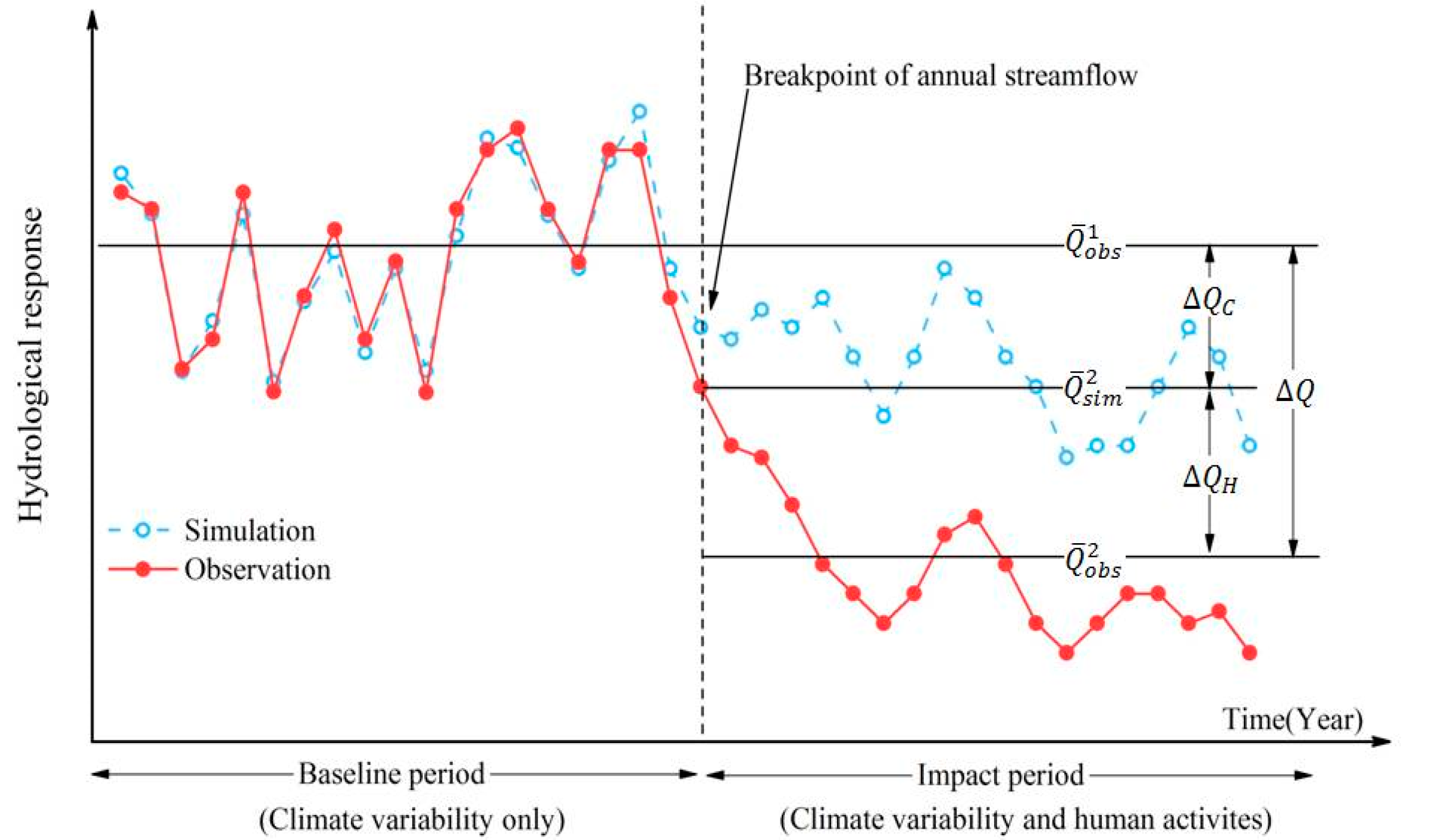
3.1. Framework for Identifying the Impacts of Climate Variability and Human Activities on Streamflow Change
3.2. Detection of Hydroclimatic Changes
3.3. The Hydrological Model: The Soil and Water Assessment Tool (SWAT)
3.3.1. SWAT Setup, Calibration and Validation
3.3.2. Baseflow Separation Using Automatic Baseflow Filter
4. Results
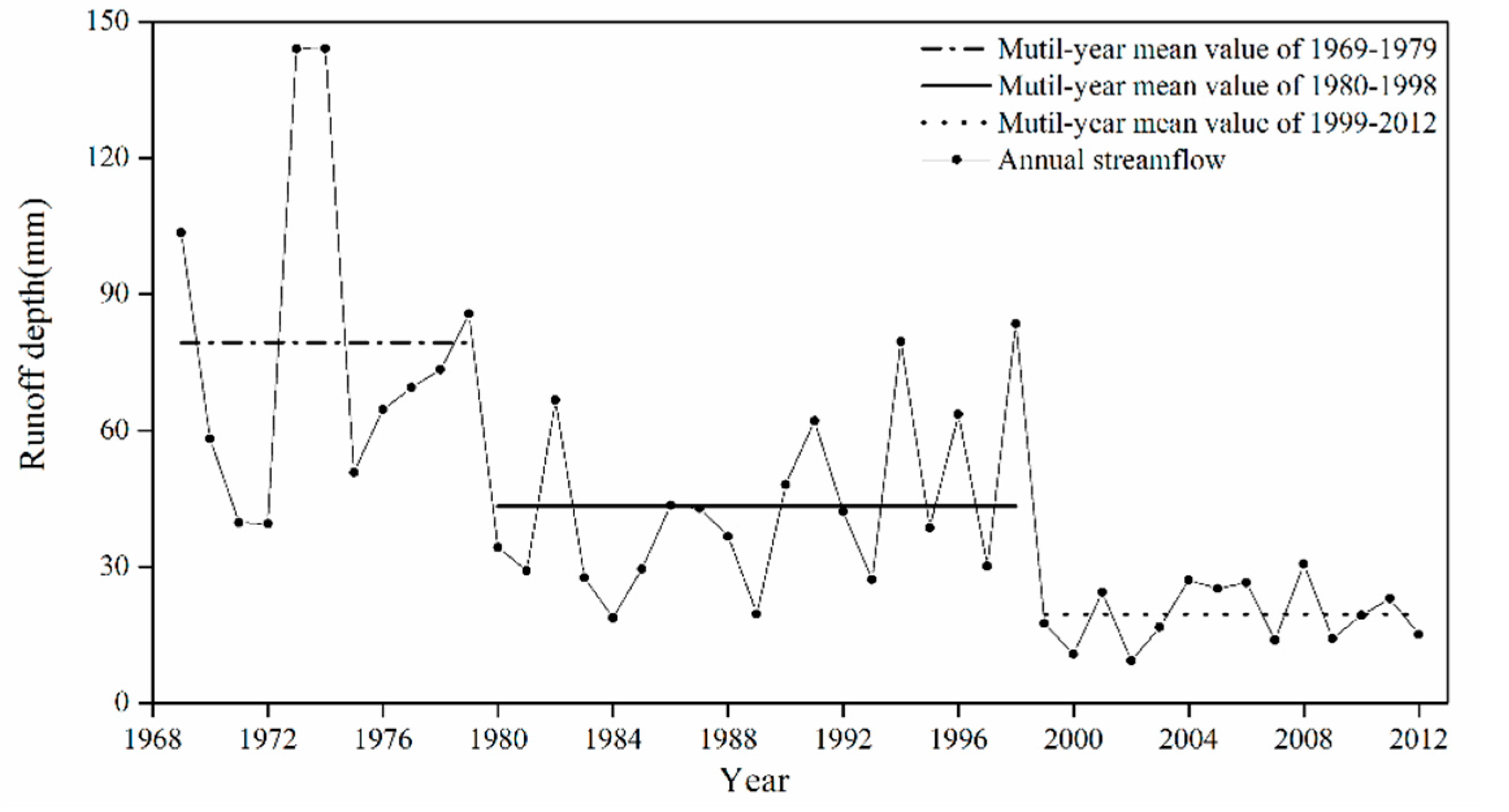
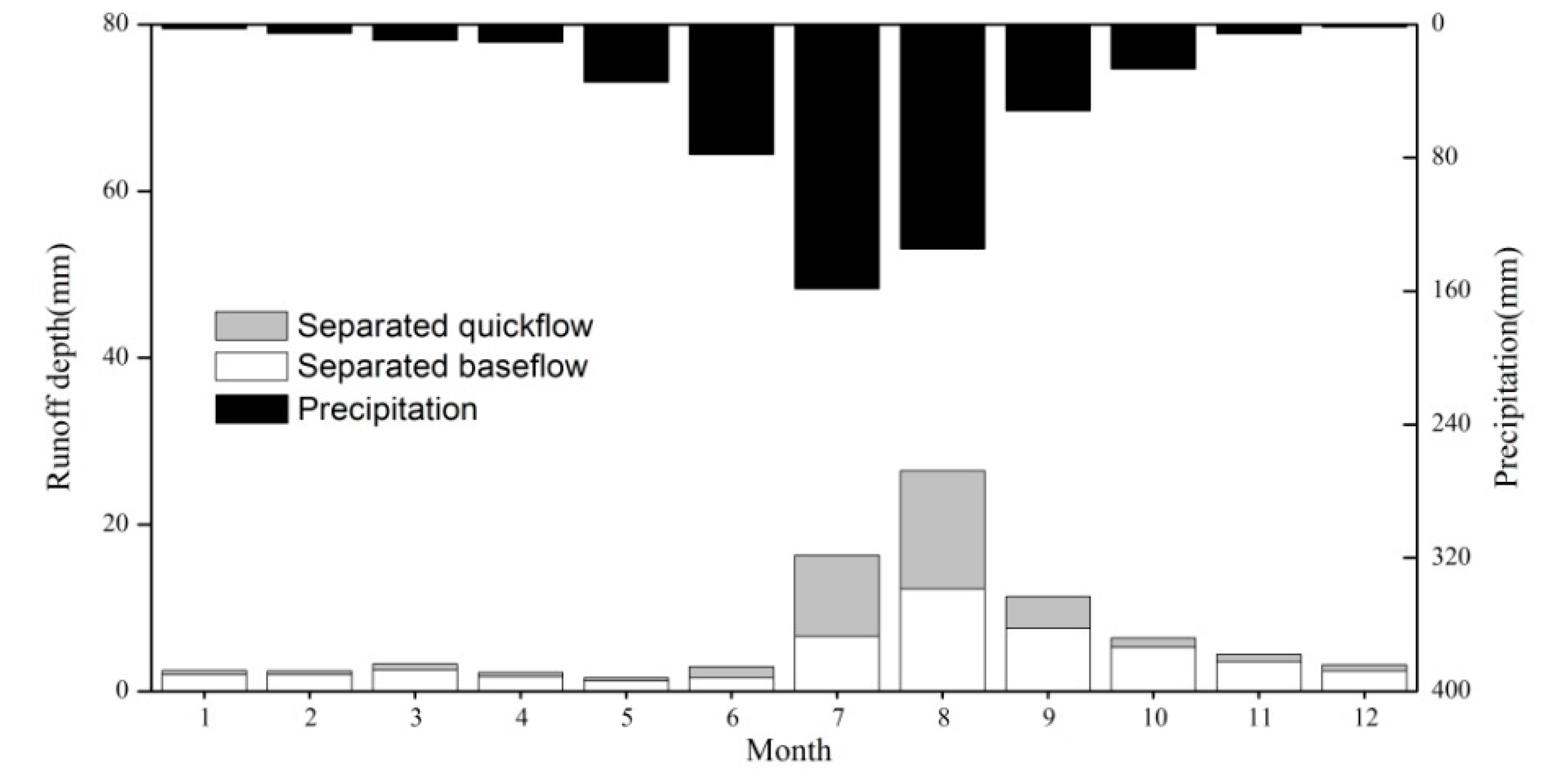
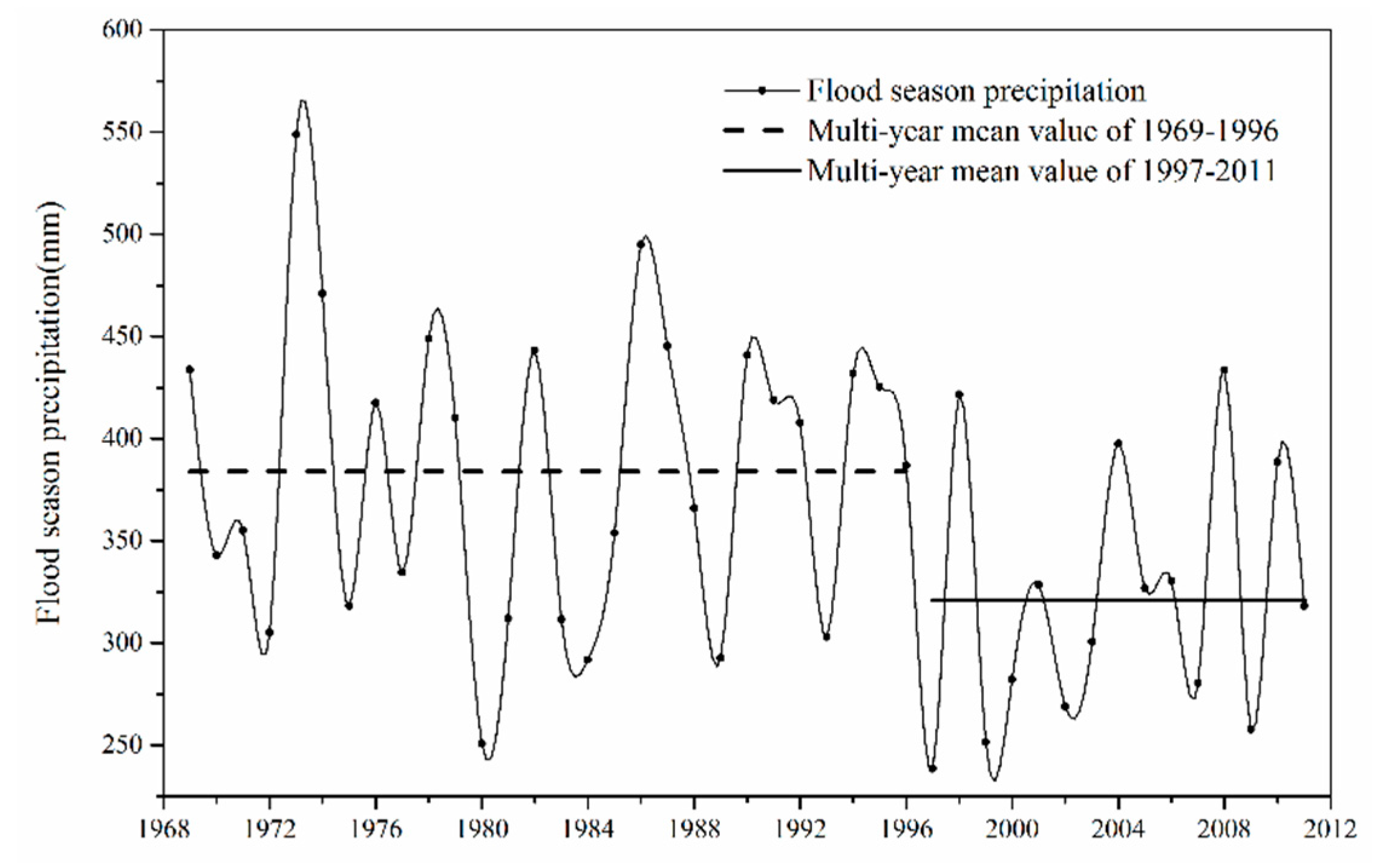
4.1. Breakpoint Determination
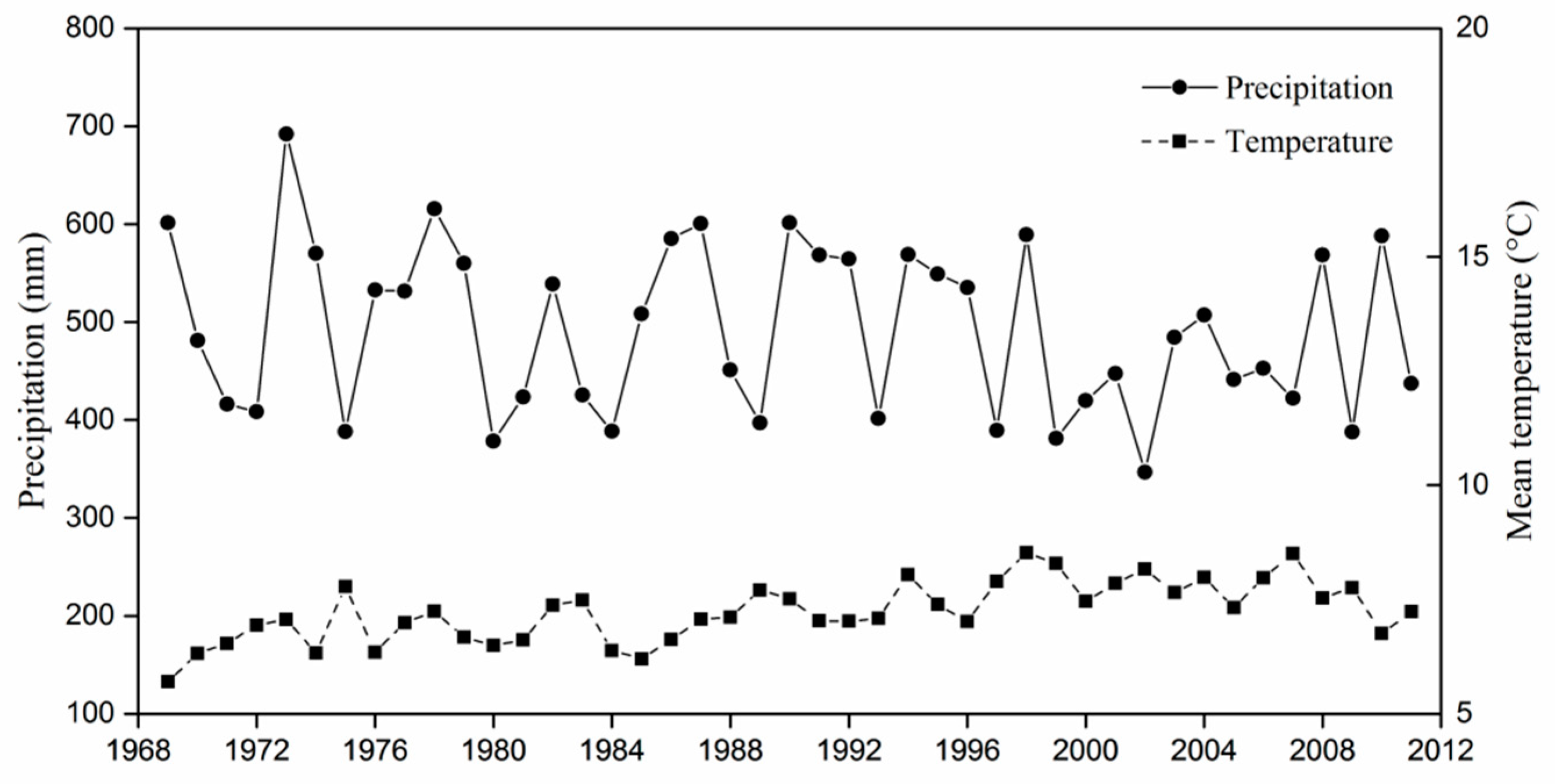
4.2. Changes in Hydroclimatic Variables
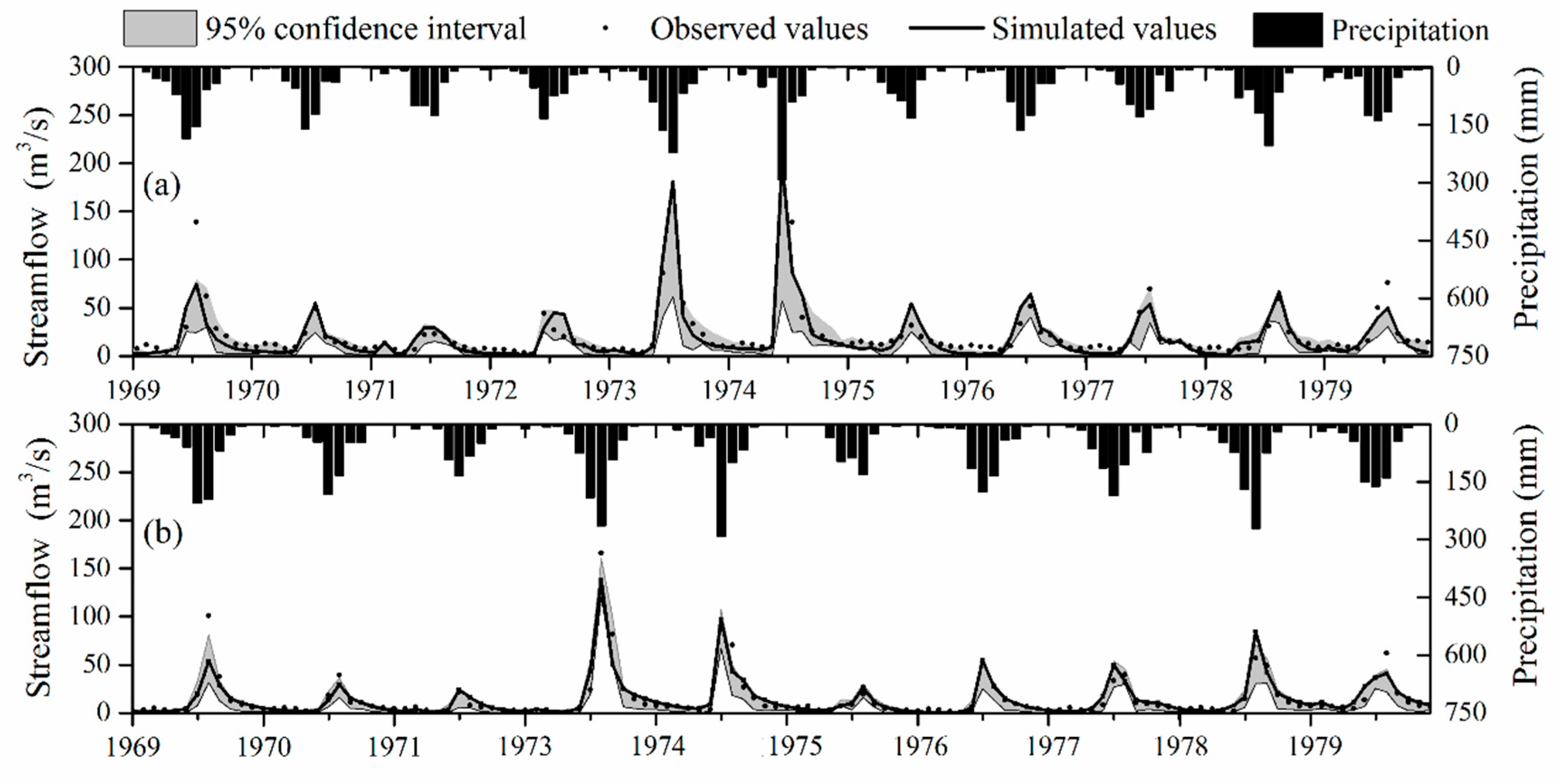
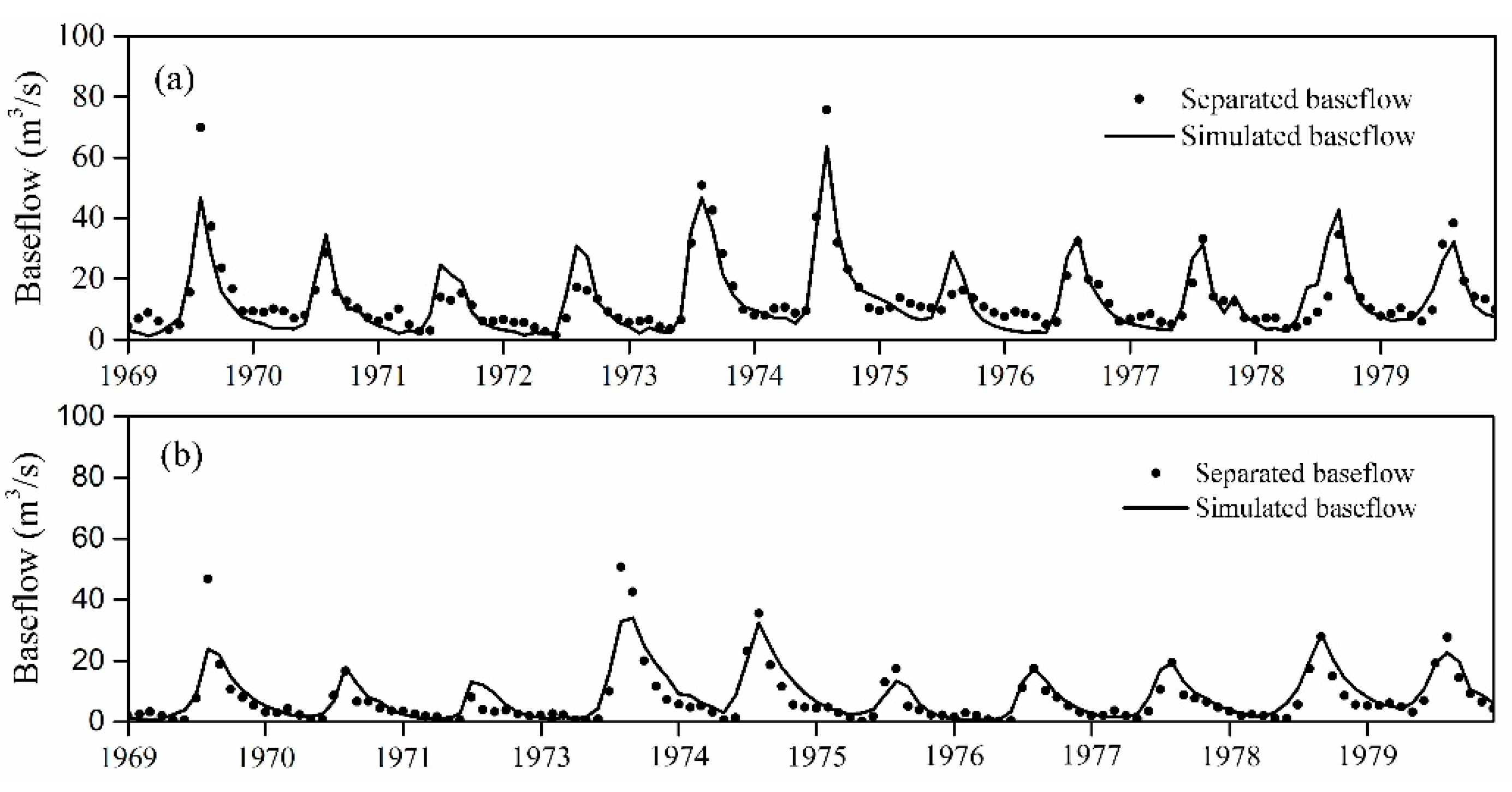
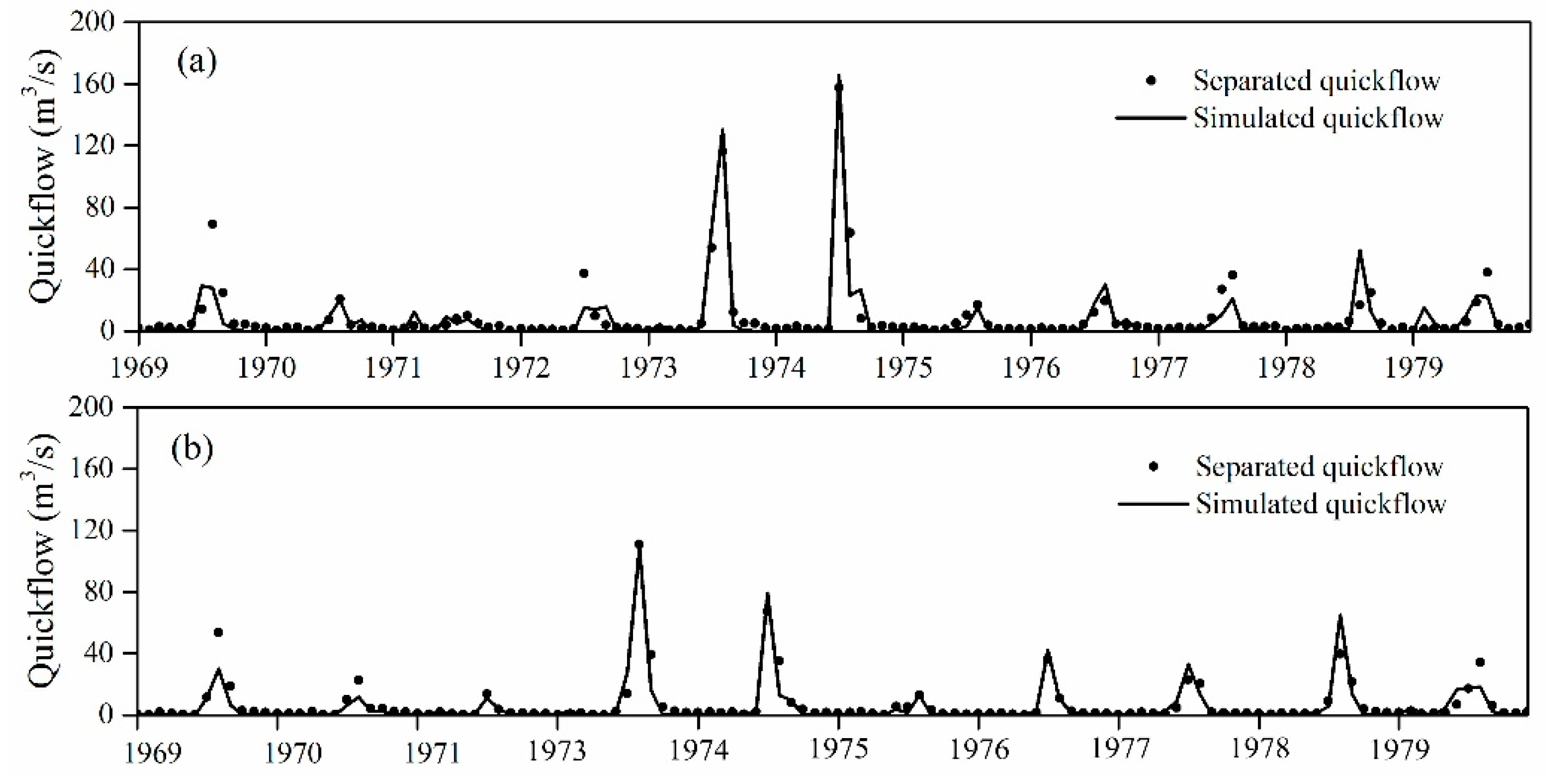
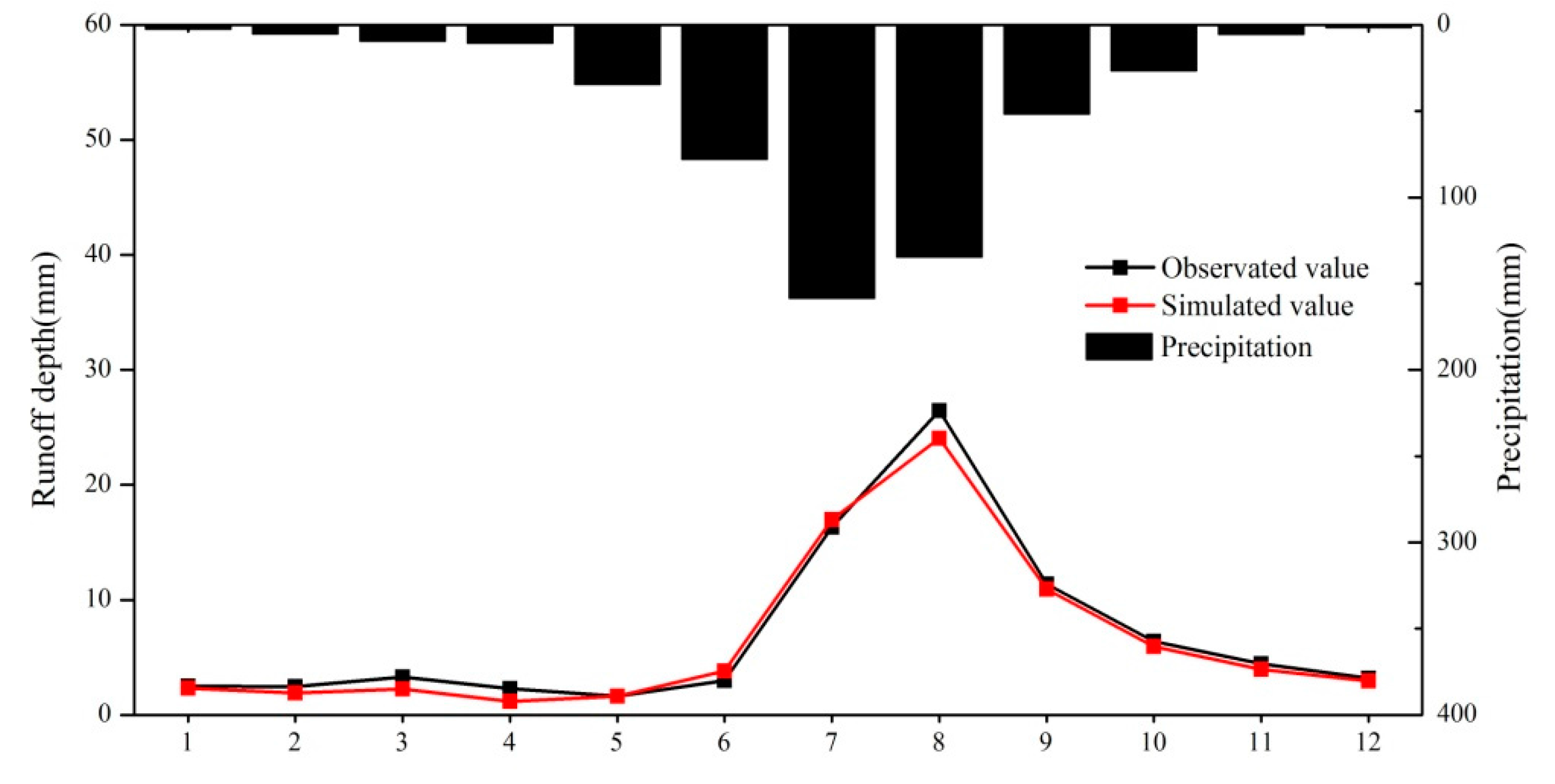
4.3. Model Performance Evaluation
4.4. Assessment of the Climate Variability and Human Activities Impacts on Streamflow Change
4.4.1. The Impact of Climate Variability on Streamflow and Its Components
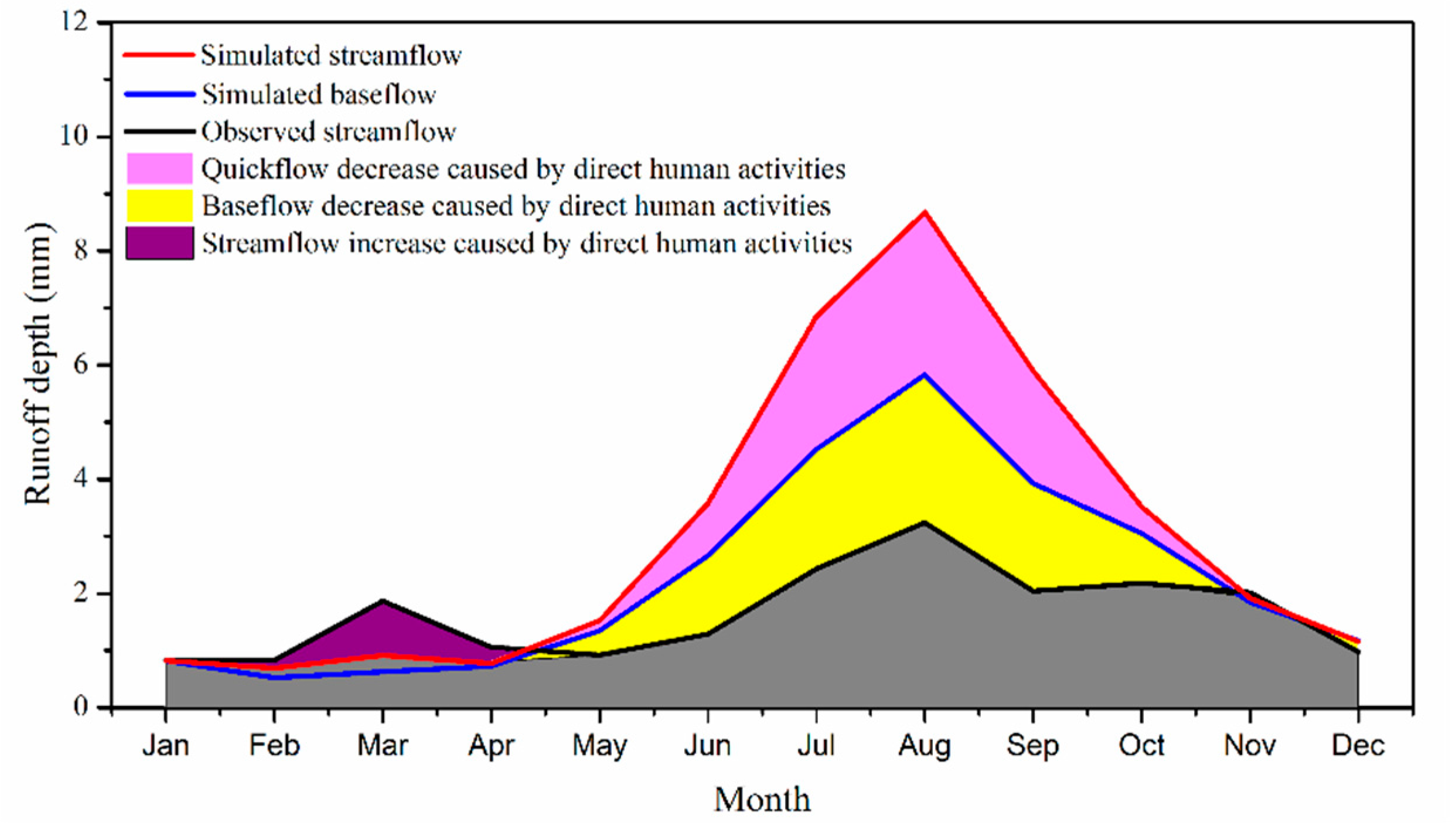
4.4.2. The Impact of Human Activities on Streamflow and Its Components
4.4.3. Contributions of Climate Variability and Human Activities to Streamflow Change
5. Discussion
5.1. Rationality Analysis of Breakpoint Identification
5.2. Uncertainty Analysis
5.3. Implications for Watershed Management
6. Conclusions
Supplementary Materials
Acknowledgments
Author Contributions
Conflicts of Interest
References
- Huntington, T.G. Evidence for intensification of the global water cycle: Review and synthesis. J. Hydrol. 2006, 319, 83–95. [Google Scholar] [CrossRef]
- Milly, P.C.D.; Dunne, K.A.; Vecchia, A.V. Global pattern of trends in streamflow and water availability in a changing climate. Nature 2005, 438, 347–350. [Google Scholar] [CrossRef] [PubMed]
- Lahmer, W.; Pfutzner, B.; Becker, A. Assessment of land use and climate change impacts on the mesoscale. Phys. Chem. Earth Part B Hydrol. Oceans Atmos. 2001, 26, 565–575. [Google Scholar] [CrossRef]
- Milliman, J.D.; Farnsworth, K.L.; Jones, P.D.; Xu, K.H.; Smith, L.C. Climatic and anthropogenic factors affecting river discharge to the global ocean, 1951–2000. Glob. Planet. Chang. 2008, 62, 187–194. [Google Scholar] [CrossRef]
- Poff, N.L.; Allan, J.D.; Bain, M.B.; Karr, J.R.; Prestegaard, K.L.; Richter, B.D.; Sparks, R.E.; Stromberg, J.C. The natural flow regime. Bioscience 1997, 47, 769–784. [Google Scholar] [CrossRef]
- Feng, X.; Zhang, G.; Yin, X. Hydrological Responses to Climate Change in Nenjiang River Basin, Northeastern China. Water Res. Manag. 2011, 25, 677–689. [Google Scholar] [CrossRef]
- Hao, X.; Chen, Y.; Xu, C.; Li, W. Impacts of climate change and human activities on the surface runoff in the Tarim River basin over the last fifty years. Water Res. Manag. 2008, 22, 1159–1171. [Google Scholar] [CrossRef]
- Dey, P.; Mishra, A. Separating the impacts of climate change and human activities on streamflow: A review of methodologies and critical assumptions. J. Hydrol. 2017, 548, 278–290. [Google Scholar] [CrossRef]
- Zhang, K.; Li, L.; Bai, P.; Li, J.; Liu, Y. Influence of climate variability and human activities on stream flow variation in the past 50 years in Taoer River, Northeast China. J. Geogr. Sci. 2017, 27, 481–496. [Google Scholar] [CrossRef]
- Kliment, Z.; Matouskova, M. Runoff Changes in the umava Mountains (Black Forest) and the Foothill Regions: Extent of Influence by Human Impact and Climate Change. Water Res. Manag. 2009, 23, 1813–1834. [Google Scholar] [CrossRef]
- Patterson, L.A.; Lutz, B.; Doyle, M.W. Climate and direct human contributions to changes in mean annual streamflow in the South Atlantic, USA. Water Res. Res 2013, 49, 7278–7291. [Google Scholar] [CrossRef]
- Wang, D.; Hejazi, M. Quantifying the relative contribution of the climate and direct human impacts on mean annual streamflow in the contiguous United States. Water Resour. Res. 2011, 47, 1–16. [Google Scholar] [CrossRef]
- Lin, K.; Guo, S.; Zhang, W.; Liu, P. A new baseflow separation method based on analytical solutions of the Horton infiltration capacity curve. Hydrol. Process. 2007, 21, 1719–1736. [Google Scholar] [CrossRef]
- Zheng, M. Estimation of base flow using flow-sediment relationships in the Chinese Loess Plateau. Catena 2015, 125, 129–134. [Google Scholar] [CrossRef]
- Merz, R.; Bloeschl, G.; Parajka, J. Spatio-temporal variability of event runoff coefficients. J. Hydrol. 2006, 331, 591–604. [Google Scholar] [CrossRef]
- Price, K. Effects of watershed topography, soils, land use, and climate on baseflow hydrology in humid regions: A review. Prog. Phys. Geogr. 2011, 35, 465–492. [Google Scholar] [CrossRef]
- Zhang, X.S.; Srinivasan, R.; Arnold, J.; Izaurralde, R.C.; Bosch, D. Simultaneous calibration of surface flow and baseflow simulations: A revisit of the SWAT model calibration framework. Hydrol. Process. 2011, 25, 2313–2320. [Google Scholar] [CrossRef]
- Zhang, A.; Zhang, C.; Fu, G.; Wang, B.; Bao, Z.; Zheng, H. Assessments of Impacts of Climate Change and Human Activities on Runoff with SWAT for the Huifa River Basin, Northeast China. Water Res. Manag. 2012, 26, 2199–2217. [Google Scholar] [CrossRef]
- Lee, G.; Shin, Y.; Jung, Y. Development of Web-Based RECESS Model for Estimating Baseflow Using SWAT. Sustainability 2014, 6, 2357–2378. [Google Scholar] [CrossRef]
- Luo, Y.; Arnold, J.; Allen, P.; Chen, X. Baseflow simulation using SWAT model in an inland river basin in Tianshan Mountains, Northwest China. Hydrol. Earth Syst. Sci. 2012, 16, 1259–1267. [Google Scholar] [CrossRef]
- Shi, P.; Chen, C.; Srinivasan, R.; Zhang, X.S.; Cai, T.; Fang, X.Q.; Qu, S.M.; Chen, X.; Li, Q.F. Evaluating the SWAT Model for Hydrological Modeling in the Xixian Watershed and a Comparison with the XAJ Model. Water Res. Manag. 2011, 25, 2595–2612. [Google Scholar] [CrossRef]
- Lin, K.; Lian, Y.; He, Y. Effect of Baseflow Separation on Uncertainty of Hydrological Modeling in the Xinanjiang Model. Math. Probl. Eng. 2014, 2014, 1–9. [Google Scholar] [CrossRef]
- Wang, G.; Xia, J.; Chen, J. Quantification of effects of climate variations and human activities on runoff by a monthly water balance model: A case study of the Chaobai River basin in northern China. Water Resour. Res. 2009, 45, 1–12. [Google Scholar] [CrossRef]
- Wang, X.; Hao, G.; Yang, Z.; Liang, P.; Cai, Y.; Li, C.; Sun, L.; Zhu, J. Variation analysis of streamflow and ecological flow for the twin rivers of the Miyun Reservoir Basin in northern China from 1963 to 2011. Sci. Total Environ. 2015, 536, 739–749. [Google Scholar] [CrossRef] [PubMed]
- Ma, H.; Yang, D.; Tan, S.K.; Gao, B.; Hu, Q. Impact of climate variability and human activity on streamflow decrease in the Miyun Reservoir catchment. J. Hydrol. 2010, 389, 317–324. [Google Scholar] [CrossRef]
- Yan, T.; Shen, Z.; Bai, J. Spatial and Temporal Changes in Temperature, Precipitation, and Streamflow in the Miyun Reservoir Basin of China. Water 2017, 9. [Google Scholar] [CrossRef]
- Tang, L.; Yang, D.; Hu, H.; Gao, B. Detecting the effect of land-use change on streamflow, sediment and nutrient losses by distributed hydrological simulation. J. Hydrol. 2011, 409, 172–182. [Google Scholar] [CrossRef]
- Zhao, Y.; Zhang, X.; Cao, W.; Yu, X.; Liu, B.; Zhu, B.; Cheng, C.; Yin, X.; Xie, G. Effect of climatic change and afforestation on water yield in the Rocky Mountain Area of North China. For. Syst. 2015, 24. [Google Scholar] [CrossRef]
- Zheng, J.; Sun, G.; Li, W.; Yu, X.; Zhang, C.; Gong, Y.; Tu, L. Impacts of land use change and climate variations on annual inflow into the Miyun Reservoir, Beijing, China. Hydrol. Earth Syst. Sci. 2016, 20, 1561–1572. [Google Scholar] [CrossRef]
- Reddy, A.S.; Reddy, M.J. Evaluating the influence of spatial resolutions of DEM on watershed runoff and sediment yield using SWAT. J. Earth Syst. Sci. 2015, 124, 1517–1529. [Google Scholar] [CrossRef]
- Tan, M.L.; Ficklin, D.L.; Dixon, B.; Ibrahim, A.L.; Yusop, Z.; Chaplot, V. Impacts of DEM resolution, source, and resampling technique on SWAT-simulated streamflow. Appl. Geogr. 2015, 63, 357–368. [Google Scholar] [CrossRef]
- Wang, H.Q.; Zhang, M.S.; Zhu, H.; Dang, X.Y.; Yang, Z.; Yin, L.H. Hydro-climatic trends in the last 50 years in the lower reach of the Shiyang River Basin, NW China. Catena 2012, 95, 33–41. [Google Scholar] [CrossRef]
- Wang, W.; Shao, Q.; Yang, T.; Peng, S.; Xing, W.; Sun, F.; Luo, Y. Quantitative assessment of the impact of climate variability and human activities on runoff changes: A case study in four catchments of the Haihe River basin, China. Hydrol. Process. 2013, 27, 1158–1174. [Google Scholar] [CrossRef]
- Ye, X.; Zhang, Q.; Liu, J.; Li, X.; Xu, C.-Y. Distinguishing the relative impacts of climate change and human activities on variation of streamflow in the Poyang Lake catchment, China. J. Hydrol. 2013, 494, 83–95. [Google Scholar] [CrossRef]
- Li, Y.; Chang, J.; Wang, Y.; Jin, W.; Guo, A. Spatiotemporal Impacts of Climate, Land Cover Change and Direct Human Activities on Runoff Variations in the Wei River Basin, China. Water 2016, 8. [Google Scholar] [CrossRef]
- Huang, S.; Huang, Q.; Leng, G.; Zhao, M.; Meng, E. Variations in annual water-energy balance and their correlations with vegetation and soil moisture dynamics: A case study in the Wei river basin, China. J. Hydrol. 2017, 546, 515–525. [Google Scholar] [CrossRef]
- Zhang, J.; Huang, Q.; Zhao, X. Comparative research on abrupt change analysis methods for hydrological time series in Zhangze reservoir. J. Basic Sci. Eng. 2013, 21, 837–844. (In Chinese) [Google Scholar]
- Liu, Q.; Wan, S.; Gu, B. A review of the detection methods for climate regime shifts. Discret. Dyn. Nat. Soc. 2016. [Google Scholar] [CrossRef]
- Bernaola-Galvan, P.; Ivanov, P.C.; Amaral, L.A.N.; Stanley, H.E. Scale invariance in the nonstationarity of human heart rate. Phys. Rev. Lett. 2001. [Google Scholar] [CrossRef] [PubMed]
- Huang, S.; Chang, J.; Huang, Q.; Wang, Y.; Chen, Y. Calculation of the instream ecological flow of the Wei river based on hydrological variation. J. Appl. Math. 2014. [Google Scholar] [CrossRef]
- Qian, B.; Zhang, D.; Wang, J.; Huang, F.; Wu, Y. Impacts of reservoirs on the streamflow and sediment load of the Hanjiang river, China. Environ. Monit. Assess. 2016, 188, 1–10. [Google Scholar] [CrossRef] [PubMed]
- Huang, F.; Xia, Z.; Li, F.; Wu, T. Assessing sediment regime alteration of the upper Yangtze river. Environ. Earth Sci. 2013, 70, 2349–2357. [Google Scholar] [CrossRef]
- Neitsch, S.L.; Arnold, J.G.; Kiniry, J.R.; Williams Grassland, J.R. Soil and Water Assessment Tool Theoretical Documentation Version 2009; Texas Water Resources Institute: Temple, TX, USA, 2011. [Google Scholar]
- Arnold, J.G.; Fohrer, N. Swat2000: Current capabilities and research opportunities in applied watershed modelling. Hydrol. Process. 2005, 19, 563–572. [Google Scholar] [CrossRef]
- Gassman, P.W.; Sadeghi, A.M.; Srinivasan, R. Applications of the swat model special section: Overview and insights. J. Environ. Qual. 2014, 43, 1–8. [Google Scholar] [CrossRef] [PubMed]
- Shen, Z.; Zhong, Y.; Huang, Q.; Chen, L. Identifying non-point source priority management areas in watersheds with multiple functional zones. Water Res. 2015, 68, 563–571. [Google Scholar] [CrossRef] [PubMed]
- Zhang, L.; Li, X. Assessing hydrological effects of human activities by hydrological characteristic parameters: A case study in the Yunzhou reservoir basin. Res. Sci. 2004, 26, 62–67. (In Chinese) [Google Scholar]
- Zhu, L.; Qin, F.; Yao, Y. Response of land use change to hydrological dynamics in rocky mountain area of north china based on Yunzhou reservoir of Zhangjiakou. Res. Soil Water Conserv. 2009, 16, 224–228. (In Chinese) [Google Scholar]
- Abbaspour, K.C.; Vejdani, M.; Haghighat, S. Swat-cup calibration and uncertainty programs for swat. Modsim 2007 Int. Congr. Model. Simul. Land Water Environ. Manag. Integr. Syst. Sustain. 2007, 1603–1609. [Google Scholar] [CrossRef]
- Yang, J.; Reichert, P.; Abbaspour, K.C.; Xia, J.; Yang, H. Comparing uncertainty analysis techniques for a swat application to the chaohe basin in china. J. Hydrol. 2008, 358, 1–23. [Google Scholar] [CrossRef]
- Moriasi, D.N.; Arnold, J.G.; Van Liew, M.W.; Bingner, R.L.; Harmel, R.D.; Veith, T.L. Model evaluation guidelines for systematic quantification of accuracy in watershed simulations. Trans. ASABE 2007, 50, 885–900. [Google Scholar] [CrossRef]
- Partington, D.; Brunner, P.; Simmons, C.T.; Werner, A.D.; Therrien, R.; Maier, H.R.; Dandy, G.C. Evaluation of outputs from automated baseflow separation methods against simulated baseflow from a physically based, surface water-groundwater flow model. J. Hydrol. 2012, 458, 28–39. [Google Scholar] [CrossRef]
- He, S.; Li, S.; Xie, R.; Lu, J. Baseflow separation based on a meteorology-corrected nonlinear reservoir algorithm in a typical rainy agricultural watershed. J. Hydrol. 2016, 535, 418–428. [Google Scholar] [CrossRef]
- Arnold, J.G.; Allen, P.M.; Muttiah, R.; Bernhardt, G. Automated base-flow separation and recession analysis techniques. Ground Water 1995, 33, 1010–1018. [Google Scholar] [CrossRef]
- Vincent, L.; Hollick, M. Stochastic Time-Variable Rainfall-Runoff Modelling; Hydrology and Water Resources Symposium Perth 1979 Proceedings; National Committee on Hydrology and Water Resources of the Institution of Engineers: Hobart, Australia, 1979; pp. 89–92. [Google Scholar]
- Arnold, J.G.; Allen, P.M. Automated methods for estimating baseflow and ground water recharge from streamflow records. J. Am. Water Resour. Assoc. 1999, 35, 411–424. [Google Scholar] [CrossRef]
- Li, L.; Maier, H.R.; Lambert, M.P.; Simmons, C.T.; Partington, D. Framework for assessing and improving the performance of recursive digital filters for baseflow estimation with application to the lyne and hollick filter. Environ. Model. Softw. 2013, 41, 163–175. [Google Scholar] [CrossRef]
- Huang, X.-D.; Shi, Z.-H.; Fang, N.-F.; Li, X. Influences of land use change on baseflow in mountainous watersheds. Forests 2016, 7. [Google Scholar] [CrossRef]
- Gan, R.; Sun, L.; Luo, Y. Baseflow characteristics in alpine rivers—A multi-catchment analysis in northwest china. J. Mt. Sci. 2015, 12, 614–625. [Google Scholar] [CrossRef]
- Ahiablame, L.; Chaubey, I.; Engel, B.; Cherkauer, K.; Merwade, V. Estimation of annual baseflow at ungauged sites in indiana USA. J. Hydrol. 2013, 476, 13–27. [Google Scholar] [CrossRef]
- Bao, Z.; Zhang, J.; Wang, G.; Fu, G.; He, R.; Yan, X.; Jin, J.; Liu, Y.; Zhang, A. Attribution for decreasing streamflow of the haihe river basin, northern china: Climate variability or human activities? J. Hydrol. 2012, 460, 117–129. [Google Scholar] [CrossRef]
- Shen, Z.Y.; Chen, L.; Chen, T. Analysis of parameter uncertainty in hydrological and sediment modeling using glue method: A case study of swat model applied to three gorges reservoir region, china. Hydrol. Earth Syst. Sci. 2012, 16, 121–132. [Google Scholar] [CrossRef]
- Shrestha, B.; Cochrane, T.A.; Caruso, B.S.; Arias, M.E.; Piman, T. Uncertainty in flow and sediment projections due to future climate scenarios for the 3s rivers in the mekong basin. J. Hydrol. 2016, 540, 1088–1104. [Google Scholar] [CrossRef]
- Yen, H.; Wang, X.; Fontane, D.G.; Harmel, R.D.; Arabi, M. A framework for propagation of uncertainty contributed by parameterization, input data, model structure, and calibration/validation data in watershed modeling. Environ. Model. Softw. 2014, 54, 211–221. [Google Scholar] [CrossRef]
- Rouhani, H.; Willems, P.; Wyseure, G.; Feyen, J. Parameter estimation in semi-distributed hydrological catchment modelling using a multi-criteria objective function. Hydrol. Process. 2007, 21, 2998–3008. [Google Scholar] [CrossRef]
- Brigode, P.; Oudin, L.; Perrin, C. Hydrological model parameter instability: A source of additional uncertainty in estimating the hydrological impacts of climate change? J. Hydrol. 2013, 476, 410–425. [Google Scholar] [CrossRef]
- Daniels, E.; Lenderink, G.; Hutjes, R.; Holtslag, A. Relative impacts of land use and climate change on summer precipitation in the netherlands. Hydrol. Earth Syst. Sci. 2016, 20, 4129–4142. [Google Scholar] [CrossRef]



| Data Type | Data Sources |
|---|---|
| DEM | The National Geomatics Center of China |
| Soil map | China Soil Map based Harmonized World Soil Database from Environmental and Ecological Science Data Center for West China |
| Land cover | Institute of Geographical Sciences and Natural Resources Research, Chinese Academy of Science |
| Climate data | Daily climatic data from 11 stations from the National Climatic Centre of China Meteorological Administration; Daily precipitation data from 25 rain gauges from the Hydrologic yearbook |
| Discharge data | Observed data from the Xiahui and Zhangjiafen stream-gauging stations from the Hydrologic Yearbook |
| Period | Baseline Period (1969–1979) | Impact Period I (1980–1998) | Impact Period II (1999–2012) | Total Impact Period (1980–2012) | ||||||||
|---|---|---|---|---|---|---|---|---|---|---|---|---|
| Q (mm) | P (mm) | T (°C) | Q (mm) | P (mm) | T (°C) | Q (mm) | P (mm) | T (°C) | Q (mm) | P (mm) | T (°C) | |
| Annual | 79.4 | 519.7 | 6.8 | −36 | −29.6 | 0.4 | −59.7 | −69.7 | 1 | −46.1 | −46.6 | 0.6 |
| Flood season | 53.9 | 423 | 19.2 | −24.8 | −28.5 | 0.4 | −45.0 | −90.7 | 1.1 | −33.4 | −54.9 | 0.7 |
| Non-flood season | 25.4 | 96.7 | 0.6 | −11.2 | −1.2 | 0.5 | −14.7 | 21.0 | 0.8 | −12.7 | 8.2 | 0.6 |
| Variables | Periods | Xiahui | Zhangjiafen | ||||
|---|---|---|---|---|---|---|---|
| NSE | R2 | PBIAS (%) | NSE | R2 | PBIAS (%) | ||
| Baseflow (m3/s) | Calibration period | 0.8 | 0.84 | 1.20 | 0.85 | 0.87 | −11.00 |
| Validation period | 0.76 | 0.81 | 19.80 | 0.71 | 0.71 | −12.10 | |
| Quickflow (m3/s) | Calibration period | 0.85 | 0.90 | −19.80 | 0.81 | 0.84 | −18.60 |
| Validation period | 0.78 | 0.79 | −9.50 | 0.63 | 0.75 | −14.80 | |
| Streamflow (m3/s) | Calibration period | 0.87 | 0.92 | −10.10 | 0.82 | 0.88 | −14.50 |
| Validation period | 0.82 | 0.83 | 6.30 | 0.82 | 0.88 | −13.10 | |
| Variables | Baseline Period | Impact Period I | Impact Period II |
|---|---|---|---|
| Streamflow (mm) | 74.9 | 62.9 | 40.6 |
| Baseflow (mm) | 47.6 | 40.8 | 27.6 |
| Quickflow (mm) | 27.3 | 22.1 | 13.0 |
| Variables | 1999 | 2000 | 2001 | 2002 | 2003 | 2004 | 2005 | 2006 | 2007 | 2008 | 2009 | 2010 | 2011 | 2012 | Mean |
|---|---|---|---|---|---|---|---|---|---|---|---|---|---|---|---|
| Q (mm) | 17.5 | 10.8 | 24.5 | 9.3 | 16.7 | 27.1 | 25.2 | 26.5 | 13.9 | 30.6 | 14.3 | 19.4 | 23.0 | 15.1 | 19.6 |
| BFs (mm) | 27.0 | 27.4 | 30.0 | 17.3 | 21.9 | 31.0 | 26.9 | 31.1 | 25.8 | 36.8 | 22.2 | 36.9 | 29.1 | 27.0 | 27.9 |
| Qs (mm) | 34.7 | 42.8 | 40.7 | 18.6 | 24.9 | 39.4 | 33.0 | 39.5 | 29.2 | 54.3 | 25.5 | 56.6 | 37.9 | 34.0 | 36.5 |
| Period | Q (mm) | ΔQ (mm) | Qs (mm) | ΔQC | ΔQH | ||
|---|---|---|---|---|---|---|---|
| (mm) | % | (mm) | % | ||||
| Baseline period | 79.4 | - | 74.9 | - | - | - | - |
| Impact period I | 43.3 | −36.1 | 62.9 | −16.5 | 45.7 | −19.6 | 54.3 |
| Impact period II | 19.6 | −59.8 | 40.6 | −38.8 | 64.9 | −21.0 | 35.1 |
| Total impact period | 33.3 | −46.1 | 53.4 | −26.0 | 56.4 | −20.1 | 43.6 |
© 2018 by the authors. Licensee MDPI, Basel, Switzerland. This article is an open access article distributed under the terms and conditions of the Creative Commons Attribution (CC BY) license (http://creativecommons.org/licenses/by/4.0/).
Share and Cite
Yan, T.; Bai, J.; LEE ZHI YI, A.; Shen, Z. SWAT-Simulated Streamflow Responses to Climate Variability and Human Activities in the Miyun Reservoir Basin by Considering Streamflow Components. Sustainability 2018, 10, 941. https://doi.org/10.3390/su10040941
Yan T, Bai J, LEE ZHI YI A, Shen Z. SWAT-Simulated Streamflow Responses to Climate Variability and Human Activities in the Miyun Reservoir Basin by Considering Streamflow Components. Sustainability. 2018; 10(4):941. https://doi.org/10.3390/su10040941
Chicago/Turabian StyleYan, Tiezhu, Jianwen Bai, Amelia LEE ZHI YI, and Zhenyao Shen. 2018. "SWAT-Simulated Streamflow Responses to Climate Variability and Human Activities in the Miyun Reservoir Basin by Considering Streamflow Components" Sustainability 10, no. 4: 941. https://doi.org/10.3390/su10040941
APA StyleYan, T., Bai, J., LEE ZHI YI, A., & Shen, Z. (2018). SWAT-Simulated Streamflow Responses to Climate Variability and Human Activities in the Miyun Reservoir Basin by Considering Streamflow Components. Sustainability, 10(4), 941. https://doi.org/10.3390/su10040941