

Brand Equity of a Tourist Destination

Abstract
1. Introduction
2. Literature Review
2.1. Brand-Related Components in a Tourist Destination
2.2. Brand Equity
2.3. Factors Affecting Brand Equity in a Tourism Destination
2.4. Brand Loyalty
3. Research Methodology
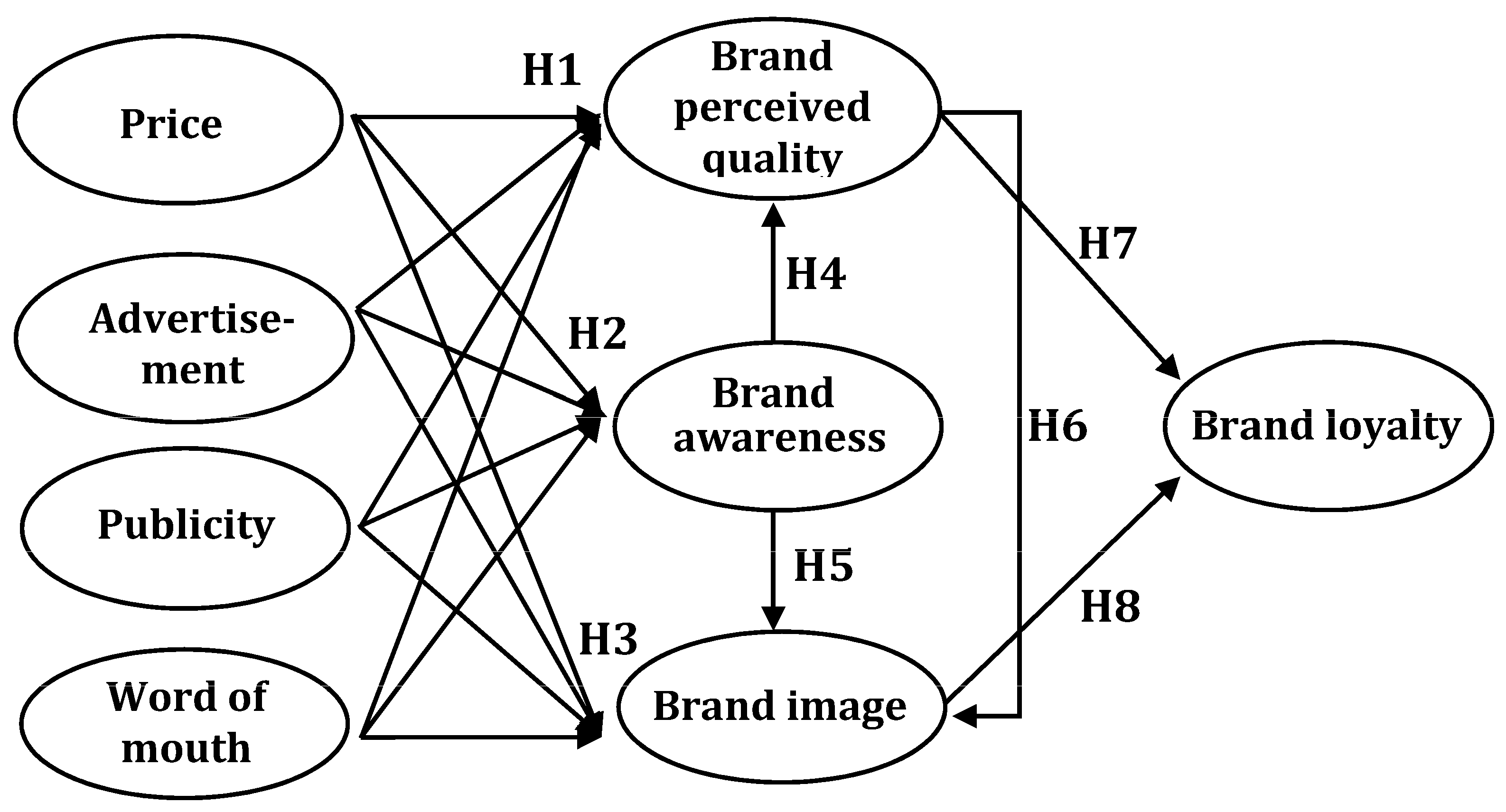
3.1. Research Models and Hypotheses
3.2. Survey Activities for Data Collection
3.3. Method of Data Analysis
4. Results
4.1. Validity and Reliability of Measurement
4.2. Verification of Research Hypotheses
5. Discussion and Conclusions
Acknowledgments
Author Contributions
Conflicts of Interest
Appendix A
| QUESTIONNAIRE |
| Dear Respondent Many thanks for your kind participation in this survey. This is about brand equity of Seoul city as a tourist destination perceived by inbound tourists from the greater Chinese region. Your answers will be useful as valuable data to have Seoul improve its attraction for Chinese tourists. Thank you very much. Researcher: Dr. XXXXXX at XXX XXXXX University. Email: XXXXXXXXXX |
- The followings are questions on the influencing factors of brand equity of Seoul as a tourist destination (price, advertisement, publicity, and word of mouth). Please tick (√) the most appropriate box that represents your opinion.(1 = Strongly agree & 5 = Strongly disagree)
Variable Strongly Agree Agree Neutral Disagree Strongly Disagree 1 The price of tourism products (in Seoul) is higher than the country I came from. ① ② ③ ④ ⑤ 2 The price of tourism products is higher than other competing countries. ① ② ③ ④ ⑤ 3 Living cost is expensive. ① ② ③ ④ ⑤ 4 There is frequent price-cutting promotion on tourism products (accommodation, transportation, shopping, etc.) ① ② ③ ④ ⑤ 5 Proactive and intensive advertising activities are carried out. ① ② ③ ④ ⑤ 6 Advertisements are seen very often. ① ② ③ ④ ⑤ 7 Advertisements are produced with higher quality than other cities. ① ② ③ ④ ⑤ 8 I frequently encounter news reports or newspaper articles about Seoul. ① ② ③ ④ ⑤ 9 News reports and newspaper articles on Seoul are positive and favorable. ① ② ③ ④ ⑤ 10 Social evaluation about Seoul seems positive. ① ② ③ ④ ⑤ 11 People around me think highly of Seoul. ① ② ③ ④ ⑤ 12 There is recommendation from other persons about Seoul City’s tourism. ① ② ③ ④ ⑤ 13 Seoul is positively described on the Internet. ① ② ③ ④ ⑤ 14 People on the SNS speak well of Seoul. ① ② ③ ④ ⑤ - The following are questions about the components of brand equity of Seoul as a tourist destination (Brand perceived quality, brand awareness, and brand image).Please tick (√) the most appropriate box that represents your opinion.(1 = Strongly agree & 5 = Strongly disagree)
Variable Strongly Agree Agree Neutral Disagree Strongly Disagree 1 The quality of tourism products (accommodation, transportation, shopping, etc.) of Seoul is outstanding. ① ② ③ ④ ⑤ 2 Seoul continuously provides a high quality of tourism products and services. ① ② ③ ④ ⑤ 3 Tourism products in Seoul are reliable and trustworthy. ① ② ③ ④ ⑤ 4 Seoul better performs as a tourist destination than its competitors. ① ② ③ ④ ⑤ 5 I am well aware of Seoul. ① ② ③ ④ ⑤ 6 I can quickly recall Seoul as a tourist destination. ① ② ③ ④ ⑤ 7 Seoul is easily compared and differentiated from other cities. ① ② ③ ④ ⑤ 8 The Logo and symbol of Seoul easily comes to me. ① ② ③ ④ ⑤ 9 There is a distinctive image on tourism products of Seoul. ① ② ③ ④ ⑤ 10 Seoul is more special than other cities. ① ② ③ ④ ⑤ 11 Seoul has a high level of popular reputation. ① ② ③ ④ ⑤ - The following are questions on the brand loyalty of Seoul as a tourist destination.Please tick (√) the most appropriate box that represents your opinion.(1 = Strongly agree & 5 = Strongly disagree)
Variable Strongly Agree Agree Neutral Disagree Strongly Disagree 1 I will put Seoul as the most prioritized destination when selecting travel destination in the future. ① ② ③ ④ ⑤ 2 I will recommend other people to visit Seoul. ① ② ③ ④ ⑤ 3 I will visit Seoul even if costs increase. ① ② ③ ④ ⑤ - The following are information on your visit to Seoul.
Number of Visits ① First Time ② Two–Three Times ③ Four–Five times ④ Six Times or More Purpose of Visiting Korea ① Tourist attraction② Shopping ③ Beauty and treatment ④ Gambling
⑤ Business trip ⑥ Gourmet tour ⑦ Festival and performanceSource of Information ① Travel agency ② Acquaintance ③ Internet ④ Tour Guide book ⑤ Mass Media ⑥ Airline, Hotel ⑦ Tourism organizations of Korea (i.e., Korea Tourism Organization) Motivation of Visit (Multiple Response) ① Want to know Seoul ② Close distance ③ Cheap travel cost ④ Shopping
⑤ Recommendation of friends ⑥ Visit filming scene location
⑦ AdvertisementInconvenience ① Communication/Language ② Signage and sign post for direction
③ Traffic congestion ④ Immigration procedures
⑤ Obtaining travel visa ⑥ Unfriendly tour guide ⑦ Food ⑧ Expensive cost
⑨ Being forced to shopType of Travel ① Individual
② Group PackageAccompany ① Alone ② With Families
③ With Friends/ColleaguesDegree of Satisfaction ① Very satisfied ② Satisfied ③ Neutral ④ Dissatisfied ⑤ Very dissatisfied - The following provides information about you that will help us to interpret the answers to the other questions. None of this data will be made public.
Gender ① Male ② Female Marital Status ① Married ② Single Age ① 20–29 ② 30–39 ③ 40–49 ④ 50 or older Occupation ① Public official ② Office worker ③ Professional ④ Production worker ⑤ Sales/Service ⑥ Self-employed ⑦ Student ⑧ Housewife ⑨ Others Education ① Up to high school ② College/University ③ Graduate school Individual Monthly Income (US Dollar) ① Up to 1000 ② 1001–2000 ③ 2001–3000 ④ 3001–4000 ⑤ More than 4000 Region of Residence ① Mainland China ② Hong Kong ③ Taiwan ④ Others
References
- Aaker, D.A. Managing Brand Equity; The Free Press: New York, NY, USA, 1991. [Google Scholar]
- Bianchi, C.; Pike, S.; Lings, I. Investigating attitudes towards three South American destinations in an emerging long-haul market using a model of consumer-based brand equity (CBBE). Tour. Manag. 2014, 42, 215–223. [Google Scholar] [CrossRef] [Scilit]
- Boo, S.; Busser, J.; Baloglu, S. A model of customer-based brand equity and its application to multiple destinations. Tour. Manag. 2009, 30, 219–231. [Google Scholar] [CrossRef] [Scilit]
- Cai, L.A. Cooperative branding for rural destination. Ann. Tour. Res. 2002, 29, 720–742. [Google Scholar] [CrossRef] [Scilit]
- Choi, H.L. The Effect of Brand Extrinsic Cues on Perceived Quality, Perceived Risk and Purchase Intention. Ph.D. Thesis, Kyung Hee University, Seoul, Korea, 2009. [Google Scholar]
- Huang, C.; Oh, K.; Zhang, Q.; Choi, Y.J. Understanding the city brand in the regional tourism market among college students. J. Travel Tour. Mark. 2013, 30, 662–671. [Google Scholar] [CrossRef] [Scilit]
- Jacoby, J.; Mazursky, D. Linking brand and retail image: Do the potential risks outweigh the potential benefits? J. Retail. 1984, 60, 105–122. [Google Scholar]
- Joshi, R.; Yadav, R. Evaluating the feedback effects of brand extension on parent brand equity: A study on Indian FMCG industry. J. Vacat. Mark. 2017, 21, 305–313. [Google Scholar] [CrossRef] [Scilit]
- Konecnik, M.; Gartner, W.C. Customer-based brand equity for a destination. Ann. Tour. Res. 2007, 34, 400–421. [Google Scholar] [CrossRef] [Scilit]
- Mitchell, M.A.; Orwig, R.A. Consumer experience tourism and brand bonding. J. Prod. Brand Manag. 2002, 11, 30–41. [Google Scholar] [CrossRef] [Scilit]
- Kim, S.S.; Moon, J.; Choe, J. Comparison of destination brand equity models of competitive convention cities in East Asia. J. Conv. Event Tour. 2016, 17, 318–342. [Google Scholar] [CrossRef] [Scilit]
- Zenker, S.; Martin, N. Measuring success in place marketing and branding. Place Brand. Public Dipl. 2011, 7, 32–41. [Google Scholar] [CrossRef] [Scilit]
- Kang, S.J. Research on the influence factors on brand equity. Mark. Sci. Res. 2001, 8, 1–35. [Google Scholar]
- Keller, K.L. Building customer-based equity. Mark. Manag. 2001, 10, 14–19. [Google Scholar]
- Kim, T.H.; Son, E.Y.; Kim, J.S. Research on the effectiveness of communication activities in brand equity, focused on family restaurant. Hotel Manag. Res. 2007, 16, 155–168. [Google Scholar]
- Morgan, R. A consumer-oriented framework of brand equity and loyalty. J. Mark. Res. Soc. 2000, 42, 65–78. [Google Scholar] [CrossRef] [Scilit]
- O’Cass, A.; Grace, D. An exploratory perspective of service brand associations. J. Serv. Mark. 2003, 17, 452–475. [Google Scholar] [CrossRef] [Scilit]
- United Nations World Tourism Organization (UNWTO). UNWTO Tourism Highlights; UNWTO Press: Madrid, Spain, 2014. [Google Scholar]
- Korea Tourism Organization. South Korea Marks 17 Million Tourists in 2016. Available online: http://english.visitkorea.or.kr/enu/AKR/FU_EN_15.jsp?cid=2470063 (accessed on 28 December 2016).
- Sparks, B.; Pan, G. Chinese outbound tourists: Understanding their attitudes, constraints and use of information sources. Tour. Manag. 2009, 30, 483–494. [Google Scholar] [CrossRef] [Scilit]
- Wu, M.Y.; Pearce, P.L. Chinese recreational vehicle users in Australia: A netnographic study of tourist motivation. Tour. Manag. 2014, 43, 22–35. [Google Scholar] [CrossRef] [Scilit]
- Breakey, N.; Ding, P.; Lee, T.J. Impact of Chinese outbound tourism to Australia: Reviewing the past; implications for the future. Curr. Issues Tour. 2008, 11, 587–603. [Google Scholar] [CrossRef] [Scilit]
- Dai, B.; Jiang, Y.Y.; Yang, L.Q.; Ma, Y.L. Stage characteristics and policy choices of China’s outbound tourism development. Tour. Trib. 2013, 28, 39–45. [Google Scholar]
- Marine-Roig, E. Measuring destination image through travel reviews in search engines. Sustainability 2017, 9, 1425. [Google Scholar] [CrossRef] [Scilit]
- Wang, Y.; Davidson, M. Pre-and post-trip perceptions: An insight into Chinese package holiday market to Australia. J. Vacat. Mark. 2010, 16, 111–123. [Google Scholar] [CrossRef] [Scilit]
- Kladou, S.; Kavaratzis, M.; Rigopoulou, I.; Salonika, E. The role of brand elements in destination branding. J. Destin. Mark. Manag. 2017, 6, 426–435. [Google Scholar] [CrossRef] [Scilit]
- Moutinho, L.; Huarng, K.; Yu, T.; Chen, C. Modeling and forecasting tourism demand: The case of flows from mainland China to Taiwan. Serv. Bus. 2008, 2, 219–232. [Google Scholar] [CrossRef] [Scilit]
- Zhang, G.; Pine, R.; Zhang, H. China’s international tourism development: Present and future. Int. J. Contemp. Hosp. Manag. 2000, 12, 282–290. [Google Scholar] [CrossRef] [Scilit]
- Jeong, S.E. Analysis of Chinese overseas investment. Small Medium Enterp. Res. 2006, 30, 119–153. [Google Scholar]
- Yoon, T.H.; Kim, Y.P. Comparing city brand personality of ‘Hi Seoul’ and ‘Dynamic Busan’. J. Tour. Leis. Res. 2010, 22, 327–341. [Google Scholar]
- Park, C.S. Estimation and Prediction of Brand Equities through Survey Measurement of Consumer Preference Structures. Ph.D. Thesis, Stanford University, Stanford, CA, USA, 1992. [Google Scholar]
- Pike, S.; Ryan, C. Destination positioning analysis through a comparison of cognitive, affective, and conative perceptions. J. Travel Res. 2004, 42, 333–342. [Google Scholar] [CrossRef] [Scilit]
- Ahn, J.; Back, K.-J. Influence of brand relationship on customer attitude toward integrated resort brands: A cognitive, affective, and conative perspective. J. Travel Tour. Mark. 2017. [Google Scholar] [CrossRef] [Scilit]
- Keller, K.L. Strategic Brand Management: Building, Measuring, and Managing Brand Equity, 3rd ed.; Prentice Hall: Upper Saddle River, NJ, USA, 2008. [Google Scholar]
- Ooi, C.S. The poetics and politics of destination branding: Denmark. Scand. J. Hosp. Tour. 2004, 3, 107–128. [Google Scholar] [CrossRef] [Scilit]
- Swaminathan, V.; Fox, R.J.; Reddy, S.K. The impact of brand extension introduction on choice. J. Mark. 2001, 65, 1–15. [Google Scholar] [CrossRef] [Scilit]
- Chen, C.F.; Tseng, W.S. Exploring customer-based airline brand equity: Evidence from Taiwan. Transp. J. 2010, 49, 24–34. [Google Scholar]
- Im, H.H.; Kim, S.S.; Elliot, S.; Han, H. Conceptualizing destination brand equity dimensions from a consumer-based brand equity perspective. J. Travel Tour. Mark. 2012, 29, 385–403. [Google Scholar] [CrossRef] [Scilit]
- Wu, C.; Funck, C.; Hayashi, Y. The impact of host community on destination (re)branding: A case study of Hiroshima. Int. J. Tour. Res. 2013, 16, 546–555. [Google Scholar] [CrossRef] [Scilit]
- Ekinci, Y.; Hosany, S. Destination personality: An application of brand personality to tourism destinations. J. Travel Res. 2006, 45, 127–139. [Google Scholar] [CrossRef] [Scilit]
- Morgan, N.; Pritchard, A.; Piggott, R. New Zealand, 100% pure: The creation of a powerful niche destination brand. J. Brand Manag. 2002, 9, 335–354. [Google Scholar] [CrossRef] [Scilit]
- Cobb-Walgren, C.J.; Ruble, C.A.; Donthu, N. Brand equity, brand preference, and purchase intent. J. Adv. 1995, 24, 25–41. [Google Scholar] [CrossRef] [Scilit]
- Simon, C.J.; Sullivan, M.W. The measurement and determinations of brand equity: A financial approach. Mark. Sci. 1993, 12, 28–52. [Google Scholar] [CrossRef] [Scilit]
- Chaudhuri, A.; Holbrook, M.B. The chain of effects from brand trust and brand affect to brand performance: The role of brand loyalty. J. Mark. 2001, 65, 81–93. [Google Scholar] [CrossRef] [Scilit]
- Seo, Y.G.; Lim, S.H. Research on retail brand value elements and the relationship with the customer preference, satisfaction, and repurchase intention. Distrib. Study 2005, 11, 71–96. [Google Scholar]
- Song, Z.; Su, X.; Li, L. The indirect effects of destination image on destination loyalty intention through tourist satisfaction and perceived value: The boot strap approach. J. Travel Tour. Mark. 2013, 30, 386–409. [Google Scholar] [CrossRef] [Scilit]
- Trembath, R.; Romaniuk, J.; Lockshin, L. Building the destination brand: An empirical comparison of two approaches. J. Travel Tour. Mark. 2011, 28, 804–816. [Google Scholar] [CrossRef] [Scilit]
- Lim, Y.; Weaver, P.A. Customer-based brand equity for a destination: The effect of destination image on preference for products associated with a destination brand. Int. J. Tour. Res. 2014, 16, 223–231. [Google Scholar] [CrossRef] [Scilit]
- Keller, K.L. Conceptualizing, measuring, and managing customer-based brand equity. J. Mark. 1993, 57, 1–22. [Google Scholar] [CrossRef] [Scilit]
- Axelrod, J. The definition measurement of brand equity. In Proceedings of the ARF Brand Equity Research Day, New York, NY, USA, 27 October 1993. [Google Scholar]
- Yoo, B.H.; Donthu, N.; Lee, S.H. An examination of selected marketing mix elements and brand equity. J. Acad. Mark. Sci. 2000, 28, 195–211. [Google Scholar] [CrossRef] [Scilit]
- Park, M.K. Research on Measuring Value of Enterprise Brand Equity. Ph.D. Thesis, Chungang University, Seoul, Korea, 2001. [Google Scholar]
- Baldauf, A.; Cravens, K.C.; Binder, G. Performance consequences of brand equity management: Evidence from organizations in the value chain. J. Prod. Brand Manag. 2003, 12, 220–236. [Google Scholar] [CrossRef] [Scilit]
- Han, S.H.; Nguyen, B.; Lee, T.J. Consumer-based chain restaurant brand equity, brand reputation, and brand trust. Int. J. Hosp. Manag. 2015, 50, 84–93. [Google Scholar] [CrossRef] [Scilit]
- Farquhar, P.H. Managing brand equity. Mark. Res. 1989, 1, 24–33. [Google Scholar]
- Baldinger, A.L. Defining and applying the brand equity concept: Why the researcher should care. J. Adv. Res. 1932, 30, RC2–RC5. [Google Scholar]
- MacLachlan, D.L.; Mulhern, M.G. Measuring brand equity with conjoint analysis. In Proceedings of the 4th Sawtooth Software Conference, Sun Valley, ID, USA, January 1991; pp. 127–140. [Google Scholar]
- Zeithaml, V.A. Consumer perceptions of price, quality, and value: A means-end model and synthesis of evidence. J. Mark. 1988, 52, 2–22. [Google Scholar] [CrossRef] [Scilit]
- Dodds, W.B.; Monroe, K.B.; Grewal, D. Effects of price, brand and store information on buyers’ product evaluations. J. Mark. Res. 1991, 28, 307–319. [Google Scholar] [CrossRef] [Scilit]
- Ha, Y.S. Influence That Sports Marketing Factors Make to Brand Equity and Consumer Behaviors. Ph.D. Thesis, Dankook University, Cheonan, Korea, 2005. [Google Scholar]
- Lee, N.R. Effects of Cultural Tourism Marketing Mix on Tourism Destination Brand Equity. Ph.D. Thesis, Hanyang University, Seoul, Korea, 2008. [Google Scholar]
- Tasci, A.D.A.; Gartner, W.C.; Cavusgil, S.T. Conceptualization and operationalization of destination image. J. Hosp. Tour. Res. 2007, 31, 194–223. [Google Scholar] [CrossRef] [Scilit]
- Gartner, W.C.; Konecnik Ruzzier, M. Tourism destination brand equity dimensions: Renewal versus repeat market. J. Travel Res. 2011, 50, 471–481. [Google Scholar] [CrossRef] [Scilit]
- Gnoth, J. Leveraging export brands through a tourism destination brand. Brand Manag. 2002, 9, 262–280. [Google Scholar] [CrossRef] [Scilit]
- Qu, H.; Kim, L.; Im, H. A model of destination branding: Integrating the concepts of the branding and destination image. Tour. Manag. 2011, 32, 465–476. [Google Scholar] [CrossRef] [Scilit]
- Kim, Y. Measuring the economic value of public relations. J. Public Relat. Res. 2001, 13, 3–26. [Google Scholar] [CrossRef] [Scilit]
- Ha, O.S. Apparel Brand Appraisal: Focused on Sports Apparel. Ph.D. Thesis, Dongguk University, Seoul, Korea, 2004. [Google Scholar]
- Tsai, H.; Lo, A.; Cheung, C. Measuring customer-based casino brand equity and its consequences. J. Travel Tour. Mark. 2013, 30, 806–824. [Google Scholar] [CrossRef] [Scilit]
- Camarero, C.; Garrido, M.J.; Vicente, E. Components of art exhibition brand equity for internal and external visitors. Tour. Manag. 2010, 31, 495–504. [Google Scholar] [CrossRef] [Scilit]
- Liu, C.R.; Liu, H.K.; Lin, W.R. Constructing customer-based museums brand equity model: The mediating role of brand value. Int. J. Tour. Res. 2015, 17, 229–238. [Google Scholar] [CrossRef] [Scilit]
- Washburn, J.H.; Plank, R.E. Measuring brand equity: An evaluation of a consumer-based brand equity scale. J. Mark. Theory Pract. 2002, 10, 46–62. [Google Scholar] [CrossRef] [Scilit]
- Abubakar, A.M.; Ilkan, M. Impact of online WOM on destination trust and intention to travel: A medical tourism perspective. J. Destin. Mark. Manag. 2016, 5, 192–201. [Google Scholar] [CrossRef] [Scilit]
- Byon, K.K.; Zhang, J. Development of a scale measuring destination image. Mark. Intell. Plan. 2010, 28, 508–532. [Google Scholar] [CrossRef] [Scilit]
- Cervera-Taulet, A.; Schlesinger, M.W.; Yagüe-Guillen, M.J. Influence of advertizing on brand personality in the airline sector: The case of Spain. J. Travel Tour. Mark. 2013, 30, 445–454. [Google Scholar] [CrossRef] [Scilit]
- Chekalina, T.; Fuchs, M.; Lexhagen, M. Customer-based destination brand equity modeling: The role of destination resources, value for money, and value in use. J. Travel Res. 2018, 57, 31–51. [Google Scholar] [CrossRef] [Scilit]
- Lim, S.H.; Kim, T.H. Influence of customers’ on/off-line oral transmission on their evaluation of brand equity and revisit intention: Focused on family restaurants. J. Tour. Sci. 2010, 34, 61–83. [Google Scholar]
- Ryu, J.S. Structural Relationship between Tourism Marketing Communication and Elements of Brand Equity for Tourism Destination. Ph.D. Thesis, Kyung Hee University, Seoul, Korea, 2009. [Google Scholar]
- Brucks, M.; Zeithaml, V.; Naylor, G. Price and brand name as indicators of quality dimensions for consumer durables. J. Acad. Mark. Sci. 2000, 28, 359–374. [Google Scholar] [CrossRef] [Scilit]
- Smith, D.C.; Park, C.W. The effects of brand extensions on market share and advertising efficiency. J. Mark. Res. 1992, 29, 296–313. [Google Scholar] [CrossRef] [Scilit]
- Kirmani, A.; Wright, P. Money talks: Perceived advertizing expense and expected product quality. J. Consum. Res. 1989, 16, 344–353. [Google Scholar] [CrossRef] [Scilit]
- Yoo, J.H. Study of Components of Brand Equity: Focused on Emotional Relationship between Consumers and Brands. Ph.D. Thesis, Sungkyunkwan University, Suwon, Korea, 2004. [Google Scholar]
- Marine-Roig, E. Identity and authenticity in destination image construction. Anatolia 2015, 26, 574–587. [Google Scholar] [CrossRef] [Scilit]
- Marine-Roig, E.; Anton Clavé, S. Perceived image specialisation in multiscalar tourism destinations. J. Destin. Mark. Manag. 2016, 5, 202–213. [Google Scholar] [CrossRef] [Scilit]
- Kim, D.K. Influence of the Marketing Communication and Service Factor on the Service Brand Equity: Focusing on Automobile Insurance Brand. Ph.D. Thesis, Cheongju University, Cheongju, Korea, 2007. [Google Scholar]
- Oliver, R.L.; Swan, J.E. Equity and disconfirmation perceptions as influences on merchant and product satisfaction. J. Consum. Res. 1989, 16, 372–383. [Google Scholar] [CrossRef] [Scilit]
- Chi, C.G.; Qu, H. Examining the structural relationships of destination image, tourist satisfaction and destination loyalty: An integrated approach. Tour. Manag. 2008, 29, 624–636. [Google Scholar] [CrossRef] [Scilit]
- Lee, T.H. A structural model to examine how destination image, attitude, and motivation affect the future behavior of tourists. Leis. Sci. 2009, 31, 215–236. [Google Scholar] [CrossRef] [Scilit]
- Danaher, P.J.; Wilson, I.W.; Davis, R.A. A comparison of online and offline consumer brand loyalty. Mark. Sci. 2003, 22, 461–476. [Google Scholar] [CrossRef] [Scilit]
- Henderson, J.C. Selling places: The New Asia—Singapore brand. J. Tour. Stud. 2000, 11, 36–44. [Google Scholar]
- Jones, T.O.; Sasser, W.E., Jr. Why satisfied customers defect. Harv. Bus. Rev. 1995, 73, 88–99. [Google Scholar] [CrossRef] [Scilit]
- Day, G.S. A two-dimensional concept of brand loyalty. J. Adv. Res. 1969, 9, 29–35. [Google Scholar]
- Hsu, C.H.C.; Oh, H.; Assaf, A.G. A customer-based brand equity model for upscale hotels. J. Travel Res. 2011, 51, 81–93. [Google Scholar] [CrossRef] [Scilit]
- Seo, I.G. Influence of Values and Image Perceived by the Nation’s Airlines’ Customers on Customers’ Satisfaction. Ph.D. Thesis, Daegu University, Daegu, Korea, 2003. [Google Scholar]
- Choi, S.M. Research on Shopping Tourists’ Emotional Consumption Tendencies, Loyal Brand Benefit, and Attachment. Ph.D. Thesis, Dong-A University, Busan, Korea, 2008. [Google Scholar]
- Kim, J.H. Relationship between marketing communication and service brand equity. Korea Contents Res. 2008, 8, 152–153. [Google Scholar]
- Rao, A.R.; Monroe, K.B. The effect of price, brand name, and store name on buyers’ perceptions of product quality: An integrated review. J. Mark. Res. 1988, 26, 351–357. [Google Scholar] [CrossRef] [Scilit]
- Krishnan, H.S.; Chakravart, D. Varieties of brand memory induced by advertising: Determinants, measures and relationships. In Brand Equity and Advertising; Aaker, D.A., Biel, A.L., Eds.; Lawrence Erlbaum: Hillsdale, NJ, USA, 1993; pp. 213–234. [Google Scholar]
- Taylor, S.A.; Celuch, K.; Goodwin, S. The importance of brand equity to customer loyalty. J. Prod. Brand Manag. 2004, 13, 217–227. [Google Scholar] [CrossRef] [Scilit]

| Author | Definition of Brand Equity |
|---|---|
| Farguhar [55] | Brand equity is the added value of a product endowed by the brand name it carries when consumers have a good impression of that specific brand. |
| Baldinger [56] | From the perspective of consumers, distribution channels, participants, and enterprises, brand equity, compared to non-branded products, ensures higher revenues and margins and is an aggregate that provides more sustainable and differentiated advantages compared to competitors. |
| MacLachlan and Mulhern [57] | The increase in cash flows derived from using a brand (company perspective). Utility or value that cannot be explained by the properties of a particular product, the source of brand loyalty (customer perspective). |
| Aaker [1] | As a combination of reliability, brand equity associated with the symbol, and brand name which is added to a product or service, brand equity adds to or subtracts from the value provided by a product or service to a firm and to that firm’s customers. |
| Keller [49] | Brand equity is the differential effect of brand knowledge on consumer response to the marketing activities of the brand. |
| Simon and Sullivan [43] | Brand equity is the increased cash flows on branded products due to investment in the brand as compared to non-branded products. |
| Yoo, Donthu and Lee [50] | Brand equity is the differences in the consumers’ choices which is claimed to be the difference between branded and non-branded products. |
| Kang [13] | Brand equity ensures higher revenues and margins compared to non-branded products, and are an aggregate that provides stronger, sustainable, and differentiated advantages compared to competitors. |
| Variables | Researchers | Scales | |
|---|---|---|---|
| Brand equity influencing factors | Price (3), Advertisement (3), Promotion (3), Word of mouth (4) | Cobb-Walgren, Ruble and Donthu [42], Keller [34], Kirmani and Wright [78], Oliver and Swan [85], Smith and Park [79], Yoo, Donthu, and Lee [51]. | Interval scale |
| Brand equity components | Perceived quality (4), Brand awareness (3), Brand image (3) | Choi [94], Dodds, Monroe, and Grewal [59], Ha [67], Konecnik and Gartner [9], Taylor, Celuch, and Goodwin [98], Yoo, Donthu, and Lee [51], Zeithaml [58]. | |
| Brand loyalty | Brand loyalty (3) | Aaker [1], Ha [67], Keller [34], Konecnik and Gartner [9]. | |
| Demographic variable | Gender, Age, Marital status, Occupation, Education, Income, Location of residence. | Pretext | |
| Visit type | Number of visits, Purpose of visit, Source of information, Type of travel, Accompany, Motivation for visit, Inconvenience, Degree of satisfaction. | Pretext | |
| Feature | Variable | Number of People | Percentage (%) |
|---|---|---|---|
| Gender | Male | 152 | 43.4 |
| Female | 198 | 56.6 | |
| Marital status | Married | 198 | 56.6 |
| Single | 152 | 43.4 | |
| Education | Up to high school | 99 | 28.3 |
| College/University | 224 | 64 | |
| Graduate school | 27 | 7.7 | |
| Occupation | Public official | 13 | 3.7 |
| Office worker | 72 | 20.6 | |
| Professional | 65 | 18.6 | |
| Production (factory) worker | 30 | 8.6 | |
| Sales/Service | 35 | 10 | |
| Self-employed | 37 | 10.6 | |
| Student | 44 | 12.6 | |
| Housewife | 17 | 4.9 | |
| Others | 37 | 10.6 | |
| Age | 20–29 | 123 | 35.1 |
| 30–39 | 109 | 31.1 | |
| 40–49 | 87 | 24.9 | |
| 50 or older | 31 | 8.9 | |
| Region of residence | China | 191 | 54.6 |
| Hong Kong | 71 | 20.3 | |
| Taiwan | 68 | 19.4 | |
| Others | 20 | 5.7 | |
| Individual monthly income (U.S. Dollar) | Up to 1000 | 27 | 7.7 |
| 1001–2000 | 84 | 24 | |
| 2001–3000 | 76 | 21.7 | |
| 3001–4000 | 53 | 15.1 | |
| More than 4000 | 110 | 31.4 | |
| Total | 350 | 100 | |
| Classification | Frequency | Percentage (%) | |
|---|---|---|---|
| Number of visits | First time | 207 | 59.1 |
| Two to three times | 109 | 31.1 | |
| Four to five times | 20 | 5.7 | |
| Six times or more | 14 | 4 | |
| Purpose of visiting Korea (Multiple responses) | Tourist attractions | 211 | 60.3 |
| Shopping | 118 | 33.7 | |
| Beauty and treatment | 15 | 4.3 | |
| Gambling | 10 | 2.9 | |
| Business trip | 48 | 13.7 | |
| Gourmet tour | 23 | 6.6 | |
| Festivals and performances | 21 | 6 | |
| Source of information | Travel agency | 182 | 52 |
| Acquaintance | 44 | 12.6 | |
| Internet | 53 | 15.1 | |
| Tour guide book | 9 | 2.6 | |
| Mass media | 36 | 10.3 | |
| Airline, Hotel | 12 | 3.4 | |
| Tourism organizations of Korea | 14 | 4 | |
| Type of travel | Individual | 90 | 25.7 |
| Group package | 260 | 74.3 | |
| Accompany | Alone | 39 | 11.1 |
| With families | 186 | 53.1 | |
| With friends/colleagues | 125 | 35.7 | |
| Motivation of visit (Multiple Responses) | Want to know Seoul | 101 | 28.9 |
| Close distance | 76 | 21.7 | |
| Cheap travel cost | 67 | 19.1 | |
| Shopping | 53 | 15.1 | |
| Recommendation of friends | 72 | 20.6 | |
| Visit filming scene location | 38 | 10.9 | |
| Advertisement | 38 | 10.9 | |
| Inconvenience (Multiple Responses) | Communication/Language | 244 | 69.7 |
| Signage and sign post for direction | 79 | 22.6 | |
| Traffic congestion | 26 | 7.4 | |
| Immigration procedures | 6 | 1.7 | |
| Obtaining travel visa | 3 | 0.9 | |
| Unfriendly tour guide | 13 | 3.7 | |
| Food | 37 | 10.6 | |
| Expensive cost | 52 | 14.9 | |
| Being forced to shop | 9 | 2.6 | |
| Degree of satisfaction | Very satisfied | 35 | 10 |
| Satisfied | 201 | 57.4 | |
| Neutral | 98 | 28 | |
| Dissatisfied | 15 | 4.3 | |
| Very dissatisfied | 1 | 0.3 | |
| Total | 350 | 100 | |
| Factor | Coefficient Estimate | Estimated Error | Standardized Coefficient Estimate | t | Concept Credibility | Dispersion Extraction Index |
|---|---|---|---|---|---|---|
| Price | 1.000 | 0.853 | 0.809 | 0.595 | ||
| 0.708 | 0.092 | 0.582 | 7.719 *** | |||
| 0.717 | 0.094 | 0.565 | 7.621 *** | |||
| Advertisement | 1.000 | 0.711 | 0.767 | 0.526 | ||
| 1.119 | 0.110 | 0.712 | 10.157 *** | |||
| 0.736 | 0.085 | 0.567 | 8.689 *** | |||
| Promotion | 1.000 | 0.696 | 0.791 | 0.558 | ||
| 0.832 | 0.079 | 0.697 | 10.528 *** | |||
| 0.717 | 0.075 | 0.614 | 9.550 *** | |||
| Word of mouth | 1.000 | 0.59 | 0.812 | 0.520 | ||
| 1.150 | 0.137 | 0.59 | 8.391 *** | |||
| 1.064 | 0.124 | 0.61 | 8.582 *** | |||
| 1.182 | 0.132 | 0.653 | 8.978 *** |
| Factor | Coefficient Estimate | Estimated Error | Standardized Coefficient Estimate | t | Concept Credibility | Dispersion Extraction Index |
|---|---|---|---|---|---|---|
| Brand perceived quality | 1.000 | 0.638 | 0.812 | 0.519 | ||
| 1.083 | 0.107 | 0.709 | 10.134 *** | |||
| 0.814 | 0.089 | 0.612 | 9.129 *** | |||
| 0.903 | 0.100 | 0.6 | 8.999 *** | |||
| Brand awareness | 1.000 | 0.562 | 0.704 | 0.548 | ||
| 1.193 | 0.126 | 0.754 | 9.474 *** | |||
| 0.828 | 0.107 | 0.536 | 7.710 *** | |||
| Brand image | 1.000 | 0.723 | 0.834 | 0.626 | ||
| 1.193 | 0.084 | 0.733 | 12.099 *** | |||
| 0.828 | 0.078 | 0.678 | 11.299 *** | |||
| Brand loyalty | 1.000 | 0.78 | 0.813 | 0.593 | ||
| 0.823 | 0.066 | 0.709 | 12.533 *** | |||
| 1.884 | 0.078 | 0.639 | 11.285 *** |
| Hypothesis | Path Coefficient | Estimated Error | Standardization of Path Coefficient | t (C. R.) | Verification of Hypothesis |
|---|---|---|---|---|---|
| H1a Price → Brand perceived quality | 0.111 | 0.056 | 0.134 | 1.992 * | Supported |
| H1b Advertisement → Brand perceived quality | 0.073 | 0.107 | 0.808 | 0.676 | Rejected |
| H1c Promotion → Brand perceived quality | 0.057 | 0.133 | 0.066 | 0.430 | Rejected |
| H1d Oral tradition → Brand perceived quality | 0.899 | 0.200 | 0.673 | 4.449 *** | Supported |
| H2a Price → Brand awareness | 0.143 | 0.053 | 0.175 | 2.677 ** | Supported |
| H2b Advertisement → Brand awareness | −0.025 | 0.111 | −0.028 | −0.226 | Rejected |
| H2c Promotion → Brand awareness | 0.330 | 0.129 | 0.386 | 2.561 * | Supported |
| H2d Oral tradition → Brand awareness | 0.578 | 0.158 | 0.443 | 3.666 *** | Supported |
| H3a Price → Brand image | −0.074 | 0.065 | −0.085 | −1.134 | Rejected |
| H3b Advertisement → Brand image | 0.263 | 0.119 | 0.277 | 2.216 * | Supported |
| H3c Promotion → Brand image | −0.207 | 0.152 | −0.228 | −1.360 | Rejected |
| H3d Oral tradition → Brand image | −0.291 | 0.265 | −0.211 | −1.098 | Rejected |
| H4 Brand awareness → Brand perceived quality | −0.034 | 0.145 | −0.034 | −0.235 | Rejected |
| H5 Brand awareness → Brand image | 0.915 | 0.206 | 0.864 | 4.445 *** | Supported |
| H6 Brand perceived quality → Brand image | 0.316 | 0.144 | 0.302 | 2.197 * | Supported |
| H7 Brand perceived quality → Brand loyalty | 0.491 | 0.100 | 0.408 | 4.899 *** | Supported |
| H8 Brand image → Brand loyalty | 0.637 | 0.096 | 0.554 | 6.609 *** | Supported |
© 2018 by the authors. Licensee MDPI, Basel, Switzerland. This article is an open access article distributed under the terms and conditions of the Creative Commons Attribution (CC BY) license (http://creativecommons.org/licenses/by/4.0/).
Share and Cite
Kim, H.-K.; Lee, T.J. Brand Equity of a Tourist Destination. Sustainability 2018, 10, 431. https://doi.org/10.3390/su10020431
Kim H-K, Lee TJ. Brand Equity of a Tourist Destination. Sustainability. 2018; 10(2):431. https://doi.org/10.3390/su10020431
Chicago/Turabian StyleKim, Hwa-Kyung, and Timothy J. Lee. 2018. "Brand Equity of a Tourist Destination" Sustainability 10, no. 2: 431. https://doi.org/10.3390/su10020431
APA StyleKim, H.-K., & Lee, T. J. (2018). Brand Equity of a Tourist Destination. Sustainability, 10(2), 431. https://doi.org/10.3390/su10020431

